Reviewed by Thomas B. · Last Updated September 22, 2026 · How we review
Last Updated September 22, 2026
Formic Pro and its discontinued predecessor, Mite Away Quick Strips (MAQS), are EPA-registered formic-acid strip treatments for Varroa destructor — and they solve a problem no other registered US treatment fully solves: formic acid vapor penetrates the wax capping over brood cells, reaching mites that oxalic acid, in any of its forms, cannot touch. This guide covers the strip treatments specifically — dosing, the application temperature window, honey-super rules, and where the US label and the UK/EU authorization genuinely disagree. It does not re-litigate how formic acid stacks up against amitraz, thymol or hop-based products across a whole season; for that side-by-side, see our varroa mite management guide.
Disclaimer: This is educational information for beekeepers, not professional, veterinary or regulatory advice — formic acid is a corrosive, EPA-registered pesticide, and you should always read and follow the current product label or authorization for the exact product you hold, in your own country.
On this page
- What Formic Pro and MAQS Strip Treatments Are
- Formic Pro vs. MAQS: What Changed
- How the Strips Actually Work
- Temperature: The Critical Application Window
- US vs. UK/EU Rules: Dosing and Honey Supers Are Not the Same
- Equipment and Protective Gear Needed
- Step-by-Step Application (US Label)
- Honey Supers and Honey Flow
- Queen Loss Risk and How to Reduce It
- Formic Acid vs. Oxalic Acid Vaporization
- Signs the Treatment Is Working (and Signs of Trouble)
- Which Colonies Are Good Candidates
- Common Mistakes
- Cost and Efficacy
- Does Varroa Resistance to Formic Acid Develop?
- Storage and Shelf Life
- Frequently Asked Questions
Key Takeaways
- Formic acid vapor is small enough to penetrate wax brood cappings, reaching mites that oxalic acid — in any delivery form — cannot touch while brood is present.
- The current US EPA label (Formic Pro, EPA Reg. No. 75710-3) sets a hard application window of 50–85°F on the day of treatment, with a specific warning that temperatures above 92°F during the first three days may cause excessive bee, brood and queen loss.
- The US label offers two dosing options — two strips for 14 days, or one strip for 10 days followed by a second for another 10 days (20 days total). The current UK/EU authorization for the same product is a single, shorter regimen: one sachet (two strips) per hive for 7 days.
- Honey supers are a flat contradiction between the two markets: the US label permits adding a super and treating during an active honey flow, while the UK Summary of Product Characteristics requires supers to be removed before treatment and forbids use during honey flow.
- A minimum colony size of roughly 10,000 bees is a label requirement, not a suggestion — smaller colonies may not move enough air to keep the in-hive formic acid concentration tolerable.
- Queen loss and brood mortality are documented, real risks tied directly to temperature and colony condition, not rare edge cases; the label itself schedules a queen-right check one month after treatment.
Table of Contents
- What Formic Pro and MAQS Strip Treatments Are
- Formic Pro vs. MAQS: What Changed
- How the Strips Actually Work
- Temperature: The Critical Application Window
- US vs. UK/EU Rules: Dosing and Honey Supers Are Not the Same
- Equipment and Protective Gear Needed
- Step-by-Step Application (US Label)
- Honey Supers and Honey Flow
- Queen Loss Risk and How to Reduce It
- Formic Acid vs. Oxalic Acid Vaporization
- Signs the Treatment Is Working (and Signs of Trouble)
- Which Colonies Are Good Candidates
- Common Mistakes
- Cost and Efficacy
- Does Varroa Resistance to Formic Acid Develop?
- Storage and Shelf Life
- Sources
- Frequently Asked Questions
What Formic Pro and MAQS Strip Treatments Are
Formic Pro is an EPA-registered varroa mite treatment consisting of a formic-acid polysaccharide gel strip wrapped in a biodegradable eco-paper wick, placed directly in the hive where it releases formic acid vapor over the treatment period. Mite Away Quick Strips (MAQS) was the predecessor product using the same active-ingredient mechanism; it has been discontinued and replaced by Formic Pro, though the older name still turns up constantly in forum threads, older extension material, and secondhand equipment listings. Both are registered under the same EPA number family held by NOD Apiary Products.
For the general comparison of formic acid against other varroa treatments, see our varroa mite management guide. For a liquid, contact-only alternative that works differently and has its own honey-super rules, see oxalic acid treatment for bees. This page stays narrowly on the formic-acid strip products themselves.
Formic Pro vs. MAQS: What Changed
Formic Pro is the direct successor to MAQS, using the same active formic-acid mechanism but reformulated for a longer, temperature-stable shelf life. NOD Apiary Products, the manufacturer, markets Formic Pro with an extended shelf life of up to 24 months and no special storage-temperature requirement, a meaningful practical improvement over MAQS, which required cooler storage and had a shorter usable window. If you see MAQS referenced in older guidance or forum posts, treat it as describing the same underlying formic-acid strip approach that Formic Pro now represents, not a different technique.
How the Strips Actually Work
Each strip is a formic-acid gel matrix wrapped in an eco-paper wick; per the current EPA label, the wrap must never be removed, because it is what controls the rate of vapor release rather than letting the acid off all at once. Bees ventilate the brood area to their own comfort level, which is how the colony itself regulates in-hive concentration. According to the UK Summary of Product Characteristics for the same formulation, peak in-hive formic acid concentrations following a two-strip application typically fall in the range of 55–85 µg/cm³ and commonly stay above 20 µg/cm³ for several days — concentration, not a fixed dose, is what actually determines both efficacy and risk. The vapor reaches mites both on adult bees (phoretic mites) and under brood cappings, addressing both reservoirs with one product rather than requiring a separate method for each.
Temperature: The Critical Application Window
This is the single detail that makes or breaks safe, effective use, and it comes directly from the current EPA-stamped label. Outside daytime highs should be between 50°F and 85°F (10–29°C) on the day of application.
Hot temperatures (>92°F during the first 3 days) may lead to excessive bee, brood and queen loss.
NOD Apiary Products USA Inc., Formic Pro EPA-Registered Product Label, EPA Reg. No. 75710-3
Two distinct thresholds are worth separating. The 50–85°F figure is the go/no-go check for the day you apply the strips. The 92°F figure is a specific danger threshold that applies through the first three days after application, which is when vapor release is heaviest. A forecast that looks fine on application day but climbs into the low 90s two days later still carries real risk, which is why checking a multi-day forecast, not just the day-of high, matters more here than for almost any other varroa treatment.
US vs. UK/EU Rules: Dosing and Honey Supers Are Not the Same
Formic Pro is sold under the same brand and the same chemistry in the United States and, since 2022, across the UK and 22 other European regions under marketing authorization from NOD Apiary Ireland Limited. It is tempting to assume one set of application rules applies everywhere. It does not. The table below compares the current US EPA label against the current UK Veterinary Medicines Directorate (VMD) Summary of Product Characteristics for the identical strip formulation (68.2 g formic acid per strip in both documents).
| Point of difference | United States (EPA label, 75710-3) | United Kingdom (VMD SPC, Vm 50769/4001) |
|---|---|---|
| Regulatory framework | Pesticide, registered by the EPA | Veterinary medicinal product, authorized by the VMD |
| Dosing options | Two strips for 14 days, OR one strip for 10 days replaced with a second strip for another 10 days (20 days total) | One sachet (two strips) per hive for 7 days — a single, shorter regimen with no 14- or 20-day option listed |
| Application temperature | 50–85°F (10–29°C) on day of application; >92°F in first 3 days risks excess loss | 10–29.5°C (50–85.1°F) on day of application; above this range in first 3 days risks brood/queen loss |
| Honey supers | May add a super with frames at time of application for space or an expected honey flow; queen excluders acceptable | Supers with honey must be removed before application; honey stored in a super added for the treatment period cannot be sold or eaten |
| Minimum colony size | Approximately 10,000 bees / six 9″ deep frames | 10,000 bees (colonies below this may not move enough air) |
| Shelf life | Up to 24 months (manufacturer figure; not a fixed label item) | 2 years, stated directly in the SPC |
Supers with honey must be removed from the hive prior to product application… Honey stored in super(s) put on for the treatment period must be removed and not used for human consumption.
NOD Apiary Ireland Limited, Formicpro 68.2 g Beehive Strips Summary of Product Characteristics, UK VMD
Neither document is wrong; they are simply two separate regulatory approvals of the same active ingredient, reviewed by different agencies under different frameworks (FIFRA pesticide registration in the US, veterinary medicine authorization in the UK/EU). If you keep bees in the UK, Ireland, or elsewhere in the 23 authorized European regions, treat the 7-day, supers-off regimen as the one that actually applies to you, not the US instructions that dominate English-language forums and YouTube videos. Always open the specific document for your own country before you treat; the two PDFs are linked above.
Equipment and Protective Gear Needed
- Formic Pro strips, purchased pre-made — this is not a DIY-mixed treatment
- Coveralls worn over a long-sleeved shirt and long pants, plus socks and closed shoes
- Acid-resistant gloves (PVC, neoprene, or nitrile), per the current label’s handler PPE requirement
- Protective eyewear
- A reliable multi-day local temperature forecast covering the full treatment period
The label’s hazard statements are blunt for a reason: the product is corrosive, causes skin burns and irreversible eye damage, and is harmful if swallowed, absorbed through skin, or inhaled. Clean or replace PPE at the end of each work session, and never let the strips contact metal hive parts, including metal covers, even briefly, since the acid is corrosive to metal.
Step-by-Step Application (US Label)
- Confirm the extended forecast falls within 50–85°F for the day of application, and specifically check that no spike above 92°F is expected in the first three days.
- Confirm the colony meets the minimum size of roughly 10,000 bees covering about six 9-inch deep frames, and remove any entrance reducer or mouse guard — the bottom entrance must be fully open, full hive width, at least 1/2 inch high, for the entire treatment.
- Close off screen bottom boards if present; they are not a substitute for the required entrance airflow and should be sealed during treatment.
- Put on coveralls, acid-resistant gloves, and eye protection before opening the sachet.
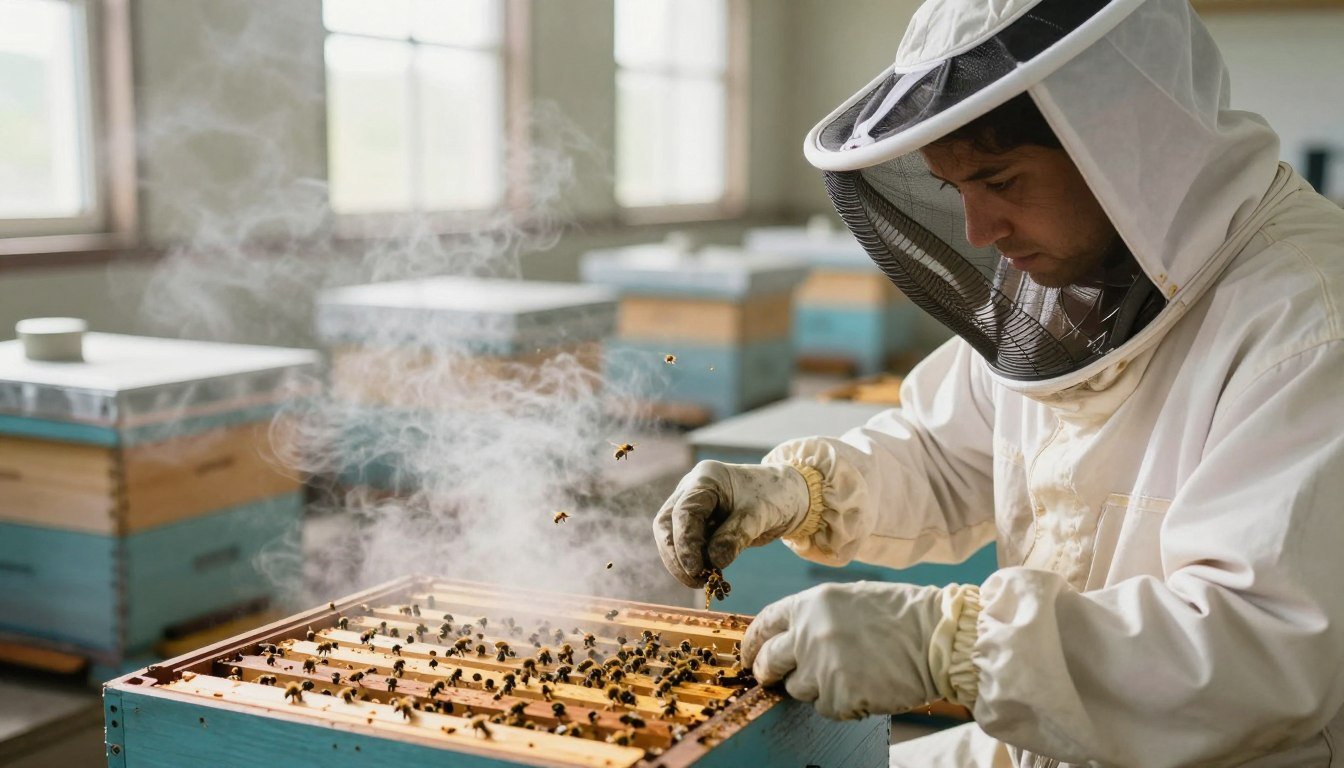
- Place the strip(s) on the top bars of the lower brood chamber, staggered across the full width, without removing the eco-paper wrap and without adding any extra spacer.
- Add an empty honey super at this point if the colony needs the room, or if a honey flow is underway and you are following the US label’s honey-flow allowance.
- Leave the colony undisturbed for the chosen treatment period, with the single exception of the day-10 strip swap if you are using the 20-day option.
- Check that the colony is queen-right about one month after application, since supersedure of a fragile queen can be triggered by the treatment itself.
Honey Supers and Honey Flow
Under the current US label, formic acid is one of the few varroa treatments that can be used with honey supers in place and during an active honey flow — formic acid is a natural component of honey already, and the label explicitly allows adding a super with frames at the time of application if the colony needs the space. That is a genuine practical advantage over treatments that require supers off. As covered above, this is exactly the point where the UK/EU authorization diverges: it requires supers to be removed before treatment, and honey collected in a super that was left on during treatment cannot be used for human consumption. If you sell honey and keep bees under UK/EU authorization, plan your formic acid timing around empty supers, not a live flow.
Queen Loss Risk and How to Reduce It
Both the US label and the UK SPC report queen loss as a real, documented risk, concentrated in the first three days of treatment and worsened by high temperature, a stressed colony, or a dearth period. The UK SPC’s adverse-event table classifies increased mortality, brood mortality, and queen loss as an “uncommon” outcome (roughly 1 to 10 colonies per 1,000 treated) under normal use, rising if the temperature or ventilation requirements are not followed. Practical ways to reduce the risk: stay strictly inside the temperature window and check the multi-day forecast, don’t disturb brood frames during application, don’t feed the colony in-hive during treatment, and avoid treating a colony that is already weak, freshly manipulated, or short on food reserves. If you are treating a colony built around a queen you cannot easily replace, some beekeepers reserve a gentler option, such as Apivar (amitraz) strips, for that specific hive and use formic acid elsewhere.
Formic Acid vs. Oxalic Acid Vaporization
| Formic Acid Strips | Oxalic Acid Vaporization | |
|---|---|---|
| Penetrates capped brood? | Yes | No — phoretic mites only |
| Honey supers, US label | Permitted, including during a honey flow | Generally used outside a honey flow |
| Temperature sensitivity | Strict window, 50–85°F; real risk above 92°F | Less temperature-critical for the vaporization step itself |
| Queen loss risk | Real, documented, temperature-dependent | Generally lower when used correctly |
| Best timing | Can be used during active brood rearing | Most effective during broodless periods |
Many integrated pest management programs use both at different points in the season precisely because their strengths are complementary: formic acid during brood season, when capped-brood penetration matters most, and oxalic acid dribble or vaporization during broodless windows, when the simpler contact method is enough on its own. If you are timing a split or a requeened colony into this rotation, see our guide to varroa treatment after making a split.
Signs the Treatment Is Working (and Signs of Trouble)
Some bearding at the entrance and a noticeable formic-acid smell in the first few days is normal and expected — it is a sign the strips are releasing vapor, not automatically a problem. The UK SPC gives a concrete baseline: natural bee birth and death is around 1,000 to 2,000 bees per day in spring and summer, so a comparable one-day equivalent of dead bees at the entrance during treatment is not, by itself, alarming. What is worth acting on is a reaction that goes well beyond that baseline: heavy bearding that persists for the entire treatment, dead-bee counts clearly above the natural daily rate, or visible agitation, any of which can indicate the temperature crept above the safe range. A mite count before and after treatment, using the method in our alcohol wash guide, remains the only reliable way to confirm the treatment actually worked, separate from how the colony outwardly reacted.
Which Colonies Are Good Candidates
The label sets a hard floor: do not treat colonies under roughly 10,000 bees, since a smaller cluster may not generate enough airflow to keep the in-hive formic acid concentration at a tolerable level. Beyond that minimum, formic acid is best suited to colonies that are already reasonably strong and not currently dealing with another acute stressor. A colony that is already weak, recently through a difficult manipulation, or short on stores is a poorer candidate for a treatment with a documented, temperature-linked queen-loss risk. If you are managing several colonies of different strength, it is reasonable to treat your strongest colonies with formic acid and pick a gentler option for anything more marginal, informed by a real seasonal plan like the one in our seasonal varroa treatment calendar.
Common Mistakes
| Mistake | Why it matters |
|---|---|
| Applying with a forecast above 85°F, or any spike above 92°F expected in the next 3 days | The label directly links high heat in the first 3 days to excessive bee, brood and queen loss |
| Applying below 50°F | Vapor release becomes ineffective, reducing efficacy against mites |
| Checking only same-day temperature, not the full forecast | Strips stay active for 7 to 20 days depending on the regimen and jurisdiction; a later spike still carries risk |
| Leaving an entrance reducer or mouse guard in place | Restricted airflow can let formic acid concentration build to damaging levels; the label requires the entrance be fully open |
| Using the US honey-super allowance in a UK/EU apiary | The UK authorization requires supers off and forbids selling honey collected during treatment; the rules are not interchangeable across borders |
| Treating an already weak or stressed colony without extra caution | Queen loss risk climbs in colonies already under stress during treatment |
Cost and Efficacy
Formic Pro is a pre-manufactured, EPA-registered product, so it carries a real per-treatment cost compared with build-your-own approaches, but that cost buys coverage of both mite reservoirs (phoretic and capped-brood) in a single product rather than layering multiple treatments to get the same result. NOD Apiary Products, the manufacturer, advertises an average efficacy range of 83–97%. That claim is a manufacturer figure, not an EPA-verified number, but it is broadly consistent with independent, peer-reviewed results: a 2025 study measured formic-acid-strip efficacy at 88.37% against Varroa destructor under field conditions. For beekeepers weighing overall treatment economics across a season, the relevant comparison is not just sticker price but how many separate products you would otherwise need to reach both mite reservoirs.
Does Varroa Resistance to Formic Acid Develop?
The current EPA label states this plainly in its resistance-management section: mites are not expected to develop resistance to formic acid, and rotation with other miticides is not necessary for resistance-management purposes specifically. That is a stronger claim than can be made for several synthetic treatments, and it follows from formic acid’s mode of action — a naturally occurring organic acid working through direct corrosive and metabolic disruption rather than a specific biological target mites can evolve around. That said, rotating chemistries across a season is still good general integrated pest management practice for other reasons, including minimizing sublethal stress on a single colony. Pairing formic acid during brood season with oxalic acid during broodless windows, as covered above, is a natural way to build that variety into an annual plan without much extra effort.
Storage and Shelf Life
Per the current EPA label, store Formic Pro indoors, in its original container, out of direct sunlight, in a cool, dry, well-ventilated area, away from oxidizing agents and ignition sources. NOD markets Formic Pro with an extended shelf life of up to 24 months without special storage-temperature requirements; the parallel UK SPC states the shelf life as packaged for sale directly as 2 years, confirming that figure is not just marketing language. This is a real practical improvement over the older MAQS formulation, which needed cooler storage and had a shorter usable window. Always check the expiration date printed on your own product’s packaging rather than assuming a general figure applies indefinitely.
Sources
Application temperature ranges, dosing configurations, honey-super rules, PPE requirements, and colony-size minimums in this guide are taken directly from the current EPA-registered US label for Formic Pro (EPA Reg. No. 75710-3) and the current UK Veterinary Medicines Directorate Summary of Product Characteristics for the same formulation, both linked in the sections above. General background on varroa monitoring and treatment thresholds comes from the Honey Bee Health Coalition’s Tools for Varroa Management guide. Manufacturer efficacy and shelf-life claims are attributed to NOD Apiary Products’ own Formic Pro product page and are labeled as such; the independent efficacy figure cited above comes from a 2025 peer-reviewed field study.
Frequently Asked Questions
What temperature is safe for applying Formic Pro in the US?
The current EPA label sets 50–85°F (10–29°C) as the outside daytime high on the day of application. Separately, it warns that temperatures above 92°F during the first three days of treatment, when vapor release is heaviest, may cause excessive bee, brood and queen loss.
Can formic acid reach mites in capped brood?
Yes. This is formic acid’s key advantage over oxalic acid, in any delivery form. Its vapor molecules are small enough to penetrate wax cappings and reach mites, including reproducing females, sheltered inside developing brood cells, not just mites riding on adult bees.
What is the difference between Formic Pro and MAQS?
MAQS (Mite Away Quick Strips) was the original formic-acid strip product; it has been discontinued and replaced by Formic Pro, which uses the same active mechanism but is reformulated for a longer, more temperature-stable shelf life, up to 24 months per the manufacturer and confirmed at 2 years in the UK SPC.
Do I need to remove honey supers before treating with Formic Pro?
It depends on where you keep bees. The current US EPA label allows adding a super and treating during an active honey flow. The UK/EU Summary of Product Characteristics requires supers to be removed first and forbids using honey collected during treatment, so check the document for your own country.
How is the UK/EU formic acid regimen different from the US one?
The UK authorization for the identical strip formulation specifies a single, shorter dose: one sachet (two strips) per hive for 7 days, with no 14- or 20-day option listed. The US label instead offers a 14-day or a 20-day option. Follow whichever document applies to your own country.
How many dead bees at the entrance during treatment is normal?
The UK SPC states natural bee birth and death runs about 1,000 to 2,000 bees per day in spring and summer, so a roughly comparable one-day equivalent at the entrance during treatment is expected. Counts clearly above that, or heavy bearding that never settles, suggest the temperature crept too high.
How soon can I retreat if the mite count is still high afterward?
Both the US label and the UK SPC set a minimum of one month between applications, and neither product should be applied at the same time as another miticide. Confirm the colony is queen-right first, then base any retreatment decision on a fresh alcohol wash rather than on how the hive looked during treatment.
Is a colony ever too small to treat with formic acid?
Yes. Both the US label and the UK SPC set a minimum colony size of roughly 10,000 bees. Below that, the cluster may not generate enough airflow to keep the in-hive formic acid concentration at a tolerable level, which raises the risk of excessive bee, brood and queen loss.