Reviewed by Thomas B. · How we review
This concise review surveys present-day research on how RNA tools can help preserve honey bee health and stabilize colonies in the United States.
The stakes are global: honey pollination supports up to 30% of food production and adds roughly US$212 billion in value to agriculture. Recent losses and colony collapse have linked viral threats, Varroa, and management stressors to weaker hives.
This article defines RNA-driven disease control as an emerging solution that aims to complement existing control methods. It explains the basic science of RNA interference and why targeted gene control can work without altering DNA.
We focus on evidence from lab work and large-scale field study, including U.S. trials that tested IAPV-specific dsRNA under natural beekeeping conditions. The review also examines delivery methods, safety, off-target risk, and practical steps for hobbyist and commercial beekeepers.
Readers should expect balanced, data-informed guidance to help decide if this technology suits their apiary needs.
Key Takeaways
- RNA approaches offer specific, non-DNA gene control to protect honey and hive health.
- U.S.-based studies show promising field results but require broader validation.
- Integration with Varroa control and good management remains essential.
- Safety, delivery, and regulatory factors will shape practical adoption.
- This review provides evidence-focused guidance for informed use.
Table of Contents
- Why RNA-based treatments matter for United States beekeeping and crop pollination
- Bee health at risk: viruses, Varroa destructor, and the collapse of honey bee colonies
- What is RNA interference (RNAi)? The science behind gene silencing in Apis mellifera
- RNA-based treatments for bee diseases: from lab promise to field performance
- Evidence spotlight: large-scale field application against Israeli acute paralysis virus (IAPV)
- Targeting Varroa destructor with RNAi technology
- Delivery methods: how dsRNA reaches bees and mites
- Benefits and limitations of RNAi as a disease control tool
- Safety, off-target effects, and non-target species considerations
- Integrating RNAi into hive management and integrated pest management (IPM)
- Mechanisms of viral counter-defense: RNAi suppressors in dicistroviruses
- Honey bee immunity beyond RNAi: Toll, Imd, JNK, and Jak-STAT pathways
- Regulatory and public acceptance landscape for RNA technologies
- Research gaps and priorities for future study
- Practical guidance for beekeepers evaluating RNAi-based treatments
- Conclusion
- FAQ
Why RNA-based treatments matter for United States beekeeping and crop pollination
Protecting colony strength in U.S. apiaries now affects both crop yields and rural livelihoods. Insect pollination, led by honey bees, supports roughly 35% of the human diet and adds about US$212 billion to the world economy.
The central questions readers have are simple: do these RNA-based treatments work in real operations, are they safe, and can they fit the seasonal rhythm of a hive? Practical answers come from field trials, ease-of-use tests, and measures that matter to beekeepers.
Economic context matters. Pollination service value often far exceeds honey sales. Losses in adult populations and foragers quickly reduce pollination capacity for high-value crops. That makes rapid, low-labor interventions attractive.
“Field data must show predictable cost, repeatability, and compatibility with existing hive practice before broad adoption occurs.”
- Time-to-impact and simple delivery are key for beekeepers balancing spring and summer moves.
- Target specificity can protect apis mellifera and surrounding wildlife while lowering chemical residue risk.
- Success depends on monitoring: forager traffic, brood and adult counts, and honey net weight.
| Concern | Practical metric | Expectation | Relevance to hive |
|---|---|---|---|
| Effectiveness | Forager return rate | Improved within weeks | Direct pollination capacity |
| Safety | Non-target impact studies | Minimal off-target effects | Protects local ecosystems |
| Practicality | Labor and cost per hive | Compatible with standard feeding | Fits seasonal workflows |
| Economics | Honey yield / pollination fees | Net benefit when pollination at risk | Supports beekeeper income |
Bottom line: These methods are best seen as complements to existing IPM. U.S. trials help set realistic expectations across diverse climates and apiary sizes. Later sections review efficacy data and deployment details that matter to commercial and hobbyist beekeepers.
Bee health at risk: viruses, Varroa destructor, and the collapse of honey bee colonies
Honey bee colonies face a tight ecological squeeze where parasites and viruses exploit hive cycles.
Intertwined life cycles of honey bees and Varroa mites
Varroa destructor times entry into brood cells just before capping. The mite reproduces on larvae and pupae during that sealed phase.
This alignment creates reproductive bursts for mites and persistent parasitism across the season. Mites feed on developing stages, causing deformities and lower adult vigor.
Key pathogens: IAPV, DWV, CBPV, SBV, and mixed infections
Varroa is a potent vector of Deformed Wing Virus and other RNA viruses, compounding colony stress. Mixed infections (DWV, IAPV, CBPV, SBV) often remain covert until colonies are stressed.
High viral loads lower immune competence and shorten adult lifespan. Chemical control alone often fails due to resistance, sublethal harm, and patchy field efficacy.
Practical outcomes:
- Weaker colonies, reduced honey yield, and poor overwintering.
- Higher replacement costs and reduced pollination capacity.
| Risk factor | Mechanism | Practical sign |
|---|---|---|
| Varroa reproduction | Brood-cell invasion at capping | High mite drop and damaged brood |
| Viral amplification | Vectoring by mites | Deformed wing and reduced foragers |
| Chemical limits | Resistance, sublethal effects | Variable control and residue concerns |
Understanding this disease ecology is essential to evaluate where targeted molecular interventions can add value within the brood and hive environment.
What is RNA interference (RNAi)? The science behind gene silencing in Apis mellifera
RNA interference is a sequence-specific, post-transcriptional process triggered by double-stranded RNA. It acts as a targeted switch that prevents specific messages from making protein in a cell.
From dsRNA to siRNA: Dicer and RISC-mediated silencing
Long dsRNA is cut by Dicer into short siRNAs. These siRNAs load into the RISC complex, which uses them as guides to find and cleave matching target RNA.
This mechanism lowers viral replication or disrupts pest genes when the sequence is well chosen. Honey bees (Apis mellifera) encode Dicer-like and Argonaute-2 proteins, supporting robust antiviral RNA responses.
Systemic spread, SID-like proteins, and potential amplification
Evidence suggests SID-like transmembrane proteins may move dsRNA between cells. That spread can produce colony-level benefits when hives are fed dsRNA broadly.
“RNAi provides reversible, sequence-directed control without altering DNA.”
| Step | Key actor | Result |
|---|---|---|
| Processing | Dicer-like protein | siRNA formation |
| Targeting | RISC / Ago2 | Target RNA cleavage |
| Spread | SID-like proteins | Intercellular dsRNA movement |
Practical note: Delivery route and tissue uptake determine which cells see strong gene silencing. These mechanistic points guide dsRNA design and dosing in field contexts.
RNA-based treatments for bee diseases: from lab promise to field performance
Progress in molecular tools now links lab success to real-world apiaries.
Scope: Researchers apply sequence-directed rna approaches against viral infections, varroa mites, Nosema, and the small hive beetle.
Scope of RNAi applications: viruses, Varroa mites, Nosema, and small hive beetle
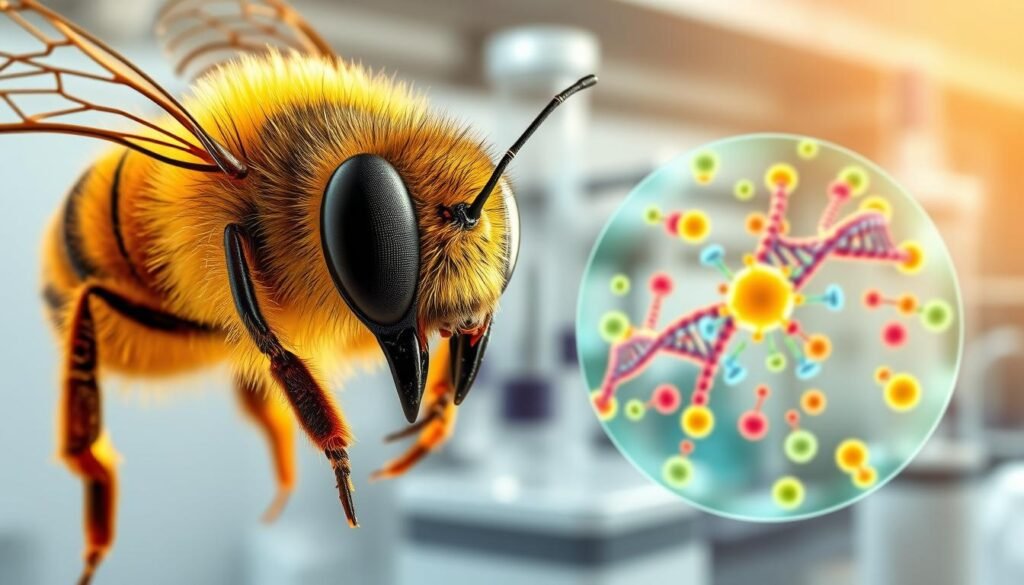
Anti-viral dsRNA targets viral sequences to blunt replication and reduce clinical signs. In labs, dsRNA lowered IAPV mortality. That work scaled to a 160-hive field study with measurable colony benefits.
Present-day status and research momentum
Anti-Varroa approaches aim at mite reproductive genes and are being tested via sugar syrup feeding in U.S. hives. Trials by industry partners explore syrup or patty delivery to reach workers and brood.
Practical fit: These tools are best used inside integrated pest management to reduce chemical acaricide dependence. Performance hinges on target design, dose, delivery, and timing.
| Application | Delivery | Primary outcome |
|---|---|---|
| Viral control (IAPV) | Syrup / dsRNA | Lower viral load, improved adult strength |
| Varroa control | Sugar syrup | Reduced mite reproduction |
| Nosema / SHB | Patties / targeted dsRNA | Lower parasite fitness |
Evidence spotlight: large-scale field application against Israeli acute paralysis virus (IAPV)
A controlled, multi-state field trial offers the clearest test of antiviral dsrna under commercial beekeeping conditions. Researchers ran parallel studies in Florida and Pennsylvania using IAPV-specific dsrna (Remebee-I) across 160 hives during active foraging season.
Design and outcomes from Florida and Pennsylvania trials (160 hives)
The two-site design tested preventative feeding of Remebee-I before virus challenge. Sites differed in seasonality and management, giving a real-world assessment across climates.
Impacts on adult population, forager activity, and honey yield
In Florida, Remebee-I+IAPV hives showed significantly larger adult populations than IAPV-only hives. Forager counts rose at 3 and 5 weeks post-challenge (p<0.01 and p<0.0001).
Honey yields were higher in treated hives in Florida (p<0.03). In Pennsylvania, both control and Remebee-I+IAPV colonies gained more weight than IAPV-only hives (means: 23.5 kg and 21 kg vs 16.3 kg; P=0.034).
Nosema dynamics and varroa levels during RNAi treatment
Nosema spore loads increased in IAPV-only colonies but decreased or stabilized in Remebee-I+IAPV and controls by study end. Varroa and mite counts did not change with antiviral rna feeding, highlighting the need for separate varroa management.
Molecular confirmation: northern blots detected IAPV-specific siRNAs in treated apis mellifera prior to challenge, confirming active RNAi processing.
“Antiviral dsrna helped sustain workforce and honey weight under viral pressure.”
Practical takeaway: This study shows that targeted dsrna can preserve colony strength and honey production under virus challenge, but results vary by site. Local validation and routine monitoring remain essential.
Targeting Varroa destructor with RNAi technology
Researchers are shifting focus to key reproductive genes in varroa destructor to slow mite reproduction at its source.
Gene targets and how gene silencing works
Scientists design dsRNA to match genes essential for mite egg development and survival. When a mite ingests matching rna during feeding, cellular machinery triggers gene silencing and lowers reproductive output.
In-hive sugar syrup delivery under study in the United States
Teams place sugar-syrup pouches or formulation blocks inside hives so workers share the feed with larvae. Mites feeding on brood consume the dsRNA-laced food indirectly, giving broad exposure without injections.
- Goal: reduce mite reproduction to slow infestation between chemical control windows.
- Developers (including GreenLight Biosciences) test dose, timing, and stability in U.S. apiaries.
- Expected outcomes: moderated varroa pressure, improved brood survival, and stronger adult populations over time.
- Design emphasizes species-specific sequences to limit impacts on honey bee and other beneficials.
Practical note: Anti-Varroa RNA approaches are intended to complement, not replace, miticide rotations and cultural controls. Key research needs remain: robust field efficacy at scale and identification of high-value gene targets.
Delivery methods: how dsRNA reaches bees and mites
How dsRNA reaches target cells in a hive shapes both effectiveness and practical use. Oral feeding via syrup or patties and direct injection are the main delivery options. Each has clear pros and cons for field use.
Oral feeding (syrup, patties) versus injection
Oral feeding is practical and low-stress. Workers share syrup or patties, extending exposure to larvae where varroa and viruses replicate.
Challenges: gut nucleases can degrade double-stranded rna and individual intake varies. Stabilized formulations or carriers improve persistence and uptake.
Injection gives precise tissue dosing and rapid uptake. It is labor intensive and can trigger immune responses or tissue damage that confound results.
Stability, dose, life stage, and tissue targeting
Dosing must match life stage: larvae require different exposure than adults to reach brood tissues. Designers should titrate frequency to balance efficacy, honey yield, and labor.
Non-specific responses are possible; one study found widespread transcriptional changes after non-target dsRNA. Careful sequence design and controlled dosing reduce that risk.
“Track consumed volume and feeding days to improve consistency in field applications.”
| Choice | Main benefit | Main limitation |
|---|---|---|
| Oral (syrup/patty) | Scalable, low stress | Degradation, intake variability |
| Injection | Precise dose | Labor, damage, immune activation |
| Formulation | Stability, sustained exposure | Development cost |
Benefits and limitations of RNAi as a disease control tool
Practical gains from gene-silencing tools rest on clear trade-offs between precision and persistence.
Key advantages include sequence specificity and on-target action. This approach uses dsRNA to silence selected genes without altering DNA. That means effects are non-heritable and targeted, reducing reliance on broad chemical control and lowering residue risk in honey and hive products.
Practical limits and operational needs
dsRNA degrades over time, so effects wane and repeat doses are required. Repeat applications add labor during busy brood and nectar-flow periods.
Incomplete knockdown can occur. Partial gene silencing may slow mites or viruses but not eliminate them, so integration with existing control measures remains essential.
- Complementary solution: can lower chemical pressure and slow resistance.
- Labor impact: scheduling and feeding raise per-hive time and cost.
- Uncertainty: rare off-target outcomes need monitoring in field use.
| Benefit | Typical outcome | Limitation |
|---|---|---|
| Sequence specificity | Reduced non-target exposure | Requires precise design and validation |
| No DNA alteration | Non-heritable, reversible effect | Effect duration limited by degradation |
| Lower chemical use | Less residue in honey | May need multiple applications |
Adoption advice: start with small pilots, record forager counts, brood quality, and honey yield. Compare labor and product costs against expected colony gains before scaling. Ongoing optimization in design, delivery, and field protocols aims to improve reliability and strengthen long-term bee health.
Safety, off-target effects, and non-target species considerations
Practical safety is built from design, dosing, and careful field observation. Risk assessment must cover molecular and delivery-related effects. That keeps apiary tests informative and safe.
Non-specific responses and gene expression shifts
Oral dsrna can trigger wide transcriptional changes. One published study found non-target dsRNA (dsGFP) altered about 1,400 honey bee genes. Such shifts show that interference may extend beyond the intended gene.
Delivery can also cause artifacts. Injection wounds or stressed cells raise mortality or immune signals unrelated to sequence-directed action.
Mitigation through design, dosing, and monitoring
- Design safeguards: screen sequences for off-target matches and avoid conserved regions across beneficial species.
- Titrated dosing: start low and escalate to the minimal effective dose to limit stress on cells and protein networks.
- Phased field rollouts: use sentinel hives and track mortality, behavior, brood, and honey metrics.
- Exposure control: choose formulations that limit environmental persistence and narrow exposure windows to protect other bees and pollinators.
- Record keeping & collaboration: log applications, outcomes, and share data with extension services and published studies to refine protocols.
“Careful design and monitoring turn promising molecular tools into practical, low-risk options.”
Integrating RNAi into hive management and integrated pest management (IPM)
Practical integration makes or breaks whether molecular tools help working apiaries.
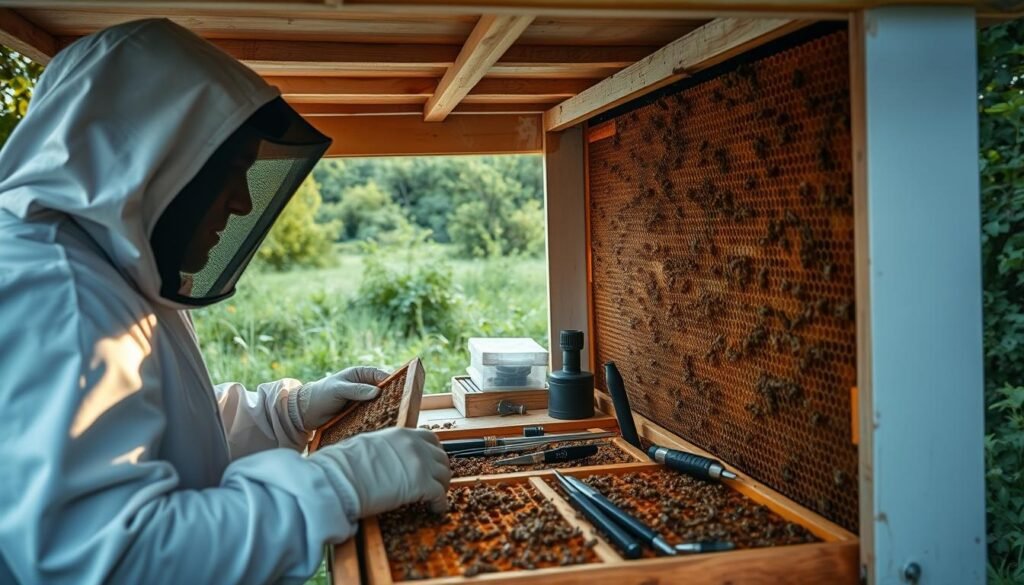
Position RNAi as one component of IPM, not a standalone cure-all. Use sequence-directed feeds to reduce viral pressure while keeping established mite control in place.
Combining approaches and timing
Pair antiviral feeds with proven varroa control: synthetic or organic miticides, drone brood removal, and timed brood breaks. Anti-IAPV dsRNA improved colony outcomes but did not lower varroa levels in trials.
Match application timing to phenology: apply before peak viral risk, ahead of major nectar flows, and during brood expansion to protect honey production and worker strength.
Practical workflows and monitoring
- Adopt simple feeding schedules and record dates and volumes.
- Monitor varroa counts and compare treated and untreated colonies to judge ROI.
- Keep logs of honey weight, brood quality, and any diagnostics used.
Resistance stewardship and scaling
Diversify modes of control across the season to limit selection pressure on targets. If mites or virus loads exceed action thresholds, implement contingency plans that prioritize queen quality, nutrition, and sanitation.
“Start small: yard-level trials let beekeepers refine timing, labor, and cost before scaling to commercial operations.”
| Action | When | Practical metric |
|---|---|---|
| Antiviral feeding | Pre-viral season / pre-flow | Forager counts, honey gain |
| Varroa control | Threshold-driven | Mite drop / alcohol wash |
| Sanitation & nutrition | Ongoing | Brood health, winter survival |
Mechanisms of viral counter-defense: RNAi suppressors in dicistroviruses
Some dicistroviruses carry dedicated proteins that blunt host antiviral responses. These viral proteins reduce the effectiveness of interference-based defense in Apis mellifera by targeting core silencing steps.
Modes of suppression vary. One well-known protein (CrPV 1A) binds Argonaute-2 and blocks slicing. Other suppressors sequester long dsRNA or siRNA, preventing RISC assembly.
Such viral strategies can explain variable field performance of antiviral dsRNA. If a virus produces a strong suppressor, a single-target design may show reduced durability and lower impact on viral load and colony health.
Practical design implications:
- Use multi-target dsRNA that hits several viral genes to reduce escape.
- Favor regions less likely to be masked by suppressor binding or rapid mutation.
- Couple dsRNA use with immunity-supporting practices (nutrition, varroa control).
Surveillance matters: track viral sequence shifts and suppressor motifs (e.g., DvExNPGP) over time. Ongoing field validation and iterative product updates help keep this technology effective against evolving viruses.
Honey bee immunity beyond RNAi: Toll, Imd, JNK, and Jak-STAT pathways
Apis mellifera relies on layered innate pathways that work together to limit viral damage and sustain colony health.
Overview: Toll and Imd mobilize antimicrobial peptides and melanization to stop invading microbes. JNK coordinates stress responses and wound repair at the cell level. Jak-STAT helps shape antiviral signaling and cellular resistance.
These pathways complement rna-mediated defenses. Bees also encode Dicer-like and Ago2 proteins, and studies show systemic RNAi movement via sid-1–like proteins. Together, these systems form a multi-layered shield against virus replication.
Practical links to management: good nutrition and lower stress raise immune protein expression and improve brood viability. Genetic variation and environmental pressure affect how strongly each pathway acts.
- Support immunity with protein supplementation and balanced forage.
- Monitor pathogens and reduce colony stressors (overcrowding, pesticide exposure).
- Use targeted interventions alongside immune-support measures to boost outcomes.
“Layered immune signaling and careful management together yield stronger colonies and better honey production.”
Regulatory and public acceptance landscape for RNA technologies
Regulatory clarity and public trust will shape how quickly novel RNA tools enter routine apiary use.
In the United States, industry-led trials are active and a regulatory pathway is evolving. Companies such as GreenLight Biosciences test syrup-based approaches aimed at varroa and mite control.
New Zealand’s HSNO framework treats sequence-directed RNA approaches differently from classic genetic modification. Still, the Environmental Protection Authority requires approvals for import, development, and field trials.
Bridging science and public views
Public perception often equates RNA methods with genetic modification. That gap slows acceptance even when regulators distinguish them.
- Engage beekeepers and local communities early to build trust.
- Commit to transparent labeling, shared data, and stewardship plans.
- Harmonize best practices across states to ease multi-state hive movement and compliance.
| Area | Need | Benefit |
|---|---|---|
| Regulatory guidance | Clear rules | Faster, safer rollout |
| Community engagement | Education | Higher acceptance |
| Industry partnerships | Field validation | Scale and trust |
“Transparent processes and robust field data help align innovation with beekeeper needs.”
Research gaps and priorities for future study
Bridging lab results and full-scale apiary performance requires targeted studies that match biology with real-world hive practice.
Key priorities center on delivery, dose, and timing across life stages, and on proving field-scale efficacy against dominant viruses like DWV and mixed infections.
Optimizing delivery, dose, and timing across life stages
Delivery success depends on life stage, stability, target tissue, and dsrna quantity. Oral formulations must resist gut enzymes and hive conditions to reach brood tissues.
Define clear dose-response curves for larvae, pupae, and adults. That will fine-tune efficacy and reduce non-target shifts in gene expression seen with some dsRNA exposures.
Align application windows with brood cycles and varroa pressure to hit the populations most at risk.
Field-scale efficacy against DWV and other prevalent viruses
Beyond IAPV, studies must evaluate double-stranded rna approaches against DWV and mixed infections that dominate U.S. apiaries.
Research actions:
- Develop multi-target dsrna to limit viral escape and counter suppressor proteins.
- Improve diagnostics so RNA interventions pair with evidence of active viral load.
- Standardize field trial design across climates to allow reproducible comparisons of colony outcomes.
“Long-term tracking of colonies, overwintering, and queen performance will reveal true population-level benefits.”
| Priority | Goal | Metric |
|---|---|---|
| Oral formulation | Stability in hive and gut | Persistence time, uptake rate |
| Dose-response | Safe, effective levels | Viral load reduction, brood survival |
| Field validation | Real-world efficacy | Colony strength, honey yield, overwintering |
| Off-target assessment | Minimize physiological shifts | Transcriptome screens, behavior |
Practical note: Cost models and standardized monitoring will help beekeepers judge adoption. Focused research now shapes reliable, scalable ways to protect honey bees, honey production, and apiary livelihoods.
Practical guidance for beekeepers evaluating RNAi-based treatments
Start with small, timed trials so management decisions rest on local data, not assumptions. Small-yard pilots let beekeepers compare treated and untreated colonies using clear, repeatable metrics.
When to consider RNAi, monitoring outcomes, and making data-informed decisions
Consider antiviral RNAi when diagnostics or symptoms suggest viral pressure, or when seasonal risk is high. Pair these feeds with existing varroa control; antiviral products do not lower mite loads.
Design pilots that track adult frames, foragers per minute, and net honey weight. Record dose, frequency, consumption, weather, and queen status to interpret changes.
- Delivery: choose syrup or patties that fit your schedule; avoid injection in routine apiary work.
- Timing: apply before peak stress periods (pre-flow or known viral flares).
- Parallel actions: maintain varroa monitoring and mite control, and boost nutrition and queen management to maximize gains.
Evaluate cost per hive against observed improvements in strength and honey. Share results with local beekeeper groups and extension services and reassess protocols each season as new field data appear.
“Start small, measure consistently, and let local data guide wider adoption.”
The University of Arkansas Extension’s beekeeping blog has a plain-language rundown of RNAi research for varroa control, the same gene-silencing approach behind emerging RNA-based bee disease treatments.
Conclusion
Conclusion. Well-designed field trials show how molecular tools can support stronger colonies by using rna interference and targeted dsrna to reduce viral pressure without altering DNA.
Evidence from U.S. IAPV studies demonstrated better foraging, higher adult population, and greater honey yield, even though varroa levels stayed unchanged. That means these approaches are a practical complement to existing mite control.
Use guidance: treat as an IPM component—pair gene silencing feeds with nutrition, queen care, and standard varroa methods. Continue research on delivery, dose, and timing and apply careful design and monitoring to limit off-target effects.
Invitation: beekeepers, researchers, and regulators should collaborate on field validation and stewardship to responsibly scale these tools in the United States.
FAQ
What is RNA interference (RNAi) and how does it work in honey bees?
RNA interference is a cellular process where double-stranded RNA (dsRNA) is processed into small interfering RNAs (siRNAs) that guide the RNA-induced silencing complex (RISC) to degrade matching messenger RNA. In Apis mellifera, delivered dsRNA can reduce expression of targeted viral or mite genes, lowering pathogen load without altering bee DNA.
Why should U.S. beekeepers and pollination-dependent growers care about this technology?
This approach targets key threats such as Varroa destructor and associated viruses, which threaten colony survival and pollination services. When effective, it can reduce colony losses and protect honey yield and crop pollination, helping safeguard livelihoods and food production.
Which pathogens have researchers targeted with dsRNA in field trials?
Field and lab work has focused on viruses such as Deformed wing virus (DWV), Israeli acute paralysis virus (IAPV), and other dicistroviruses, as well as Varroa-specific genes and, in some studies, Nosema and small hive beetle targets.
How has RNAi performed in large-scale field trials?
Trials in locations such as Florida and Pennsylvania (involving hundreds of hives across studies) showed reductions in IAPV levels, improved adult bee populations and forager activity in treated colonies, and changes in honey yield metrics. Results vary by delivery method, dose, and local stressors.
How is dsRNA typically delivered inside hives?
Common delivery methods include mixing dsRNA into sugar syrup or protein patties for oral uptake. Researchers also use topical applications or injection in controlled studies. Oral feeding is most practical for beekeepers but requires attention to stability and dose.
Can dsRNA reach Varroa mites that feed on bees?
Yes. Mites acquire dsRNA when ingesting bee hemolymph or fat body material that contains the molecule. Target selection aims at mite reproduction or survival genes to impair mite fitness after uptake.
Are there safety concerns for non-target insects, humans, or honey?
Properly designed dsRNA sequences minimize off-target effects through high specificity to target genes. Current evidence indicates low risk to mammals and many non-target species when sequences are specific, and dsRNA does not alter DNA. Regulatory review and monitoring remain important.
How long do effects last and will treatments need repeating?
RNAi effects are transient. Knockdown duration depends on dose, stability, and bee turnover; therefore repeated applications are typically required during seasons with high pathogen pressure.