Reviewed by Elena P. · Last Updated September 24, 2026 · How we review
A smart hive entrance counter records bees going in and out of the hive, usually by making them walk through a row of narrow tunnels fitted with sensors. Most use a pair of infrared sensors in each tunnel so the order in which they trip gives the bee’s direction. Others use a camera with image recognition, or a small Doppler radar mounted above the entrance. The raw counts are easy to collect. Interpreting them is harder: the numbers mostly follow the weather, and counter accuracy is rarely validated. The useful signals come from comparing hives with each other, not from reading one hive’s daily total.
This guide covers how each counter type works and which real devices and open-source projects exist. It also explains what the published research says about accuracy and how to read the data without over-interpreting it. For the wider picture of hive sensors (scales, temperature, sound), start with Smart Hive Monitoring 101.
Written by Sofia T., who works with a family apiary of about 30 colonies in southeastern North Dakota and covers hive equipment. Fact-checked by Elena P. Product details were checked on the makers’ own pages in September 2026. We have no commercial relationship with any maker named here.
Key Takeaways
- Entrance counters use one of four methods: infrared gates, cameras, Doppler radar, or RFID tags on individual bees (research only).
- In a UK study, temperature and solar radiation explained 78% of the variation in bee flight activity. That makes day-to-day changes in one hive a poor signal on their own.
- Compare hives in the same yard on the same day. A hive that falls out of step with its neighbours is the one to inspect.
- A 2022 review found few counters on the market that deliver reliable data and no standard way to validate them. Check your own counter against a short phone video.
- In the northern Plains, take counters off before hard frosts and snow. Cold and ice cause false counts and can block the tunnels.
Table of Contents
- How entrance counters work
- The four counting technologies compared
- Real devices and open-source projects
- How accurate are bee counters?
- How to read entrance counter data
- Installing a counter without upsetting the colony
- Is an entrance counter worth it?
- Frequently Asked Questions
How Entrance Counters Work
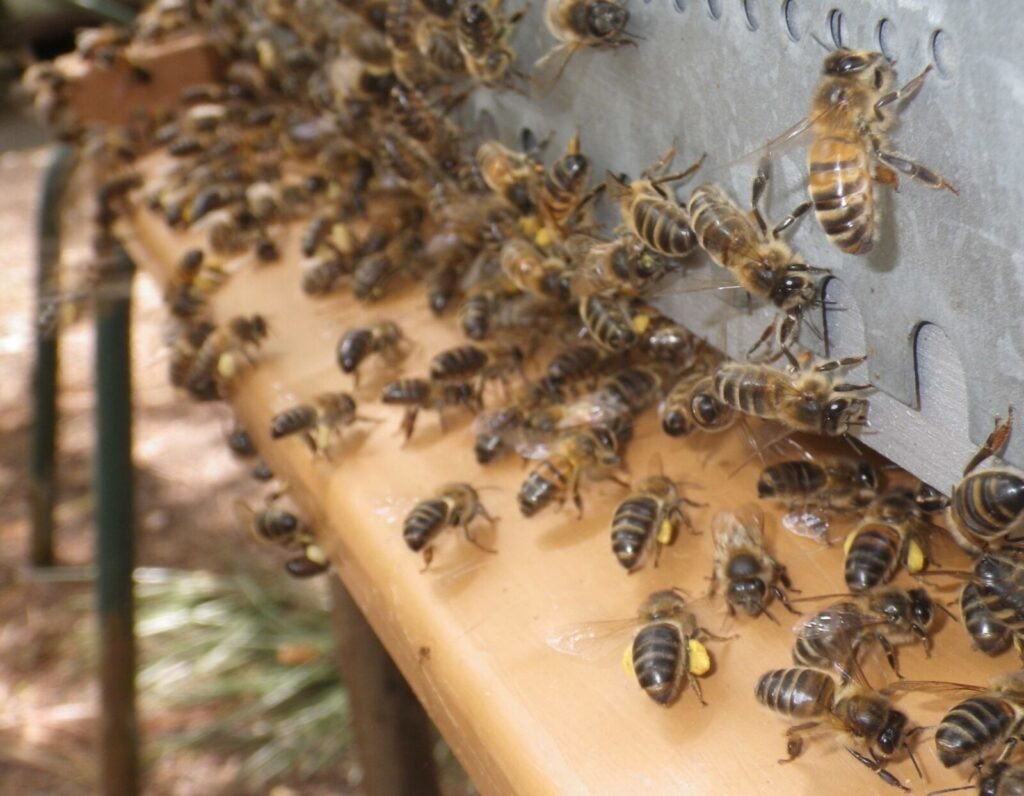
Bees at a normal entrance move in every direction at once, so a simple sensor aimed at an open landing board can’t count them one at a time. Gate-type counters solve this by closing the normal entrance and fitting a strip of small tunnels, each just wide enough for one bee. Every tunnel has two sensors a few millimetres apart. When the outer sensor trips first and the inner one second, the firmware logs an arrival. When the order is reversed, it logs a departure.
Most hobby and low-cost designs use infrared reflectance sensors. An LED shines into the tunnel, and a detector registers the extra light reflected when a bee is underneath. The tunnel floor is kept black so the only strong reflection comes from a bee. Many sensors have to be read quickly, so designs chain them through shift registers into a small microcontroller. That keeps power low enough for a battery and a small solar panel.
Camera counters take a different route. A camera looks down at the landing board, and software detects and tracks each bee between frames, so the entrance itself doesn’t need to be modified. Radar counters sit above the entrance and measure the Doppler shift from bees flying toward or away from the hive. That gives a measure of flight activity rather than a count of individual bees.
The Four Counting Technologies Compared
| Technology | How it detects bees | Direction? | Main trade-offs | Example |
|---|---|---|---|---|
| Infrared gates | Paired IR sensors in single-bee tunnels | Yes, from trigger order | Cheap and low power; tunnels restrict the entrance; bees lingering in tunnels cause errors | BeeData Counter; open-source Easy Bee Counter |
| Camera + image recognition | Detects and tracks bees in video of the landing board | Yes, if tracked | No change to the entrance; more power and processing; affected by light and crowding | BeeMate (early access); BeePi research system |
| Doppler radar | Measures motion of flying bees near the entrance | Toward and away motion | Nothing in the bees’ path; an activity measure, not a head count | BroodMinder-BeeDar |
| RFID | Reader at the entrance logs tagged individual bees | Yes, per bee | Tracks individuals only; each bee must be tagged by hand; used in research | Pesticide homing studies |
Real Devices and Open-Source Projects
There aren’t many entrance counters on the market. These are the ones we could verify directly on the maker’s or author’s page:
BeeData Counter (infrared gates)
The BeeData Counter has 24 entrances of 9 × 9 mm, each with an infrared proximity sensor. It uses a 6 V, 0.2 A solar panel and a 330 mAh lithium-polymer battery that the maker rates at about 48 hours without light. It is rated IP53 for dust and spray and from −30 °C to +55 °C. The counter sends data by Bluetooth over 2 to 4 metres, so a separate BeeData hive unit has to sit nearby. It was listed at €119 when we checked. IP53 covers spray, not driving rain or snow, so plan an overhang.
Easy Bee Counter (open-source)
The 2019 Easy Bee Counter is a published open-source design with 24 gates across roughly 14.75 inches of entrance and 48 infrared LEDs paired with reflective sensors. Six 74HC165 shift registers feed an Adafruit Feather or ItsyBitsy board, and the author reports sensor current below 1 mA, not counting the microcontroller. The circuit boards have to be black so they absorb stray infrared. The project does not publish an accuracy figure. For what DIY builds realistically demand, see DIY vs commercial hive monitoring.
BroodMinder-BeeDar (radar)
The BroodMinder-BeeDar mounts above the entrance and combines a Doppler radar flight monitor with an acoustic sensor. BroodMinder says it is based on radar work by Herbert Aumann at the University of Maine. The maker notes the acoustic sensor may struggle on plastic or heavily insulated hives. It was listed at $241.99 when we checked. For how BroodMinder’s other sensors compare with rival systems, see BroodMinder vs Arnia vs SolutionBee.
Camera-based counters
BeeMate, an Australian company, describes a camera-and-AI smart entrance that counts bees. When we checked, it was in an early-access program with a waitlist, not general sale. In research, Utah State University’s BeePi system films the landing board and counts bee motion with trained detection models. A 2024 study used it on ten colonies at the USDA-ARS Carl Hayden Bee Research Center in Tucson to forecast hive weight, temperature and entrance traffic (Kulyukin et al., 2024, Sensors). If you only want to watch the entrance rather than count it, a trail camera may be enough. See wildlife camera vs hive monitor.
How Accurate Are Bee Counters?
Accuracy is the weakest part of the field, and makers rarely publish figures. Richard Odemer’s review of nearly a century of electronic bee counters puts it plainly:
“There are few counters on the market that are able to fulfil this task.”
The task he means is remote monitoring that doesn’t disturb normal flight while still producing precise data. The review also names a main challenge: there is no standard way to validate a counter’s precision, so figures from different devices can’t be compared.
The common error sources are easy to picture once you watch a gate counter at work:
- Loitering bees. Guards and fanners stand in tunnels and trip sensors repeatedly.
- Two bees at once. Bees passing head to tail or in opposite directions can confuse the direction logic.
- Congestion. In a strong flow, the tunnels become a bottleneck and bees queue, turn back or pile up on the board.
- Light and dirt. Direct sun, reflective surfaces, propolis and dead bees in the tunnels all create false triggers or blocked lanes.
Check your own counter: On a busy afternoon, film the counter with a phone for five minutes. Count the arrivals and departures in slow motion and compare them with the counter’s log for the same five minutes. Repeat once in the morning. If the two disagree by a wide margin, treat the counter’s trends as rough and don’t rely on its absolute numbers.
How to Read Entrance Counter Data
The most useful research finding for anyone reading counter data is about weather. In a UK study using a custom electro-optical counter and an on-site weather station, temperature and solar radiation together explained 78% of the observed variation in how many bees left the hive (Clarke and Robert, 2018, Apidologie). A drop in one hive’s traffic on a cool, cloudy day tells you almost nothing about the colony.
Weather affects every hive in a yard at once, so the useful signal is how a hive compares with its neighbours. A practical way to read the data:
| What the counter shows | Likely meaning | What to check |
|---|---|---|
| All hives drop together | Weather or the end of a flow | Nothing; compare with the weather |
| One hive steadily below its neighbours | Weaker colony, queen problem or disease | Inspect brood and queen |
| Sudden huge outbound burst around midday, no matching return | Possible swarm | Check the hive and any scale data for a weight drop |
| Heavy two-way traffic in a dearth, late in the day | Possible robbing | Watch the entrance for fighting and reduce it |
| Short afternoon bursts on warm days | Orientation flights of young bees | Usually normal |
| Departures consistently far above returns | Foragers not coming home, or a counter error | Validate the counter first, then look for pesticide exposure |
The last row needs care. Forager loss can be real. A study in Science used RFID tags at the entrance to show that bees exposed to a sublethal dose of thiamethoxam more often failed to return home (Henry et al., 2012). But a gate counter with direction errors can produce the same imbalance, so validate the counter before drawing conclusions.
Counters are most useful alongside a hive scale. Traffic tells you bees are flying, and weight tells you whether they are bringing nectar in. See reading your hive’s weight curve. For what robbing looks like up close, see how to identify robbing early.
Installing a Counter Without Upsetting the Colony
- Close every other entrance. Any gap or upper entrance lets bees bypass the sensors and skews the counts.
- Give enough lanes. A strong colony in a flow needs plenty of gates. If bees pile up on the board, the counter is restricting them.
- Shade the sensors. An overhang above the tunnels cuts sunlight false triggers and keeps rain off.
- Protect ventilation. A tunnel strip replaces a wide entrance, so add a screened or upper vent that bees can’t use as a door in hot weather.
- Let the colony adjust. Ignore the first few days of data while foragers learn the new entrance.
- Plan for power and range. Bluetooth reaches only a few metres. See powering and connecting hive sensors for battery and wireless trade-offs.
In eastern North Dakota and western Minnesota, the season for a counter runs roughly from the first steady spring flying to the first hard frosts. Take gate counters off before winter. Dead bees, ice and condensation block the tunnels, and a winter colony needs a clear entrance for cleansing flights.
Is an Entrance Counter Worth It?
For most backyard beekeepers, a counter is an interesting tool rather than an essential one. A scale answers more management questions per dollar. A counter earns its place if you are comparing colonies across a yard, watching for pesticide events near crops, or running your own trials, especially if you check it against video. If you just want to know whether the bees are flying, a few minutes at the entrance still tells you a lot. See how to tell if a hive is preparing to swarm for the entrance signs worth knowing.
Frequently Asked Questions
How does a bee counter know if a bee is going in or out?
Gate counters put two sensors in each tunnel. The order they trigger, outer then inner or inner then outer, gives the direction. Camera systems track each bee across video frames, and radar measures motion toward or away from the hive.
Do entrance counters harm bees or the colony?
Not directly, but a gate counter narrows the entrance. With too few lanes, bees queue in a strong flow and ventilation suffers. Give plenty of gates and a separate vent.
Can a bee counter detect swarming?
A swarm usually shows as a sudden, large outbound burst without a matching return, often around midday. A scale showing a sharp weight drop at the same time is stronger confirmation.
Can a bee counter tell if my hive is queenless?
Not directly. Traffic in a queenless colony declines slowly as the population falls, which a counter can’t separate from other causes. You still need to inspect the brood.
Are DIY bee counters accurate?
They can be reasonable for trends, but most DIY projects don’t publish validated accuracy figures. Test yours against a few minutes of phone video before relying on the numbers.
Why does my counter show different numbers every day?
Mostly weather. Research found temperature and solar radiation explained 78% of the variation in flight activity. Compare hives on the same day rather than one hive across different days.
Image credits: Photo: Marc Andrighetti, CC BY-SA 3.0, via Wikimedia Commons.