Last Updated September 15, 2026
A modular hive system, in an apiculture research context, is a standardized hive and hardware architecture built so sensor packs, RFID reader networks, or robotic modules can be added, removed, or moved between colonies without redesigning the hive itself. Universities and USDA laboratories use these systems to track individual foraging bees, log hive conditions automatically, and run comparable experiments across dozens of colonies at once — a different job entirely from the consumer “smart hive monitor” most backyard beekeepers know.
Key Takeaways
- “Modular” in research apiculture means standardized, swappable hardware — sensor packs, RFID antenna networks, or robotic modules — built to a common frame or interface spec so they move between colonies without redesign.
- USDA-ARS and North Dakota State University field-tested a $130-per-unit wireless temperature/humidity/CO2 sensor at three colonies in Fargo, ND, through a full foraging season and winter (Sensors, 2026).
- USDA’s Beltsville Bee Research Laboratory runs a solar-powered, 32-antenna RFID system that can track individually tagged bees across up to 32 colonies at once (Alburaki et al., Sensors, 2021).
- Research-grade modular systems differ from consumer hive monitors (BroodMinder, Arnia, SolutionBee) in purpose: they’re built for standardization and raw data export across many colonies, not single-hive health alerts for one beekeeper.
- Open questions remain, including whether RFID tag weight or reader electromagnetics subtly affect forager behavior, and the lack of a shared hardware standard between research programs.
Table of Contents
- What "Modular" Actually Means in a Research Apiary
- Environmental Sensor Modules: What USDA-ARS Actually Measures
- RFID Networks: Tracking Individual Bees at Scale
- Robotic and Experimental In-Hive Modules
- How This Differs from a Consumer Smart Hive Monitor
- Comparing Modular Research Approaches
- Limitations and Open Questions
- Frequently Asked Questions
- Sources
What “Modular” Actually Means in a Research Apiary
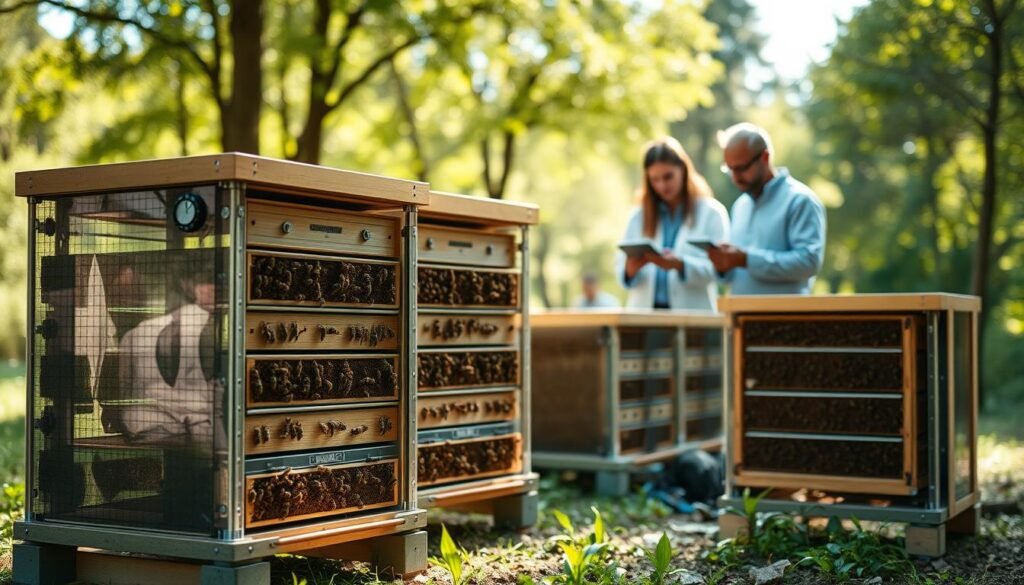
Commercial beekeeping already standardized hive geometry a century ago — that’s the entire point of the Langstroth hive’s interchangeable frames. Research apiculture pushes that same idea one layer further: not just the boxes and frames, but the sensors, tags, and robotics attached to them. A “modular” research system is built to a common mechanical or electrical interface — a standard frame size, a common mounting bracket, a shared data protocol — so a module validated on one colony can be redeployed on another without custom engineering each time.
That standardization is what makes an experiment reproducible. If every colony in a study has differently mounted, differently calibrated hardware, researchers can’t cleanly separate “difference between colonies” from “difference between instruments.” A 2026 open-hardware project called COMB (Common Open Modular robotic platform for Bees), built by researchers including Tim Landgraf, sizes its in-hive robotic module to fit a standard Deutsch-Normalmaß (DNM) frame — the same standardization logic European research apiaries lean on — with a sealed, movable access window and a swappable payload interface for different sensors or actuators. It’s a research tool, not a commercial product, but it’s a clean example of what “modular” means in practice: one mechanical footprint, many interchangeable experiments. On the hardware side, the same modular logic shows up in this site’s own coverage of 3D-printed hive components and laser-cut frame innovations — both are ways of producing standardized, swappable hardware cheaply enough to deploy across many hives.
Environmental Sensor Modules: What USDA-ARS Actually Measures
The most straightforward modular research package monitors basic hive environment: temperature, humidity, and gas concentration. A 2026 paper in the journal Sensors, from a team at North Dakota State University working with USDA’s Agricultural Research Service, describes a wireless sensor unit built around a Particle Argon microcontroller (nRF52840) with Wi-Fi, paired with an Adafruit NDIR SCD-30 and a Sensirion SCD41 CO2 sensor. The unit streams readings to a cloud dashboard (ThingSpeak), runs on a 9V battery or USB power, and cost roughly $130 to build per unit. In testing at USDA-ARS facilities in Fargo, North Dakota, across three active colonies through a full foraging season (September 2024–2025) and a winter cluster period (January 2025), it held accuracy of about ±1°C for temperature, ±7–9% for relative humidity, and ±30 ppm for CO2.
That’s a genuinely modular design in the practical sense: cheap enough to deploy across many colonies at once, standardized enough that every unit reports comparable numbers, and simple enough for a university lab to build in-house rather than buying a proprietary system. It sits one step up in rigor from the temperature and humidity sensors a hobbyist might install — the underlying physics is the same, but the research version is built for calibrated, exportable, multi-colony datasets rather than a single beekeeper’s phone app.
RFID Networks: Tracking Individual Bees at Scale
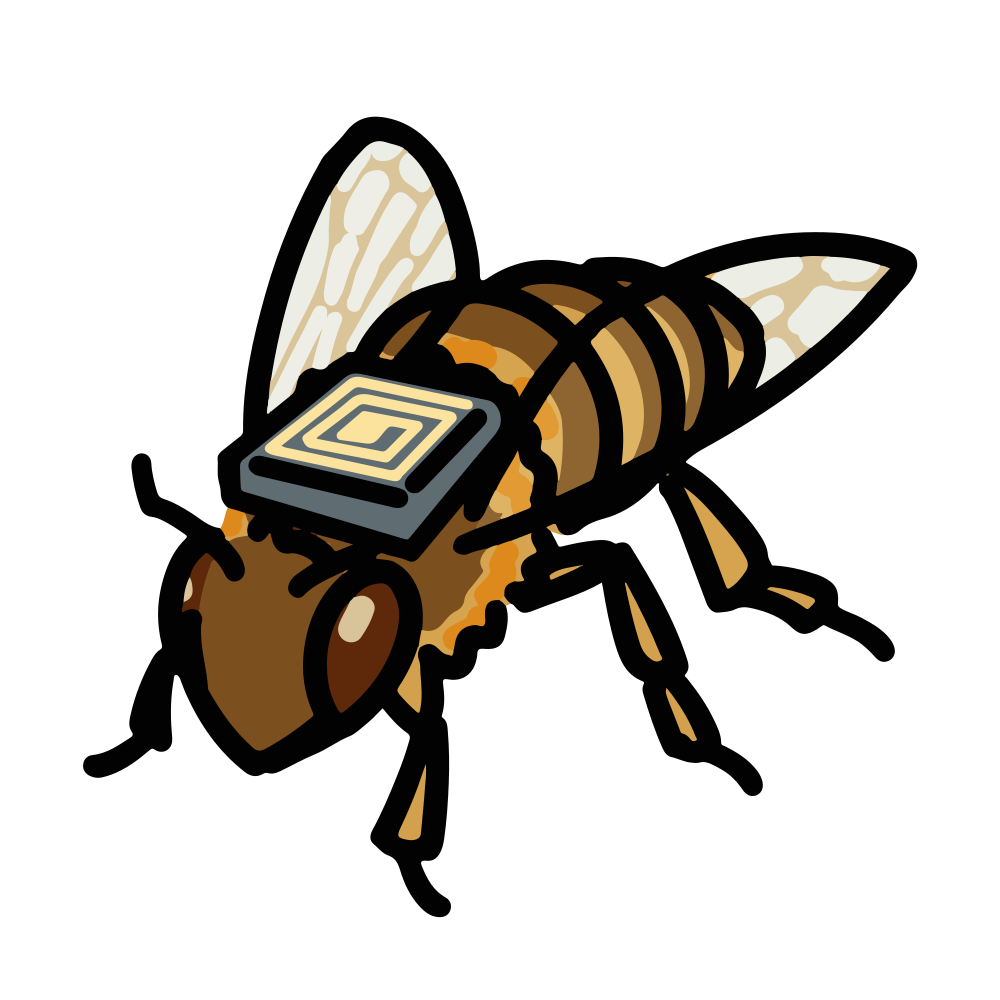
Environmental sensors describe the hive; they don’t say anything about what any individual bee is doing. For that, apiculture research has relied on radio-frequency identification (RFID) for over a decade. USDA’s Bee Research Laboratory in Beltsville, Maryland — the oldest of the federal bee labs — operates a 32-antenna RFID system, described in a 2021 Sensors paper by Alburaki, Madella, and Corona, that runs independently on solar power and can monitor up to 32 colonies simultaneously. Tiny tags glued to individual bees’ thoraxes are read as they pass antennas at the hive entrance, letting researchers reconstruct foraging trips, robbing behavior, and queen or drone mating flights automatically, at a scale no human observer could match by watching hive entrances directly.
The technique’s value shows clearly in a widely cited 2012 study by Schneider, Tautz, Grünewald, and Fuchs, published in PLoS ONE, which used RFID-tagged foragers to measure how two neonicotinoid pesticides affected honeybee foraging behavior:
The development of insecticides requires valid risk assessment procedures to avoid causing harm to beneficial insects and especially to pollinators such as the honeybee Apis mellifera.
Across 10 trials and 29,610 tracked foraging flights, the study found imidacloprid at 1.5 ng per bee cut feeder visits by 47% within three hours, rising to a 98% reduction at 3 ng; clothianidin was more potent still, cutting visits 71% at just 1 ng, with only 20.6% of bees returning to the hive after a 2 ng dose. Numbers like that are only possible because RFID turns “did the bee come back” into an automated, individually attributable data point across thousands of flights rather than a handful of manually observed ones.
Robotic and Experimental In-Hive Modules

The newest layer of modular research hardware doesn’t just sense — it interacts. The COMB platform mentioned above pairs its standardized DNM-frame footprint with interchangeable actuators and sensors specifically so researchers can test hypotheses about bee communication, including the waggle dance, by inserting a robotic agent directly into a live colony’s social environment. It’s early-stage, open-source, and not something a hobbyist apiary would deploy — but it illustrates where modular research hardware is heading: not just recording what a colony does, but running controlled interventions inside it.
How This Differs from a Consumer Smart Hive Monitor
It’s worth being explicit about a distinction that matters for anyone comparing this to the commercial hive-monitoring products covered elsewhere on this site. A consumer device like those compared in our BroodMinder vs. Arnia vs. SolutionBee guide, or explained in Smart Hive Monitoring 101, is built to answer one beekeeper’s question about one hive: is this colony healthy, should I intervene, is it about to swarm. A research-grade modular system asks a different question across many colonies at once: does this variable — a pesticide dose, a genetic line, a management practice — produce a measurable, statistically comparable effect, with hardware standardized enough that the answer isn’t confounded by inconsistent equipment. Neither replaces the other. A backyard beekeeper doesn’t need a 32-antenna RFID array, and a USDA research program doesn’t need a consumer app’s swarm alert — but the underlying sensor technology (temperature probes, humidity sensors, entrance counters) frequently starts in one world and migrates to the other, which is exactly how today’s consumer hive monitors trace their lineage back to research platforms like these.
Comparing Modular Research Approaches
| Module type | What it measures | Typical scale | Real-world example |
|---|---|---|---|
| Environmental sensor pack | Temperature, humidity, CO2 | Single colonies to small research apiaries | NDSU/USDA-ARS wireless unit, Fargo, ND (Sensors, 2026) |
| RFID antenna network | Individual bee identity, entrance/exit timing, direction | Up to ~32 colonies on one solar-powered network | USDA-ARS Beltsville 32-antenna system (Alburaki et al., 2021) |
| RFID + controlled dosing | Behavioral response to a specific variable (e.g., pesticide dose) | Small trial cohorts, high flight-count sampling | Schneider et al., PLoS ONE, 2012 (10 trials, 29,610 flights) |
| Robotic in-hive module | Bee response to a physical/robotic stimulus | Single-colony, early-stage experimental | COMB open-hardware platform (Kedia, Messerich, Landgraf) |
Limitations and Open Questions
Modular research hardware isn’t a solved problem. Cost and technical complexity still limit how many colonies a smaller program can instrument at once — a solar-powered multi-antenna RFID network or a custom sensor build is a meaningfully bigger undertaking than clipping a consumer monitor onto a single hive, even at the roughly $130-per-unit cost of the simplest sensor packs described above. There’s also no single shared hardware standard across institutions: a module built for a DNM-frame colony in a European lab isn’t a drop-in fit for a Langstroth-format research apiary in the US, which limits how easily hardware and protocols transfer between programs. And some open questions haven’t been fully resolved even in the RFID literature itself — including whether the added weight of a tag, or the electromagnetic field from a reader antenna, subtly changes how a tagged forager behaves compared to an untagged one. Researchers generally treat this as a small, acceptable source of noise rather than a fatal flaw, but it’s a genuine limitation worth knowing about rather than glossing over.
For a hands-on starting point that doesn’t require USDA-scale budgets, see our guide to building a bee research micro-lab at home, and for the record-keeping discipline that makes any of this data usable afterward, see documenting hive data scientifically. Programs looking to contribute to (rather than build) a modular monitoring network can also plug into the Bee Informed Partnership, whose national sentinel apiary program already aggregates standardized colony-health data from beekeepers across the country.
Frequently Asked Questions
What makes a hive system “modular” for research purposes?
A shared mechanical or electrical interface — a standard frame size, mounting spec, or data protocol — that lets a sensor, RFID reader, or robotic module be validated on one colony and redeployed on another without custom rebuilding each time.
How is this different from a consumer smart hive monitor?
A consumer monitor answers one beekeeper’s question about one hive’s health. A research-grade modular system is built for standardized, comparable, exportable data across many colonies at once, usually to test a specific variable rather than flag a single colony’s problem.
Can RFID tagging harm the bees being tracked?
The tags used in published research are extremely light (milligrams) and glued to the thorax without apparent immediate harm, but researchers acknowledge it’s not fully settled whether tag weight or reader electromagnetics have any subtle behavioral effect on tagged foragers.
How many colonies can one RFID network cover?
USDA’s Beltsville Bee Research Laboratory operates a solar-powered, 32-antenna system capable of monitoring up to 32 colonies simultaneously (Alburaki et al., Sensors, 2021).
What does a basic environmental sensor module cost to build?
The NDSU/USDA-ARS wireless temperature, humidity, and CO2 unit described in a 2026 Sensors paper cost approximately $130 per unit to build, using off-the-shelf components.
Where can I find real published data from systems like these?
Peer-reviewed journals such as Sensors and PLoS ONE, and USDA’s Agricultural Research Service publication database, carry the primary studies cited throughout this article — a more reliable starting point than secondhand summaries.
Sources
- USDA-ARS Bee Research Laboratory, Beltsville, MD
- Alburaki, Madella & Corona, “RFID technology serving honey bee research: A comprehensive description of a 32-antenna system,” Sensors, 2021
- Schneider et al., “RFID Tracking of Sublethal Effects of Two Neonicotinoid Insecticides on the Foraging Behavior of Apis mellifera,” PLoS ONE, 2012
- Das Gupta et al., “A Wireless Sensor Platform for Beehive Monitoring,” Sensors, 2026
- Kedia, Messerich & Landgraf, “COMB: Common Open Modular robotic platform for Bees,” 2026
This overview covers institutional and university research hardware, not consumer products — it’s educational information for beekeepers and students curious about the research side of apiculture, not a buying guide. Last reviewed September 15, 2026.