

Reviewed by Michael R. · Last Updated October 8, 2026 · How we review
Beeswax crafts are projects that turn clean, rendered beeswax into useful things: candles, food wraps, lip balm and salves, wood polish, ornaments, wax seals and dye-resist art such as batik and pysanky. Almost every one needs the same three things: a water bath, a thermometer and wax kept below 185°F (85°C). Rolled candles, lip balm and food wraps are the easiest places to start.
This page is our hub for beeswax projects. It covers what each craft involves, the temperatures that matter and how much craft wax a hive gives you, then links to a full step-by-step guide for each project.
Educational information only, not professional, medical or legal advice. Hot wax is a burn and fire hazard; follow the U.S. Fire Administration’s candle fire safety guidance. If you plan to sell skin-care products, read the FDA’s fact sheet for small and homemade cosmetics businesses.
Key Takeaways
- Melt beeswax in water or a water bath, never directly over heat, and keep it below 185°F (85°C). Above that it starts to discolor, according to the FAO’s beekeeping products bulletin.
- Beeswax melts at about 144–149°F (62–65°C). Most projects work between that point and about 176°F (80°C).
- Rolled candles from foundation sheets need no pot of melted wax, so they are the easiest first project.
- In frame hives, cappings wax is only about 1–2% of the honey crop. At the 2025 US average of 48 pounds of honey per colony, that is roughly 8 to 15 ounces of wax.
- Balms made only of wax, oils and butters keep far longer than creams that contain water, which spoil within weeks to months.
Table of Contents
- Beeswax Projects at a Glance
- How to Melt Beeswax Safely
- Craft Wax From Your Own Hive (or a Supplier)
- Beeswax Candles: Rolled, Molded and Dipped
- Lip Balm, Salves and Other Skin Care
- Beeswax Food Wraps
- Wood Polish, Waxed Canvas and Household Fixes
- Ornaments, Wax Seals and Modelling Wax
- Batik and Pysanky: Beeswax as a Dye Resist
- Storing Wax and Finished Pieces
- Frequently Asked Questions
- The Bottom Line
Beeswax Projects at a Glance
The table sorts the common beeswax projects by difficulty and shows how much of each mix is actually beeswax. That share is what decides how far a block of wax goes.
| Project | Skill level | Beeswax share of the mix | Full guide |
|---|---|---|---|
| Rolled candles | Easiest; no melting | 100% (foundation sheets) | Candles, below |
| Lip balm | Easy | About one-third (1 part wax to 2 parts oil) | beeswax lip balm recipe |
| Food wraps | Easy | A thin coat of wax, pine resin and jojoba oil on cotton | how to make beeswax food wraps |
| Wood polish | Easy | 5–50% of the polish | homemade beeswax wood polish |
| Ornaments | Easy | 100% | beeswax holiday ornaments |
| Wax seals | Easy | A pea-sized piece per seal | making wax seals with beeswax |
| Fire starters | Easy | Scraps and dark wax are fine | beeswax fire starters for camping |
| Molded candles | Beginner to intermediate | 100% | making beeswax candles from your hive |
| Deodorant | Intermediate | Up to about 35% | DIY beeswax deodorant |
| Waxed canvas | Intermediate | About 2 parts wax to 1 part linseed oil | waxed canvas with beeswax |
| Bar soap | Intermediate | A small addition to the oils | making beeswax soap |
| Creams and lotions | Intermediate | 8–12% (cold cream); needs an emulsifier | Skin care, below |
| Dipped tapers | Advanced | 100% | Candles, below |
Sources for the wax shares: the lip balm ratio is the lip gloss formula in Stefan Bogdanov’s Beeswax Book (Bee Product Science, 2017). The polish, cold cream and deodorant figures come from the FAO’s beeswax chapter in Value-Added Products from Beekeeping (Agricultural Services Bulletin 124). The wrap, canvas and soap figures are from our own guides linked in the table.
How to Melt Beeswax Safely
Every project starts the same way: melt the wax gently, in water or a water bath, and keep a thermometer in it. A double boiler, or a heat-proof jug standing in a pan of simmering water, does the job. Keep these tools for wax only, because beeswax is hard to clean off kitchen pans.
“In all cases, extreme care needs to be taken since beeswax is highly flammable and because of its high heat capacity, can cause severe burns when dropped onto bare skin.”
The rules that apply to every project
- Use water or a water bath. The FAO bulletin says wax heated directly, without water, or above 85°C (185°F) discolors, so it “always needs to be processed in water or in a water bath.”
- Choose the right pot. Stainless steel, heat-proof glass or enamel. The same bulletin warns that iron, copper, brass and zinc (galvanized steel) darken wax.
- Stay with it. The US Fire Administration’s first cooking rule is “Stand by your pan.” If you leave the room, turn the heat off.
- Keep a lid or baking sheet within reach. If the pot catches fire, the USFA says to cover it to put the fire out. Turn off the burner and do not carry a burning pot. If the fire spreads, get out and call 911.
- Keep children and pets back. Hot wax holds its heat, which is why spills burn so badly.
Beeswax temperatures that matter
These are the numbers behind every recipe on this page, in one place:
| Temperature | What happens | Source |
|---|---|---|
| 86–95°F (30–35°C) | Wax turns soft and pliable; hand warmth is enough to model it | Bogdanov, Beeswax Book |
| About 102°F (39°C) | The first components begin to melt | Bogdanov (calorimetry data) |
| 144–149°F (62–65°C) | Fully melted; the usual pharmacopoeia melting range | FAO Bulletin 124 |
| 149°F (65°C) | Wax bath for dipping candles | FAO Bulletin 124 |
| 158–176°F (70–80°C) | Water bath for pouring molded candles | Bogdanov, Beeswax Book |
| 185°F (85°C) | Upper limit; above this wax discolors | FAO Bulletin 124 |
| 203–221°F (95–105°C) | Surface foam forms | Bogdanov, Beeswax Book |
| 284°F (140°C) | Volatile compounds start to evaporate | Bogdanov, Beeswax Book |
| Above 489°F (254°C) | Flash point | Fisher Scientific beeswax safety data sheet |
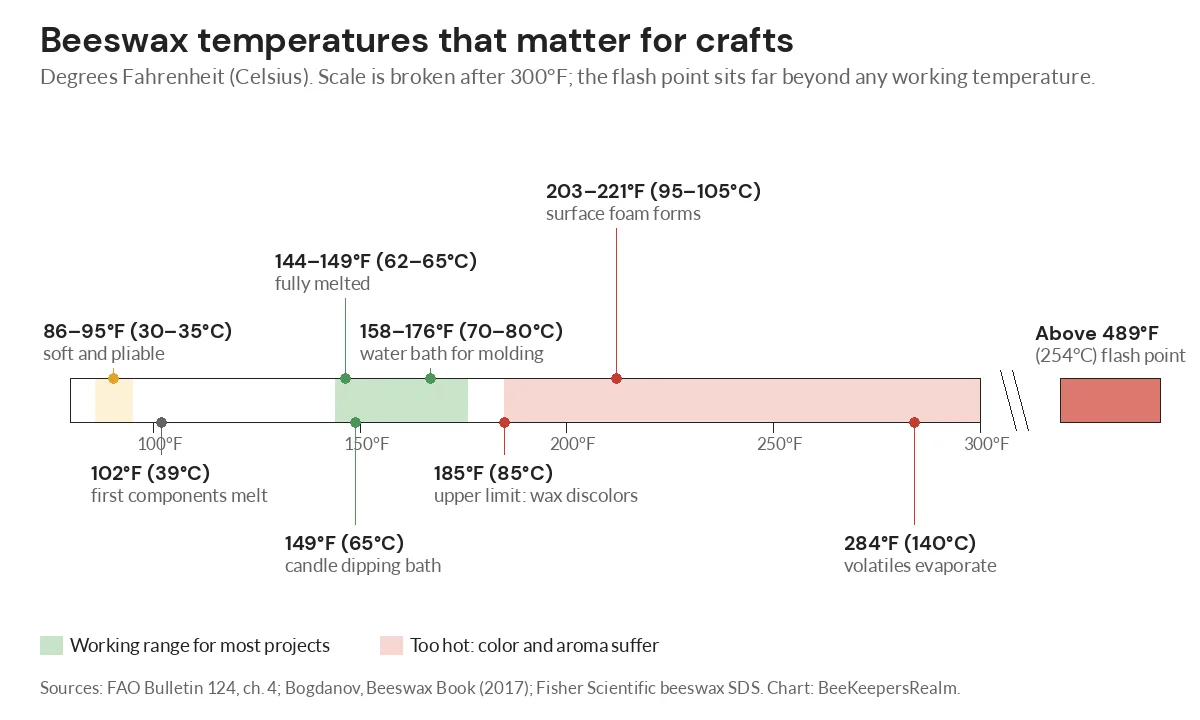
The flash point is far above any working temperature. The real risks at home are wax that boils dry, wax spilled onto a burner and burns from splashes. A thermometer turns all of these from guesswork into a number you can watch.
Craft Wax From Your Own Hive (or a Supplier)
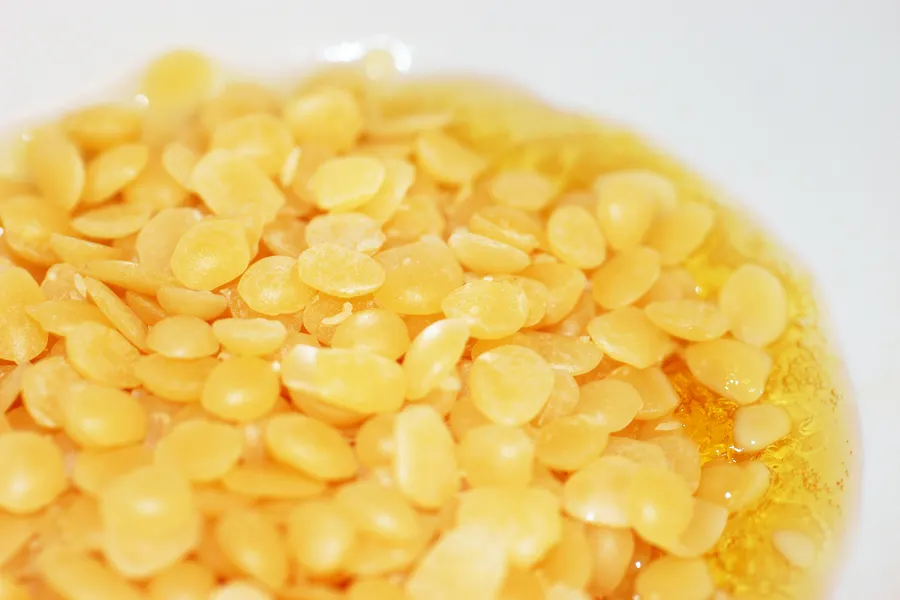
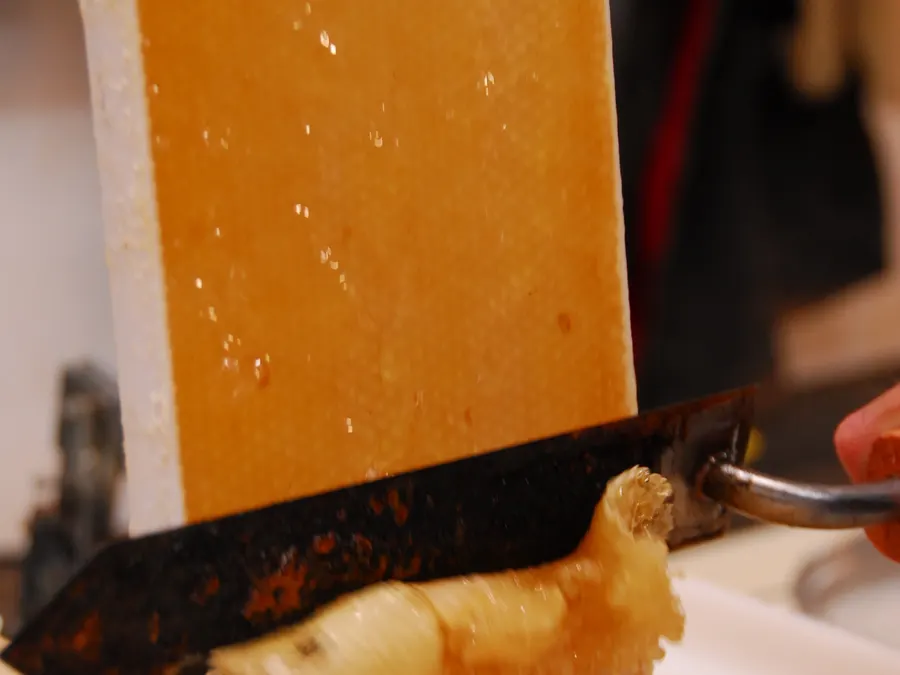
For beekeepers, the best craft wax is already in the honey house. The FAO bulletin calls wax rendered from cappings “a very high quality, light coloured wax.” Light-colored broken comb is next best. Old, dark brood comb gives the least wax and the poorest quality.
How much wax one hive gives you
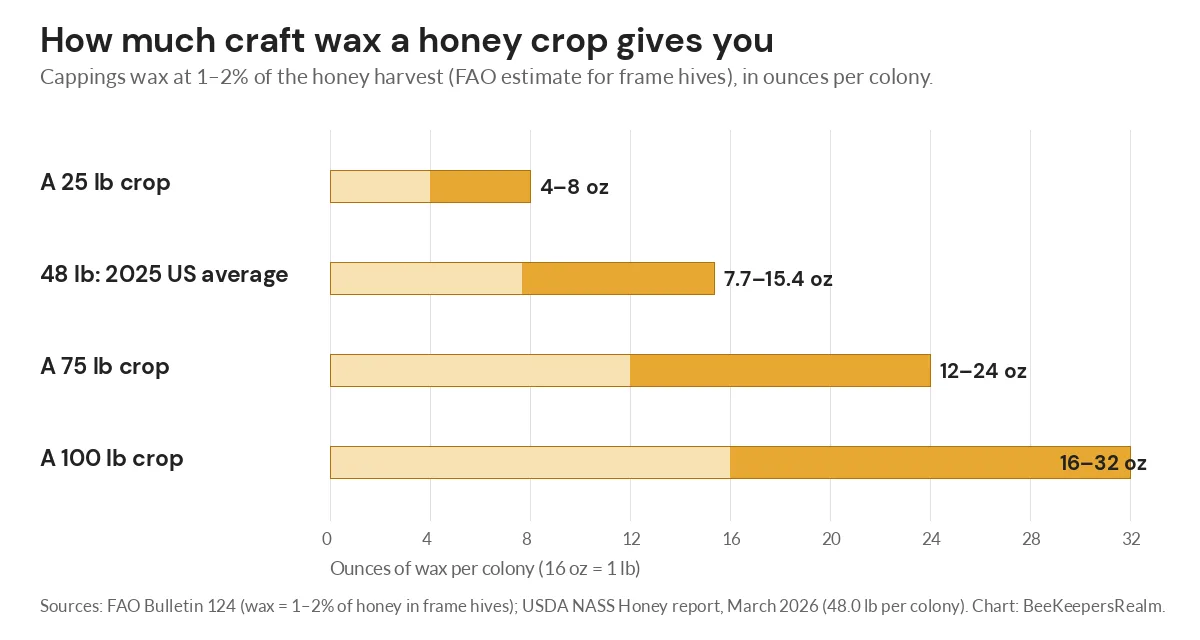
Less than most new beekeepers expect. In frame-hive beekeeping, the FAO puts the wax yield at only 1–2% of the honey crop. Top-bar and traditional hives, where whole combs are crushed, yield 10–15%.
The USDA’s March 2026 Honey report puts the 2025 US average at 48.0 pounds of honey per colony. At 1–2%, that crop yields about 0.5 to 1 pound of cappings wax, or roughly 8 to 15 ounces. That’s enough for a run of lip balms or a few molded candles from each hive, not a winter of candle making.
Two details from the FAO bulletin matter for crafts. Freshly cleaned wax can hold up to 20% water, so let new blocks sit a few weeks before you weigh them for a recipe. And candle wax must be “extremely clean,” because propolis or pollen makes a candle sputter. To get there, see how to render cappings wax cleanly, then filter and purify the wax. Burr comb and scrapings from inspections can be sorted and melted separately, and dark comb is best saved for fire starters.
Buying wax if you don’t keep bees
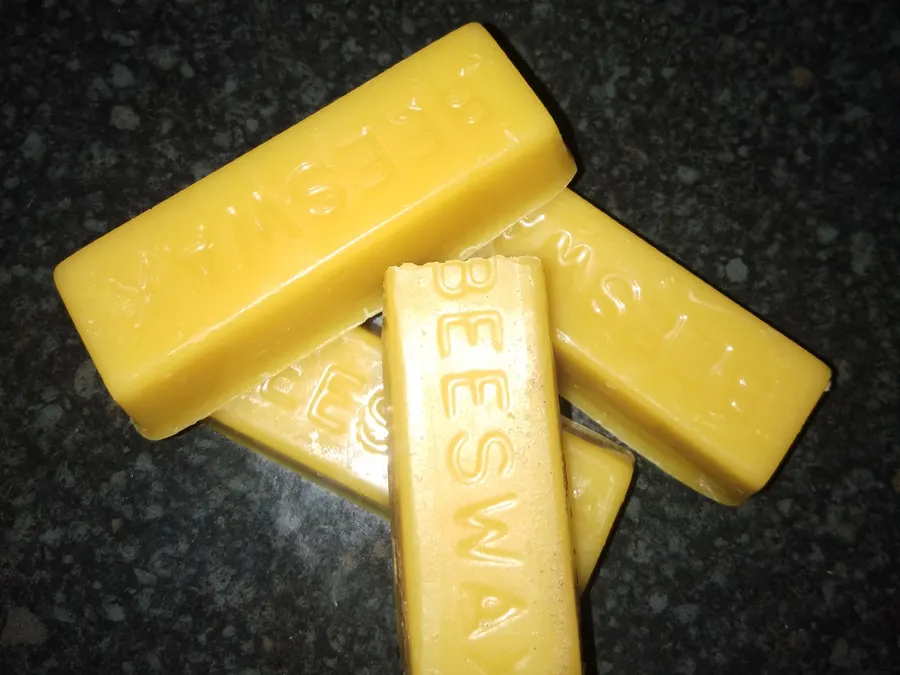
Good rendered beeswax is yellow to orange and smells sweet. The FAO bulletin notes that pure white beeswax “has always been bleached,” and that very dark wax was poorly cleaned or melted in unsuitable metal. Blending with paraffin is hard to spot without lab tests, so buy from a beekeeper or a supplier that states the wax is 100% beeswax. Pellets melt faster and are easier to weigh. If you are comparing waxes for candles, see beeswax vs. paraffin vs. soy wax.
Beeswax Candles: Rolled, Molded and Dipped
For centuries, the FAO bulletin notes, beeswax was valued as the best material for candles. It melts at a higher temperature than most paraffin waxes (48–68°C, or 118–154°F), so beeswax candles stay straight in warm rooms. The FAO bulletin adds a fact few craft guides mention: the Roman Catholic church requires its ceremonial candles to contain at least 51% pure beeswax.
Rolled candles: the no-melt starter
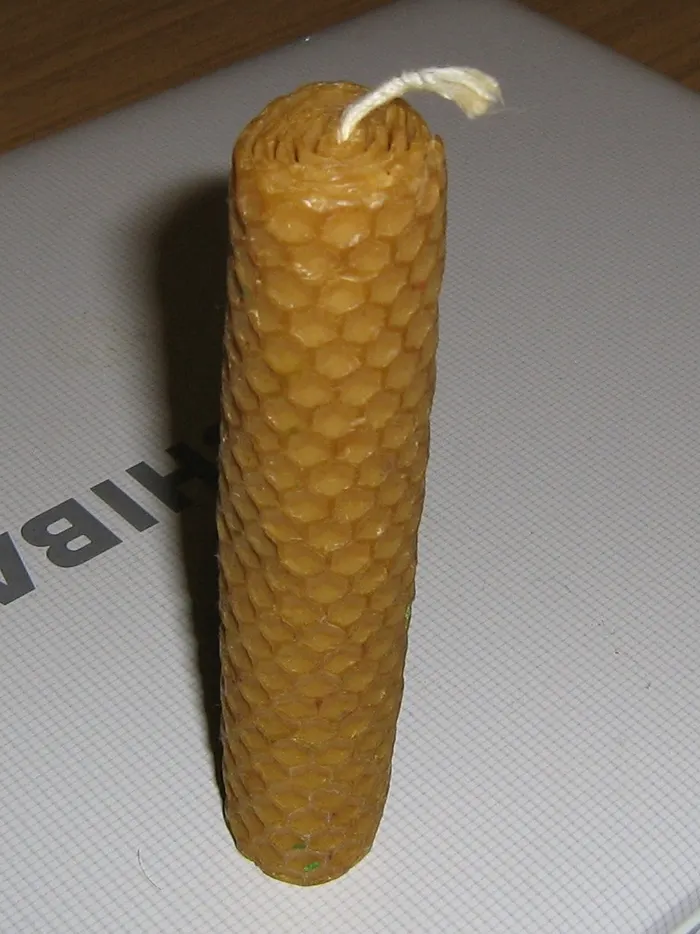
Rolled candles are made by wrapping a sheet of wax around a wick. Beekeepers often use the same embossed foundation sheets that go into frames. Bogdanov’s advice is to soften the sheets at about 77–86°F (25–30°C) so they roll without cracking; a warm room does this. The FAO bulletin says to soak the wick in hot wax first and let it cool straight. Press the final edge in with a warm thumb. To make your own sheets, see making wax foundation at home.
Molded and poured candles
Melt the wax in a water bath at 158–176°F (70–80°C), per Bogdanov, and pour into silicone or metal molds with the wick held centered. The FAO bulletin says to warm the molds first and cool the candles slowly in a warm, draft-free place. A cold mold or a fast cool makes the center sink or the candle crack. Our step-by-step guide covers filtering, molds and curing: how to make beeswax candles from your hive.
Dipped tapers
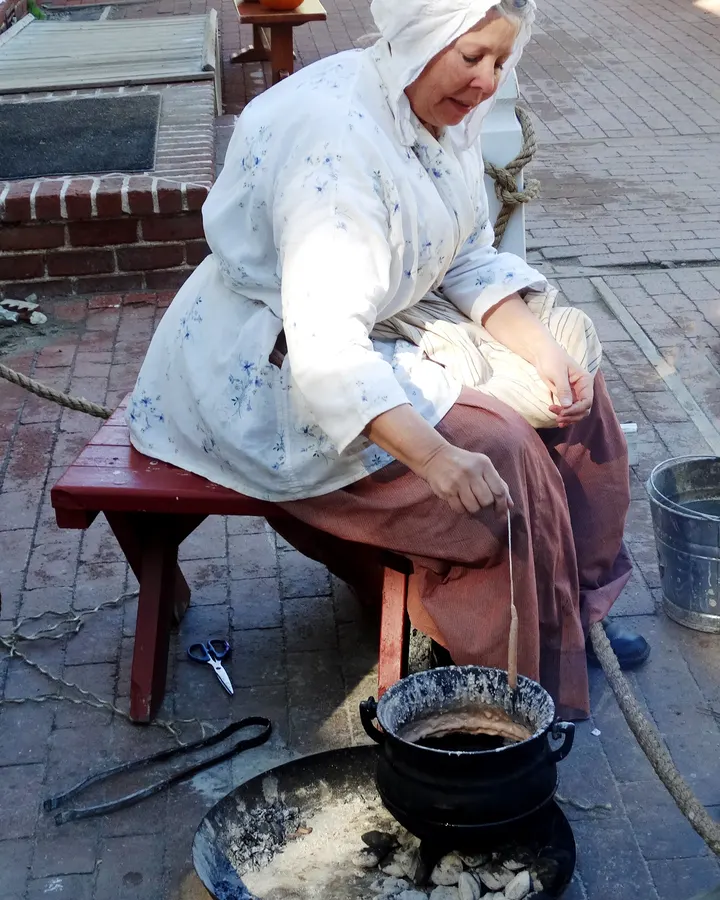
Dipped candles are built up one layer at a time by lowering a wick into wax held at 149°F (65°C), the temperature the FAO bulletin gives. The bulletin calls the method excellent but warns it “requires considerable skill and patience.” Each dip needs a few minutes to cool before the next.
Choosing a wick
Beeswax is thick when molten, which changes how a wick draws it up. Atkins & Pearce, a Kentucky wick maker, says its square-braided wick series was originally designed for beeswax candles. Its datasheet matches wick size to candle diameter like this:
| Candle type | Extra small wick | Small | Medium | Large | Extra large |
|---|---|---|---|---|---|
| Pillars and containers | Under 1 in | 1–2 in | 2–3 in | 3–4 in | 4 in and up |
| Tapers | 3/16–1/2 in | 1/2–3/4 in | 3/4–7/8 in | Not suggested | Not suggested |
Treat the chart as a starting point and test-burn. The FAO bulletin says the right ratio “should be determined by experiment.” A thick candle with a thin wick burns longer but gives less light. Bogdanov adds two burning tips. Candles up to about 1 inch (24 mm) thick burn more evenly and smoke less. On the first burn, let a candle burn about one hour for every inch of diameter, so the melt pool reaches the edge and it does not tunnel.
Once lit, treat it like any candle. The USFA says to keep candles at least 12 inches from anything that burns and to blow them out when you leave the room. Its figures from the National Fire Protection Association show about 20 home candle fires reported every day.
Lip Balm, Salves and Other Skin Care
Beeswax thickens oils and holds moisture against the skin. The simplest skin-care crafts are anhydrous, meaning they contain no water: just wax, oils and butters. Bogdanov’s lip gloss formula is 1 part beeswax to 2 parts oil by weight, heated to 158°F (70°C). More wax makes a firmer balm; more oil, or a soft oil such as coconut, makes it softer. Weigh ingredients instead of measuring by volume.
The FAO bulletin gives typical beeswax shares for commercial products: cold creams 8–12% by weight, hair creams 5–10%, deodorants up to 35%. Creams and lotions contain water, so they need an emulsifier to stay mixed. The FAO’s basic cream uses borax. They also spoil fast. The bulletin says water-and-oil emulsions keep for “a few weeks to a few months,” and longer refrigerated, unless a preservative is added. Plant oils turn rancid within weeks, so make small batches and date every tin.
Our project guides cover the details:
- How to make beeswax lip balm, with three ratios compared.
- Mustache wax and beard balm, which differ mainly in wax content.
- DIY beeswax deodorant.
- Beeswax soap, where a little wax hardens the bar.
If you plan to sell balms or salves
In the US, lip balms and salves are regulated as cosmetics. The FDA’s fact sheet for small and homemade cosmetics businesses says you may make cosmetics at home, and that cosmetics other than color additives need no FDA approval. You are still legally responsible for making sure they are safe and properly labeled. That includes listing ingredients by their common names and giving your name and place of business. Claims matter. A product meant to “treat or prevent disease,” such as a salve sold to heal cuts, is regulated as a drug. Under the Modernization of Cosmetics Regulation Act of 2022 (MoCRA), certain small businesses are exempt from facility registration and product listing, but not from safety and labeling rules. State and local rules may add requirements, so check before your first craft fair.
Beeswax Food Wraps
A beeswax wrap is cotton fabric coated with beeswax, usually with pine resin for cling and jojoba oil for flexibility. You spread the mix on the cloth, melt it in with an iron between sheets of parchment or briefly in a low oven, and hang it to set. Our beeswax food wrap guide compares published ratios and both methods.

On food safety, be precise about what the sources say. Under federal regulation 21 CFR 184.1973, beeswax itself is generally recognized as safe as a food ingredient. That covers the wax, not a homemade wrap with its fabric, resin and oil. Bee’s Wrap, a Vermont maker, advises keeping wraps away from raw meat or fish and waiting until hot food has cooled. Wash them in cool water with mild soap, keep them away from heat, and expect up to a year of use.
As for keeping food fresher, the one controlled test we found does not support the claim. A 2021 University of Montana study stored strawberries, bread and cheese for 15 days at 65°F in beeswax cloth, wax paper or plastic bags. It found no difference in 87% of comparisons. Where there was a difference, the beeswax wraps did worst.
“While beeswax wraps may be preferred as a natural food storage material, their ability to preserve food is no better than conventional options.”
Wraps are still a good way to cut single-use plastic. Just don’t make freshness claims for them.
Wood Polish, Waxed Canvas and Household Fixes
Wood polish is beeswax dissolved in an oil or solvent. The FAO bulletin says the wax content of polishes “can range from 5 to 50%.” One of its simple recipes is equal parts turpentine, linseed oil and beeswax, melted in a water bath. Turpentine is highly flammable, so use no open flame and work outdoors or in good ventilation. For cutting boards and bowls, use a food-safe oil instead; our beeswax wood polish guide has both versions.
The choice of oil decides shelf life. The FAO notes that polishes made with mineral or other non-vegetable oils “can last for years.” Vegetable oils such as olive oil go rancid within weeks.
- Waxed canvas: rubbing or brushing a wax and linseed oil blend into cotton canvas makes it water-resistant. See how beeswax waterproofs fabric.
- Leather: Bogdanov’s leather dressing is 5–6 parts beeswax, 8 parts tallow and 8 parts neatsfoot oil, heated together to 160°F. He notes it is a conditioner, not a polish. Test on a hidden spot first.
- Quick fixes: a bar of beeswax rubbed on a sticking drawer runner, a stiff zipper or a length of hand-sewing thread reduces friction.
Ornaments, Wax Seals and Modelling Wax
Ornaments are the most forgiving pour. Melt the wax, pour it into silicone molds, press a ribbon loop into the soft wax and unmold when cold. Silicone releases beeswax easily. For wooden or rigid molds, the FAO bulletin suggests coating the surface with soapy water or diluted honey so the wax does not stick. Our beeswax holiday ornaments guide covers molds and finishes. A white haze that appears on finished pieces over time is natural and harmless; see wax bloom on beeswax.
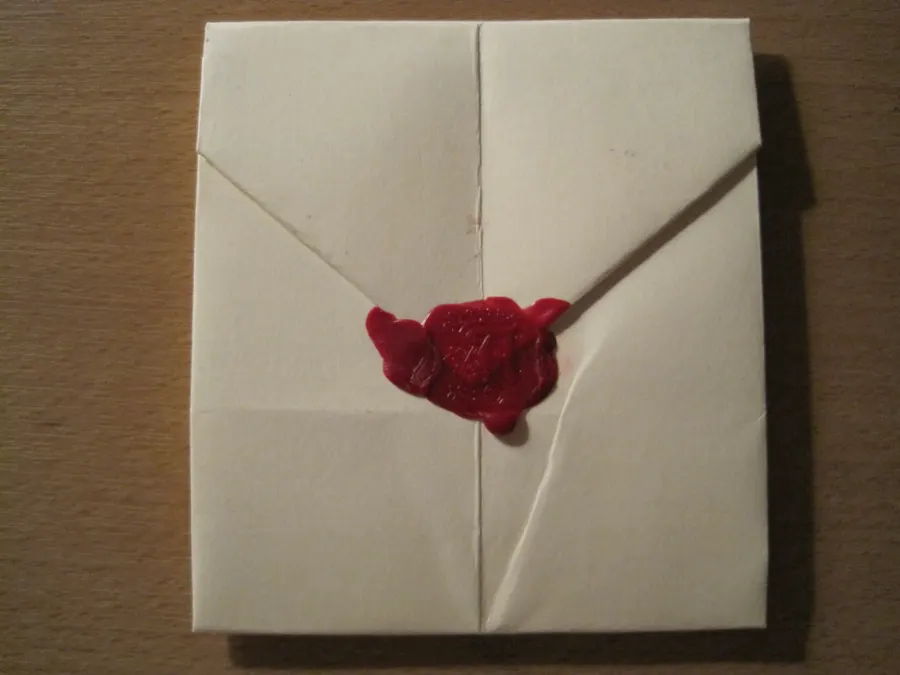
Wax seals need only a small heat source, a pea-sized piece of wax and a metal stamp. Let each seal cool fully before handling. Our wax seal guide compares beeswax with shellac sealing wax and covers whether seals survive the mail.
Modelling wax for children: beeswax turns pliable at 86–95°F (30–35°C), so a child’s warm hands can shape a thin sheet without any melting. Adults should do all melting and pouring. For homemade crayons, use pigments sold for wax or candle work. The FAO bulletin notes that ordinary paint pigments often do not dissolve in wax and that food coloring leaves residues.
Batik and Pysanky: Beeswax as a Dye Resist
Melted wax blocks dye wherever it sits, which makes it a resist. Bogdanov’s table of beeswax uses lists batik textiles and resist engraving for this reason. In batik, wax is drawn onto cloth with a spouted tool called a tjanting or applied with a brush. The cloth is dyed, and the wax is then removed, usually by ironing it out between absorbent paper.
Pysanky, the Ukrainian Easter eggs, use the same idea on eggshells. The maker draws lines in beeswax with a small stylus called a kistka, dyes the egg from light colors to dark, adding wax between dyes, and finally melts the wax away to reveal the pattern.

Both crafts need only a little wax kept just above its melting point. Use a candle-warmed stylus or a small electric pot. Never leave a flame unattended, and practice on scrap cloth or blown eggs first.
Storing Wax and Finished Pieces
Store rendered wax in a cool, dry place. The FAO bulletin adds: never in the same room as any pesticide. Clean blocks resist wax moths, which attack comb before it is rendered. Over months, wax slowly crystallizes and hardens. The FAO says this is reversible without damage, as with crystallized honey, and the white bloom on old blocks is made of the same wax crystals. Keep candles and ornaments out of hot cars and sunny windows, since beeswax softens from about 86°F (30°C). Finished skin-care products keep for as long as their oils do.
For one popular project, see making honey soap: cold process vs melt and pour.
Frequently Asked Questions
What can I make with beeswax?
Candles, lip balm and salves, food wraps, wood polish, ornaments, wax seals, fire starters, waxed canvas, crayons and dye-resist art such as batik and pysanky. Rolled candles, lip balm and wraps are the easiest.
What temperature should I melt beeswax at?
It melts at about 144–149°F (62–65°C). Work between that point and about 176°F (80°C), and never go above 185°F (85°C), where the FAO says it starts to discolor.
Can I melt beeswax directly in a pot or a microwave?
Use a water bath instead. The FAO bulletin says wax heated directly, without water, discolors, and direct heat makes overheating and fire more likely.
What does beeswax not stick to?
Silicone releases it easily, which is why silicone molds are popular. For wood, glass or metal surfaces, the FAO suggests a coat of soapy water or diluted honey.
Can bacteria grow in beeswax products?
Pure wax, and balms made only of wax and oils, are a poor home for microbes. Creams and lotions that contain water are another matter. The FAO calls water-and-oil emulsions “an excellent environment for microorganisms,” unless a preservative is added.
How much beeswax does one hive produce?
In frame hives, about 1–2% of the honey crop, mostly as cappings. At the 2025 US average of 48 pounds of honey per colony, that is roughly 8 to 15 ounces.
Do I need FDA approval to sell homemade lip balm?
No. Cosmetics do not need FDA approval, but they must be safe and correctly labeled. Making medical claims turns a balm into a drug.
Are beeswax wraps food safe?
Beeswax is approved as a food ingredient, and wrap makers say to keep wraps away from raw meat, fish and hot food. A 2021 study found they keep food no fresher than plastic bags or wax paper.
The Bottom Line
Start with a rolled candle or a small batch of lip balm. Both teach you how beeswax behaves with almost no risk. Then move on to poured projects once you have a water bath and a thermometer. If your wax comes from your own hives, begin by rendering your cappings cleanly, since every project on this page depends on clean wax.


