
Reviewed by Daniel M. · Last Updated November 5, 2026 · How we review
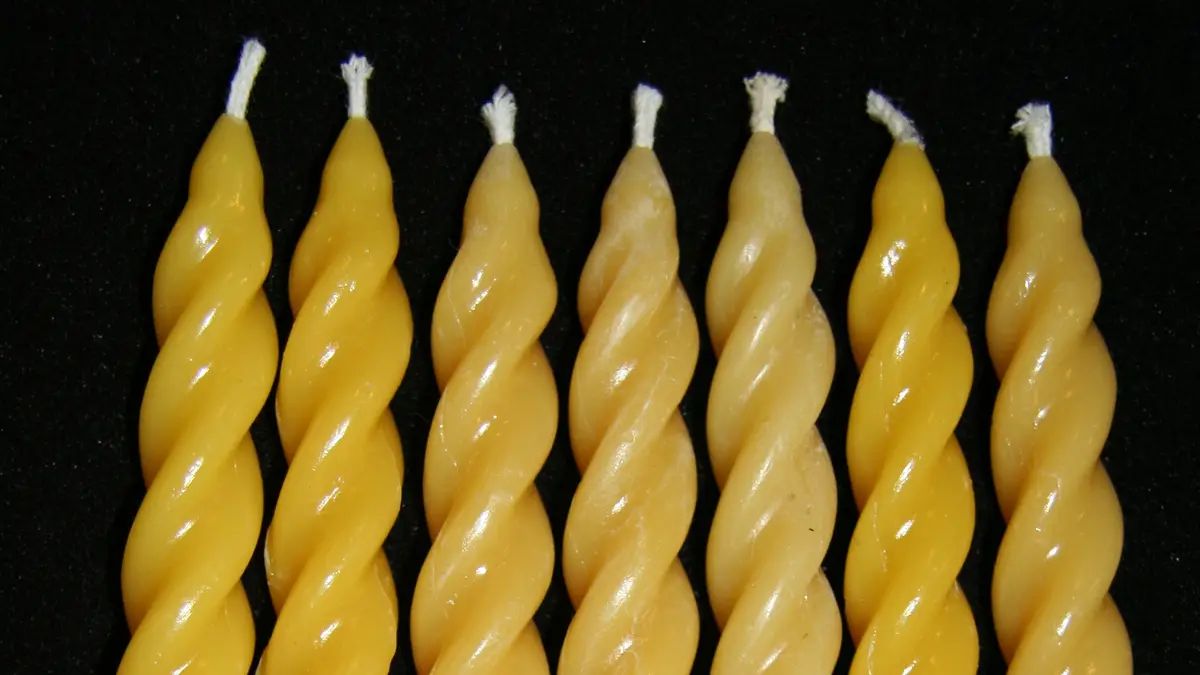
Beeswax candles are candles poured, dipped or rolled from the wax honey bees build comb with. To make them from your own hive, melt clean cappings wax in a water bath, keep it under 185°F, pour at about 150 to 165°F, and match the wick to the candle’s width. They burn steadily and smell faintly of honey, but no study we found shows they clean the air.
Below: the method, how many candles one hive’s wax makes, what a 2026 emissions study found, and what a “100% beeswax” label is worth in the US.
Key Takeaways
- Beeswax melts at 144 to 149°F (62 to 65°C). Pour at 150 to 165°F and never heat it above 185°F (85°C).
- An average US hive’s harvest yields about half a pound to a pound of wax, enough for roughly 2 to 5 tapers.
- The wick decides how a candle burns. Start from a chart, then test-burn.
- A 2026 study found beeswax and soy candles made more ultrafine particles than paraffin. “Purifies the air” is not supported.
- No federal rule sets a minimum beeswax percentage for a “beeswax candle”.
Table of Contents
- What Makes Beeswax Candles Different
- Do They Clean the Air?
- How Many Candles Your Hive Will Make
- Clean the Cappings First
- Equipment
- Melting and Pouring Temperatures
- Choosing the Wick
- Step by Step: Poured Candles
- Tealights, Rolled and Dipped Candles
- Troubleshooting
- Burning Them Safely
- What the Label Means
- Frequently Asked Questions
What Makes Beeswax Candles Different
Beeswax is harder than most candle waxes and melts hotter. The FAO’s beekeeping products bulletin notes that most paraffins melt between 48 and 68°C, so beeswax candles stay straight in a warm room and, with the right wick, drip less. Unbleached wax is golden and smells lightly of honey. With time it can grow a whitish film called wax bloom, which is harmless.
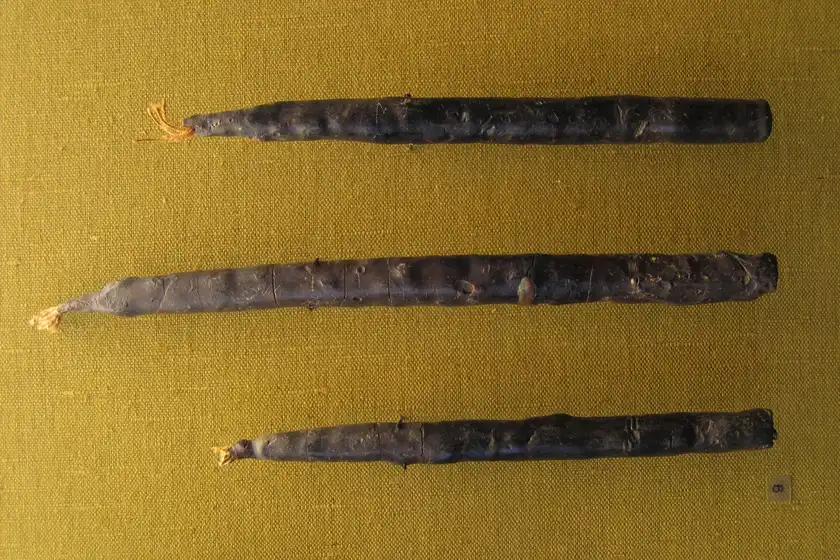
Until cheaper petroleum waxes such as paraffin took over, beeswax and the cheaper tallow were the main candle materials.
In this video from Bob Binnie’s Blue Ridge Honey Company, a Georgia beekeeping business, Pamela shows the molds, square-braided wicks and melter they use for the candles they sell. She pours between 155 and 165°F, warns that hotter wax causes sinkholes and bubbles, and levels wobbly bases on a hot plate lined with parchment.
Do They Clean the Air?
The most repeated claim about beeswax candles is that they release negative ions that clean the air. We found no study showing this. The newest direct measurement points the other way: in 2026, researchers at Georgia Southern University burned three paraffin, two soy and one beeswax candle in a sealed, unventilated room.
“Natural candles, particularly those containing soy and beeswax and multiple or wooden wicks, may promote unstable combustion and enhanced ultrafine particle formation.”
Paraffin gave off more of the larger particles. Only one beeswax candle was tested, so treat this as a warning sign, not the final word. For the full wax comparison, see beeswax vs paraffin vs soy wax.
| Claim | What we found | Source |
|---|---|---|
| “Purifies the air” | No study found. Beeswax candles emit ultrafine particles too. | Crunkelton et al., 2026 |
| “Burns without soot” | Any candle soots when the flame is disturbed. Trim the wick; avoid drafts. | National Candle Association |
| “No formaldehyde” | In a 2002 lab test, beeswax and soy fumes showed formaldehyde peaks similar to or slightly above the blank; paraffin had small amounts. | Rezaei, Wang and Johnson, JAOCS, 2002 |
| “Burns longer than paraffin” | Plausible, since it melts hotter, but we found no independent burn-time test. | FAO |
How Many Candles Your Hive Will Make
Backyard candle wax mostly comes from cappings, the wax lids you slice off frames at harvest. Howland Blackiston, author of Beekeeping For Dummies, estimates one or two pounds of wax per 100 pounds of honey. USDA NASS put the 2025 US average at 48.0 pounds of honey per colony. That is about 0.5 to 1 lb of wax per hive, before rendering losses.
One pound of solid beeswax fills about 16 fluid ounces, using the FAO’s density of about 0.96 g/cm³.
| Candle | Wax each | Per pound | Per average hive |
|---|---|---|---|
| Taper, 7/8 by 10 in | 95 g (3.4 oz) | 4.8 | 2.3 to 4.6 |
| Pillar, 2 by 3 in | 148 g (5.2 oz) | 3.1 | 1.5 to 2.9 |
| 8 oz jar filled to 7 fl oz | 199 g (7.0 oz) | 2.3 | 1.1 to 2.2 |
| Pillar, 3 by 6 in | 667 g (1.5 lb) | 0.7 | 0.3 to 0.7 |
Our calculation: cylinder volume times 0.96 g/cm³; hive range from 48.0 lb of honey at 1 to 2 lb of wax per 100 lb.
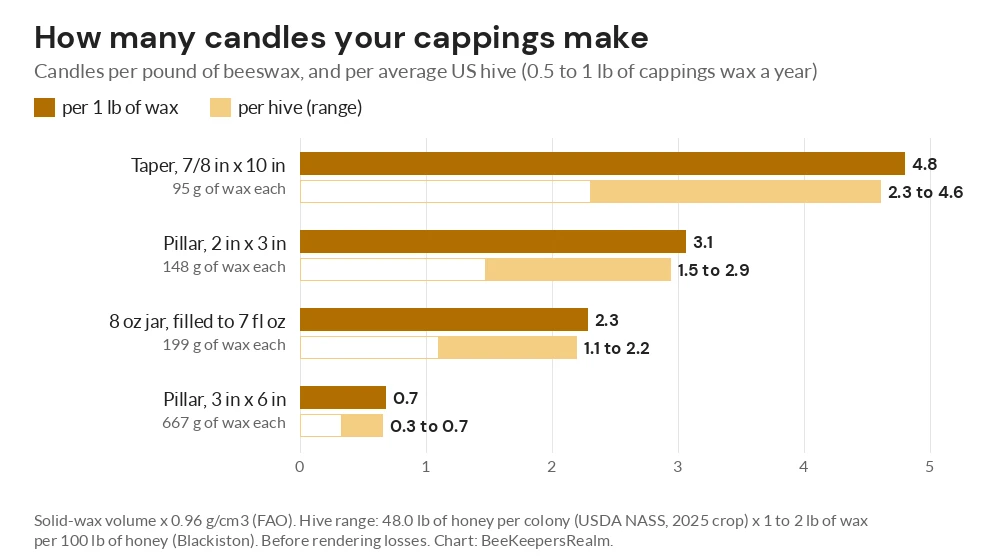
So one hive gives a few candles a year. Saving cappings over two or three seasons helps. For small batches, see our beeswax crafts guide.
Clean the Cappings First
The FAO says candle wax must be extremely clean and free of propolis and pollen, or the candle will sputter and can spit hot wax. Pale cappings are the best start; dark brood comb holds cocoons, as our comparison of cappings wax vs brood comb wax explains.
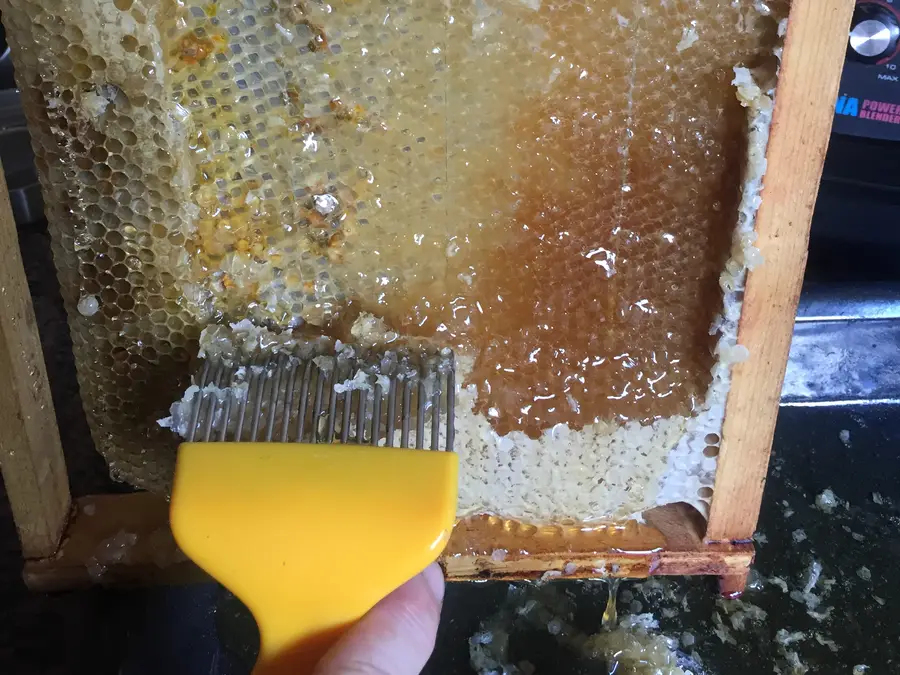
Rinse the cappings in cool water, melt them in water, let the block set and scrape the dirty layer off its base, then remelt and strain through fine cloth. Our guide to rendering cappings wax cleanly has the details, and these purification methods help with stubborn wax. A solar wax melter does the first melt for free in summer.
Equipment
- A double boiler or pouring pitcher in a pot of water. The FAO recommends stainless steel or glass; iron, copper and plain steel discolor wax.
- A thermometer.
- Wick, wick tabs or a wicking needle, and bobby pins or craft sticks to center it.
- Molds, heat-safe jars or tealight cups, and mold release for rigid molds.
- Fine cloth for straining and a lid that fits the melting pot.
Melting and Pouring Temperatures
Heat wax only in water. Direct heat scorches it, and the FAO calls beeswax “highly flammable”. A double boiler keeps wax near or below the boiling point of water, which is still above the safe limit, so watch the thermometer.
“Wax should never be heated above 85 °C.”
| Stage | Temperature | Source |
|---|---|---|
| Wax melts | 144 to 149°F (62 to 65°C) | FAO |
| Pour | 150 to 160°F | Betterbee |
| Pour | 155 to 165°F | Blue Ridge Honey Co. |
| Upper limit | 185°F (85°C); hotter wax discolors | FAO |
Choosing the Wick
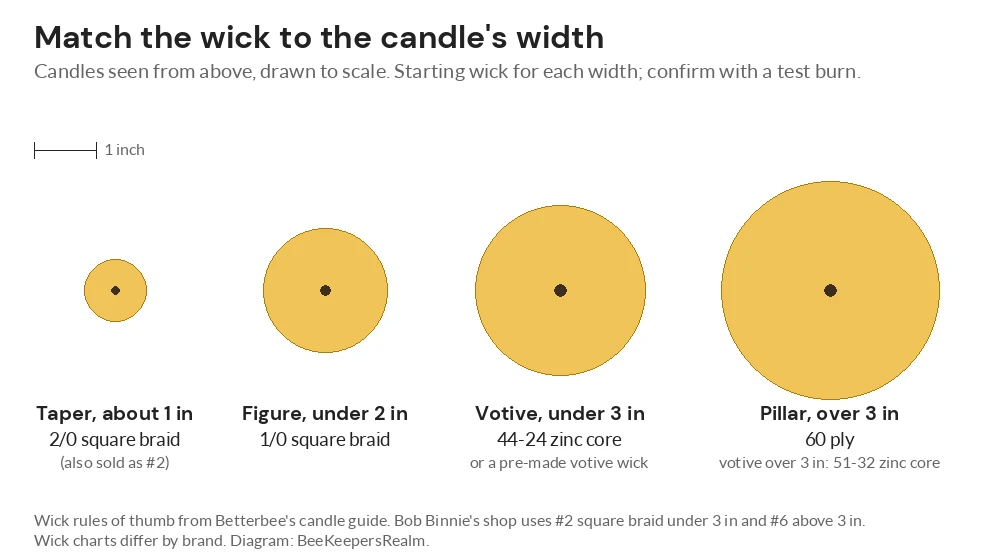
Thicker candles need thicker wicks, and the FAO says the exact ratio “should be determined by experiment”. These starting points come from Betterbee’s basic guide to beeswax candles:
| Candle | Starting wick |
|---|---|
| Taper, about 1 in wide | 2/0 square braid (or #2) |
| Figure under 2 in | 1/0 square braid |
| Votive under 3 in | 44-24 zinc core, or a pre-made votive wick |
| Votive over 3 in | 51-32 zinc core |
| Pillar over 3 in, or figure over 2 in | 60 ply |
Binnie’s shop keeps it simpler: #2 square braid under 3 inches, #6 above. Lead-core wicks have been banned in the US since 2003.
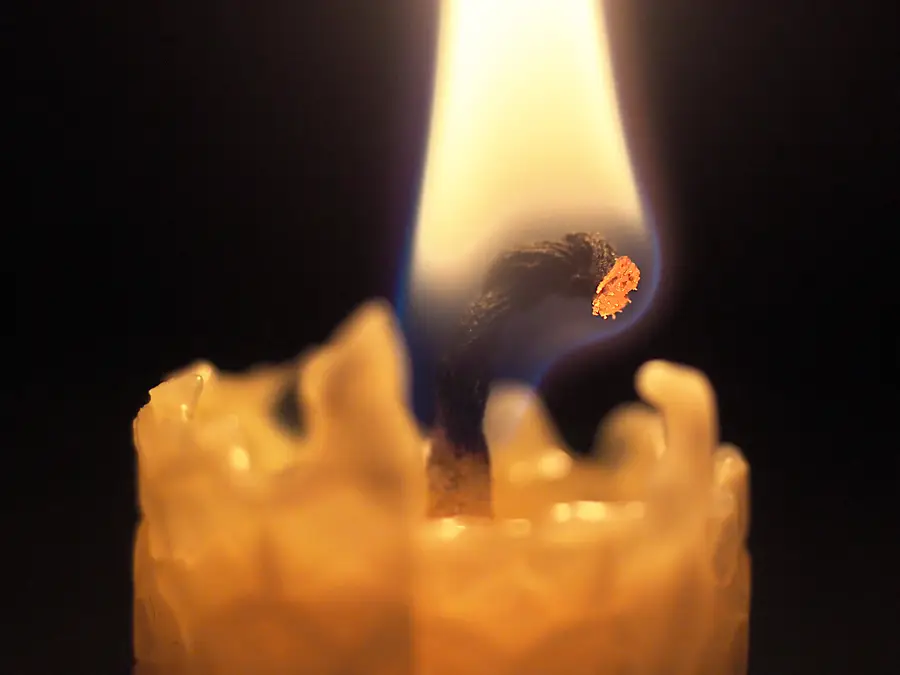
Test-burn each new size for a few hours. Too small a wick drowns and tunnels; too large smokes and flickers.
Step by Step: Poured Candles
- Wick the mold, center the wick and pull it snug. Spray rigid molds with release.
- Melt clean wax in the water bath.
- Let it cool to 150 to 165°F.
- Pour slowly and steadily toward the center.
- Cool at room temperature, away from drafts. Betterbee says tealights set in 30 to 45 minutes and molded candles take 1 to 1.5 hours at 60 to 70°F.
- Top up any sinkhole with a little hot wax.
- Unmold, level the base and trim the wick to ¼ inch.
Tealights, Rolled and Dipped Candles
Tealights and jars
Fix a pre-tabbed wick to the bottom of the cup or jar. Container candles are the hardest to wick, so test one before pouring a batch.
Rolled candles
Roll a wax sheet tightly around a primed wick. The FAO calls it “a very clean and simple process”, and it needs no melting.
Dipped tapers
Dip a wick into a tall pot of melted wax, let each layer set, and repeat until the taper is thick enough. Drape one wick over a stick to dip a pair at once.
Troubleshooting
| Problem | Likely cause | Fix |
|---|---|---|
| Sinkhole or bubbles | Poured too hot | Pour at 155 to 165°F; top up |
| Tunneling | Wick too small | Go up one size |
| Smoke, large flame | Wick too big or long, or a draft | Trim to ¼ inch, move it, or size down |
| Sputtering | Debris or water in the wax | Remelt and strain |
| White haze | Wax bloom | Harmless; buff it off |
Burning Them Safely
Natural wax is still an open flame. From 2020 to 2024, US fire departments responded to an average of 5,894 home candle fires a year, with 63 deaths and 532 injuries, according to the NFPA’s candle safety page. Over half began when something flammable was too close.
- Keep candles at least 12 inches from anything that can burn.
- Blow them out before you leave the room or go to sleep.
- Trim the wick to ¼ inch before each burn and stop at 2 inches of wax (½ inch in a jar), as the National Candle Association advises.
- If the melting pot catches fire, turn off the heat and slide the lid on, as the US Fire Administration advises for pan fires.
What the Label Means
If you buy beeswax candles instead, we found no US federal rule on how much beeswax they must contain. General advertising law still applies.
“Under the law, claims in advertisements must be truthful, cannot be deceptive or unfair, and must be evidence-based.”
One benchmark exists: the FAO notes that the Roman Catholic Church requires ceremonial candles to contain at least 51% beeswax. Otherwise, ask the seller for the percentage. “Made with beeswax” can mean mostly another wax.
Leftover scraps make good beeswax fire starters.
For a seasonal project, try beeswax holiday ornaments.
To see where the wax comes from, read how bees produce beeswax.
Frequently Asked Questions
What are the downsides of beeswax candles?
Cost and supply: one hive yields only about a pound of wax a year at most. Beeswax is also fussier to wick, and it still gives off particles when burned.
Are beeswax candles healthier than soy candles?
Neither has been shown to be healthy to burn. In the 2026 sealed-room study, both made more ultrafine particles than paraffin, and the beeswax candle added more lung-deposited particle surface area than soy.
Do beeswax candles purify the air?
No. We found no study showing they remove pollutants or release air-cleaning negative ions.
How many candles does 1 pound of beeswax make?
About five 10-inch tapers, three 2-by-3-inch pillars, or two 8-ounce jars.
Can you add coconut oil to beeswax candles?
Yes. Some recipes, such as Mommypotamus’s, add coconut oil to help scent last. Re-test the wick, and note the candle is no longer pure beeswax.
Can I use dark wax from old brood comb?
You can, but it needs heavy filtering. Pale cappings are easier, because debris makes candles sputter.
The Bottom Line
Beeswax candles reward care more than gear: clean wax, a water bath, a thermometer and a test-burned wick. Expect a few per hive each year, and make them for the scent and steady flame, not for clean air.
Image credits: featured photo of spiral beeswax tapers by Jonathunder, via Wikimedia Commons, CC BY-SA 3.0, cropped. Other credits are in the captions.


