

Reviewed by Thomas B. · Last Updated October 13, 2026 · How we review
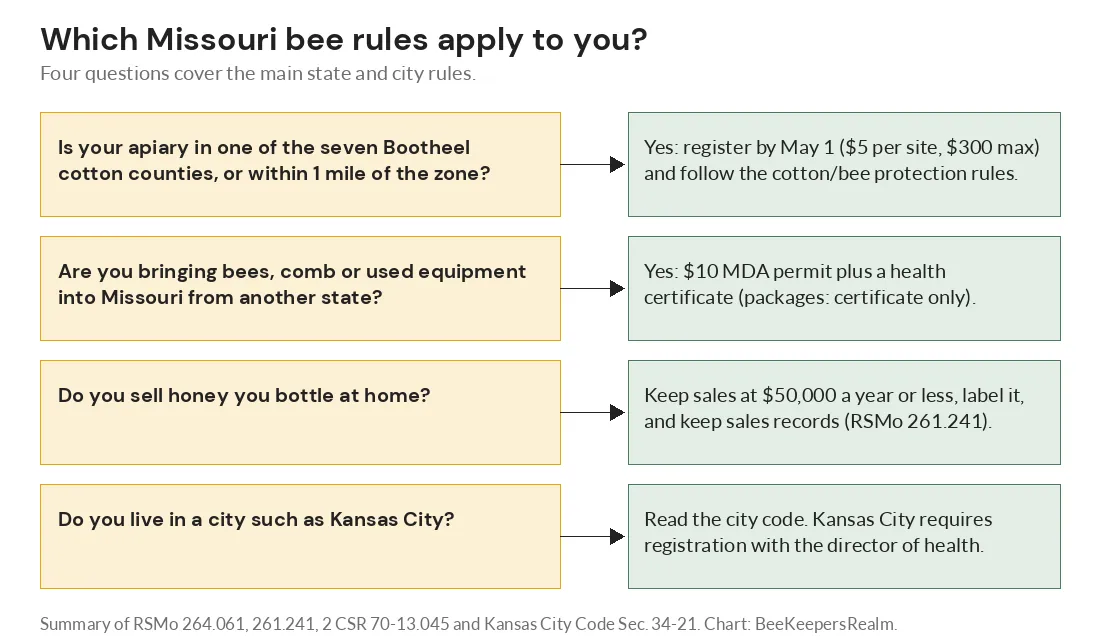
No, most Missouri beekeepers do not have to register their hives, and there is no state beekeeping license or fee. Three rules can still apply: apiaries in seven Bootheel cotton counties must be registered by May 1 ($5 per location, $300 maximum); bees or used equipment brought into Missouri need a $10 permit and a health certificate; and Kansas City requires every beekeeper to register with its director of health. The Missouri Department of Agriculture inspects hives on request for $5 (up to five colonies, plus mileage), and you can bottle and sell honey at home if sales stay at $50,000 a year or less.
Legal note: This is educational information, not legal advice. We checked every rule below against official text on October 13, 2026: the Missouri Apiculture Law, RSMo Chapter 264, the Code of State Regulations and city codes. Confirm with the Department of Agriculture or your city clerk before you act.
Key Takeaways
- Missouri’s bee law (RSMo 264.011 to 264.101) has no registration section; BeeCheck is a voluntary pesticide-warning map, not a legal registry.
- The Bootheel rule, 2 CSR 70-13.045, belongs to the boll weevil (cotton) eradication program, not to Africanized bee control.
- Bees, comb and used equipment entering Missouri need a $10 permit and a health certificate (RSMo 264.061).
- Kansas City Code Sec. 34-21 requires registration of every apiary and a name label on every hive.
- Breaking the state bee law is a class A misdemeanor (RSMo 264.101).
Table of Contents
- What the Missouri Apiculture Law Requires
- The Bootheel Exception: Registration in Cotton Country
- Bringing Bees or Used Equipment Into Missouri
- Who Inspects Hives in Missouri, and What It Costs
- City Ordinances: Kansas City and Your Own Town
- Selling Honey in Missouri
- Missouri Beekeeping Rules at a Glance
- Frequently Asked Questions
What the Missouri Apiculture Law Requires
The Missouri Apiculture Law (RSMo 264.011 to 264.101, passed in 1978) is a disease and pest law. It lets the director of agriculture inspect bees, quarantine infected apiaries and control what enters the state, targeting foulbrood, tracheal and varroa mites and the Africanized honey bee. Our history of American foulbrood laws explains where laws like this came from.
The chapter has no registration requirement, license or yearly fee. Two online claims do not hold up. RSMo 265.020, sometimes cited for registration, covers grading standards for farm products. And the Department of Agriculture’s Plant Pest Control page lists no state registry; it points beekeepers to BeeCheck and DriftWatch, free maps that show pesticide applicators where hives are (see our guide to DriftWatch and BeeCheck).
The law still has teeth: violating it, or forging or misusing a certificate, is a class A misdemeanor, punishable in Missouri by up to one year in jail and a fine of up to $2,000.
The Bootheel Exception: Registration in Cotton Country
Missouri requires apiary registration in one corner of the state, because of cotton. Rule 2 CSR 70-13.045 sits in the chapter titled “Boll Weevil Eradication” and was issued under RSMo 263.505, which lets the department regulate the “location of honeybee colonies” in areas treated for boll weevil. Cotton growers approved the program by referendum in 2000, and a ten-year referendum in 2019 keeps it funded, according to the Department of Agriculture.
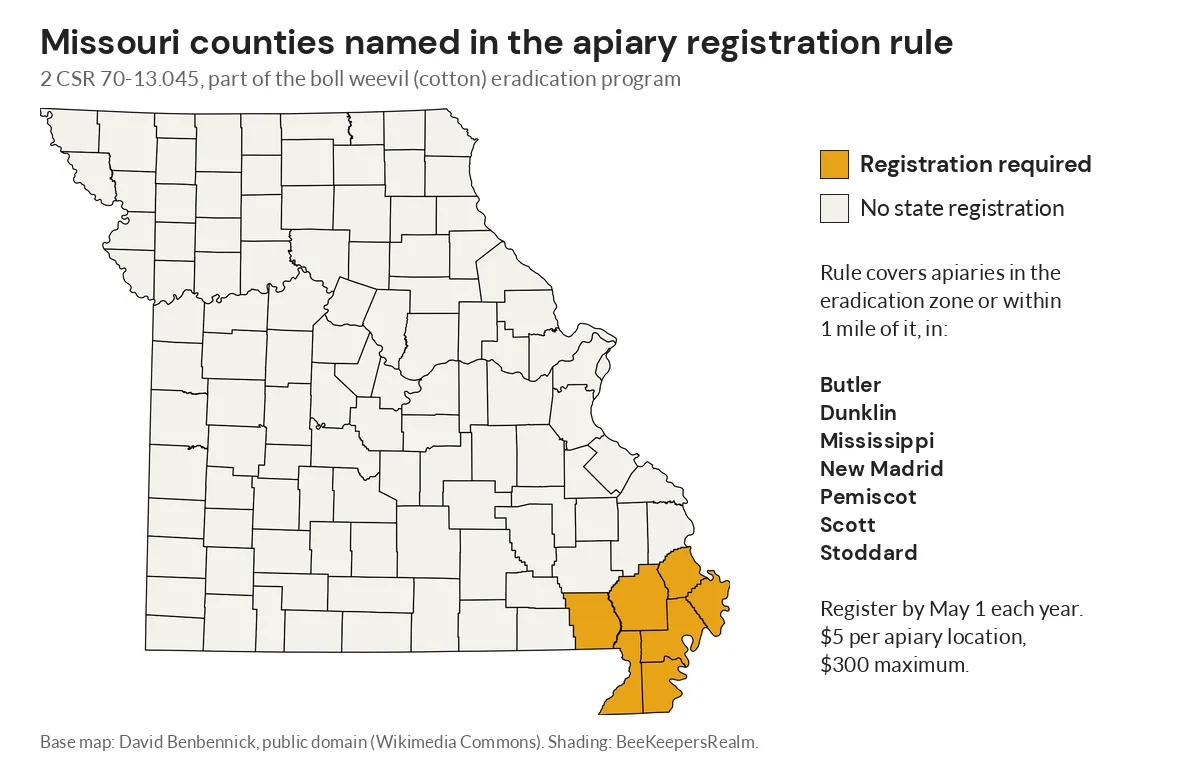
If your apiary is in the eradication zone, or within one mile of it, in Butler, Dunklin, Mississippi, New Madrid, Pemiscot, Scott or Stoddard County, you must:
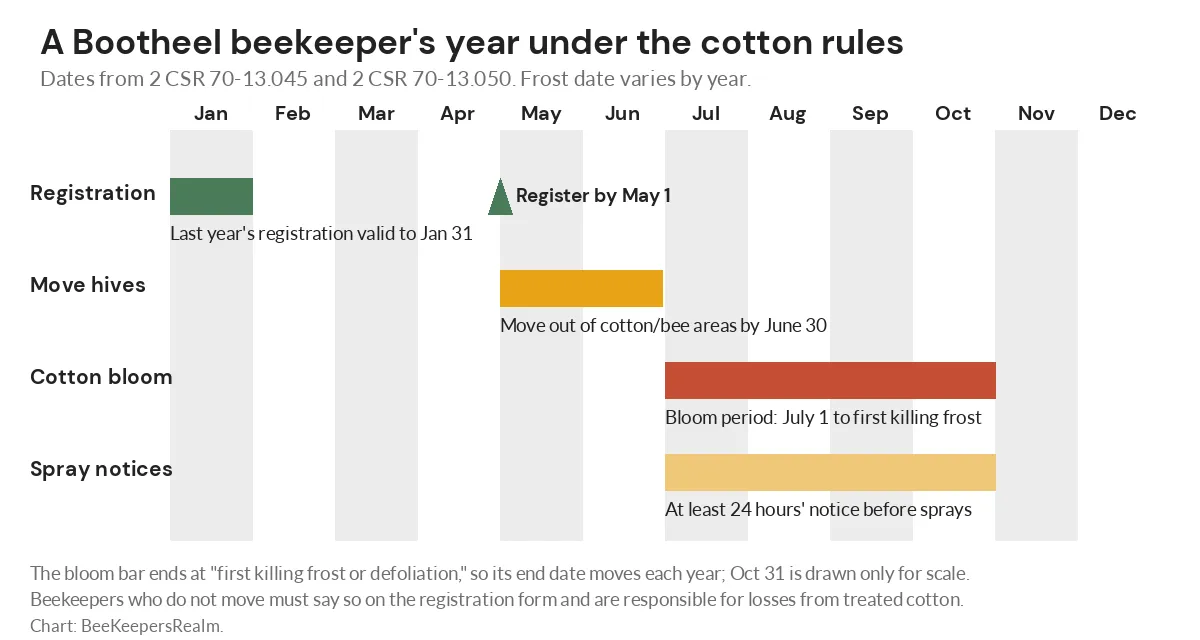
- Register each location with the Department of Agriculture by May 1 every year, or before moving bees in later. The fee is $5 per location, $300 maximum, and registration runs to January 31.
- Give GPS coordinates for every apiary and update them as soon as you move; wrong coordinates void the registration.
- At apiaries away from your home, post a sign with your name, address and phone number, and mark each hive with your name or brand.
- File the landowner’s written approval for land you do not own or lease.
Registering a site without active hives, or not reporting within 24 hours that one is no longer used, can cost up to $500 per location.

The cotton/bee protection rule
Rule 2 CSR 70-13.050 covers spraying season. Land inside a cotton field, or within one mile of planted cotton, is a “cotton/bee protection area” during bloom, from July 1 until the first killing frost or defoliation. Notified beekeepers must move apiaries out before June 30. If you stay, you must say so on your registration form, you are advised to confine your bees as described in University of Missouri publication G7600, and you get at least 24 hours’ notice before each spray. The rule is blunt about the risk:
“Beekeepers not moving apiaries will be responsible for losses caused by bees foraging on treated cotton…”
Bringing Bees or Used Equipment Into Missouri
Hobbyists meet this rule most often, when buying nucs or used boxes out of state. RSMo 264.061 makes it unlawful to bring bees, combs or used beekeeping equipment into Missouri without a permit from the director of agriculture.
“Anyone desiring to move bees or used beekeeping equipment into the state, must contact the State Entomologist to obtain an application for the necessary permit.”
The application costs $10, lists the number of colonies and where they will be kept, and must include a certificate of health from an official in the state of origin. That certificate must show an inspection during active brood rearing within 90 days before the move. Combless packages and queens need no Missouri permit if they travel with an inspection certificate from their home state. Colonies returning to Missouri within 90 days can get a permit without a new inspection. Shipping bees out? The destination state’s rules apply; neighboring Kansas, for example, repealed its bee law in 2002.
Who Inspects Hives in Missouri, and What It Costs
The Department of Agriculture’s Plant Pest Control Program, (573) 751-5505, runs inspections with inspectors who must be practical beekeepers or apiculture-trained graduates (RSMo 264.031).
Requested inspections: under 2 CSR 70-15.015 the fee is $5 for five colonies or fewer, 50 cents for each extra hive opened, plus mileage. Under 2 CSR 70-15.025, every hive is opened in yards of 1 to 15 colonies, while yards of 16 to 99 are sampled 15 at a time unless more than 2% are diseased. A clean result earns a certificate of health valid for 90 days (RSMo 264.051).
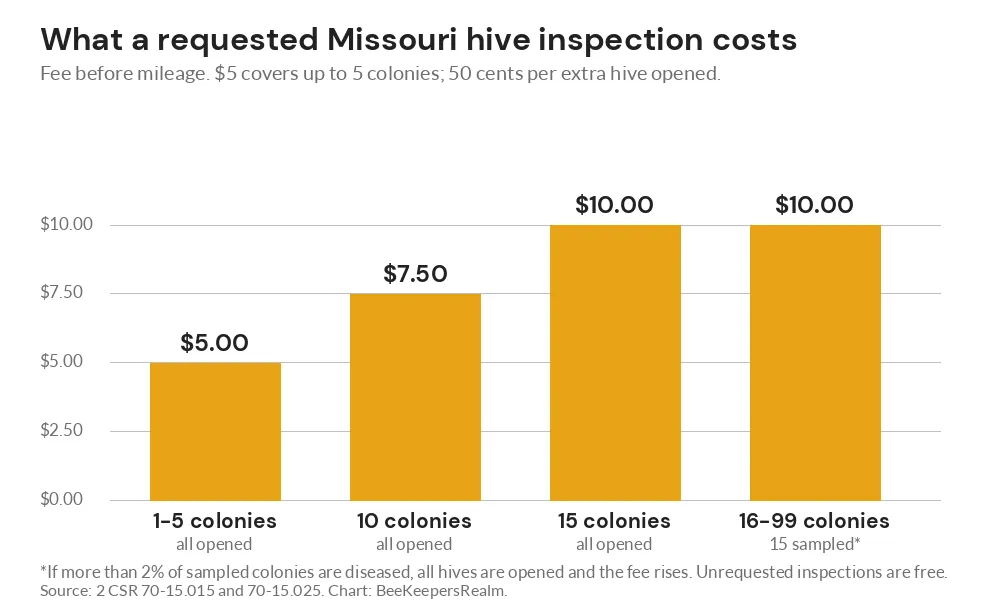
Unrequested inspections are free but need probable cause, such as disease within two miles, and written notice. After notice you may not move hives or equipment for 30 days or until results arrive, whichever is first. Infected apiaries can be quarantined, and if the problem remains at the next inspection, within a year, the director supervises eradication. Compare other state bee inspector programs.
Do Missouri hives need removable frames?
Missouri defines a hive as “any domicile with removable frames for keeping bees” (RSMo 264.021), and bees in box hives count as impossible to inspect. That is not an outright ban. Under 264.041 you may first make the brood reachable; only if you refuse can the director order the colonies moved into removable-frame hives within six months, and destroy them if the order is ignored. A Langstroth or top-bar hive avoids the issue.
City Ordinances: Kansas City and Your Own Town
Most Missouri beekeeping rules live in city codes. Sec. 34-21 of the Kansas City Code requires every beekeeper to register each apiary with the director of health, giving addresses, phone numbers, the number of hives and a location precise enough for a verification visit. Each hive must show the beekeeper’s name, addresses and phone numbers, legible in daylight at ten feet. Beekeeping that causes “unnecessary annoyance” to neighbors is a nuisance. The section sets no hive limit, setback or fee. Kansas City, Kansas, across the state line, has its own code.
Ellisville, in St. Louis County, has posted its 2022 Bill No. 3756, which amends Section 205.450 to require a city beekeeping permit; the section also sets a 10,000-square-foot minimum lot and a six-foot sight-proof fence between hives and any walkway. Confirm the adopted text with the city clerk. We could not reach the official beekeeping text for St. Louis, Springfield or Columbia online on October 13, 2026, so we do not quote their limits here. Ask your clerk, and check HOA covenants; see beekeeping and HOAs and how close hives can be to neighbors.
Selling Honey in Missouri
Honey has its own statute. Under RSMo 261.241, as amended by Senate Bill 500 in 2015, sellers with $50,000 or less in yearly honey sales per domicile need no separate bottling facility and are exempt from the remaining honey-bottling health rules if they bottle in the harvester’s home, label the honey with the preparer’s name and address, the common name and all ingredients, and keep sales records. Honey is not covered by Missouri’s cottage food law, RSMo 196.298, which lists baked goods, jams and jellies, and dried herbs. Eugene Makovec of Three Rivers Beekeepers, a club that pushed for the 2015 change, summed up the result:
“Beekeepers can now sell honey either direct to consumer or via third-party retailers without having to bottle in an inspected kitchen.”
Honey sold at a farmers’ market is also exempt from state and local sales tax under RSMo 144.527, for sellers with less than $25,000 a year in market sales. City business licenses can still apply. See how to start selling honey legally and selling raw honey at farmers markets.
Missouri Beekeeping Rules at a Glance
| Rule | Who it covers | What it requires | Source |
|---|---|---|---|
| Hive registration | Most of Missouri | None | RSMo 264.011 to 264.101 |
| Bootheel registration | Apiaries in or within 1 mile of the eradication zone, 7 counties | Register by May 1; $5 per location, $300 max | 2 CSR 70-13.045 |
| Cotton/bee protection | Apiaries within 1 mile of cotton in the zone | Move out by June 30 or accept spray losses | 2 CSR 70-13.050 |
| Bringing bees in | Bees, comb, used equipment | $10 permit plus health certificate | RSMo 264.061 |
| Requested inspection | Any beekeeper | $5 up to 5 colonies, 50 cents per extra hive, plus mileage | 2 CSR 70-15.015 |
| Kansas City | Beekeepers in city limits | Register apiaries; label hives | KC Code Sec. 34-21 |
| Honey sales | Sellers at or under $50,000 a year | Bottle at home, label, keep records | RSMo 261.241 |
| Penalty | State bee law violations | Class A misdemeanor | RSMo 264.101 |
Frequently Asked Questions
Do I need to register my beehives in Missouri?
Only in or within one mile of the boll weevil eradication zone in the seven Bootheel counties, or where your city requires it, as Kansas City does.
Do you need a license to keep bees in Missouri?
No. Missouri issues no beekeeping license. You need a permit only to bring bees, comb or used equipment into the state.
How much does a Missouri hive inspection cost?
$5 for up to five colonies, 50 cents per additional hive opened, plus mileage. Inspections the state starts itself are free.
Can I sell honey from home without a commercial kitchen?
Yes, if you bottle at home, label it, keep sales records and sell $50,000 or less a year.
Are bees allowed in Kansas City, Missouri?
Yes. There is no hive limit, but you must register each apiary and label every hive.
The Bottom Line
Check your city code first, get a permit before buying bees from another state, and register by May 1 in the Bootheel cotton counties. For other states, see our U.S. beekeeping regulations by state.



.jpg)