

Reviewed by Elena P. · Last Updated October 13, 2026 · How we review
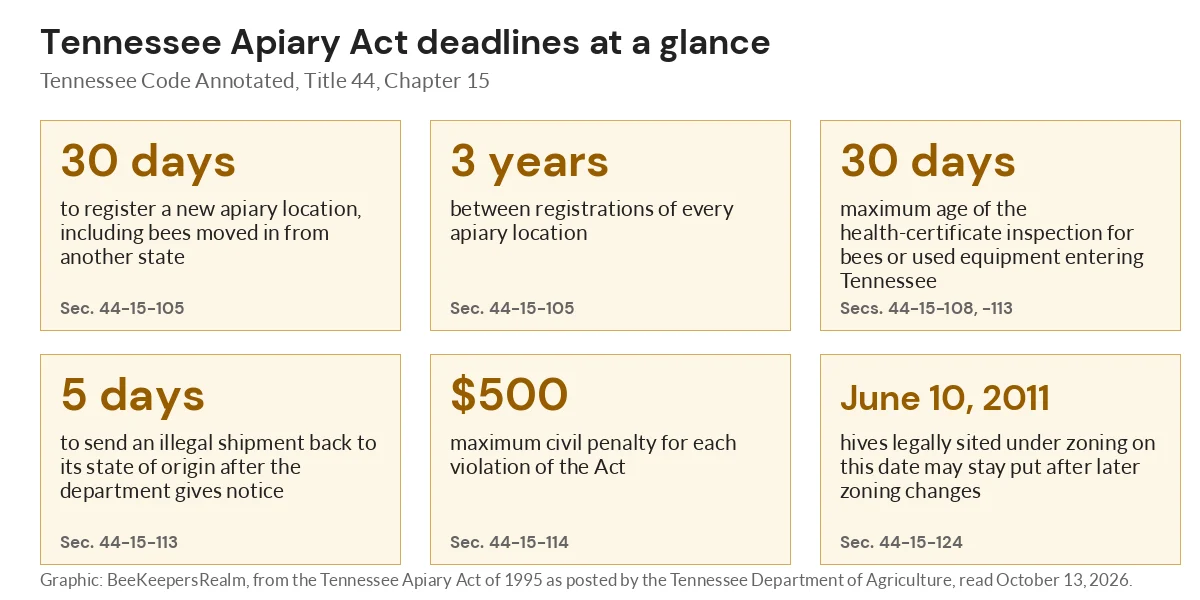
Yes, Tennessee requires you to register your bees. Under the Tennessee Apiary Act, anyone with even one colony must register each apiary location with the Tennessee Department of Agriculture (TDA) within 30 days of setting it up and every three years after that. No fee is listed. Every hive needs movable frames, and state apiary inspectors may enter any property to inspect bees. Cities cannot ban hives, but they can zone them.
Educational information only, not legal advice. Confirm current rules with the Tennessee Department of Agriculture and your city or county before you act. Sources checked October 13, 2026.
This guide works from the statute itself, Tennessee Code Annotated Title 44, Chapter 15, and the codes of Tennessee’s four largest cities. For other states, see our overview of beekeeping regulations by state.
Key Takeaways
- Register each apiary location with TDA within 30 days of setting it up, then every three years (T.C.A. § 44-15-105).
- A registered beekeeper who follows the Act and runs the apiary reasonably is not liable for injury or damage caused by the bees, barring gross negligence or intentional wrongdoing (§ 44-15-125).
- Violations carry a civil penalty of up to $500 each, and TDA pays no indemnity for unregistered colonies destroyed for disease.
- Cities may not ban compliant hives (§ 44-15-124) but can zone them. Memphis allows 2 to 8 colonies by lot size; Nashville’s Metro Code has no beekeeping section.
- Honey made and packed at home can be sold in Tennessee without a license under the Food Freedom Act, with a required label statement.
Table of Contents
- How to Register Your Bees
- What the Apiary Act Requires of Every Hive
- The Liability Shield for Registered Beekeepers
- Penalties and Indemnity
- City Rules: Memphis, Knoxville, Chattanooga, Nashville
- Bringing Bees Into Tennessee or Selling Colonies
- Selling Honey in Tennessee
- Who to Contact
- Frequently Asked Questions
- The Bottom Line
How to Register Your Bees
Section 44-15-105 of the Tennessee Apiary Act of 1995 covers every beekeeper “owning one (1) or more colonies of bees.” There is no hobbyist exemption. New locations, including apiaries stocked with bees brought in from another state, must be registered within 30 days.
“Please remember that by law all honey bee colonies in the state of Tennessee are required to be registered with this office.”
Register through the online form linked from TDA’s registration page. Its first screen asks for your name, address, phone, email and the apiary’s latitude and longitude. Paper cards are available from TDA, county Extension offices and local beekeeping associations; for help, TDA lists plant.certification@tn.gov and (615) 837-5137.
Cost: neither the Act nor TDA’s page lists a fee, and the online form showed no payment step when we checked on October 13, 2026. You receive a registration number you can brand on hives and equipment. TDA also lists benefits: disease-outbreak emails, notice of aerial pesticide spraying, free inspections when you sell or move colonies, and compensation if colonies must be destroyed for American foulbrood. Our guide to state bee inspector programs compares these programs nationally.
What the Apiary Act Requires of Every Hive
Registration is only one duty. Most summaries skip the others:
| Section | Rule | In practice |
|---|---|---|
| § 44-15-106 | Movable frames | No skeps or fixed-comb boxes. The State Apiarist can order a transfer and confiscate bees left in place. |
| § 44-15-107 | Inspections | Inspectors may enter public or private property, after a reasonable effort to notify you. |
| § 44-15-109 | Duty to report | Report a known regulated disease or pest to a state apiary inspector immediately. |
| § 44-15-110 | Quarantine | Bees may not leave a quarantined area without permission. |
| § 44-15-112 | Used equipment | Sanitize it by an approved method before selling or giving it away, unless it holds live bees. |
| § 44-15-120 | Honey handling | Keep honey-wet equipment out of reach of foraging bees. |
The reporting duty matters most for American foulbrood; our comparison of American and European foulbrood shows the field signs.

The Liability Shield for Registered Beekeepers
Section 44-15-125, added in 2011, is the best practical reason to register. A person who has registered under § 44-15-105, otherwise complies with the Act and “operates such apiary in a reasonable manner” is not liable for personal injury or property damage caused by the bees or equipment at that apiary. It does not cover intentional wrongdoing or gross negligence, and a lapsed registration or a hive without movable frames could cost you the protection.
Penalties and Indemnity
Each violation of the Act, or of an order issued under it, can bring a civil penalty of up to $500, assessed through an administrative proceeding (§ 44-15-114). TDA’s page warns that failing to register “may result in” confiscation of bees and equipment and a $500 fine. In practice, inspectors must first try to find the owner of an unregistered apiary and notify them by registered letter (§ 44-15-105(b)). The Act authorizes confiscation for hives without movable frames and illegal shipments, and confiscated colonies found heavily infested are burned (§ 44-15-117).
Indemnity for destroyed colonies is partial, depends on available funds and can be refused if the owner is in violation (§ 44-15-123). TDA is blunter: “There is no indemnity paid for the loss of unregistered bee colonies.”
City Rules: Memphis, Knoxville, Chattanooga, Nashville
“No county, municipality, consolidated government, or other political subdivision of this state shall adopt or continue in effect any ordinance or resolution prohibiting the establishment or maintenance of honeybees in hives, provided that such establishment or maintenance is in compliance with this chapter.”
The same section preserves local zoning, so cities still decide where hives go. Hives that met zoning on June 10, 2011 may stay put after later zoning changes. The statute binds governments only, not homeowners associations, so an HOA covenant can still ban bees; see our guide to getting HOA approval for beekeeping.
| City | Code section | Hive limit | Placement |
|---|---|---|---|
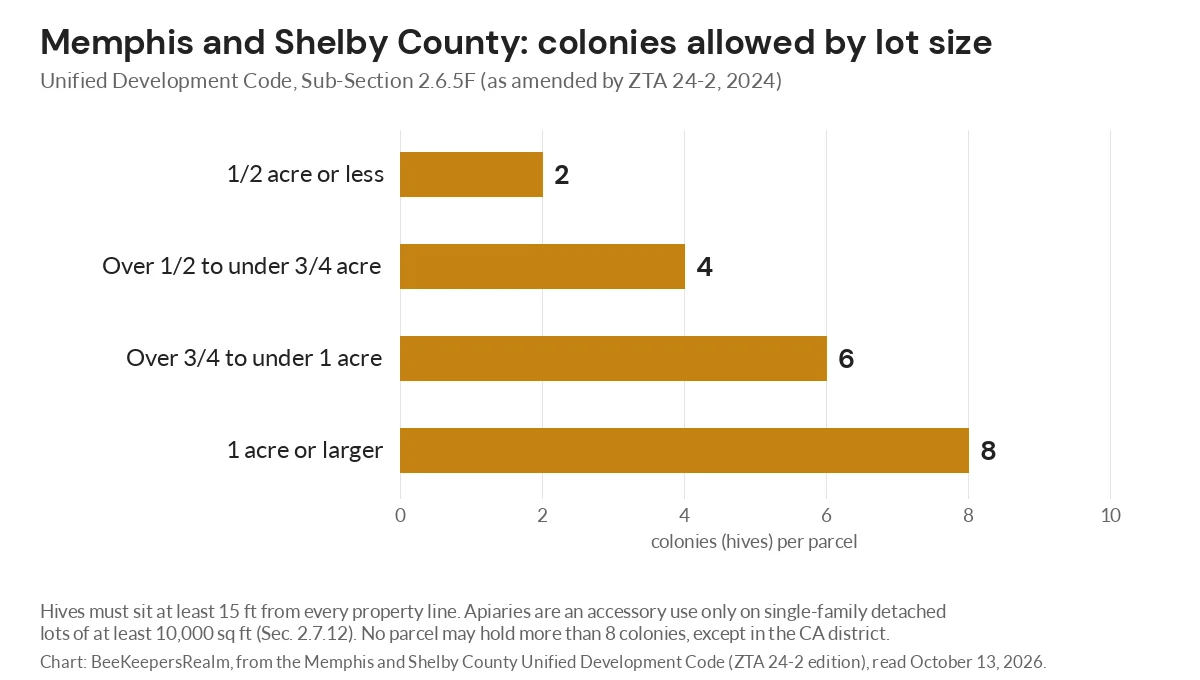
| Memphis and unincorporated Shelby County | Unified Development Code 2.6.5F, 2.7.12 | 2 to 8 by lot size | 15 ft from property lines; single-family detached lots of 10,000 sq ft or more |
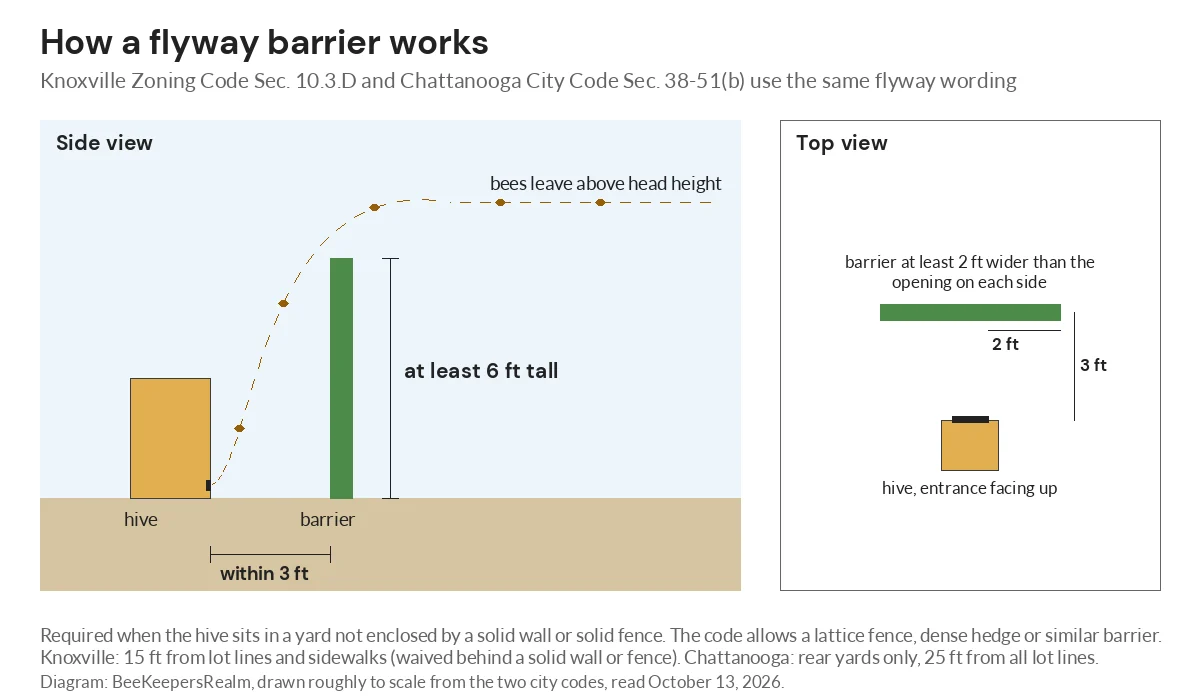
| Knoxville | Zoning Code 10.3.D | None set | Side or rear yards; 15 ft from lot lines and sidewalks unless behind a solid wall or fence; flyway barrier; water on site |
| Chattanooga | City Code 38-51(b) | None set | Rear yards only; 25 ft from all lot lines; flyway barrier |
| Nashville-Davidson County | None found | None found | State registration only |
Memphis and Shelby County
The Memphis and Shelby County Unified Development Code (ZTA 24-2 edition, 2024) allows apiaries as an accessory use on single-family detached lots of at least 10,000 square feet, or in neighborhood gardens of at least 5,000. No parcel may hold more than 8 colonies outside the CA district, and no flyway barrier is required. The acreage bands skip a lot of exactly three-quarters of an acre, so ask the planning office if that is yours.
Knoxville and Chattanooga
Both codes use identical flyway wording: unless the yard is enclosed by a solid wall or fence, a barrier at least 6 feet tall, such as lattice or a dense hedge, must stand within 3 feet of the hive opening and extend at least 2 feet past it on each side. Knoxville also requires openings to face away from the nearest neighboring lot. Our beekeeping zoning laws guide explains setbacks and flyways in general.
Nashville and other cities
We searched the Metro Nashville code (Supplement 53, current through December 2025) for bees, beekeeping, apiary, honeybees and hive and found no beekeeping provision, so Davidson County beekeepers answer to state law and general nuisance rules. Clarksville’s zoning ordinance requires beekeeping to follow state law and TDA’s “Honey Bee Best Management Policy and Practices”; that document’s old TDA link now returns an error, so ask the State Apiarist for a copy.
Bringing Bees Into Tennessee or Selling Colonies
Bringing live bees, used brood comb or used equipment into Tennessee requires a TDA entry permit (§§ 44-15-108, 44-15-113). The application needs a health certificate from the origin state showing an inspection within 30 days before transport. Loads moving into, within or through the state must be secured so bees cannot escape, inspectors may stop them to check certificates, and illegal shipments must leave within five days of notice or face confiscation. Our guide to moving bees between apiaries covers the practical side.
Inside the state, no bees may be sold or moved unless an official inspection has found them apparently free of regulated diseases and pests (§ 44-15-108(a)). TDA applies this to anyone selling colonies, nucs, packages, queens or used equipment, and registered beekeepers get that inspection free. TDA also has a form for reporting colonies moved within Tennessee for pollination.
Selling Honey in Tennessee
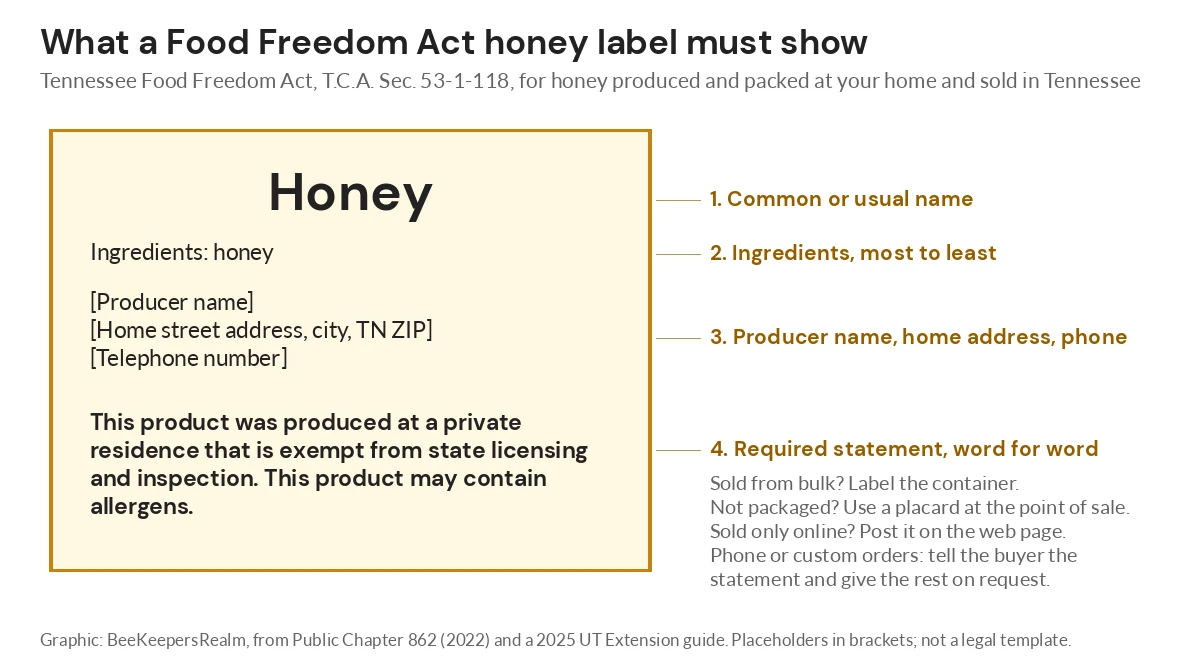
Apiary registration does not cover food sales. Home-produced honey falls under the Tennessee Food Freedom Act, T.C.A. § 53-1-118, passed in 2022 and amended effective July 1, 2025. Food produced, and packaged if packaged, at your private residence is exempt from state licensing, permitting, inspection and labeling laws, if you meet its conditions:
- Sell only within Tennessee: in person, by phone, online or through a store.
- Label it with your name, home address and phone, the food’s common name, its ingredients, and the statement shown below, word for word.
- Do not supply restaurants, food trucks or caterers, according to UT Extension’s 2025 guide.
Honey extracted or bottled away from home, such as in a shared honey house, falls outside the exemption. TDA says it cannot advise individual businesses, so check edge cases with a lawyer.
Separately, Tennessee’s standard of identity for honey, TDA Rule 0080-04-12 (2015), defines what may be sold as honey: nothing added, including water, no more than 20% moisture, and no heating that impairs quality. A floral name such as sourwood is allowed only if the honey comes mainly from that plant, and comb or chunk honey must be labeled as such. For the business side, see how to start selling honey legally.
Who to Contact
TDA lists Mike Studer as State Apiarist: (615) 517-4451, mike.studer@tn.gov. Its Apiary Inspector Staff page assigns inspectors county by county; one covers Davidson, Sumner and Wilson counties, for example. TDA also offers grants to local beekeeping associations to pay inspectors they choose, with $22,050 allocated according to its apiary page. For training, it points to UT Extension and the Tennessee Master Beekeeping Program.
The law sets a minimum, not good-neighbor practice. A UT Extension manual co-written by Studer puts it plainly:
“Some people are frightened of bees and no amount of education will allay their fears.”
Frequently Asked Questions
How much does it cost to register a beehive in Tennessee?
No fee is listed in the Apiary Act or on TDA’s registration page, and the online form showed no payment step in October 2026.
How many beehives can I have in Tennessee?
State law sets no limit. Local zoning can: Memphis and unincorporated Shelby County allow 2 colonies on half an acre or less, up to 8 on an acre or more.
Can my HOA ban beekeeping in Tennessee?
Yes. The state’s anti-ban law covers counties and cities, not private covenants.
Am I liable if my bees sting someone in Tennessee?
Not if your apiary is registered, you comply with the Act and you run it reasonably (§ 44-15-125), unless you were grossly negligent or acted intentionally.
Do I need a license to sell honey in Tennessee?
Not if you produce and pack it at home, sell only in Tennessee and use the Food Freedom Act label.
Do I need a permit to bring bees into Tennessee?
Yes. Get a TDA entry permit backed by a health certificate from an inspection within 30 days, then register the new apiary within 30 days.
The Bottom Line
Register before your bees arrive, keep every colony on movable frames, and check local zoning and any HOA covenants. Near a state line, compare the rules in Kentucky and Georgia before moving colonies across it.

.jpg)