Reviewed by Elena P. · Last Updated October 13, 2026 · How we review
No, Massachusetts does not require you to register your bees or get a state permit. Registration with the Department of Agricultural Resources (MDAR) is free and voluntary. State law still lets MDAR’s apiary inspectors enter any apiary, requires you to report disease within 48 hours, and requires two business days’ notice and a health certificate before bees come in from another state. Your city or town can require more: Boston charges a $25 registration fee and allows up to five hives per lot or roof, while Cambridge requires a permit ($50, then $25 a year) and allows two hives.
Educational information only, not legal advice. Confirm current rules with the MDAR Apiary Program and your local board of health before you act. Sources checked October 13, 2026.
This guide works from the statute, Massachusetts General Laws Chapter 128, Sections 32 to 38, the state apiary regulation (330 CMR 8.00, last amended May 13, 2022) and the local codes of Boston, Cambridge and Raynham. For other states, see our overview of beekeeping regulations by state.
Key Takeaways
- No state permit or registration is required to keep bees in Massachusetts. MDAR registration is voluntary and free, but it is the only way to get foulbrood alerts for your area.
- Every beekeeper must let state inspectors in (M.G.L. c. 128, § 36), report disease within 48 hours and mark hives and supers with a name (330 CMR 8.02 and 8.04).
- Bees, comb and used equipment entering the state need two business days’ notice to MDAR and a health certificate based on an inspection within 60 days.
- Local rules decide whether you can keep bees at all. Boston: $25 registration, five hives. Cambridge: permit, two hives. Raynham: $25 a year and proof of state registration.
- Unprocessed honey sold at a farmers market or from a home kitchen needs no board of health permit under 105 CMR 590.010. Processed or blended honey does.
Table of Contents
- Do You Have to Register Bees in Massachusetts?
- What State Law Requires of Every Beekeeper
- Inspections, Disease Reports and Foulbrood Alerts
- Bringing Bees Into or Out of Massachusetts
- City and Town Rules: Boston, Cambridge, Raynham
- Selling Honey in Massachusetts
- Who to Contact
- Frequently Asked Questions
- The Bottom Line
Do You Have to Register Bees in Massachusetts?
No. MDAR’s own registration page is explicit:
“Apiary and colony registration are highly recommended, but voluntary in the Commonwealth.”
The statute leaves room for a mandatory system. Section 32 of Chapter 128 says the state “may require by regulation” the registration of all colonies, with a fee capped at five dollars per registrant. The current regulation, 330 CMR 8.00 as amended in 2022, does not use that power: it has no registration section. MDAR’s Honey Bee FAQ adds that “a permit is not required by the state.” Several older guides, including a UMass Extension FAQ, still say you must register. That is out of date.
Why register anyway. MDAR notifies registered apiaries within 5 to 6 miles of a laboratory-confirmed case of American foulbrood. In 2026 it has confirmed cases in Rehoboth (Bristol County), South Deerfield (Franklin County) and Southwick (Hampden County). The online form asks for your name, mailing address, county, email and phone, plus a name, address, county and colony count for up to three apiaries. We saw no fee and no deadline on it on October 13, 2026.
One catch: a town can make state registration a condition of its own permit. Raynham’s Board of Health requires proof of MDAR registration before it issues a beekeeper’s permit (see the local rules below).

What State Law Requires of Every Beekeeper
Registration is optional. These duties are not, and they apply to hobbyists with one hive:
| Source | Rule | In practice |
|---|---|---|
| M.G.L. c. 128, § 33 | No fixed or cross-built comb | Use removable frames. Do not sell, give away or leave out diseased bees or equipment in a way that spreads disease. |
| M.G.L. c. 128, § 36 | Inspector access | Inspectors with credentials may enter any place where bees or bee equipment are kept. Each inspected colony gets a dated card. |
| 330 CMR 8.04(1) | Report disease | Tell the Chief Apiary Inspector within 48 hours if you find disease or Africanized honey bees. |
| 330 CMR 8.04(3)-(4) | Orders | Inspectors can order quarantine, treatment or destruction. You carry it out; if you do not, they do. |
| 330 CMR 8.03 | Robbing | Do not leave used hive parts or comb outdoors or in open buildings where bees can rob them. |
| 330 CMR 8.02(6) | Marking | Every hive and super carries the beekeeper’s or apiary’s name, inside or outside. |
| M.G.L. c. 128, § 34 | Compensation | The state pays $2 per colony destroyed by an inspector. |
| M.G.L. c. 128, § 38 | Penalties | Violating § 33 or § 35: up to $30, then $75, then $150 for each later violation. |
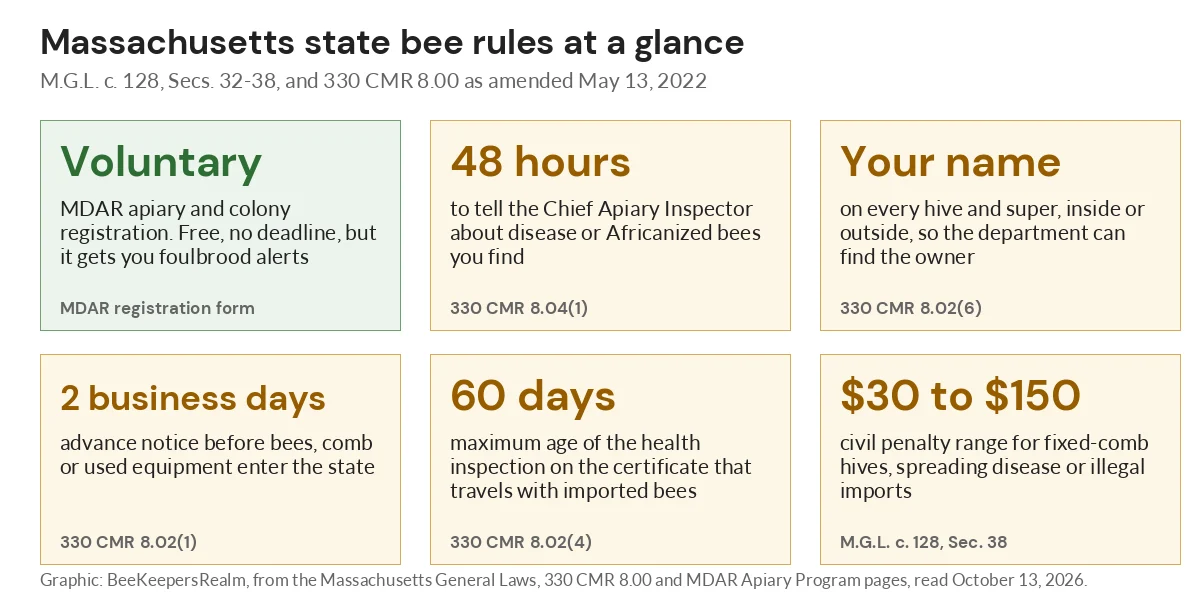
The program behind these rules is sizable. MDAR estimates 6,000 to 6,500 beekeepers manage 40,000 to 45,000 colonies in the state and produce about 1.5 million pounds of honey a year.
Inspections, Disease Reports and Foulbrood Alerts
Section 32 requires a full-time Chief Apiary Inspector; MDAR’s program lists a chief inspector plus full-time inspectors around the state. The right of entry is written into the statute:
“No owner, renter, or keeper of beehives, used bee equipment, or places where bees have lodged, shall refuse or obstruct entry of the inspector or his assistants to any such place for inspection and for disease control purposes.”
You can also ask for an inspection through MDAR’s online request form. MDAR prefers at least 30 days’ notice and limits requests to one per apiary per season, except emergencies such as suspected American foulbrood, a pesticide kill or sudden colony death. Our comparison of American and European foulbrood shows what to look for, and when to call an apiary inspector covers the judgment call. For how Massachusetts compares with other states, see our guide to state bee inspector programs.
MDAR does not remove swarms or colonies from buildings, and it does not handle complaints about a neighbor’s hive. Those go to your city or town.
Bringing Bees Into or Out of Massachusetts
Most new Massachusetts beekeepers buy packages or nucs from other states, so this section matters more than registration. Under 330 CMR 8.02 and M.G.L. c. 128, § 35:
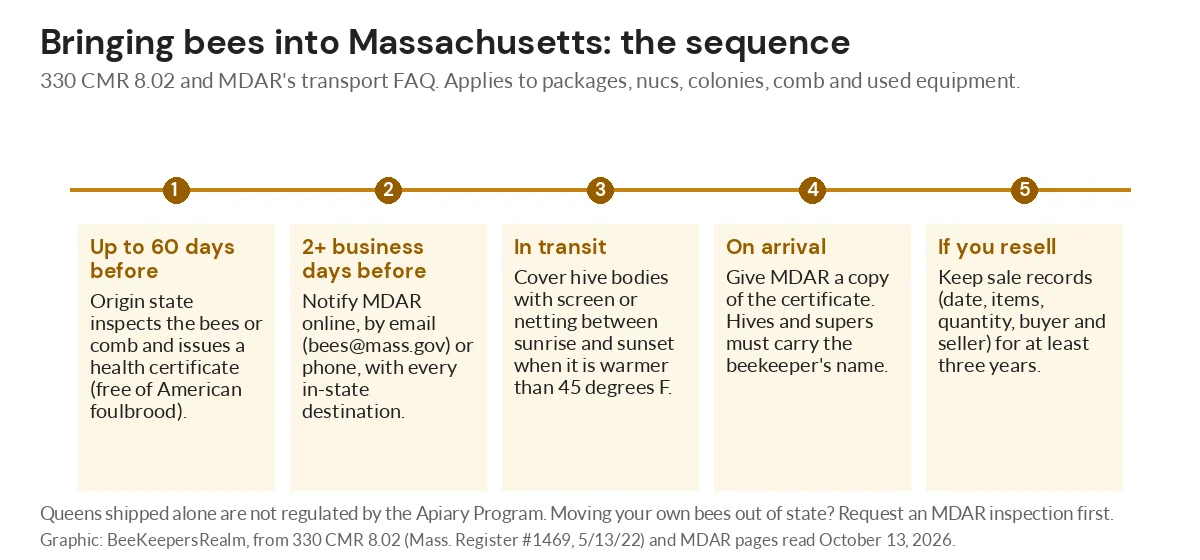
- Notice: tell MDAR at least two business days before any colony, package, nuc, comb or used equipment enters the state, with each in-state destination. Use the online shipment notification form, bees@mass.gov or (508) 281-6784.
- Certificate: the shipment must travel with a health certificate from the state of origin, based on an inspection within 60 days, showing at least that it is free of American foulbrood. Send MDAR a copy.
- Transit: cover hive bodies with screen or netting between sunrise and sunset when it is above 45°F.
- Resale: anyone selling imported bees or used equipment keeps sale records for three years.
Queens shipped on their own are not regulated, MDAR’s transport FAQ says. Section 35 lets MDAR charge an import fee (never on five or fewer hives at a time, capped at $250 a year), but the 2022 regulation sets none. Moving your own bees out of state? Most destination states want a certificate, so request an MDAR inspection first. Our guide to moving bees without spreading disease covers the practical side.
City and Town Rules: Boston, Cambridge, Raynham
MDAR’s FAQ says there are “no state laws or regulations that permit or prohibit beekeeping.” That leaves the question to each of the state’s 351 cities and towns, usually through zoning or a board of health regulation adopted under M.G.L. c. 111, § 31. The three codes below show how far apart they are.
| Rule | Boston | Cambridge | Raynham |
|---|---|---|---|
| Code | City Code, Ordinances § 16-1.27 (2024) | Public Health Dept. beekeeping regulation (2024 update) | Board of Health regulation (2014) |
| Approval | Registration with ISD Health Division | Permit from a hearing panel | Board of Health beekeeper’s permit |
| Fee | $25 | $50, then $25 a year (expires April 30) | $25 a year (expires December 31) |
| Hive limit | 5 per lot or roof | 2 per lot (4 for up to 20 days for a swarm or split) | Not set; MBA practices apply |
| Setback | 5 ft from lot lines unless a wall or fence; 10 ft from sidewalks; none in front yards | 5 ft from lot lines unless a solid fence or wall | Town zoning |
| Other | Hive max 6 ft tall, 24 cu ft; rooftop needs a building permit | Hives 5 in off the ground; owner consent; daily fresh water | Bee course, MDAR registration, certified letter to abutters |
| Fines | Written warning or cancelled registration | $50, $75, $100, then $300 | $50, then $100 |
Boston
Until 2024, Boston regulated bees through Article 89 of its zoning code, which limited where hives could go. An ordinance passed by the City Council on March 6, 2024 and signed on March 11 moved bees into the City Code as Section 16-1.27, with a companion zoning amendment taking them out of Article 89. You register with the Inspectional Services Department (ISD) Health Division at isdhealth@boston.gov or 1010 Massachusetts Ave., 4th floor, with a to-scale sketch showing setbacks, nearby walls and fences, the nearest abutters and your flyway. Ground-level hives need no building permit. Rooftop hives need one, with an engineer’s load assessment for an existing permitted deck, and must sit 6 feet from the roof edge. ISD’s bulletin CB2024-05 took effect December 5, 2024. Details are on the ISD Keeping of Honey Bees page.
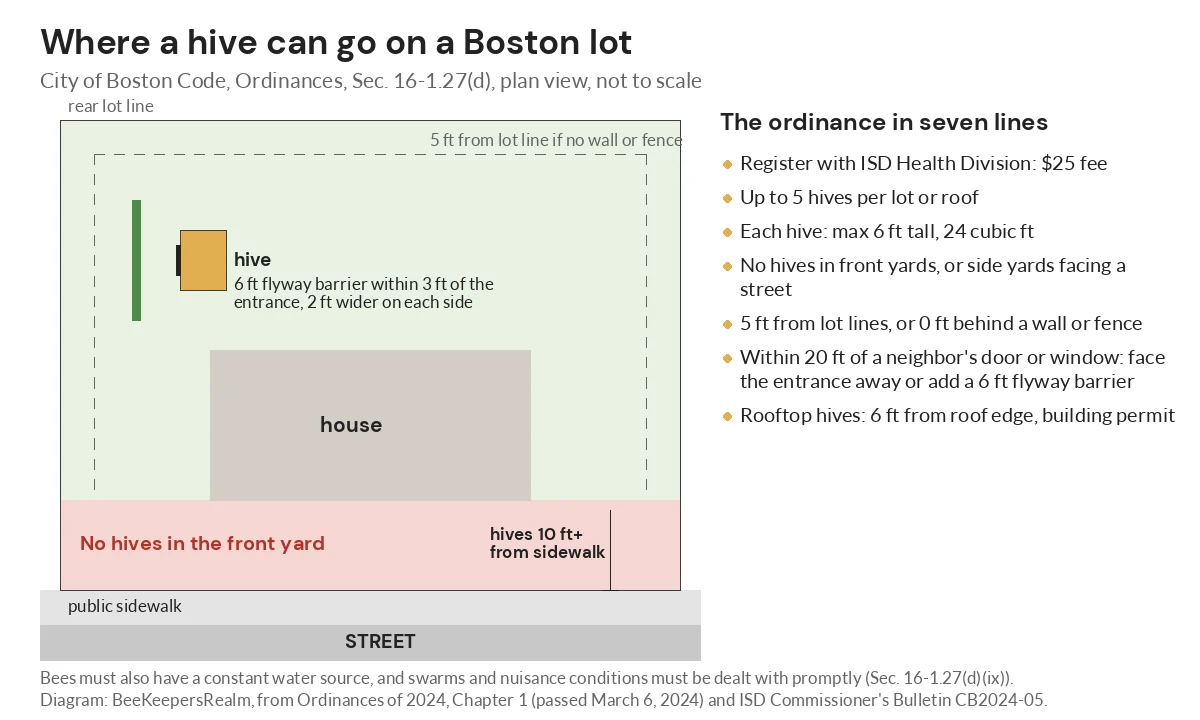
Some summaries still give Boston’s limit as two or three hives. Those figures predate the ordinance, which says five.
Cambridge
Cambridge requires a permit before you keep bees, issued by a panel appointed by the Commissioner of Public Health. Your application needs a scale drawing, a description of how the hives exclude pests, the property owner’s signed consent and a written plan for rehoming the bees if you lose the site. Hive entrances may not face a door, window, deck, street or walkway within 10 feet unless a flyway barrier sits within 3 feet of the entrance, at least 1 foot taller than the hive. The Cambridge regulation also requires compliance with 330 CMR 8.00 and the Massachusetts Beekeepers Association’s best practices.
Raynham and other towns
The Raynham regulation is typical of small-town boards of health: it adopts 330 CMR 8.00, requires a beekeeping course, MDAR registration and certified-mail notice to direct abutters, and sends anyone outside zoning rules to the Zoning Board of Appeals. If your town has no beekeeping rule, ask the board of health and the building or zoning office before you buy bees. Your deed or an HOA covenant can still restrict hives; see our guide to getting HOA approval for beekeeping.
Where no hive limit is written down, boards often fall back on the MBA’s guidance, which itself is cautious about fixed numbers:
“Strict rules regarding the number of colonies that may be placed on a given plot of land are of limited value because lot size is only one variable to be considered when locating one or more hives.”
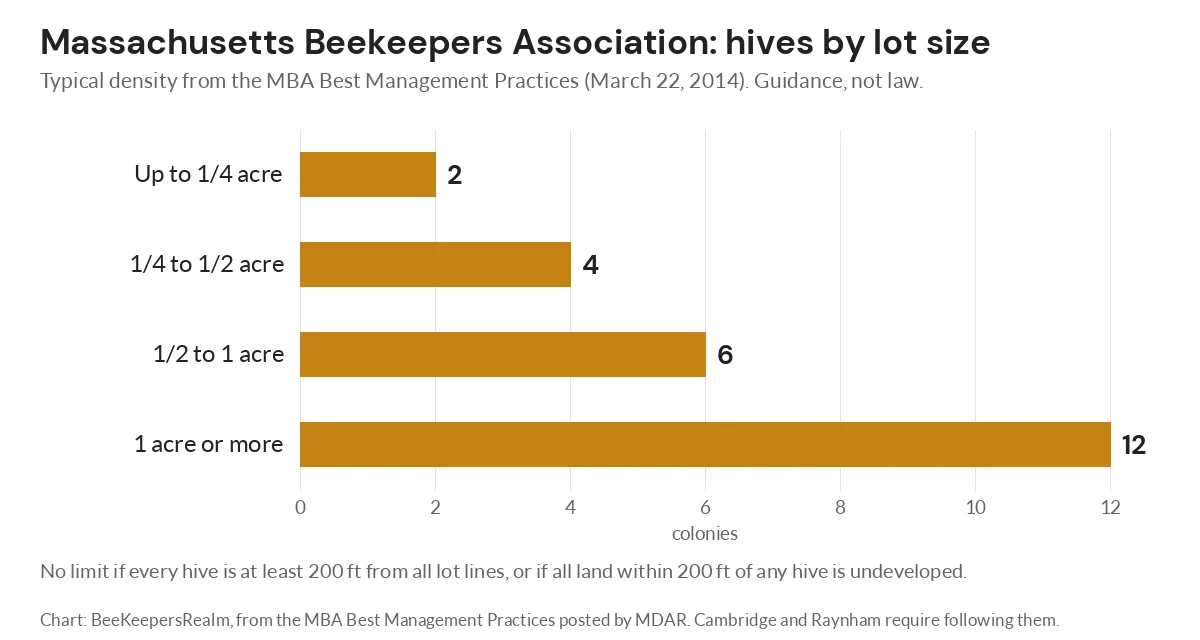
The same document suggests barriers six feet high or more near property lines. Our guide to how close hives can be to neighbors explains why flyways work.
Selling Honey in Massachusetts
MDAR’s answer is short: you can sell honey you collect, but you must follow the honey labeling law and any local ordinances. Three rules do the work:
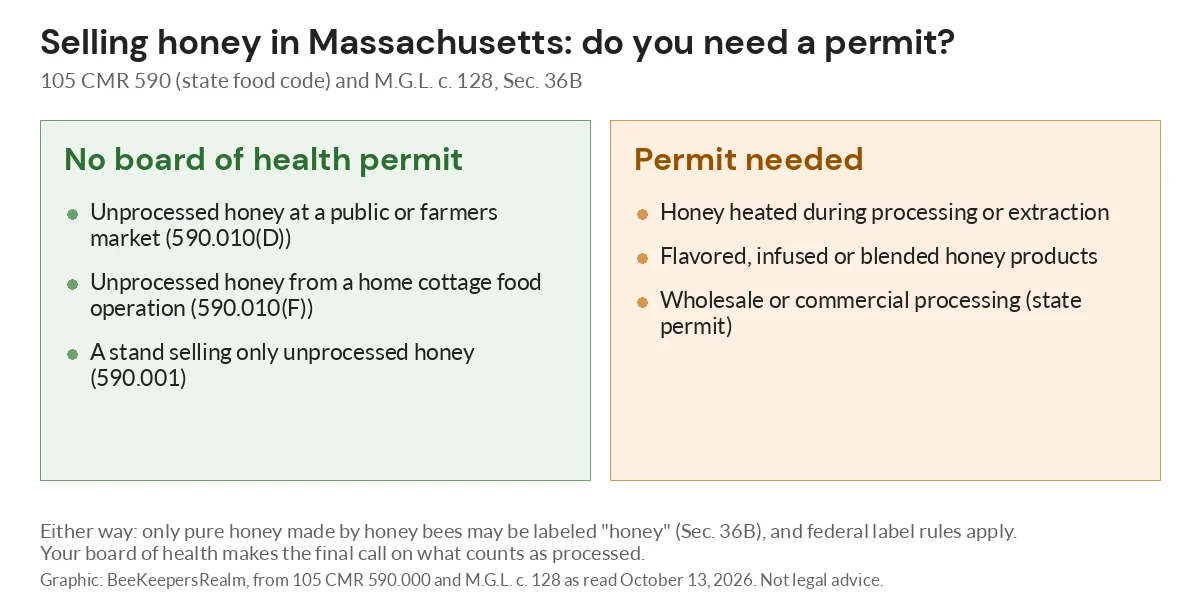
- Permits: under the state food code, 105 CMR 590.010(D) and (F), no board of health permit is needed to sell unprocessed honey at a public or farmers market or from a home cottage food operation, and a stand that sells only unprocessed honey is not a “food establishment” at all (590.001). Anything else needs a permit. Cambridge, for example, defines processed honey as honey heat-treated or extracted with heat and requires a retail food permit for it; wholesale processed honey needs a permit from the state Department of Public Health.
- Purity: M.G.L. c. 128, § 36B bars calling anything “honey” unless it is pure honey made by honey bees. A blend of honey with anything else may not be sold as honey and must list its ingredients. Fines run to $2,000 for a first violation, $5,000 for a second and $10,000 after that (§ 38).
- Labels: federal labeling rules still apply. Our guide to what must be on a honey jar covers them.
For market logistics, see selling raw honey at farmers markets. MDAR also invites honey sellers to list themselves on its MassGrown map.
Who to Contact
- State rules, registration, inspections, imports: MDAR Apiary Program, bees@mass.gov, (508) 281-6784. Offices in West Springfield and Southborough.
- Boston: ISD Health Division, isdhealth@boston.gov, 617-635-5326.
- Everywhere else: your local board of health, then the building or zoning office.
- Training and mentors: the Massachusetts Beekeepers Association lists county clubs, many of which run spring bee schools.
Keeping bees near a state line? Compare Connecticut, New Hampshire and Rhode Island.
Frequently Asked Questions
Do you need a permit to keep bees in Massachusetts?
Not from the state. MDAR’s FAQ says a state permit is not required, but your city or town may require one. Boston requires a $25 registration and Cambridge a permit.
Is beehive registration mandatory in Massachusetts?
No. State registration is voluntary and free. It is mandatory only where a town makes it so; Raynham, for example, requires proof of MDAR registration for its local permit.
How many beehives can you have in Boston?
Up to five per lot or roof under City Code § 16-1.27, each no taller than 6 feet and no larger than 24 cubic feet.
Can I keep bees in my backyard in Massachusetts?
Usually, if your town’s zoning and board of health rules allow it. Keep hives back from lot lines or behind a solid fence, point entrances away from neighbors, and provide water.
Do I need a license to sell honey in Massachusetts?
Not for unprocessed honey sold at a farmers market, farm stand or from your home (105 CMR 590.010). Heated, blended or flavored honey needs a permit from your board of health.
How do I bring bees into Massachusetts from another state?
Notify MDAR at least two business days ahead and ship with a health certificate based on an inspection within 60 days. Queens alone are exempt.
Who do I contact about a neighbor’s beehive?
Your city or town government or board of health. MDAR does not handle neighbor complaints.
The Bottom Line
Start with your town, not the state: the local code decides whether and where you can keep bees. Then register with MDAR anyway, because a foulbrood alert from 5 miles away is worth far more than the short online form costs you.