Last Updated September 15, 2026
Contrary to what dozens of beekeeping blogs will tell you, Minnesota does not currently require beekeepers to register with the state. A mandatory registration and inspection-fee system did exist in Minnesota law for decades — but the state’s entire apiary statute, Minnesota Statutes Chapter 19, has been repealed in stages since 1951, with the final remaining sections eliminated in 2006 (see the Minnesota House Research bill summary for H.F. 3442, the actual repeal legislation). Today, Minnesota’s beekeeping framework at the state level is a light-touch, request-based inspection service rather than a mandatory registry, which makes Minnesota a genuinely unusual case among the states covered on this site — and makes local city ordinances considerably more important here than in most states.
This guide covers why Minnesota’s old apiary registration law no longer applies, what the Minnesota Department of Agriculture (MDA) actually offers beekeepers today, the voluntary BeeCheck pesticide-protection registry, honey labeling resources, and a detailed look at how Saint Paul’s municipal beekeeping permit system fills the gap state law leaves open. This matters well beyond a legal technicality: a new Minnesota beekeeper who reads an outdated blog post and spends time hunting for a state registration form that no longer exists is wasting effort that would be better spent checking their own city’s actual requirements, which, as this guide explains, are where the real regulatory action in Minnesota now lives.
Disclaimer: This guide is for educational purposes only and is not legal advice. Beekeeping regulations change over time — always confirm current requirements directly with your local or national agricultural authority before acting.
Key Takeaways
- Minnesota Statutes Chapter 19 (Apiaries), which once required beekeeper registration and per-colony inspection fees, has been fully repealed — the last provisions were eliminated in 2006.
- The current statute governing MDA’s apiary work, Section 17.445, only authorizes inspections on request, mainly for interstate bee sales and transport, with cost-recovery fees rather than a mandatory annual registration fee.
- MDA charges $50 plus mileage for apiary inspections, most commonly requested by beekeepers who need certification to transport bees to other states.
- Minnesota beekeepers can voluntarily register hive locations through BeeCheck (part of the FieldWatch platform) to receive pesticide-application protection near their apiaries.
- Because state law imposes no general registration, siting, or permit requirement, city ordinances carry unusually heavy weight in Minnesota — Saint Paul, for example, requires a full permit with neighbor consent, an education requirement, and detailed siting rules.
Table of Contents
- No Mandatory State Registration (Despite What You’ll Read Online)
- What MDA Actually Offers: Request-Based Inspections
- BeeCheck: Voluntary Pesticide-Protection Registration
- Disease Identification Resources
- Honey Labeling Resources
- Local Ordinances Fill the Gap: Saint Paul as an Example
- Minnesota Apiary Regulation Timeline
- Frequently Asked Questions
No Mandatory State Registration (Despite What You’ll Read Online)
Search for “Minnesota beekeeping registration requirements” and you’ll find numerous sites confidently stating that every Minnesota beekeeper must register annually, citing a per-colony inspection fee and even prosecution for unregistered apiaries. That information describes Minnesota Statutes Chapter 19, “Apiaries” — a real law that genuinely did require exactly that. The problem is that Chapter 19 no longer exists. Checking the Minnesota Revisor of Statutes’ own table of sections for Chapter 19 directly shows every single section repealed, across several waves dating back to 1951, continuing in 1983 and 1993, with the final remaining provisions eliminated in 2006. There is currently no Minnesota statute requiring beekeepers to register their apiaries with the state. This is a genuinely unusual case worth flagging explicitly, since so much online content about Minnesota beekeeping law is describing a legal framework that hasn’t existed for close to two decades. See our state-by-state beekeeping regulations overview for how Minnesota’s approach compares to states that still register beekeepers.
What MDA Actually Offers: Request-Based Inspections
The current statute governing the Minnesota Department of Agriculture’s apiary-related authority is Minnesota Statutes Section 17.445, enacted in 2006 — the same year the old Chapter 19 registration system was finally eliminated. Under this section, MDA’s role is to provide inspections and other services on request, primarily to help beekeepers maintain access to domestic and foreign markets, rather than to enforce a mandatory registry. In practice, this means a Minnesota beekeeper who wants an official inspection — most commonly to satisfy another state’s requirement for a health certificate before transporting bees across state lines — can request one from MDA for a fee of $50 plus mileage, billed after the inspection is completed rather than paid upfront. MDA’s apiary inspector is also called on by the department’s Pesticide and Fertilizer Management Division when investigating suspected pesticide misuse affecting bee colonies, giving the position a genuine dual role beyond pure disease inspection.
BeeCheck: Voluntary Pesticide-Protection Registration
Minnesota beekeepers can register their apiary locations through BeeCheck, part of the FieldWatch platform — the same nonprofit registry system covered in our Iowa beekeeping law guide, which pesticide applicators consult before spraying near registered hive locations. Because Minnesota has no mandatory state registration requirement of its own, BeeCheck functions as the closest thing Minnesota has to a formal apiary registry, and it’s entirely voluntary: a beekeeper who wants pesticide-drift protection for their hives needs to actively register through the platform, since there’s no default state database an applicator could otherwise consult. Minnesota agriculture includes significant row-crop acreage — corn and soybeans in particular — where aerial and ground pesticide applications are routine during the growing season, which makes voluntary BeeCheck registration a genuinely practical protective step for any Minnesota beekeeper whose apiary sits anywhere near active farmland, not just a theoretical nicety.
Disease Identification Resources
Although Minnesota no longer runs a mandatory reporting or registration system tied to disease control, MDA still maintains genuinely useful technical resources for beekeepers dealing with a suspected disease issue, including dedicated informational pages on chalkbrood disease and foulbrood disease linked directly from the apiary program page. These function as identification and management references rather than components of a regulatory reporting chain, and beekeepers are also connected to the University of Minnesota’s Bee Squad and Bee Lab — two well-regarded research and outreach programs beekeepers can turn to for diagnostic help or general beekeeping guidance, independent of any state regulatory process.
Honey Labeling Resources
MDA maintains published honey label requirements as a resource for Minnesota beekeepers selling honey, covering the standard federal and state expectations around net weight, ingredient disclosure, and identifying the product accurately as honey. Beekeepers selling honey commercially in Minnesota should treat this as their primary compliance reference, since — consistent with the broader pattern in this guide — Minnesota’s honey-specific consumer-protection rules exist independently of any beekeeping-specific registration requirement. Minnesota also has its own cottage food framework covering honey sold directly to consumers from a home operation, distinct from the honey-labeling rules that apply to any commercial honey sale regardless of scale — a beekeeper selling a modest amount of honey at a farmers market should check both frameworks rather than assuming the labeling requirements alone cover the full picture — see our guide to cottage food laws and selling honey legally for the general framework behind this.
Local Ordinances Fill the Gap: Saint Paul as an Example
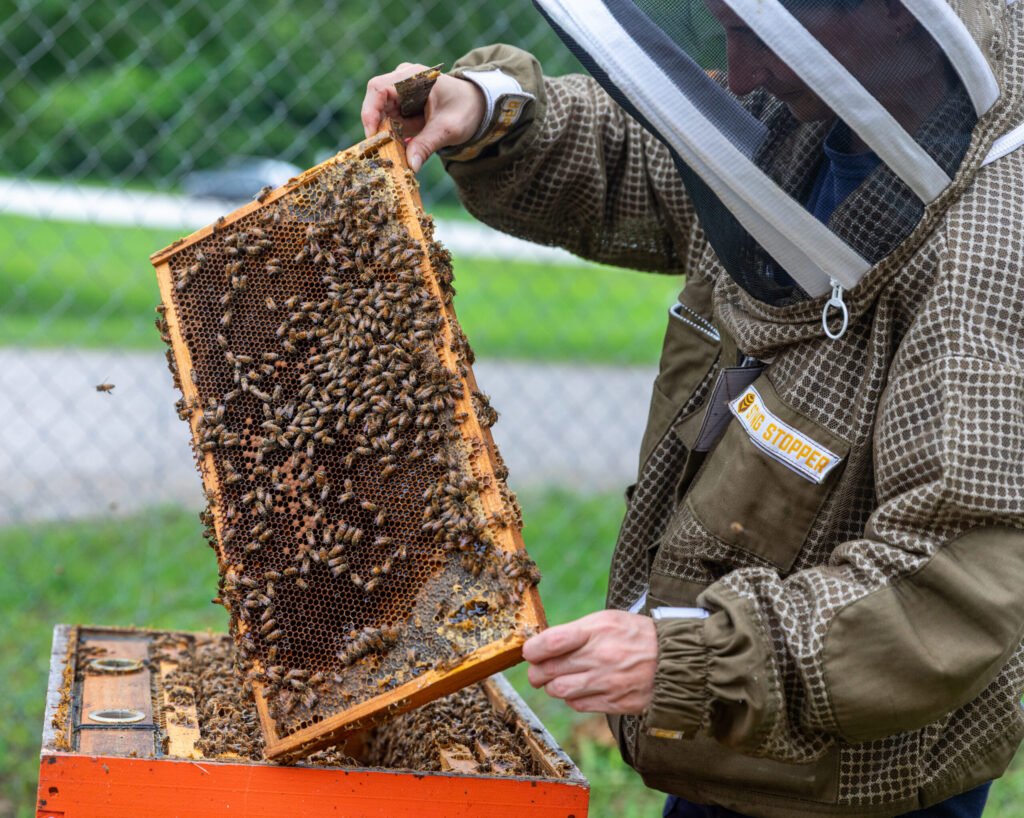
Because Minnesota imposes no general state-level siting, permit, or registration requirement on beekeepers, city ordinances do far more of the practical regulatory work in Minnesota than they do in most other states. Saint Paul’s municipal beekeeping permit system illustrates just how detailed a city’s own rules can get in that vacuum: a permit application requires consent from 75% of neighboring property owners (100% if the property is multi-family), proof of a beekeeping class completed within the prior two years, a maximum of two colonies per 2,000 square feet of property (capped at four colonies on any single property), a mandatory on-site water source, and specific siting rules — no hives in front yards, at least 25 feet from an occupied building on another lot, at least 10 feet from any property line. Fencing is required for most yards keeping bees (with a narrow consent-based exemption for lots not bordering a public right-of-way), and any colony closer than 25 feet to a property line needs a 6-foot flyway barrier extending 10 feet in each direction along that line. A visible warning sign is required at the hive, and rooftop hives — permitted only on flat roofs — come with their own additional layout and access requirements. A Minnesota beekeeper moving between cities should never assume their previous city’s rules, or the absence of state rules, carries over automatically. Minneapolis, Duluth, Rochester, and other Minnesota cities each maintain their own separate beekeeping ordinances as well, and none of them are obligated to mirror Saint Paul’s specific approach — a beekeeper relocating even a short distance within the Twin Cities metro area could go from a detailed permit-and-petition system to a much lighter municipal code, or vice versa, purely because city limits changed rather than anything about state law.
Minnesota Apiary Regulation Timeline
The repeal of Minnesota’s apiary statute didn’t happen all at once — it unwound in stages over more than half a century, which is part of why so much outdated advice about “required” registration still circulates:
| Year | What Happened |
|---|---|
| 1951 | First wave of repeals begins chipping away at the original Chapter 19 apiary statute |
| 1983 | Further sections of Chapter 19 repealed |
| 1993 | Additional sections repealed |
| 2006 | Remaining sections fully repealed via H.F. 3442; MDA’s current request-based authority (Section 17.445) enacted the same year |
For reference, an MDA-requested apiary inspection today costs a flat $50 plus mileage, billed after the visit — not an annual registration fee, and not tied to colony count the way most other states’ fees are.
Frequently Asked Questions
Do I need to register my beehives with the state of Minnesota?
No, Minnesota’s apiary registration statute was fully repealed by 2006; there is currently no mandatory state registration requirement.
Why do so many websites say Minnesota requires beekeeper registration?
They’re describing the old Minnesota Statutes Chapter 19, which did require registration until it was repealed in stages between 1951 and 2006.
How do I get a health certificate to move bees out of Minnesota?
Request an inspection from MDA, which charges $50 plus mileage, billed after the inspection is completed.
Is there any voluntary registry for Minnesota beekeepers?
Yes, BeeCheck (part of FieldWatch) lets beekeepers register hive locations so pesticide applicators can avoid spraying nearby.
Does my city have its own beekeeping rules even though the state doesn’t?
Very likely — cities like Saint Paul have detailed permit systems covering neighbor consent, colony limits, siting, and fencing, since state law leaves this entirely to local governments.
Related Reading
For more on this topic, see the official Minnesota state government apiary program page.
Image credits: Photo: Ser Amantio di Nicolao, CC BY-SA 3.0, via Wikimedia Commons; Photo: Robert Engelhardt., CC BY-SA 3.0, via Wikimedia Commons.