Reviewed by Daniel M. · Last Updated October 23, 2026 · How we review
Yes, you must register. Every Florida beekeeper, including someone with one backyard hive, has to register with the Florida Department of Agriculture and Consumer Services (FDACS) under section 586.045, Florida Statutes. An FDACS apiary inspector checks your bees before the certificate is issued, and the yearly fee is $10 for 1 to 5 colonies, up to $100 for 501 or more. Cities and counties cannot ban or regulate managed hives, because state law preempts them, but HOA deed restrictions can. On residential land you may keep 3 colonies on a quarter acre or less, and you can sell your own honey from home under the cottage food law.
Educational information only, not legal advice. Check the official sources before you act: the FDACS Beekeeper Registration page and Chapter 586, Florida Statutes. Sources checked October 23, 2026.
This guide works from the 2026 text of Chapter 586 (the Florida Honey Certification and Honeybee Law), Rule Chapter 5B-54 of the Florida Administrative Code, the FDACS Beekeeper Compliance Agreement (form FDACS-08492) and the cottage food statute, section 500.80. For other states, see our overview of beekeeping regulations by state.
Key Takeaways
- Registration is mandatory for anyone keeping honey bee colonies in Florida (s. 586.045; Rule 5B-54.010). It is not free: $10 a year for 1 to 5 colonies, up to $100 for 501 or more, plus $10 if you renew late.
- An inspector checks your colonies for regulated pests and unwanted races, such as African honey bees, before you get a registration number. You then mark every hive body with that number, in letters at least 1/2 inch high, in the upper left corner.
- Since 2012, section 586.10(1) has given the state, not your city or county, authority over where registered hives go. HOA covenants and deed restrictions are the exception.
- On land not classified as agricultural, the Compliance Agreement caps density (3 colonies on a quarter acre or less, 15 on 1 to 2.5 acres) and requires a 6-foot flyway barrier for any hive within 15 feet of a property line.
- Home honey sales fall under the cottage food law: up to $250,000 in gross sales a year, online and mail order allowed, no wholesale, and a required label statement.
Table of Contents
- Do You Have to Register Bees in Florida?
- How Registration Works, Step by Step
- Marking Your Hives with Your Firm Number
- What the Apiary Inspector Looks For
- Can a City, County or HOA Ban Beehives?
- Rules for Hives on Residential Land
- Agricultural Land and the Right to Farm Act
- Buying, Selling and Moving Bees
- Selling Honey in Florida
- Swarms, Bee Removals and Mosquito Spraying
- Penalties for Breaking Florida’s Bee Law
- Frequently Asked Questions
- The Bottom Line
Do You Have to Register Bees in Florida?
Yes, and there is no minimum colony count. Section 586.045(1) says each beekeeper “having honeybee colonies within the state” must apply for certificates of inspection and registration, then renew every year on the anniversary date. Rule 5B-54.010(7) adds that failing to register, or letting registration lapse “while maintaining European honey bees,” violates the statute. FDACS’s inspection FAQ puts it simply: everyone who keeps bees must register.
FDACS says the point of the program is to certify colonies as “free or substantially free from honey bee pests of regulatory significance” and “free from unwanted types of honey bees.” The UF/IFAS Polk County extension office adds that registration aims to limit the spread of Africanized bees, and in Florida it starts with an inspection rather than a form alone.
It is a big program. A UF/IFAS publication by James D. Ellis, Thomas A. Bustamante and Mary Bammer counts nearly 5,000 registered beekeepers in Florida as of December 2022, with nearly 85% in the backyard class of 40 colonies or fewer. Rule 5B-54.001 uses the same classes: backyard (1 to 40 colonies), sideline (41 to 100) and commercial (101 or more).
How Registration Works, Step by Step
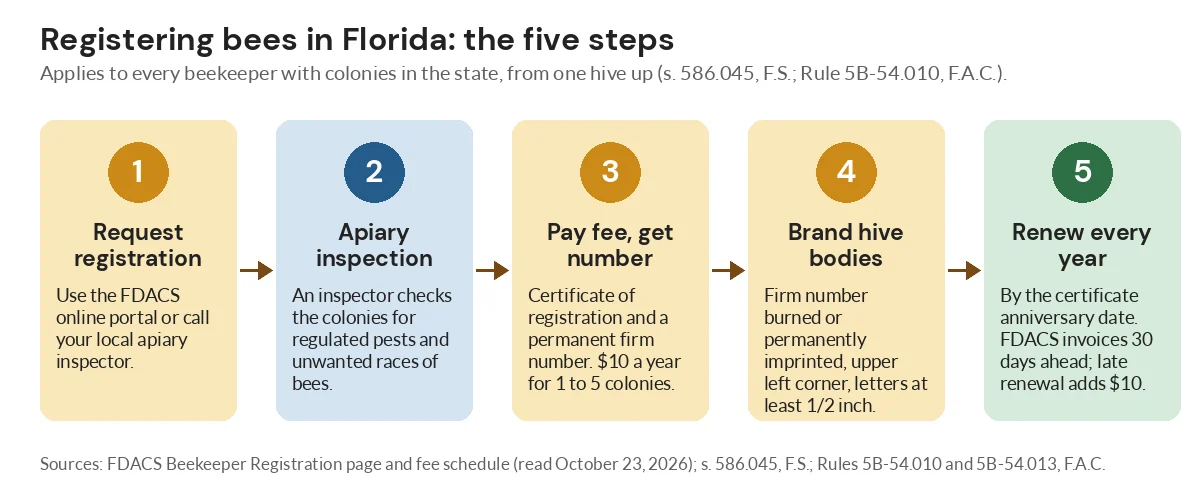
- Request registration. Create a login on the FDACS online portal (Plant Pay) and submit a request, or contact your local apiary inspector through FDACS’s Apiary Inspector Directory.
- Get inspected. Under Rule 5B-54.010(2), your bees must be found free of common honey bee pests, including the regulated ones, and of unwanted races before you are registered.
- Pay the fee. You receive a Certificate of Beekeeping Registration (FDACS-08177) and a permanent firm number (Rule 5B-54.013(1)).
- Mark your hives with that number (next section).
- Renew every year by the certificate’s anniversary date. FDACS invoices the fee 30 days before expiration, and a renewal received after the anniversary date costs an extra $10 (s. 586.045(1); Rule 5B-54.010(6)).
The fee depends on the total number of colonies you operate, not on how many apiary sites you have. These are the amounts on FDACS’s registration page as we read it on October 23, 2026:
| Colonies you operate | Annual registration fee |
|---|---|
| 1 to 5 | $10 |
| 6 to 40 | $20 |
| 41 to 200 | $40 |
| 201 to 500 | $70 |
| 501 or more | $100 |
| Renewal after the anniversary date | Add a $10 late filing fee |
Section 586.045(3) caps any registration or renewal fee at $100. Some online guides say Florida registration is free; FDACS’s own fee schedule says otherwise. One Florida-specific safety valve: if you apply before your renewal date with written documentation of good cause, such as a natural disaster, FDACS may extend the renewal date by up to 90 days without penalty (s. 586.045(5)). That matters in hurricane season; see our hurricane preparedness guide for beekeepers.
The extension offices in Polk and Hardee counties made a short video on registration and the Compliance Agreement:
In this 4:53 video from February 2026, UF/IFAS Extension Polk County, working with UF/IFAS Hardee County, explains why Florida requires beekeepers to register and covers the key points of the Beekeeper Compliance Agreement. The extension office describes it as aimed at both new and established beekeepers, and it points viewers to resources for setting up a compliant apiary.
Marking Your Hives with Your Firm Number
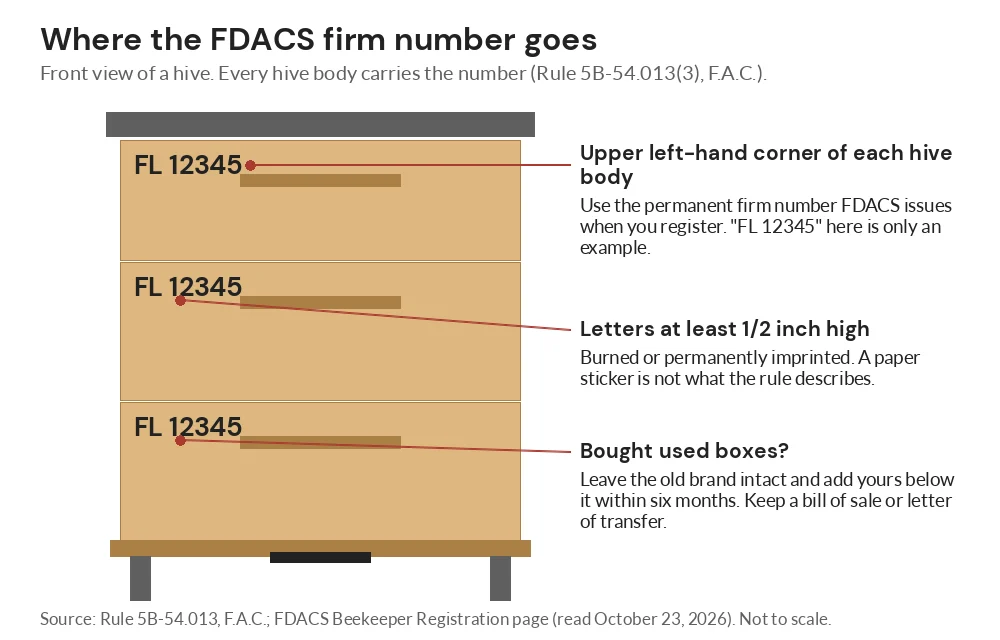
Rule 5B-54.013(3) requires the firm number to be “burned or permanently imprinted on the upper left hand corner of the hive bodies in letters at least one-half inch in height.” Three details catch people out:
- Every hive body is marked, not just one box per hive.
- Burned or permanently imprinted is the standard. A paper sticker that fades in the Florida sun is not what the rule describes.
- Used equipment keeps its history. If you buy branded boxes, leave the original brand intact and put yours below it within six months. Keep a bill of sale or letter of transfer, because anyone holding equipment marked with someone else’s number needs one (Rule 5B-54.013(4) and (5)). Altering or removing a brand is itself a violation.
Commercial beekeepers (101 or more colonies) must also post a 5-by-9-inch placard with an emergency contact at each apiary (Rule 5B-54.013(2)).
What the Apiary Inspector Looks For
Rule 5B-54.003 names the pests and races Florida treats as nuisances: American foulbrood (Paenibacillus larvae), the mite Tropilaelaps clareae, the African honey bee (Apis mellifera scutellata) and the Cape honey bee (A. m. capensis). Inspectors visit “at such intervals as it may deem best,” in the words of section 586.10(3)(f).
Under Rule 5B-54.011, an inspector opens at least 5% of an apiary’s colonies, with a minimum of 10, so in a backyard apiary of fewer than 10 every hive is opened. The same rule requires movable frames: keeping bees “in containers without movable frames” is prohibited. Top-bar hives are allowed, but the owner must help move the comb during the inspection. Each apiary must also allow reasonable access.
If American foulbrood is confirmed, infected colonies must be burned or irradiated within 7 days, and the rest of the yard is quarantined for at least 30 days (Rule 5B-54.017). Section 586.14 allows compensation of up to 50% of the appraised value, capped at $30 per colony and only if funds are available. FDACS’s page adds that the $30 cap applies to the first 10 hives, with payment discounted after that. Compare the two foulbroods in our guide to American vs. European foulbrood.
Small hive beetles
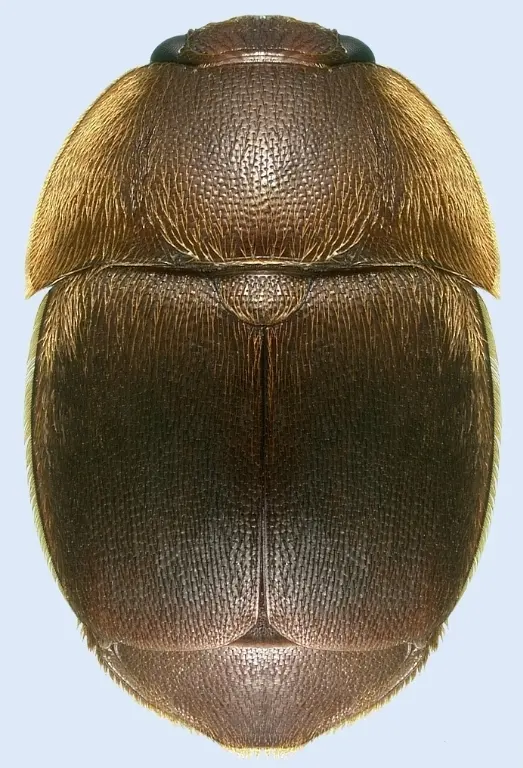
The small hive beetle is not on Florida’s regulated list, but it is a constant local problem. The UF/IFAS publication by Ellis and colleagues notes that some pests, “such as small hive beetles, thrive in climates like Florida’s due to the higher temperatures and humidity.” Learn the signs in our guide to small hive beetle slime-out.
African honey bees and the European-stock rule
UF/IFAS says African honey bees have been found in Florida “since at least the early 2000s” and nest in high densities in southern Florida. FDACS may refuse to certify colonies where an unwanted race exists (s. 586.10(3)(m)). The Compliance Agreement tells residential beekeepers to re-queen collected swarms and new colonies with queens or queen cells from European honey bee producers, to inspect every colony at least once a month, and to call their apiary inspector if a colony turns overly aggressive. For field signs, see how to identify Africanized bees.
Can a City, County or HOA Ban Beehives?
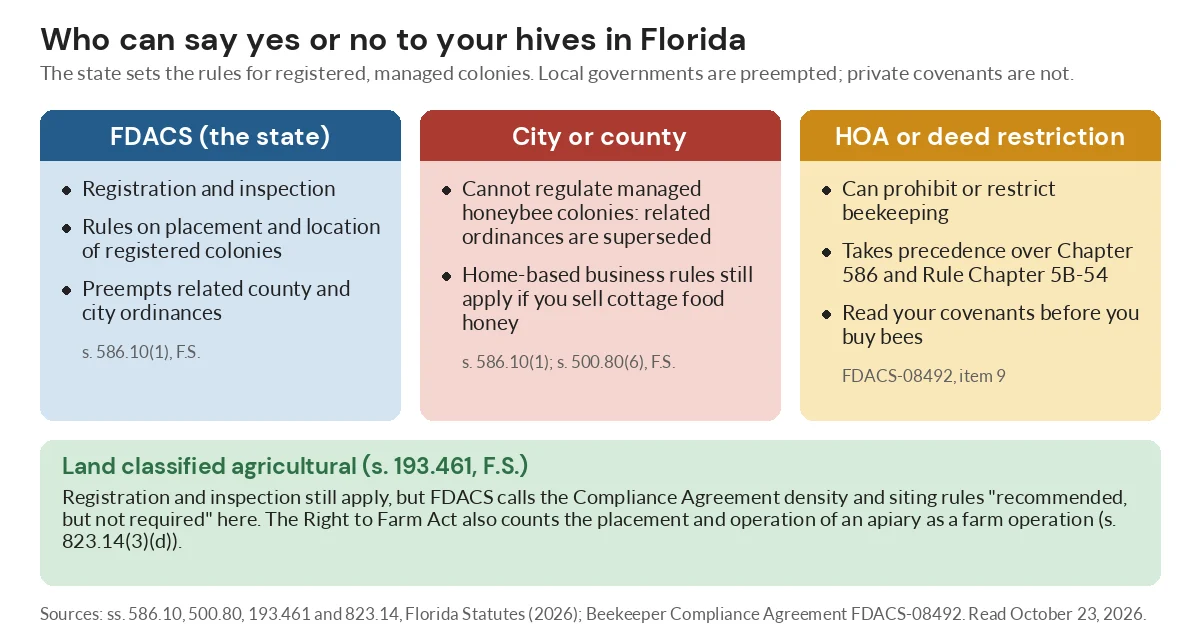
A city or county cannot. A 2012 law (chapter 2012-83, Laws of Florida), which took effect that July, ended local bans and put managed honey bee colonies under state control:
“The authority to regulate, inspect, and permit managed honeybee colonies and to adopt rules on the placement and location of registered inspected managed honeybee colonies is preempted to the state through the department and supersedes any related ordinance adopted by a county, municipality, or political subdivision thereof.”
So the siting rules that matter are the state’s, set out in the Compliance Agreement below, not a separate city beekeeping code. The placement language refers to registered, inspected colonies, one more reason to register first.
A homeowners association is different. The Compliance Agreement says so directly:
“Deed restrictions and covenants that prohibit or restrict the allowance for managed honey bee colonies within their established jurisdictions take precedence and as a result supersede the authority and requirements set forth in Chapter 586 Florida Statutes and Rule Chapter 5B-54, Florida Administrative Code.”
If you live in a deed-restricted community, read your declaration and rules before you order bees. Our guides on getting HOA approval for beekeeping and fighting an HOA fine cover the process.
Rules for Hives on Residential Land
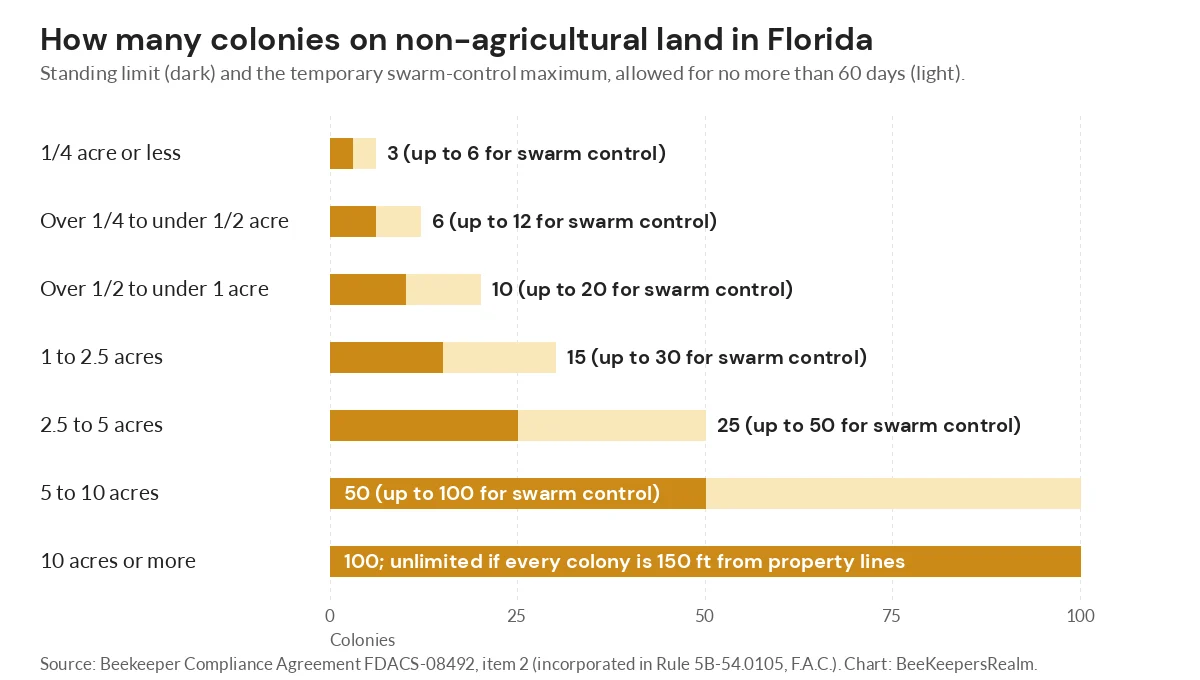
Residential lots are generally classified as non-agricultural under section 193.461. Under Rule 5B-54.0105(1)(b), colonies may be kept on such land, with the landowner’s permission, if the beekeeper signs the Beekeeper Compliance Agreement. If you rent, that means your landlord’s permission too. The agreement’s best management requirements cap how many colonies a lot can hold:
| Tract size | Colony limit | Temporary maximum for swarm control (60 days or less) |
|---|---|---|
| 1/4 acre or less | 3 | 6 |
| More than 1/4 acre, less than 1/2 acre | 6 | 12 |
| More than 1/2 acre, less than 1 acre | 10 | 20 |
| 1 acre up to 2.5 acres | 15 | 30 |
| 2.5 to 5 acres | 25 | 50 |
| 5 up to 10 acres | 50 | 100 |
| 10 acres or more | 100 | Unlimited if every colony is at least 150 feet from property lines |
The other requirements in the agreement:
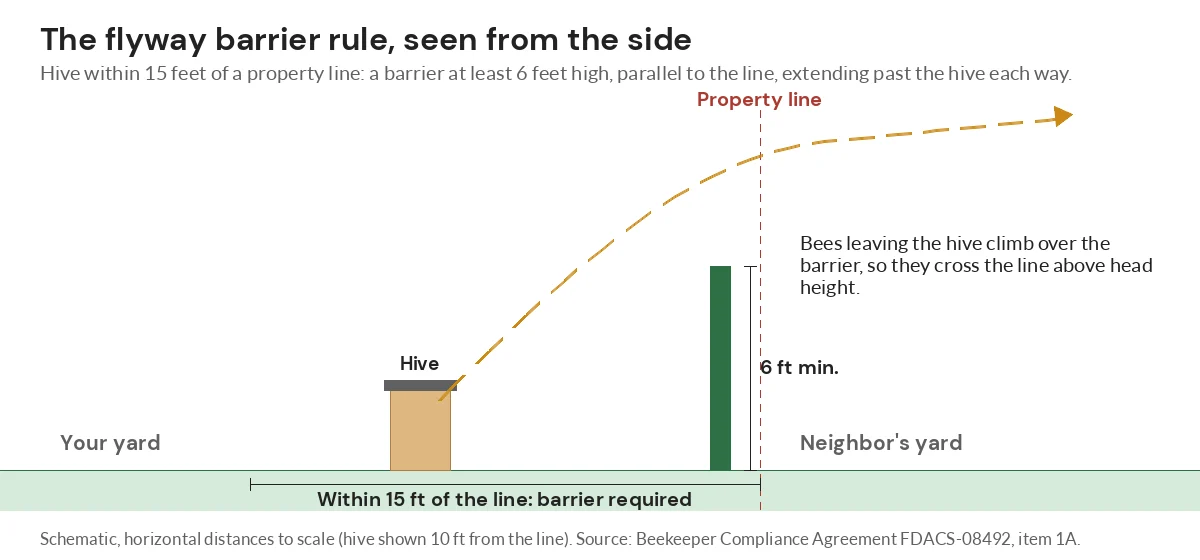
- Flyway barrier. A colony within 15 feet of a property line needs a barrier at least 6 feet high (a solid wall, fence, dense vegetation or a mix) that runs parallel to the line and extends beyond the colony in each direction.
- Fenced, gated site. The property, or the part holding the colonies, must be fenced or otherwise closed off, with a gated entrance.
- Water. A convenient water source on the property at all times, so bees do not gather at unintended water sources such as a neighbor’s pool.
- Distance from people and animals. No apiary within 150 feet of tethered or confined animals or public places people frequent, such as day care centers, schools, parks and parking lots. Hives must not block emergency access to buildings.
- No public land (schools, parks and similar) without a special permit letter from the Division of Plant Industry and the owner’s written consent.
- Swarm prevention following the UF/IFAS publication Swarm Control for Managed Beehives (ENY-160). Our swarm prevention playbook covers the techniques.
If your lot cannot meet these terms, Rule 5B-54.0105(4) allows a special permit for property integral to a beekeeping operation: you submit a map of the proposed colonies and a written justification, and the Division must agree the apiary will not be a public nuisance. Colonies out of compliance get a Notice of Non-Compliance (FDACS-08499). For how setbacks compare elsewhere, see how close beehives can be to neighbors.
Agricultural Land and the Right to Farm Act
Florida ties apiary siting to the property tax classification in section 193.461. The county property appraiser classifies all land each year as agricultural or non-agricultural, and the statute’s list of “agricultural purposes” includes “bee” alongside livestock and poultry (s. 193.461(5)). Section 586.055 then says an apiary may be located on land classified as agricultural or on land that is integral to a beekeeping operation.
The classification changes which rules bind you. The Compliance Agreement says its guidelines “are recommended, but not required” for bees kept on land classified as agricultural. Registration, hive marking and inspection still apply everywhere. Two more statutes help on agricultural land:
- The Florida Right to Farm Act defines a farm operation to include “the placement and operation of an apiary” (s. 823.14(3)(d)). A farm operation running for a year or more that was not a nuisance when it started, and that follows generally accepted agricultural practices, cannot become a public or private nuisance, with narrow exceptions (s. 823.14(4)).
- Section 163.3162(3)(a) bars local governments from limiting a bona fide farm operation’s activities on agricultural land when that activity is already regulated through best management practices or rules of FDACS or another listed agency.
Agricultural classification is a tax decision. The statute requires “good faith commercial agricultural use,” and you must file by March 1. A single hobby hive is unlikely to meet that test. For how counties weigh bee operations, see our guide to agricultural property tax exemptions for beekeeping.
Buying, Selling and Moving Bees
Movement rules matter in Florida, where, according to UF/IFAS, many of the commercial beekeepers in the United States move their bees for the winter.
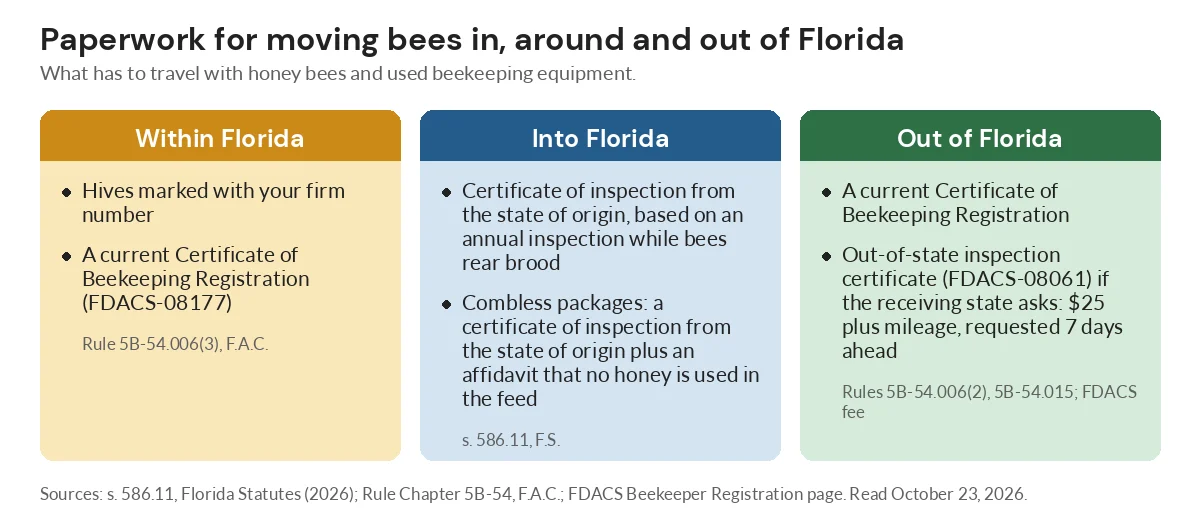
- Within Florida. Rule 5B-54.006(3) requires bees and used equipment moved within the state to be marked under Rule 5B-54.013 and to travel with a current Certificate of Beekeeping Registration. FDACS’s page words it as a certificate on each sale or movement unless the hives are branded with your number.
- Into Florida. Honey bees and used beekeeping equipment need a certificate of inspection from the state of origin, showing the apiaries were inspected annually while the bees were rearing brood (s. 586.11). Bees in combless packages need a certificate of inspection plus an affidavit that no honey is used in the feed. Sheriffs and the Florida Highway Patrol enforce these rules.
- Out of Florida. Bees leaving the state travel with a current Certificate of Beekeeping Registration (Rule 5B-54.006(2)). If the receiving state asks for it, FDACS issues a Certificate of Apiary Inspection for Out of State Movement. FDACS lists a fee of $25 per certificate or special inspection, plus mileage. Request a special inspection at least seven days before the move (Rule 5B-54.015).
- Selling nucs, colonies or queens. Producing nucs or colonies for sale requires a Stock Dealer Certificate (FDACS-08517); rearing queens for sale requires a Queen Certificate (FDACS-08057) (Rule 5B-54.014).
Selling Honey in Florida
Selling honey is handled by a different FDACS division, Food Safety. Honey is on FDACS’s list of approved cottage foods, and a cottage food operation is exempt from a food permit if its annual gross sales of cottage food products stay at or below $250,000 (s. 500.80(1)(a)). Some older guides and search summaries still give a $50,000 cap or say mail order is banned. FDACS’s current page says:
“Cottage food operators may sell cottage food products on their website, by mail order, and direct to consumer (in person).”
The rest of section 500.80:
- No wholesale. You cannot sell, offer or deliver cottage food products at wholesale. Retail or wholesale sales outside the cottage food rules need the appropriate FDACS food permit (s. 500.12).
- Home kitchen, stored on premises. The UF/IFAS Polk County extension office notes that cottage food honey must be bottled in the kitchen of a private residence, and the statute requires you to store the products on the premises.
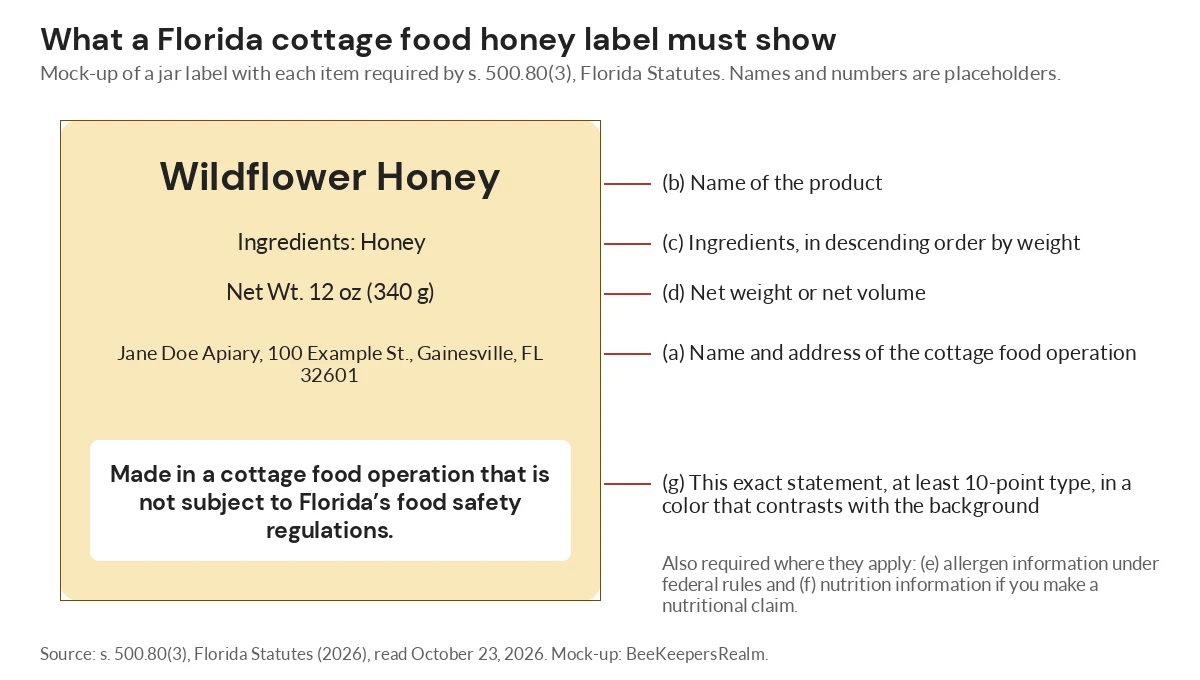
- Labels. Each jar must be prepackaged with a label showing your name and address, the product name, ingredients, net weight or volume, allergen information where federal rules require it, nutrition information if you make a nutritional claim, and this statement printed in at least 10-point type: “Made in a cottage food operation that is not subject to Florida’s food safety regulations.”
- Local rules. A city or county cannot prohibit a cottage food operation, but you must meet the home-based business conditions in section 559.955 (s. 500.80(6)).
One Florida-specific trap: your beekeeper registration does not make your honey “registered.” Section 586.025(2) makes it unlawful to use the terms “certified honey,” “certified,” “registered” or “inspected,” or any term implying certification, unless FDACS has actually certified the honey. Section 586.03 lets beekeepers apply for that certification. For the steps beyond a home stand, read how to start selling honey legally.
Swarms, Bee Removals and Mosquito Spraying
FDACS says registered beekeepers may remove and relocate nuisance swarms or established colonies under Rule 5E-14.151, F.A.C., and can ask to be listed on its Bee Removal or Eradication List. Killing a colony is different: only a licensed pest control company may eradicate one (s. 482.021). How a colony is removed is the property owner’s choice.
County mosquito control is the other local agency worth contacting. Volusia County Mosquito Control, for example, keeps a record of beehive locations for planning spray operations, sprays adulticides after sunset and before sunrise, and offers beekeepers a courtesy notification list. Ask your county program whether it does the same, and see our guide to DriftWatch and BeeCheck hive registries.
Penalties for Breaking Florida’s Bee Law
- Criminal: a first violation of Chapter 586 is a first-degree misdemeanor; a second or later one is a third-degree felony (s. 586.15(1)).
- Administrative: FDACS may impose a Class II fine, which section 570.971 caps at $5,000 per violation, and may suspend or revoke a certificate. If a fine order is not complied with, an extra $100 a day may be added (s. 586.15(2)).
- Stop orders and destruction: FDACS can issue a stop-sale or stop-movement notice (s. 586.112). After written notice of infested colonies you have 48 hours to have them removed, destroyed or treated under supervision; if you do not act within 10 days, FDACS can do it and bill you (s. 586.13).
For help, call the FDACS Division of Plant Industry at 1-888-397-1517, or contact your county’s UF/IFAS extension office. The Florida State Beekeepers Association, whose stated mission is to represent the interests of all beekeepers in the state, has a clubs section on its website. Neighboring states take different approaches; compare Georgia beekeeping laws and Alabama beekeeping laws.
Frequently Asked Questions
Can I keep bees in my backyard in Florida?
Yes. Register with FDACS, sign the Beekeeper Compliance Agreement and stay within its limits: 3 colonies on a quarter acre or less, plus a 6-foot flyway barrier for hives within 15 feet of a property line. HOA covenants can still forbid it.
How much does it cost to register bees in Florida?
$10 a year for 1 to 5 colonies, $20 for 6 to 40, $40 for 41 to 200, $70 for 201 to 500 and $100 for 501 or more. Late renewals add $10.
How many beehives can you have on one acre in Florida?
On non-agricultural land, 15 colonies on 1 to 2.5 acres, or up to 30 for no more than 60 days as a swarm-control measure. Just under an acre, the limit is 10.
Can my city or county ban beekeeping in Florida?
No. Section 586.10(1) preempts local ordinances on managed, registered colonies. HOA covenants and deed restrictions are not preempted.
Do you have to pay property taxes if you keep bees in Florida?
Keeping bees does not exempt land from tax. Land used for good faith commercial agriculture, including bees, can be classified agricultural under section 193.461 if you file with the county property appraiser by March 1.
Do you need a license to sell honey in Florida?
Not under the cottage food law, if you sell directly to consumers, label correctly and stay at or under $250,000 a year. Wholesale sales need an FDACS food permit.
Are top-bar hives legal in Florida?
Yes. Rule 5B-54.011 bans containers without movable frames but allows top-bar hives, as long as the owner helps the inspector move the comb.
The Bottom Line
Register as soon as you have bees, brand every box, and check your HOA documents rather than your city code. Rules and fees change, so confirm current figures with FDACS before you buy bees.
Image credits: Featured photo: Preston Keres, USDA/FPAC, public domain.