Reviewed by Daniel M. · Last Updated October 24, 2026 · How we review
Yes, you can keep honey bees anywhere in New York State, including New York City. Every beekeeper must register with the New York State Department of Agriculture and Markets and renew each year, at no cost. In the five boroughs, each hive also needs a free registration with the NYC Health Department, renewed by May 31. State apiary inspectors check colonies for disease, and you can sell honey from your own bees without a state food processing license if you add nothing to it.
Educational information, not legal advice. Laws change, so check the official sources: Agriculture and Markets Law Article 15 and the NYC beekeeper registration page. Sources read October 23, 2026.
Key Takeaways
- Since December 23, 2021, every New York beekeeper must report colony numbers by county and contact details each year, and say whether they will sell nucs. There is no fee.
- New York City adds a per-hive registration: file within 30 days, renew by May 31, report changes within 10 business days.
- State law and the NYC Health Code both require movable-frame hives.
- Report disease “at once.” Colonies destroyed under a state order are not compensated.
- State penalties run up to $600 for a first violation and $1,200 after that.
Table of Contents
- New York Beekeeping Rules at a Glance
- Statewide Registration Under Article 15
- Inspections, Disease and the Movable-Frame Rule
- Bringing Bees Into New York and Selling Nucs
- Extra Rules in New York City
- Towns, Landlords and HOAs
- Selling Honey Without a Food License
- Property Taxes and Penalties
- Frequently Asked Questions
New York Beekeeping Rules at a Glance
| Question | Anywhere in New York State | Also inside New York City |
|---|---|---|
| Must I register? | Yes, every beekeeper, every year | Yes, each hive, on top of the state |
| With whom? | Department of Agriculture and Markets | Department of Health and Mental Hygiene |
| Cost | No fee | No fee |
| Deadlines | Annual update | 30 days after a new hive; renew by May 31 |
| Who inspects? | Seasonal state apiary inspectors | Health Department handles nuisance complaints |
| Hive limits or setbacks? | None in Article 15; check local zoning | None in the Health Code; nuisance standard |
| Legal basis | AML §§173 to 175-b | Health Code §161.01(b)(12), §161.02 |
To compare other states, see our state-by-state beekeeping regulations guide.
Statewide Registration Under Article 15
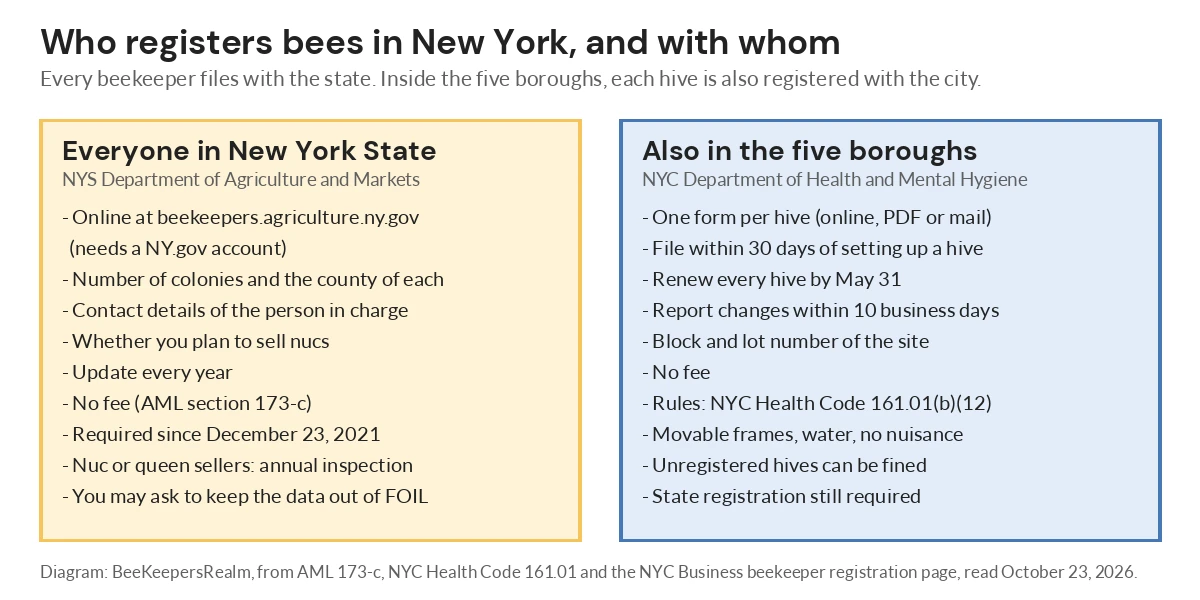
New York’s bee law is Article 15 of the Agriculture and Markets Law (AML), “Bee Diseases.” Under §173-c(1)(a), every beekeeper must give the commissioner the number of managed colonies, the county of each colony and current contact information, say whether they intend to sell nucleus colonies, and update this annually. A beekeeper is anyone keeping managed honey bees “for profit, research, recreational, or educational purposes,” so one backyard hive counts.
You register online with a free NY.gov account; the department’s Honey Bee Health page links to both. The statute rules out any charge:
“There shall be no fee or other registration cost for participation in the cooperative honey bee health improvement program.”
A detail none of the top-ranking guides we checked mention: under §173-c(4), you may ask that your registration information be exempted from disclosure under Public Officers Law §89(5), the Freedom of Information Law, if you would rather keep hive locations private.
Registration has been required twice
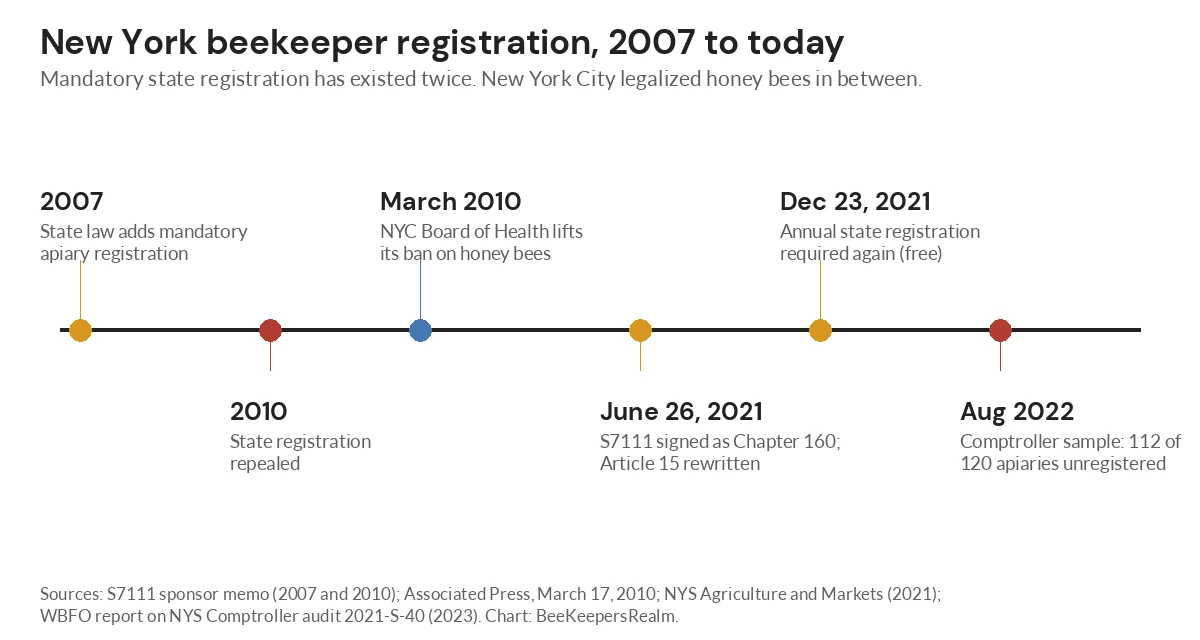
The sponsor’s memo for bill S7111 says mandatory apiary registration was added in 2007 and repealed in 2010. S7111 restored it: signed June 26, 2021 as Chapter 160, effective 180 days later, which the department dates to December 23, 2021.
“The new law will give Ag and Markets accurate information and an up-to-date census of beehives in New York State.”
Compliance started slowly. Reporting on State Comptroller audit 2021-S-40, WBFO said 112 of 120 apiaries selected for random review had not registered as of August 2022.
Inspections, Disease and the Movable-Frame Rule
The department’s Division of Plant Industry has seasonal apiary inspectors across the state. Under §173-b they may inspect any apiary for disease, parasites and harmful bee species, but must give you “reasonable advance notice.” For how these programs work, see our guide to state bee inspector programs. Inspection only works if the combs come out:
“Persons keeping bees shall keep them in hives of such construction that the frames and combs may be easily removed without damaging them for examination of the brood for the purpose of determining whether disease exists in the brood.”
A standard Langstroth hive complies; a skep or log hive with fixed comb does not.
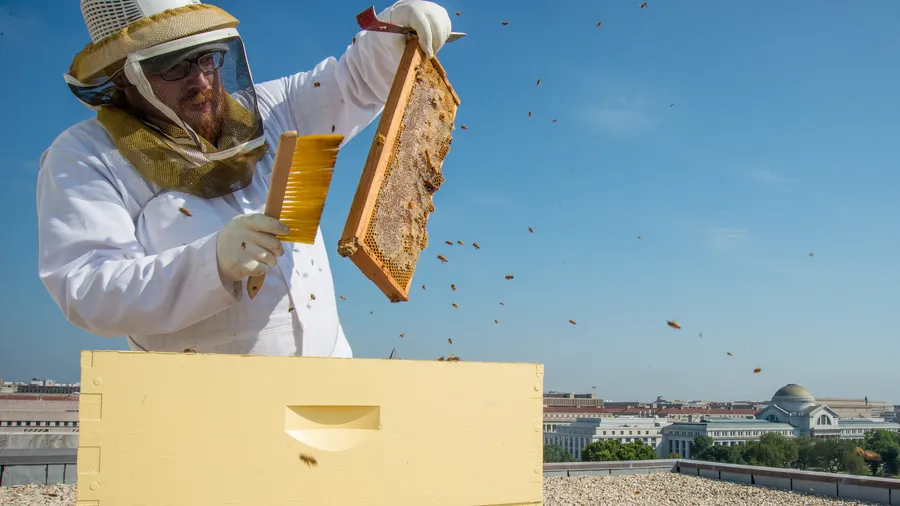
If you know your bees exceed the department’s disease or parasite tolerances, §174(1) says you must “at once report such fact to the commissioner.” Infected colonies and equipment are quarantined by written notice and may be ordered treated or destroyed. You have five days to request a hearing, which pauses enforcement (§174(6)), and no damages are paid for anything destroyed (§174(4)(c)). The statute names American foulbrood; see American vs. European foulbrood for the signs.
Bringing Bees Into New York and Selling Nucs
- Packages and caged queens from another state need a commissioner’s permit or a disease-free certificate from the origin state (§173-c(1)(e)).
- Colonies, used comb and used equipment need a permit or a certificate of inspection made within 60 days before shipment (§173-c(1)(f)).
- Selling nucs or queens raised in New York requires a department inspection first and every year after (§173-c(1)(c)).
Extra Rules in New York City
The Associated Press reported on March 17, 2010 that the city’s health board had just voted to end its beekeeping ban. Health Code §161.01(b)(12) still lists venomous insects among the wild animals the city prohibits, but excepts “non-aggressive honey bees (Apis mellifera).” Beekeepers must file a notice with the Health Department, update it within ten business days of changes, keep colonies in movable-frame hives “in sound and usable condition,” provide a constant water source, and be able to control swarms and fix nuisances immediately.
Under §161.02, a beekeeping nuisance includes aggressive bees, hives or flight paths that interfere with pedestrians or neighbors, and overcrowded, dead or abandoned hives. Article 161 sets no hive limit or setback distance.
The city’s registration page asks for one form per hive, filed within 30 days and renewed by May 31, with the site’s block and lot number. There is no fee, unregistered hives can be fined, and you must register with the state too. The Health Department tells the public to call 911 for a swarm.
Towns, Landlords and HOAs
Because Article 15 sets no hive limits or setbacks, the practical limits outside the city come from town or village zoning, leases and HOA covenants. See our beekeeping zoning guide and getting HOA approval for beehives. In the city, a co-op or condo board can still say no; see keeping bees in a condo or co-op.
Selling Honey Without a Food License
Food processors normally need an Article 20-C license ($175 per facility for a small-scale processor). AML §251-z-3(2) exempts honey processors “who do not purchase” honey from others for repackaging and who do not mix it with ingredients capable of supporting infectious or toxigenic organisms, if they work in sanitary conditions. The department’s regulation, section 276.4, adds that containers must be clean and labeled under Part 259, and its page words the exemption as covering processors who “do not combine” honey “with any other substance.” Ask the department before selling infused or flavored honey.
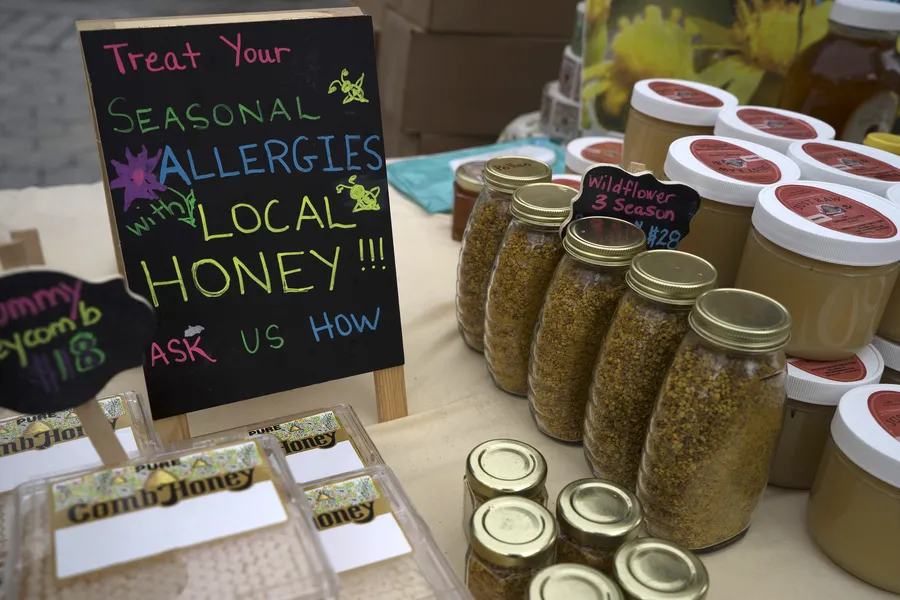
See what must be on a honey label and how to start selling honey legally.
Property Taxes and Penalties
S7111 also amended Real Property Tax Law §483(e), which now lists buildings “used in the production of honey, royal jelly, bee pollen, propolis and beeswax,” including bee storage, as exempt farm buildings; buildings used to sell honey are excluded. AML §301 counts honey, beeswax, nucs and queens toward an agricultural assessment, which generally needs seven acres and $10,000 in average gross sales.
The general penalty in AML §39 is up to $600 for a first violation and $1,200 for each later one, and §41 allows misdemeanor charges. Some websites still reprint the pre-2021 law, with section numbers such as 169-d and fines of $50 to $200.
Frequently Asked Questions
Do you need a license to keep bees in New York State?
No license, but every beekeeper must register with the Department of Agriculture and Markets each year, free.
Is it legal to keep bees in New York City?
Yes. Non-aggressive honey bees are allowed if each hive is registered with the Health Department and the state.
How many beehives can I have in New York?
Neither state law nor the NYC Health Code sets a number. Local zoning, leases and HOAs may.
Do beekeepers get a property tax break in New York?
Honey production buildings can qualify as exempt farm buildings. Land needs about seven acres and $10,000 in sales for an agricultural assessment.
Can I sell honey from home in New York?
Yes, without a 20-C license, if it is your own honey with nothing added and properly labeled.
What happens if I don’t register my bees in New York?
State penalties reach $600 for a first violation, and New York City can fine unregistered hives.
Related Reading
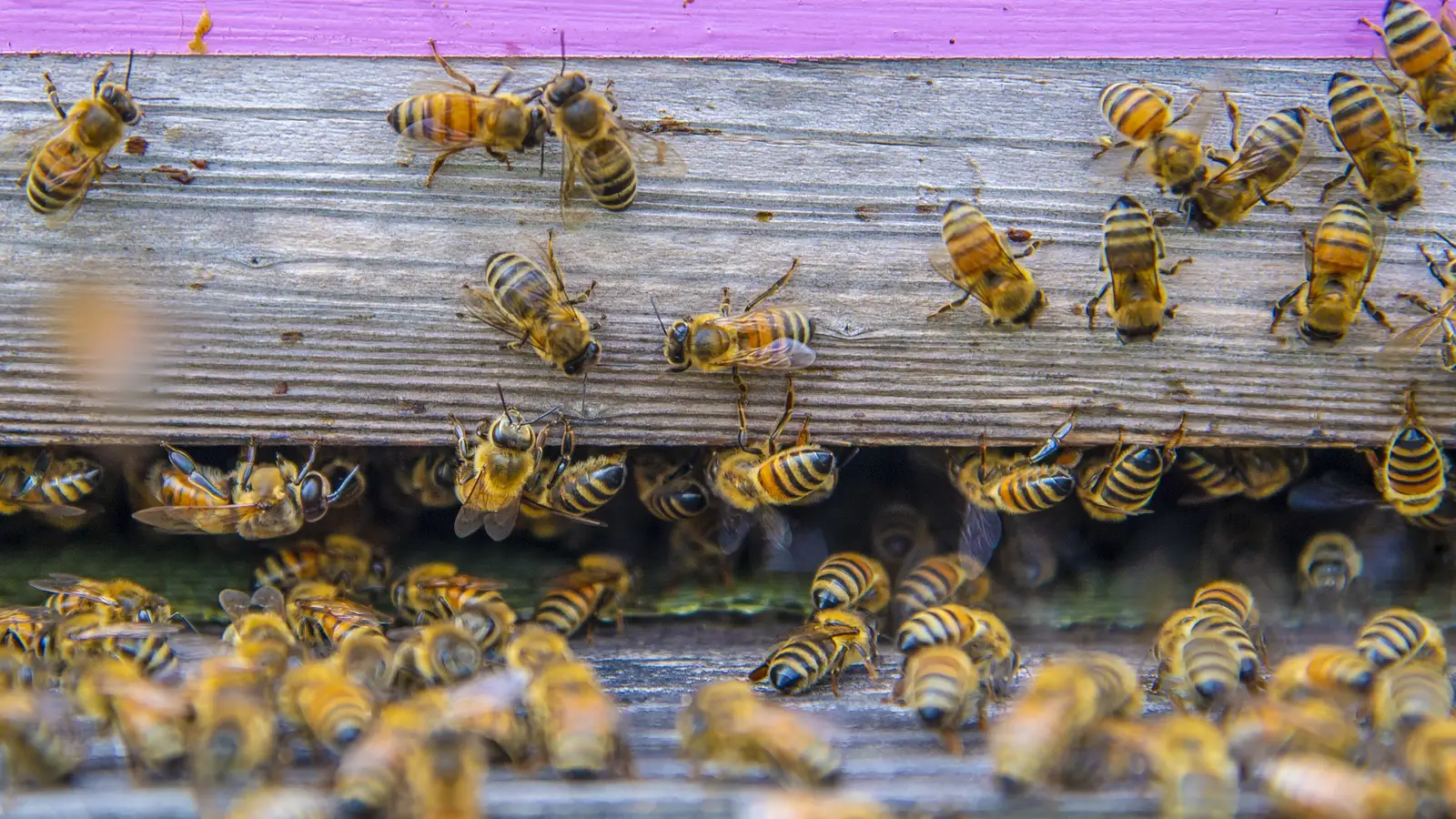
Image credits: Featured photo: Preston Keres, USDA, public domain, via Wikimedia Commons (honey bees at a hive on an urban farm in Brooklyn, 2018), cropped.