

Reviewed by Sofia T. · Last Updated October 14, 2026 · How we review
Yes, every beekeeper in Rhode Island must register every apiary with the Department of Environmental Management (DEM) each year, whether you keep one hive or a hundred. DEM’s online portal renews registrations by April 30, and its apiary page lists no registration fee. DEM-appointed apiary inspectors enforce the state Apiculture Law, and cities add their own siting rules: Providence allows hives only in rear yards, 10 feet from lot lines, and East Providence requires a zoning certificate before your first colony arrives.
Legal disclaimer: This guide is educational information, not legal advice. Laws, fees and portal dates change; confirm current requirements with RI DEM’s Apiary Registration page and your city or town before you act. Statutes below were checked against the General Assembly text in October 2026.
Key Takeaways
- State law requires all apiaries to be registered annually with the DEM director and owners to report hive locations and colony numbers (R.I. Gen. Laws § 4-12-12).
- The statute still says “not later than March first”, but DEM now runs registration through its DAFE portal with a yearly renewal date of April 30. Registering before March 1 satisfies both.
- Each colony must carry the owner’s name and address and live in a removable-frame hive; violations are misdemeanors with fines of up to $1,000.
- Providence and East Providence have written beekeeping rules with setbacks and flyway barriers; East Providence also caps hives by lot size.
- Neither of Rhode Island’s home-food laws names honey, so ask the Department of Health before you sell jars.
Table of Contents
- Rhode Island Beekeeping Rules at a Glance
- Registering Your Hives with DEM
- Hive Rules in the Apiculture Law
- Inspections, Quarantines and Disease
- Bringing Bees and Equipment Into Rhode Island
- City and Town Beekeeping Rules
- Selling Honey in Rhode Island
- First-Year Compliance Checklist
- Frequently Asked Questions
Rhode Island Beekeeping Rules at a Glance
The state rules sit in one short chapter, the Rhode Island Apiculture Law, R.I. Gen. Laws §§ 4-12-1 to 4-12-17. The duties that affect a hobbyist:
| Requirement | What it says | Source |
|---|---|---|
| Register every apiary | Annually, with the DEM director; report location and number of colonies | § 4-12-12(a) |
| Deadline | Statute: by March 1. DEM portal: renews by April 30 | § 4-12-12(a); DEM apiary page |
| Registration fee | None set in the statute; none listed on DEM’s apiary page | § 4-12-12; DEM apiary page (April 2026) |
| Transfer of bees | Notify DEM in writing within 30 days, with the new owner’s name and address | § 4-12-12(b) |
| Hive type | Removable frames; otherwise DEM can order a transfer within 30 days | § 4-12-6(a) |
| Colony labels | Owner’s name and address on each colony | § 4-12-13(a) |
| Bringing bees in | DEM entry permit plus an origin-state health certificate; packages and queens follow a separate route | § 4-12-8; 250-RICR-40-10-3 |
| Penalty | Misdemeanor, fine of not more than $1,000 | § 4-12-17 |
| Neighbor notice | Not required by state law; some cities add siting rules | Ch. 4-12; city codes |
Registering Your Hives with DEM
There is no small-apiary exemption. Section 4-12-12(a) begins: “All apiaries in the state must be registered, annually.” The Apiculture Law defines an apiary as any place where “one or more colonies or nuclei of bees are kept” (§ 4-12-2). A single backyard nuc counts. DEM, not a separate agriculture department, runs the program through its Division of Agriculture.
“To help prevent the spread of some pretty tough diseases, all hives in Rhode Island, whether commercial or private, are required to be registered.”
Registration also protects you: the Apiculture Law defines an “abandoned” colony partly as one that has not been registered in the preceding two years, and DEM can remove or destroy abandoned apiaries after written notice and 60 days (§§ 4-12-2(1), 4-12-13(b)).
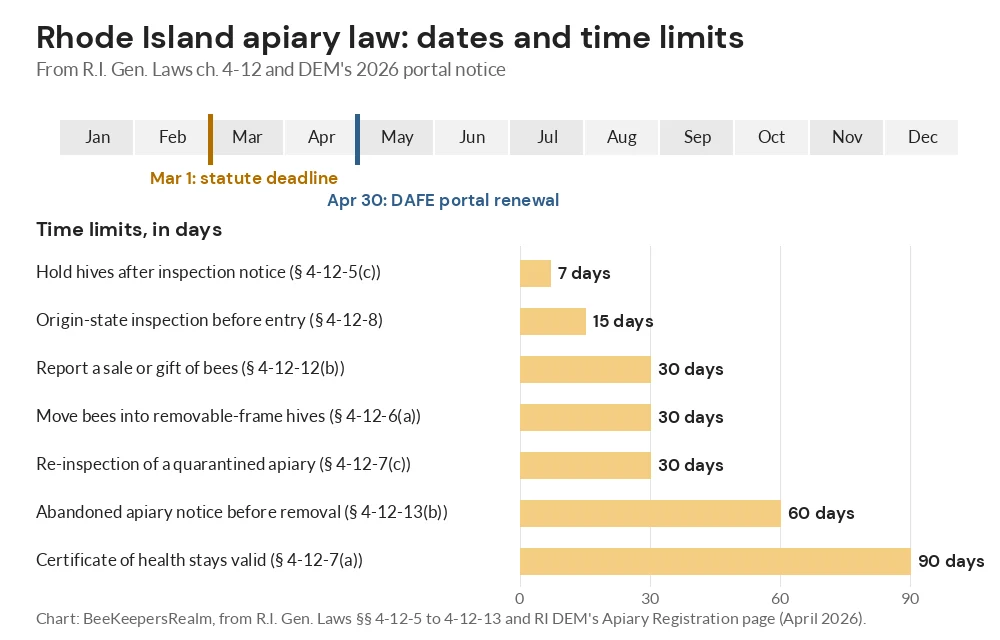
March 1 in the statute, April 30 in the portal
The two dates come from different places. The statute sets March 1 and tells DEM to publish notice of the requirement 14 to 30 days beforehand (§ 4-12-12(c)). DEM’s 2026 notice says the DAFE Application Portal “has a new yearly renewal date of April 30” and that last year’s registrations now expire on April 30. In practice, register before March 1 and before new colonies arrive. If you did not register the previous year, DEM says you must create a new registration; new beekeepers first create a portal profile, then start the apiary registration.
The portal also handles inspection requests and entry permits. In April 2026 DEM listed Tyler Hertzwig (401-537-4279) as the contact for registration questions. For the national picture, see our explainer on state bee inspector programs and apiary registration.
Selling or giving away bees: the 30-day notice
Anyone who “sells, gives, barters, or otherwise transfers” bees, colonies or nuclei must notify DEM in writing within 30 days with the new owner’s name and address (§ 4-12-12(b)), even for a few nucs sold to a club member.
Hive Rules in the Apiculture Law
Removable frames. Bees kept in box hives, logs or other containers without reasonably removable frames are “deemed impossible to inspect” unless the owner exposes the brood. DEM can order the colony moved into a removable-frame hive within 30 days and may destroy it if the order is ignored (§ 4-12-6(a)). A standard Langstroth hive meets this; check with DEM before you build anything unusual.
Owner labels. The law is short and specific:
“Each colony within an apiary shall be identified with the owner’s name and address.”
The label can go outside or between the inner and outer covers.
If you add an out-yard or split heavily, update the locations and colony numbers in your portal record.
There is no statewide setback, hive limit or neighbor-notice rule in Chapter 4-12. Those come from local zoning, covered below.
Inspections, Quarantines and Disease
The DEM director appoints an inspector of apiaries, who may hire deputies (§ 4-12-3). Inspectors must be practical beekeepers or apiculture-trained agricultural graduates, and may not own more than 50 colonies themselves (§ 4-12-4).
- Yearly survey. DEM must inspect 20% of the colonies in 33% of the state’s apiaries each year, or run a statistical survey (§ 4-12-5(a)).
- Inspection on request. A registered beekeeper can ask in writing for an inspection, for a “reasonable fee” (§ 4-12-5(b)). If no disease or pest is found, DEM issues a certificate of health that expires 90 days after the inspection (§ 4-12-7(a)). Buyers in other states may ask for one.
- Seven-day hold. Once you receive written notice of an inspection, you may not move hives, bees or equipment for seven days or until you get the results (§ 4-12-5(c)).
- Quarantine. An apiary with a contagious disease or pest can be quarantined, which bars moving bees, honey, wax or used equipment. If the problem remains at the next inspection, no more than 30 days later, DEM supervises treatment or destruction (§ 4-12-7(b)-(c)).
The statute names American foulbrood in its definition of disease, alongside tracheal mites and Africanized bees as pests (§ 4-12-2). In a state-declared quarantine area, if an owner ignores orders, DEM can do the work itself and place a lien on the property for the cost (§ 4-12-10(e)). If you suspect a problem, our guide on when to call an apiary inspector explains what to report.
A six-member advisory board that includes the Rhode Island Beekeepers Association president advises DEM on disease control and quarantines (§ 4-12-16).
Bringing Bees and Equipment Into Rhode Island
Most new colonies come from out of state, so two sets of rules matter in your first spring.
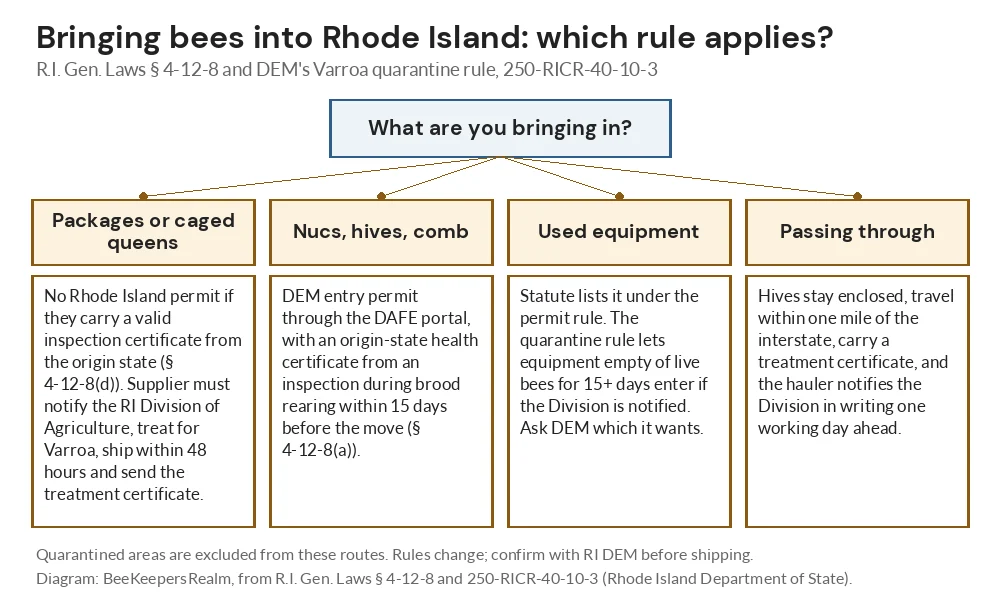
The statute (§ 4-12-8). Bringing in bees, bees on comb, combs or used equipment is unlawful without a DEM permit. The application needs a health certificate from the origin state showing an inspection during active brood rearing within 15 days before the move. Combless packages and queens can enter without a Rhode Island permit if they carry a valid certificate of inspection from the state of origin. Neither route applies to bees from quarantined areas.
The Varroa quarantine rule (250-RICR-40-10-3). This active DEM rule adds conditions:
- Package and queen suppliers must notify the Division of Agriculture of the number of cages and packages and their destination, treat for Varroa, ship within 48 hours of treatment and send a copy of the treatment certificate.
- Bees in hives, nucs or brood comb need the proper anti-Varroa steps before entry.
- Used equipment that has been free of live bees for 15 days or more may enter if the Division is notified. The statute still lists used equipment under its permit rule, so ask DEM which paperwork it wants.
- Migratory hives passing through must stay enclosed, travel within one mile of the interstate highway, and the hauler must notify the Division in writing one working day before the trip.
Before you order, ask your supplier whether they handle the Rhode Island notice, and file your own entry permit in the portal for nucs or full hives. Our comparison of package bees vs nucs covers the practical choice.
City and Town Beekeeping Rules
State registration does not settle where you can put a hive; cities and towns control that through zoning. Two examples with written beekeeping provisions:
Providence: rear yards, 10 feet back
The Providence Zoning Ordinance (Chapter 2014-39, No. 513, in the edition with amendments through May 2016) treats an apiary as an accessory structure under § 1302.C. As written:
- No building permit is needed.
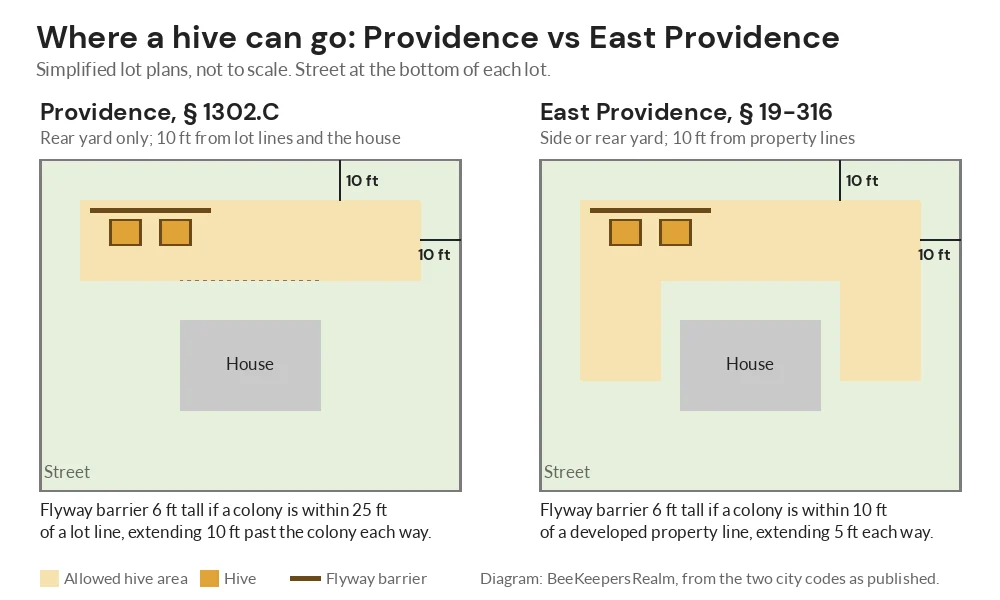
- Apiaries are allowed only in the rear yard, at least 10 feet from any lot line and from the principal building.
- Colonies must be in removable-frame hives kept in sound condition.
- Any colony within 25 feet of a lot line needs a flyway barrier at least 6 feet tall (hedge, fence or wall), parallel to the lot line and extending 10 feet past the colony on each side.
- Bees need water at all times; aggressive or swarm-prone colonies must be requeened.
Confirm with the city that no later amendment changed § 1302.C.
East Providence: a zoning certificate first
East Providence Code Chapter 19, Division 13 (§§ 19-316 and 19-317) allows beekeeping as an accessory use in all zoning districts, with conditions.
“No one shall engage in apiculture without first obtaining a zoning certificate as provided for in this section.”
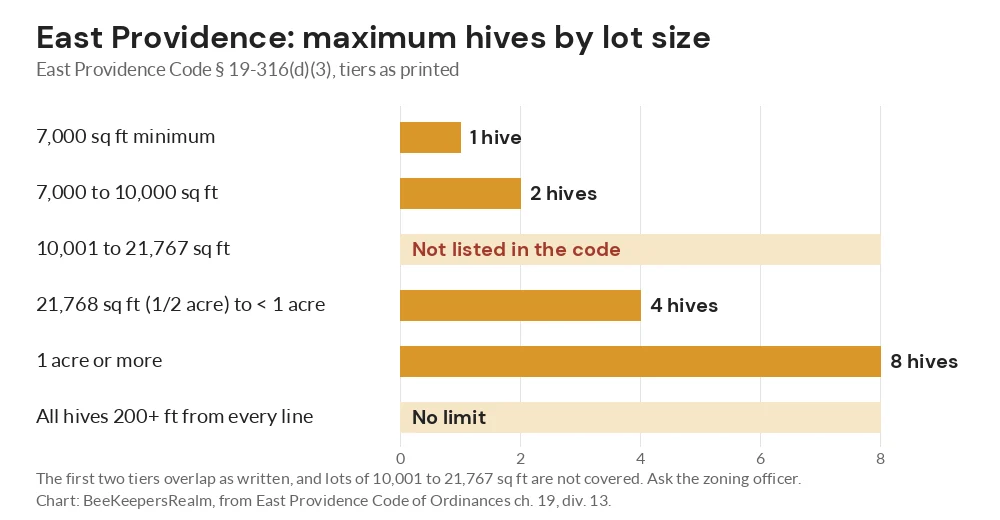
The application needs proof of DEM registration and a site plan showing setbacks, flyway fencing and water. The certificate is recorded in the city’s land evidence records at your expense, and each year you must send your DEM registration to the zoning officer and animal control officer. Hives go in a side or rear yard at least 10 feet from property lines; a colony within 10 feet of a developed property line needs a 6-foot flyway barrier extending 5 feet beyond the hive each way. Colonies must have marked queens (see our queen marking color chart).
| Lot size (East Providence § 19-316(d)(3), as printed) | Maximum hives |
|---|---|
| Minimum of 7,000 sq ft | 1 |
| Minimum of 7,000 sq ft but 10,000 sq ft or less | 2 |
| One-half acre (21,768 sq ft) to under 1 acre | 4 |
| 1 acre or larger | 8 |
| All hives at least 200 ft from every property line | No limit |
As printed, the first two tiers overlap, and lots between 10,001 and 21,767 square feet are not listed. If your lot falls in that range, ask the zoning officer how it is applied before you buy bees.
Everywhere else
An undated DEM-hosted presentation by Donald Joslin, then president of the Rhode Island Beekeepers Association, noted that Barrington specifically allows beekeeping. Many towns have no dedicated section, so ask your zoning office whether hives are an allowed accessory use, what setbacks apply and whether you need a permit. Then read our guide to how close beehives can be to neighbors and give bees a reliable water source so they stay out of the neighbors’ pools. In dense neighborhoods, talking to neighbors first helps.
Selling Honey in Rhode Island
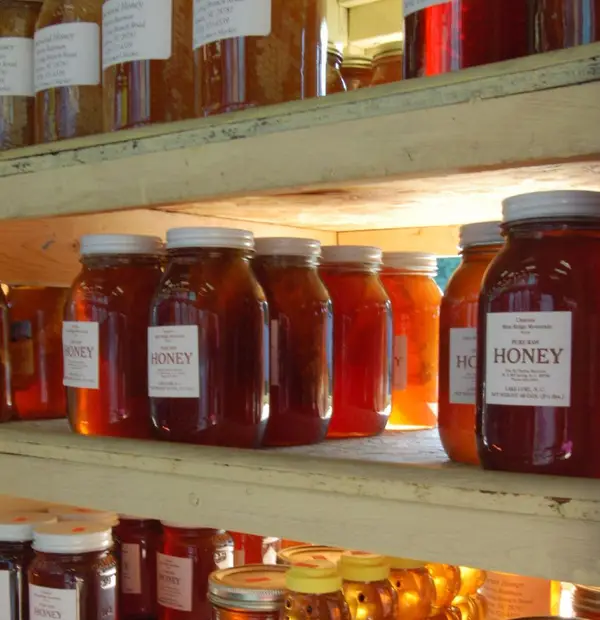
Many guides assume honey falls under a cottage food law. Rhode Island’s statutes do not say so.
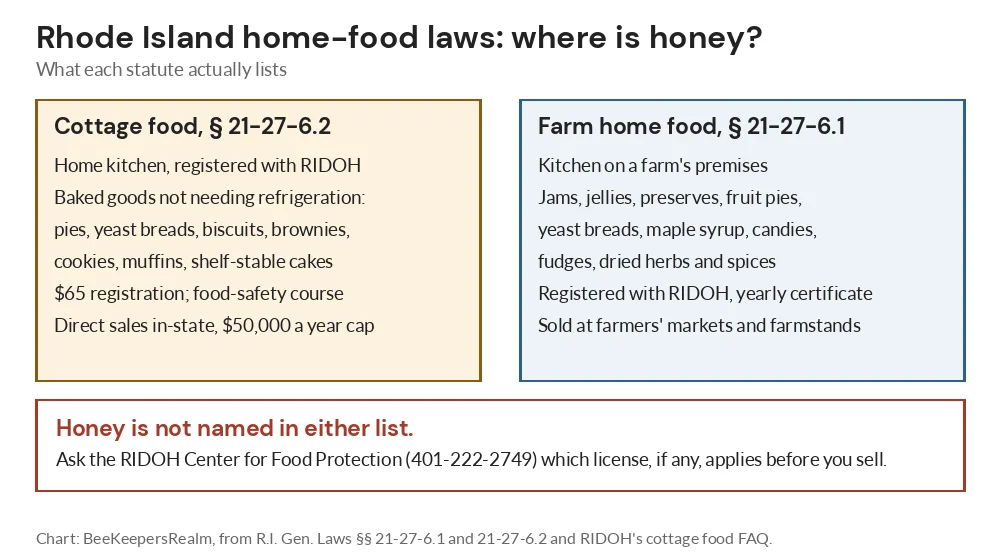
- Cottage food (§ 21-27-6.2). The Department of Health (RIDOH) registers home kitchens to make baked goods that do not need refrigeration: double crust pies, yeast breads, biscuits, brownies, cookies, muffins and shelf-stable cakes, plus other goods “as defined by the department.” Registration costs $65, needs food-safety training and a notarized kitchen affidavit, and sales are capped at $50,000 a year, direct to consumers in-state.
- Farm home food (§ 21-27-6.1). This covers a registered kitchen on a farm’s premises selling at farmers’ markets, farmstands and farm-run stores. Its list names jams, jellies, fruit pies, yeast breads, maple syrup, candies and dried herbs. Honey is not named.
Neither list mentions honey, and we found no RIDOH page that assigns it to either path. RIDOH’s cottage food FAQ tells producers with questions about a specific item to call the Center for Food Protection at 401-222-2749. Ask them in writing whether raw honey you extract and bottle needs a license, and whether market sales need the retail food peddler license RIDOH requires of cottage-food vendors.
Federal labeling rules apply whichever path RIDOH puts you on; our guide to honey labeling requirements covers what goes on the jar, and how to start selling honey legally walks through the business side.
First-Year Compliance Checklist
- Call your town’s zoning office; in East Providence, apply for the zoning certificate.
- Create a DAFE portal profile and register your apiary before bees arrive, ideally before March 1.
- Confirm your supplier’s Rhode Island paperwork; file an entry permit for nucs or hives.
- Use labeled, removable-frame hives sited to local setbacks, with water and any required flyway barrier.
- Renew the registration every year by April 30 and update colony numbers.
- Notify DEM in writing within 30 days of selling or giving away bees.
- Ask RIDOH before selling honey.
Frequently Asked Questions
Do hobbyist beekeepers have to register hives in Rhode Island?
Yes. Section 4-12-12 covers all apiaries, and one colony counts as an apiary.
How much does it cost to register beehives in Rhode Island?
The statute sets no registration fee and DEM’s apiary page lists none; owner-requested inspections carry a “reasonable fee” (§ 4-12-5(b)).
When is the Rhode Island apiary registration deadline?
The statute says March 1; DEM’s DAFE portal renews registrations by April 30. Registering before March 1 meets both.
Who inspects beehives in Rhode Island?
An inspector of apiaries appointed by the DEM director (§ 4-12-3). Request an inspection through the DAFE portal.
Can I keep bees in Providence?
Yes, under Zoning Ordinance § 1302.C: rear yard only, 10 feet from lot lines and the house, with a 6-foot flyway barrier within 25 feet of a lot line. Confirm the current text with the city.
Do I need a permit to bring bees into Rhode Island?
For nucs, hives or comb, yes: a DEM entry permit plus an origin-state health certificate (§ 4-12-8). Certified packages and queens skip the permit, but suppliers must follow the Varroa quarantine rule.
Do I have to tell my neighbors before keeping bees?
State law does not require it, but some cities regulate siting.
What happens if I don’t register?
Violating Chapter 4-12 is a misdemeanor with a fine of up to $1,000 (§ 4-12-17), and long-unregistered colonies can be treated as abandoned.
Before You Order Bees
Do the paperwork in this order: town zoning, DEM registration, then supplier paperwork. If you keep an out-yard over the state line, compare Massachusetts beekeeping laws and Connecticut’s rules, since each state registers its own apiaries.


.jpg)
