Reviewed by Sofia T. · Last Updated October 13, 2026 · How we review
If you keep 50 or fewer colonies for pleasure, Idaho does not require you to register them and charges you no state fee or honey tax. Commercial beekeepers register with the Idaho State Department of Agriculture (ISDA) by July 1 each year, paying $10 for the first 50 colonies, 10 cents for each extra colony and a 5-cent-per-colony honey tax. ISDA inspects for bee disease. Where your hives may sit is a city matter: Boise allows three colonies per quarter acre, Idaho Falls makes you register every hive with its animal shelter, and Hailey bans hives on lots under 8,000 square feet. Since March 20, 2026, honey sold straight to consumers needs no state food license if buyers get the required notice.
Legal note: This is educational information, not legal advice. We checked every rule below against official sources on October 13, 2026: the ISDA Apiary Program, Idaho Code Title 22, Chapters 25 and 28, the current Idaho Administrative Code, and each city’s own code. Laws and fees change, so confirm with ISDA or your city before you act.
Key Takeaways
- Idaho Code 22-2502 defines a hobbyist beekeeper as someone who keeps bees “for pleasure” with no more than 50 colonies. Hobbyists are exempt from the registration fee and the honey tax.
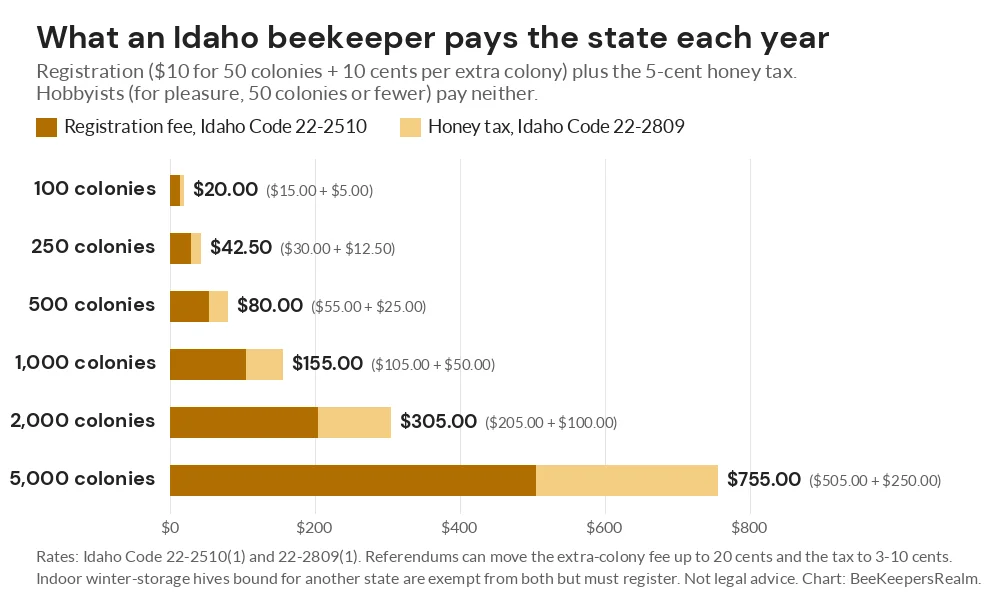
- Everyone else pays $10 for up to 50 colonies plus 10 cents per extra colony (22-2510), and 5 cents per colony in honey tax (22-2809), due by July 1.
- Idaho’s bee rules were folded into IDAPA 02.06.02 in 2023. The old rule requiring posted owner details at every apiary, and the old $15-an-hour inspection fee, are no longer in it, though many guides still cite them.
- Hives brought in for indoor winter storage need an ISDA permit before transport. They are exempt from fees and tax but must still be registered.
- Honey sold directly to consumers falls under the Idaho Direct-to-Consumer Commerce Act: no license, but a set notice plus your name and contact details.
Table of Contents
- Do You Have to Register Bees in Idaho?
- What Registration and the Honey Tax Cost
- Who Inspects Beehives in Idaho?
- The 2023 Rule Change Most Guides Missed
- Moving Bees Into, Through or Out of Idaho
- Penalties, Civil Fines and Hive Seizure
- City Rules: Boise, Idaho Falls and Hailey
- Selling Honey in Idaho
- Frequently Asked Questions
- The Bottom Line
Do You Have to Register Bees in Idaho?
Only if you are not a hobbyist. Idaho’s bee law is Title 22, Chapter 25 of the Idaho Code (the Bee Inspection chapter), and its definitions section, 22-2502, sets two tests for a hobbyist beekeeper: you manage honey bees “for pleasure,” and your stock does not exceed 50 colonies. Section 22-2510 then exempts hobbyists from the registration fee. ISDA’s program page states the requirement this way:
“All commercial beekeepers with more than 50 colonies are required to register their bees with the Idaho State Department of Agriculture and pay a registration fee along with a honey advertising tax on each colony of bees.”
The same page says registration is “highly recommended” for hobbyists. The current rule, IDAPA 02.06.02, Section 340, sets the deadline: on or before July 1 each year, file ISDA’s registration form with your name, residence, apiary locations and number of colonies, plus the fee. Registration is done online through ISDA’s licensing portal, and the department lists Plant Industries at (208) 332-8621 for renewal questions.
A gray area for small sellers
The hobbyist test has two parts, and most guides only mention the colony count. The statute defines a commercial beekeeper as one who manages bees “for their products and for pollination services.” If you keep 20 colonies and sell honey at a farmers market, you are under the 50-colony line but arguably not keeping bees only “for pleasure.” ISDA’s own page frames mandatory registration around more than 50 colonies, and we found no published ISDA ruling on small sellers. If that describes you, ask Plant Industries before assuming you are exempt; the full fee for up to 50 colonies is $10.
Why hobbyists often register anyway
Registration puts you on a list the law does something with. Under Idaho Code 22-2508, ISDA gives the names, phone numbers and counties of registered beekeepers to registered pesticide applicators, abatement and pest control districts, and University of Idaho county extension offices, to help prevent accidental poisoning of honey bees. Section 22-2809 also lets a hobbyist pay a voluntary $10 a year to register with the Idaho honey commission and appear on its lists. For other ways to warn sprayers, see our guide to DriftWatch and BeeCheck pesticide registries.
What Registration and the Honey Tax Cost
A commercial Idaho beekeeper pays two separate state charges set by two different chapters. The registration fee in Idaho Code 22-2510 funds bee inspection. The tax in 22-2809, part of the Honey Industry Act (Chapter 28), funds the Idaho honey commission’s promotion, research and education work. Both carry the same hobbyist exemption, and the tax section says so directly:
“Hobbyist beekeepers, as defined in chapter 25, title 22, Idaho Code, are exempt from taxation under this section.”
| Charge | Amount | Who pays | Law |
|---|---|---|---|
| Registration fee | $10 for up to 50 colonies, plus $0.10 per colony over 50 | Non-hobbyist beekeepers, and those bringing bees into Idaho | Idaho Code 22-2510(1) |
| Honey tax | $0.05 per hive or colony, imposed July 1 | Every non-exempt colony, not just those over 50 | Idaho Code 22-2809(1) |
| Voluntary hobbyist registration | $10 a year | Hobbyists who want to support the honey commission and be listed | Idaho Code 22-2809(1) |
| Requested inspections | Set by rule; no amount is published in the current rules | The person requesting the inspection | Idaho Code 22-2503 |
Two details are easy to miss. First, both rates can change by referendum of registered Idaho beekeepers at the annual meeting of the Idaho Honey Industry Association: the per-colony registration charge can rise to no more than 20 cents, and the tax can move between 3 and 10 cents. Second, unpaid fees and taxes become a lien on the beekeeper’s bees, equipment and honey. The tax notice goes out by June 1 and payment is due by July 1.
Who Inspects Beehives in Idaho?
ISDA does, through the director of agriculture and his agents. Section 22-2501 explains why the program exists: Idaho beekeepers need inspections and certification to ship bees to other states for pollination, and the state wants to limit bee pests and diseases at home. ISDA asks beekeepers to schedule inspections through its field offices: Treasure Valley at (208) 332-8650 and Magic Valley at (208) 736-2195. Under 22-2503, the person who requests an inspection pays for it under a fee schedule set by rule.
The director’s powers apply to every beekeeper, hobbyist or not:
- Right to enter. Section 22-2506 lets the director enter any beekeeper’s premises where bees or equipment are kept and inspect them. Resisting or refusing is a misdemeanor.
- Investigation and abatement. Under 22-2504, the director investigates reports of a transmissible disease or exotic strain and may order abatement, including destroying infested bees and equipment. Infested colonies may not leave the premises without his written permission.
- Owner’s duty. Section 22-2505 makes it a misdemeanor to ignore the director’s instructions to cure the disease or destroy the bees, hives and equipment within the time he sets.
The diseases covered are listed in IDAPA 02.06.02, Section 310: American foulbrood, European foulbrood, sac brood and bee paralysis, Varroa mite, tracheal mite, and “any other disease or abnormal condition” of honey bee eggs, larvae, pupae or adults. If you are unsure what you are looking at, our guide to American vs. European foulbrood shows the differences, and our overview of state bee inspector programs explains how Idaho compares with states that inspect every apiary.
The 2023 Rule Change Most Guides Missed
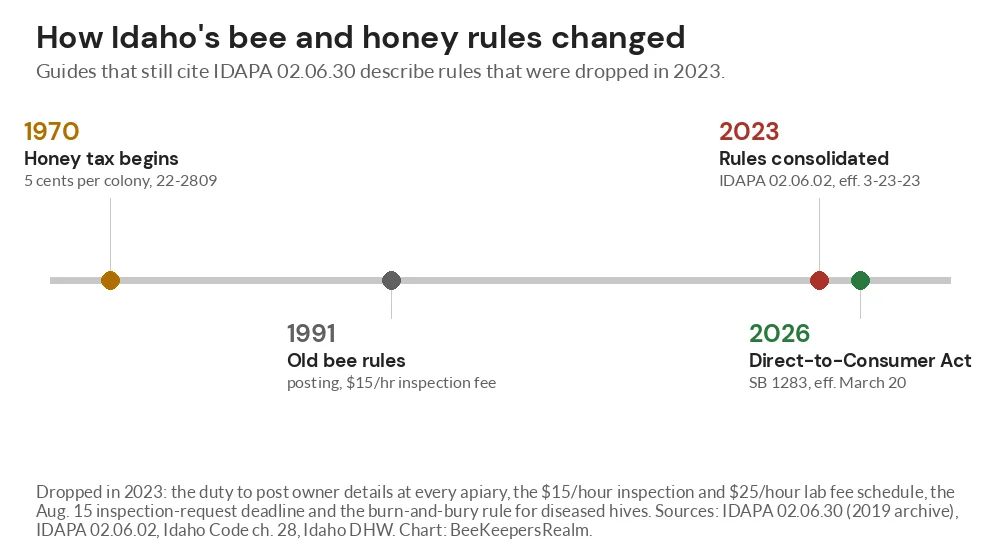
Many Idaho bee law summaries, including earlier versions of this page, describe rules from IDAPA 02.06.30, “Rules Under the Idaho Bee Inspection Law.” That chapter is now archived. Idaho moved its bee rules into IDAPA 02.06.02, “Rules Governing Registrations and Licenses”, Subchapter B, Bee Inspection, with sections dated March 23, 2023. The new subchapter has only three sections, on regulated diseases, regulated products and registration. Comparing the 2019 archived text with the current rule shows what was not carried over:
| Provision | Old IDAPA 02.06.30 | Current IDAPA 02.06.02 |
|---|---|---|
| Posting at the apiary | Every apiary posted with owner’s name, address, phone and state registration number (150.03) | No posting rule |
| Inspection fees | $15 per hour plus travel; $25 per worker-hour for lab work (300) | No fee amounts listed |
| Inspection requests | Due August 15; no inspections after November 15 (150.01) | No deadline in the rule |
| Diseased hives | Treat with registered products or burn and bury under 18 inches of soil (200.01) | Director’s orders under Idaho Code 22-2504 and 22-2505 |
| Registration by July 1 | Yes (100) | Yes (340) |
So if a source tells you Idaho law requires a sign with your contact details at every apiary, it is citing a dropped rule. Labeling your hives is still wise. Idaho Code 22-2512(3) lets ISDA seize hives that lack the owner’s identifying information and registration numbers, and Idaho Falls and Hailey require a name and phone label on every hive.
Moving Bees Into, Through or Out of Idaho
Idaho’s bee law has separate rules for colonies that cross the state line, depending on why they are moving.
- Winter storage. ISDA requires a Temporary Winter Storage Permit, submitted before you transport hives into Idaho. The form asks where the bees will be stored and the estimated arrival and departure dates; attaching an inspection certificate is recommended but not mandatory. Under 22-2510(4) and 22-2809, hives stored indoors before moving to another state for pollination or honey are exempt from the fee and tax, but you must still register the storage location, dates, your contact details and an in-state contact. Our guide to indoor overwintering covers how this storage works.
- Any other purpose. ISDA’s permit page says bees moved in for anything other than temporary winter storage must be registered and pay all applicable fees.
- Passing through. Section 22-2507 says colonies in transit through Idaho must be netted while in the state and may not be unloaded without full compliance with Idaho law. The same section allows a registered beekeeper to move hives across the state line between his own apiaries.
- Shipping to California. ISDA and the California Department of Food and Agriculture run a pre-shipment inspection program. Inspections are scheduled in early December, and certified colonies get expedited entry, skipping inspection at California’s border stations. The inspection must take place no more than 30 days before shipping for colonies stored outside, or 60 days for indoor storage.
Penalties, Civil Fines and Hive Seizure
Idaho Code 22-2512 sets the penalties for violating the bee chapter:
- Criminal: a misdemeanor, with a fine of $100 to $1,000, three to 12 months in county jail, or both.
- Civil: up to $100 per offense, plus reasonable attorney’s fees, but only after notice and a chance for a hearing.
- Seizure: ISDA may seize bees and equipment brought in by a nonresident in violation of the law, kept on land without the owner’s permission, or lacking the owner’s identifying information and registration numbers. If unclaimed and not brought into compliance within 90 days, they may be sold at a sealed-bid auction.
The same section says the director does not have to prosecute minor violations when a warning serves the public better.
City Rules: Boise, Idaho Falls and Hailey
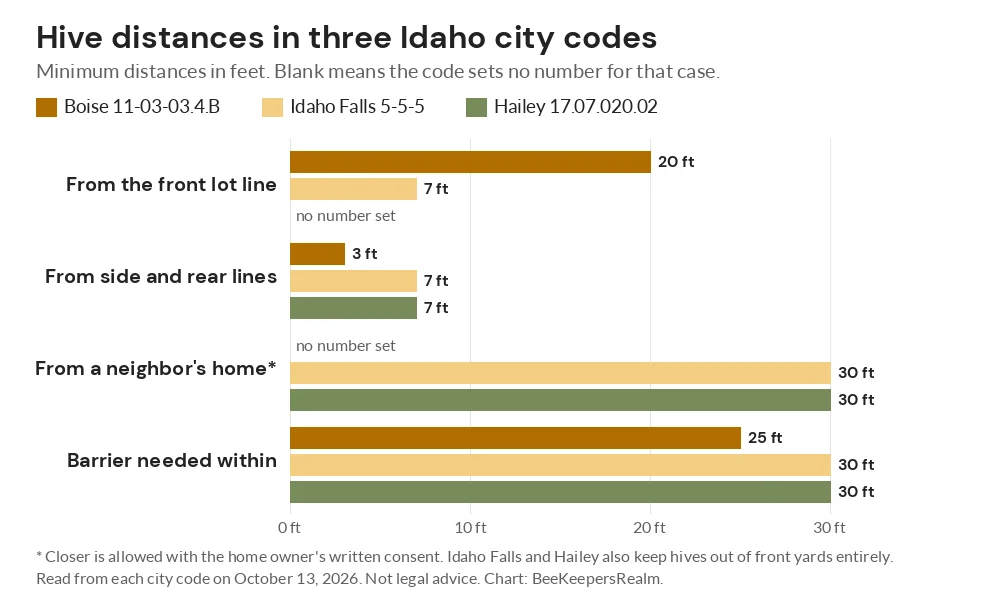
State law says nothing about how many hives you can keep in a backyard or how far they must sit from a fence. Cities decide that, and the three codes we read differ a lot. For the general approach, see our beekeeping zoning laws guide.
| Rule | Boise (11-03-03.4.B) | Idaho Falls (5-5-5) | Hailey (17.07.020.02) |
|---|---|---|---|
| Smallest lot allowed | No minimum | No minimum stated | 8,000 sq ft |
| Hive limit | 3 colonies per 1/4 acre, plus 1 nucleus per 2 colonies | 2 on lots of 8,000 sq ft or less; 3 on 12,000 to 20,000; up to 5 on 1/2 acre or more | 2 on 8,000 to 11,999 sq ft; 3 on 12,000 to 21,779; 5 on 1/2 acre or more |
| Where on the lot | 20 ft from front lines, 3 ft from other lines | Side or rear yard; 7 ft from any lot line | Side or rear yard, or rooftop; 7 ft from others’ property |
| Near a neighbor’s home | No set distance | 30 ft from homes, decks, pools and play equipment unless the owner consents in writing | 30 ft from a dwelling unless the owner consents in writing |
| Barrier | 6 ft flyway barrier if within 25 ft of a lot line | 6 ft by 20 ft barrier if within 30 ft of a lot line | 6 ft by 20 ft barrier if within 30 ft of others’ property |
| Registration and labels | Contact info posted if hives are on a vacant lot | Register every hive with the city Animal Shelter; name and phone on every hive | Name and phone on every hive |
Sources: Boise City Code 11-03-03.4.B on American Legal Publishing (code current through June 9, 2026); Idaho Falls City Code Title 5, Chapter 5; Hailey City Code 17.07.020.02 (Ord. 1191, 2015). Read October 13, 2026.
Boise
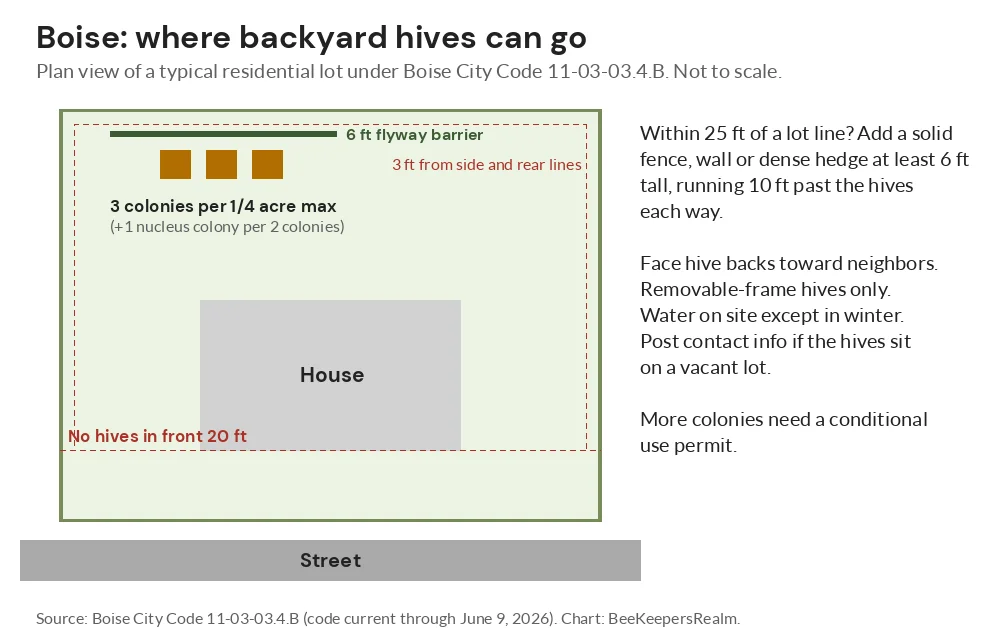
Boise’s zoning code lists accessory beekeeping in every zoning district, subject to standards. There is no minimum lot size, but density is capped at three colonies per quarter acre, and more needs a conditional use permit. Hive backs must face neighboring properties, and the code bans keeping Africanized bees, wasps and hornets. A colony that turns unusually aggressive must be destroyed or requeened. A flyway barrier must extend 10 feet past the apiary in each direction. HOA covenants can be stricter than the city; our guide to beekeeping and HOAs explains how to ask for approval.
Idaho Falls
Idaho Falls has the only city hive registration we found: every beekeeper must register each hive with the city’s Animal Shelter, giving name, mailing address, phone and each hive’s address. Hives must sit at least 6 inches off the ground and are not allowed in commercial or industrial zones. One quirk: the hive-limit text covers lots of 8,000 square feet or less and lots of 12,000 to 20,000, but gives no number for lots in between or from 20,000 square feet to half an acre, so ask the city if your lot falls in a gap.
Hailey
Hailey adopted its rules in 2015 and is the strictest of the three on small lots: no apiary at all under 8,000 square feet. Rooftop hives are allowed if they cannot be seen from the street, and the city may inspect at any time and remove non-compliant hives as a nuisance. Whatever your city, our guide on how close beehives can be to neighbors covers placement habits that prevent complaints.
We did not review codes for Meridian, Nampa, Pocatello or Coeur d’Alene. If you live there, search your city code for “bees” or “apiary,” or call the planning department.
Selling Honey in Idaho
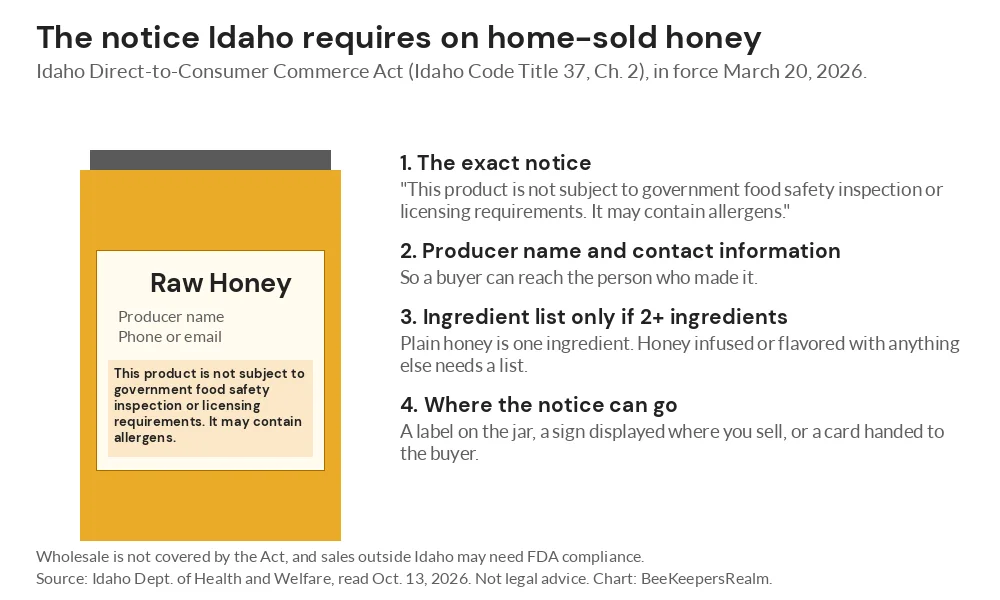
Idaho changed its rules for home food sales in 2026. Senate Bill 1283 created the Idaho Direct-to-Consumer Commerce Act, a new Chapter 2 of Title 37 of the Idaho Code, effective March 20, 2026. According to the Idaho Department of Health and Welfare, it replaces the old cottage food rule in IDAPA 16.02.19. Producers selling under the Act need no state food license, but must tell each buyer, by a displayed sign, a label or a card, that:
“This product is not subject to government food safety inspection or licensing requirements. It may contain allergens.”
The notice must also give the producer’s name and contact information, plus an ingredient list if the product has two or more ingredients. Plain honey is one ingredient; honey infused with herbs or fruit is not. The department adds that wholesale operations are not exempted by the Act and that selling food outside Idaho may need FDA approval. Under the Act’s “designated agent” model, a store can sell your honey on consignment if it keeps it separate from inspected stock, according to summaries by the South Central Public Health District and the Farm-to-Consumer Legal Defense Fund. Confirm the details with your local public health district.
Honey is also covered by the Honey Industry Act. Section 22-2807 directs the Idaho honey commission to set honey quality, identity and labeling standards by rule, and 22-2810 lets the commission or ISDA sample retail honey after a written complaint. Federal labeling rules still apply; see our guides to honey labeling rules and selling honey legally.
Frequently Asked Questions
Do I need a permit to keep bees in Idaho?
Not from the state if you are a hobbyist with 50 or fewer colonies. Commercial beekeepers register with ISDA by July 1. Your city may add rules: Idaho Falls requires registering each hive with its Animal Shelter.
How many beehives can I have in my backyard in Idaho?
The state sets no limit. Boise allows three colonies per quarter acre, Idaho Falls two to five depending on lot size, and Hailey two to five, with none on lots under 8,000 square feet.
Is there a tax on beehives in Idaho?
Yes, for non-hobbyists: 5 cents per colony each year under Idaho Code 22-2809, on top of the registration fee of $10 for up to 50 colonies plus 10 cents per extra colony.
Who do I call for a beehive inspection in Idaho?
ISDA’s field offices: Treasure Valley at (208) 332-8650 or Magic Valley at (208) 736-2195. The person requesting an inspection pays for it.
Can I sell honey from home in Idaho without a license?
Yes, directly to consumers in Idaho, under the Direct-to-Consumer Commerce Act in force since March 20, 2026. Give buyers the required notice with your name and contact details. Wholesale sales are not covered.
Do I need a permit to bring bees into Idaho?
For winter storage, yes: submit ISDA’s Temporary Winter Storage Permit before transport. Bees brought in for other purposes must be registered and pay fees, and bees passing through must be netted.
Do I have to put my name on my hives in Idaho?
The state rule requiring posted contact details was dropped in 2023, but ISDA can seize hives without owner identification, and Idaho Falls and Hailey require a name and phone label on every hive.
The Bottom Line
Most Idaho hobbyists owe the state nothing, so your city code is the rule to read first. If you sell honey or keep more than 50 colonies, register with ISDA before July 1. For other states, see our U.S. beekeeping regulations by state.
Related Reading
Image credits: Photo: An Errant Knight, Wikimedia Commons, CC BY-SA 4.0.