

Reviewed by Michael R. · Last Updated October 23, 2026 · How we review
No, Texas does not require you to register your bees or get a permit to keep them. The Texas Apiary Inspection Service (TAIS), part of Texas A&M AgriLife Research, enforces the state’s bee law and offers an optional $35 Beekeeper Registration, which you do need to remove bees from buildings legally. Hive limits and setbacks come from your city, county or HOA, not the state. Since September 1, 2025, you can sell raw, unblended honey from your own bees without being treated as a food establishment, and the old 2,500-pound cap is gone.
Educational information only, not legal advice. Check the TAIS regulations page and your city or county before you act. Sources checked October 23, 2026.
This guide works from the statutes themselves: Agriculture Code Chapter 131, the TAIS rules in Title 4, Chapter 71 of the Texas Administrative Code, and the tax, occupations and health codes that touch beekeeping. New to bees? Start with our guide to starting beekeeping in Texas. For other states, see beekeeping regulations by state.
Key Takeaways
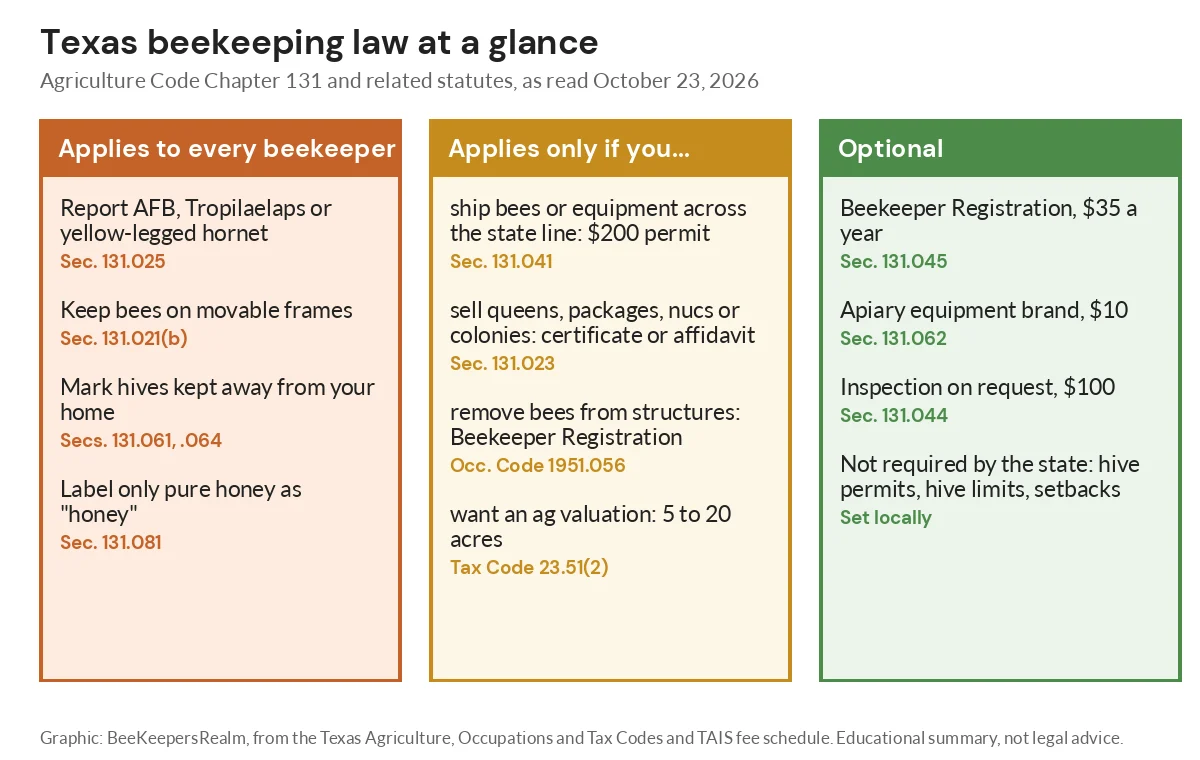
- Registration is optional ($35, valid September 1 to August 31), but you need it to remove bees from structures without a pest control license (Occupations Code § 1951.056).
- Every beekeeper must report American foulbrood, Tropilaelaps mites and the yellow-legged hornet, keep bees on movable frames, and mark hives kept away from home (Agriculture Code §§ 131.025, 131.021, 131.061).
- Shipping bees or equipment into or out of Texas needs a $200 interstate permit. Moving hives between Texas counties has needed no permit since September 1, 2023.
- Most violations are Class C misdemeanors, with fines up to $500. Breaking the honey label rules is a Class B misdemeanor.
- Bees can qualify 5 to 20 acres for the 1-d-1 agricultural valuation. Your county appraisal district sets how many hives that takes.
Table of Contents
- Who Makes and Enforces Texas Bee Law
- Do You Have to Register?
- Removing Bees From Buildings
- Bringing Bees Into or Out of Texas
- Selling Queens, Packages and Nucs
- Reportable Pests, Inspections and Quarantines
- Hive Marking, Brands and Movable Frames
- Penalties Under Chapter 131
- Selling Honey After the 2025 Change
- City, County and HOA Rules
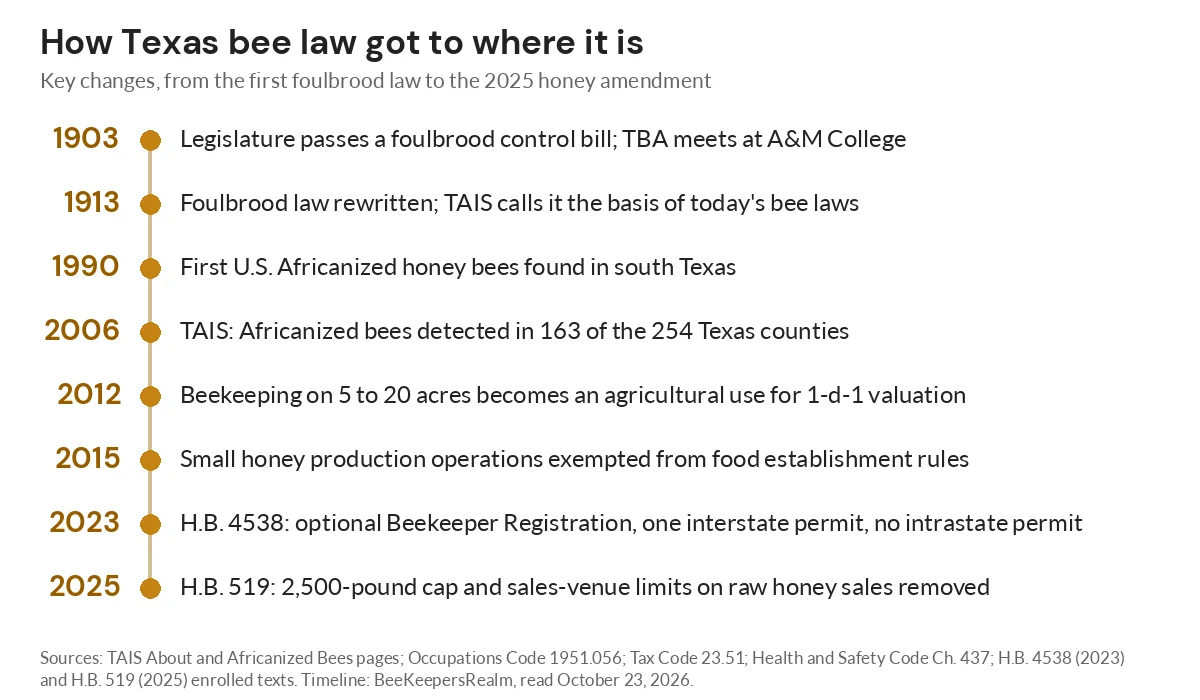
- Africanized Bees: No State Zone Today
- Bees and the 1-d-1 Ag Valuation
- TAIS Fees
- Frequently Asked Questions
- The Bottom Line
Who Makes and Enforces Texas Bee Law
Several bodies share the job. TAIS enforces the bee rules in Agriculture Code Chapter 131. Its chief apiary inspector is appointed by the director of Texas A&M AgriLife Research (§ 131.002), and the TAIS contacts page lists Angela Steinhauer in that post. The Department of State Health Services enforces the honey labeling rules (§ 131.101). County appraisal districts decide agricultural valuation, and cities, counties and HOAs decide where hives may go.
| Topic | Rule | Where it is | Who handles it |
|---|---|---|---|
| Registration | Optional, $35 a year | Ag. Code § 131.045; 4 TAC § 71.24 | TAIS |
| Bee removal | Registration needed for the pest control exemption | Occ. Code § 1951.056 | TAIS registers; pest control licensing is separate |
| Interstate shipments | $200 permit plus inspection certificate | § 131.041; 4 TAC § 71.9 | TAIS |
| Selling bees | Certificate or affidavit with each sale | § 131.023 | TAIS |
| Disease reporting | AFB, Tropilaelaps, yellow-legged hornet | § 131.025 | TAIS |
| Hive identification | Name, brand or sign away from home | §§ 131.061-131.064 | TAIS |
| Honey labels | Only pure honey may be called honey | §§ 131.081-131.084 | DSHS |
| Honey sales | Honey production operation exemption | Health & Safety Code §§ 437.0197-437.01991 | Local health departments barred |
| Ag valuation | 5 to 20 acres of beekeeping | Tax Code § 23.51(2) | County appraisal district |
| Hive limits, setbacks | None at state level | City codes, deed restrictions | Cities, counties, HOAs |
Do You Have to Register?
No. Texas is a voluntary-registration state, and TAIS says so on its regulations page:
“The beekeeping laws in Texas are limited. The state of Texas does not require a beekeeper to register.”
Section 131.045 says each beekeeper “may register” every year. A registration expires on the August 31 after it is issued, whenever you sign up, and must list the counties where you keep bees. TAIS charges $35. It can ask for a map of your apiaries, and the statute makes that map a trade secret under Chapter 552 of the Government Code that may not be disclosed.
Older guides describe a free, one-time “apiary registration.” That ended on September 1, 2023, when H.B. 4538 took effect; TAIS’s ag valuation page says the Beekeeper Registration replaced it. The same law deleted “six or more” from the definition of an apiary, so an apiary is now any place where colonies or nuclei are kept (§ 131.001(2)).
Registration still pays off in three cases: you remove bees for pay, you want a dated record of hives for your appraisal district, or you want a registered brand. To compare Texas with states where registration is mandatory, see our guide to state bee inspector programs and apiary registration.
Removing Bees From Buildings
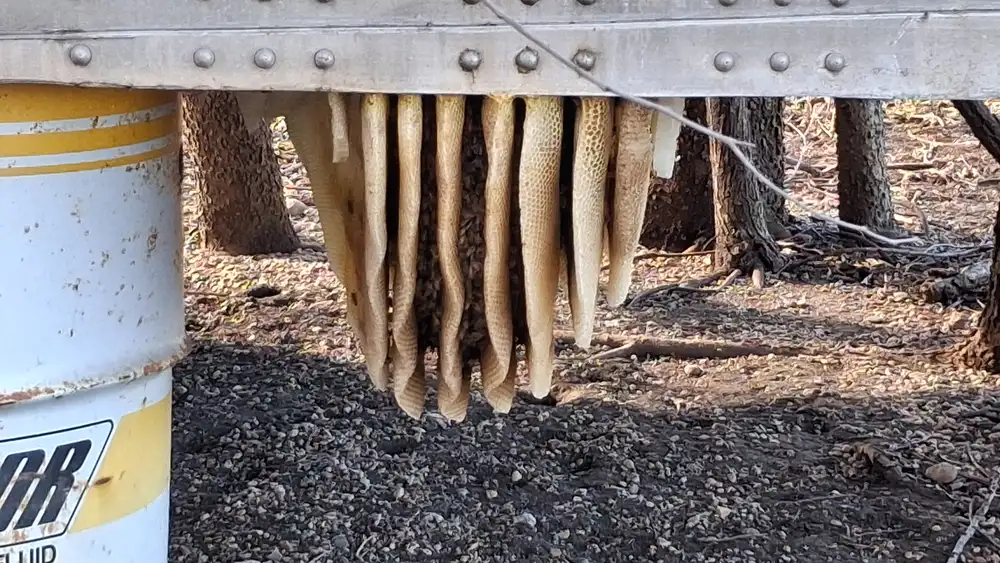
Section 1951.056 of the Occupations Code takes a beekeeper outside the Structural Pest Control Act only when all three conditions hold: the beekeeper is registered with the chief apiary inspector, uses no pesticides or electrical devices other than conventional bee smokers or beekeeping equipment, and is collecting, removing or destroying honey bees. TAIS states it directly: to legally remove bees in Texas, a beekeeper “must maintain a current beekeeper registration with TAIS.”
To be listed publicly, file the free Bee Removal Statement with your registration. On October 23, 2026, we counted TAIS’s Bee Removal list (dated October 22). It held 279 distinct name-and-phone listings and 2,180 county entries, since most removers list several counties. Travis County had the most entries (46), followed by Harris (40). TAIS stresses that it does not license or issue permits for bee removal and has no information on removers’ qualifications. One oddity: the list’s disclaimer still cites § 131.043(b), a section H.B. 4538 repealed; registration now sits in § 131.045.
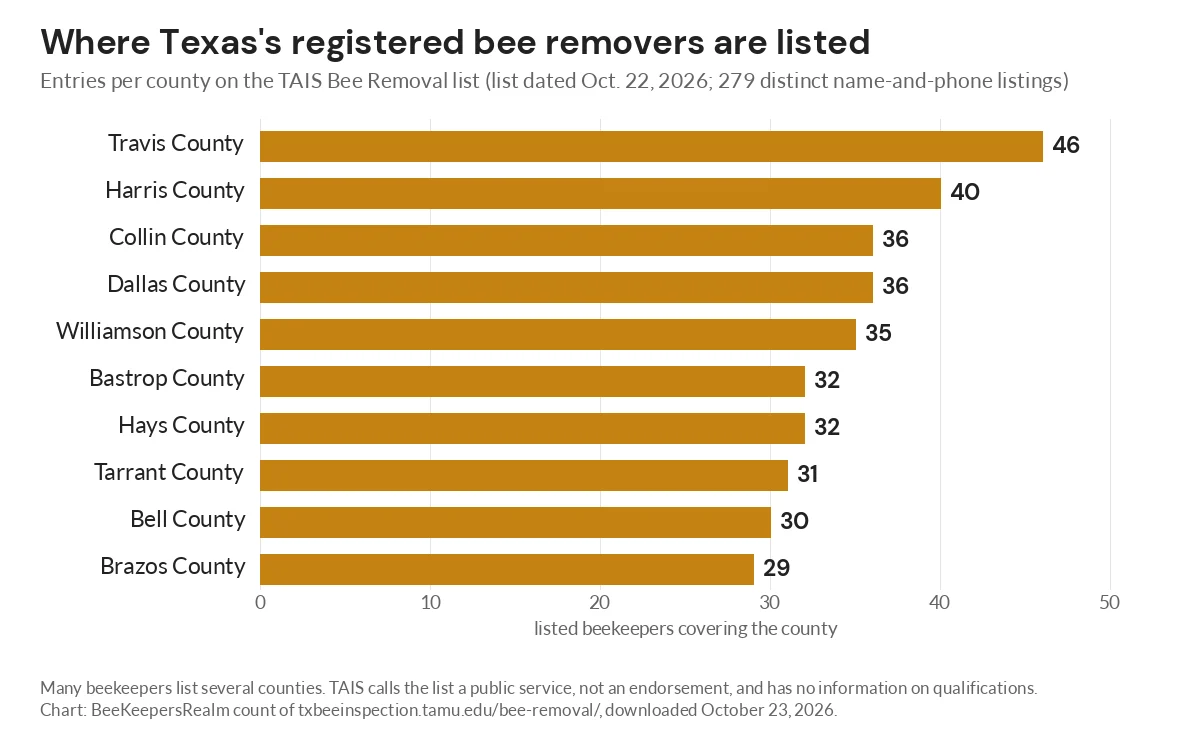
Pricing, insurance and equipment are covered in our guide to starting a bee removal business.
Bringing Bees Into or Out of Texas
Section 131.041 bars anyone from shipping bees or equipment into or out of Texas without a permit from the chief apiary inspector. The details:
- One permit covers all of a beekeeper’s shipments and expires August 31. TAIS charges $200.
- If you do not already hold a permit, apply before the 10th day preceding the shipment.
- Bees coming in need a certificate from the origin state’s official apiary inspector or entomologist, or a Texas inspection, based on an inspection no more than 12 months before shipment. From a place with no apiary inspector, you may offer other evidence, or ship under quarantine and have the bees inspected within 30 days of arrival.
- Shipments of package bees are exempt (§ 131.041(g)).
- TAIS says commercial operations need a state health inspection to cross state lines, and its certificates are valid for one year from the inspection date (4 TAC § 71.10).
Moving hives between Texas counties needs no permit. TAIS dropped its intrastate permit on September 1, 2023, and says the interstate permit is not a substitute; it covers state-line moves only. For long hauls, see our migratory beekeeping guide.
Selling Queens, Packages and Nucs
Under § 131.023, you may not sell queens with attendants, package bees, colonies, nuclei or queen cells in Texas unless the bees come with one of two documents: a copy of a TAIS certificate showing the source apiary was inspected within 12 months and found apparently free from disease, or a copy of your affidavit stating that, to your knowledge, the bees are not diseased. TAIS describes the affidavit as self-generated, signed and notarized, and required with every sale if you have no certificate. Queen breeders can order a dedicated inspection for $300.
Reportable Pests, Inspections and Quarantines
Section 131.025 makes reporting mandatory: a beekeeper who knows a colony has a reportable disease or pest must “immediately report” all known facts to the chief apiary inspector. TAIS lists three: American foulbrood, Tropilaelaps mites and the yellow-legged hornet. European foulbrood, varroa and small hive beetle sit on its “other pests and diseases” list, not the reportable one. Report to TAIS at 979-321-5827 or tais@ag.tamu.edu.
If lab tests confirm AFB, TAIS says the infected hives must be destroyed and the apiary is quarantined and re-inspected in 30 days. Under 4 TAC § 71.11, nothing may leave a quarantined apiary without written authorization. Inspectors may enter public or private premises at a reasonable hour (§ 131.102), and each extra inspection needed to contain a reportable pest costs at least $25 (§ 131.044(e)). Learn the field signs in American vs. European foulbrood and our guide to the yellow-legged hornet in the US.
Hive Marking, Brands and Movable Frames
Hives at your principal residence are exempt from marking. Anywhere else, § 131.061 requires one of three things: your name permanently marked on the hives, a brand registered to you by TAIS, or a weatherproof sign in the apiary showing your name and contact details or brand number in letters at least one inch high.
For marks on the hives themselves, § 131.064 asks for “figures at least one-half of an inch high” on one or both ends. TAIS’s regulations page asks for one-inch letters on each end. One-inch marks on both ends satisfy both.
A brand costs $10. By statute it is seven numbers separated by hyphens: the first marks it as state-registered, the next three identify your county of residence and the last three identify you (§ 131.062(b)). It can be transferred only with TAIS approval and only when you sell all your bees and equipment to the new owner, with a bill of sale showing the brand (§ 131.065).
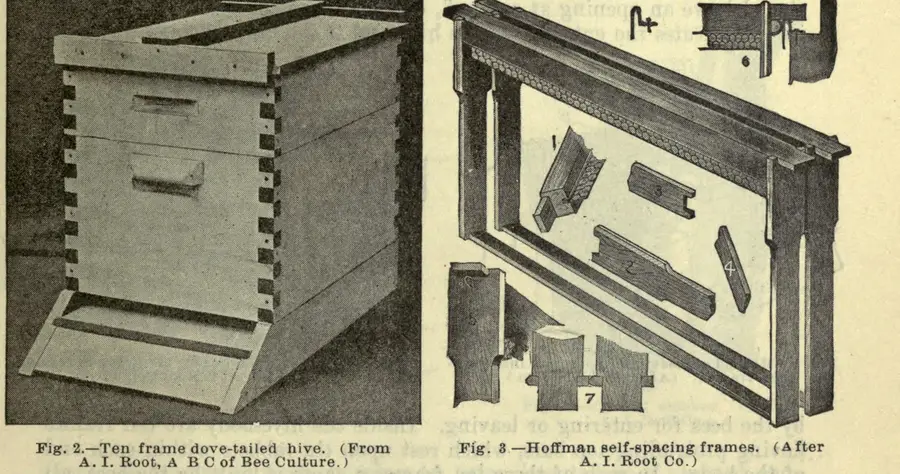
Section 131.021(b) treats bees “not hived with movable frames” as infectious, which allows TAIS to seize them. Langstroth hives qualify. Top-bar hives also have removable combs, but the statute does not name them, so ask TAIS before relying on one; see our top-bar hive guide. Austin goes further and requires a Langstroth-type hive with removable frames.
Penalties Under Chapter 131
| Offense | Section | Class | Maximum penalty |
|---|---|---|---|
| Failing to report a reportable pest; selling bees without a certificate or affidavit; breaking a quarantine; shipping bees or equipment into Texas without a permit; blocking an inspection | § 131.121 | Class C misdemeanor | Fine up to $500 |
| Operating an apiary without the required identification; altering a registered brand | § 131.122 | Class C misdemeanor | Fine up to $500 |
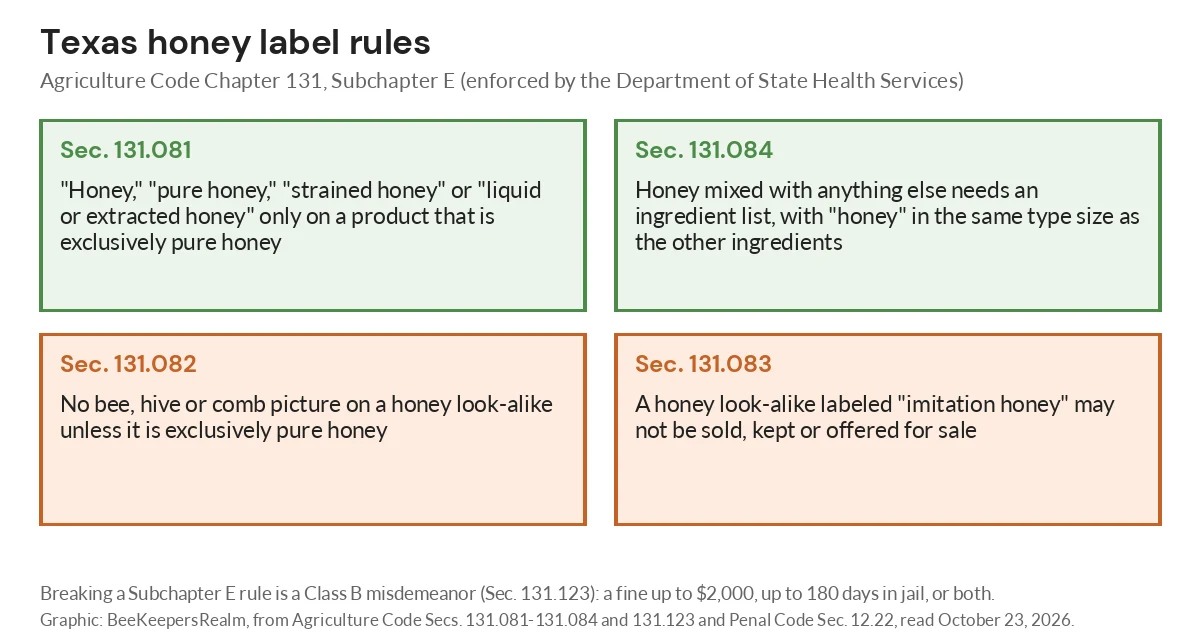
| Breaking a honey label rule | § 131.123 | Class B misdemeanor | Fine up to $2,000, up to 180 days in jail, or both |
Maximums come from Penal Code §§ 12.22 and 12.23. TAIS can also seize and destroy diseased or abandoned colonies, issue stop-sale orders and sue to stop violations (§§ 131.021, 131.103, 131.104).
Selling Honey After the 2025 Change
Two separate laws apply. Health and Safety Code Chapter 437 decides whether you are a regulated food establishment; Agriculture Code Subchapter E decides what your label can say.
Before September 1, 2025, the exemption covered only a “small honey production operation” producing less than 2,500 pounds a year and selling directly to consumers at home, farmers markets, farm stands or events, with a required label statement. H.B. 519 struck the cap, the venue list and the statement. A “honey production operation” is now a beekeeper selling honey or honeycomb they produce that is pure, raw and not blended or adulterated (§ 437.001(7)). It is not a food service establishment (§ 437.0197), and extracting and bottling count as harvesting and packaging a raw agricultural commodity (§ 437.01991).
“A local government authority, including a local health department, may not regulate the production of honey or honeycomb at a honey production operation.”
Many guides, and Google’s AI summary for “texas beekeeping laws” when we checked on October 23, 2026, still cite the 2,500-pound limit. Flavored, infused or blended products fall outside the definition, so check with DSHS before selling them. For the business side, see how to start selling honey legally.
City, County and HOA Rules
State law sets no hive limit, setback or permit for keeping bees, and Chapter 131 contains no section limiting what cities may regulate. TAIS points beekeepers to city and county ordinances and notes that homeowners associations may have their own rules. The Texas State Law Library’s neighbor-law guide links the animal codes of six of the largest cities.
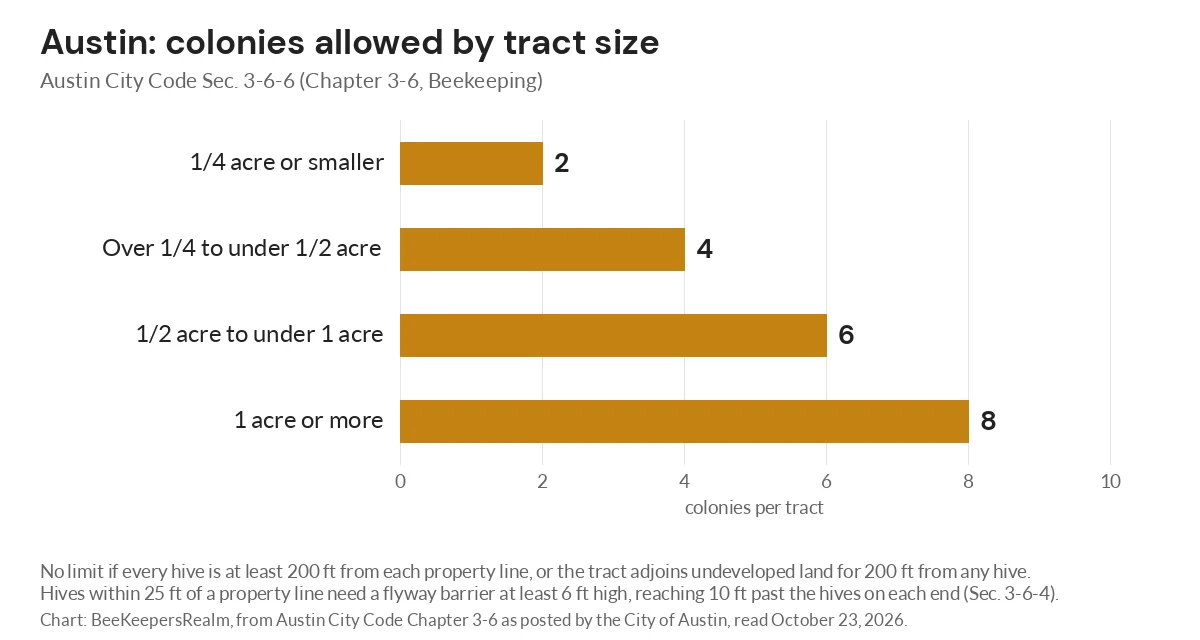
Austin City Code Chapter 3-6 shows what a full city chapter looks like:
- Colony caps by tract size, from 2 on a quarter acre or less to 8 on an acre or more, with no cap if every hive is at least 200 feet from each property line (§ 3-6-6).
- A flyway barrier at least 6 feet high for hives within 25 feet of a property line, unless the neighboring land is undeveloped (§ 3-6-4).
- A water source for the bees, sealed storage for removed comb, and prompt requeening of aggressive colonies with stock bred for gentleness (§§ 3-6-3, 3-6-5).
- The owner’s name or phone number on hives kept off the owner’s home tract (§ 3-6-7).
Read your own city’s code and any deed restrictions before you buy bees. See the Austin beekeeping chapter for the full text, and our guide to getting HOA approval for beekeeping for covenants.
Africanized Bees: No State Zone Today
According to TAIS, Africanized honey bees first entered the United States in south Texas in the fall of 1990, and by August 2006 they had been detected in 163 of the state’s 254 counties. TAIS says it had “an aggressive approach to monitoring and regulating commercial honey bee movement” to slow the spread. Today neither Chapter 131 nor 4 TAC Chapter 71 contains an Africanized-bee rule or zone. The chief apiary inspector can still declare a protective or restrictive quarantine of any area for a bee pest (§ 131.022; 4 TAC § 71.12).
The working rules are local, such as Austin’s requeening requirement. For safety advice, see how to identify Africanized bees and stay safe.
Bees and the 1-d-1 Ag Valuation
Since January 1, 2012, Tax Code § 23.51(2) has counted raising or keeping bees for pollination or for producing human food or other commercial products as an agricultural use, on land of at least 5 and no more than 20 acres. The other 1-d-1 tests still apply: the land must be devoted principally to agricultural use at the intensity generally accepted in the area, for five of the preceding seven years (§ 23.51(1)). The Comptroller’s Manual for the Appraisal of Agricultural Land (October 2024) notes that, except for beekeeping, there is no minimum or maximum amount of acreage that may qualify.
File the application with your county appraisal district before May 1 (§ 23.54(d)). If the land later changes use, § 23.55 imposes a rollback tax covering the three preceding years.
“TAIS does not collaborate with local county offices to mandate registration. However, TAIS is aware that registration through our office is used to show the existence of bee hives on a property for that purpose.”
Each district sets its own hive count. Kaufman CAD’s February 2026 guidelines require 6 colonies on 5 acres plus one more per additional 2.5 acres, hives on the land at least 7 months a year, and receipts and photos with the application. Kaufman says its minimum comes from the Agriculture Code’s definition of an apiary as six or more colonies. That wording is gone: H.B. 4538 struck “six or more” in 2023. The district’s number still applies, but anyone protesting a denial should know the statutory basis it cites has changed. Our Texas starter guide has the hive-by-acreage table, and our guide to agricultural tax exemptions for beekeeping compares other states.
TAIS Fees
| Service | Fee | Notes |
|---|---|---|
| Beekeeper Registration | $35 | Valid September 1 to August 31; optional |
| Interstate Permit | $200 | All state-line moves, September 1 to August 31 |
| Apiary Equipment Brand | $10 | Transferable only with TAIS approval |
| Apiary inspection, requested by beekeeper | $100 | Certificate valid one year |
| Queen Breeder Inspection | $300 | Per inspection |
| Bee Removal Statement | No fee | Must accompany a Beekeeper Registration |
| Extra official permit copy | $10 | Per copy |
Source: TAIS Forms & Fees page, read October 23, 2026. Late payment can bring a $10 penalty or revocation of the permit or registration (4 TAC § 71.22).
Compare Texas's current apiary definition with other states.
Frequently Asked Questions
Do you need a license to keep bees in Texas?
No. Texas has no license or permit to keep bees. Registration is optional ($35) and needed only for activities such as bee removal.
Can I keep bees in my backyard in Texas?
State law allows it, but your city code, deed restrictions or HOA may limit or ban hives. Austin, for example, allows 2 colonies on a quarter-acre lot.
How many acres do you need for a beekeeping ag valuation in Texas?
At least 5 and no more than 20 acres (Tax Code § 23.51(2)), with five of the past seven years in agricultural use. Your appraisal district sets the hive count.
Do I need a permit to sell honey in Texas?
Not for raw, unblended honey from your own bees. Since September 1, 2025, local health departments may not regulate its production, with no pound limit. Labels must follow Agriculture Code Subchapter E.
Do I need a permit to move bees in Texas?
Only across the state line, where a $200 interstate permit is required. Moves between Texas counties have needed no permit since September 1, 2023.
Who do I report American foulbrood to in Texas?
The Texas Apiary Inspection Service, at 979-321-5827 or tais@ag.tamu.edu. Reporting is required by § 131.025.
Can I remove bees from a house in Texas without a pest control license?
Yes, if you hold a current TAIS Beekeeper Registration and use no pesticides or electrical devices beyond normal beekeeping equipment (Occupations Code § 1951.056). Otherwise the Structural Pest Control Act’s licensing rules can apply.
The Bottom Line
Keep bees on movable frames, report the three reportable pests, mark hives kept away from home, and get a $200 permit before bees cross the state line. Register if you remove bees or want a record for your appraisal district, and check your city code and HOA before the bees arrive. Near a border, compare the rules in Oklahoma and Louisiana before moving colonies.


.jpg)

_BHL23474223.jpg)