Reviewed by Elena P. · Last Updated October 13, 2026 · How we review
In Ireland you do not need a licence to keep bees, but four rules are binding. Anyone producing honey for sale must register with the Department of Agriculture, Food and the Marine (DAFM). American foulbrood, European foulbrood, small hive beetle and Tropilaelaps mite must be reported to DAFM without delay. Bees brought in need an animal health certificate. Honey labels must follow S.I. 367/2003, as amended in 2025. There is no statutory ban on importing non-native bees: a bill to create one passed the Seanad in 2024 but is not law.
Disclaimer: This guide is educational information, not legal advice. Irish and EU rules change; check the current text on DAFM’s Beekeeping and Honey page or ask DAFM (beekeeping@agriculture.gov.ie) before you act. Sources were checked on 13 October 2026.
Key Takeaways
- No national beekeeping licence or hive permit exists, but selling honey legally requires DAFM registration as a Food Business Operator.
- S.I. No. 130 of 2016 makes four bee diseases notifiable. Small hive beetle and Tropilaelaps also trigger a 7-day ban on moving hives after you notify, unless DAFM licenses the move.
- Varroa is not on the notifiable list. Treatments must be authorised medicines, and honey producers must record what they used.
- Bees from another EU country need a health certificate and 24 hours’ advance notice to DAFM. From outside the EU, including Great Britain, only queen bees (with up to 20 attendants) and bumble bees may enter.
- Since 14 June 2026, blended honey must list every country of origin by weight, with each country’s percentage.
Table of Contents
- Which Irish Laws Cover Bees and Honey
- Registering With DAFM as a Honey Producer
- Notifiable Bee Diseases and What Reporting Triggers
- Asian Hornet: Reporting a Sighting
- Bringing Bees Into Ireland
- The Native Irish Honey Bee and the Proposed Import Ban
- Selling Honey: Labels and Food Registration
- Where You Can Keep Hives
- Grants and Free Services
- Frequently Asked Questions
Which Irish Laws Cover Bees and Honey
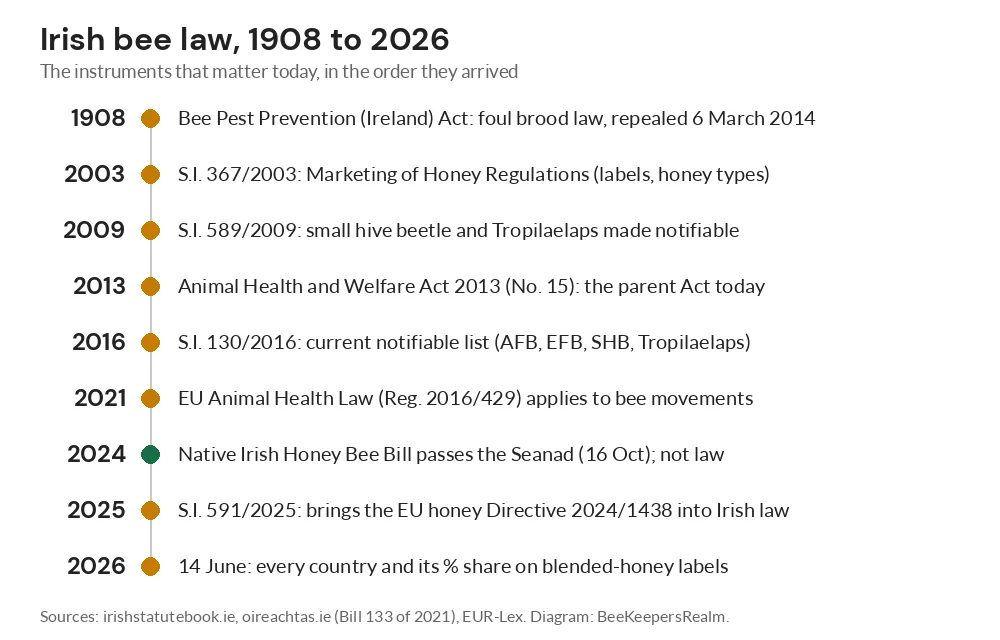
Ireland’s dedicated bee statute, the Bee Pest Prevention (Ireland) Act 1908, was repealed by the Animal Health and Welfare Act 2013 from 6 March 2014. Bee law now sits in a few statutory instruments plus directly applicable EU regulations. The older Brehon law on bees, the Bechbretha, Ireland’s 7th-century bee law, is history rather than current law.
| Topic | Main instrument | Who enforces it |
|---|---|---|
| Disease powers | Animal Health and Welfare Act 2013 (No. 15 of 2013) | DAFM |
| Notifiable bee diseases | S.I. No. 130 of 2016, as amended | DAFM |
| Registering honey producers | EU food hygiene rules (Regulation (EC) No 852/2004) | DAFM |
| Moving bees between EU countries | Regulation (EU) 2016/429; Delegated Regulation (EU) 2020/688 | DAFM and the sending country |
| Bees from outside the EU | Regulation (EU) 2020/692; Implementing Regulations (EU) 2021/403 and 2021/404 | DAFM border control posts |
| Honey composition and labels | S.I. No. 367 of 2003, amended by S.I. No. 591 of 2025 | DAFM; FSAI for wider food law |
| Bee medicines | Veterinary medicines law | HPRA authorises products |
Northern Ireland is part of the UK and has its own rules under its Department of Agriculture, Environment and Rural Affairs. Our UK beekeeping laws guide covers that side of the border.
Registering With DAFM as a Honey Producer
Registration comes from EU food hygiene law, not from a beekeeping act. DAFM’s registration FAQ explains that honey is a product of animal origin, so a beekeeper who produces it is a primary producer and must register as a Food Business Operator with DAFM. A “food business” in that FAQ is any undertaking “whether for profit or not.” DAFM’s FAQ is blunt about the consequence:
“You will not be able to sell your produce legally without this registration.”
There are three categories: Primary Producer of Honey (an individual, company or joint venture), Association Apiary, and Honey Packer/Purchaser. You request the form from RegisterFBO@agriculture.gov.ie and return it by email or post to the Honey Registration Section at Backweston Campus, Celbridge, Co. Kildare. DAFM then issues a unique beekeeper registration number.
If your honey never leaves your own household, EU hygiene law does not apply: Article 1(2)(a) of Regulation (EC) No 852/2004 excludes “primary production for private domestic use.” Gifting, swapping or selling a few jars is no longer private domestic use, so register first.
Registered producers must keep records, including bee feed, every treatment given (product, dose, dates, withdrawal period) and test results. DAFM publishes a free recording template.
Notifiable Bee Diseases and What Reporting Triggers
The current list is the Schedule to S.I. No. 130 of 2016, the Notification and Control of Diseases affecting Terrestrial Animals (No. 2) Regulations 2016, made under section 36 of the Animal Health and Welfare Act 2013. The bee entries sit in two parts, and the part decides what happens next. Regulation 3(1) sets the duty for anyone with reasonable grounds to suspect a listed disease:
“shall, without any delay, notify the fact or suspicion to an officer of the Minister at the local office of the Department or in cases where an official control programme is in place, to the persons or authority responsible for that control programme.”
| Pest or disease | Status in Irish law | What follows a report |
|---|---|---|
| Small hive beetle (Aethina tumida) | Notifiable, Part A. Not reported in Ireland to date (DAFM) | Automatic 7-day ban on moving the bees, their products or hives on or off the site, unless licensed |
| Tropilaelaps mite | Notifiable, Part A. Not reported in Ireland to date (DAFM) | Same automatic 7-day movement ban |
| American foulbrood | Notifiable, Part B | An authorised officer may serve a restriction notice on the bees or the site |
| European foulbrood | Notifiable, Part B | Same restriction-notice power |
| Varroa, Nosema ceranae | Named in the 2013 Act’s Schedule 2, but not notifiable | No duty to report; DAFM offers free testing |
For any listed disease the Minister can also direct a control plan, which may cover sampling, laboratory testing and biosecurity. Breaching the notification or movement rules is an offence. Regulation 7 makes them penal provisions under section 36(4)(b) of the Act, which carries up to a class A fine or 6 months on summary conviction, and up to €250,000 or 5 years on indictment.
Learn the field signs before you need them. Our guides compare American and European foulbrood and show what small hive beetle damage looks like.
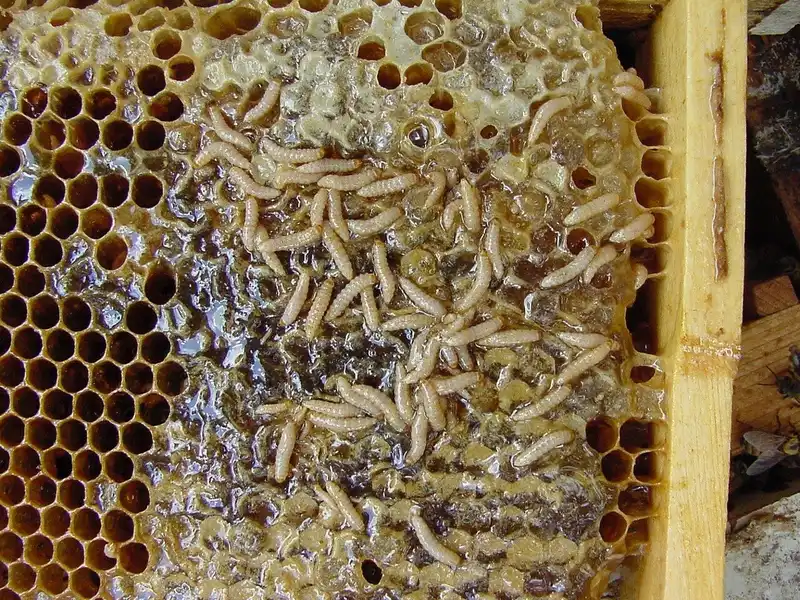
Varroa is a medicines-law matter: use only products authorised for bees (DAFM points to the HPRA’s list). DAFM’s free Honey Bee Health Surveillance Programme tests samples for both foulbroods, Nosema, tracheal mite and more, and its Sentinel Apiary Programme watches for small hive beetle and Tropilaelaps.
Asian Hornet: Reporting a Sighting
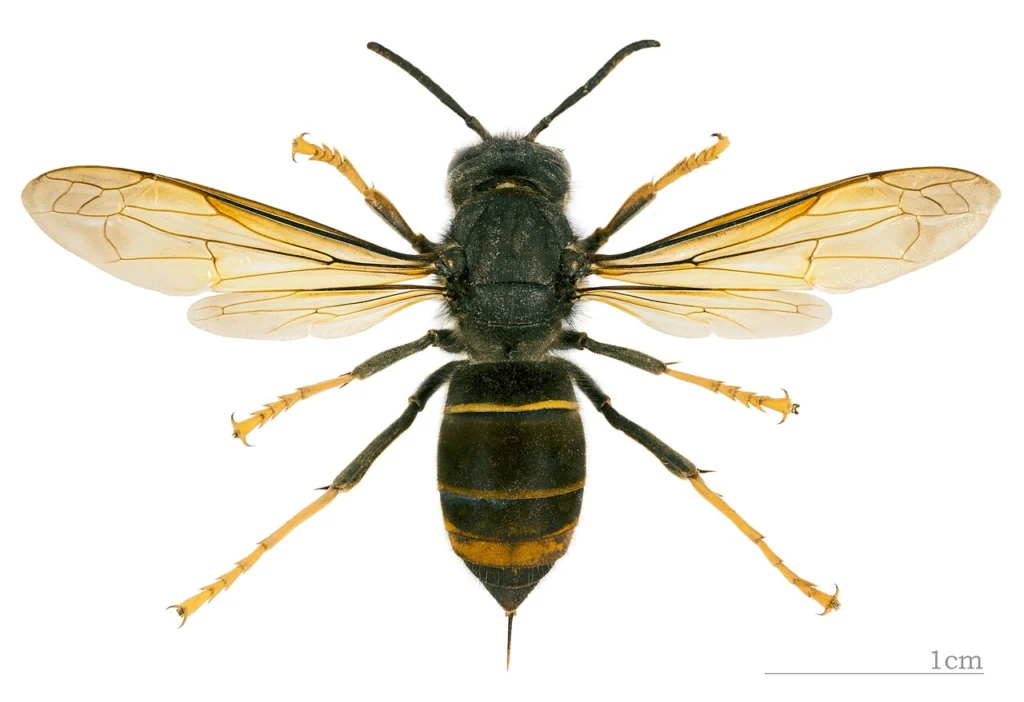
The Asian or yellow-legged hornet (Vespa velutina) is not established in Ireland, but it is arriving more often. DAFM records the first live specimen on 25 April 2021, then 36 confirmed sightings in 2025 and two nests in Cork, both destroyed. Report any suspect hornet through Invasives.ie; DAFM’s 2026 trap programme, aimed at apiaries near ports and airports, also asks for a photo by email. For a success story, see how Spanish researchers eradicated Asian hornets there.
Bringing Bees Into Ireland
Bee movements are governed by the EU Animal Health Law, Regulation (EU) 2016/429, so the rules depend on where the bees come from.
| Requirement | From another EU country | From outside the EU, including Great Britain |
|---|---|---|
| What may come in | Honeybees at any stage, including brood | Only queen honeybees (each with up to 20 attendants) and bumble bees |
| Health conditions at origin | No AFB within 3 km in the last 30 days; no small hive beetle or Tropilaelaps within 100 km (Regulation (EU) 2020/688, Article 48) | Approved establishment; same 3 km and 100 km conditions; comb tested negative for AFB within 30 days of dispatch |
| Paperwork | Health certificate from the sending country’s authority (Article 71) | Model certificate in Regulation (EU) 2021/403; CHED-A pre-notification in TRACES |
| Notice to DAFM | Advance Notification Form at least 24 hours before arrival | At least 24 hours’ notice to the border control post |
| Entry point | Any | Dublin Airport, Dublin Port or Rosslare |
Importers must be registered with DAFM and on TRACES, the European Commission’s certification system. Non-EU queens are re-caged under official supervision, and their transport cages and attendants are lab-checked for small hive beetle and Tropilaelaps. See the official DAFM guidance on importing honeybees and bumble bees.
The Native Irish Honey Bee and the Proposed Import Ban
Many Irish beekeepers keep the dark European honey bee, Apis mellifera mellifera, and groups such as the Native Irish Honey Bee Society argue imported strains dilute it through cross-breeding. Ireland’s bees were already reshaped once: after the acarine epidemic known as Isle of Wight disease, Irish associations restocked with imported queens.
Today, no Irish statute bans importing non-native honey bees. The Protection of the Native Irish Honey Bee Bill 2021 (Bill 133 of 2021), sponsored by Senator Vincent P. Martin, would “ban the importation of non-native honey bees,” create authorised officers and make forging an animal health certificate an offence. It passed the Seanad on 16 October 2024, and the Oireachtas page lists it as “currently before Dáil Éireann, Second Stage” (last updated 1 May 2025). It is not law. The Public Interest Law Alliance noted in 2022 that EU free movement of bees as livestock is the main obstacle. For now, choosing local stock is voluntary.
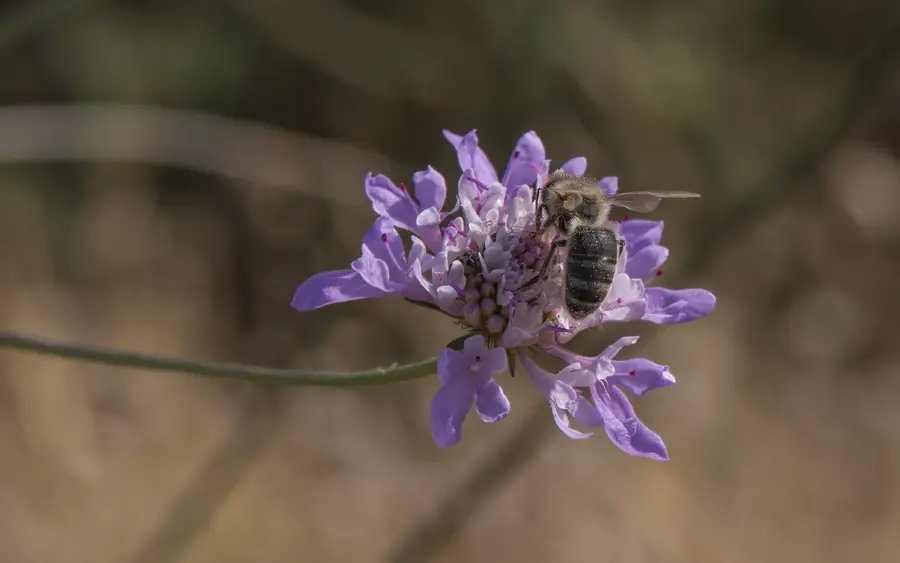
For the subspecies’ wider European story, see our profile of the dark bee, Apis mellifera mellifera.
Selling Honey: Labels and Food Registration
Honey sold in Ireland must meet the European Communities (Marketing of Honey) Regulations 2003 (S.I. No. 367 of 2003). The latest amendment, S.I. No. 591 of 2025, gives effect to Directive (EU) 2024/1438, and DAFM inspects for compliance. DAFM’s Labelling of Honey guidance note sets out what every jar needs:
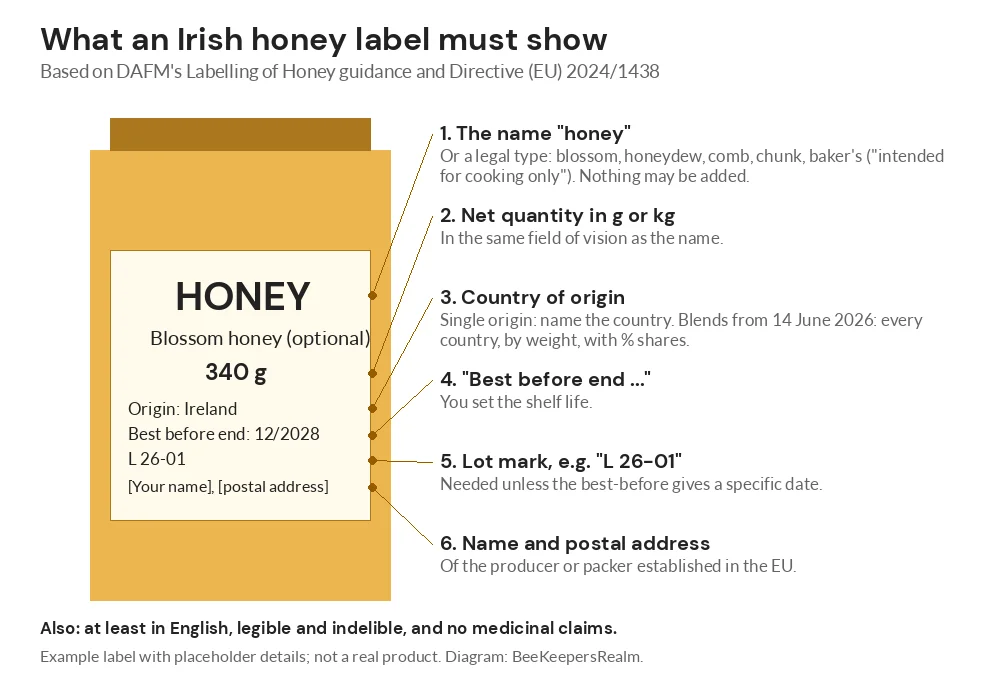
The 2026 change only affects honey from more than one country. Single-origin Irish honey still just says “Ireland.” For blends, the amended Directive requires the countries “in descending order of their share in weight, together with the percentage,” in the principal field of vision, allowing a 5% tolerance per share. Member states may let a blend of more than four origins show percentages for only the four largest, if those make up over 50%. On jars under 30 g, two-letter country codes may replace the names.
| Blended honey label | Before 14 June 2026 | From 14 June 2026 |
|---|---|---|
| Origin wording | “Blend of EU honeys”, “blend of non-EU honeys” or “blend of EU and non-EU honeys” allowed | Every country named |
| Order and share | Not required | Descending order by weight, with each percentage (5% tolerance) |
| Older stock | n/a | Honey produced or labelled before 14 June 2026 may be sold until stocks run out (S.I. 591/2025) |
“All food businesses placing honey on the market after 14 June are required to ensure that their labelling complies with these new requirements.”
The FSAI says every food business must register “before you start operating, even if operating from home,” with the authority depending on the business. For honey it is DAFM; other foods you make may need registration with your HSE environmental health office. The EU-wide detail is in our explainer on the EU’s new honey labeling law.
Where You Can Keep Hives
We found no hive-siting distance or hive-count limit in the Animal Health and Welfare Act 2013 or in the bee-specific instruments above. A dispute with a neighbour about bees would fall under general nuisance law rather than a beekeeping rule. Placement is still worth care: the Tribes Beekeepers Association’s beginner guide makes joining a local association step one, and local associations, affiliated to the Federation of Irish Beekeepers’ Associations or the Irish Beekeepers’ Association, advise members on where to put hives.
Grants and Free Services
DAFM’s commercial horticulture investment scheme covers beekeeping equipment and honey houses (hives but not frames or bees), with a €2,000 minimum investment excluding VAT. In October 2026 DAFM listed it as closed but expected to reopen, subject to Exchequer funding. Disease testing and Asian hornet traps are free.
Frequently Asked Questions
Do I need a licence to keep bees in Ireland?
No. There is no national beekeeping licence or hive permit. If you produce honey for sale, register with DAFM as a Food Business Operator.
Do I have to register my hives if I only keep bees as a hobby?
Not if the honey stays in your household; EU hygiene law excludes primary production for private domestic use. Once honey is sold or supplied outside the home, DAFM says you cannot sell it legally without registration.
Which bee diseases are notifiable in Ireland?
American foulbrood, European foulbrood, small hive beetle and Tropilaelaps mite, under S.I. No. 130 of 2016. Report suspicions to DAFM without delay.
Is varroa notifiable in Ireland?
No. Varroasis is named in the 2013 Act’s schedule of diseases but is not on the notifiable list. Treat it only with medicines authorised for bees.
Can I import bees into Ireland?
Yes, from other EU countries with a health certificate and 24 hours’ notice to DAFM. From outside the EU, including Great Britain, only queens with up to 20 attendants and bumble bees may enter, through an approved border control post.
Is there a ban on importing non-native bees into Ireland?
Not yet. The Protection of the Native Irish Honey Bee Bill 2021 passed the Seanad in October 2024 and was listed at Dáil Second Stage in May 2025. It is not law.
The Bottom Line
Register before you sell, learn the four notifiable diseases, and label every jar to DAFM’s checklist. If you are unsure whether a rule applies, ask DAFM’s beekeeping team; a written answer is worth keeping.