Reviewed by Thomas B. · Last Updated October 23, 2026 · How we review
You do not need a licence, permit or registration to keep honey bees anywhere in the UK, and the government bee registers are free and voluntary: BeeBase in England, Scotland and Wales, DataBees in Northern Ireland. The law bites on disease: American and European foulbrood, small hive beetle and Tropilaelaps mites must be reported in all four nations, and varroa everywhere except Northern Ireland. Government inspectors enforce it. Landlords and allotment rules decide where hives go; honey labels follow each nation’s rules.
Disclaimer: Educational information, not legal advice. Bee law is devolved; check the official source for your nation: the National Bee Unit’s legal responsibilities of beekeepers (England and Wales), the Scottish Government bee health team, or DAERA’s bee health page (Northern Ireland). Legislation was read on legislation.gov.uk on 23 October 2026.
Key Takeaways
- No UK nation licenses beekeepers. BeeBase registration “is not a legal requirement,” says the National Bee Unit; Northern Ireland’s DataBees is also voluntary.
- Suspected foulbrood, small hive beetle or Tropilaelaps must be reported at once; nothing can leave the apiary until it is cleared.
- Varroa has been reportable in England, Wales and Scotland since 21 April 2021. Northern Ireland’s Order has no varroa duty.
- Since 7 March 2026, Scotland can issue a £200 fixed penalty for breaching its reporting and movement rules.
- Since 14 June 2026, blended honey in Northern Ireland must list every country with its percentage; Great Britain still allows “blend of honeys” wording.
Table of Contents
- The Four Nations Side by Side
- Registering Your Hives: BeeBase or DataBees
- Notifiable Diseases and What Reporting Triggers
- Varroa: Reportable in Great Britain Only
- Reporting a Yellow-Legged (Asian) Hornet
- Importing Bees and Moving Them to Northern Ireland
- Bee Medicines and the Five-Year Record
- Selling Honey: Labels Differ by Nation
- Neighbours, Nuisance and Where Hives Can Go
- Frequently Asked Questions
The Four Nations Side by Side
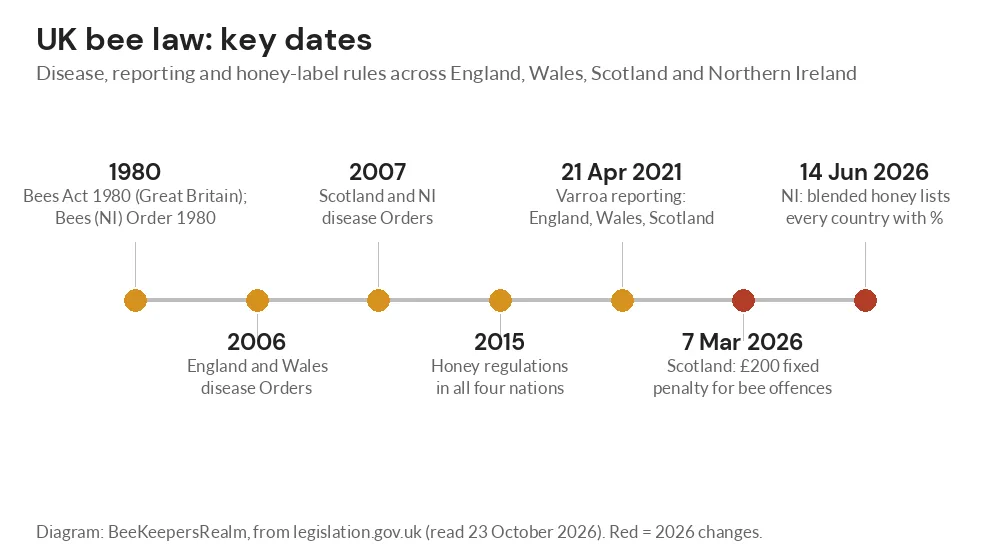
The Bees Act 1980 covers Great Britain and the Bees (Northern Ireland) Order 1980 covers Northern Ireland. Each nation has its own disease Order and honey regulations.
| England | Wales | Scotland | Northern Ireland | |
|---|---|---|---|---|
| Disease law | SI 2006/342 | SI 2006/1710 | SSI 2007/506 | SR 2007/246 |
| Varroa duty | Art. 3A: report if you know | Art. 2A: know or suspect | Art. 2A: know or suspect | None |
| Free register | BeeBase | BeeBase | BeeBase | DataBees |
| Inspectors | APHA National Bee Unit | National Bee Unit, for the Welsh Government | Scottish Government bee inspectors; SASA lab | DAERA inspectors; AFBI lab |
| Honey law | SI 2015/1348 | SI 2015/1507 | SSI 2015/208 | SR 2015/261, amended 2026 |
| Blend label | “Blend of honeys from more than one country” | Same | Six set wordings | Every country, with % |
Registering Your Hives: BeeBase or DataBees
BeeBase, run by the APHA National Bee Unit (NBU), states that “Registration is open to beekeepers in England, Scotland and Wales only.” Northern Ireland beekeepers use DAERA’s DataBees.
“There is no fee for this registration, or for any statutory control inspections.”
Registering brings alerts about nearby outbreaks. A landlord can make it compulsory: Croydon Council’s 2019-20 allotment beekeeping rules require tenants “to register all hives” on BeeBase.
Notifiable Diseases and What Reporting Triggers
All four Orders name the same notifiable diseases (American and European foulbrood) and pests (small hive beetle, Tropilaelaps mites). Compare the diseases in our AFB vs EFB guide.
“It is a legal requirement to notify the National Bee Unit (NBU) if you know or suspect your colonies of honey bees to have a notifiable disease or pest.”
Article 3 of the England Order says the keeper “shall immediately notify”; Northern Ireland’s says “as soon as is reasonably possible.” Anyone who finds a notifiable pest at work must report it too.
- Notifying freezes the apiary. Under Article 4, hives, bees, combs, honey and equipment stay put until an inspector or a lab clears them.
- Notices. Article 6 bans removal; Articles 7 and 8 order destruction or treatment. Confirmed American foulbrood means the bees and combs are destroyed.
- Penalties. Breaching an Order is an offence under section 1(7) of the Bees Act 1980 (Article 7 of the 1980 Order in Northern Ireland), with a fine up to level 5; obstructing an inspector is a level 3 offence under section 2(3). In Scotland, breaching Articles 2A, 3, 4 or 5 can bring a £200 fixed penalty instead.
Varroa: Reportable in Great Britain Only
Varroa is “reportable”, not notifiable: it triggers no standstill. Article 3A of the England Order, in force from 21 April 2021, applies to a keeper “who knows” varroa is present. Scotland’s Article 2A, like the Welsh one, covers a keeper who “knows or suspects.” Report it on BeeBase or the NBU’s form. Northern Ireland’s Order has no varroa provision.
Knowing means testing; see how to test for varroa mites.
Reporting a Yellow-Legged (Asian) Hornet
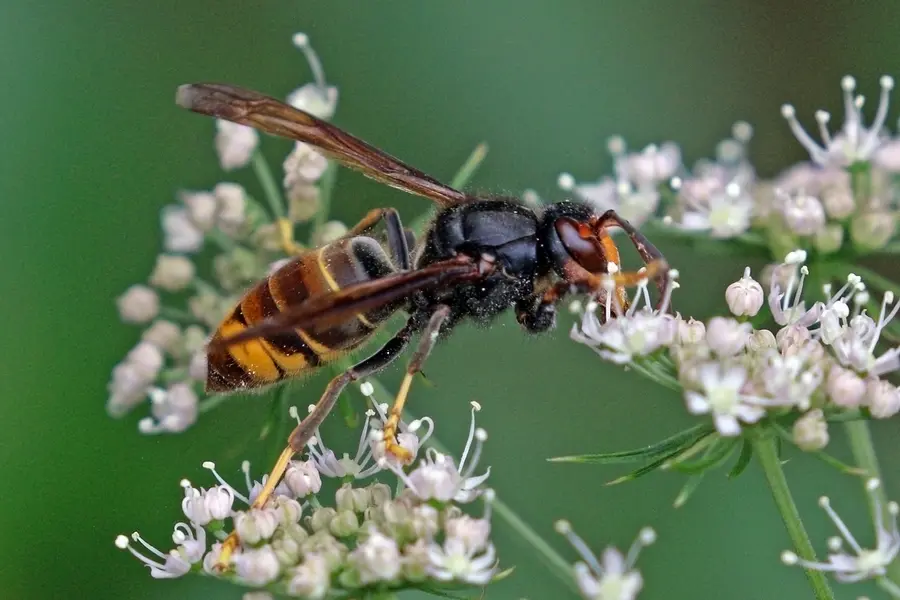
Vespa velutina is not on any of the four Orders’ notifiable lists, but officials ask the public to report sightings, ideally with a photo. GOV.UK’s pests and diseases guidance points to the UK Centre for Ecology and Hydrology form; the NBU also takes reports through the Asian Hornet Watch app. Northern Ireland uses the app or CEDaR; its first confirmed hornet was caught in Dundonald, Belfast, on 10 October 2025.
As of 15 October 2026, the NBU counted 226 credible UK sightings and 85 nests this year. Since 2026, hornets are no longer routinely lab-tested; specialists confirm most from a clear photograph. Compare look-alikes in our bee, wasp and hornet identification guide.
Importing Bees and Moving Them to Northern Ireland
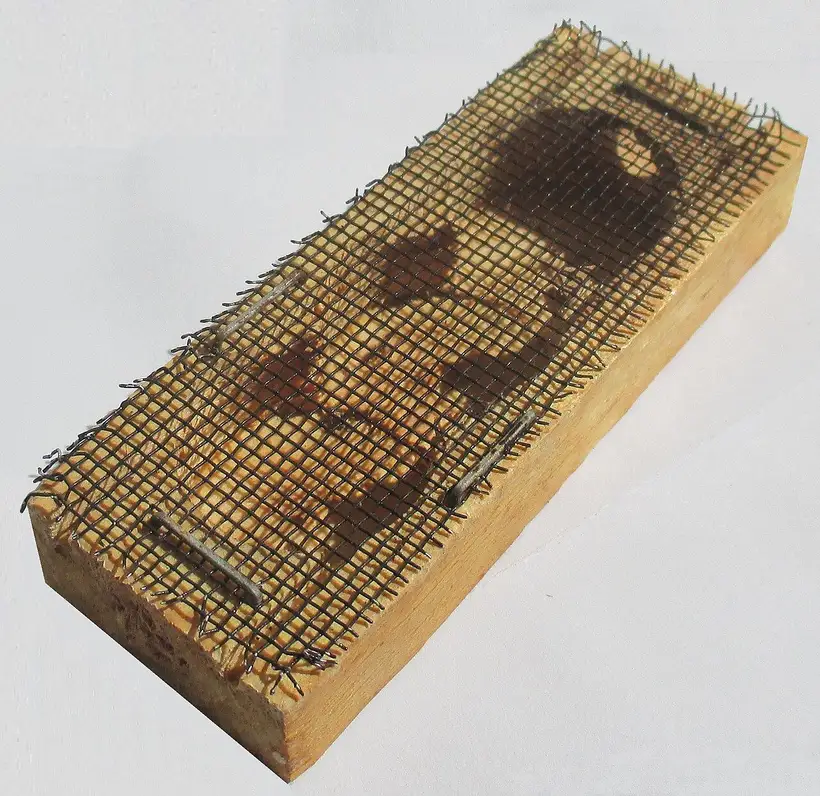
Imports into Great Britain need an IPAFFS notification and an export health certificate from an approved country. Except from New Zealand, only queens may enter; see our New Zealand beekeeping laws guide. Under Article 11 of the England Order, queens go into new cages, and the NBU asks for the old cages and attendants within 5 days: to Fera Science Ltd in York from England and Wales, or SASA in Edinburgh from Scotland.
Sending bees from Great Britain to Northern Ireland counts as an export, and the NBU says “Only queen bees can be moved to Northern Ireland (NI) from GB.”
Bee Medicines and the Five-Year Record
Use only medicines authorised for honey bees in the UK, as labelled; anything else is an offence. Regulation 19 of the Veterinary Medicines Regulations 2013 requires a record of each product bought and used, and regulation 20 says to keep it “for at least five years,” even if the colony dies.
Selling Honey: Labels Differ by Nation
Each nation’s 2015 honey regulations reserve the name “honey” for honey with nothing added and allow a floral claim only if it “comes wholly or mainly from the indicated source.” Food labelling law adds net quantity, a best-before date, a lot number and a business name and address, and new food businesses register with their local authority.
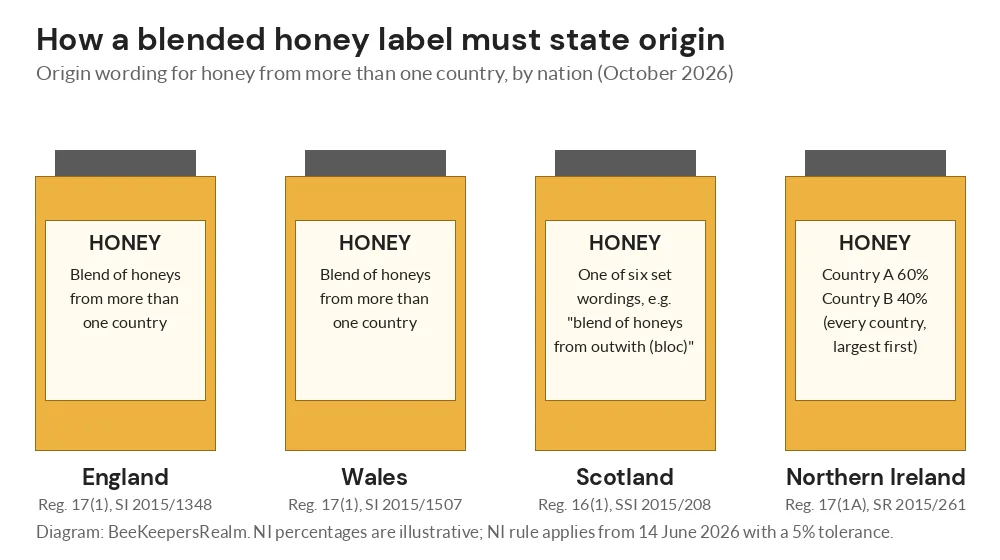
Blends are where the nations split. In England and Wales, regulation 17(1) lets a blend say “blend of honeys from more than one country.” Scotland’s regulation 16(1) gives six set wordings “or similar wording”. In Northern Ireland, regulation 17, as amended from 14 June 2026, requires every country “in descending order of their share in weight together with the percentage.” That follows the EU rule covered in our EU honey labelling law explainer.
Neighbours, Nuisance and Where Hives Can Go
None of the bee Orders sets a distance between hives and a boundary. The legal backstop is statutory nuisance: section 79(1)(f) of the Environmental Protection Act 1990 (England, Wales, Scotland) and section 63(1)(f) of Northern Ireland’s Clean Neighbourhoods and Environment Act 2011 cover “any animal kept in such a place or manner as to be prejudicial to health or a nuisance.” In Great Britain, a council that finds one must serve an abatement notice under section 80.
“Avoid placing hives facing onto a neighbour’s property or near a public footpath. Facing a hedge or fence will usually encourage the bees to fly above head height and avoid being a nuisance.”
Allotments add contract rules. Croydon’s require BBKA-affiliated membership, the BBKA Basic Assessment or a mentor who holds it (see BBKA certification explained), £5 million public liability cover and at most 2 hives plus 1 nucleus per plot. BBKA, Welsh Beekeepers Association and Scottish Beekeepers’ Association membership includes liability cover; Bee Diseases Insurance is “only available to beekeepers living in England and Wales.” Before your first hive, read how to talk to your neighbours about bees.
Frequently Asked Questions
Do you need permission to keep bees in the UK?
Not from the government, but possibly from a landlord, an allotment committee or your property’s covenants.
Can I keep bees in my back garden in the UK?
Yes. The bee laws set no minimum garden size or distance, but a nuisance can bring a council abatement notice.
Is BeeBase registration compulsory?
No. It is free and voluntary in Great Britain; Northern Ireland uses DataBees. Some allotment rules require it.
Is varroa notifiable in the UK?
It is reportable in England, Wales and Scotland, without a standstill. Northern Ireland has no varroa duty.
Can I complain about my neighbour’s bees?
Yes, to the council’s environmental health team, which can serve an abatement notice for a statutory nuisance.
Do I have to report an Asian hornet?
Not under the bee Orders, but the NBU and DAERA ask for sightings, ideally with a photo.
The Bottom Line
Register free, learn the notifiable diseases, test for varroa and label to your nation’s rules. For the Republic, see our Ireland beekeeping laws guide.
Related Reading
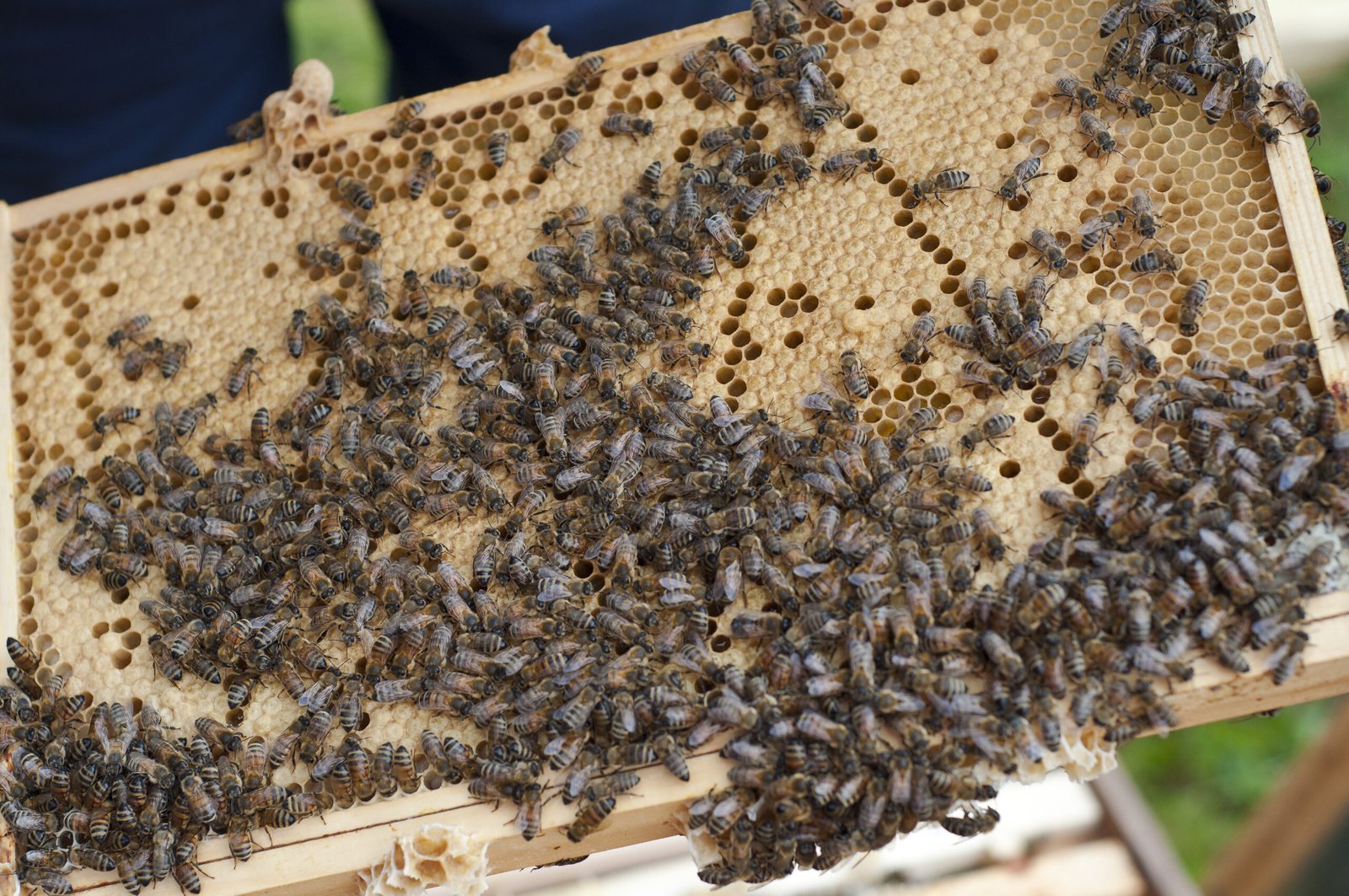
Image credits: Featured photo of a full brood frame by Stew Parr (b3tarev3), via Wikimedia Commons, public domain.