Reviewed by Michael R. · Last Updated October 13, 2026 · How we review
Yes, South Africa regulates beekeeping. Anyone who keeps bees in a hive or removes colonies must register with the national Department of Agriculture, for 24 months at a time. Bees may not cross the Cape bee “line” without written approval, imported bees, honey and used hive equipment need a permit, honey for sale must be graded and labelled under R.835, and Cape Town and Johannesburg also require city permission.
The national rules are the Control Measures relating to Honey-Bees (R.858 of 2013, amended by R.1511 of 2019), made under the Agricultural Pests Act 36 of 1983.
Educational information only, not legal advice. Check the Government Gazette notice R.858 and confirm with the Department of Agriculture or your municipality before acting.
Key Takeaways
- Hobbyists, commercial beekeepers and bee removers must register. Since 2019 registration lasts 24 months; the 2013 rule was yearly, which is why many sites still say “annually.”
- Hives must carry your registration number, and you must keep written records.
- No bees may cross the line, and no Cape bees may be kept north of it, without written approval.
- American foulbrood is the only notifiable bee disease: report it, don’t move infected colonies, destroy them if control fails.
- Cape Town (by-law section 34) and Johannesburg (section 145) need city permission for urban hives.
Table of Contents
- South African Bee Rules at a Glance
- Registering as a Beekeeper
- The Cape Bee Line
- American Foulbrood: Report, Isolate, Destroy
- Importing Bees, Honey and Used Equipment
- Selling Honey: Grades and Labels
- City By-laws: Cape Town and Johannesburg
- Frequently Asked Questions
South African Bee Rules at a Glance
| Rule | Legal source | Requirement |
|---|---|---|
| Register | R.858, control measure 2 | All beekeeping activities, including removals; 24 months |
| Mark hives | R.858, control measure 3 | Registration number on every hive |
| Keep records | R.858, control measure 4 | Colonies, apiary sites, disease, losses |
| Cape bee line | R.858, control measure 6 | No crossing without written approval |
| Notifiable disease | R.858, measures 5, 8, 9; Annexure A | Report AFB; no moving; destroy if control fails |
| Imports | Agricultural Pests Act, s3(1) | Permit for insects, honey, beeswax, used equipment |
| Honey sales | R.835 of 2000 | Graded; 11 label items |
| Cape Town | Animal Keeping By-law 2021, s34 | City permission in residential areas |
| Johannesburg | Public Health By-laws, s145 | Permit; 5 m and 20 m setbacks |
Registering as a Beekeeper
Control measure 2(1) reads: “Every person who carries out any beekeeping activities shall register with the Department.” Since 2019 that expressly covers keeping bees for honey, queens or pollination, and removing or relocating colonies. Control measure 2(9) also bars anyone from hiring an unregistered beekeeper.
The form asks for contact details, the type of beekeeping and colony numbers (2(2)); you get a permanent registration number (2(3)). Registration lasts 24 months from registration or renewal (2(4)), and a lapse means deregistration and penalties (2(5)). The department’s 2017 form stated “There is no cost involved.”
Every hive must display your number, and no one may place an unmarked, occupied hive on any property without written authority (control measure 3). You must record colony numbers, apiary locations, disease, treatments and losses (control measure 4). Breaking a control measure can bring a fine of up to R4,000 or a year in prison on a first conviction (section 13 of the Act).
The Cape Bee Line
The regulations name two native subspecies: the African honey bee (Apis mellifera scutellata) and the Cape honey bee (A. m. capensis). Cape workers can lay eggs that become females, which lets them take over African bee colonies; see our Cape honey bee guide.
The “line” starts on the Atlantic coast at the northern edge of the Vredendal district, follows district boundaries east past Calvinia, Beaufort West and Cradock, and meets the Indian Ocean at Willowvale. Cape bees belong south of it.
“No person may— (a) remove honey-bees across the line; (b) remove or keep Cape bees north of the line; (c) remove any Capensis-infected colony, without the prior written approval of the executive officer.”
An infected colony may only be moved to be destroyed or isolated (6(2)), and must be destroyed if the Cape workers cannot be removed (7(1)).
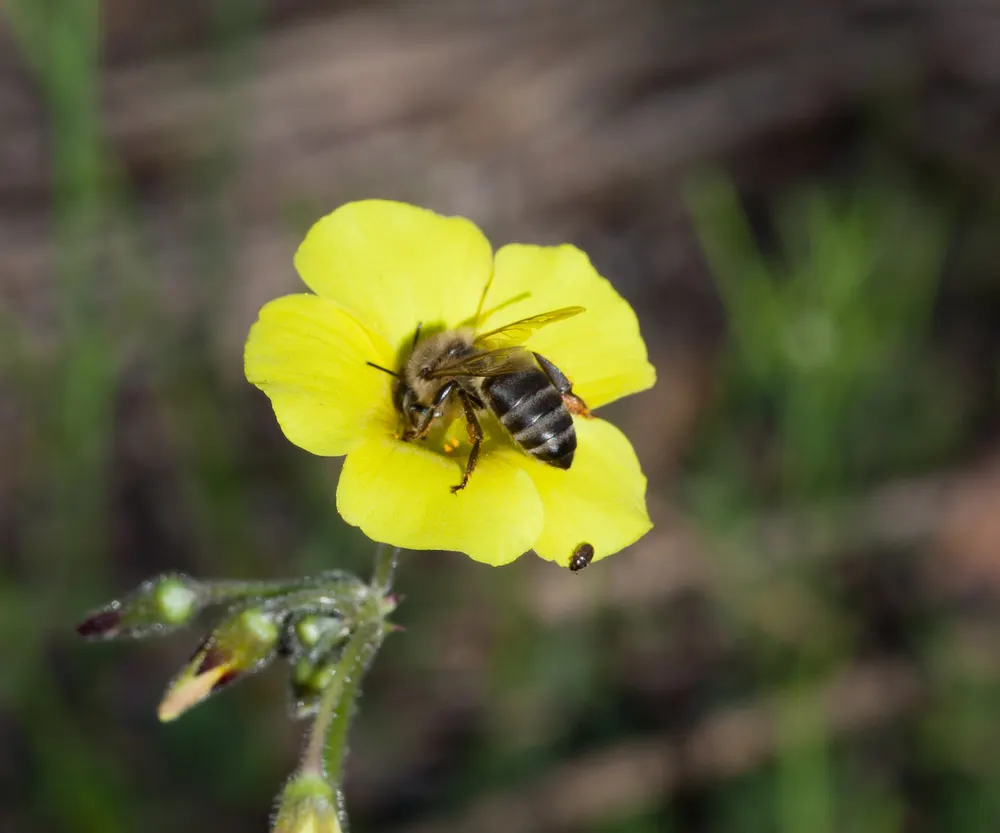
The rule dates from the “Capensis calamity.” A 2022 South African Journal of Science paper reports that beekeepers were estimated to have lost 50,000 to 100,000 colonies in 1993, after large numbers of Cape colonies were moved north in 1990 and 1991, and that a movement barrier followed in Regulation 159 of 5 February 1993.
“Despite these strict measures the problem persisted, and it is still the most serious one plaguing beekeeping outside the geographical distribution area of the Cape honeybee.”
American Foulbrood: Report, Isolate, Destroy
Annexure A lists one notifiable disease, American foulbrood (AFB). Its columns for mites, fungal and viral diseases are empty, so varroa is not notifiable under these measures.
You must inspect regularly and notify the executive officer or area official of suspected AFB or Capensis, in hives or wild colonies (control measure 5). Infected colonies may not be moved except for destruction, isolation or with written approval (8). A colony must be destroyed when management measures cannot be applied or fail (9), and officials may order destruction (5(5)).
The measures do not mention antibiotics; they accept treatment only if symptoms are no longer seen or detected by a laboratory test. Early detection with a rope test and knowing when to burn comb matter most; see also American vs. European foulbrood.
Importing Bees, Honey and Used Equipment
Section 3(1)(a) of the Agricultural Pests Act bars importing “any plant, pathogen, insect, exotic animal, growth medium, infectious thing, honey, beeswax or used apiary equipment” without a permit. Bees count as insects, and “honey” includes comb honey and pollen. Goods must enter through a prescribed port and be inspected (3(2)), and regulation R.111 asks for the application 30 working days before arrival. A first conviction for importing without a permit carries up to R20,000 or five years (section 13).
The Animal Diseases Act 35 of 1984 does not cover bees: it defines “animal” as a mammal, bird, fish, reptile or amphibian.
Selling Honey: Grades and Labels
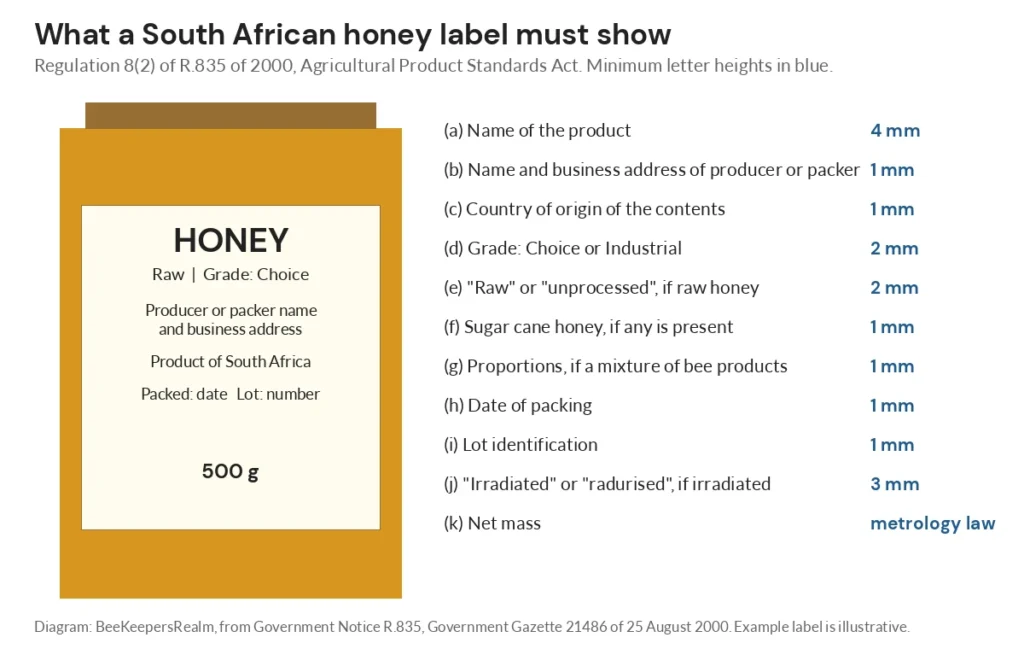
Honey for sale falls under R.835 of 2000, made under the Agricultural Product Standards Act 119 of 1990. Liquid, creamed and comb honey are Choice or Industrial grade; raw honey is not graded, and crystallised honey cannot be downgraded for that reason (regulation 5). Tests include moisture of no more than 20% and HMF of no more than 40 mg/kg (regulation 6). Regulation 8(2) lists 11 label items, and regulation 9 bans misleading wording. Compare other countries in our honey labeling guide.
City By-laws: Cape Town and Johannesburg
Under section 34 of Cape Town’s Animal Keeping By-law, 2021, you need the City’s permission to keep bees in a residential area or public open space, must be registered with a beekeepers’ association or the national department, and must send the City proof within 30 days.
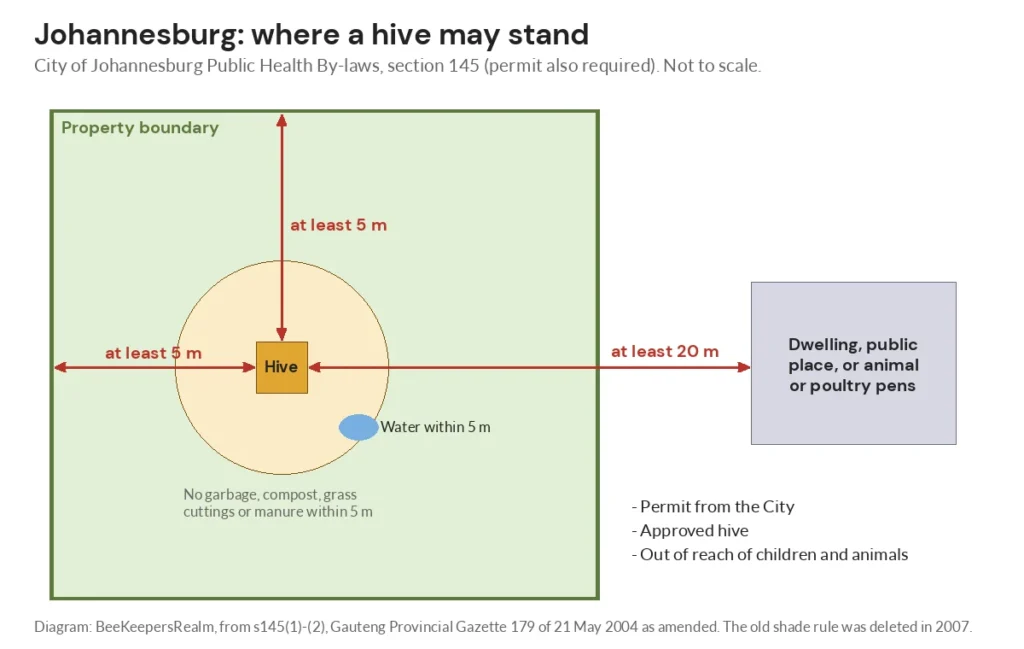
Section 145 of Johannesburg’s Public Health By-laws requires a permit and an approved hive at least 5 m from any boundary and 20 m from homes, public places and animal enclosures, out of reach of children and animals, with water within 5 m. The “kept in the shade” clause some sites still quote was deleted in 2007.
Smaller towns can be stricter: Swartland’s 2002 by-law requires yearly council approval, a plot of at least 3,700 m² and hives 90 m from streets and homes, except on agricultural land. For other countries, see Kenya’s beekeeping laws and UK beekeeping laws.
Related Reading
Frequently Asked Questions
Do I need to register as a beekeeper in South Africa?
Yes. Control measure 2 of R.858 covers hobbyists, commercial beekeepers and removers, for 24 months at a time.
Is it legal to keep bees in a residential area?
Usually, with city permission: section 34 in Cape Town, section 145 in Johannesburg.
Can I move my hives from the Western Cape to Gauteng?
Not without the executive officer’s written approval. Control measure 6 bars moving bees across the line.
Who may remove bees from my house?
Only a registered beekeeper; control measure 2(9) bars using an unregistered one.
Can I import queens or honey?
Only with a permit under section 3 of the Agricultural Pests Act.
Which bee diseases must be reported?
American foulbrood, the only disease in Annexure A.
The Bottom Line
Register, number your hives, keep bees on their own side of the line, and ask your city before placing a hive in town.
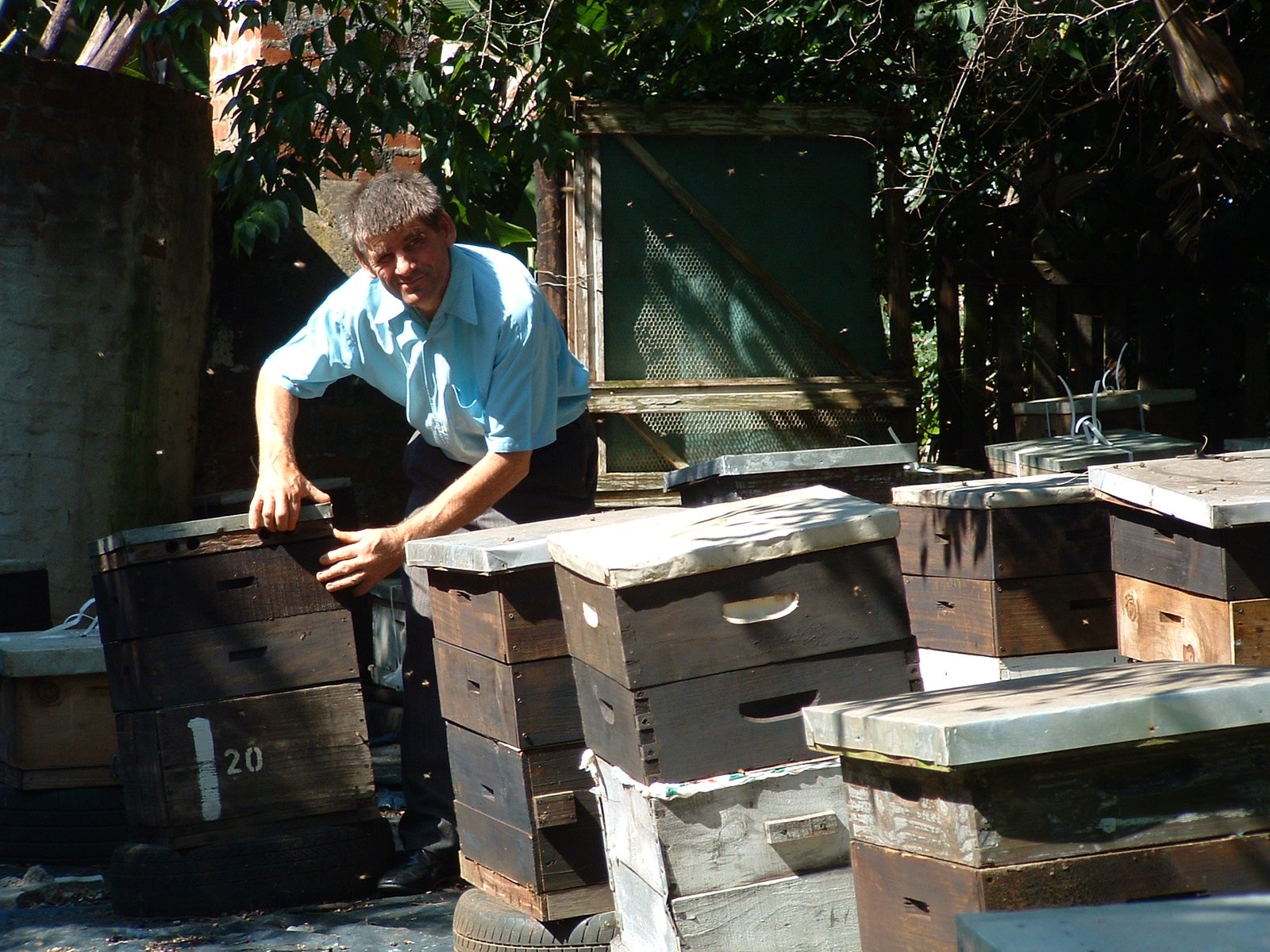
Image credits: Photo: A beekeeper inspects a hive in KwaZulu-Natal, South Africa. Photo by Marius140%, CC BY-SA 4.0.