Reviewed by Sofia T. · Last Updated October 13, 2026 · How we review
Every beekeeper in New Zealand, even with a single backyard hive, must register with NZ Bee Health & Biosecurity (NZBB) and notify each apiary before the hives have sat there for 30 consecutive days. Registration is free; the 2026/27 American foulbrood levy is $40 per beekeeper plus $1.95 per colony (excluding GST), due by 1 June, along with an Annual Disease Return. Unless you hold a DECA, every colony must be inspected for American foulbrood between 1 August and 30 November. AFB must be reported, and the colony burned, within 7 days. Exotic pests such as European foulbrood and small hive beetle are notifiable to MPI; varroa is not.
Educational information only, not legal advice. Laws and levy rates change; check the official source, starting with the AFB pest management plan order on NZ Legislation, before you act. All rules below were checked against the official texts on October 13, 2026.
This guide maps each obligation to the clause that creates it. Comparing countries? See our Australia beekeeping laws guide or the U.S. beekeeping regulations by state.
Key Takeaways
- The core law is the Biosecurity (National American Foulbrood Pest Management Plan) Order 1998, made under the Biosecurity Act 1993. The Apiaries Act 1969, still quoted on some sites, is repealed.
- Registering is free. A two-colony hobbyist pays $50.48 including GST in AFB levy for 2026/27; pay late and you owe 10% more, plus 2% a month.
- File the Annual Disease Return by 1 June even if you have no bees. Non-DECA beekeepers need a Certificate of Inspection, and you cannot inspect your own hives for it.
- Found AFB? Notify NZBB and destroy the colony by burning within 7 days. Drugs that mask AFB are banned.
- Most councils do not license backyard hives, but rules differ: Wellington allows up to four hives on a residential property without permission; Auckland requires approval for hives in council public places.
- Selling honey brings in the tutin limit of 0.7 mg/kg; exporting it as mānuka requires MPI’s five-attribute lab test.
Table of Contents
- Which Laws Apply in 2026
- Registering as a Beekeeper and Each Apiary
- What It Costs: The 2026/27 AFB Levy
- Your Annual Compliance Calendar
- Certificate of Inspection or DECA
- If You Find American Foulbrood
- Notifiable Pests You Must Report to MPI
- Council Rules: Auckland vs Wellington
- Selling Honey: NP1 Registration and Tutin
- Exporting Honey and the Mānuka Definition
- Penalties for Breaking the Rules
- Frequently Asked Questions
Which Laws Apply in 2026
New Zealand has no single beekeeping statute. Day-to-day obligations come from a national pest management plan aimed at one disease, American foulbrood (AFB), plus food, export and local rules. The table lists the instruments that matter and where each duty sits.
| Law or instrument | What it requires of beekeepers | Key provisions |
|---|---|---|
| Biosecurity Act 1993 | Framework for pest plans; offence and penalty for breaking plan rules; duty to report unusual or notifiable organisms | s44, s46, s154N(18), s157(5) |
| AFB National Pest Management Plan Order 1998 | Movable-frame hives, apiary notification, ID code, Annual Disease Return, annual inspection, 7-day AFB reporting and destruction | cl 11, 15, 17–20, 26–28, 32, 36–37 |
| AFB Beekeeper Levy Order 2003 | Annual levy per beekeeper and per colony, due 1 June; late penalty | cl 7, 8, 13, 14 |
| Biosecurity (Notifiable Organisms) Order 2016 | Lists the exotic bee pests you must report | cl 3 and Schedule |
| Food Act 2014 and the Food Standards Code | NP1 registration to extract or pack honey for sale; tutin limit | Food (Tutin in Honey) Standard 2016 |
| Animal Products Act 1999 | MPI listing, records and Risk Management Programmes for export honey | MPI General Export Requirements for bee products |
| Council bylaws | Hive placement, nuisance, hive numbers, hives on public land | e.g. Auckland Animal Management Bylaw 2015; Wellington Animal Bylaw 2024 |
The plan is run by NZ Bee Health & Biosecurity, a charitable trust the Minister for Biosecurity appointed as management agency under section 100D of the Biosecurity Act; it took over from the old AFB Management Agency in mid-2025. The 1998 Order is under ministerial review: NZBB’s 2027/28 levy consultation says Cabinet approval of a renewed plan is likely in early 2027, with implementation from mid-2027. Until a new order is made, the current rules apply, and the online reprint (current as at 2 March 2018) is the text to read.
Legislative control of AFB in New Zealand dates to 1906, according to NZBB. For how the U.S. took a different path, see our history of American foulbrood laws and apiary inspection.
Registering as a Beekeeper and Each Apiary
If you own a hive that bees can reach, you must be registered under the plan, whatever the size of your operation. Most people register online through NZBB’s HiveHub portal; NZBB’s Beekeeper 101 guide walks through each step, and a paper form is available.
“There is no charge to register yourself as a beekeeper however all registered beekeepers are required to pay an annual AFB levy.”
The plan works through apiaries, not hives. The obligations, clause by clause:
- 30-day rule (cl 15). Hives may not sit in a place for more than 30 consecutive days unless you have notified it as an apiary. This is the deadline behind the common “register within 30 days” advice.
- What counts as one apiary (cl 17). One hive, or a group where each hive is 200 metres or less from another of yours. The notice must give the occupier’s name and a GPS or map reference.
- Your code on site (cl 19–20). On your first apiary you get an identification code. Mark it on a hive or a sign at every apiary, readable at any time: within 30 days of receiving the code, then within 7 days of notifying each new site.
- Movable frames only (cl 11). Bees must be kept in hives whose frames can be lifted out for inspection without damage. Exemptions exist only for research, queen rearing, packages and public display (cl 12).
- Changes (cl 21, 24). When you sell hives, remove your code and notify NZBB of the buyer. When a site stops being used, tell NZBB in writing within 30 days.
Hives you cannot account for carry a cost. Under clause 25, an authorised person who finds hives in an unregistered place can fix a notice giving the owner 30 days to notify the site, then destroy the hives.
What It Costs: The 2026/27 AFB Levy
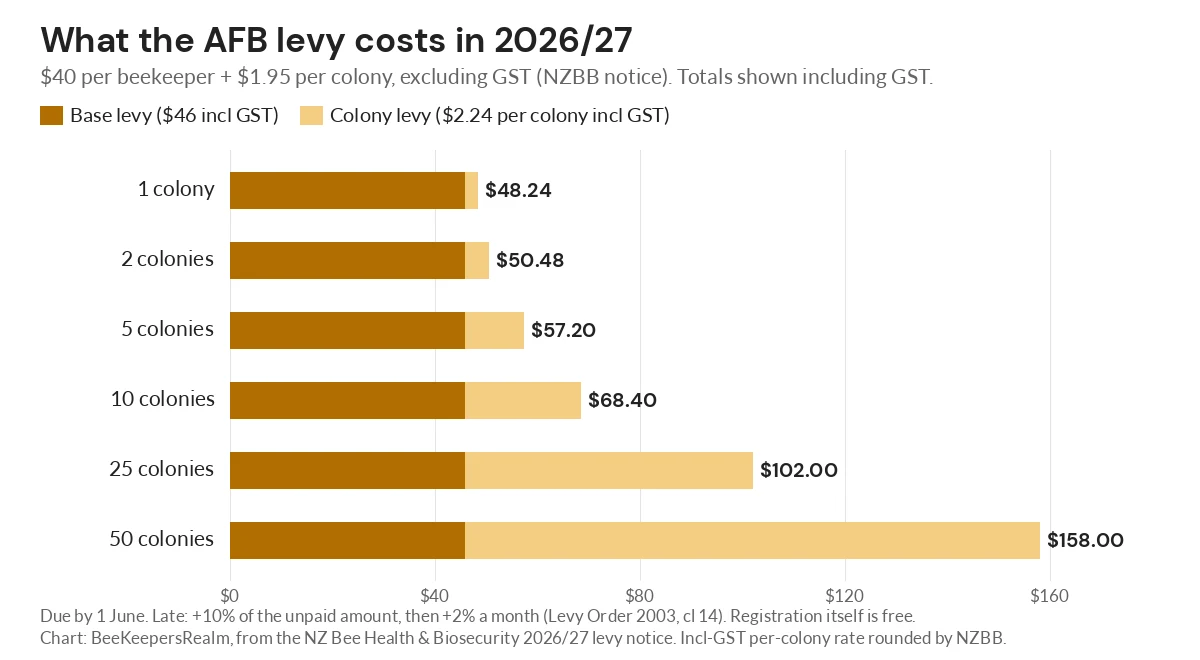
The plan is funded by beekeepers through the Biosecurity (American Foulbrood—Beekeeper Levy) Order 2003. For the levy year starting 1 June 2026, NZBB’s notice under clause 12 sets $40 per beekeeper plus $1.95 per colony owned on 31 March 2026, excluding GST ($46 and $2.24 including GST). A nuc counts as a colony. The order caps the rate at $40 plus $2.55 per colony.
| Colonies owned on 31 March | Levy excl. GST | Levy incl. GST |
|---|---|---|
| 1 | $41.95 | $48.24 |
| 2 | $43.90 | $50.48 |
| 5 | $49.75 | $57.20 |
| 10 | $59.50 | $68.40 |
| 50 | $137.50 | $158.00 |
| 500 | $1,015.00 | $1,166.00 |
Our arithmetic from NZBB’s published rates; the GST-inclusive column uses NZBB’s rounded $2.24 per colony. Clause 13 makes the levy payable by 1 June, and NZBB must send the invoice at least 28 days before. Under clause 14, an unpaid amount attracts an extra 10%, then 2% for each month it stays outstanding.
Two other costs come with the system. NZBB’s AFB Recognition course costs $100 in a classroom and $100 including GST online with the assessment; the online refresher is free. Non-DECA beekeepers also pay whatever their inspector charges, which NZBB treats as a private arrangement. NZBB has proposed raising the colony levy to $2.20 for 2027/28, with the base rate unchanged.
NZBB’s figures show the system’s scale: between 1 June 2025 and 31 May 2026, registered beekeepers fell from 7,872 to 7,203 and colonies from 505,745 to 487,784.
Your Annual Compliance Calendar
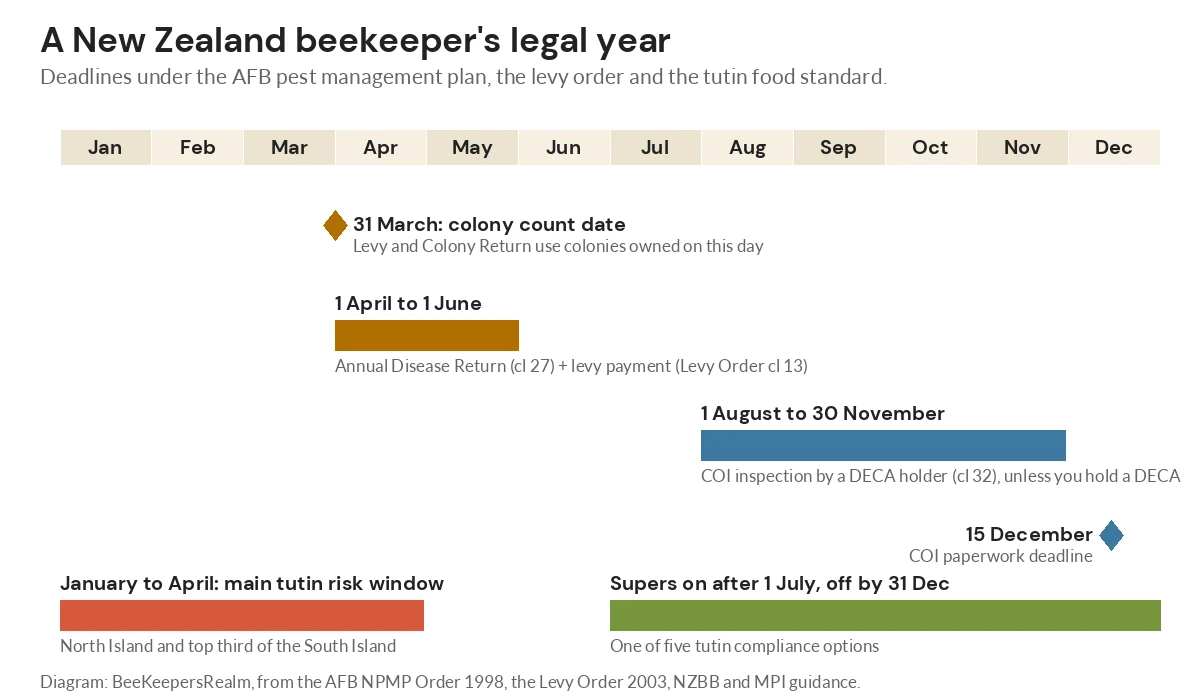
The deadlines come from three instruments, so they are easy to miss. In date order:
| Date or window | What you do | Who | Source |
|---|---|---|---|
| 31 March | Count colonies (nucs included) for the levy and Colony Return | All registered beekeepers | Levy Order cl 7(3) |
| 1 April to 1 June | Annual Disease Return on HiveHub, required even with zero bees | All registered beekeepers | Order cl 27 |
| By 1 June | Pay the levy | All registered beekeepers | Levy Order cl 13 |
| 1 August to 30 November | Every colony inspected for AFB by a DECA holder | Beekeepers without a DECA | Order cl 32(1)–(2) |
| 14 days after inspection, and before 15 December | Submit the Certificate of Inspection | Beekeepers without a DECA | Order cl 32(3) |
| Any day | Report AFB and destroy the colony within 7 days | Everyone | Order cl 26, 28 |
Certificate of Inspection or DECA
Clause 32 requires every colony to be inspected for AFB once a year between 1 August and 30 November. Most hobbyists meet this with a Certificate of Inspection (COI): you book a DECA holder, they inspect every colony on every apiary, and you file the signed certificate within 14 days, and before 15 December. NZBB is explicit that you cannot inspect your own colonies for a COI. A late COI counts as non-compliance, and beekeepers who never file one risk a “default COI” inspection by an authorised person, with the cost recovered from them.
A Disease Elimination Conformity Agreement (DECA) is the alternative. It is a written agreement with NZBB setting out how you will inspect for, record and destroy AFB, and holding one exempts you from the COI (cl 36). To qualify, NZBB requires you to:
- pass the AFB Recognition course assessment (cl 37(1)(aaa));
- be fully compliant with the plan for at least 12 months; and
- have submitted a COI by 15 December within those 12 months.
A DECA does not exempt you from inspections by NZBB’s authorised persons. NZBB can revoke it, for example when an operation is classed as high risk (clinical AFB in at least 10% of its hives and at least three cases) and multiple non-compliances are found. To practise the field checks inspectors rely on, see our guide to the rope test for American foulbrood.
If You Find American Foulbrood
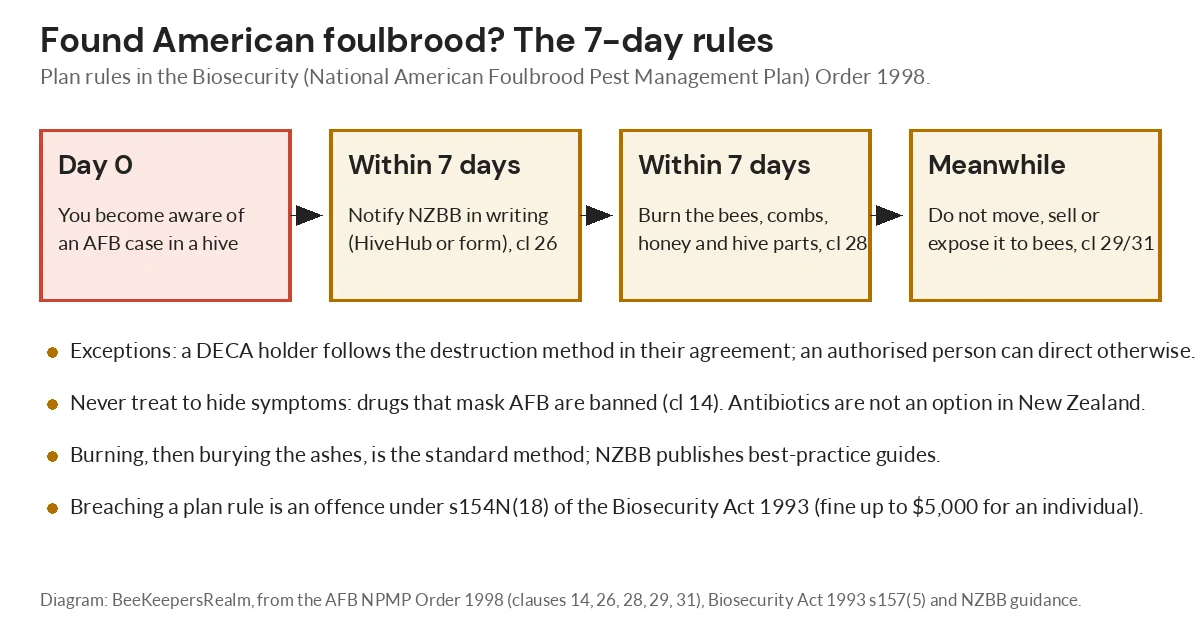
New Zealand does not treat AFB; it destroys it. Clause 14 bans any drug or substance that masks or conceals AFB symptoms, so the antibiotic route used in the U.S. (see our Terramycin guide) is closed. Once you know about a case:
- Within 7 days, notify. The person in charge of the bees must tell NZBB and the hive owner in writing (cl 26), usually through HiveHub.
- Within 7 days, destroy. The owner must “destroy by burning” the bees, bee products and appliances from that colony unless an authorised person directs otherwise (cl 28). A DECA holder follows the method in their agreement.
- Meanwhile, contain. Do not let bees reach honey or equipment from the colony (cl 29), and do not sell, give away or move any of it (cl 31).
So yes, burning infected hives is routine, and legally required, in New Zealand. Our guide to burning comb after American foulbrood covers the method. NZBB notes that AFB spores can survive for over 35 years, which is why boxes cannot simply be reused.
Notifiable Pests You Must Report to MPI
AFB is managed under the pest plan, not reported to MPI. Exotic bee pests are different. Under section 46 of the Biosecurity Act, anyone who suspects a notifiable organism where it is not established must report it “without unreasonable delay”. The Biosecurity (Notifiable Organisms) Order 2016 lists nine organisms affecting honey bees:
| Notifiable organism | Common name |
|---|---|
| Melissococcus pluton | European foulbrood |
| Aethina tumida | Small hive beetle |
| Acarapis woodi | Tracheal mite |
| Tropilaelaps clareae, T. koenigerum | Tropilaelaps mites |
| Varroa underwoodi, Euvarroa sinhai | Exotic varroa species |
| Apis mellifera capensis | Cape bee |
| Apis mellifera scutellata and hybrids | Africanised honey bee |
The Order’s schedule does not include Varroa destructor, the mite New Zealand beekeepers treat for. MPI says it was first detected in 2000 and has since spread throughout the country; the Chatham Islands hold the only large bee population free of both varroa and AFB. Section 44 adds a general duty to tell MPI about anything that appears to be an organism not normally found in New Zealand. MPI’s exotic pest and disease hotline is 0800 80 99 66. New Zealand is one of the few countries still free of European foulbrood; see our comparison of American vs. European foulbrood.
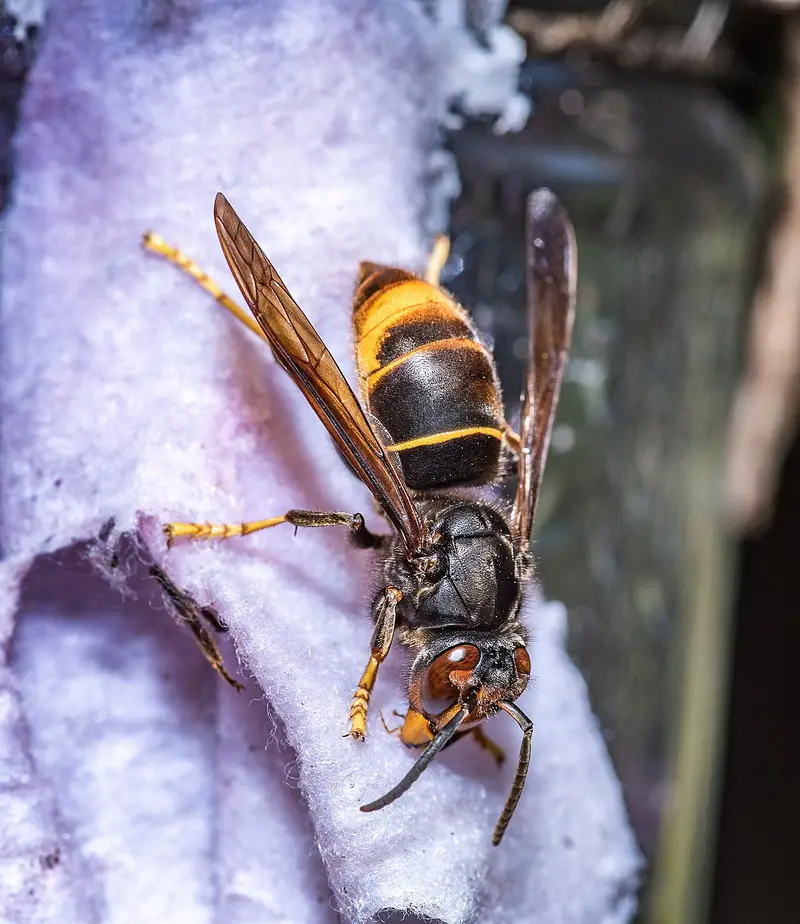
The most recent test of this system is the yellow-legged hornet (Vespa velutina), which MPI classes as an unwanted organism. It was found on Auckland’s North Shore in October 2025. MPI’s update of 15 September 2026 reports 77 queens and 133 nests destroyed, no sign of hornets since April 2026, and more than 438 active registered apiaries inside the 11 km surveillance zone. Anyone who sees a hornet or nest should report it on the same hotline, 0800 80 99 66. For identification, see our guide to the yellow-legged hornet.
Council Rules: Auckland vs Wellington
The national rules say nothing about where on your section a hive may sit. Councils fill that gap with bylaws, and the two largest cities show how far they vary.
| Question | Auckland | Wellington |
|---|---|---|
| Instrument | Animal Management Bylaw 2015 and Bee, Stock and Horse Riding Control 2015 (as at 25 November 2021) | Animal Bylaw 2024 (in force 18 April 2024) |
| Licence for hives on your own property? | No licence, but urban beekeepers must meet Control cl 7(1) | No, up to four hives in a Residential area (cl 12.2.2); none needed in a Rural area (cl 12.2.1) |
| Hive limit | None set for hobbyists | Written permission needed for more than four hives in a Residential area (cl 8.1.3) |
| Hives on council land | Approval required in council-controlled public places (Bylaw cl 7(1)(d)) | Licence or written permission (cl 12.1.1); new hives on parks only in licensed community gardens (cl 12.1.2) |
| Conduct rules | Minimal impact on others, calm temperament, swarm control, water, excrement (Control cl 7(1)(a)–(e)) | Flight path away from neighbouring dwellings, water source, nuisance management (cl 12.3.1) |
| If there are complaints | Nuisance provisions of the bylaw (cl 6) | Council may require removal or relocation (cl 12.2.3); fine up to $20,000 (cl 16.1) |
Auckland’s control, clause 7(1)(e), requires a person keeping bees in an urban area to “take all reasonable steps to minimise nuisance to any other person from bee excrement”. The council’s Animal Management Bylaw page links the full text. Its guidance suggests a flyway barrier 1–2 metres from the entrance. Keeping bees for farming purposes in Auckland’s urban areas falls under the Unitary Plan and may need resource consent.
Outside these two cities, check your own district’s bylaw before buying a hive. On land you do not own, Apiculture New Zealand’s code of conduct expects the landowner’s permission. For placement and setback ideas that work anywhere, see how close beehives can be to neighbors.
Selling Honey: NP1 Registration and Tutin
Honey you eat yourself is outside food law. Selling it is not. MPI’s food safety rules for beekeepers require anyone who extracts or packs honey for sale to register with their local council under National Programme Level 1 (NP1) of the Food Act 2014 and be checked by a verifier. An NP1 registration lasts 2 years. A hobbyist needs neither if they sell only honey packed in a registered facility, direct to consumers.
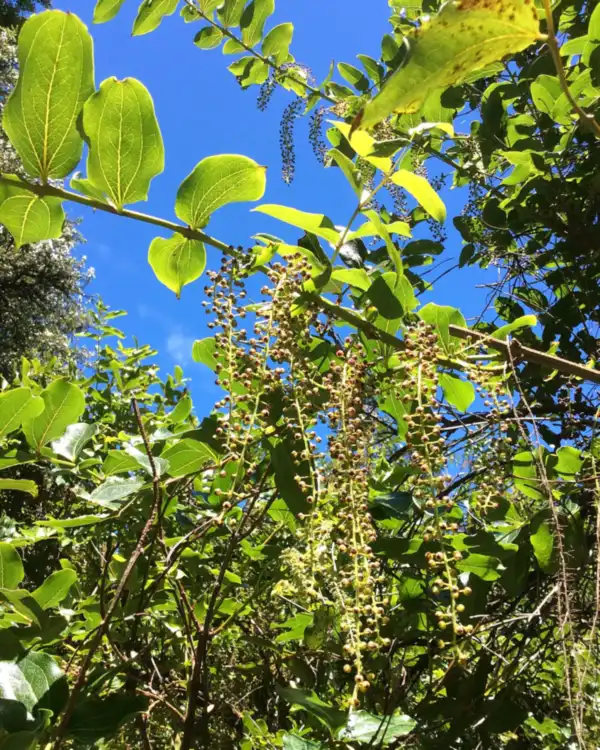
Tutin is the hazard most foreign guides miss. It is a toxin from the native tutu shrub (Coriaria arborea) that reaches honey when bees collect honeydew from passion vine hoppers feeding on tutu. The Food Standards Code caps it at 0.7 mg/kg in honey and comb. The main risk is January to April, across most of the North Island and the top third of the South Island. The Food (Tutin in Honey) Standard 2016 gives five ways to comply:
- laboratory testing;
- putting supers on after 1 July and harvesting them by 31 December of the same year;
- siting hives where the foraging range holds no significant tutu;
- keeping hives in the bottom two-thirds of the South Island, south of 42°S; or
- showing low risk through several years of targeted testing.
You must keep records of the option you used and pass them to whoever extracts or packs your honey. Giving honey away does not get you out of it:
“Note that donating or bartering honey is a form of trade. If you do either, you must comply with this standard.”
Exporting Honey and the Mānuka Definition
Exporters may only ship honey from beekeepers listed with MPI, so supplying the export chain adds three duties:
- List with MPI. The listing (form AP14) takes about 20 working days, lasts 12 months and is renewed with a fee each year. Exemptions apply if you work under your own risk-based measure or an exclusive supply contract named in a processor’s Risk Management Programme.
- Keep records. Mark every honey box with your AFB identification code and keep records for each apiary for four years.
- Declare the harvest. Give a harvest declaration with every delivery to the first processor.
Processors that export to markets requiring an official certificate must operate under a registered Risk Management Programme under the Animal Products Act 1999. MPI’s annual bee products programmes charge for processors exporting is $2,566.08 excluding GST.
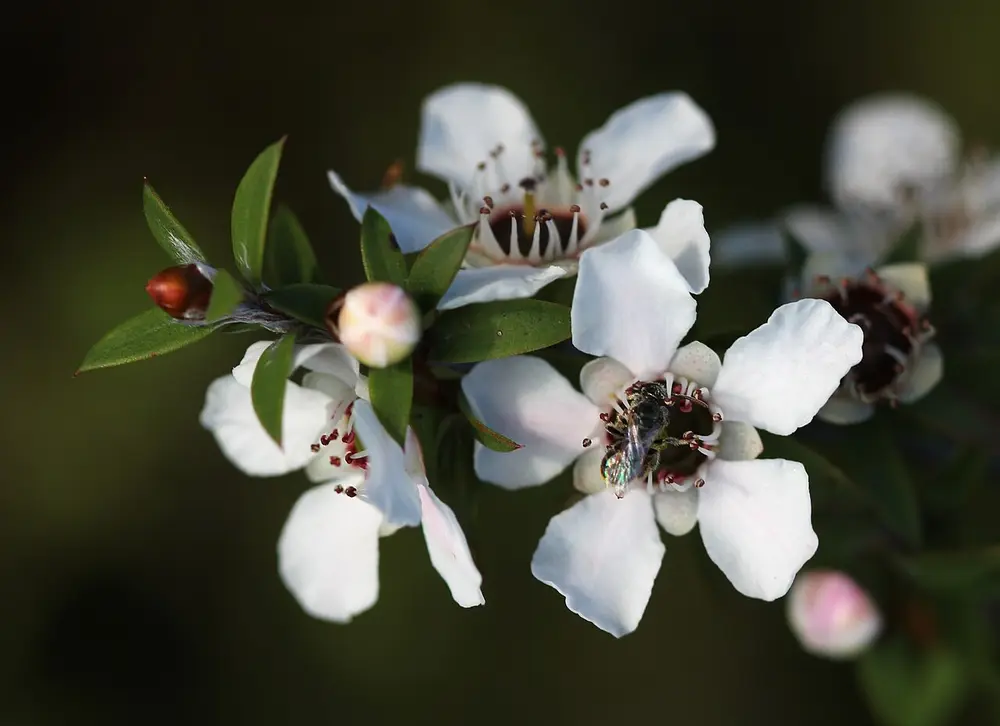
Honey labelled mānuka for export must pass MPI’s science definition, finalised in December 2017 and left unchanged after a review completed in 2023. An MPI-recognised laboratory tests five attributes: four nectar chemicals and a mānuka pollen DNA marker. Monofloral mānuka needs, among other markers, 3-phenyllactic acid at 400 mg/kg or more; multifloral needs 20 to under 400 mg/kg. Domestic sales fall under general labelling and Fair Trading Act rules instead. For the naming fight with Australia, see the mānuka honey trademark war; for the wider process, our honey export process guide.
Penalties for Breaking the Rules
Almost every plan rule ends with the same line: a breach “is an offence under section 154N(18) of the Act”. That section reads:
“A person commits an offence against this Act who fails to comply with a rule in a national pest management plan or a national pathway management plan that specifies that a contravention of the rule creates an offence against this Act.”
Section 157(5) sets the maximum for that offence: a fine of $5,000 for an individual or $15,000 for a corporation. NZBB’s Beekeeper 101 page quotes different figures, up to 12 months’ imprisonment and $10,000 for a corporation; the Act’s current text, which we checked, gives the fine only. On top of fines:
- unpaid levy grows by 10% plus 2% a month (Levy Order cl 14);
- a missed COI can bring a cost-recovered default inspection; and
- hives in unregistered sites can be destroyed after 30 days’ notice (cl 25).
Council bylaws carry their own penalties; Wellington’s is up to $20,000.
Frequently Asked Questions
Do you need a licence to keep bees in New Zealand?
No national licence exists, but you must register as a beekeeper and notify each apiary under the AFB pest management plan. Auckland and Wellington require approval only for hives on council land, though some councils set other limits.
Do I have to register if I only have one hive?
Yes. The plan applies to anyone who owns a beehive bees can access, and registration through NZBB’s HiveHub is free.
How much does it cost to keep bees legally in NZ?
For 2026/27 the AFB levy is $40 per beekeeper plus $1.95 per colony, excluding GST: $50.48 including GST for two colonies.
Is New Zealand burning beehives?
Only hives with American foulbrood. Clause 28 of the plan requires the owner to burn the bees, honey and gear from an AFB colony within 7 days.
Is varroa a notifiable organism in New Zealand?
No. Varroa destructor is established and not on the notifiable list; exotic varroa species, European foulbrood and small hive beetle are.
How many hives can I keep in a Wellington or Auckland backyard?
Wellington allows up to four on a residential property without permission. Auckland sets no number for hobbyists but requires nuisance control under its bylaw.
Can I inspect my own hives for the Certificate of Inspection?
No. A DECA holder must inspect them between 1 August and 30 November, unless you hold your own DECA.
Can I give away honey without following the tutin rules?
No. MPI treats donating or bartering honey as trade, so the 0.7 mg/kg tutin standard applies.
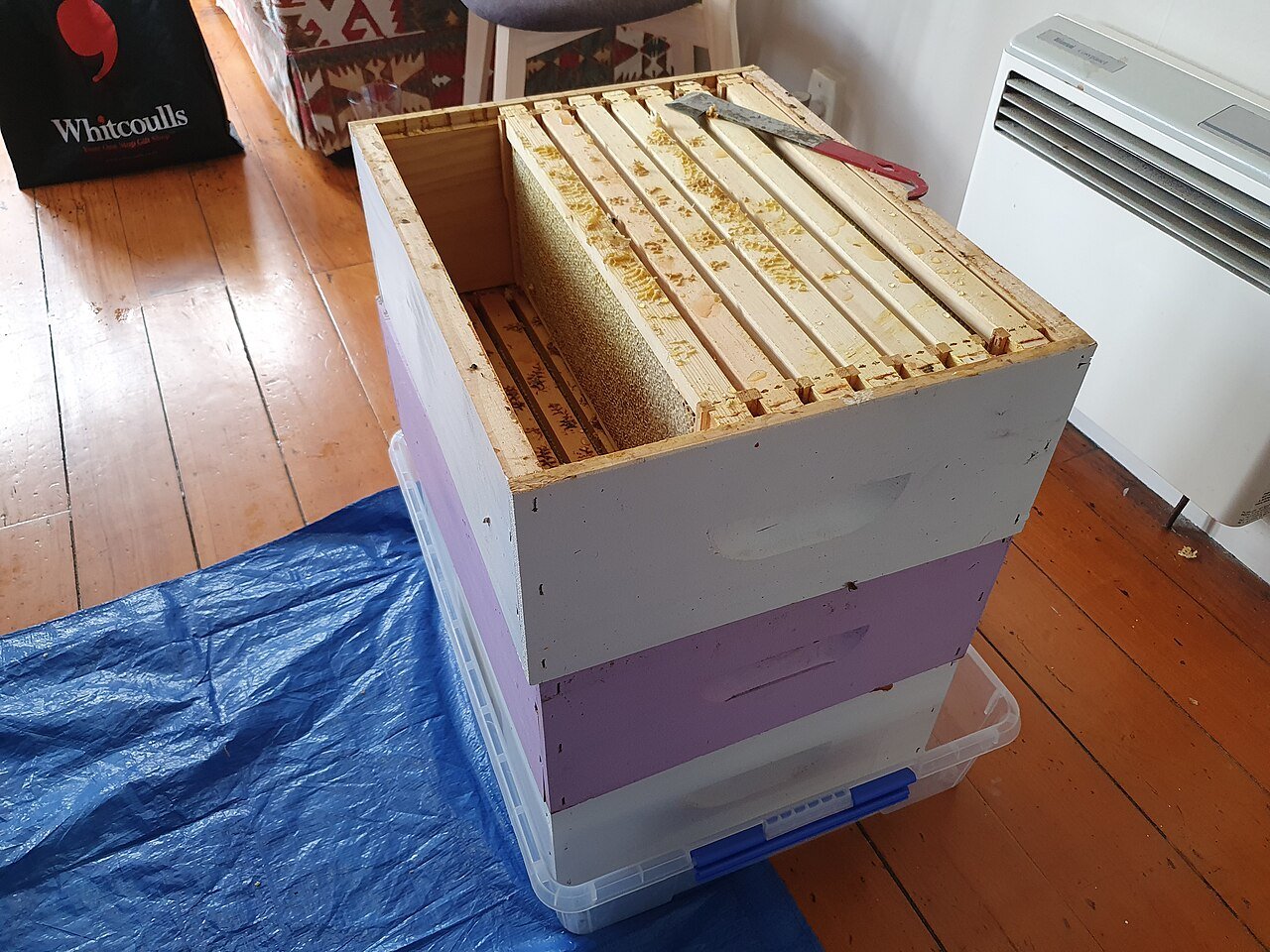
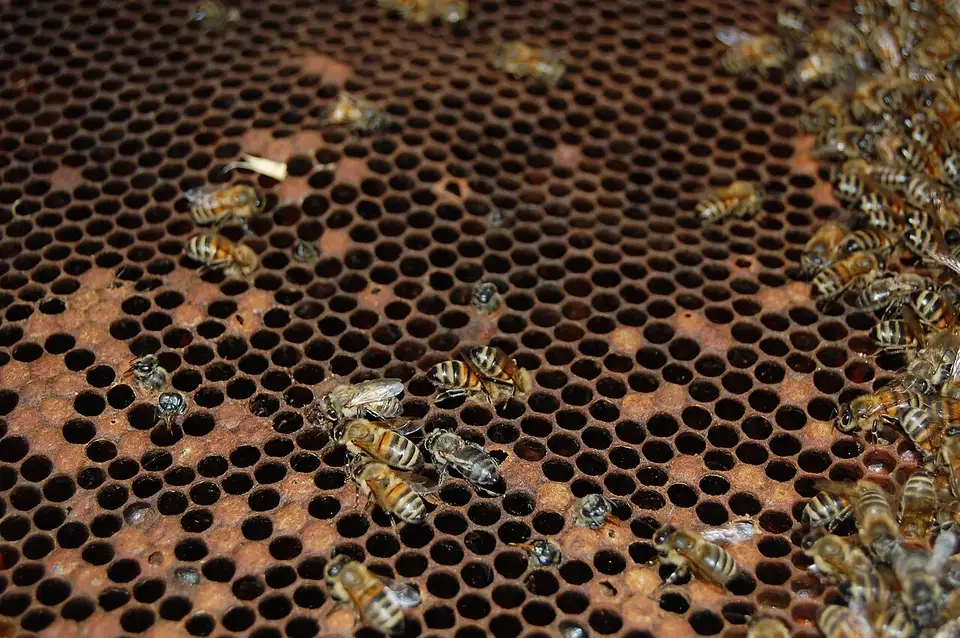
Before your first hive arrives, register on HiveHub, book an AFB Recognition course and check your council’s bylaw. Top photo: hive frames in Auckland, Prosperosity via Wikimedia Commons, CC BY-SA 4.0.
Related Reading
Image credits: Photo: Hive frame from urban beekeeping in Auckland, New Zealand. Photo by Prosperosity, CC BY-SA 4.0.