Reviewed by Thomas B. · Last Updated October 13, 2026 · How we review
No, you do not have to register beehives with the State of Kansas, and there is no state fee or state bee inspector. Kansas repealed its apiary law, K.S.A. 2-411 to 2-428, effective July 1, 2002. The rules that apply come from your city: Overland Park, Newton and Lawrence set hive limits and distances, and Newton requires free yearly registration. Honey sold directly to consumers needs no state food license, and since July 1, 2026, small beekeepers can also sell through stores without one.
Legal note: This is educational information, not legal advice. We checked every rule below against official sources on October 13, 2026: state law on the Kansas Office of the Revisor of Statutes and city rules in each city’s own code or guide. Ordinances change, so confirm with your city clerk before setting up hives.
Key Takeaways
- Kansas has no state beekeeper registration, permit, fee or inspection. The apiary act was repealed by L. 2002, ch. 91, sec. 17.
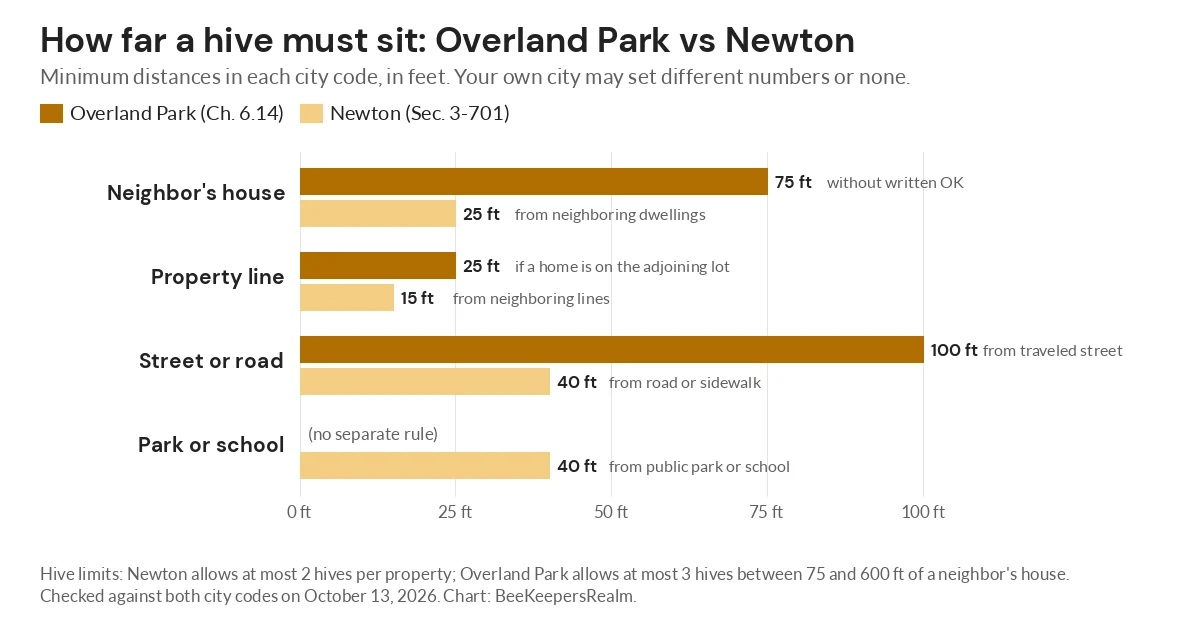
- City codes are the real law. Overland Park keeps hives 75 feet from a neighbor’s house unless the neighbor agrees in writing; Newton allows two hives and requires yearly registration and neighbors’ written approval.
- BeeCheck KS is a free, voluntary hive map for pesticide applicators, not a legal requirement.
- Raw honey sold straight to consumers needs no Kansas Department of Agriculture (KDA) license under K.S.A. 65-689(d)(4).
- HB 2158 (2026) lets beekeepers with $35,000 or less in yearly honey sales sell through stores without a license if they meet seven conditions, including a set label disclaimer.
Table of Contents
- Is There a State Beekeeping Law in Kansas?
- Who Inspects Beehives in Kansas?
- City Ordinances: Where Kansas Beekeeping Is Regulated
- BeeCheck KS and Pesticide Protection
- Selling Honey in Kansas
- Frequently Asked Questions
- The Bottom Line
Is There a State Beekeeping Law in Kansas?
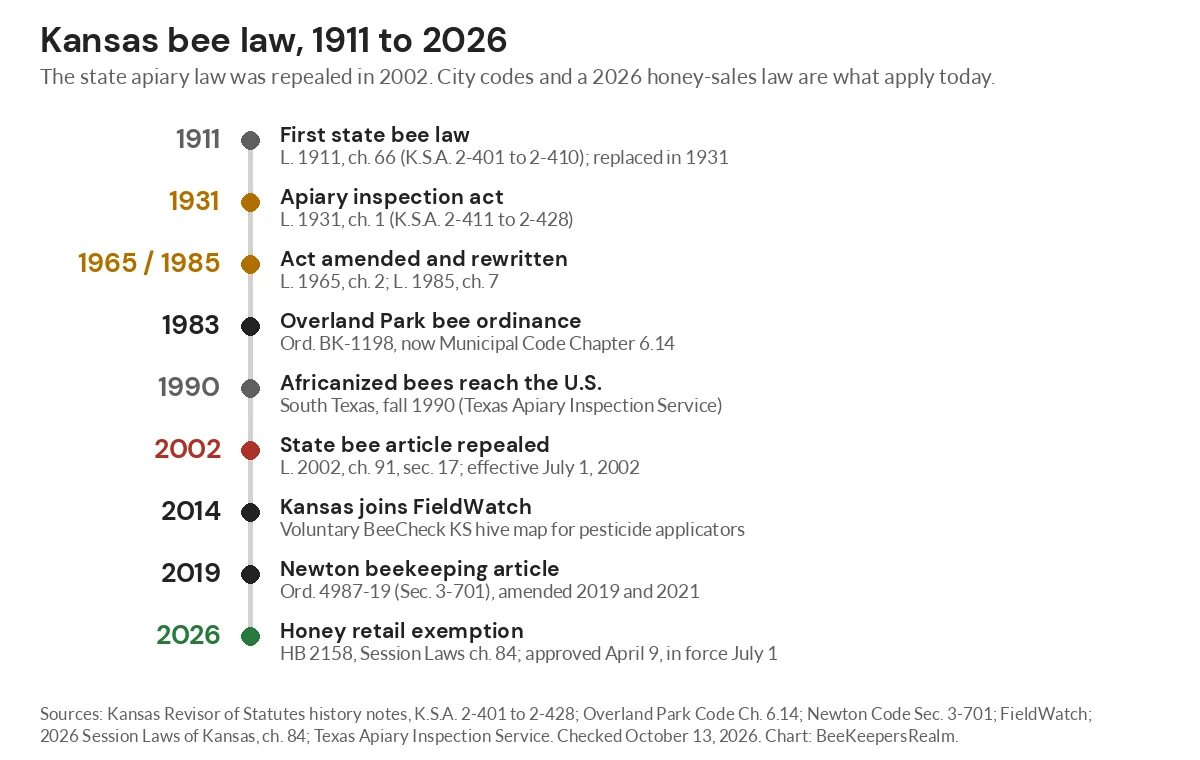
Not anymore. On the Revisor of Statutes site, Chapter 2, Article 4 of the Kansas Statutes, titled “Bees,” is marked “Not in active use,” and every section is listed as repealed. The history notes show a 1911 bee law, replaced in 1931 by an apiary inspection act (L. 1931, ch. 1), which was amended in 1965 and rewritten in 1985 (L. 1985, ch. 7). L. 2002, ch. 91, sec. 17 repealed what remained, effective July 1, 2002.
We found no current Kansas law or regulation that replaced it. That makes Kansas unusual: neighbors such as Missouri and Nebraska still have state bee statutes. For why states passed these laws in the first place, see our history of American foulbrood laws and apiary inspection. The Overland Park-based Northeastern Kansas Beekeepers Association puts it plainly:
“The state of Kansas does not have any beekeeping ordinances.”
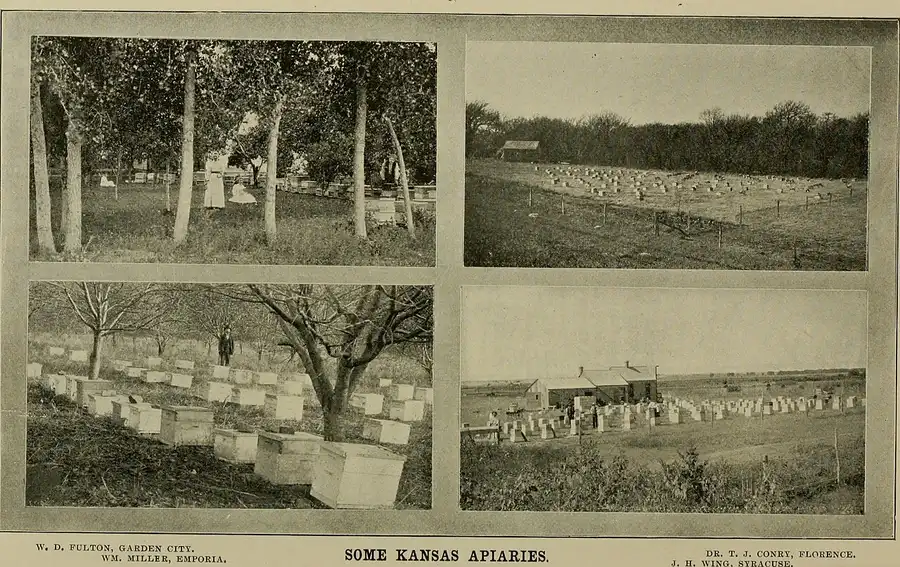
The state’s beekeeping history is older than its bee laws. In 1899 the state printer in Topeka published a report on alfalfa, grasshoppers and bees with photos of working Kansas apiaries.
Who Inspects Beehives in Kansas?
No state agency inspects apiaries. There is no state apiarist, no routine disease inspection, and no state permit to bring colonies into Kansas that we could find. If you move bees out of Kansas, the destination state’s rules apply. Oversight comes from three places:
- Your city. Cities enforce their bee codes like any other ordinance. Newton can revoke a beekeeper’s license and fines $100 to $1,000 per conviction.
- KDA, for food only. Honey sellers who are exempt from a food license can still be inspected “when a violation is observed or reported,” under K.S.A. 65-689(e).
- You. For disease diagnosis, the USDA Agricultural Research Service Bee Research Laboratory in Beltsville, Maryland, examines U.S. samples at no charge. Local clubs in our list of U.S. beekeeping associations are the usual source of mentors.
City Ordinances: Where Kansas Beekeeping Is Regulated
Each Kansas city decides whether bees are allowed and on what terms. Here are three verified examples. For how zoning rules work in general, see our beekeeping zoning laws guide.
| Rule | Overland Park (Ch. 6.14) | Newton (Sec. 3-701) | Lawrence |
|---|---|---|---|
| City registration | None in the chapter | Yearly by January 1, free; written approval from all adjacent residents | None for by-right hives |
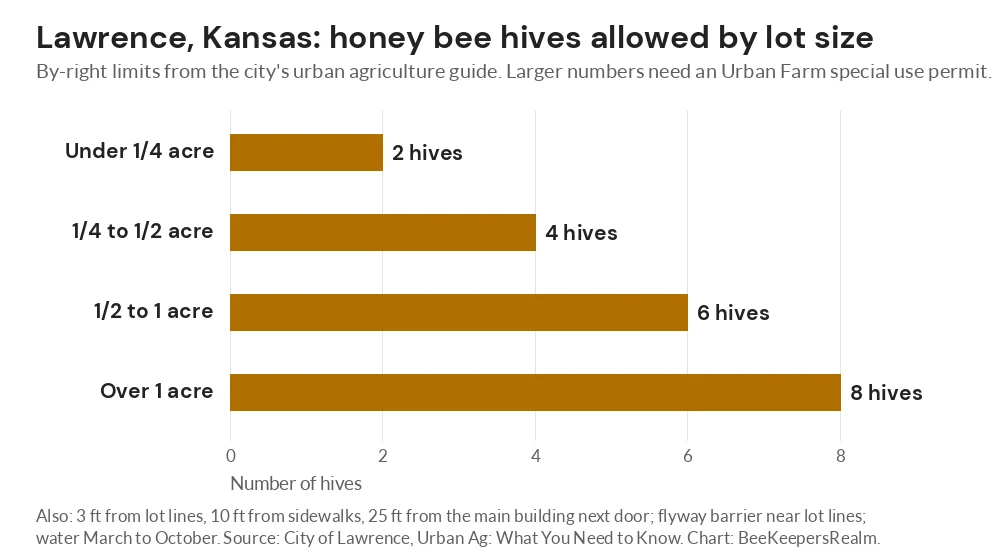
| Hive limit | 3 between 75 and 600 ft of a neighbor’s home | 2 per property | 2 to 8, by lot size |
| From a neighbor’s home | 75 ft, unless the neighbor gives written permission | 25 ft | 25 ft from the main building on adjacent lots |
| From property lines | 25 ft if a home is on the adjoining lot | 15 ft | 3 ft |
| From streets and sidewalks | 100 ft from the traveled street | 40 ft; also 40 ft from parks and schools | 10 ft from sidewalks |
| Other duties | Water within 25 ft; owner sign on hives kept off-site | Monthly hive checks; 6-ft flyover barrier near lot lines; name and phone on every hive | Flyway barrier within 10 ft of a lot line; water March to October |
Sources: Overland Park Municipal Code Chapter 6.14; Code of the City of Newton, Article 7; City of Lawrence, “Urban Ag: What You Need to Know.” Checked October 13, 2026.
Overland Park
The Northeastern Kansas Beekeepers Association counts Overland Park’s code among the earliest in Kansas. The code’s history notes date it to 1983 (Ordinance BK-1198), with a severability clause added in 1985. Besides the distances above, Section 6.14.050 makes a beekeeper move hives if a neighbor later builds closer, and keeping hives on land you do not own needs the owner’s written permission.
The ordinance grew out of concern about Africanized honey bees moving north. Those bees first reached the U.S. in south Texas in the fall of 1990, according to the Texas Apiary Inspection Service. The association notes they have never been found to establish naturally in Kansas, likely because the winters are too cold. Our guide to identifying Africanized bees covers the warning signs.
Newton
Newton’s Article 7 (Ordinances 4987-19, 4998-19 and 5038-21) asks the most of beekeepers. You must register the number and location of your hives each January 1, or 30 days before getting a hive, and bring written approval from all adjacent residents. The city then issues a free, revocable license. The code also requires movable-frame hives, a monthly inspection, swarm prevention and requeening of defensive colonies. Our tips on talking to neighbors about getting bees can help with the sign-off.
Lawrence
Lawrence treats bees as small animal agriculture, allowed by right in every residential zone. Hive numbers grow with lot size, and hives may sit on rooftops or in side or back yards. For spacing advice beyond what codes require, see how close beehives can be to neighbors.
How to Check Your Own City
K-State Research and Extension in Johnson County lists Lenexa, Mission, Olathe, Overland Park, Prairie Village and Shawnee as allowing residential beekeeping, some with a permit. Many small towns have no bee ordinance at all. Search for “[your city] municipal code,” then search the code for “bee,” “apiary” and “hive.” Check the zoning code too: Olathe, for one, keeps its bee rules in its development code. Outside city limits, ask your county planning and zoning office.
BeeCheck KS and Pesticide Protection
Kansas joined FieldWatch in 2014. Its free BeeCheck KS registry at ks.beecheck.org lets you map your hives so pesticide applicators can see them before spraying. It is voluntary:
“It is not a substitute for any state regulatory requirements.”
One trap: Google’s snippet for the BeeCheck KS page can show “Registration is the law for Beekeepers.” That line comes from California’s BeeWhere disclaimer, which is embedded on the same page. It does not apply in Kansas. Our DriftWatch and BeeCheck guide explains how the registry works.
Selling Honey in Kansas
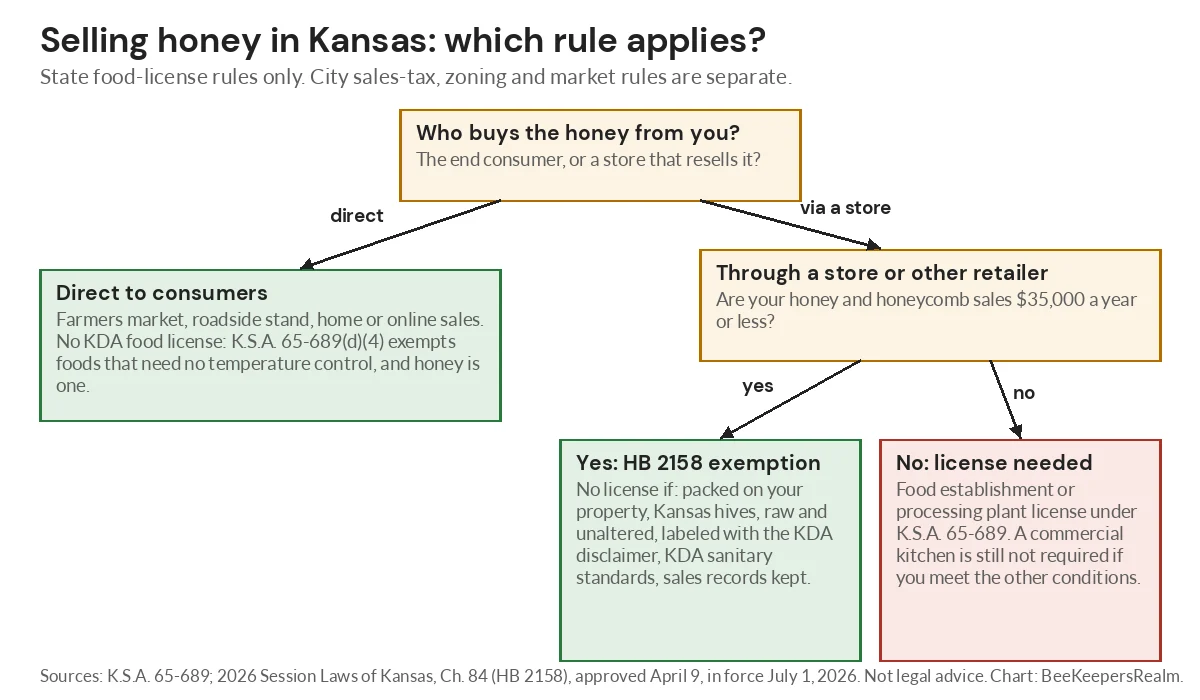
Kansas food licensing runs through K.S.A. 65-689 and the KDA Food Safety and Lodging program. Which rule applies depends on who buys your honey. City sales tax, zoning and market rules are separate.
Direct to Consumers: No License
K.S.A. 65-689(d)(4) exempts food sold directly to the end consumer if it needs no time and temperature control. K-State’s publication MF3138, Foods Sold Direct to Consumers in Kansas, reviewed by KDA food safety staff, lists honey among foods that can be sold this way without a license, including at farmers markets and online with direct delivery or shipping to the buyer’s home. Out-of-state buyers bring their own state’s rules. See our guides to selling honey legally and selling raw honey at farmers markets.
Through Stores: The 2026 HB 2158 Exemption
Until 2026, selling packaged honey to stores for resale required a KDA license. House Bill 2158, requested by the Kansas Honey Producers Association and the Northeastern Kansas Beekeepers Association, changed that. The governor approved it April 9, 2026, and it took effect July 1, 2026, as 2026 Session Laws of Kansas, Chapter 84. A beekeeper may sell honey or honeycomb “for sale or resale at a retailer” without a license if:
- it is packaged on the property of the beekeeper who harvests and sells it;
- the label shows “honey” or “honeycomb,” the beekeeper’s name, address and ZIP code, the net weight, and the required disclaimer;
- it stays unaltered (raw, at most strained, never pasteurized) with no additives;
- the hives were in Kansas at harvest;
- annual gross honey and honeycomb sales are $35,000 or less;
- the beekeeper follows KDA’s minimum sanitary packaging standards; and
- the beekeeper keeps sales records (amount by container size, where and when sold) for KDA to see on request.
The disclaimer must read:
“Product not subject to routine inspection by the Kansas department of agriculture.”
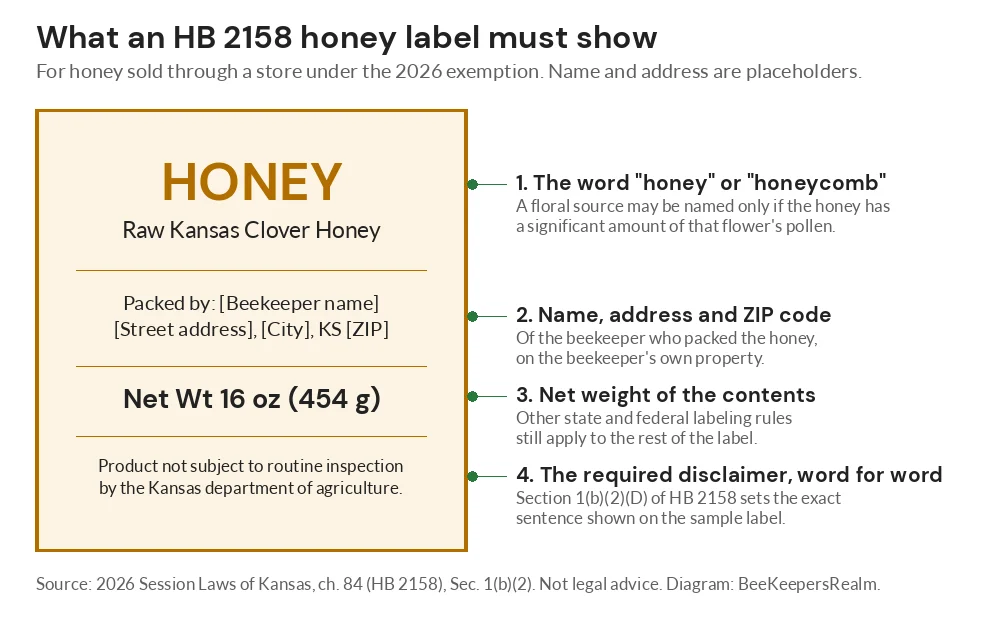
Over the $35,000 cap you need a license to sell through stores, but if you meet the other conditions you still do not need a commercial kitchen (Section 1(c)). For the rest of the label, see what must be on a honey jar.
Frequently Asked Questions
Do I need to register my beehives in Kansas?
Not with the state, and there is no state fee. Some cities require registration: Newton’s is free and yearly and needs adjacent residents’ written approval.
Who inspects beehives in Kansas?
No state agency inspects apiaries. Cities enforce their own bee codes, and KDA can inspect exempt honey sellers when a food-safety violation is observed or reported.
Can I keep bees in city limits in Kansas?
Often, yes. Overland Park, Newton, Lawrence, Olathe, Lenexa, Mission, Prairie Village and Shawnee allow residential hives under their own rules. Check your code and any HOA covenants first.
How many hives can I have in Kansas?
The state sets no limit. Newton allows two per property, Lawrence two to eight by lot size, and Overland Park three within 75 to 600 feet of a neighbor’s home.
Do I need a license to sell honey in Kansas?
Not for raw honey sold directly to consumers. Since July 1, 2026, beekeepers under $35,000 in yearly honey sales can also sell through stores without one if they meet HB 2158’s conditions.
Can I sell honey to a grocery store in Kansas?
Yes, if you pack it on your property, keep it raw, use the required label, stay at or under $35,000 a year and keep sales records. Otherwise you need a KDA food license.
The Bottom Line
In Kansas your city code matters more than any state law. Read your city’s ordinance before buying bees, map your hives on BeeCheck KS, and if you sell through stores, set up your label and records to match HB 2158. For other states, see our U.S. beekeeping regulations by state.