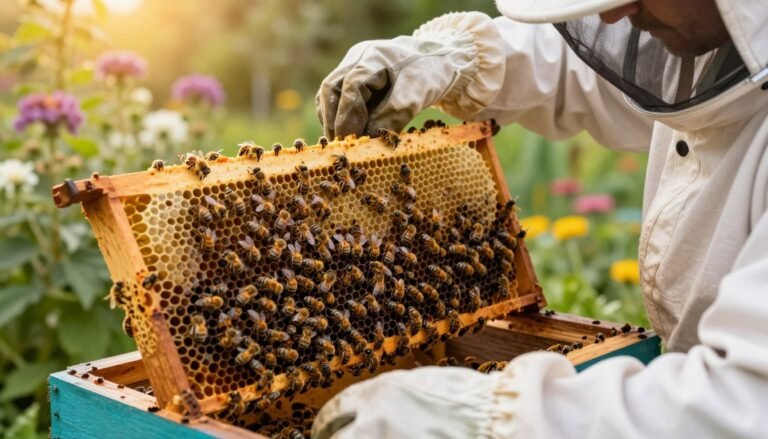
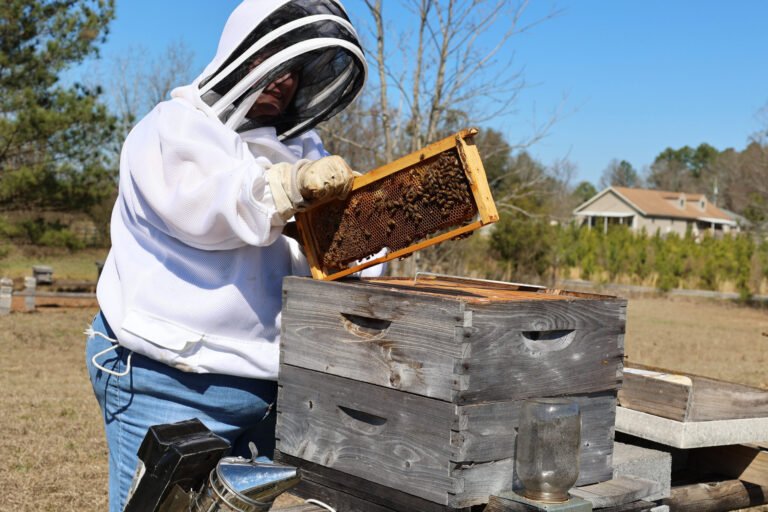
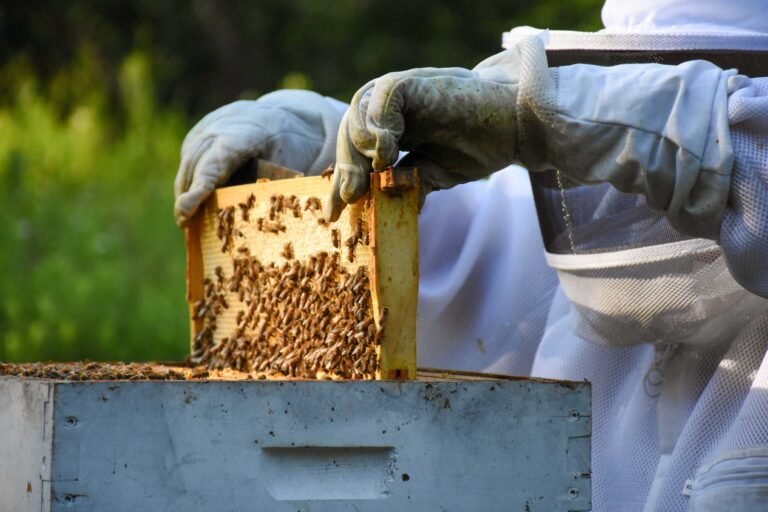
Beekeeping has its own vocabulary, and a lot of it, from hive anatomy to disease names to queen-rearing jargon, isn’t obvious to a newcomer. This glossary collects clear, concise definitions for the terms you’re most likely to encounter across beekeeping books, forums, extension publications, and the rest of this site, organized alphabetically for quick reference. Where a term has its own in-depth guide elsewhere on this site, we’ve linked to it directly.
Table of Contents
Jump to a Letter
A | B | C | D | E | F | G | H | I | K | L | M | N | O | P | Q | R | S | T | U | V | W
A
Absconding — When an entire honeybee colony abandons its hive, typically due to disease, pest pressure, starvation, or repeated disturbance, rather than the more common seasonal behavior of swarming.
Africanized honey bee — A hybrid honeybee strain descended from African and European subspecies, known for heightened defensiveness, established in parts of the southern US. See this site’s guide to Africanized bees.
Apiary — A location where one or more beehives are kept; also called a bee yard.
American foulbrood (AFB) — A highly contagious, spore-forming bacterial brood disease considered the most serious disease in beekeeping, often requiring destruction of infected equipment.
Apis mellifera — The scientific name for the western honeybee, the species kept by the overwhelming majority of beekeepers worldwide.
Apis cerana — The Asian honeybee species, native to Asia, that coevolved with predatory hornets and developed defenses western honeybees never needed. See this site’s comparison of Apis cerana and Apis mellifera.
B
Bee bread — Pollen that’s been packed into comb cells and fermented by bacteria and enzymes, used by nurse bees as a protein source for feeding larvae.
Bee escape — A one-way device installed between hive boxes that allows bees to leave a honey super but not return, used to clear bees before harvest.
Bee space — The roughly 3/8-inch gap bees naturally leave between comb surfaces; hive equipment is engineered around this measurement to prevent bees from filling gaps with burr comb or sealing them with propolis.
Brood — Developing bees at any immature stage: egg, larva, or pupa.
Brood pattern — The visual arrangement of capped and uncapped brood cells on a frame; a tight, consistent pattern indicates a healthy, productive queen, while a spotty pattern can signal disease or a failing queen.
Burr comb — Small, irregular pieces of comb bees build in unintended spaces, such as between frames or boxes, when bee space isn’t properly maintained.
Bearding — Bees clustering on the outside front of the hive, usually on hot days, to help regulate internal temperature rather than a sign of swarming.
C
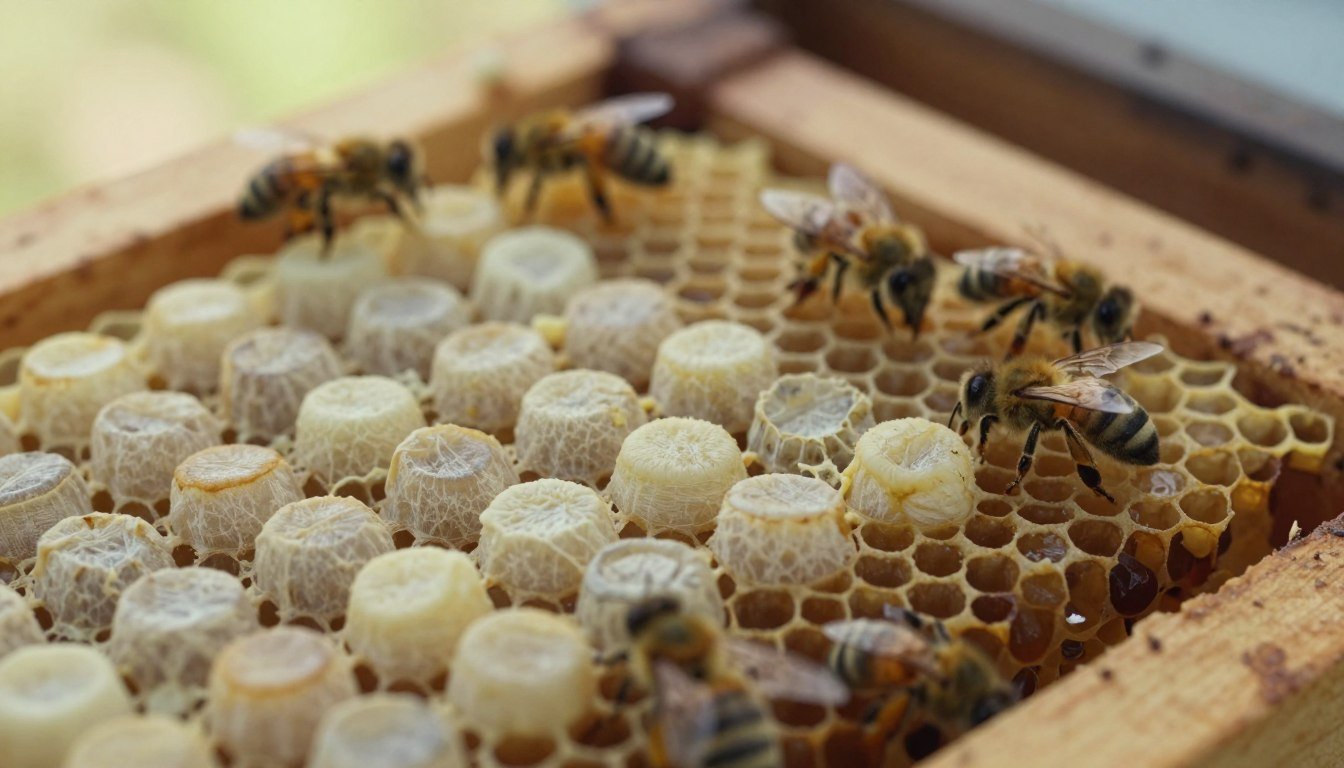
Capped brood — Brood cells sealed with a porous wax cap once the larva inside has finished feeding and begun pupating.
Chalkbrood — A fungal disease that kills honeybee larvae, leaving them mummified and chalky white or gray inside capped cells.
Colony — A complete honeybee society: one queen, her workers, and (seasonally) drones, functioning as a single biological unit.
Colony collapse disorder (CCD) — A specific pattern of colony loss, most notably documented in the mid-2000s, marked by the sudden disappearance of adult worker bees leaving behind a queen, brood, and food stores with few or no dead bees present.
Comb — The hexagonal wax structure bees build to store honey and pollen and to raise brood.
Crystallization (granulation) — The natural process by which liquid honey solidifies into a semi-solid, grainy texture over time, driven mainly by its glucose-to-fructose ratio.
D
Dearth — A period, often mid-to-late summer, when little to no nectar is available for foraging bees, sometimes requiring supplemental feeding.
Diastase — A natural enzyme in honey used as one indicator of honey quality and freshness, since it degrades predictably with heat exposure over time.
Drawn comb — Comb that bees have already built out from a foundation sheet or foundationless frame, ready to be filled with brood or honey.
Drone — A male honeybee, whose sole biological role is mating with virgin queens; drones cannot sting and don’t forage or produce wax.
Drone congregation area — A specific airborne location where drones from many colonies gather to await and mate with virgin queens on their mating flights.
Deep box — The tallest standard Langstroth hive box size, most often used for the brood chamber.
Dead-out — A hive that has lost its entire colony, whether through disease, starvation, absconding, or other causes.
E
Emerging — The moment an adult bee chews its way out of its capped cell after completing pupal development.
European foulbrood (EFB) — A bacterial brood disease generally considered less severe than American foulbrood, though still capable of significantly weakening a colony.
Extractor — A centrifugal device used to spin honey out of uncapped comb without destroying the comb structure, allowing it to be reused.
Entrance reducer — A wooden or metal insert that narrows a hive’s entrance, used to help a weak colony defend itself or to manage ventilation during winter.
F
Foulbrood — A general term for two distinct bacterial brood diseases (American and European foulbrood), among the most serious diseases a colony can face.
Foundation — A thin sheet of beeswax or plastic, embossed with a hexagonal pattern, inserted into a frame to guide bees in building straight comb.
Frame — The removable wooden or plastic rectangle that holds comb inside a hive box, allowing beekeepers to inspect, move, and manage comb individually.
G
Granulation — Another term for honey crystallization; see Crystallization above.
Guard bee — A worker bee stationed at the hive entrance whose role is identifying and repelling intruders, including robbing bees, wasps, and other threats.
H
HMF (hydroxymethylfurfural) — A compound that forms in honey as it ages or is heated, used as a key indicator of honey freshness and processing quality; high HMF suggests overheating or long storage.
Hive body — A single box within a stacked hive system that holds frames of comb, typically categorized as deep, medium, or shallow by height.
Hive tool — A flat metal prying and scraping tool essential for separating hive boxes and frames that bees have sealed together with propolis.
Honey flow — A period of abundant nectar availability during which bees rapidly convert nectar into stored honey.
Honey super — A hive box added specifically to store surplus honey for harvest, kept separate from the brood chamber, often using a queen excluder.
Hive stand — A raised platform a hive sits on, used to improve drainage, reduce dampness, and make certain pests harder to reach the entrance.
I
Inner cover — A lightweight cover placed directly on top of the uppermost hive box, beneath the outer telescoping cover, providing insulation and an air gap.
Instrumental insemination — A controlled breeding technique in which a queen is artificially inseminated with selected drone semen rather than mating naturally in flight.
Inspection — A routine, hands-on check of a hive’s frames to assess brood pattern, queen presence, food stores, and signs of disease or pests.
K
Kenya top-bar hive — A horizontal, frameless hive design using angled side walls and top bars instead of full frames, widely used in low-resource beekeeping settings and increasingly by treatment-free hobbyists in the US.
L
Langstroth hive — The standard vertical, modular, frame-based hive design used by the overwhelming majority of American beekeepers, patented in 1852 and still the industry default today.
Laying worker — A worker bee that begins laying unfertilized eggs, producing only drones, typically occurring in a colony that has been queenless for an extended period.
Larva — The legless, grub-like feeding stage of bee development between egg and pupa.
M
Mating flight — The one or more flights a virgin queen takes early in her life to mate with multiple drones in the air, storing their sperm for the rest of her egg-laying life.
Melissopalynology — The scientific study of pollen found in honey, used to determine and verify a honey’s floral and geographic origin. See this site’s guide to melissopalynology.
Monofloral honey — Honey derived predominantly from a single plant species, also called single-source honey.
Migratory beekeeping — Moving hives seasonally, often across state lines, to follow crop blooms for pollination contracts or to chase specific honey flows.
N
Nectar — The sugary liquid secreted by flowers to attract pollinators, which bees collect and convert into honey.
Nosema — A fungal gut parasite affecting adult honeybees, causing dysentery-like symptoms and reduced colony productivity.
Nuc (nucleus colony) — A small, functioning starter colony, typically on three to five frames, used to establish a new hive or as a backup colony.
Nectar dearth — See Dearth above.
O
Oxalic acid — A naturally occurring organic acid used as a treatment against Varroa mites, applied either as a vapor or a liquid dribble.
P
Package bees — A quantity of loose worker bees (typically two to three pounds) plus a caged queen, sold without comb, used to start a new colony.
Pollen basket (corbicula) — The flattened, hair-fringed section of a honeybee’s hind leg used to carry compacted pollen back to the hive.
Propolis — A resinous substance bees collect from tree sap and buds, mixed with wax and used to seal and sterilize the hive interior. See this site’s guide to propolis.
Pupa — The developmental stage between larva and adult bee, occurring inside a capped cell.
Pheromone — A chemical signal bees use to communicate, coordinating everything from alarm responses to queen recognition and brood care.
Q
Queen excluder — A grid with openings sized to allow worker bees through but not the larger queen, used to keep her confined to the brood chamber and out of honey supers.
Queen cell — A distinctive, elongated, peanut-shaped cell in which a new queen develops, built either for planned swarming, emergency replacement, or supersedure.
Queen excluder — See above.
Queenless — A colony’s state when it has no functioning queen, whether through death, removal, or supersedure failure.
R
Requeening — The deliberate act of replacing a colony’s existing queen with a new one, typically to improve genetics, temperament, or productivity.
Robbing — Aggressive behavior in which bees (often from a stronger colony) or wasps attempt to steal honey stores from a weaker or poorly defended colony.
Robbing screen — A mesh barrier placed over a hive entrance that forces bees to navigate a maze-like path in, making it harder for robbing bees or wasps to locate and overwhelm the entrance.
S
Sacbrood — A viral brood disease causing larvae to die within their unshed final larval skin, giving them a distinctive fluid-filled, sac-like appearance.
Smoker — A handheld device that burns fuel to produce cool smoke, used to calm bees during hive inspections by masking alarm pheromones and triggering a feeding response.
Supersedure — The natural process by which a colony replaces its own queen, usually due to age, illness, or poor performance, without swarming.
Swarming — The natural reproductive process in which a colony splits, with the old queen and roughly half the workers leaving to found a new colony while the original hive raises a new queen.
Split — A deliberate, beekeeper-managed division of one colony into two, used to prevent swarming, increase colony numbers, or requeen.
T
Top-bar hive — A general category of horizontal, frameless hive designs, including the Kenya top-bar hive, in which bees build comb downward from removable top bars rather than full frames.
U
UMF (Unique Manuka Factor) — A grading system for Manuka honey’s antibacterial potency, based primarily on methylglyoxal content. See this site’s guide to Manuka honey and UMF ratings.
Uncapping — The process of slicing or scraping the wax cappings off honeycomb cells before extraction.
Uniting — Combining two colonies, most often a weak one with a stronger one, typically done using a sheet of newspaper between them to allow the two colonies to merge gradually.
V
Varroa destructor — A parasitic mite, originally a host of the Asian honeybee, that has become the single most significant pest affecting western honeybee colonies worldwide.
Virgin queen — A newly emerged queen who has not yet gone on a mating flight and cannot yet lay fertilized eggs.
W
Waggle dance — A figure-eight movement pattern performed by returning forager bees to communicate the direction and distance of a food source to nestmates.
Wax moth — A pest moth whose larvae tunnel through and destroy stored beeswax comb, particularly in weak colonies or improperly stored equipment.
Winter cluster — The tight ball formation worker bees form around the queen during cold weather, generating and sharing heat through muscle vibration.
Worker bee — A female honeybee that performs all of a colony’s labor, foraging, nursing, guarding, and comb-building, aside from egg-laying.
Sources
For additional authoritative detail on this topic, see American Bee Journal, the beekeeping industry’s longest-running trade publication.
Frequently Asked Questions
Are these terms specific to Langstroth beekeeping, or do they apply to other hive types too?
Most terms here, particularly biology and behavior terms like swarming, supersedure, and brood pattern, apply universally regardless of hive design; a smaller number of terms, like queen excluder or honey super, are specific to frame-based systems like Langstroth hives.
Why do some terms have different names for the same thing?
Beekeeping vocabulary developed regionally and historically before much standardization occurred, so synonyms like crystallization and granulation, or nuc and starter colony, persist side by side in common use.
Is this glossary complete?
It covers the terms most commonly encountered by hobbyist and small-scale beekeepers; this site continues to add new terms as new articles are published, so check back for updates.