
Reviewed by Daniel M. · Last Updated September 24, 2026 · How we review
Pollination service liability insurance is, in most cases, a commercial general liability policy that responds when someone else claims your bees or your crew injured them or damaged their property while you were working a grower’s crop. Beekeeper programs commonly offer limits of $1 million per claim and $2 million in aggregate. That policy does not pay for your own dead colonies, stolen hives, wrecked truck or lost pollination income; those need separate cover such as inland marine (movable property), commercial auto, and, for weather and some disaster losses, the USDA’s rainfall-index insurance and disaster programs. Your pollination contract decides which risks land on you in the first place, so insurance and contract have to be read together.
This article explains the pieces and where the gaps usually sit. It is general education written by beekeepers, not insurance or legal advice, and BeeKeepersRealm does not sell insurance or receive commissions from any carrier or agency mentioned here.
Key Takeaways
- General liability covers claims made against you by third parties; it does not reimburse your own colony, equipment or income losses.
- Hives on trucks and at grower sites need property cover that travels, usually called inland marine, plus a commercial auto policy that covers hauling for hire.
- USDA’s Apiculture rainfall-index insurance and the ELAP disaster program can cover some weather-related losses, but ELAP’s list of eligible causes does not include pesticide poisoning.
- Minnesota pays limited compensation for acute pesticide kills, but only if your apiary was registered on a pesticide registry such as BeeCheck before the incident.
- Contract clauses on stings, theft, vandalism and spray notice often shift more risk than any policy does.
Table of Contents
- What Can Go Wrong on a Pollination Job
- General Liability: The Core Policy
- Protecting Your Own Colonies, Equipment and Trucks
- USDA and State Programs That Fill Some Gaps
- Pesticide Kills: The Gap to Plan For
- How Contract Clauses Shift Your Exposure
- Questions to Ask Your Agent
- Frequently Asked Questions
What Can Go Wrong on a Pollination Job
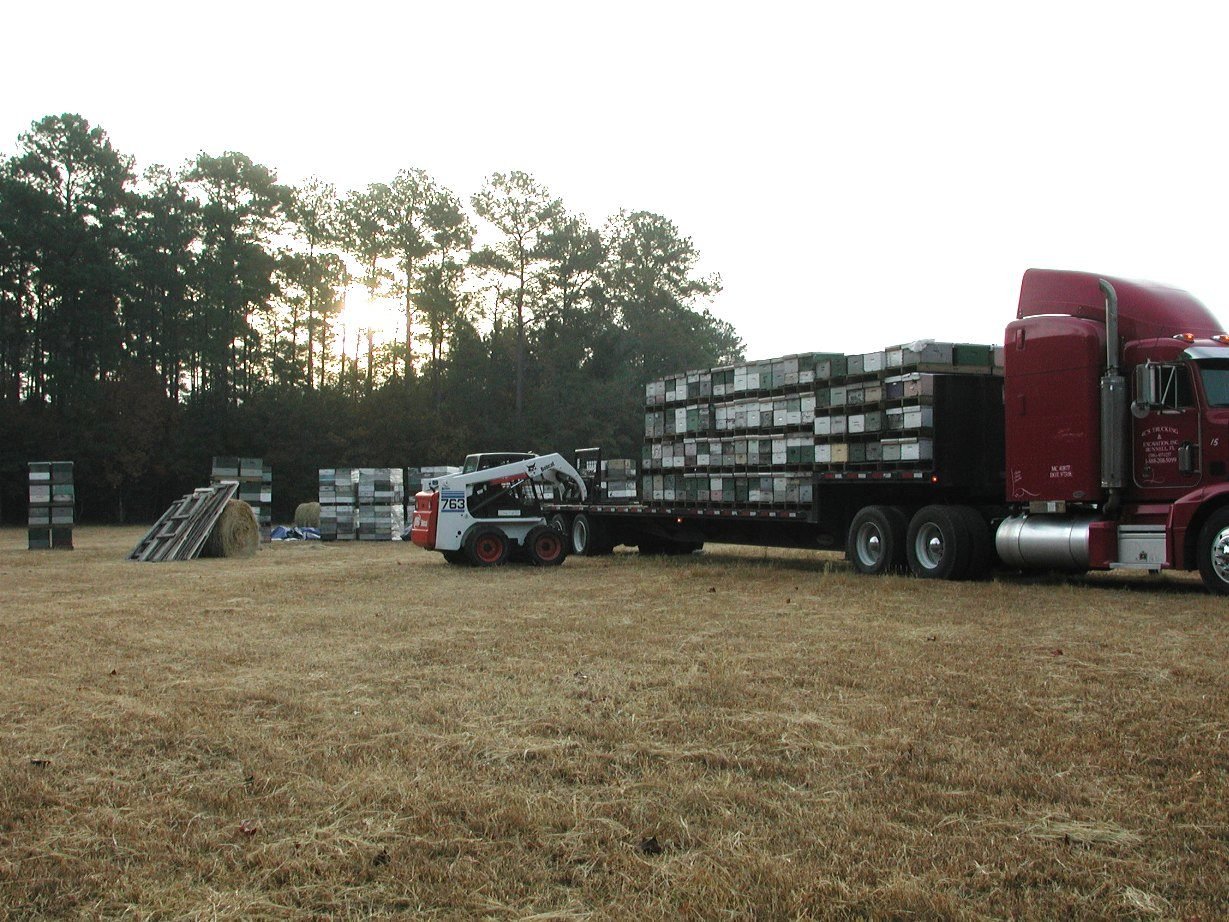
Pollination work puts your bees, crew and vehicles on someone else’s land, often in another state, for weeks at a time. The table maps the common loss events to the protection that usually responds. The contract column draws on the sample agreements published by the Mid-Atlantic Apicultural Research and Extension Consortium in the SARE handbook Managing Alternative Pollinators, by University of Minnesota entomologist Marla Spivak in her guide to pollination contracts, and by Project Apis m. for almonds.
| Loss event | What the sample contracts say | Protection that may respond |
|---|---|---|
| A farmworker or member of the public is stung and claims injury | Spivak’s sample puts public stinging liability on the grower while bees are in the crop | Grower’s farm liability; your general liability if the claim names you |
| Your truck damages crops or field edges while servicing hives | The SARE/MAAREC sample has the grower assume loss to fields from the beekeeper’s vehicles | Contract allocation first; your commercial auto or general liability depending on circumstances |
| Colonies stolen or vandalised at the grower’s site | Spivak’s sample has the grower assume vandalism liability; many agreements are silent | Your inland marine or scheduled property policy, if theft is covered |
| Colonies killed by a pesticide application | Samples require advance notice (48 hours in two of them) and grower-paid moves | Contract remedy; state compensation where it exists; rarely your own liability policy |
| Flood, blizzard or wildfire destroys colonies | Project Apis m. lets the beekeeper remove colonies if flooding threatens | Inland marine (if the peril is covered); USDA ELAP for losses above normal mortality |
| Grower’s crop yield disappoints | Project Apis m.: beekeeper gives no warranty of pollination and is not responsible for crop failure | Contract language is the main protection |
If your contract is silent on a row, assume the dispute will be expensive, whoever wins it.
General Liability: The Core Policy
Commercial general liability (CGL) pays defence costs and damages when a third party claims bodily injury or property damage caused by your operations or products. For beekeepers that typically means stings, bees affecting neighbouring property, and product claims from honey you sell.
Specialist programs exist. BeeInsure, a program administered by Citadel Insurance, advertises limits of $1,000,000 per claim and $2,000,000 aggregate, a $250 deductible and prices starting at $450 a year (as listed on its site in September 2026), and is open to hobbyists and commercial apiaries. We cite it as an example of how these programs are structured, not as a recommendation; compare several quotes.
For pollination work, four details in a CGL policy matter more than the headline limit:
- Where it applies. Confirm that operations away from your home yard, including other states you move through, are covered.
- Certificates. Growers and brokers may ask for a certificate of insurance before delivery. Ask your agent how quickly one can be issued.
- Additional insured requests. Some grower or broker contracts ask to be named as an additional insured. Whether that is available, and what it costs, varies by policy; check before you sign the pollination contract, not after.
- Pollution and pesticide wording. Ask how the policy treats claims connected to chemicals. This matters less for claims against you than for understanding that the policy will not reimburse your own poisoned colonies.
Our broader guide to insurance considerations for beekeepers covers product liability and hobby-to-business thresholds, and does homeowners insurance cover beehives explains where a homeowner’s policy typically stops, which matters once you are paid for pollination.
Protecting Your Own Colonies, Equipment and Trucks
Liability cover protects you from other people’s claims. Your own assets need their own policies. Agencies that specialise in apiary risks, such as InsureCAL in California’s Central Valley, list the building blocks: beekeeper inland marine coverage, commercial auto, farm and commercial general liability, theft, fire, flood and vandalism cover for colonies, property cover, workers’ compensation and excess liability.
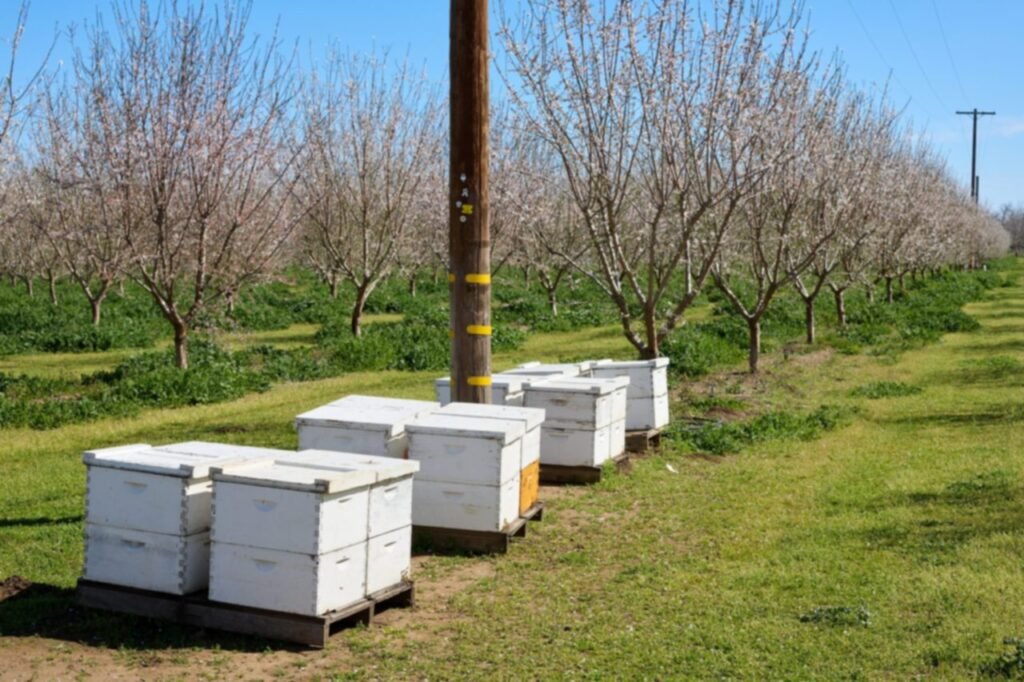
- Inland marine is the usual form for movable property: hive bodies, pallets, frames, colonies in transit and colonies sitting at a grower’s orchard. Check whether bees themselves are covered or only the equipment, which perils are named (theft, fire, flood, overturn), and how value is set.
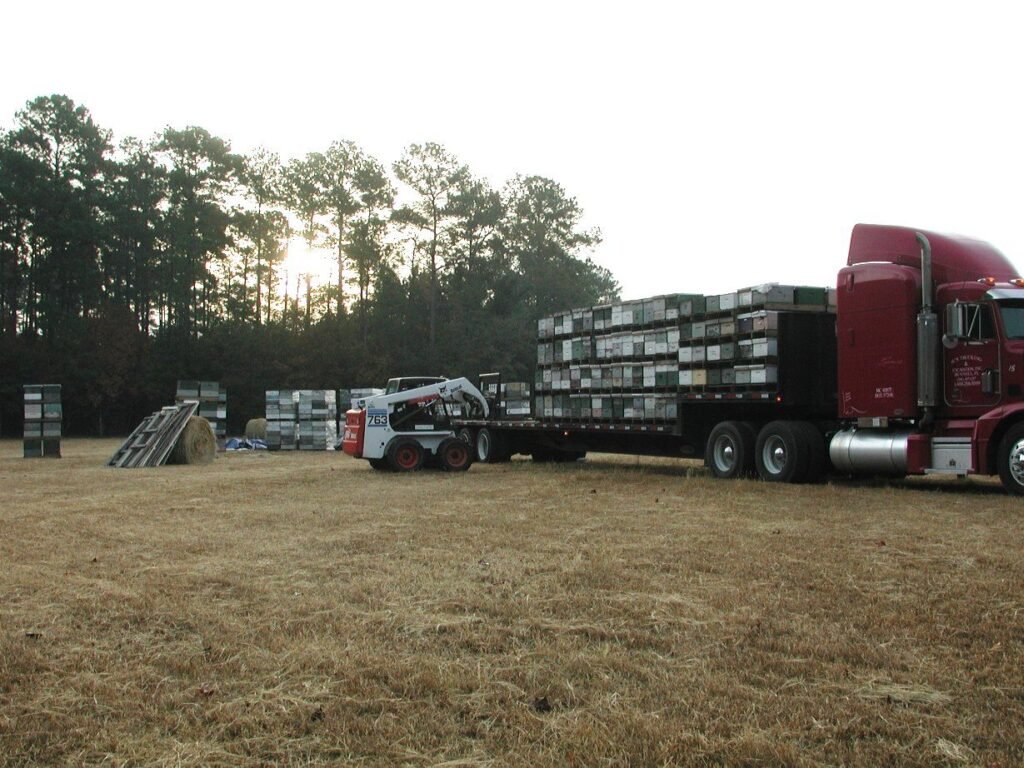
- Commercial auto matters because a load of hives is both valuable cargo and a hazard on the road. Confirm with your carrier that hauling colonies for paid pollination is a covered use, and that cargo cover matches the value of a full load.
- Theft is a real exposure in almond country. Our article on beehive theft in almond pollination covers how it happens and how beekeepers mark and track hives.
- Workers’ compensation applies once you employ a crew, and moving hives at night is physically risky work.
USDA and State Programs That Fill Some Gaps
Three public programs are worth understanding before you set private limits.
| Program | What it covers | Key terms (as published) |
|---|---|---|
| USDA RMA Apiculture (API) rainfall-index insurance | Revenue risk from below-normal rainfall in chosen grid areas, which affects honey, pollen, wax, breeding stock and pollination income | Sold through crop insurance agents; enrollment deadline December 1 for the following year; premium subsidies of 51% to 59%; no minimum colony count |
| USDA FSA ELAP honeybee assistance | Colony losses above normal mortality, damaged hives and feed, from eligible causes such as flood, tornado, wildfire, winter storm and colony collapse disorder | For 2024: normal mortality 24.2%, colony value $129, hive value $230; payments at least 75% of those values; notice of loss and application due January 30 after the program year |
| Minnesota bee kill compensation | Colonies killed by acute pesticide poisoning confirmed by the Minnesota Department of Agriculture | Fair market value $270 per hive for 2026; claims under $100 not paid; up to $10,000 per incident and $20,000 per fiscal year; apiary must be registered on BeeCheck beforehand |
The API details come from an October 2025 farmdoc daily analysis by agricultural economist Brittney Goodrich; because API pays on a rainfall index rather than on your actual losses, it can pay when you had no loss and miss a loss caused by something other than dry weather. The ELAP figures are from the Farm Service Agency’s April 2024 honeybee fact sheet; FSA updates the values each program year, so check the current ELAP page before relying on them. For disaster claims in practice, see beekeeping insurance claims after a natural disaster.
Pesticide Kills: The Gap to Plan For
Pesticide exposure is one of the main risks of pollination work, yet it is the one most beekeepers find least covered. ELAP’s published list of eligible conditions covers weather events and colony collapse disorder but not pesticides. A liability policy protects you against claims, not against your own losses. That leaves three lines of defence.
The contract. Require written notice before any bee-toxic application (the SARE/MAAREC and Project Apis m. samples both use 48 hours), agree which products are acceptable during bloom, and state who pays to move colonies out and back. The Project Apis m. almond sample sets a $4.00 per colony charge to the grower for a pesticide or flood removal and replacement. Our guides to pesticide clauses in pollination agreements and preventing pesticide losses during contracts go further.
State programs. Minnesota runs a dedicated compensation program for pesticide-killed bees, and it is conditional on registration. The statute is specific:
“To be eligible for compensation under this section, the bee owner and the affected apiary must be registered prior to the bee kill incident with a commonly utilized pesticide registry program.”
The Minnesota Department of Agriculture requires a written complaint to start an investigation, sends investigators to sample bees, and defines an acute poisoning partly by the number of dead bees found per live frame. North Dakota handles pesticide complaints through its department of agriculture and requires beekeepers to be licensed and to register hive locations, which also helps applicators find your yards.
Your records. Whatever the program or dispute, you will need proof of where the colonies were, how strong they were at delivery, and what happened. Date-stamped strength records and photographs, described in our guide to documenting hive strength for growers, are the same evidence an investigator or adjuster will ask for.
How Contract Clauses Shift Your Exposure
Many pollination deals never address these risks at all. In Goodrich’s survey of almond growers, published in Choices magazine in 2019, only 29.6% of agreements had a pesticide clause, 18.4% a theft clause and 14.3% an unpaid-balance clause, and 36.7% had none of the clauses listed. Where a contract is silent, the loss usually stays with whoever owns the damaged thing, which for colonies is you.
A few clauses do a lot of work: who carries public stinging liability while bees are on the farm, who bears theft and vandalism at the grower’s site, who pays for extra moves, a no-crop-warranty statement, and a named third-party inspector for disputes. Our pollination contract template shows where they fit. Growers who host hives outside of pollination contracts face a different set of questions, covered in liability insurance for a commercial beehive program.
Questions to Ask Your Agent
- Does the general liability policy cover operations at grower sites and in every state my colonies pass through?
- Can you issue certificates of insurance quickly, and is an additional-insured endorsement available if a grower requires one?
- Are live colonies covered under inland marine, or only equipment? Which perils, and on what valuation basis?
- Does my commercial auto policy cover hauling hives for paid pollination, and does cargo cover match a full load?
- How are chemical or pollution-related claims treated?
- Would Apiculture rainfall-index insurance make sense for my operation, and can you write it before the December 1 deadline?
Frequently Asked Questions
Do I need liability insurance to provide pollination services?
No federal rule requires it, but many growers and brokers ask for proof of coverage before colonies are delivered, and a single sting or vehicle claim can exceed a season’s pollination income. Treat general liability as a basic cost of paid pollination work.
Does general liability insurance cover my bees if they die on a pollination contract?
No. General liability pays claims made against you by others. Your own colonies need property or inland marine cover, and some losses may qualify for USDA ELAP or state programs.
Are pesticide kills covered by USDA disaster assistance?
Pesticides are not on ELAP’s published list of eligible conditions, which focuses on weather events and colony collapse disorder. Pesticide losses are usually addressed through contract terms, state programs such as Minnesota’s, or disputes with the applicator.
Does Apiculture rainfall-index insurance cover pollination income?
It is designed to protect revenue from hive products and services, including pollination, against below-normal rainfall in the grid areas you choose. It pays on the index, not on your individual losses.
Who is liable if a farmworker is stung by rented bees?
It depends on the contract and the facts. Some extension sample agreements place public stinging liability on the grower while colonies are in the crop, but many contracts say nothing. Settle it in writing and make sure both parties’ insurance matches.
How much does beekeeping liability insurance cost?
Prices vary with operation size, products and limits. As one published example, the BeeInsure program listed prices starting at $450 a year for $1 million per claim and $2 million aggregate in September 2026. Commercial migratory operations with trucks, employees and property cover will pay considerably more in total.
The Bottom Line
For pollination work, liability insurance is necessary but not sufficient. Pair a general liability policy that covers operations at grower sites with property cover for colonies and equipment, commercial auto for hauling, and a contract that settles stings, theft, spray notice and extra moves. Check which public programs apply to you, register your yards, and keep records good enough to prove a loss.

-104A8316.jpg)
