Reviewed by Daniel M. · Last Updated September 24, 2026 · How we review
To protect a new colony from robbing, cut its entrance down to one or two bee-widths before the bees go in, feed only inside the hive, keep syrup, wax and honey off every outside surface, and keep inspections short, late in the day and one hive at a time. Most importantly, keep that protection in place for five or six weeks, not just the first few days. A package or small nuc is at its weakest around weeks three to five, when the original bees are dying off faster than new workers can emerge.
This guide is about newly installed packages, nucs and splits. The general causes of robbing and the tactics for established colonies are covered in our guides to feeding without causing robbing and brood collapse during a nectar dearth. Here the focus is what makes a new colony different, and the risk calendar that follows from it.
Key Takeaways
- A new colony has few guards, sweet-smelling syrup and no reserve population, which makes it the easiest target in any yard.
- Risk peaks twice: at installation (open boxes, syrup, confusion) and again around weeks 3 to 5, when a package has lost roughly a third of its bees.
- Set a one- or two-bee entrance and close every upper gap before the bees go in, then widen only when the colony clearly needs the space.
- Feed inside the hive only. Entrance feeders and open feeding in the apiary are the most common way beekeepers start robbing themselves.
- Learn the difference between orientation flights and robbing so you neither panic over normal behaviour nor miss the real thing.
- If robbing starts, shrink the entrance, cover the hive and remove every exposed sweet within minutes; if it continues, move the colony.
Table of Contents
- Why New Colonies Are the Easiest Target
- The Robbing Risk Calendar for a New Colony
- Set the Entrance Before the Bees Go In
- Feed Inside the Hive, Never at the Front Door
- Inspect Short, Late and One Hive at a Time
- Robbing or Orientation Flights?
- If Robbing Starts: The First 15 Minutes
- After a Robbing Attack
- Frequently Asked Questions
Why New Colonies Are the Easiest Target
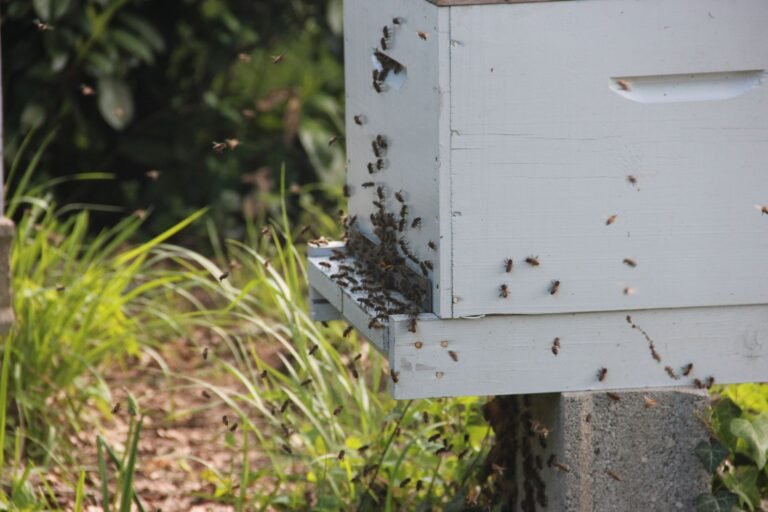
When nectar is scarce, foragers look for sugar wherever they can get it, and a hive that cannot defend its entrance is the cheapest source around. A newly installed colony checks almost every box.
- Few guards. A three-pound package or a five-frame nuc has a fraction of the workforce of an overwintered colony, and in the first weeks most of those bees are busy drawing comb, feeding the queen and warming the first brood. Very few are standing at the entrance.
- Syrup smells like a nectar flow. New colonies are almost always fed. Syrup that drips, spills or sits in an exposed feeder advertises the hive to every forager in the neighbourhood.
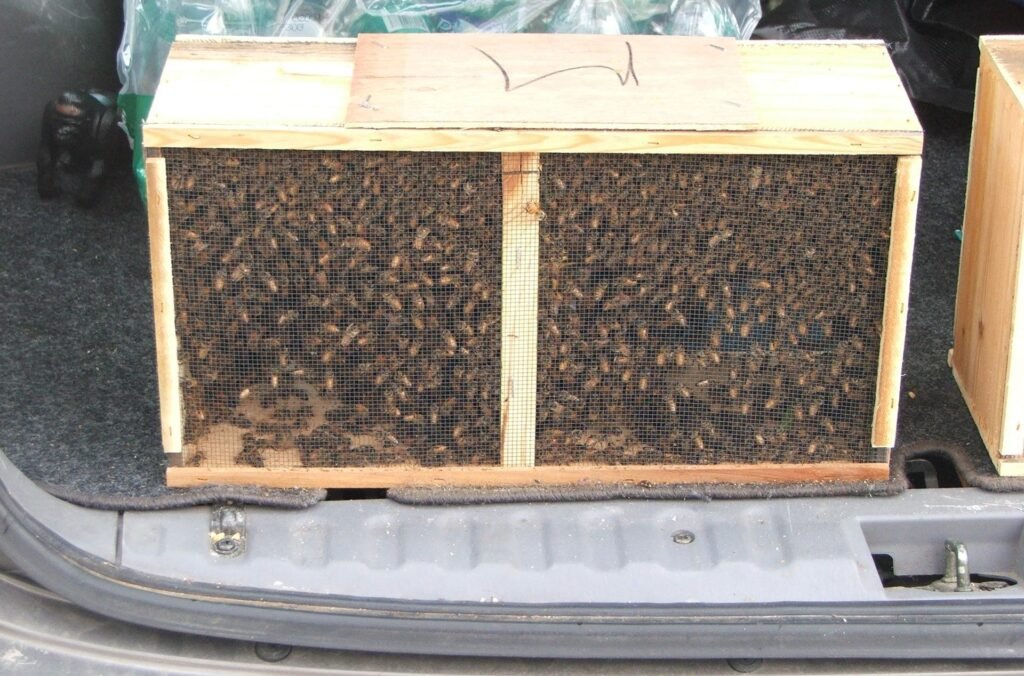
- No population reserve. A package does not grow for its first three weeks. It shrinks.
- Loose equipment. New boxes that have not been propolized yet, warped secondhand boxes and inner-cover notches all create extra gaps the colony is not yet able to guard.
That shrinking population is the part most beginners never hear about. The first workers the new queen produces take 21 days from egg to adult, and the package bees she arrived with are already middle-aged.
During the first 21 days after installation, a package bee colony experiences about a 35 percent loss in population.
In practice, the colony you install is the strongest it will be for about a month. Any robbing defence you set up on day one should still be in place when the colony is at its lowest.
The Robbing Risk Calendar for a New Colony
The table below follows a package installed in spring. A nuc starts one step further along because it already has brood and emerging bees, but a small nuc follows the same pattern if it is fed heavily or sits next to strong hives.
| Period after installation | Why the risk changes | What to do |
|---|---|---|
| Install day to day 7 | Boxes open, syrup handled, queen not yet released, bees disoriented | Install late in the afternoon, smallest entrance, internal feeder only, clean up every drip |
| Days 7 to 21 | Comb building, first brood capped, population falling, feeder refills every few days | Refill in the evening, keep checks under 10 minutes, keep the entrance small |
| Days 21 to 35 | Population low point, first new workers only starting to emerge | Highest-risk window: do not widen the entrance yet, watch the front on warm afternoons |
| Weeks 5 to 8 | New workers emerging daily, colony covering more frames | Widen to the next reducer setting when traffic backs up or bees beard on hot days |
| First nectar dearth | Established colonies turn to robbing across the whole yard | Return to a small entrance, consider a robbing screen, stop open-top inspections |
In eastern North Dakota and western Minnesota, packages usually go in from late April through May. Spring bloom from willows, maples and dandelions can be generous, but cold, windy stretches are common, and the first warm afternoon after a cold spell brings hungry foragers out of every overwintered colony at once. The other predictable danger is the gap between spring bloom and the main summer flow, and again after that flow ends in late summer, when a small colony that is still being fed becomes very attractive.
Set the Entrance Before the Bees Go In
An entrance is only as secure as the number of bees guarding it. For a package or small nuc, that means a very small opening. The University of Florida’s extension guidance puts the principle plainly:
Use an entrance reducer on all colonies during times of nectar dearth.
For a new colony, do more than the dearth rule and treat every week of the first month as a dearth week. Set it up before installation day:
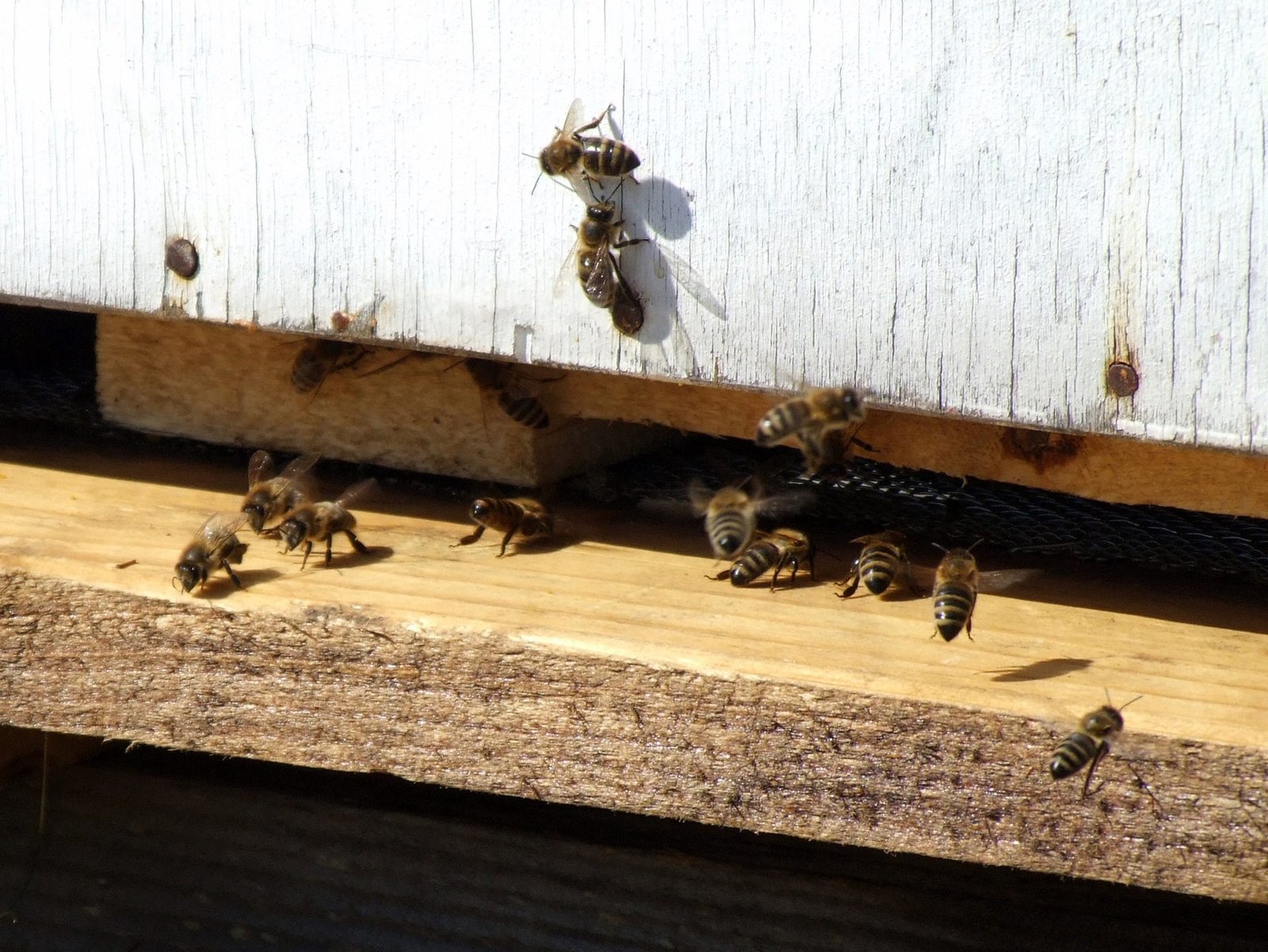
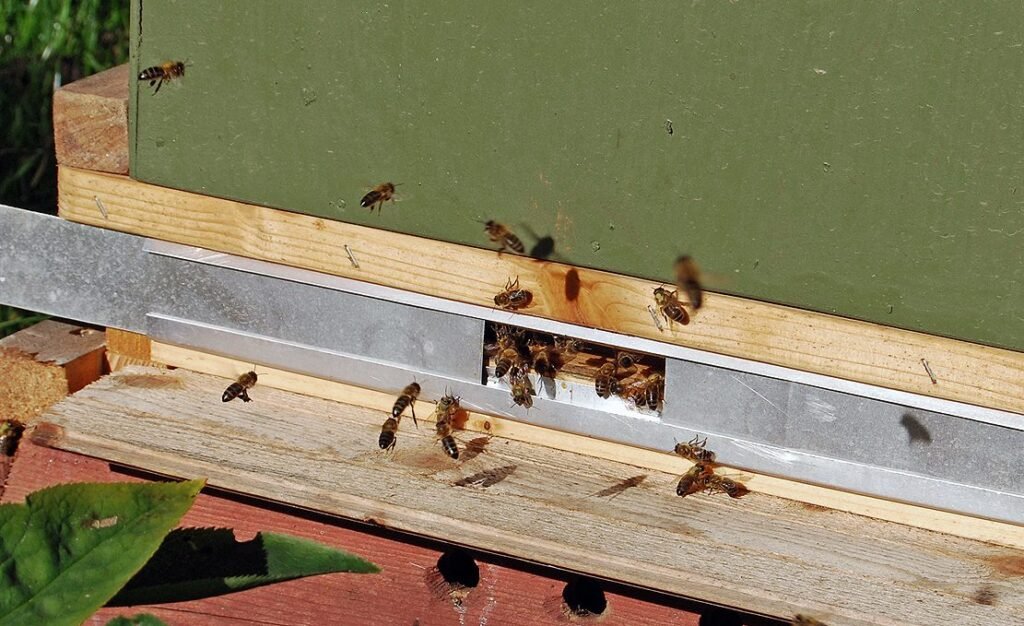
- Use the smallest reducer notch, about one or two bees wide, for packages and five-frame nucs. A plug of grass that the bees chew away over a few days can make it smaller still for the first night.
- Close every upper entrance. Tape the inner-cover notch or turn the cover so the notch is closed. Robbers find upper gaps quickly, and a small colony will not guard them.
- Check the box joints. Warped or mismatched boxes leave slits along the edges. Tape them or swap the box. A new colony should have exactly one way in.
- Keep screened bottoms closed or secure. The screen itself keeps robbers out, but gaps around a loose tray or a missing plug do not.
- Add a robbing screen if you have strong colonies nearby. A robbing screen moves the working entrance away from where the hive smell comes out. Returning residents learn the new route, while robbers keep searching at the old one.
When should you open it up? Watch the entrance, not the calendar. When bees queue at the entrance, beard on the front on hot afternoons, or the colony covers six or seven frames, move to the next reducer setting. On a very hot day, widen it a little rather than let the colony overheat, and close it again when the heat passes. For nuc boxes, see how insulated and standard nuc boxes differ.
Feed Inside the Hive, Never at the Front Door
Feeding is the single biggest robbing risk for a new colony, and it is almost always self-inflicted. The UF/IFAS publication advises keeping external feeder surfaces free of syrup and cleaning up spills, and new-colony feeding makes that harder because refills are frequent.
- Skip entrance (Boardman) feeders. They put syrup right at the one place the colony is trying to guard, and they leak scent every time the jar breathes.
- Use an internal feeder. An inverted pail or jar over the inner-cover hole inside an empty box, a frame feeder, or a top feeder all keep syrup where only the colony can reach it. Our guide to pail feeder hole size and lid setup covers how to stop pail feeders from dripping.
- Mix syrup away from the hives, and carry it in a closed container.
- Refill in the evening. Fewer foragers are flying, and the colony has the night to settle.
- Never open-feed in the same yard. A tub of syrup for “all the hives” teaches every colony to hunt for sugar, and the smallest colony pays for it.
How much and how long to feed is covered in our complete guide to feeding bees. The robbing rule is simply that nothing sweet should be reachable from outside the box.
Inspect Short, Late and One Hive at a Time
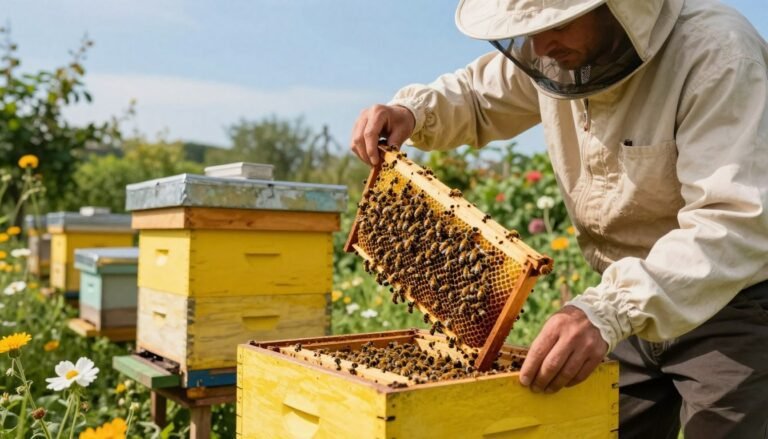
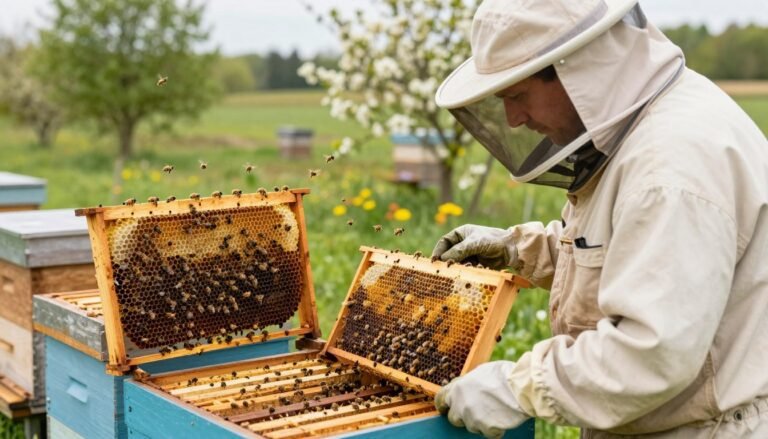
Every time you open a new colony you release the smell of syrup and wax and pull guards off the entrance. UF/IFAS recommends working colonies carefully and quickly during dearths, not working more than one at a time, and working later in the day to reduce the amount of daylight hours bees have to rob.
- Plan the visit before you lift the lid. Know what you are checking, whether that is queen release, eggs or feeder level, and close up once you have the answer.
- Cover what you are not looking at. A damp towel or a spare cover over the open box, and a lid over any box you have set aside, cuts the scent plume sharply.
- Do not leave burr comb or drips behind. Pick up wax scraps and put them in a lidded bucket rather than on the ground.
For what to look for during those short visits, see our guides to checking for eggs after package installation and the first inspection after installing a nuc.
Robbing or Orientation Flights?
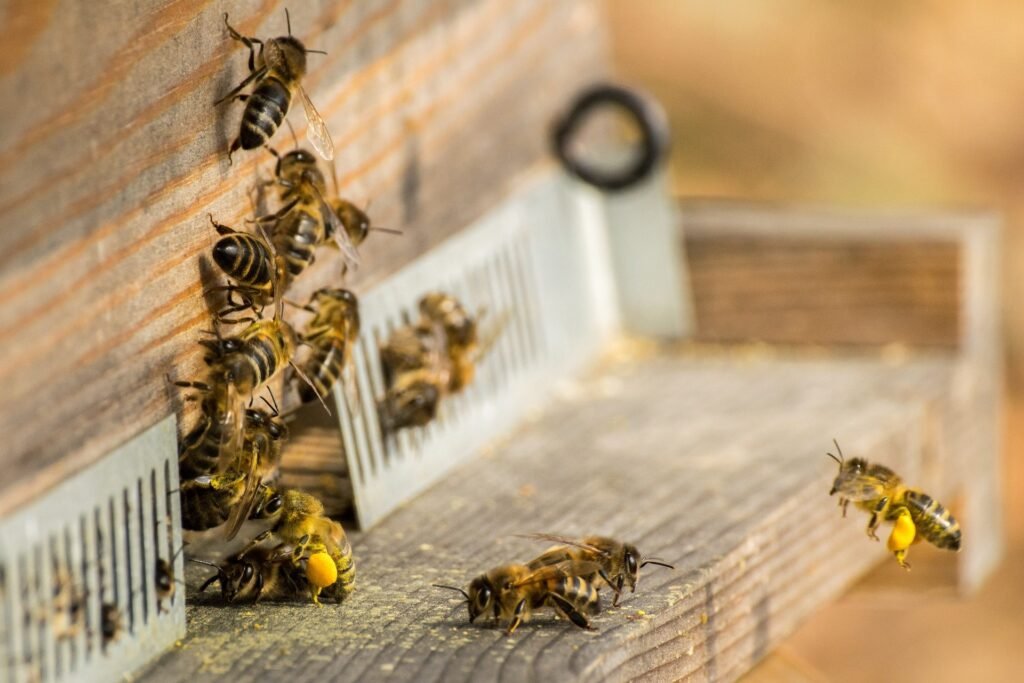
New beekeepers often mistake orientation flights for robbing. Bees learning a hive’s position hover in front of it, facing the entrance. Package bees do this in their first days in a new location, and from about four weeks after installation the colony’s own young bees do it on most fine afternoons. Betterbee’s guide to identifying and preventing hive robbing describes orientation flights as usually afternoon events lasting 20 to 30 minutes, while robbing goes on until dark.
| Sign | Orientation flights | Robbing |
|---|---|---|
| Flight pattern | Slow loops and hovering, bees facing the hive | Fast zig-zags in front of the entrance and along box seams |
| Duration | A burst on warm afternoons, then quiet | Continues and builds until dusk, resumes next morning |
| Landing board | Calm traffic, pollen coming in | Bees grappling in pairs, bodies on the board or ground |
| Debris | Normal | Ragged wax flakes and torn cappings below the entrance |
| Where bees try to enter | Only the entrance | Cracks, the inner-cover notch, gaps under the lid |
| Bees leaving | Leave light | Leave heavy and climb before flying off |
If you are not sure, watch for ten minutes. Orientation calms down; robbing does not.
If Robbing Starts: The First 15 Minutes
A small colony can lose its stores, and sometimes its queen, within hours. Act as soon as you are confident it is robbing.
- Close any open hive in the yard and remove all exposed comb, supers or syrup.
- Shrink the victim’s entrance to one bee, using grass or a strip of screen if the reducer is already at its smallest.
- Drape a wet sheet or towel over the front and sides of the hive. Residents find their way under it; robbers mostly give up.
- Check the other hives for gaps and leaking feeders. The robbers are coming from somewhere nearby.
- Leave the internal feeder in place only if it is sealed and not dripping. Otherwise remove it until evening.
- If robbing resumes the next day, move the victim colony out of the apiary. The UF/IFAS guidance lists removing victim colonies as the step when the others do not work. A move of several miles is safest.
After a Robbing Attack
Once the yard is quiet, open the new colony late the next day and check three things: whether there are still eggs (proof the queen survived), whether there are any stores left, and how many bees remain.
- Eggs present and bees covering several frames: keep the entrance small, resume internal feeding carefully and check again in a week.
- No eggs and no queen: the colony needs a new queen quickly. See queen introduction with a push-in cage and our guidance on when to requeen a weak package colony.
- Only a small cluster left: combining it with another queenright colony is usually better than nursing it along through the rest of the season.
Robbing also moves mites and disease between colonies, so a new colony that robbed, or was robbed, deserves a mite count a few weeks later. Our guide on whether to medicate package bees covers mite monitoring in new colonies.
From late summer on, yellow jackets add a second threat to small colonies; see how to protect beehives from yellow jackets.
Frequently Asked Questions
Should a new package have an entrance reducer?
Yes. Set the reducer to its smallest opening before installation, close any upper entrances, and keep it small for at least the first four to five weeks. Widen it only when bees queue at the entrance, beard on hot days or cover six to seven frames.
Does feeding a new colony cause robbing?
Feeding itself does not, but feeding carelessly does. Entrance feeders, drips on the outside of the hive, spilled syrup and open feeding in the apiary are the usual triggers. An internal feeder refilled in the evening carries very little risk.
How long is a new colony vulnerable to robbing?
The highest risk runs from installation through about week five, with the low point in population around weeks three to five. After that, a healthy colony gains strength every week, although any colony becomes vulnerable again during a nectar dearth.
What time of day do robber bees attack?
Robbing usually builds through warm afternoons and continues until dark, starting again the next morning. That is why inspections and refills late in the day are safer than midday work during a dearth.
Can a robbed package colony recover?
Often, if the queen survived and enough bees remain to cover a few frames. Protect the entrance, feed internally, and confirm eggs within a day or two. If the queen is gone or only a handful of bees remain, requeening or combining is usually the better choice.
Is a robbing screen necessary for a new hive?
Not always. A properly reduced entrance and clean internal feeding are enough in many yards. A robbing screen is worth adding when the new colony sits near strong established hives, or when a dearth arrives while the new colony is still small.
Bottom Line
A new colony gets robbed because it is small, sweet-smelling and easy to get into. Take away the easy access with a one- or two-bee entrance and no upper gaps, and take away the smell with internal feeding and short, late inspections. Then keep those defences through weeks three to five, when the colony is at its weakest. If you are still planning installation day, start with our step-by-step guide on how to install package bees.