Reviewed by Sofia T. · Last Updated September 23, 2026 · How we review
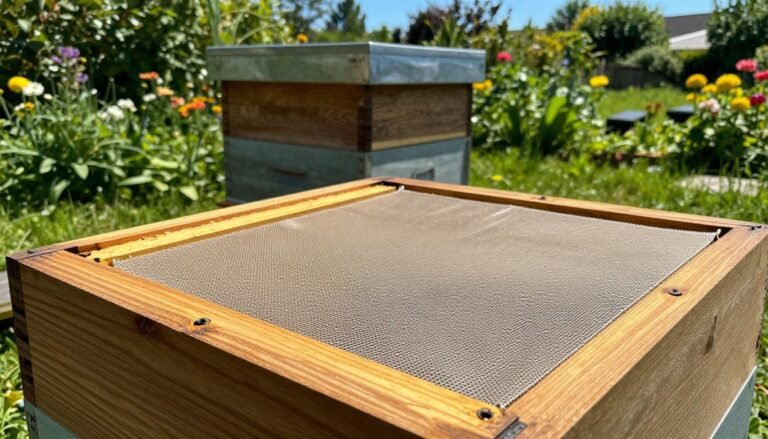
For a homemade pail feeder, make 8 to 15 holes about 1/16 inch (roughly 1.5 mm) wide, grouped in a patch no wider than 2 inches in the center of the lid, and use a lid that seals airtight. Small holes and a sealed lid let a vacuum hold the syrup inside until bees drink it. Commercial pails do the same job with a small patch of stainless mesh in the lid. When a pail leaks, the cause is almost always holes that are too big, a lid that doesn’t seal, or, the one most guides miss, too much air left inside the pail.
Key Takeaways
- Make holes about 1/16 inch wide, 8–15 of them, in a tight cluster. If the holes are bigger, air bubbles in and the vacuum fails.
- The lid seal matters as much as the holes. Air getting in at the rim will drain the pail.
- Fill the pail as full as you can. Trapped air expands on warm afternoons and pushes syrup out.
- Turn the pail upside down over a bucket first and wait for the drips to stop before setting it on the hive.
- Set the pail over the inner-cover hole, inside an empty box. An open bucket in the yard is a different method with different rules.
Table of Contents
Pail Feeder Specs at a Glance
| Setting | What works | Why |
|---|---|---|
| Hole size | About 1/16 inch (fine drill bit or small finishing nail) | Surface tension forms a film across the hole that air can’t get through |
| Hole count | 8–15; fewer for slow spring feeding | More holes let more bees feed, but give more ways for a leak to start |
| Pattern | Cluster no wider than about 2 inches, centered | Keeps every hole over the inner-cover opening and level with the others |
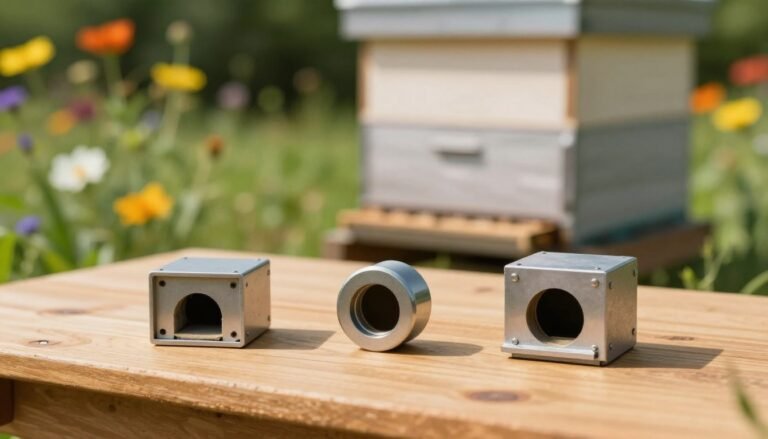
| Store-bought option | Lid with built-in stainless mesh, or a screen plug fitted into a standard lid | Fine mesh works like many tiny holes |
| Fill level | As full as possible | Less air means less syrup pushed out as the pail warms |
How the Lid Holds Syrup
When you flip a full, sealed pail, syrup can only leave if air gets in to replace it. Air can only get in through the holes. When the holes are small, the syrup’s surface tension forms a film across each one that air can’t push through. So after a few drips, the air trapped against the pail’s closed end has stretched just enough to hold the syrup up, and the bees drink from the holes. That’s the design extension services describe for feeding packages:
“You can make this feeder by punching ten to fifteen small nail holes in the lid of a jar or can with removable lid (such as coffee can or clean paint can).”
Mid-Atlantic Apiculture Research and Extension Consortium (MAAREC), “Feeding Packages Syrup”
The same design explains every way it can fail. If the holes are too big, the film breaks. If the lid doesn’t seal, air gets in at the rim. If the pail sits on a tilt, air can get in at the high side of the cluster while syrup leaks from the low side.
Making the Holes
Most beekeepers who make their own pail feeders use holes about 1/16 inch wide, and some go down to a 3/64-inch bit. Rusty Burlew’s feeder comparison at Honey Bee Suite describes commercial operators drilling 10–12 small holes in sealed bucket lids. She also notes that thick 2:1 syrup leaks less than 1:1.
- Use a food-grade one- or two-gallon pail with an intact gasket in the lid. Never use a pail that has held chemicals or paint.
- Mark a circle about 2 inches across in the center of the lid.
- Drill inside the circle with a 1/16-inch bit on slow speed, or tap a small nail through. Put scrap wood under the lid so it doesn’t crack.
- Sand off any raised burrs on the outside of the lid, where the bees will feed.
- Test with water over a sink. A few drips and then nothing means the pail holds a vacuum. If it keeps dripping, the problem is the seal or a hole that’s too big.
If you’d rather not drill, Blue Sky Bee Supply’s pail feeder is a typical store-bought version, with a screen built into the lid.
Why Pails Drip on Warm Afternoons
The air pocket inside the pail expands as it warms, by about 1% for every 5 °F. The pail can’t stretch, so that extra volume goes out through the holes, pushing syrup with it. Around here the daily swing is large. NOAA’s 1991–2020 normals for Fargo average a May high of 68.7 °F against a low of 44.4 °F, and a September high of 72.0 °F against a low of 48.1 °F (climate table). A pail under a sunny cover can warm even more than that.
Here’s roughly how much syrup gets pushed out, starting at 40 °F:
| Air in the pail | +15 °F | +25 °F | +40 °F (sun-heated) |
|---|---|---|---|
| 8 fl oz (filled to the brim) | ~0.2 fl oz | ~0.4 fl oz | ~0.6 fl oz |
| 32 fl oz (1-gallon pail, three-quarters full) | ~1.0 fl oz | ~1.6 fl oz | ~2.6 fl oz |
| 64 fl oz (2-gallon pail, three-quarters full) | ~1.9 fl oz | ~3.2 fl oz | ~5.1 fl oz |
| 128 fl oz (2-gallon pail, half full) | ~3.8 fl oz | ~6.4 fl oz | ~10.2 fl oz |
Two things follow from this. A pail filled to the brim barely drips. And a pail drips more as it empties, because the air pocket grows as the bees drink. So if a half-empty pail starts leaking during a warm spell, top it up rather than making more holes. The small drip right after you flip a full pail has the same cause: the air has to stretch a little before it can hold up the syrup.
Setting the Pail on the Hive
Set the flipped pail so the whole hole cluster sits over the inner-cover opening. Our guide to feeder access hole sizes for inner covers covers that opening. Then put an empty deep box (or two mediums) around the pail and the outer cover on top. Check first that a two-gallon pail fits under the cover. With the syrup enclosed, no scent escapes, so this is much safer than open feeding. See feeding bees without causing robbing for the rest of that picture, and our top feeder vs frame feeder vs pail feeder comparison if you’re still choosing a feeder.
Don’t confuse this with an open bucket feeder, which sits in the yard about 100 feet from the hives. Carolina Honeybees’ bucket feeder guide explains that it feeds every colony within flying range, including robbers, and uses different placement rules.
Syrup and Northern Plains Timing
Use 1:1 sugar to water in spring and 2:1 in fall. Our guide to feeding bees covers mixing, and for new colonies see how much to feed a new package colony. The 1:4 sugar-to-water ratio you’ll see in some “bucket feeder” articles is for hummingbirds. It’s far too thin for honey bees and ferments quickly. In eastern North Dakota, October highs average only about 56 °F, and bees often ignore cold syrup, so finish fall pail feeding in September. After that, the usual backup is dry sugar, using the Mountain Camp method.
Troubleshooting
- Drips steadily, even on cool mornings: This is an air leak. Re-seat the lid and check for cracks or a hole that’s too big.
- Drips only in the afternoon: There’s too much air in the pail. Top it up.
- Syrup level doesn’t drop: It’s too cold, or the holes are crusted with sugar. Rinse the lid in warm water, then work through why bees won’t take sugar syrup.
- Sour smell or cloudy syrup: The syrup has fermented. Empty the pail and wash it, following our guide to cleaning feeders between colonies.
Frequently Asked Questions
What size drill bit should I use for a pail feeder lid?
Use a 1/16-inch bit, or go down to 3/64 inch. If the bees need to feed faster, add a few more small holes rather than making the holes bigger.
How many holes should a pail feeder lid have?
Usually 8 to 15; MAAREC suggests ten to fifteen. Use fewer holes for slow spring feeding and more when the colony needs to store syrup quickly in fall.
Why does my pail feeder leak when I turn it over?
A short burst of drips is normal while the vacuum forms. If the dripping never stops, the lid isn’t sealed or a hole is too big.
Is a one-gallon or two-gallon pail better?
A one-gallon pail is easier to fill completely and fits under less headroom. A two-gallon pail means fewer refills, but it holds more air as it empties, so it drips more on warm afternoons.
Should I use a pail feeder in winter?
Not in a northern winter. Bees generally won’t break cluster to take cold syrup. Finish syrup feeding by the end of September and use dry sugar or fondant after that.
The Bottom Line
Use small holes, an airtight lid and as little trapped air as you can. Flip the pail over a bucket first, enclose it in an empty box, and top it up before a warm spell rather than adding holes. That way the pail feeds steadily without dripping on the frames or drawing robbers.