Reviewed by Elena P. · How we review
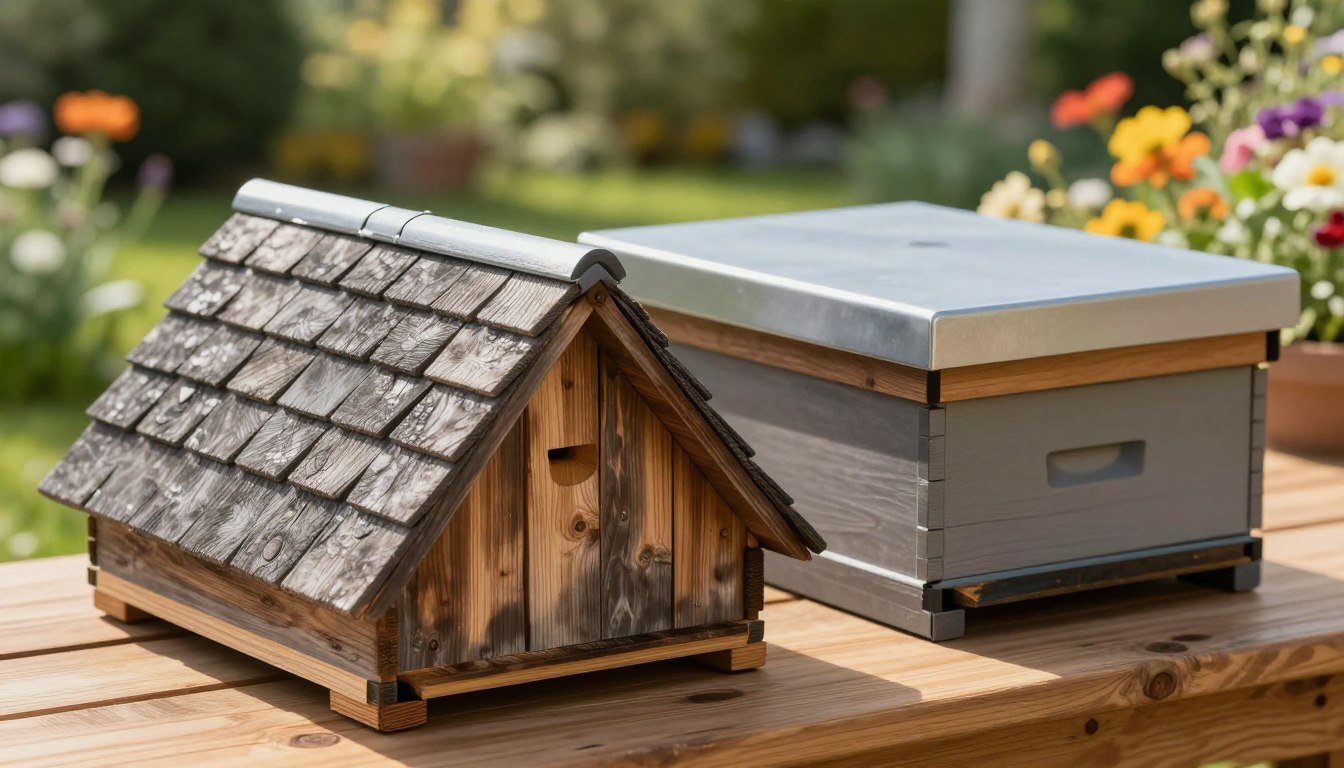
Most Langstroth hives in North America wear a flat cover, either a telescoping lid or a migratory lid. Walk through a garden apiary in Britain or look at Warré and top-bar hives, though, and you will see plenty of peaked, gabled roofs. The shape of the roof affects how the hive sheds rain and snow, how much space there is above the bees for insulation and ventilation, how easy the hive is to move and stack, and how it looks.
This guide compares the two roof shapes. For the question of material, a metal-clad top versus painted wood, see Metal Roof vs Painted Wood Hive Cover: Pros, Cons, and More.
Key Takeaways
- Gabled roofs shed rain and snow well and leave an “attic” space above the bees that can hold insulation or a quilt.
- Flat covers are simpler, cheaper, lighter, and far better for stacking, moving, and working hives in large numbers.
- Gabled roofs are standard on WBC and Warré hives and common on top-bar hives. Flat covers are standard on Langstroth hives.
- Double-walled, gabled designs like the WBC are often said to insulate better, but that claim has not been proven by research.
- Either shape needs to be secured against wind.
Table of Contents
- What Counts as a Gabled Hive Roof?
- What Counts as a Flat Hive Cover?
- Rain and Snow
- Space Above the Bees: Insulation and Ventilation
- Stacking, Moving, and Everyday Handling
- Wind
- Cost and Building
- Appearance
- Gabled vs Flat: Side-by-Side
- Which Should You Choose?
- Conclusion
- FAQ
What Counts as a Gabled Hive Roof?
A gabled (pitched) roof has two sloping sides that meet at a ridge, like a small house roof. You will see it on:
- WBC hives. This traditional British double-walled hive has sloping outer “lifts” and a pitched roof. The roof is typically covered with metal and usually has a bee escape cone in the gable so stray bees can get out (Wikibooks, WBC Hive).
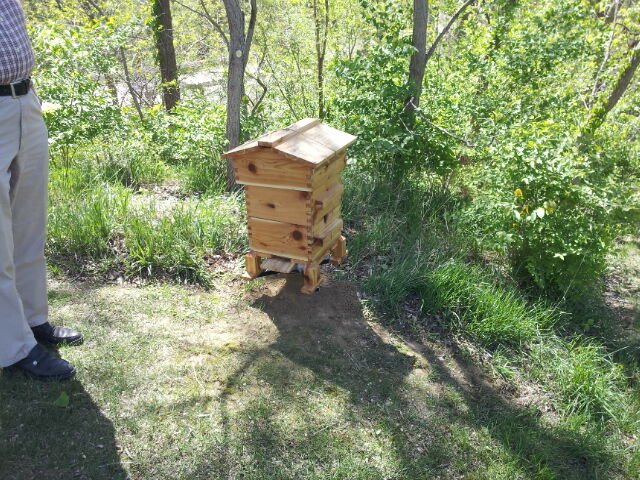
- Warré hives. These vertical top-bar hives are traditionally topped with a quilt and a gabled roof. See Warre Beehive Guide: Nadiring, Design, and Real Limits.
- Top-bar hives. Many horizontal top-bar hives use a peaked or sloped roof over the bars. See Top-Bar Beehive Guide: The Kenyan Design Explained.
- Decorative garden hives, where appearance matters as much as function.
What Counts as a Flat Hive Cover?
Flat covers are the norm on Langstroth hives, and they come in two main designs:
- Telescoping outer cover: a flat lid with a rim that hangs down over the top box, usually used with an inner cover underneath.
- Migratory lid: a flat board that sits flush with the sides of the box, with no overhang.
The differences between those two are covered in Migratory Lid or Telescoping Cover: Which to Choose? Here we are comparing flat covers as a group with pitched roofs.
Rain and Snow
A pitched roof’s main job is shedding water. Rain runs off both slopes, and snow tends to slide rather than pile up. That helps in very wet climates and in places with heavy snowfall.
A flat cover holds water and snow on its top surface. That is rarely a problem if the lid is sound, and a telescoping cover’s overhanging rim carries water away from the box joints. But a flat lid depends more on its waterproof surface, whether metal skin or paint, and it needs to sit level or tilt very slightly forward so water does not pool.
Space Above the Bees: Insulation and Ventilation
The triangle inside a gabled roof creates an “attic” above the crown board, inner cover, or quilt. That space can hold insulation or a quilt box, and it can be ventilated through small screened vents in the gable ends so that moist air has somewhere to go. It is one reason gabled roofs pair naturally with quilt-style moisture management.
A flat cover leaves very little space above the inner cover unless you add it. Langstroth beekeepers get the same effect by placing foam board above the inner cover, adding a spacer rim, or using a quilt box under the lid. See Optimal Inner Cover Insulation Thickness.
Gabled, double-walled hives are often said to keep bees warmer in winter and cooler in summer. The Wikibooks entry on the WBC hive notes that this is often argued but has not been proven by research, so don’t choose a roof shape for insulation claims alone.
Stacking, Moving, and Everyday Handling
This is where flat covers clearly win:
- Transport: Flat migratory lids let hives be packed tightly together. Beekeeping Made Simple notes that because the migratory lid does not extend over the sides, beekeepers can fit four hives on a pallet (Beekeeping Made Simple). You cannot stack or pallet gabled hives in the same way.
- Work surface: A flat lid can be turned upside down on the ground during inspections and used as a clean base for boxes you remove.
- Parts and weight: Gabled roofs are bulkier and have more parts. Wikibooks notes that WBC hives have more parts than other designs, which makes them more expensive, and that they are difficult to move.
Wind
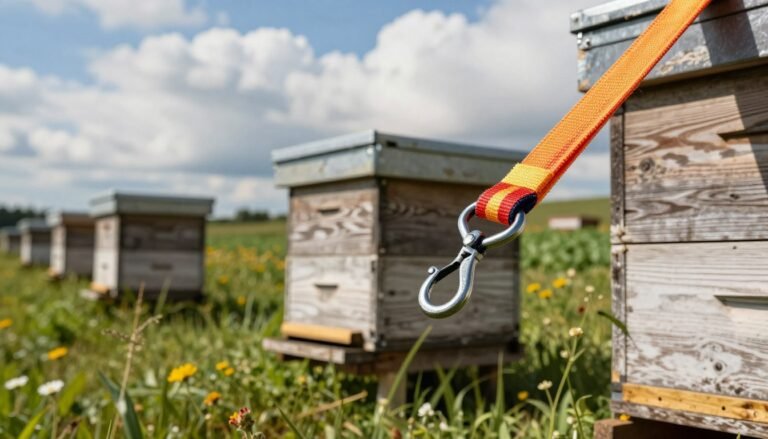
A tall, peaked roof presents more surface to the wind than a low, flat lid. Either kind can blow off in a storm, and losing a roof in winter can kill a colony. The UK National Bee Unit recommends strapping hives to their stands so roofs are not blown off in windy weather (National Bee Unit). For options, see Ratchet Straps for Windy Apiaries.
Cost and Building
A flat lid is about the simplest part of a hive to build: a board with cleats, or a shallow frame with a top. A gabled roof needs angled cuts, a ridge, and more material, so it takes more time to build or costs more to buy. For a hobbyist with one or two hives the difference is small. For a beekeeper with dozens, it adds up.
Appearance
Gabled roofs are popular in gardens, public spaces, and anywhere the hive is on show. The classic white WBC hive is the image many people have of a beehive. If looks matter and you are not moving the hive, that is a fair reason to choose a pitched roof.
Gabled vs Flat: Side-by-Side
| Factor | Gabled roof | Flat cover |
|---|---|---|
| Typical hives | WBC, Warré, many top-bar and garden hives | Langstroth (telescoping and migratory) |
| Rain and snow | Sheds water and snow readily | Holds snow; relies on its waterproof surface and overhang |
| Space above bees | Built-in attic for insulation or a quilt; easy to vent | Little space unless you add foam, a rim, or a quilt box |
| Stacking and transport | Cannot stack; awkward to move | Stacks and pallets easily, especially migratory lids |
| Handling | Bulkier, more parts | Light, simple, doubles as a work surface |
| Cost | Higher | Lower |
| Wind | Taller profile; secure it | Lighter lids can lift; secure it |
| Appearance | Traditional, decorative | Plain, functional |
Which Should You Choose?
- Langstroth hives, especially more than a few: stick with flat covers. They match the equipment, stack easily, and are cheap to replace.
- Warré, WBC, or top-bar hives: the gabled roof is part of the design and pairs naturally with a quilt.
- Hives you move for pollination or between yards: flat migratory lids.
- A single showpiece hive in a garden: a gabled roof is a reasonable choice, as long as it is well built and strapped down.
Conclusion
Gabled and flat hive covers solve the same problem in different ways. A gabled roof sheds weather well, provides an attic for insulation or a quilt, and looks traditional. It costs more, has more parts, and makes hives harder to move and stack. A flat cover is simple, cheap, stackable, and standard on Langstroth equipment, and you add insulation above the inner cover when you need it. Choose the shape that fits your hive type and how you manage your apiary, then secure it well against wind.
FAQ
Is a gabled roof better than a flat cover for a beehive?
Not in every case. A gabled roof sheds rain and snow well and leaves room for insulation or a quilt, but it is bulkier, costs more, and cannot be stacked. For Langstroth hives, and for anyone managing many hives or moving them, a flat cover is usually more practical.
Can I put a gabled roof on a Langstroth hive?
Yes. Gabled roofs made to fit Langstroth boxes exist, and many beekeepers build their own. Use it over an inner cover or quilt, make sure it fits snugly, and strap it down, since a taller roof catches more wind.
Do gabled roofs keep bees warmer?
They provide space for insulation above the bees, which helps. The broader claim that gabled, double-walled hives like the WBC insulate better has not been proven by research. Insulation above the inner cover on a flat-topped hive achieves a similar effect.
Why do WBC and Warré hives use gabled roofs?
Both are traditional designs where the roof sheds weather and covers the space above the top box. On a Warré hive, the roof sits over a quilt of insulating material. On a WBC hive, the roof tops the outer lifts and usually includes a bee escape in the gable.
Does snow on a flat hive cover cause problems?
Snow on a sound, well-fitted lid is not usually a problem for the colony. Make sure the lid is waterproof, sits level or tilts very slightly forward, and is secured. After heavy storms, check that the entrances are not blocked.