Reviewed by Daniel M. · Last Updated September 24, 2026 · How we review
For most Langstroth beekeepers, a framed, welded-wire metal queen excluder is the better long-term buy. It stays flat, it scrapes clean with a hive tool, and its round wires give workers a smooth edge to squeeze past. A molded plastic excluder does the same job for about half the price or less. It’s a sensible choice if you keep a few hives and handle it gently. What neither material changes is the gap. Metal and plastic excluders are both built to roughly 4.1 to 4.4 mm, so both let workers through and stop queens and drones. The real differences are in construction: round wire versus punched slots, framed versus flat, rigid versus flexible. That’s what decides how easily your bees cross and how much burr comb you scrape off.
Key Takeaways
- The gap is the same (about 4.1–4.4 mm) in metal and plastic. Material doesn’t change what gets through.
- Welded round-wire excluders give workers the smoothest passage. Punched or stamped slots can leave rough or sharp edges.
- A framed (bound) excluder holds its shape and keeps a bee space. Flat sheets lie on the top bars and collect brace comb and propolis.
- At Mann Lake on September 24, 2026, a 10-frame plastic excluder cost $5.99. A metal-bound wire excluder was $12.99 and a wood-bound one $19.99–$20.99.
- Plastic is cheap and light but bends and kinks if pried or stored badly. Metal costs more once and lasts if kept flat.
Table of Contents
What Actually Differs: Gap, Edge and Frame
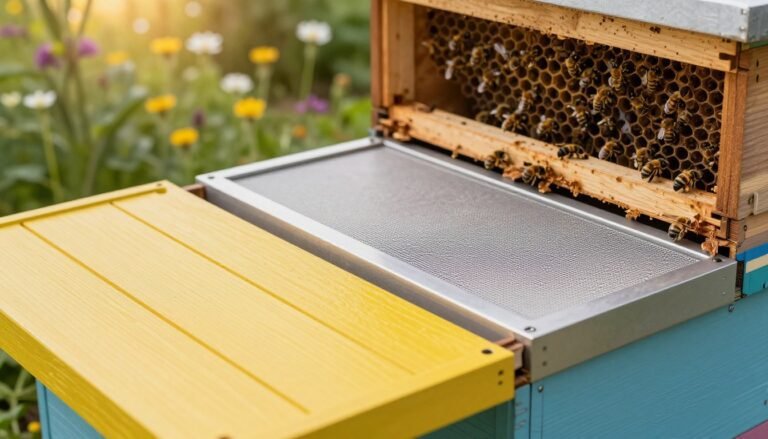
Every queen excluder works the same way. The openings are wide enough for a worker’s thorax and too narrow for a queen’s or a drone’s. The Mid-Atlantic Apiculture Research and Extension Consortium (MAAREC) describes the two basic builds. One is a thin sheet of perforated metal or plastic. The other is welded round-wire grills supported by wooden or metal frames.
UK beekeeper Dave Cushman, whose reference pages on bee equipment are widely cited, measured the common types in his survey of queen excluder types:
- Herzog-type round-wire grid: 4.22 mm between wires.
- Welded-wire grid (2 mm wires welded to thicker cross rods): 4.3 mm.
- Perforated zinc or punched sheet: slots about 4.38 by 18.3 mm.
- An A.I. Root wood-and-wire design from about 1920: 0.163 inch, or 4.14 mm.
So the gap barely varies. What varies is the edge the bee rubs past, and whether the excluder is framed. On punched sheets, Cushman found a burr on zinc and rough, granular edges on punched plastic. He also objected to flat sheets being laid directly on the top bars. That causes a great deal of propolis and brace comb, and a big disturbance when you peel the sheet off. He rated molded plastic “a vast improvement” on punched plastic. His verdict on round wire:
“As the wires are round and smoothly finished they allow easy passage of worker bees.”
Dave Cushman, “Queen Excluder Types Used In Bee Hives”
Metal vs Plastic Side by Side
These are real, currently sold 10-frame examples from one US supplier. Prices were checked on the maker’s pages on September 24, 2026, and will change.
| Excluder | Construction | Price (10-frame) | Strengths | Weak points |
|---|---|---|---|---|
| Mann Lake metal excluder (HD120) | Welded low-carbon steel wire, bound with metal on all sides. Listed at 2.5 lb. | $12.99 | Rigid, round wires, scrapes clean | Heavier, can rust if the plating is damaged |
| Mann Lake wood-bound metal excluder (Z539) | Welded wire grid in a wooden frame | $19.99–$20.99 | Frame adds bee space and keeps it flat. Mann Lake says the frame eases worker passage. | Most expensive. The wood frame needs to stay dry in storage. |
| Mann Lake plastic excluder (Z159) | Molded (not stamped) food-grade polypropylene sheet. Listed at 0.5 lb. | $5.99 | Cheap, light, no rust. Molding avoids stamped burrs. | Flexible. Can kink or crack if pried hard or left in hot sun. Sits flat on top bars. |
All three are also sold in 8-frame sizes. On cost, the gap is smaller than it looks. The metal-bound excluder costs $7 more than the plastic one, and the wood-bound one about $14 more. If a plastic sheet gets creased and replaced even once over the life of a wire excluder, the price difference mostly disappears. We couldn’t find published service-life figures for either type, so we won’t quote any. The honest rule is that plastic fails from handling, and wire fails from bending or rust. How you pry, clean and store the excluder will affect its life more than the purchase price. If you run many hives, a mixed approach works: framed wire on the colonies you super every year, and plastic as spares for splits and for anything you might need to trim.
Unbound stamped-metal sheets, the traditional “slotted zinc,” remain common in the UK, according to Cushman. They share the flat sheet’s brace-comb problem and add Cushman’s burr complaint. We wouldn’t choose one over either option above.
Durability, Cleaning and Storage
Metal wire. Scrape burr comb off with the flat of a hive tool, working along the wires rather than across them. A wire excluder stays usable until wires are bent far enough to open a gap or the plating rusts through. Check it against the light each spring. A gap you can see is a gap a queen can use. Store it flat so the frame doesn’t twist.
Plastic. Cushman reported that molded plastic excluders “don’t get damaged when scraped with a hive tool” and that a washing soda solution removes wax and propolis. The usual failures are mechanical. Prying a propolized sheet up by one corner creases it. Stacking it under heavy boxes in a hot shed can leave it wavy. A wavy sheet leaves uneven gaps at the box edge. Replace any plastic excluder with a crease you can’t flatten.
In the northern Plains, the excluder isn’t on the hive through the cold months. It comes off when the last supers do, as our guide on when to use a queen excluder explains. So winter cold on plastic is a storage question, not an in-hive one. Dry, flat, out of the sun and away from mice suits both types. Our guide to storing supers between flows covers the rest of the super stack.
Worker Traffic, Drones and Wings
Workers. Workers do cross excluders during a flow, but they hesitate more when the brood nest still has room. That’s the “honey excluder” complaint. The type of excluder matters less than timing and colony strength here. A smooth round-wire grid and a framed bee space help at the margin. Young colonies are a special case; see when first-year colonies need a honey super.
Drones. No queen excluder lets drones through, metal or plastic. Drones reared above an excluder, or ones that wander into the supers, are trapped unless the supers have their own exit. Give strong colonies a small upper entrance while supers are on. Our comparison of escape cones and escape boards covers clearing bees from supers at harvest.
Wings. Sellers of both types claim theirs is gentler on bees’ wings. We couldn’t find a controlled study comparing wing wear on metal and plastic excluders. Treat those claims as marketing until one exists. Burrs and rough punched edges are the only well-documented edge problem, and molded plastic and round wire both avoid them.
Our Pick by Type of Beekeeper
- One to three hives, tight budget: molded plastic. Lift it by rocking the hive tool along a long edge, never by one corner.
- Hives you plan to keep for years: a metal-bound or wood-bound wire excluder. It pays for itself in fewer replacements and less scraping.
- Heavy propolis or burr-comb colonies: framed wire. The bee space above and below cuts brace comb, and wire tolerates hard scraping.
- Mixed 8- and 10-frame equipment: buy each size separately. A trimmed 10-frame sheet on an 8-frame box leaves edge gaps unless it’s cut exactly.
Whatever you choose, the excluder only works if the box above and below match. Check that your equipment is square and your frames are spaced correctly. See our guide to frame spacing for straight comb. For the device’s long and argumentative history, read the history of the queen excluder.
Frequently Asked Questions
Is a metal or plastic queen excluder better?
For long-term use, a framed welded-wire metal excluder is usually better: rigid, easy to scrape and smooth for workers. Molded plastic works well for less money if handled gently.
Do metal and plastic excluders have different gap sizes?
Not meaningfully. Both are made to about 4.1–4.4 mm, so workers pass and queens and drones don’t.
Do plastic queen excluders warp?
They can crease if pried up by a corner, or distort if stored under weight in heat. A creased or wavy sheet should be replaced because it can leave gaps at the box edge.
Which side of a framed queen excluder goes up?
On a wire excluder, Carolina Honeybees advises that the side with the support wire faces down toward the brood nest. On a framed excluder with a deeper rim on one side, follow the maker’s instructions.
Can drones get through a queen excluder?
No. Drones are too wide for either type, so give colonies with supers on a small upper entrance so trapped drones can leave.
How do I clean a queen excluder?
Scrape wax and propolis with a hive tool along the wires or slots. For plastic, a soak in washing soda solution loosens residue. Let either type dry flat before storage.
The Bottom Line
Buy for construction, not material. Round wire in a frame is the smoothest, most durable option. Molded plastic is a fair budget choice. Punched flat sheets are the ones to skip. Whichever you buy, the bigger factor in how well bees cross it is when you put it on.