Last Updated September 15, 2026
This guide explains how a ruler’s chemical signals set the tone for hive life. Workers read those signals across the broodnest. They use them to tune reproductive choices, task focus, and daily activity.
Well-distributed signals lead to larger retinues, calmer workers, and steady egg-laying. That flow keeps brood pheromones moving through the nest, which helps reduce worker ovary activation and conflict.
Signals are blends from several glands, so loss of a single component rarely collapses regulation. Practical signs beekeepers watch include retinue behavior, brood pattern, backfilling, and new queen cell starts.
Later sections will cover basic signal biology, redundancy, how to read hive cues, swarming triggers, comb and space fixes, and management methods beekeepers use across the United States to keep productive, balanced colonies.
Key Takeaways
- Queen chemical blends shape worker behavior and reproduction patterns.
- Strong, well-spread signals usually mean calmer, efficient workers.
- Redundancy in gland sources gives evolutionary resilience.
- Field indicators help beekeepers diagnose weak signaling early.
- Proper space and comb management reduce swarming risk and protect honey yield.
Table of Contents
- Why Queen Pheromone Strength Matters in Honey Bee Colonies
- Queen Pheromones 101: From QMP to the Full Queen Retinue Pheromone
- Pheromone Redundancy: How Queens Regulate Workers Without QMP
- Signals, Not Sovereignty: How Colonies “Read” the Queen
- Impact of queen pheromone strength on colony morale
- Brood Pheromone, Retinue Pheromone, and Worker Behavior
- Age of the Queen, Mating Quality, and Pheromone Levels
- Colony Conditions That Modulate Pheromone Effects
- Swarming Cues: Dilution, Backfilling, and the Honey Band
- Comb, Cells, and Space: Managing the Broodnest to Support Morale
- Cavity Volume and Hive Configuration: Single vs. Multi-Deep Colonies
- Emergency Queen, Supersedure, and Queen Cells: Reading the Hive’s Response
- Measuring Queen Pheromone “Strength” in Practice
- Synthetic Pheromones in Beekeeping: Tools, Limits, and Timing
- Research Highlights on Honey Bee Pheromones and Colony Behavior
- Conclusion
- Frequently Asked Questions
Why Queen Pheromone Strength Matters in Honey Bee Colonies
A queen’s chemical signals keep a nest balanced by curbing worker reproduction and guiding daily tasks.
Signals from the ruler and brood work together. They suppress worker ovary activation, steady division of labor, and coordinate growth and reproduction. When the blend is robust, workers show stronger attraction and gene expression patterns tied to productivity.
When signals dilute during rapid population growth, the nest can read that change as a cue to reproduce via swarming. Crowding and limited comb make dilution worse. Managers who add space and drawn comb keep units large without triggering swarm thresholds.
Practical markers for a healthy unit include tight brood patterns, a steady retinue, and no recent queen cell starts. These signs point to stable behavior and steady nectar conversion.
- Tight brood pattern: developmental stability.
- Steady retinue: consistent tending and low conflict.
- No queen cells: reduced supersedure and emergency responses.
For more on chemical signaling in hives see bee pheromones for practical background and regional tips.
Queen Pheromones 101: From QMP to the Full Queen Retinue Pheromone
What beekeepers call QMP is a core signal, but it is not the whole story. The classic queen mandibular pheromone contains 9‑ODA, 9‑HDA (both enantiomers), HOB, and HVA. Together these compounds drive retinue attraction and suppress worker ovary activation.
Queen mandibular pheromone versus queen retinue pheromone
QMP refers to the mandibular blend that elicits the tight retinue and reproductive suppression. The queen retinue pheromone (QRP) is a broader bouquet that mirrors natural queen scent in the hive.
Produced mandibular glands and other sources: tergal, tarsal, Dufour’s
Research shows 9‑ODA is uniquely mandibular, while 9‑HDA and HOB occur elsewhere. Tergal, tarsal, and Dufour’s glands add compounds that complete the queen retinue signal in apis mellifera.
Demandibulated (MG−) queens with no detectable 9-ODA still drew a retinue of about 10 workers, statistically the same as intact queens, and achieved equivalent worker ovary suppression (82% vs. 81% of workers with inactive ovaries).
That redundancy matters. In experiments MG− queens had no 9‑ODA, less 9‑HDA, but similar HOB and normal worker responses. For practitioners, this means assessing behavior — brood pattern and retinue — is often more telling than gland assays alone.
- Practical note: stock differences change recognition thresholds; introductions may need extra care.
- Applied use: synthetic blends should match the full retinue profile, not just mandibular pheromone alone.
Pheromone Redundancy: How Queens Regulate Workers Without QMP
Bees often read a broad scent bouquet rather than relying on one dominant chemical cue.
Experimental removals of mandibular output (MG−) removed detectable 9‑ODA yet left other compounds like HOB similar to intact queens. Despite lower 9‑HDA, these queens kept a stable retinue and suppressed worker ovary activation.
Demandibulated queens still drive retinue and inhibit ovaries
In cages and observation hives, MG− and MG+ produced near-identical worker physiology and behavior metrics.
This included retinue size (~10 workers), prevalence of worker-sized cells, and no rise in royal draft cells.
Implications for colony homeostasis and evolutionary advantage
Redundancy spreads regulatory power across glands. That lowers the risk that damage or environmental wear will erase control.
For beekeepers: assess multiple indicators — retinue clustering, worker calm, and egg patterns — before assuming failure from mandibular removal alone.
“Queens appear to have multiple active compounds with similar functions in the colony (pheromone redundancy).”
| Metric | MG− (demandibulated) | MG+ (intact) |
|---|---|---|
| 9‑ODA detection | Not detectable | Detectable |
| Retinue size | ~10 workers | ~10 workers |
| Ovary inhibition | Equal | Equal |
| Worker-sized cells | High prevalence | High prevalence |
| Royal draft cells | Prevented | Prevented |
- Redundancy explains why synthetic QMP alone may not reproduce full queen retinue effects.
- Stable cell construction under MG− helps avoid premature shifts to drone or queen investment.
- Integrate redundancy awareness when evaluating queen status in U.S. apiaries.
Signals, Not Sovereignty: How Colonies “Read” the Queen
Colonies read layered messages from the queen and brood, then translate those signals into work and reproduction schedules.
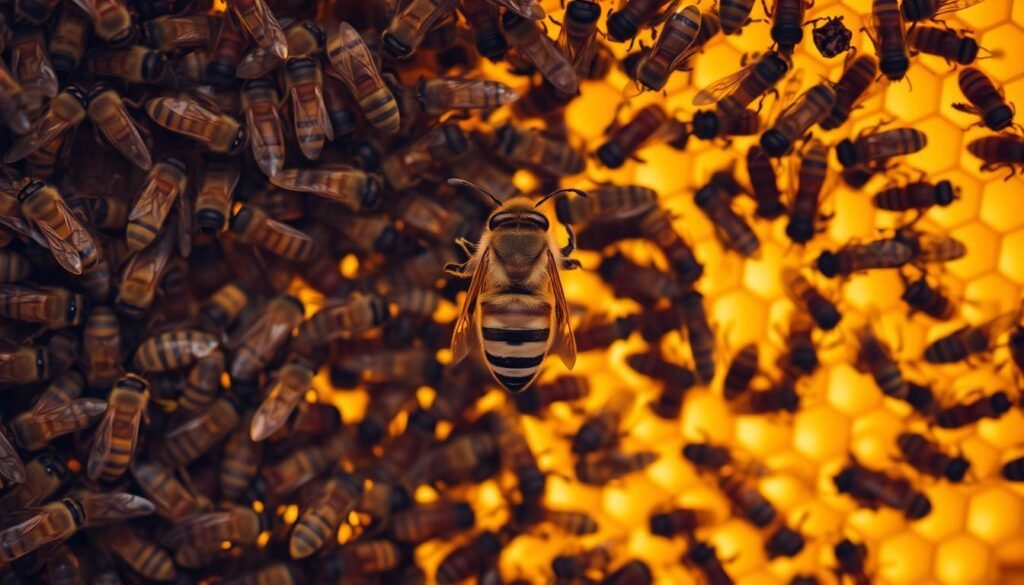
The hive acts as a distributed decision-maker. The queen supplies genetic material and scent cues, but workers carry and interpret those messages. Patrols of mid-aged bees sample scent, temperature, and nectar flow to keep the system balanced.
Mid-aged workers use tactile cues — tremble, stop, and shaking signals — to shift behavior quickly. Those gestures, together with pheromone and brood cues, tune comb building, nursing, and foraging effort.
Quality of the queen signal reports mating status and reproductive fitness. Better-mated queens often produce a more attractive blend, which smooths transitions between tasks and reduces conflict.
When signal flow weakens or becomes irregular, the colony treats that as a warning. Workers may prepare supersedure, alter brood care, or change reproduction timing. In short, morale emerges from steady signal streams, enough space, and available resources synchronized to seasonality.
Impact of queen pheromone strength on colony morale
A steady queen scent keeps worker roles clear and cuts internal reproductive fights. Strong signal levels suppress worker ovary activation and keep attention fixed on brood care, foraging, and comb expansion.
Worker ovary inhibition and reduced reproductive conflict
Clear chemical cues lower the chance workers start laying. When ovaries stay inhibited, the workforce stays organized and fewer resources go to unneeded reproduction.
Retinue size, attentiveness, and the “cheerleader” effect
Stable retinues of roughly ten attendants show effective scent distribution. Attentive workers spread cues by antennation and trophallaxis, which raises colony activity and calm.
Better-mated queens act like pheromonal cheerleaders, shifting worker gene expression toward productivity. That change speeds foraging and wax production when nectar is available.
Comb building: worker-sized cells and suppression of drone/queen cells
A strong queen signal biases comb toward worker-sized cell construction. This conserves resources and prevents premature queen cells or drone-heavy investment.
| Indicator | What to watch | Action if low |
|---|---|---|
| Retinue size | ~10 attendants clustered | Add space, check queen health |
| Worker calm | Low aggression, steady nursing | Inspect brood pattern, reduce disturbance |
| Brood pattern & cells | Tight worker-sized cells; no queen cells | Provide drawn comb, relieve backfilling |
- Monitor retinue, brood pattern, and lack of queen cells as practical proxies for morale.
- Remember: even high-output queens can seem weak if crowding prevents scent dispersal.
Brood Pheromone, Retinue Pheromone, and Worker Behavior
Brood signals tune nurse effort and set the pace for worker shifts from feeding to foraging.
Brood pheromone acts as a fecundity cue. A steady stream of young larvae keeps nurses focused at the comb. That lowers the chance workers start emergency queen cells when brood is abundant.
Task allocation, foraging, and gene expression shifts
Retinue pheromones and brood cues work together to set nurse-to-brood ratios. When brood scent is strong, nurses delay foraging longer. That keeps care levels high and supports steady reproduction.
Synthetic brood products like SuperBoost have raised egg laying and foraging in trials when nutrition matched demand. Boosted signals can speed buildup and honey production, but gains need adequate pollen and nectar.
| Signal | Observed effect | Beekeeper action |
|---|---|---|
| Brood cue | Higher nursing, fewer queen cells | Keep empty drawn comb near brood |
| Retinue scent | Slower worker aging, task fidelity | Monitor retinue size and health |
| Synthetic boost | Increased egg laying and foraging | Use when nutrition is sufficient |
Practical rule: maintain empty drawn comb next to brood to prevent egg-laying restriction and preserve steady pheromone output. For more on chemical signaling, see bee pheromone production.
Age of the Queen, Mating Quality, and Pheromone Levels
Mating richness and years on the comb tune the queen’s scent profile, which alters worker behavior.
Multiple mating usually improves blend attractiveness. Queens that mate with many drones produce richer cues. Workers respond with larger retinues and steadier task focus.
Age matters too. Older queens can show signal decline as gland output shifts. That change shows up as spotty brood and a weak retinue.
Risks and field indicators
Poor mating or bad weather at mating flights raises rapid supersedure risk. Watch for patchy egg patterns, early queen cell starts, and reduced retinue responsiveness.
Practical checks:
- Brood pattern consistency — look for uniform capped cells.
- Retinue responsiveness — attendants should cluster and antennate.
- Early queen cell starts — an alert sign for replacement planning.
When to requeen
If indicators persist, proactive requeening with a vigorous new queen stabilizes production and reproduction prospects. Strong, multiply-mated new queens restore attractive blends and calm worker behavior.
In practice, pheromone blend dynamics act as a useful proxy for a queen’s reproductive potential and can help time interventions like requeening.
| Factor | Sign | Consequence |
|---|---|---|
| Mating richness | Large retinue, strong attraction | Stable workforce, higher production |
| Queen age | Spotty brood, lower output | Higher supersedure likelihood |
| Poor mating weather | Weak retinue, early queen cells | Plan requeening soon |
Colony Conditions That Modulate Pheromone Effects
Regional bloom timing and weather shape how strongly hive scent cues are read by workers. In the United States, phenology — not calendar dates — sets swarm season. Nectar and pollen pulses, temperature, and rainfall synchronize brood peaks and young-worker proportions across apiaries.
Resource abundance: nectar, pollen, and nurse-to-brood ratios
Abundant forage raises brood rearing. That increases both brood pheromone and queen signal circulation, which boosts colony morale and productivity. Yet if space is limited, the same surge pushes colonies toward swarm preparation.
Practical tip: add drawn comb or reverse brood chambers when sealed brood and worker numbers climb rapidly. These actions restore scent flow and reduce reproductive impulses.
Phenology, weather, and timing in U.S. beekeeping regions
Local bloom sequences tell you when to add space. Base interventions on flower maps and temperature trends rather than fixed dates. A short, intense nectar flow will amplify signal effects; a long, steady flow favors buildup without pressure to swarm.
Nutrition matters. During pollen dearths, consider protein feeding to stabilize brood pheromone and support nurse-to-brood balance. This helps limit drone eviction, reduces varroa movement into worker brood, and lowers late-season virus risk.
“Watch bloom timing and nurse-to-brood ratios; they decide whether a colony keeps growing or shifts toward reproduction.”
- Monitor local phenology and hive population, not the date.
- Add space early in a rapid buildup; drawn comb is best.
- Feed protein during dearths to protect brood signals and manage varroa risk.
Swarming Cues: Dilution, Backfilling, and the Honey Band
Rapid population growth paired with packed brood frames creates conditions that prime a colony for swarming. Crowding dilutes the ruler’s scent across comb, lowering signal concentration near the broodnest and changing worker behavior.
Crowding, sealed brood peaks, and open comb thresholds
Sealed brood peaks mean many emerging workers soon. That surge plus limited open comb reduces room for eggs. Workers read this as a near-full cavity cue and shift toward reproductive prep.
Backfilling the broodnest as a “full cavity” signal
Backfilling happens when fresh nectar fills cells around brood. With fewer empty cells, the queen lays less and workers start building queen cells at margins. The honey band can block vertical scent flow and speed that response.
“Backfilling is less about greed and more about a structural cue: no room, so prepare to reproduce.”
Practical interventions to halt swarming
- Add drawn supers above the broodnest to give nectar space and keep eggs flowing.
- Ensure a clear path through the honey band so scent and attendants can move freely.
- Reverse brood chambers or move frames to restore open comb near the queen.
- Remove sealed brood or use the Demaree method to separate queen and many nurses, which resets cues without major honey loss.
| Trigger | What to watch | Action |
|---|---|---|
| Diluted scent by crowding | High worker numbers, tight frames | Add supers, reverse boxes |
| Backfilling | Nectar in brood adjacent cells | Provide drawn comb above brood |
| Sealed brood peak | Many capped cells, lots of young workers | Consider sealed-brood removal or Demaree |
Remember that smaller single-box setups reach thresholds sooner than multi-deep hives. Larger cavities often favor supersedure rather than swarming, so adjust timing and intervention by hive configuration and local apis mellifera phenology.
Comb, Cells, and Space: Managing the Broodnest to Support Morale
A clear path of usable comb through the honey band prevents the nest from reading “no room” cues. This keeps laying steady and reduces emergency rearing behavior.
Place drawn comb immediately beside or above brood. Workers need contiguous, usable comb to accept eggs and move nectar. Frames of foundation often sit unused until the colony produces white wax, so drawn comb is strategically superior for swarm control.
Providing empty drawn comb and reversing brood chambers
Reversing brood boxes restores open-comb access below the queen and removes the empty-frame cue that triggers queen cells. Make sure the cluster can reach new comb without crossing a sealed honey band.
Demaree and emergency queen cell control
Use the Demaree method to break the swarm impulse while keeping workforce and honey income. Move most brood above, leave the queen below, and return in 7–8 days to cut emergency queen cells above as brood emerges and fills with honey.
- Keep drawn comb contiguous: frames must form a path through the honey band.
- Avoid placing drawn comb below the cluster without access: isolated frames often fail to avert swarming.
- Timing: check after one week and remove any emergency queen cells before they mature.
| Action | Effect | When |
|---|---|---|
| Add drawn comb | Maintains egg space and brood pheromone flow | During rapid buildup |
| Reverse boxes | Restores open comb access | At first signs of backfilling |
| Demaree | Eliminates emergency queen cells, preserves honey | When many sealed brood and queen cells appear |
Cavity Volume and Hive Configuration: Single vs. Multi-Deep Colonies
A hive’s internal volume and arrangement shape worker perception of space and reproductive timing.
Single deep setups match the preferred cavity for many european honey bee units and often fill quickly. These colonies can reach swarming thresholds early because comb and stores concentrate in a small volume.
Multi-deep or expanded boxes spread stores and brood. Larger volume lowers perceived crowding and makes colonies more likely to supersede rather than swarm during their first season.
Practical options for beekeeping:
- Add a brood chamber or an extra deep to reduce scent dilution and backfilling.
- Use queen excluders with a rotating pair of sticky supers (Australian practice) to keep an apparent open broodnest below.
- Scale space before major nectar flows to prevent swarming and to protect honey storage goals.
| Configuration | Effect on space perception | Recommended action |
|---|---|---|
| Single deep | Rapid fill, early swarming | Add drawn comb or second deep early |
| Multi-deep | Greater storage, lower swarm pressure | Manage brood placement to maintain scent flow |
| Excluder + rotated supers | Maintains open brood arc | Rotate stickies to move nectar upward |
Tip: in U.S. apiaries watch phenology, not calendar dates, and add space ahead of rapid buildup to keep bees working for honey instead of preparing to reproduce.
Emergency Queen, Supersedure, and Queen Cells: Reading the Hive’s Response
When worker ovary signals wobble, colonies can switch to building emergency queen cells almost overnight.
How to tell emergency rearing from planned supersedure: emergency cells appear at comb margins or beside brood where eggs vanish. Supersedure cells sit near the center, often with steady egg layers still present.
Timing matters. In Demaree-style interventions destroy new cells after 7–8 days to stop fresh starts while workers finish existing brood. Quick action prevents repeated cycles of cell building.
Consistent eggs and young larvae combined with a calm queen retinue usually halt emergency responses. If brood pheromone and ruler signals normalize, suppression resumes and cells stop forming.
Practical checks:
- Record eggs, retinue presence, and worker calm at each inspection.
- Note drone buildup — drone presence often precedes swarm cells; drought or dearth can flip this to drone eviction and raise varroa risk.
- Schedule follow-up checks 7–10 days after intervention to confirm stabilization.
“Workers respond rapidly to changes in egg availability and scent; timely inspection and removal of starter cells often restores order.”
For background on female biology and signals used in these assessments, see honeybee queen biology.
Measuring Queen Pheromone “Strength” in Practice
Inspecting retinue clustering, egg coverage, and worker temperament provides a rapid read on scent transmission in the hive. Field checks are fast and repeatable during routine inspections.
Field indicators to log
Retinue behavior: count attendants around the ruler; ~10 in observation hives matched effective signaling in trials.
Egg-laying pattern: uniform eggs and abundant young larvae mean uninterrupted fecundity signaling.
Worker calm: low aggression, steady nursing, and normal task flow support a strong scent presence.
When to act: requeening, removal, or rearing
Consider replacement if brood becomes spotty, retinues shrink or vary, or queen cells persist despite adding space and drawn comb.
Short-term fixes include using synthetic stand-ins or queen rearing to stabilize behavior while arranging permanent requeening.
“Measure outcomes — comb usage, task flow, and temperament — not a single chemical metric.”
| Indicator | Good sign | Threshold for action |
|---|---|---|
| Retinue size | ~10 attendants clustered | Consistently |
| Brood pattern | Tight, uniform eggs and young larvae | Patchy brood over multiple inspections |
| Worker behavior | Calm, task-focused | Agitation despite added space |
- Practical protocol: record indicators at each check and schedule requeening before regional swarm windows.
- Maintain queen rearing stock or supplier contacts to act quickly when thresholds are met.
- Remember that measured effects across the hive beat any single lab value for field decisions in apis mellifera beekeeping.
Synthetic Pheromones in Beekeeping: Tools, Limits, and Timing
Beekeepers sometimes use synthetic blends to steady weak colonies during critical buildup and queen rearing windows. These products can be practical aids when used with suitable nutrition and timing.
QMP stand-ins to stabilize units and aid queen rearing
Products such as Pseudoqueen and BeeBoost mimic key components of the queen mandibular pheromone to calm queenless packs, improve queen cell acceptance, and steady mating nucs. They often reduce rejection during introductions and help packages remain tractable.
Use notes: place the device in the nuc or mating box during the first 7–14 days and monitor shorthorn beetle (SHB) risk in warm climates where baiting can concentrate pests.
Brood pheromone products to stimulate buildup and reduce swarming
Synthetic brood pheromone (for example SuperBoost) has increased egg laying, foraging, adult population, and honey production in trials when colonies had adequate pollen and syrup. These products keep nurse behavior focused and can reduce the drive to build emergency queen cells by maintaining a fecundity cue.
Caveat: synthetic blends mimic parts of the queen retinue pheromone and brood bouquet, not the full natural signal. Their benefit depends on colony condition, timing, and food supply. Overuse or deployment during dearths gives little gain.
The practical rule of thumb: deploy pheromone aids during active buildup and when protein is available, and remove them once natural signals and comb usage stabilize.
| Tool | Primary use | Timing advice (U.S.) |
|---|---|---|
| Pseudoqueen / BeeBoost | Stabilize queenless units, smooth introductions | First 7–14 days in mating nucs or packages |
| SuperBoost (brood mimic) | Stimulate egg laying, increase foraging, reduce swarm prep | Early season buildup when pollen present or supplemented |
| Temporary stand-ins | Bridge while rearing a new queen | Use short-term; remove when new queen established |
- Practical summary: use QMP stand-ins for introductions and mating nuc stability; use brood pheromone to accelerate buildup when nutrition is good.
- Always pair synthetic tools with feeding or natural forage and remove them after stability returns.
- Track outcomes—production, honey, and retinue behavior—rather than relying on product claims alone.
Research Highlights on Honey Bee Pheromones and Colony Behavior
Recent studies show multiple gland sources keep worker behavior steady even when a single compound is missing.
MG− versus MG+ trials found no detectable 9‑ODA in demandibulated queens yet equal retinue size and equal ovary inhibition. That work points to redundancy from tergal, tarsal, and Dufour’s glands.
Genomic research links richer signals to broad shifts in worker gene expression. Hundreds of genes change with signal quality, and that alters task allocation, aging rates, and overall tempo in apis mellifera units.
Pheromone dilution, nurse-to-brood ratios, and resource flow set the thresholds for reproduction and swarming. In short, demographics and scent together cue reproduction decisions in honey bee colonies.
Layered chemical signals from multiple glands provide this resilience: one gland can under-produce without collapsing overall regulation, exactly what Maisonnasse and colleagues documented in the demandibulated-queen trials above.
Practical, research-backed actions:
- Add drawn comb or reverse brood boxes to restore scent flow.
- Use Demaree or cavity adjustments to shift thresholds without heavy loss.
- Apply synthetic aids only with good nutrition during rearing or buildup.
Maisonnasse, Alaux, Beslay, Crauser, Gines, Plettner, and Le Conte, publishing in Apidologie (full text), found that queens missing their main mandibular pheromone compound still controlled worker behavior just as effectively, suggesting queens rely on more than one signal to hold a colony together. Separately, controlled field trials of the synthetic brood pheromone product SuperBoost found real gains in egg-laying, foraging activity, and honey production when colonies had adequate nutrition (Sagili & Pankiw, Journal of Economic Entomology, 2012), the actual study behind the SuperBoost claims made earlier in this guide.
Conclusion
When scent, brood cues, and cavity layout align, bees stay focused on foraging and wax work. Clear signals plus open, drawn comb keep behavior steady and reduce swarming pressure during rapid buildup.
Redundancy in gland sources protects a unit when one component wanes. Read outcomes — retinue size, brood pattern, and new cell starts — rather than relying on a single lab value.
Use management levers in phenology-driven order: add drawn frames, manage honey bands, reverse brood boxes, or apply the Demaree to restore space and scent flow. Treat synthetic pheromones as short-term tools to stabilize packs, not full replacements for natural signaling and sound hive care.
Practical outlook: by reading integrated signals and adjusting space, configuration, and timing, U.S. beekeepers can keep colonies calm, lower swarming risk, and optimize honey yields season after season.
Frequently Asked Questions
What does queen pheromone strength mean in practical beekeeping?
It refers to the total chemical signal produced by the queen that workers detect. Beekeepers judge it by retinue size, steady egg laying, low worker ovary activation, and calm hive behavior. Strong signals correlate with stable brood patterns and reduced reproductive conflict.
How do queen mandibular pheromone and queen retinue pheromone differ?
Queen mandibular pheromone (QMP) is a key blend from the queen’s mandibular glands that attracts and organizes the retinue. The full retinue pheromone includes QMP plus compounds from tergal, tarsal, and Dufour’s glands. Together they shape worker behavior more robustly than any single source.
Can queens regulate workers without QMP?
Yes. Maisonnasse et al.’s demandibulated-queen trials found redundant cues from other glands can suppress worker reproduction and maintain retinue behavior even with zero detectable 9-ODA, preserving colony homeostasis.
What field signs indicate a weak pheromone signal?
Watch for reduced retinue size, spotty egg laying, increased emergency or supersedure cells, and workers developing ovaries or laying unfertilized eggs. Restlessness during inspections and higher rates of worker-laid drone cells are also red flags.
How do queen age and mating quality influence pheromone levels?
Older queens and those poorly mated often show reduced chemical output and altered blends. This increases supersedure risk and can prompt rapid replacement. Well-mated, younger queens generally produce more consistent signals and attract larger retinues.
What cues trigger swarming related to pheromone dilution?
Crowding, a high proportion of sealed brood, and “backfilling” of the broodnest reduce queen exposure and dilute her chemical reach. These conditions, together with honey banding and limited comb space, often precede swarm preparation.
Can synthetic pheromones help stabilize a weak unit?
Synthetic QMP and brood pheromone products can temporarily calm units, reduce emergency cell construction, and aid queen rearing. They are tools, not substitutes for good queen genetics or proper colony management, and timing matters for effectiveness.