Last Updated September 15, 2026
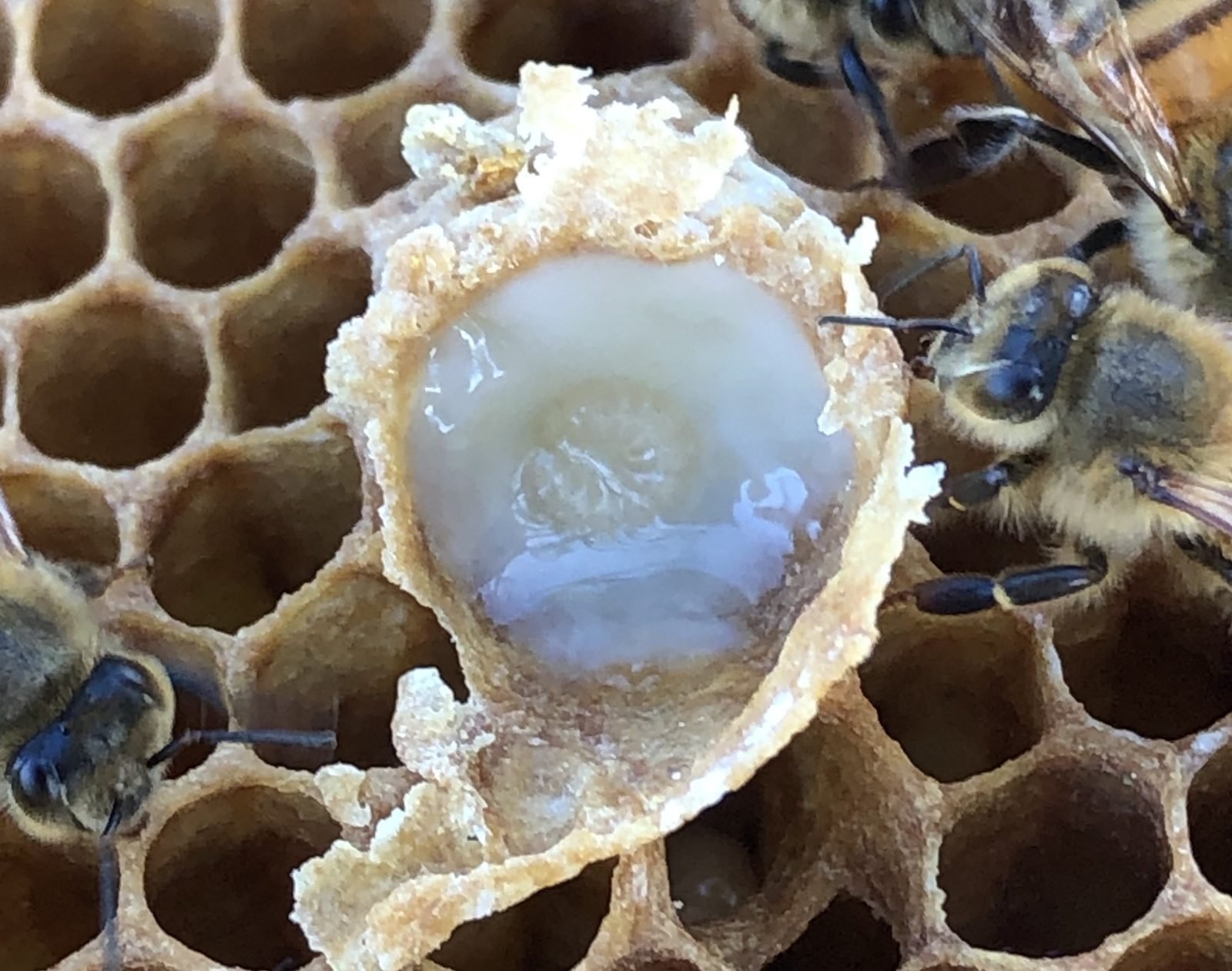
Every honey bee larva eats royal jelly for its first three days of life, but only one caste keeps eating it for its entire life: the queen. That single dietary difference — acting through a specific, now well-studied molecular mechanism — is what turns a fertilized egg into a queen instead of a worker.
Royal jelly itself is not a mysterious substance — it is a specific glandular secretion produced by nurse bees, and modern research has mapped out fairly precisely which glands make it, when in a nurse bee’s life they are active, what the secretion is actually made of, and how it switches on a completely different developmental program in the larva that eats it.
Key Takeaways
- Royal jelly is produced by two glands in a nurse bee’s head: the hypopharyngeal glands and the mandibular glands, each contributing different components.
- Hypopharyngeal glands only fully develop after a young bee has consumed large amounts of pollen for roughly her first 7 to 10 days of adult life.
- Fresh royal jelly is roughly 60-68% water, 12-17% sugars, 10-14% protein, and 3-7% lipids, with a family of nine “major royal jelly proteins” (MRJP1-9) making up most of its protein content.
- All worker and queen larvae receive royal jelly for their first three days; only larvae destined to become queens continue receiving it exclusively for the rest of their development.
- A landmark 2008 study (Kucharski et al., Science) showed the queen/worker switch works through DNA methylation, not a different gene sequence — royal jelly silences an enzyme called Dnmt3, and that silencing alone is enough to push a normal worker-destined larva toward becoming a queen.
Table of Contents
- The Two Glands Behind Royal Jelly
- What Royal Jelly Is Actually Made Of
- Why Pollen Consumption Comes First
- A Gland That Changes Jobs as a Bee Ages
- The Molecular Switch: Why Diet, Not Genes, Determines Caste
- How Beekeepers Encounter This in Practice
- A Note on Royal Jelly as a Human Supplement
- Frequently Asked Questions
- Sources
The Two Glands Behind Royal Jelly
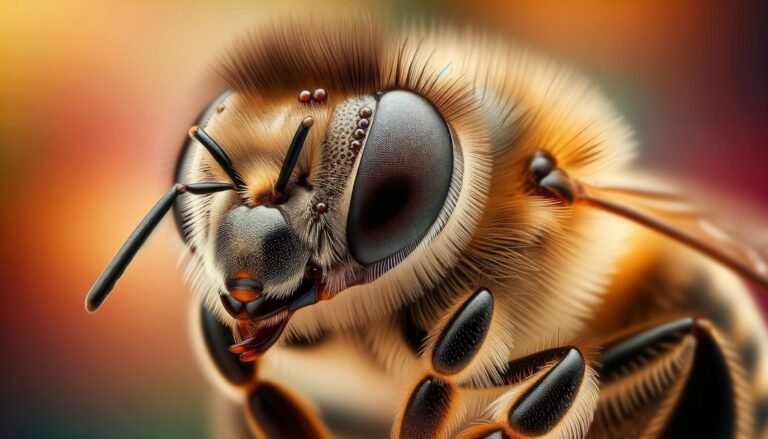
Royal jelly is a joint product of two separate gland systems in a nurse bee’s head. The hypopharyngeal glands are paired structures made up of a long central duct lined with many small secretory acini; those acini synthesize and secrete the protein-rich component of royal jelly, which then travels through the gland’s collecting duct to the bee’s mouthparts. The mandibular glands, simpler sac-like structures at the base of each mandible, contribute the lipid-rich component. Combined, these two secretions make up the yellowish-white, acidic substance fed to young larvae and, for a queen’s entire life, to her exclusively.
“RJ is a yellowish-white, creamy, acidic secretion from the mandibular and hypopharyngeal glands of young worker bees of the Apis mellifera species.”
Full citations for the hypopharyngeal-gland research and the composition data below are gathered in the Sources section at the end of this article, including a specific 2025 Journal of Apicultural Research paper on the molecular mechanism of royal jelly secretion.
What Royal Jelly Is Actually Made Of
Fresh royal jelly’s bulk composition is fairly consistent across studies: roughly 60-68% water, 12-17% sugars (mostly fructose and glucose, which together make up about 90% of the sugar fraction), 10-14% protein, and 3-7% lipids, plus vitamins, minerals, and free amino acids in smaller amounts. Protein accounts for more than half of royal jelly’s dry weight, and the majority of that protein comes from a family of nine related proteins called major royal jelly proteins (MRJP1 through MRJP9). MRJP1 alone makes up roughly a third of total royal jelly protein and is the largest and most abundant of the nine.
| Component | Approximate share of fresh royal jelly | Notes |
|---|---|---|
| Water | 60-68% | Largest single component by weight |
| Sugars | 12-17% | ~90% is fructose and glucose combined |
| Protein | 10-14% | Majority is the MRJP1-9 protein family |
| Lipids | 3-7% | Largely unique fatty acids not common elsewhere in nature |
Why Pollen Consumption Comes First
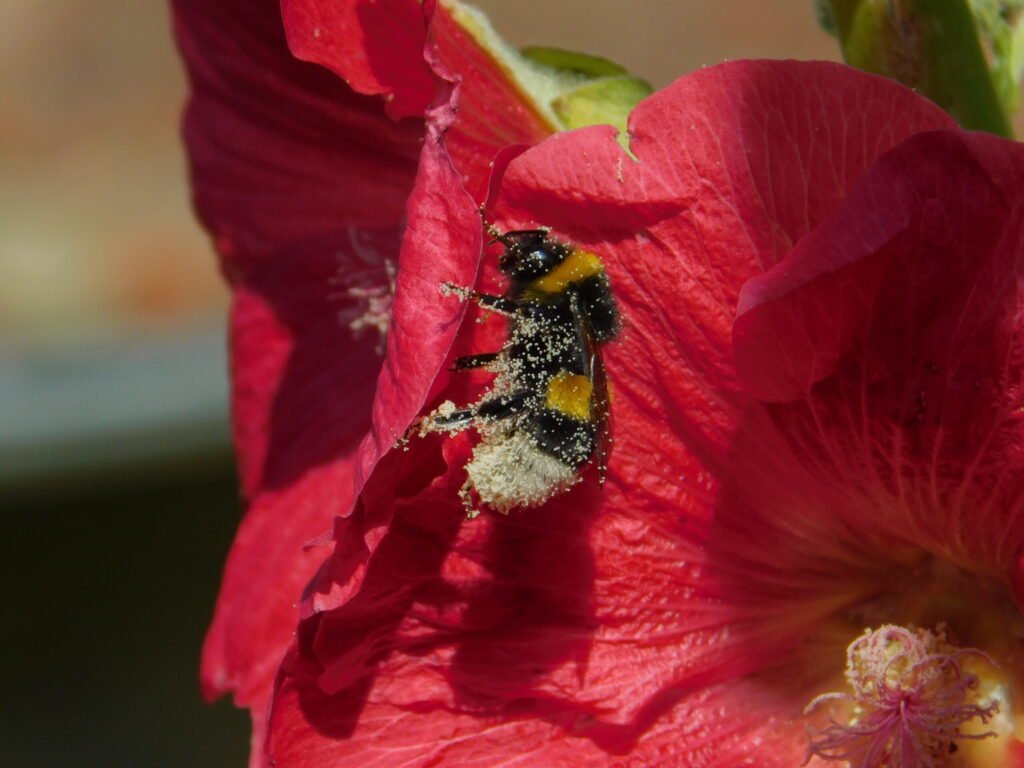
A young worker cannot produce royal jelly on demand — her hypopharyngeal glands need to develop first, and that development depends directly on eating large quantities of pollen (or, in a fermented form, bee bread) during roughly her first 7 to 10 days as an adult. This is a big part of why a colony with a genuine pollen shortage struggles to raise strong brood even if nectar and honey stores look fine — the nurse bees simply cannot manufacture adequate royal jelly without that early protein intake.
A Gland That Changes Jobs as a Bee Ages
Hypopharyngeal gland activity is not constant across a worker’s life. It ramps up and peaks between roughly day 6 and day 12 of adulthood — squarely within the nursing period covered in our guide to worker bee roles — and then changes function entirely once a bee transitions to foraging. In foragers, the same glands stop producing royal jelly’s protein components and instead secrete invertase, the enzyme that converts nectar sucrose into the simple sugars fructose and glucose needed for honey ripening. In other words, the same organ that feeds the next generation early in a bee’s life helps process the colony’s food supply later in it.
The Molecular Switch: Why Diet, Not Genes, Determines Caste
Every larva in the colony — future workers and future queens alike — starts out genetically capable of becoming either one. What decides the outcome isn’t a different set of genes; it’s which genes get switched on or off, and diet is what does the switching. A landmark 2008 study by Kucharski, Maleszka, Foret, and Maleszka, published in Science, identified the actual mechanism: DNA methylation, an epigenetic process that silences specific genes without altering the underlying DNA sequence. The researchers found that silencing a single enzyme, DNA methyltransferase 3 (Dnmt3), in newly hatched worker-destined larvae was enough on its own to push most of them toward developing as queens, with fully functional ovaries — essentially mimicking what a royal-jelly-heavy diet normally does. Later research (PLOS Biology and others) confirmed queens and workers show genome-wide differences in DNA methylation patterns, particularly in genes tied to ovary development and reproductive physiology.
That’s a meaningfully more precise explanation than “diet decides,” which is where a lot of general bee-biology content stops. The diet doesn’t rewrite the larva’s genome; it changes which parts of an identical genome get read. Every larva in the colony — future workers and future queens alike — receives royal jelly for its first three days of life. After that, worker-destined larvae are switched to a mixture of pollen, honey, and glandular secretions, while larvae in queen cells continue receiving royal jelly exclusively for their entire larval development. That sustained diet is what keeps the epigenetic “queen” program switched on long enough to produce a queen’s distinct anatomy and functional ovaries.
How Beekeepers Encounter This in Practice
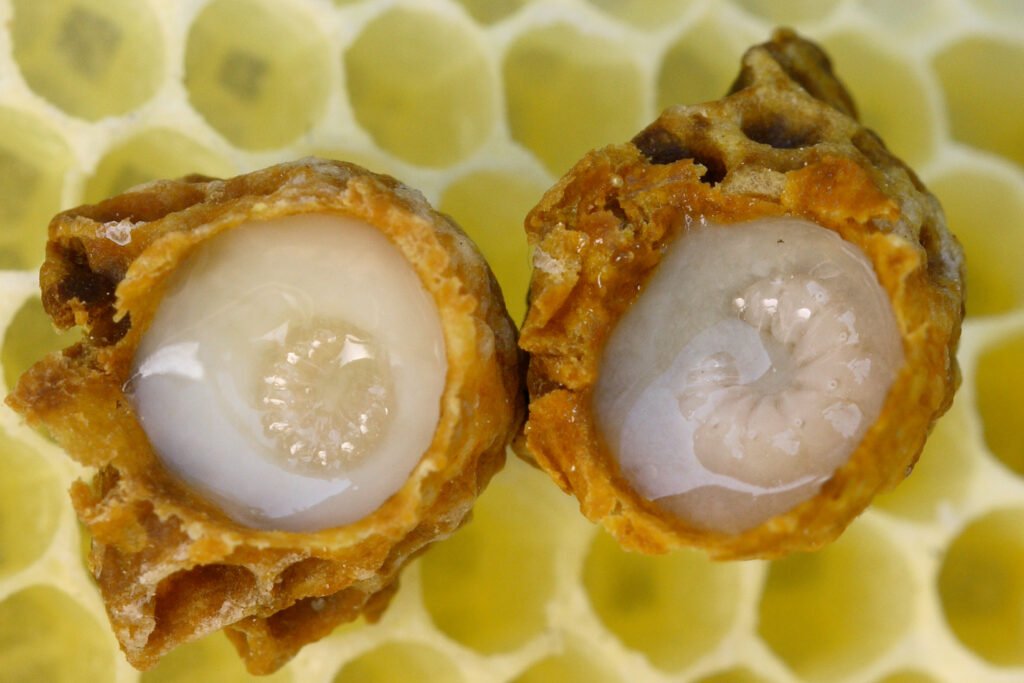
This is also the biological basis for grafting-based queen rearing: moving a young worker-caste larva into an artificial queen cell cup and having nurse bees feed it royal jelly exclusively is enough, on its own, to redirect that larva’s development toward becoming a queen. Our queen rearing basics guide covers grafting step by step, and beekeepers who want a graft-free alternative that relies on the same underlying biology can see the Hopkins method or OTS queen rearing. It is also why a colony that has gone hopelessly queenless can sometimes raise emergency queens from ordinary worker eggs or very young larvae already present in the nest — the deciding factor is diet and its epigenetic effect, not a special egg.
A Note on Royal Jelly as a Human Supplement
Royal jelly is also sold as a human dietary supplement, marketed for a range of health claims. That’s a separate topic from how it functions inside the hive, covered in more depth in our royal jelly benefits guide. Worth flagging here: this article is educational information about honey bee biology, not medical advice, and human research on royal jelly supplementation remains preliminary and mixed rather than settled — anyone considering it for a health condition should talk to a healthcare provider first, particularly given documented allergic reactions in a small subset of people.
Frequently Asked Questions
What glands produce royal jelly?
Royal jelly comes from two glands in a nurse bee’s head: the hypopharyngeal glands, which produce its protein-rich component, and the mandibular glands, which contribute lipid-rich components.
Why do nurse bees need to eat pollen before producing royal jelly?
A young worker’s hypopharyngeal glands only fully develop after she consumes substantial amounts of pollen during roughly her first 7 to 10 days as an adult, which is a prerequisite for royal jelly production.
Do the same glands always produce royal jelly?
No. Hypopharyngeal gland output changes with age: it peaks around days 6-12 during the nursing period, then shifts in foragers to producing invertase, an enzyme used to convert nectar sugars instead.
Why does royal jelly turn a larva into a queen?
All larvae receive royal jelly for their first three days, but only larvae in queen cells continue receiving it exclusively throughout development. Research published in Science in 2008 traced this to DNA methylation — royal jelly’s effect silences a gene-regulating enzyme (Dnmt3), which is enough on its own to trigger queen development, including functional ovaries.
What is royal jelly actually made of?
Roughly 60-68% water, 12-17% sugars, 10-14% protein, and 3-7% lipids. Most of the protein comes from a family of nine major royal jelly proteins (MRJP1-9), with MRJP1 the single largest component.
Can a beekeeper use this biology to raise queens deliberately?
Yes — grafting a young worker larva into an artificial queen cup and letting nurse bees feed it royal jelly exclusively is the basis of standard queen-rearing techniques, including grafting and graft-free methods like the Hopkins method.
Sources
- “The association between the hypopharyngeal glands and the molecular mechanism which honey bees secrete royal jelly,” Journal of Apicultural Research
- Kucharski, Maleszka, Foret & Maleszka, “Nutritional Control of Reproductive Status in Honeybees via DNA Methylation,” Science, 319(5871), 2008
- Collazo et al., “Health Promoting Properties of Bee Royal Jelly: Food of the Queens,” Nutrients, 13(2), 2021
Last reviewed September 15, 2026.
Image credits: Photo: L. Rusert, CC BY-SA 4.0, via Wikimedia Commons.