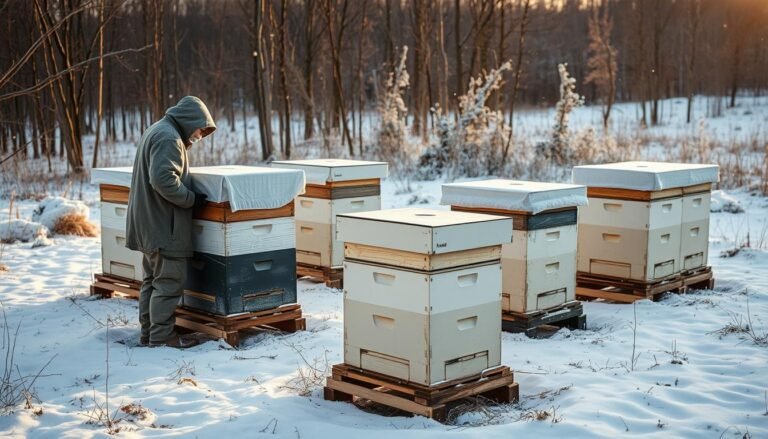
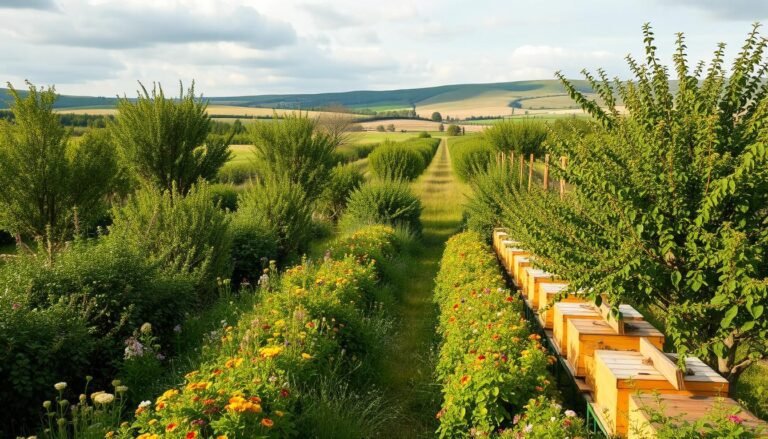
Understanding foraging range shapes smart beekeeping. Honey bees usually work within about one to two miles of their hive for energy efficiency. When local nectar runs low, strong colonies can push several miles further, which changes how we plan placement and inspections.
Different species behave very differently. Mason and bumble species often stay within a few hundred yards. Queens make longer mating flights, and individual flight speed and wingbeat rates affect how many blooms a colony can pollinate in a day.
The practical takeaway: a modest radius makes a large area. That fact complicates organic honey claims in the United States and forces managers to map land use around an apiary. Later sections will show numbers, species differences, mapping tips, and placement strategies that fit real-world pollinators and production goals.
Key Takeaways
- Honey bees usually forage within a 1–2 mile practical range; they may extend range when needed.
- Different species show different patterns; nearby blooms may come from distant hives or local nests.
- Even a small radius equals a large area, affecting honey labeling and land planning.
- Flight efficiency and energy budgets guide foraging choices more than raw endurance.
- Understanding range helps with placement, inspection cadence, and pollination planning.
Why Foraging Distance Matters for Beekeepers Today
Where colonies search for blooms determines energy budgets, pesticide exposure, and yield. Knowing the practical range helps a beekeeper choose a location that keeps key resources close. That lowers wasted flights and improves efficiency when converting nectar into honey and brood support.
Audit nearby land uses. Check residential, natural, and agricultural patches near your apiary so the hive has steady water and flowers without needing long trips. This reduces risk from sprays and from competing pollinators.
- Stage supplemental feed and water where foragers will find it quickly to save energy and keep the colony productive.
- Plan placements for crops: the work radius sets how many colonies cover field edges and interiors during bloom.
- Use bloom calendars and microclimate notes to predict when colonies will stay close or stretch outward.
Collaboration matters. Work with landowners and growers to increase nearby forage. Denser floral resources near the hive keep bees within a comfortable range and support steadier production and lower exposure risk.
Evidence-Based Ranges: How Far Honey Bees Typically Fly
Real-world monitoring shows a clear working radius that drives hive management decisions. Most collection trips stay close when flowers are abundant. That pattern boosts overall efficiency and yield.
Typical working distances
Core numbers: U.S. beekeepers generally count on a practical radius of 1–2 miles, with colonies stretching toward about 5 miles when nearby sources dry up (Kylie Chacon, 2025).
Metric perspective and outliers
In metric terms, the common zone is ~3 km, with rare excursions up to ~10 km reported by Flow Hive data. Such outliers usually reflect fragmented landscapes or seasonal shortages.
What drives longer flights
Scarcity, seasonality, land use, and colony strength push longer distance behavior. Individual flight speed (around 35 km/h) and wingbeat rate (~240 Hz) help cover ground, but energy economics govern whether long loops pay off.
- Population patterns: Distances describe repeated circuits over time, not one-off explorations.
- Practical tip: Map the listed ranges against local blooms to spot short-loop versus long-loop signatures.
Beyond Honey Bees: Species Differences and Foraging Goals
Not every pollinator ranges the same way; many native species keep tight patrols near home. Mason and bumble species commonly remain within a few hundred yards of their nest, which concentrates pressure around local patches and affects nearby plant visit patterns.
A bee’s daily work has clear goals: workers collect nectar for energy and honey production, gather pollen for brood protein, and haul water for cooling and processing stores. These needs shape route choices and time spent at each stop.
Mating versus resource trips
Queens undertake high-altitude mating flights to drone congregation areas, while workers stick to resource collection that sustains the colony. That difference changes flight profiles and return intervals.
- Flower density and patch size shorten loops. Rich, compact flowers keep foragers close to home and boost efficiency.
- Overlap occurs: honey bees may compete with mason and bumble insects in prime zones, so diverse plantings help all pollinators thrive.
- Practical cue: heavier nectar loads and long gaps between sightings often mean a forager came from several miles away, while steady, quick returns signal nearby flowers.
For deeper range data and species comparisons, see this range details and a useful nectar collection overview.
38. how far bees travel to forage
A two-mile radius around an apiary becomes a surprisingly vast working territory for a colony. Convert that radius into an area and even a 1–2 mile circle covers thousands of acres, which explains why a backyard hive taps into distant plant communities.
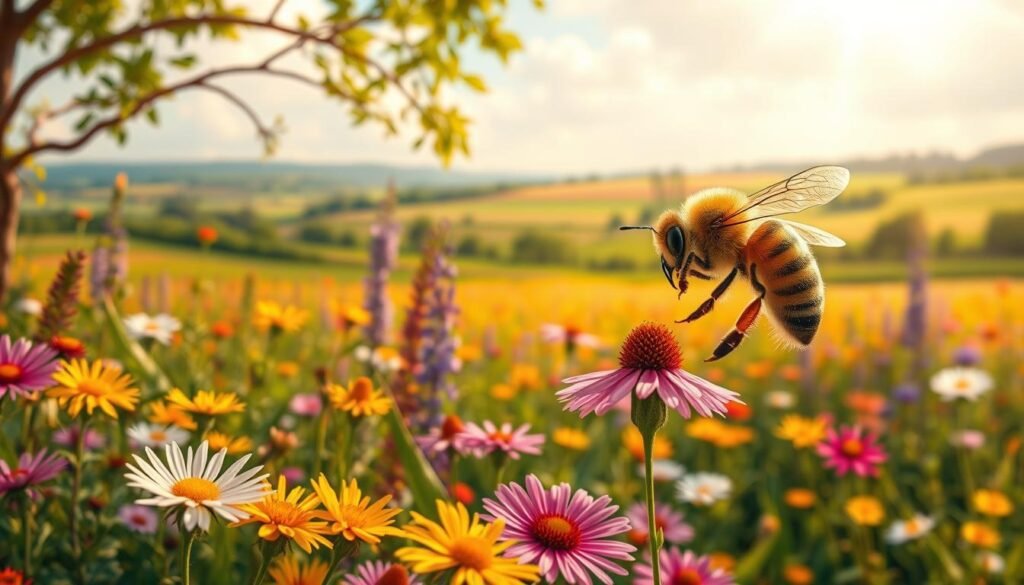
From radius to area: turning miles into the real foraging footprint
Use the simple formula for a circle to see scale: area rises with the square of the radius. A one-mile ring already covers over 3,000 acres; two miles multiplies that footprint many times.
Understanding “tens of thousands of acres” and what it means for forage sources
Scale matters. When a hive samples tens of thousands of acres, the mix of plants, bloom timing, and water points varies greatly. That diversity shapes honey character and seasonal yield.
Quick mapping workflow: draw a circle, assess plants, and note competing resources
Map step-by-step:
- Draw a 1–2 mile circle from the hive center and mark dominant plants and plant communities.
- Flag intensive agriculture, urban landscaping, and neighboring apiaries as competing resources.
- Walk the nearer mile, then inspect the outer ring to see which patches attract the most visits back hive.
- Note corridors—tree lines, waterways, and wind breaks—and water sources that guide traffic.
These simple checks help interpret why foragers focus on some patches despite the huge area available, and they connect landscape scale to practical expectations for honey by season.
How to Use Foraging Distance to Plan Hive Placement and Forage Availability
A practical siting plan focuses on clusters of flowers and steady water inside a short radius. Place the hive so key plants peak within a 1–2 mile range, since honey bees normally work that zone and strong colonies may extend farther when needed.
Choosing locations: proximity, water, and bloom timing
Prioritize diversity. Pick locations with mixed trees, wildflowers, and crops that bloom at different times. Reliable water nearby reduces wasted flights and supports brood care.
Balancing energy cost and yield
Keep high-value nectar and pollen sources close. When plants are inside the core range, the colony converts nectar into honey more efficiently and conserves energy for growth.
Crop pollination logistics
For field work, position hives along edges and internal corridors so foragers reach bloom areas without long detours. Align moves with bloom calendars and scale colony strength to the crop’s peak.
- Use a short siting checklist: map plants, mark water, note wind and shade, and confirm peak dates.
- Coordinate with growers to add staggered plantings that extend reliable sources within the range.
- Monitor entrance returns for nectar and pollen to verify site performance and adjust placement when intake falls.
For step-by-step placement guidance, see these proper beehive placement tips that align with range-based planning and apiary efficiency.
Practical Ways to Gauge Your Bees’ Foraging Range in the Field
A short field routine can reveal whether your colony is working nearby blooms or stretching out into the outer miles.
Quick timing and simple maps offer the best mix of accuracy and ease of use for most backyard and commercial keepers.
Observation basics
Mark or note a departing forager at a known flower patch, then time its return to the back hive. Repeat these checks several times across the day.
Short returns usually mean nearby resources; long times suggest trips of one or more miles. Use average times, not single samples.
Mapping and bearings
- Log flight direction during peak hours and plot bearings on a map to find high-use corridors.
- Triangulate by visiting likely patches and confirming on-site activity.
- Record flower types and pollen colors on incoming foragers to match source plants.
| Method | What to record | What it indicates |
|---|---|---|
| Timing departures | Seconds to return | Near (15 min) |
| Bearing logs | Compass direction samples | Preferred corridors and patches |
| Pollen checks | Pollen color and type | Dominant flower sources |
| Entrance counts | Outbound/inbound rates | Overall work pressure and daily peaks |
Repeat these tests on different days and weather conditions. Correlate entrance traffic with field counts to validate your map. Watch return posture and load; heavy pollen loads often mean nearer trips while bare returns can signal longer flights.
Implications for Honey, Purity Claims, and Pollination Outcomes
Because a colony can work tens of thousands of acres, a beekeeper rarely controls every source that contributes to a harvest.
This scale complicates organic and purity statements under U.S. rules.
Why organic labels are hard to guarantee
A hive’s circle can include farms, roadsides, and wild patches. Bees may range up to about 5 miles when nearby resources are scarce, so nectar and pollen often come from mixed land uses.
That reality means a producer cannot ensure every drop meets strict organic standards, even with careful beekeeping and stewardship.
- Label strategy: emphasize floral sources and regional character rather than absolute purity.
- Monitoring: track dominant incoming pollen and nectar colors to predict seasonal shifts.
- Coordination: work with growers to boost preferred crops and timing within the core area.
| Issue | Practical action | Expected outcome |
|---|---|---|
| Mixed land uses in the circle | Map surrounding acres and log dominant crops | Clearer marketing claims and risk reduction |
| Uncontrolled distant sources | Monitor pollen and entrance returns | Better prediction of honey profile shifts |
| Pollination variability | Coordinate plantings and bloom schedules with growers | Improved set and consistent pollination services |
| Market expectations | Use transparent labels and floral notes | Higher buyer trust and realistic claims |
For more detailed range data and management tips, consult a recent range study that explores operational distances and landscape impacts.
Conclusion
Good managers watch flight timing and pollen loads; these simple checks show when a hive needs closer flowers and water.
Keep observations daily. Note return times and load size across the day. Short, steady trips mean nearby food; long, sparse returns hint that foraging has stretched into several miles.
Map a one- to two-mile circle around each apiary, mark bloom dates, and add plants or water where gaps appear. Use a recent range study for context when models and movement matter.
Bottom line, aligning resources near the home reduces energy loss, protects honey yield, and raises pollination reliability. Start by reviewing local bloom calendars and drawing that mile circle for each apiary.
FAQ
How far do honey bees usually fly from the hive when foraging?
Honey bees most often forage within a 1–2 mile radius of the hive. This range balances energy use with resource gain. When nearby nectar and pollen are abundant, bees stick closer. If resources are scarce, some workers can extend flights to about 3–5 miles, and rare trips have been recorded up to roughly 10 kilometers.
Why does foraging distance matter for beekeepers and crop pollination?
Foraging distance affects honey yield, pollination efficiency, and risk of contamination. Keeping diverse forage sources and water within the efficient 1–2 mile zone increases colony productivity and reduces fuel costs. For field pollination, hive placement must account for the bees’ typical range to ensure adequate coverage of target crops.
What factors make bees fly farther than usual?
Several drivers push bees to travel farther: seasonal shortages, landscape fragmentation, weak local floral diversity, colony population size, and weather. When local blooms end, strong colonies will send foragers on longer trips to meet nutritional needs.
Do other bee species travel as far as honey bees?
No. Many solitary and native pollinators, such as mason and bumble bees, usually forage much closer—often a few hundred yards from their nest. Their smaller range changes pollination patterns and the area each species can service.
What do bees collect during foraging trips?
Foragers gather nectar, pollen, water, and propolis. Nectar provides carbohydrates for flight and honey production; pollen supplies protein for brood. Workers also scout for water and materials for nest repair, and drones make mating flights that differ from foraging behavior.
How can a beekeeper estimate the real foraging area around a hive?
Convert the flight radius into a circle to map the foraging footprint. A 2-mile radius covers roughly 12,566 acres; a 1-mile radius covers about 3,142 acres. Use simple mapping tools to draw these circles, then inventory floral resources and competing colonies inside them.
Is it realistic to claim honey is pure or organic given bee foraging ranges?
It’s challenging. Bees can visit a wide area that includes unmanaged crops, treated fields, and wild plants. Because workers can travel several miles, ensuring all visited sources meet strict organic standards is difficult without isolated placement and continuous monitoring.
What practical methods help measure my bees’ foraging behavior on-site?
Observe hive entrances for return rates, track bee flight paths to nearby patches, and time forager round-trips. Mark-and-recapture, pollen analysis from returning bees, and simple mapping of flower visitation also reveal preferred distances and key forage sites.
How should I choose hive locations to maximize forage availability?
Place hives near diverse, staggered bloom sources and reliable water. Aim to keep high-value forage inside the 1–2 mile efficient radius. Consider landscape features, competing apiaries, and seasonal crop rotations when planning placement.
How does foraging distance influence crop pollination logistics?
For large fields, position colonies so most target flowers lie within the bees’ efficient range. Stronger colonies can cover more area, but travel time reduces visitation per flower. Match colony strength to distance and crop bloom window for optimal results.