Reviewed by Elena P. · How we review
Robbing is one of the fastest ways to lose a colony. When nectar runs short, foragers from strong hives go looking for easy sugar, and a small or weakened colony full of stored honey is exactly what they find. Once a robbing frenzy starts, a weak hive can be stripped of its stores, and its bees killed, surprisingly quickly.
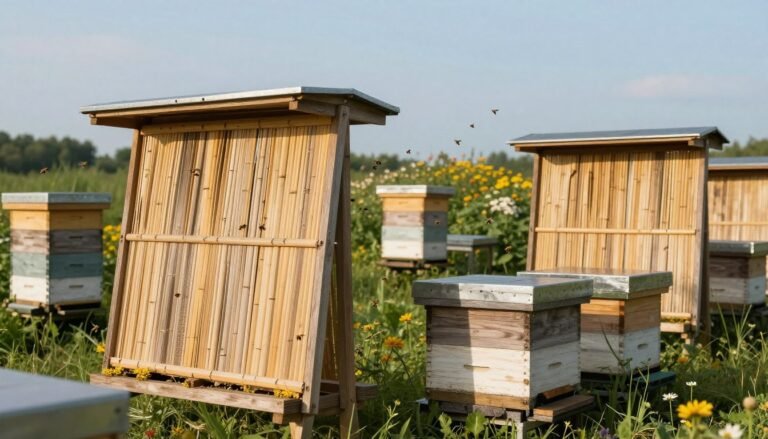
An entrance tunnel is one of the simplest defenses. The idea is to make the path from outside to the colony’s stores longer, narrower, or less direct, so the colony’s own bees can learn it while robbers get confused. This article explains how entrance tunnels and robbing screens work, when to use them, how to make a basic one, and what else to do to keep robbing under control.
Key Takeaways
- Robbing peaks during nectar dearths, when strong colonies look for weaker hives to raid.
- An entrance tunnel or robbing screen moves the real entrance away from where robbers expect it. Resident bees learn the new route; robbers tend to keep trying where they smell honey.
- A long, narrow entrance also gives a small colony’s guards a smaller front to defend.
- Fit screens before robbing starts, especially on nucs, new colonies, and hives being fed.
- Screens work best combined with reduced entrances, careful feeding, and fewer inspections during a dearth.
Table of Contents
- Why Robbing Starts and Why Weak Hives Are Targets
- How an Entrance Tunnel Works
- Types of Entrance Tunnels and Robbing Screens
- When to Put One On
- Making a Simple DIY Robbing Screen
- Limitations and Side Effects
- Other Robbing-Prevention Steps
- Conclusion
- FAQ
Why Robbing Starts and Why Weak Hives Are Targets
Robbing is driven by opportunity. Penn State Extension notes that during the summer nectar dearth “strong colonies may begin robbing smaller or weaker colonies,” and that robbing can be reduced by limiting inspections during a dearth and by fitting a robbing screen on the entrance (Penn State Extension: Honey Bee Management Throughout the Seasons).
Weak colonies are targets because they don’t have enough guard bees to cover a full-width entrance. Nucs, newly installed packages, queenless or diseased hives, and colonies recovering from a split are all at higher risk. Syrup spills, open feeders, and honey supers left exposed during a dearth make the problem worse.
Signs of robbing include bees fighting and tumbling on the landing board, bees darting side to side in front of the hive before trying to slip in, dead bees at the entrance, and ragged wax cappings on the bottom board. For a full checklist, see how to identify robbing behavior early.
How an Entrance Tunnel Works
An entrance tunnel exploits a difference between how robbers and residents find their way in:
- Robbers follow the smell of honey. They fly toward the strongest odor coming from the hive, which is usually the original entrance or a screened panel in front of it.
- Residents learn the new route. The colony’s own foragers orient to the hive and, after some initial confusion, learn to use the relocated opening.
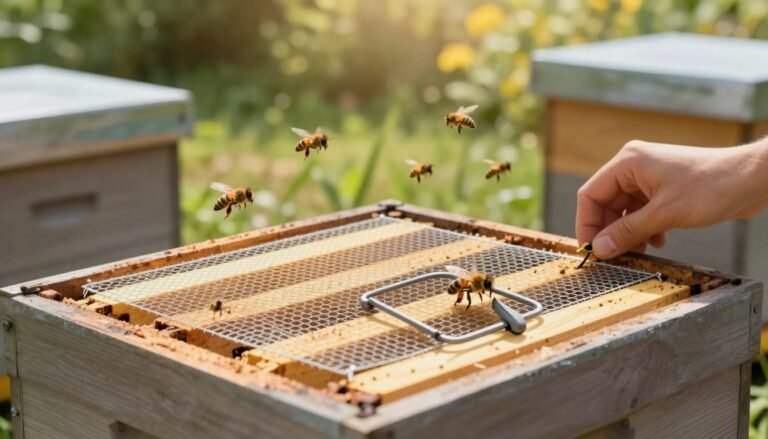
On a typical robbing screen, a panel of mesh covers the normal entrance. Bees exit the hive into the space behind the screen and leave through a small opening near the top of the panel. As Betterbee’s guide explains, the mesh lets the smell of the stores drift out, so robbers approach the screen and try to get through it, while the real entrance sits somewhere else (Betterbee: Robbing Screens to Protect Honey).
A long or narrow tunnel also helps a small colony defend itself. A few guards can hold a passage one or two bees wide far more easily than an open, full-width entrance.
Types of Entrance Tunnels and Robbing Screens
| Type | How it works | Best for | Drawbacks |
|---|---|---|---|
| Entrance reducer | Narrows the entrance to a small notch | New colonies, nucs, early dearth | Doesn’t redirect robbers; the opening is still where they expect it |
| Commercial robbing screen | Mesh panel over the entrance with a relocated upper opening, often with sliding gates to open or close | Apiaries with regular dearth robbing | Cost; must match your hive width |
| DIY screened frame | Wooden frame and window screen fitted over the front, with a small opening at the top | Budget setups and odd hive sizes | Must seal well at the edges or robbers slip around it |
| Tube or block tunnel | A narrow passage several inches long leading to the entrance | Small nucs and mating nucs | Restricts ventilation and traffic in hot weather or strong colonies |
Entrance reducers are the most common first step. See beehive entrance reducer sizes for choosing the right opening.
When to Put One On
- At the start of a nectar dearth, before robbing begins. A screen prevents robbing much better than it stops a frenzy already underway.
- Whenever you feed a weak or small colony. Syrup smell attracts robbers. See feeding bees without causing robbing.
- On nucs, packages, and splits in their first weeks, when guard numbers are low.
- After a colony has been weakened by queen loss, disease, or a heavy honey harvest nearby.
Many beekeepers fit screens in the evening, when most foragers are home, so the bees meet the new entrance on their first flights the next morning. Expect some confusion for a day or two as returning foragers cluster on the mesh before finding the opening.
Making a Simple DIY Robbing Screen
- Build a rectangular frame from thin strips of wood, as wide as the hive body and tall enough to cover the entrance and several inches of the front.
- Staple window screen or fine mesh across the frame.
- Leave a small opening, about one bee-space tall and an inch or two wide, along the top edge of the frame. This becomes the new entrance.
- Add a bottom strip so the frame sits flush on the bottom board and closes off the old entrance except into the screened space.
- Fit it tight against the hive front with screws or nails, and check that there are no gaps at the sides where robbers could slip in.
A sliding piece of wood or a screw-on block over the upper opening lets you close the hive completely for moving, or narrow the opening further.
Limitations and Side Effects
Robbing screens are widely used, but they aren’t free of costs. Randy Oliver, who has studied robbing screens in field trials, found that returning foragers can take time to learn the hidden entrance, and that some young bees making their first flights from screened hives drifted into neighboring colonies. He concludes that more research is needed to know whether the benefits of robbing screens outweigh their possible downsides (Scientific Beekeeping: Robbing Screens, Part 5).
Other practical limits:
- Screens restrict ventilation somewhat, so watch for bearding and heat stress in hot weather.
- A screen alone rarely stops a full-blown robbing frenzy. Close the entrance down hard first.
- Screens on every hive in the yard can confuse drifting bees. Use them where they are needed most.
Other Robbing-Prevention Steps
- Reduce entrances on small colonies during a dearth.
- Feed carefully: use internal feeders, feed in the evening, and clean up spills right away.
- Limit inspections during a dearth, and keep them short.
- Never leave honey, wet supers, or comb exposed in the apiary.
- Combine or strengthen weak colonies before the dearth if they can’t defend themselves.
- If a frenzy starts, close the entrance to a single bee space, and many beekeepers drape a damp sheet over the hive so robbers can’t find the entrance while residents gradually work their way in underneath.
New colonies need the most attention. See securing new bee colonies against robbing for a step-by-step plan.
The same entrance logic applies when wasps are the problem; see how to protect beehives from yellow jackets.
Conclusion
An entrance tunnel protects a weak hive by moving the real entrance away from the smell robbers follow and by giving the colony’s guards a narrow, defensible passage. Fitted before a dearth and combined with reduced entrances, careful feeding, and fewer inspections, a robbing screen or tunnel is one of the cheapest and most effective ways to protect small colonies. Watch for side effects such as confused foragers, drift, and reduced ventilation, and take screens off once the danger has passed.
FAQ
What is an entrance tunnel for robbing reduction?
It is any device that lengthens, narrows, or redirects the path into a beehive, such as a robbing screen with a relocated upper opening or a narrow tube entrance. Resident bees learn the new route, while robbers tend to keep trying where the smell of honey is strongest.
How long does it take bees to learn a robbing screen entrance?
Expect a day or two of confusion, with returning foragers clustering on the mesh before finding the opening. Fitting the screen in the evening, when most foragers are home, lets them meet the new entrance on their first flights the next morning.
When should I install a robbing screen?
Install it before robbing starts: at the beginning of a nectar dearth, when feeding weak colonies, and on nucs, packages, and splits in their first weeks. A screen prevents robbing better than it stops a frenzy that is already underway.
Is an entrance reducer enough to stop robbing?
A reducer helps a small colony defend itself by shrinking the area guards must cover, but the opening is still where robbers expect it. For colonies under heavy pressure, a robbing screen that relocates the entrance adds a second layer of protection.
Do robbing screens have any downsides?
Yes. They can confuse returning foragers at first, some young bees may drift to other hives, and they reduce ventilation somewhat. Use them where robbing risk is highest and remove them once the dearth ends.