
Reviewed by Michael R. · How we review
To protect beehives from yellow jackets, shrink each entrance to a gap the guard bees can hold, keep every colony strong, and keep the apiary free of spilled syrup and exposed comb. Trap yellow jackets only with protein baits or a chemical lure matched to your local species, set well away from the hives. Sweet baits catch honey bees too. Late summer and fall is when this matters, because yellow jacket colonies peak just as nectar runs out.
This guide is written from eastern North Dakota, but the biology holds across North America. If you are not yet sure the striped insects at your entrance are wasps, start with our guide to telling yellowjackets and honey bees apart.
Key Takeaways
- Oregon State University Extension recommends reducing an entrance under attack to 1 to 2 inches. A weak colony may need it down to one bee length.
- Sweet baits attract honey bees. Protein baits do not, because honey bees get all their protein from pollen.
- The common trap lure, heptyl butyrate, works mainly on the western yellowjacket. In Michigan trials the eastern yellowjacket and its relatives responded to acetic acid plus isobutanol instead.
- Casual trapping rarely takes enough wasps to relieve a hive. The entrance and colony strength do most of the work.
- Homemade poison baits are illegal in the U.S. Only labeled products may be used, and the one product OSU names has variable results.
Table of Contents
- Why Yellow Jackets Turn on Beehives in Late Summer
- What an Attack Looks Like at the Entrance
- Make the Entrance Defensible
- Keep Colonies Strong and the Apiary Clean
- Trap With the Right Bait, or Not at All
- When Entrance Defense Fails
- Dealing With Nearby Nests
- Frequently Asked Questions
- The Bottom Line
Why Yellow Jackets Turn on Beehives in Late Summer
A yellow jacket colony lasts one season. A queen that spent the winter alone starts a nest in spring, usually underground, and raises the first workers herself. Oregon State University’s Protecting honey bees from yellowjacket wasps (Carolyn Breece, Ramesh Sagili and Dan Wyns, published 2018, reviewed 2024) puts a colony at up to 5,000 workers at its peak.
What those workers want changes over the season. The University of California’s Pest Notes on yellowjackets (Eric Mussen and Michael Rust) explains that from spring to midsummer the larvae need large amounts of protein, so workers hunt insects. By late summer colony growth slows and the wasps need large amounts of sugar instead. That is exactly when flowers dry up and a beehive becomes the richest store of sugar and protein around. OSU adds that long, dry fall dearths make it worse.
| Season | What the yellow jacket colony is doing | What to do at your hives |
|---|---|---|
| Spring | Overwintered queens emerge and start nests alone | The best time to trap queens with protein water traps or lures |
| Early to midsummer | Workers hunt insects to feed protein to larvae | Protein baits pull well now; keep the apiary tidy |
| Late summer | Colonies near peak size and switching to sugar | Reduce entrances as the flow ends; fit robbing screens on weak colonies |
| Fall dearth | Raids on beehives peak | Check entrances on cool mornings; combine weak colonies; never open-feed |
| After hard frosts | Workers die; only newly mated queens overwinter | Pressure is over until next year |
Keep the threat in proportion, though. Mark Creighton, a Connecticut apiary inspector, told Entomology Today that healthy hives are seldom seriously threatened by yellow jackets. The late wasp researcher Justin Schmidt went further.
“In North America, yellowjacket predation on honey bees is not a major problem in most cases.”
What an Attack Looks Like at the Entrance
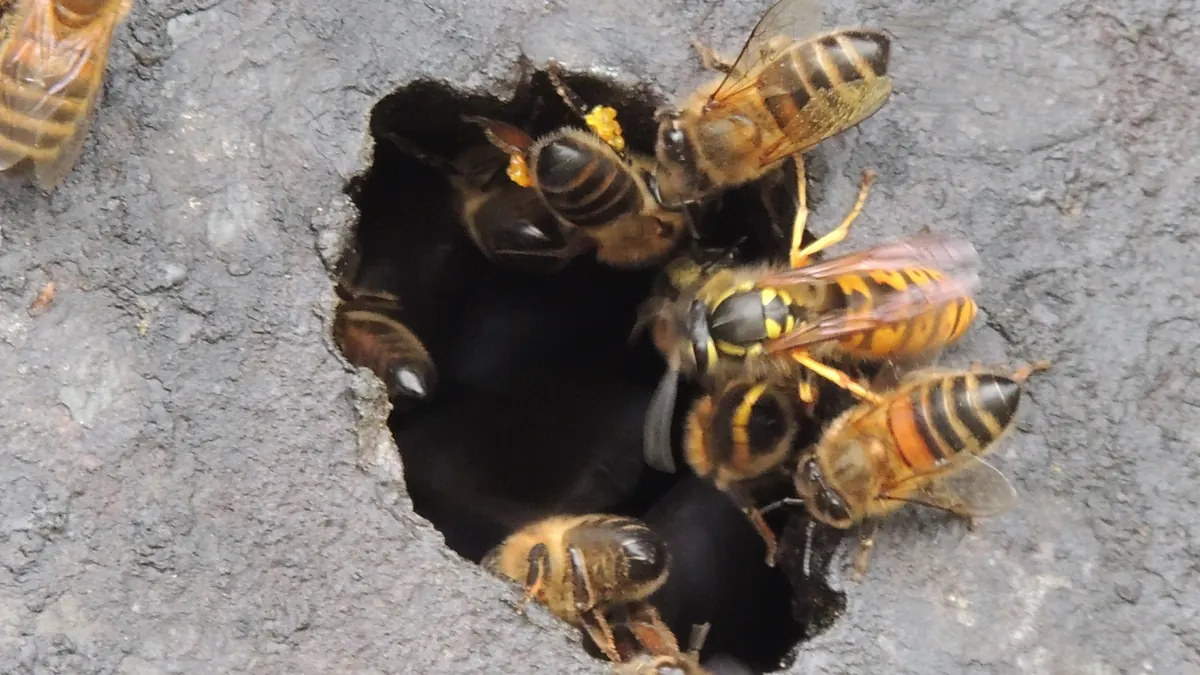
Yellow jackets work a hive in two ways. Some hover or wait near the entrance and pick off bees as they come and go, then cut them up to carry home. Others try to walk straight in past the guards to take honey, larvae and pupae. Rusty Burlew of Honey Bee Suite warns that once yellow jackets get inside a weak colony, they will not give up until the hive is empty.
Headless and bitten-in-half bees are the signature of wasp predation; our guide to dead bees in front of the hive covers other causes. Yellow jackets also follow robbing, because fighting leaves dead bees and torn-open honey cells for them to find (see spotting robbing early).
“If robbing gets well underway, yellowjackets are sure to follow.”
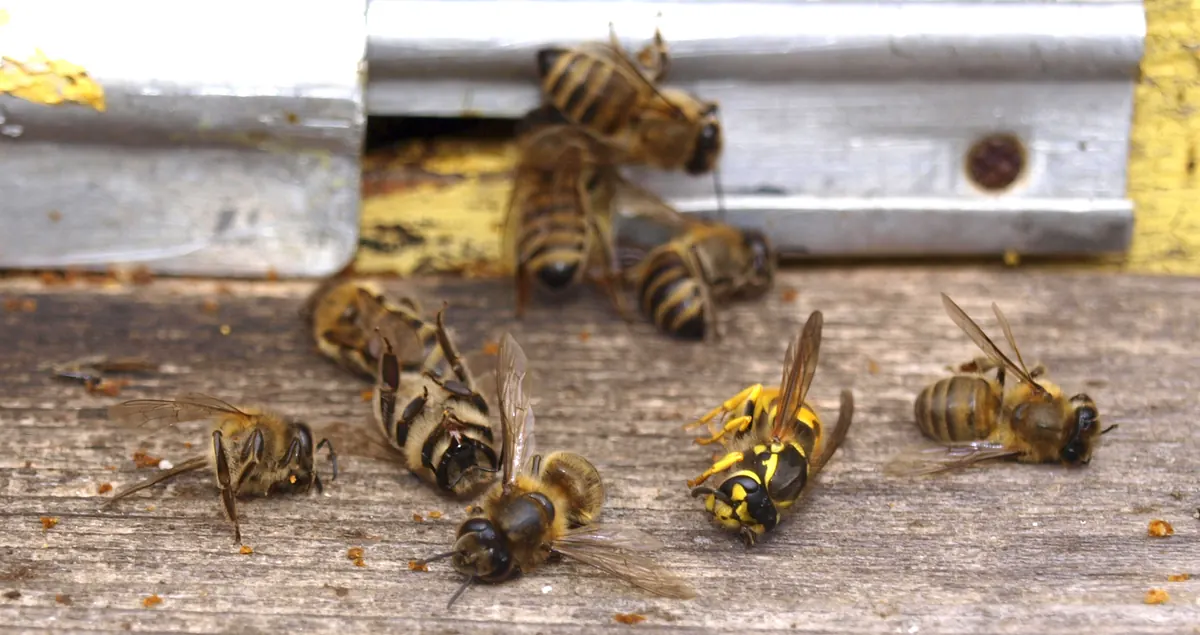
Guard bees fight back by grabbing a wasp and piling onto it, sometimes in a ball that overheats it (see how honey bees defend the colony). But managed bees are not especially good at it. In a 2019 test in San Diego, researchers tethered live German yellowjackets about 1 inch from hive entrances for up to 10 minutes. The results, published by Harmen Hendriksma and colleagues in 2023, were that managed European colonies killed 2 of 7 wasps. Africanized hybrid colonies killed 7 of 8 and formed defensive balls twice as large. The sample was small, but the lesson is practical: gentle bees need a narrow entrance to win.
Make the Entrance Defensible
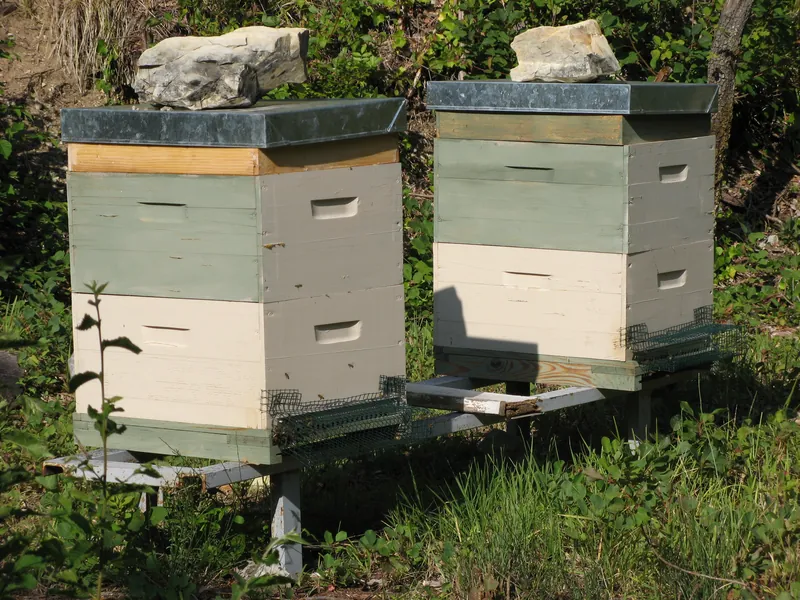
This is the most useful single step, because a few guards can hold a narrow gap. OSU advises cutting an entrance under attack down to 1 to 2 inches. Burlew’s rule is to reduce each entrance, as soon as nectar gets scarce, to what the colony can defend. A big, busy colony needs no restriction, while a small one may need its entrance cut to one bee length. See our guide to entrance reducer sizes.
- Close every other opening. Upper entrances, notched inner covers, gaps between warped boxes and cracked woodenware all count. A guard force cannot hold two fronts.
- Add a robbing screen to weak colonies. A robbing screen moves the working entrance up and away from where the hive smells of honey. OSU notes it lets resident bees through while excluding yellow jackets. An entrance tunnel does a similar job on small colonies.
Keep Colonies Strong and the Apiary Clean
Yellow jackets pick on small and weak colonies, and OSU’s first line of prevention is simply to have fewer of them going into fall.
- Combine weak colonies before they fail. A colony covering only a few frames going into the dearth is a target. See how to combine two weak colonies.
- Control varroa. High mite loads shrink the fall population and the guard force with it. Get a real count with an alcohol wash or sugar roll.
- Feed inside the hive, late in the day. OSU advises pouring syrup carefully and cleaning up spills immediately. Our guide to feeding without causing robbing covers feeder choice.
- Take debris away. OSU says wax scrapings and material cleaned from frames, feeders and bottom boards should go off site, especially when they contain brood or dead bees. Remove rotting fruit and food waste nearby too.
- Keep inspections short in a dearth. Every open box and exposed frame is an invitation to robbers and wasps.
Trap With the Right Bait, or Not at All
Traps are where most advice goes wrong. Popular guides and videos suggest sugar water, juice or even open-feeding syrup away from the hives to draw wasps off. Those baits also attract honey bees, especially in a dearth. OSU is explicit that if you build your own trap, “it is important to avoid using sugary attractants as they could inadvertently attract bees.” We found no trial showing that adding vinegar keeps bees out of a sugar bait, so treat it as a sweet bait.
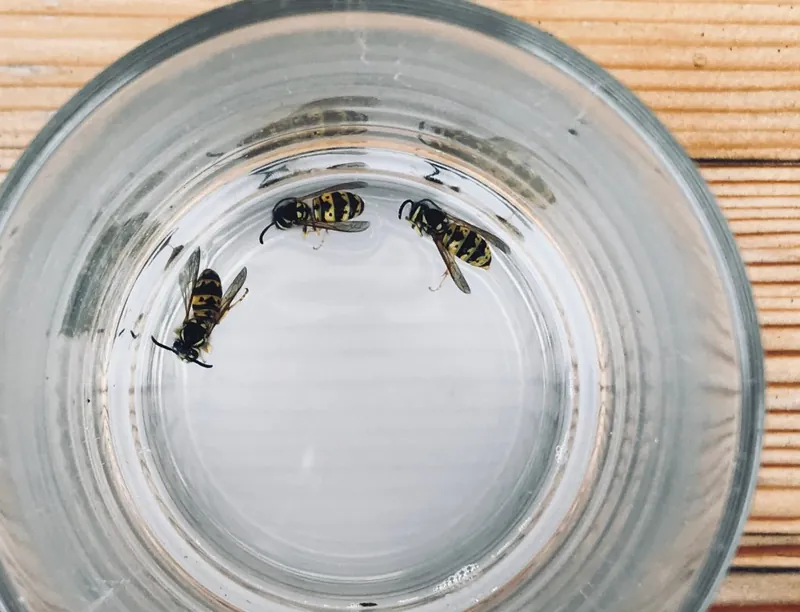
Protein baits avoid that problem, because honey bees get all their protein from pollen. The catch is timing. UC says protein water traps work best as queen traps in late winter to early spring, and in summer and fall usually do not bring numbers down enough. OSU adds that meat spoils within hours, and that in one California study, catching queens in spring did not reduce the workers trapped later.
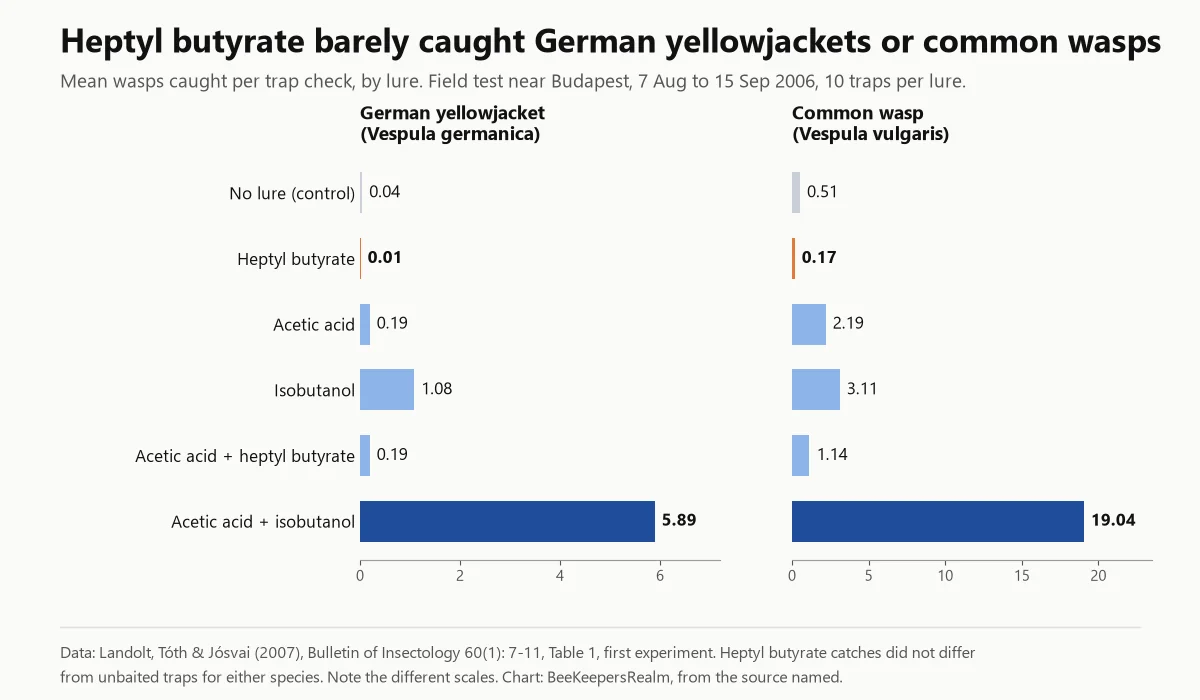
With commercial chemical lures, the species matters. The most common trap lure, heptyl butyrate, “attracts primarily the western yellowjacket and not other species,” according to UC. In Michigan field trials published in 2002, H. C. Reed and Peter Landolt found that the eastern yellowjacket and its close relatives responded mainly to a blend of acetic acid and isobutanol. Heptyl butyrate drew a different set of three yellowjacket species, the Vespula rufa group. A later test in Hungary by Landolt and colleagues found that heptyl butyrate caught no more German yellowjackets or common wasps than an empty trap.
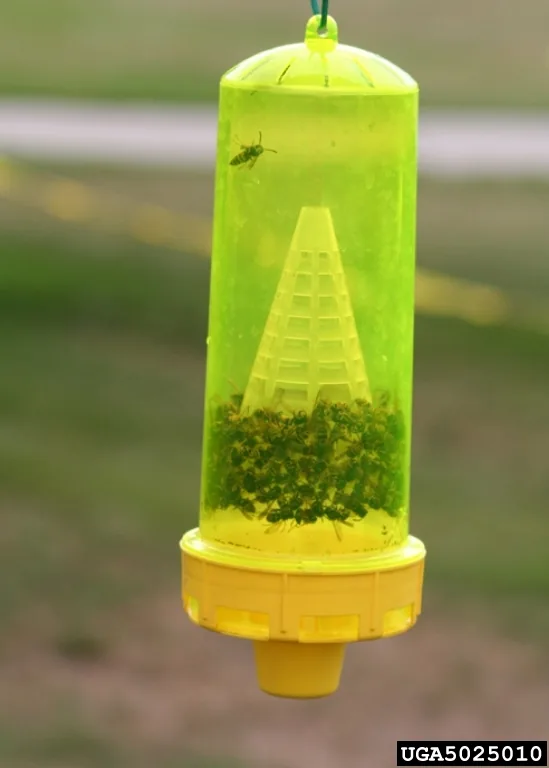
Where the lure does match, it is remarkably selective. In a 2009 mass-trapping trial at the Pacific National Exhibition in Vancouver, published by J. H. Borden and colleagues in 2025, 70 heptyl butyrate bag traps caught 44,489 yellowjackets in four weeks, 98.6% of them western yellowjackets. They caught six honey bees.
| Bait | What it catches best | When it works | Risk to honey bees |
|---|---|---|---|
| Sugar water, juice, soda, fruit, syrup | Many wasps, especially late in the season | Late summer and fall | High. Keep it out of the apiary. |
| Raw meat, fish, pet food over soapy water | Many yellow jackets; UC says meat is believed to improve German yellowjacket catches | Best for queens in spring; spoils within hours | Low. Honey bees do not collect meat. |
| Heptyl butyrate lure | Western yellowjacket; also the southern yellowjacket and the Vespula rufa group | Best for queens in spring; later it thins workers only locally | Very low. Six bees among 44,489 wasps in one trial. |
| Acetic acid plus isobutanol | German and eastern yellowjackets and their relatives; bald-faced hornets | Tested in summer and fall field trials | Not measured in the studies we reviewed |
So read the label. A lure listing heptyl butyrate alone is tuned to the western yellowjacket; for eastern or German yellowjackets, expect a poor catch. Without a matched lure, early-season protein bait is the fallback that will not draw your bees. Wherever you trap:
- Hang traps low and at least 20 feet from the hives, so wasps drawn to the trap do not discover the colonies (OSU).
- Keep expectations modest. OSU notes that casual trapping rarely reduces the population enough to relieve the hives.
- Never make your own poison bait. OSU states that baiting yellow jackets with any chemical other than a labeled bait product violates state and federal pesticide law. The one product it names, microencapsulated esfenvalerate, gives variable results, and UC says such products have not proven effective in trials.
When Entrance Defense Fails
Sometimes a reduced entrance is not enough. Signs that a colony is losing:
- Yellow jackets walking in and out of the entrance without being grabbed
- Few or no guards on the landing board on a warm afternoon
- Wasps leaving with bits of larvae or bees
OSU is blunt about this stage.
“Halting a full-fledged yellowjacket attack may be difficult.”
Its emergency steps are to cut the entrance to 1 to 2 inches, run a lawn sprinkler next to the hive to discourage flight, and consider moving the colony to an apiary with less yellow jacket pressure. Then work out why the colony failed. A queenless, mite-damaged or tiny colony will not recover in a fall dearth; combining it with a strong one saves the remaining bees and stores. If a colony has already been emptied, remove the equipment so it stops feeding wasps and robbers.
Timing your checks helps, as beekeeper Frederick Dunn shows in the video below.
In this September 2023 video, Dunn checks his landing boards on a cold fall morning and finds yellow jackets entering one hive. He says the wasps can fly in colder weather than the bees can, so a hive that looks fine at midday can be raided in the early morning. His fix is to reduce the entrance, then keep watching to confirm the bees are holding it. If they are not, he inspects during the warm part of the day, because a colony that has stopped defending may be queenless or have brood problems, and he combines weak colonies with stronger ones.
Dealing With Nearby Nests
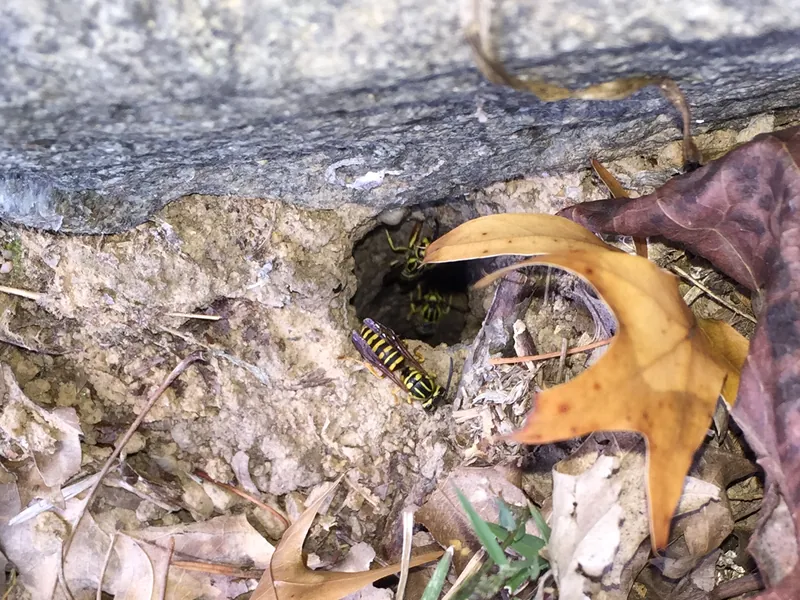
OSU says yellow jackets usually forage within about 1,100 feet of their nest, so the nest is often findable: follow a wasp dusted with flour or powdered sugar. UC notes that many nest in old rodent burrows, though some use wall or ceiling voids.
OSU recommends considering a professional first, since a late-season nest holds thousands of defensive wasps, and UC warns that stings are likely even at night. If you treat it yourself, work at night, wear protective gear, and use only a product labeled for yellow jacket nests, exactly as the label says. Many such products are highly toxic to bees, so keep them away from hives and flowers bees are working. OSU also notes that some areas have venom collectors who will remove nests; ask your local Extension office.
In parts of the Southeast, the attacker may instead be the invasive yellow-legged hornet, which hovers at entrances to catch bees in flight. See our page on the yellow-legged hornet in the U.S. and report any sighting.
Frequently Asked Questions
How do I keep yellow jackets away from my beehive?
Reduce the entrance to what the colony can guard, close other gaps, and fit robbing screens on weak colonies. Keep colonies strong and the apiary free of spilled syrup and comb.
What kills yellow jackets but not honey bees?
Traps baited with meat, fish or a lure matched to your yellow jacket species. In one Vancouver trial, heptyl butyrate traps caught 44,489 yellowjackets and six honey bees.
Do yellow jackets harm honey bees?
Yes. They catch bees at the entrance and raid hives for honey and brood in late summer and fall. Strong colonies usually cope; weak ones can be emptied.
Do yellow jacket traps attract honey bees?
Sweet traps do, which is why Oregon State University advises against sugary attractants. Protein baits and heptyl butyrate lures catch almost none.
Why isn’t my yellow jacket trap catching anything?
The lure may not match your species. Heptyl butyrate attracts mainly western yellowjackets; in Michigan trials, eastern yellowjackets responded to acetic acid plus isobutanol instead.
Will a robbing screen stop yellow jackets?
It helps. OSU notes that robbing screens let resident bees through while excluding yellow jackets. Pair one with a reduced entrance and a strong colony.
What do yellow jackets hate the most?
We found no field trial showing that a scent or spray keeps yellow jackets off a hive. What does stop them is a narrow entrance packed with guard bees.
When do yellow jackets go away?
After hard frosts. In most of North America the workers and nests die in fall, and only newly mated queens survive to start new nests in spring.
The Bottom Line
Yellow jackets beat weak colonies with wide entrances in a fall dearth. Take those conditions away: narrow the entrances, combine small colonies, keep sugar and comb out of reach, and trap only with protein or a species-matched lure, away from the bees. Then check landing boards on cold mornings until frost ends the season.


