Reviewed by Michael R. · How we review
The honey badger (Mellivora capensis), also called the ratel, is a stocky, long-clawed member of the weasel family that lives across sub-Saharan Africa, the Middle East and South Asia. Adults weigh about 5.5 to 14 kilograms (12 to 31 pounds), the IUCN rates the species Least Concern, and it raids bee nests mainly for the brood rather than the honey. It resists some snake venoms but is not proven immune, and no biologist has confirmed that a honeyguide bird leads it to hives.
This guide comes from the beekeeper’s side, beside our page on bee pests and predators. Every figure is from a named source, and where sources disagree we say so.
Key Takeaways
- The honey badger is the only living member of its genus. Males weigh about 9 to 14 kg and females 5.5 to 10 kg, and the IUCN lists it in about 60 countries as Least Concern, with a decreasing trend.
- It eats mostly small mammals, reptiles and snakes. In the best-studied Kalahari population, solitary bee larvae were 1.2% of the food eaten by weight.
- Defending bees chased badgers off on 61% of 37 recorded hive visits in that study. Thick, loose skin protects a badger, but it is not sting-proof.
- Badgers wreck hives: 11.25% of hives in one Tanzanian year, and a South African survey found damage fell from 21.8% to 6% once hives were protected.
- Honeyguides do lead people to bees’ nests, which is documented. A review of the literature and 394 honey-hunter interviews found no convincing evidence that they guide honey badgers.
- A 2015 study explains how honey badgers resist snake nerve toxins. Resistance is not the same as immunity.
Table of Contents
- What Is a Honey Badger? Names, Family and Size
- Where Honey Badgers Live: Range and Status
- What Honey Badgers Eat
- How Honey Badgers Raid Beehives
- How Much Damage Honey Badgers Do
- Badger-Friendly Beekeeping: What Works
- The Honeyguide Myth
- Snake Venom: Resistant, Not Immune
- Honey Badger Claims Checked
- Honey Badger vs American Badger
- Frequently Asked Questions
- The Bottom Line
What Is a Honey Badger? Names, Family and Size
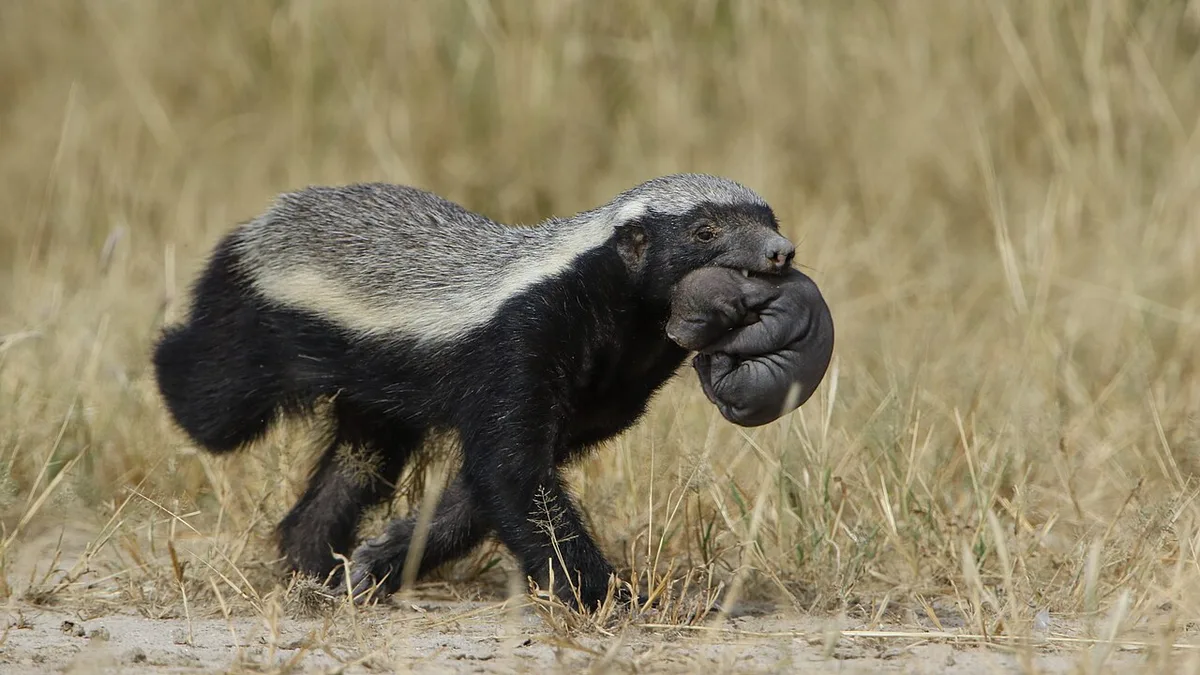
The honey badger is the only living species in the genus Mellivora and in its subfamily, Mellivorinae, within the weasel family (Mustelidae). Mellivora comes from the Latin for honey and devour, according to a report by wildlife researcher Keith Begg, and “ratel” is the other common name. It has a broad, flattened back, short strong legs, front claws that can reach 40 mm, and a black body with a grey-white mantle from crown to tail. Its skin is thick and loose, which the San Diego Zoo Wildlife Alliance says lets a badger twist round and bite an animal gripping its neck.
| Honey badger at a glance | Figure | Source |
|---|---|---|
| Scientific name | Mellivora capensis; also honey badger, ratel | IUCN Red List |
| Body and tail | Body 50 to 64 cm, tail 16 to 23 cm | Fact file, honeybadger.com (Begg research site) |
| Shoulder height | 23 to 30 cm | Same fact file |
| Weight, males | 9 to 14 kg (20 to 31 lb) | Same fact file |
| Weight, females | 5.5 to 10 kg (12 to 22 lb) | Same fact file |
| Lifespan | Estimated 5 to 8 years in the wild; up to 24 to 26 in zoos | honeybadger.com; San Diego Zoo Wildlife Alliance |
| Young | Usually one cub after a gestation of at most 50 to 70 days; cubs take 12 to 16 months to become independent | Begg et al. 2005, Journal of Zoology 265 |
| Conservation status | Least Concern (assessed 2015, published 2016); trend decreasing | IUCN Red List |
Published sizes vary. The African Wildlife Foundation gives 8 to 12 kg for the species, and National Geographic gives 13 to 30 pounds. Males are the larger sex: the South African Red List assessment puts them at least one-third larger than females.
Where Honey Badgers Live: Range and Status
The IUCN Red List records the species as native to about 60 countries and territories. They run across sub-Saharan Africa, through the Arabian Peninsula and Iran, into Turkmenistan, Uzbekistan and Kazakhstan, and east to Pakistan, India and Nepal. The habitats are forest, savanna, shrubland and desert, from sea level to about 4,000 m. Honey badgers do not live in the Americas or Europe, so there are no wild ones in the United States.

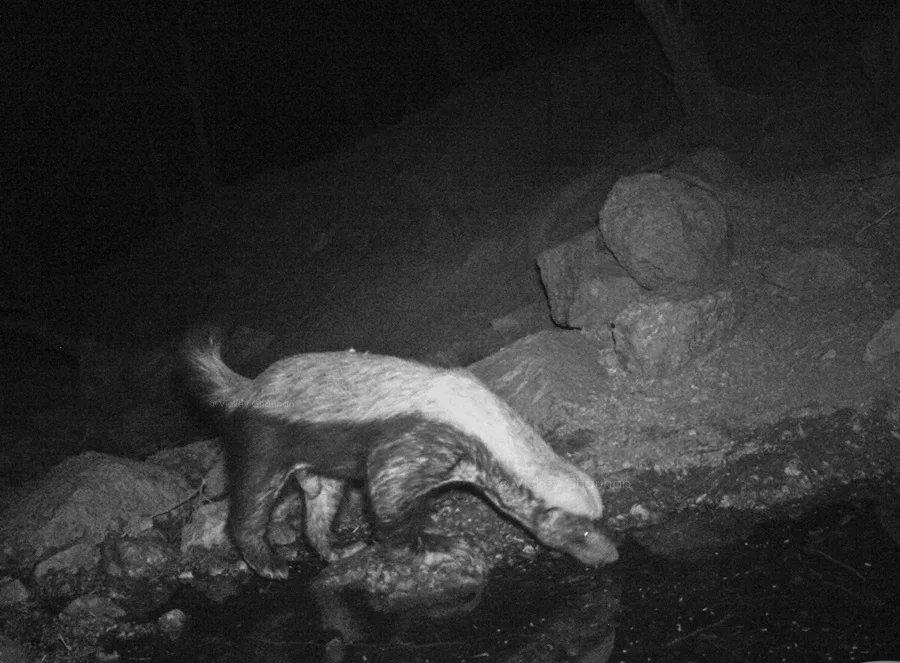
The IUCN’s 2015 assessment, published in 2016, rates the species Least Concern but lists the population trend as decreasing, with hunting and trapping as the recorded threat. South Africa’s regional assessment moved the species from Near Threatened in 2004 to Least Concern in 2016, while noting that persecution over beehive damage continues locally.
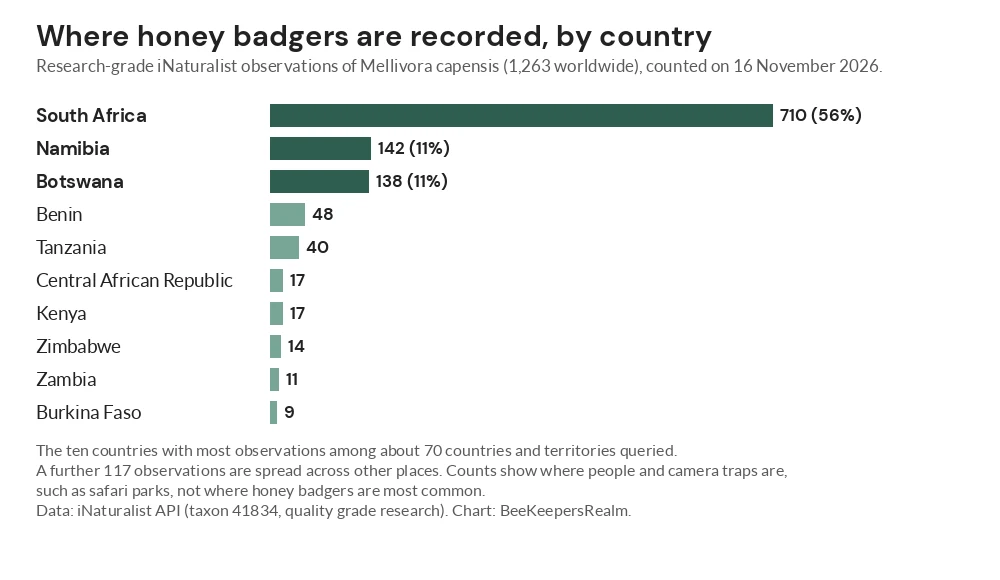
For a rough picture of where people actually see them, we counted research-grade iNaturalist observations for the species. South Africa alone has 56% of the 1,263 worldwide.
What Honey Badgers Eat
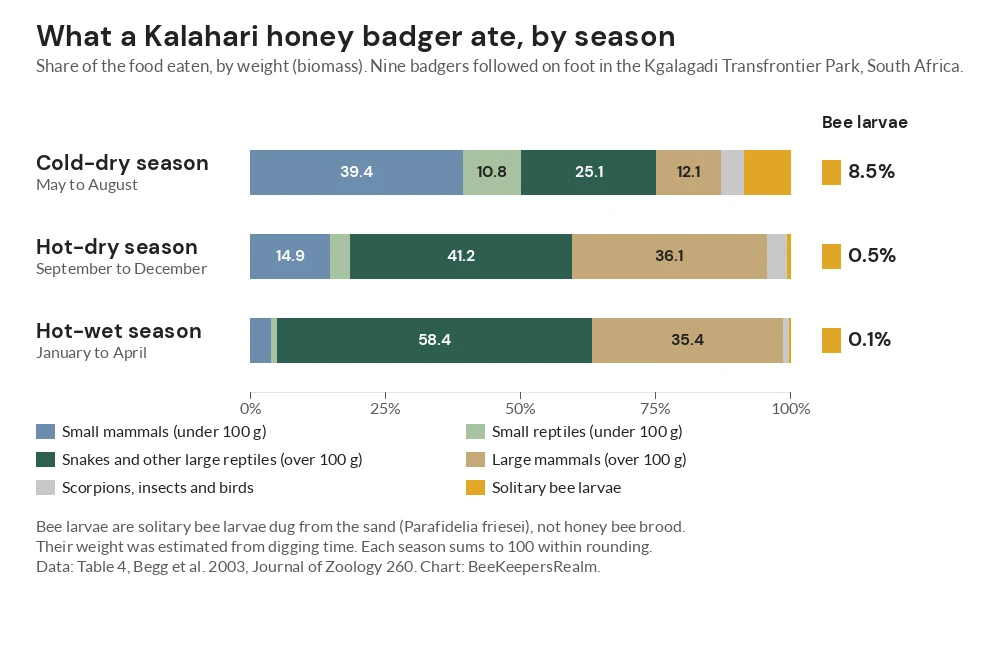
Honey badgers are generalist predators that dig out most of what they eat. The most detailed study followed nine habituated animals, five females and four males, in the Kgalagadi Transfrontier Park and recorded 3,324 food items, covering 59 species (Begg et al. 2003, Journal of Zoology 260). By weight, four species supplied 67% of the food: springhare (22.2%), mole snake (21.4%), puff adder (12.5%) and Cape cobra (10.5%).
The mix shifted with the seasons. In the hot-wet months, large snakes alone made up 58% of what was eaten by weight. In the cold-dry months, small mammals supplied 39%. The only plant food was the tsama melon, which the authors say was eaten mainly for its water.
Do Honey Badgers Actually Eat Honey?
Yes, when they find it, but the prize is the brood. Honey bee brood is the eggs, larvae and pupae described in our guide to how honeybee brood develops. The Begg research site says bee brood is not a necessary part of the diet, although badgers go to great lengths to reach it. In the Kalahari, solitary bee larvae dug from the sand were 1.2% of the overall weight eaten, about 3,000 larvae, and they peaked at 8.5% in the cold-dry season. Raids on honey bee hives were a small, separate record there. An older stomach study from Zimbabwe and Botswana, cited in Begg’s 2001 report, found brood in 14% of the food items in seven badgers.
How Honey Badgers Raid Beehives
African honey bees nest in ground cavities, rock crevices and tree hollows, and badgers have been recorded digging hives out from tree roots and limestone crevices. They climb too: adults are competent climbers and have broken into hives high in trees. The bees involved are African honey bees, Apis mellifera scutellata, the parent of the Africanized bees covered in our guides to Africanized versus European honey bees and how to identify Africanized bees.
At managed hives the pattern is destructive. Badgers typically roll a hive over and rip the lid or box from the brood chamber, especially where the wood has rotted. They tend to return to the same hive over several days until the brood is gone, and the colony weakens each day. Keith Begg’s report calls the raiding of domestic hives a learned behaviour.
Bees do fight back. In the Kalahari study, two badgers, a female and her large cub, broke into 13 hives over 37 visits, and the swarm’s defence was enough to chase the badgers off on 61% of the visits. Our guide to how honeybees defend the colony covers the alarm pheromone and heat balling behind that defence.
Stings, skin and the gland myth
The skin is thick and loose, the hair coarse and the fat layer deep, and badgers are often called sting-proof. Begg’s report found a more careful picture: a female at Mana Pools in Zimbabwe showed no concern for the bees during the 21 minutes she took to break into a hive, yet other badgers backed away from defensive colonies, and there are records of badgers stung to death in apiary traps. For how a honeybee sting compares with other insects, see the Schmidt sting pain index.
The report also tested a popular claim. Badgers are said to fumigate hives with anal-gland scent or sweep bees away with the tail, and the African Wildlife Foundation’s ratel page describes the gland fumigation as fact. Researchers saw badgers visit hives at least 41 times in the southern Kalahari and never saw either behaviour.
How Much Damage Honey Badgers Do
Apart from people, honey badgers are considered the most destructive mammal predators of honey bees in Africa, and one can destroy more than 20 hives in a night, according to sources cited by Begg. In Tanzania, 2,700 of 24,000 hives (11.25%) were damaged in a single year despite the precautions of traditional beekeepers.
The best South African figures come from Begg’s 2001 survey of 82 beekeepers, 50 of them in the Western Cape with more than 24,000 hives (full report). Of the Western Cape group, 82% reported badger problems, and half of those admitted killing badgers despite the species’ legal protection. Beekeepers who did nothing kept losing 10% to 75% of their hives. Those who protected them saw damage fall from 21.8% to 6%.
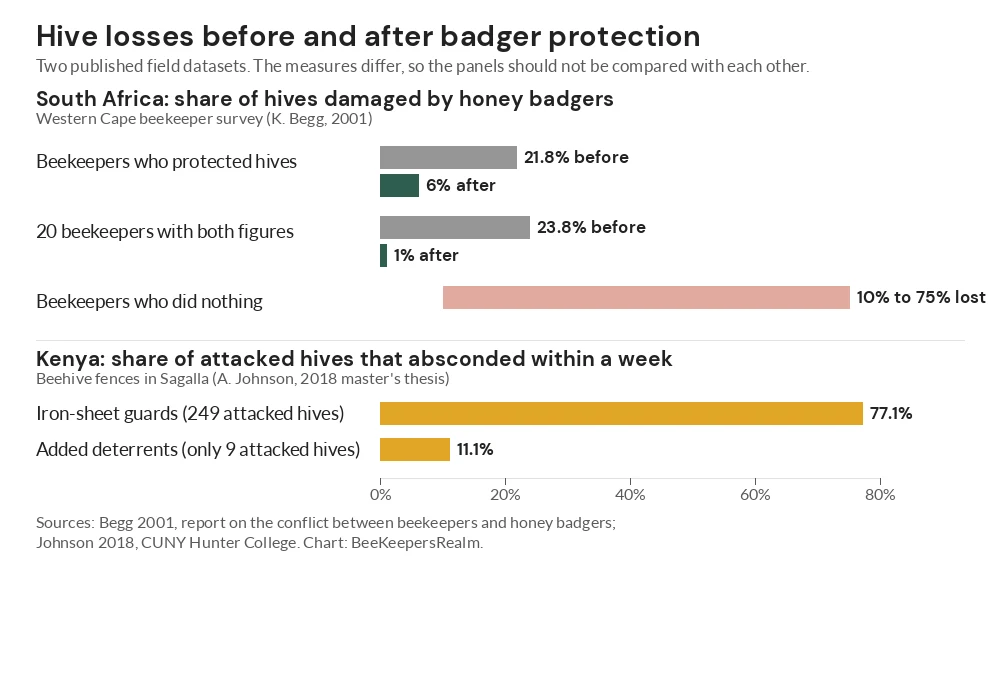
A 2018 master’s thesis at Hunter College, City University of New York, tested deterrents at beehive fences in Sagalla, Kenya. Before the study, 77.1% of the 249 hives a badger attacked absconded within a week. After a motion-activated light, a cone baffle and a hive cage were added, 11.1% did, but that rests on only nine attacked hives. Our guide to Kenyan beehive fences against elephants explains why those hives matter.
North American beekeepers face bears, raccoons and skunks instead, and our guide to protecting hives from bears and raccoons also starts with raised, secured hives.
Badger-Friendly Beekeeping: What Works
Begg’s survey sorted successful protection into two groups: strengthen the hive, or lift it off the ground. Stands and trestles were the more popular choice, used by 81% of the beekeepers surveyed. Typical heights were 0.8 to 1.5 m, and the stand had to be secure with the hive fastened to it. A badger can often reach a hive by standing on its hind legs, but it lacked the leverage to topple a properly secured one.

- Fasten the hive. Three screws across each box joint, with a short wire wrapped round the heads, cost about 1 rand per hive in 2001. Pegging the hive to the ground cost about 7 rand.
- Raise it. Protection overall ranged from 3 to 150 rand per hive, and stands, the dearest option, averaged 37 rand among 19 beekeepers. For general stand heights, see our guide to ideal hive stand height.
- Suspend it. Traditional African beekeepers hang log and basket hives in the upper branches of tall trees, and wire suspension from trees has worked in Tanzania. Our guide to Ethiopian beekeeping describes hives hung from branches or set on simple stands.
The Endangered Wildlife Trust launched a badger-friendly initiative in 2002 with the South African Bee Industry Organization and the Wildlife and Environmental Society of South Africa. Beekeepers who sign a public declaration may label their honey badger-friendly, and an extension officer monitors compliance. A 2017 review counted more than 320 subscribed beekeepers. The San Diego Zoo Wildlife Alliance reports that many African beekeepers now sell “badger-friendly honey”. Begg’s report adds that in Europe, electric fencing has proved the most effective way to deter European badgers, while repellents were of little use.
The Honeyguide Myth
The greater honeyguide (Indicator indicator) is a real partner for people. In a Science experiment in Mozambique, Spottiswoode, Begg and Begg showed that a special call made by honey-hunters raised the chance of being guided from about 33% to 66%, and the chance of finding a bees’ nest from 17% to 54%.
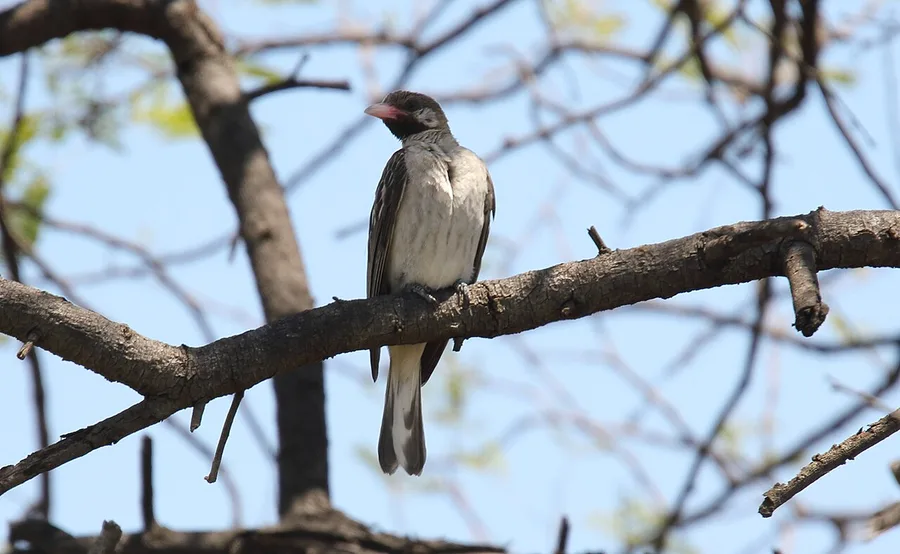
The claim that the bird also leads honey badgers is much weaker. It goes back to accounts collected by the naturalist Anders Sparrman in the 1780s. In 1990, three ornithologists, Dean, Siegfried and MacDonald, challenged it:
“Naturalists and biologists have been active in Africa for more than 200 years. During this period, to the best of our knowledge, no biologist or naturalist, amateur or professional, has observed a Greater Honeyguide leading a Honey Badger to a beehive.”
Claire Spottiswoode, the honeyguide researcher, told Yong that a YouTube clip of a honeyguide seemingly guiding a badger was a set-up with a stuffed bird and a tame badger. The newest evidence is a 2023 review in the Journal of Zoology by 26 authors, including both Beggs. They combed the literature, added their own field observations and conducted 394 interviews with honey-hunters in 11 communities across nine African countries (van der Wal et al. 2023).
“We find that the scientific evidence relies on incomplete and second-hand accounts and does not convincingly indicate that the two species cooperate.”
Most honey-hunters interviewed were doubtful too, but many in the Hadzabe, Maasai and mixed communities in Tanzania said they had seen the two interact. The authors conclude it may happen but be highly localized or hard to observe. In Niassa, Mozambique, where both animals are common, a honeyguide was seen with a badger only once, and Begg’s team suggests the bird may be following the badger rather than leading it. Reference pages still disagree: the African Wildlife Foundation and the University of Michigan’s Animal Diversity Web describe the partnership as established, while IFAW notes the lack of evidence.
Snake Venom: Resistant, Not Immune
Honey badgers eat venomous snakes, and the diet study lists puff adders and Cape cobras among the top prey by weight. In 2015, Drabeck, Dean and Jansa compared mammal sequences of the muscle nicotinic acetylcholine receptor, the target of snake alpha-neurotoxins (Toxicon 99). Honey badgers, hedgehogs and pigs had independently gained amino acid replacements that put a positively charged residue where an uncharged one normally sits, which impedes toxin binding. Mongooses use different replacements that carry sugar attachments, thought to block binding. The authors count at least four origins of resistance and two biochemical mechanisms.
That is a sequence analysis of one receptor and one toxin family, not a claim that every venom component is blocked. Researcher Colleen Begg described one case in a BBC Wildlife Q&A republished by Discover Wildlife:
“I encountered one individual that was bitten on the face by a puff adder. Despite a large swelling on his cheek, he was up and chasing snakes again just five hours later.”
The swelling shows the bite did harm, and recovery in five hours shows strong tolerance. “Resistant” fits the evidence better than “immune”.
Honey Badger Claims Checked
| Claim | What the evidence says | Source |
|---|---|---|
| Honey badgers are immune to snake venom | Receptor changes reduce alpha-neurotoxin binding; a bitten badger swelled and recovered in about five hours. Resistant, not proven immune. | Drabeck et al. 2015; C. Begg in Discover Wildlife |
| They are immune to bee stings | Thick, loose skin helps, but badgers retreated from defensive colonies on 61% of recorded visits and some were stung to death in traps. | Begg et al. 2003; Begg 2001 |
| They live mostly on honey | No. Small mammals and snakes dominate by weight, and solitary bee larvae were 1.2% in the Kalahari. | Begg et al. 2003 |
| A honeyguide leads them to hives | Unconfirmed. The 2023 review found no convincing evidence of cooperation. | van der Wal et al. 2023; Dean et al. 1990 |
| A honeyguide leads people to hives | Documented. A honey-hunter call raised guiding odds from about 33% to 66% in Mozambique. | Spottiswoode et al. 2016, Science |
| They fumigate hives with gland scent | Not seen in at least 41 hive visits in the Kalahari. | Begg 2001 |
| They cannot climb | Adults are competent climbers and have broken into hives in trees. | Begg 2001; San Diego Zoo Wildlife Alliance |
| They are “the most fearless animal in the world” | A Guinness World Records title in the 2002 edition. IFAW says honey badgers cannot and do not kill lions, and are preyed on by them. | SANBI; IFAW |
Honey Badger vs American Badger
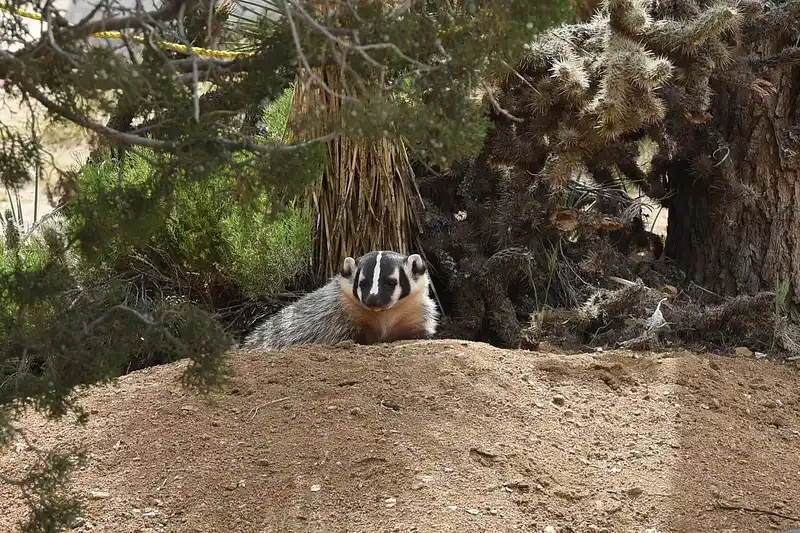
US readers often wonder if the honey badger is just a tropical American badger. It is not: the two belong to different genera and subfamilies of the weasel family. The American badger (Taxidea taxus) lives on North America’s open grasslands, while the honey badger lives only in Africa and Asia.
| Honey badger | American badger | |
|---|---|---|
| Scientific name | Mellivora capensis | Taxidea taxus |
| Subfamily | Mellivorinae | Taxidiinae |
| Range | Africa, Arabian Peninsula, Central and South Asia | Great Plains and the western US, central Canada, Mexico |
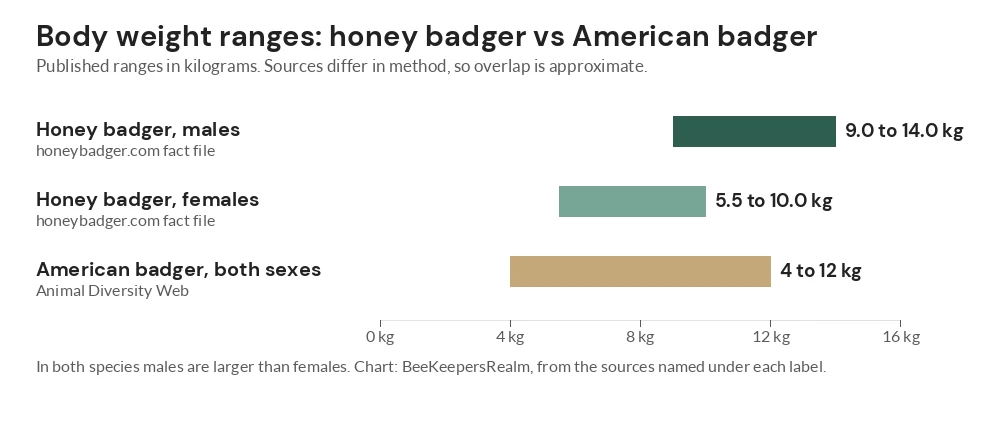
| Weight | 5.5 to 14 kg | 4 to 12 kg |
| Diet | Small mammals, reptiles and snakes, plus insects, eggs and bee brood | Pocket gophers, ground squirrels and other burrowing rodents; some bees and honeycomb |
| IUCN status | Least Concern (decreasing) | Least Concern |
Sources: Mustelidae classification (Wikipedia, after Law et al. 2018); Animal Diversity Web (University of Michigan) for the American badger; honeybadger.com and the IUCN for the honey badger.
They do share habits. Both catch much of their food by digging, and the 2003 Kalahari study notes that the honey badger’s mostly carnivorous diet resembles the American badger’s, unlike the plant-eating European badger.
Frequently Asked Questions
Do honey badgers eat honey?
Yes, when they find it, but they raid nests mainly for the bee brood. In the Kalahari study, solitary bee larvae were 1.2% of the food by weight.
Are honey badgers immune to snake venom?
No. A 2015 study found receptor changes that reduce snake nerve-toxin binding, so they are resistant. One badger bitten by a puff adder swelled but was hunting again about five hours later.
How big is a honey badger?
Males weigh about 9 to 14 kg and females 5.5 to 10 kg, with a body of 50 to 64 cm and a shoulder height of 23 to 30 cm. Males are at least one-third larger than females.
Where do honey badgers live?
In about 60 countries across sub-Saharan Africa, the Middle East, Central Asia and the Indian subcontinent. There are no wild honey badgers in North America.
Does a honeyguide lead honey badgers to bees’ nests?
That is unconfirmed. Honeyguides do lead people, but a 2023 review of the evidence and 394 honey-hunter interviews found no convincing proof that they lead honey badgers.
Can honey badgers kill lions?
No. IFAW says they cannot and do not. A cornered badger tries to scare a predator off, and lions do prey on honey badgers.
How long do honey badgers live?
Estimates for the wild are about 5 to 8 years, and zoo animals have reached 24 to 26 years.
Are honey badgers endangered?
The IUCN rates them Least Concern, though the trend is listed as decreasing, and they are persecuted in places over beehive damage.
The Bottom Line
The honey badger is a widespread, generalist hunter whose reputation outruns the evidence, and the practical lesson for beekeepers is simple: a fastened hive on a secure stand beats a dead badger.
Image credits: honey badger carrying a cub in the Kgalagadi park (featured photo) by Derek Keats, CC BY 2.0; Gujarat camera-trap photo by Vickey Chauhan, CC BY-SA 4.0; greater honeyguide by Dominic Sherony, CC BY-SA 2.0; Kenyan hives by treesftf, CC BY 2.0; American badger by the National Park Service, public domain; range map by Oona Räisänen and IUCN, CC BY-SA 3.0. All via Wikimedia Commons, resized. Charts by BeeKeepersRealm.