Reviewed by Elena P. · How we review
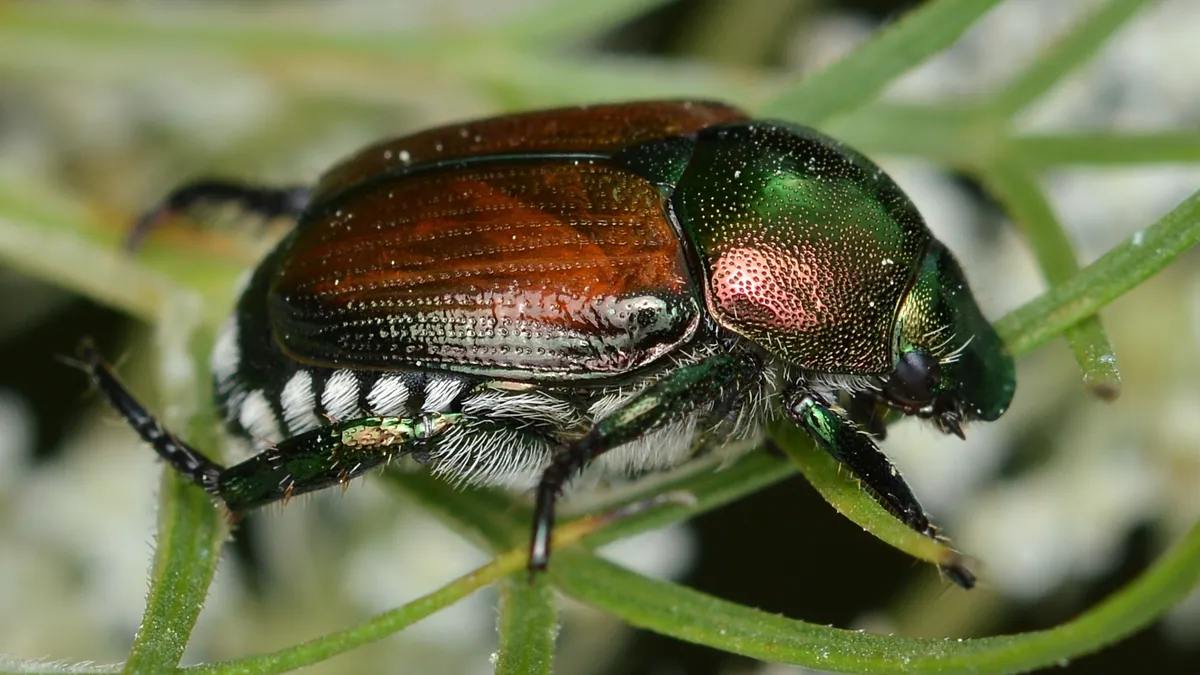
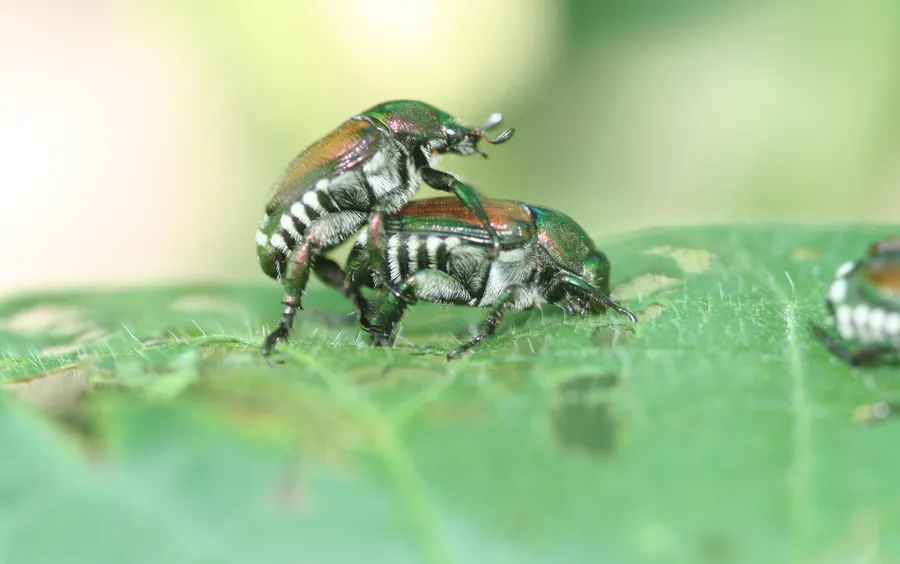
The Japanese beetle (Popillia japonica) is an invasive scarab beetle about 3/8 to 1/2 inch long, with a metallic green head, copper-brown wing covers and five white hair tufts on each side of its abdomen. Adults eat the leaves, flowers and fruit of more than 300 plant species from late June through August, while the white grubs eat lawn roots underground. Extension programs say traps usually make damage worse, and that hand-picking, covers on plants not in bloom and less-preferred plants are safer for bees than most sprays.
Every fact below is credited to a named university or federal agency; the observation counts are our own pull of iNaturalist records. We make no claim of first-hand experience with Japanese beetles, and the pesticide notes are general information, not label instructions: the label is the law.
Key Takeaways
- The white hair tufts are the identifying mark: five on each side of the abdomen plus two at the tip (University of Minnesota Extension, UMN).
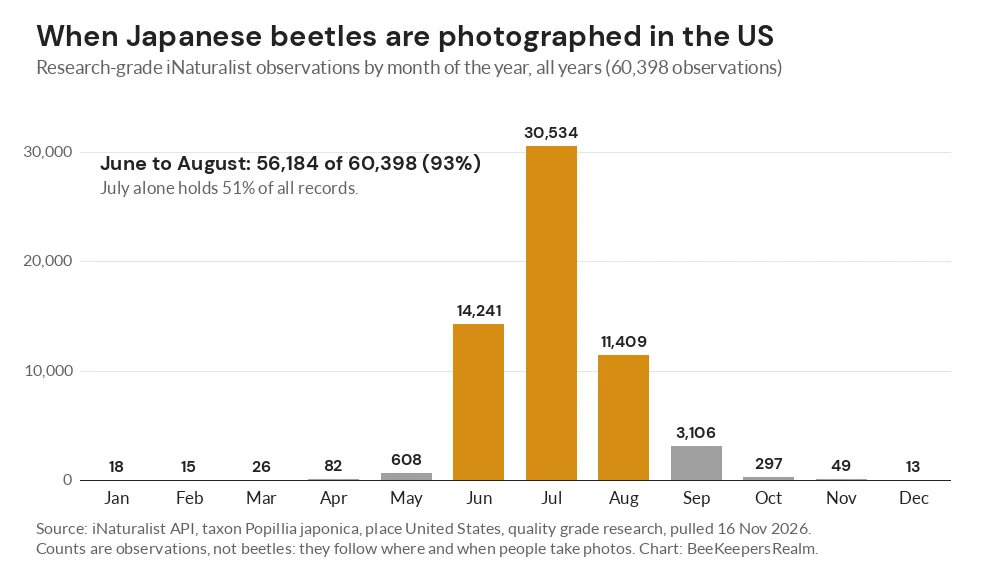
- Adults emerge in late June or early July and live about 30 to 45 days (University of Kentucky, UKy). In our iNaturalist pull, 93% of US observations fall in June to August.
- The host range is more than 300 plants (UMN, USDA APHIS), led by rose, grape, linden, apple, birch and raspberry. Damage on healthy mature plants is usually cosmetic.
- Do not buy traps. UMN says they attract more beetles than they catch, and UKy research found the same.
- Hand-pick into soapy water, net plants not in bloom, and choose less-preferred plants. Lawn grub control does not reduce adults on shrubs.
- Milky spore has shown no benefit in modern university trials (UMN) and under 5% effect where long established (Colorado State).
- Imidacloprid and dinotefuran are very toxic to pollinators (UMN). Linden blooms in July, when beetle damage peaks, so never apply them to a tree in bloom.
Table of Contents
- What Does a Japanese Beetle Look Like?
- Japanese Beetle Look-Alikes
- Life Cycle and Timing
- What Japanese Beetles Eat and the Damage They Do
- Grub Damage in Lawns
- When and Where They Are Recorded in the US
- Do Japanese Beetle Traps Work?
- How to Control Adults Without Harming Bees
- Grub Control: Milky Spore, Nematodes and Timing
- Natural Enemies: Tiphia Wasps and the Winsome Fly
- Bees, Pollinators and Japanese Beetle Sprays
- Frequently Asked Questions
- Sources
What Does a Japanese Beetle Look Like?
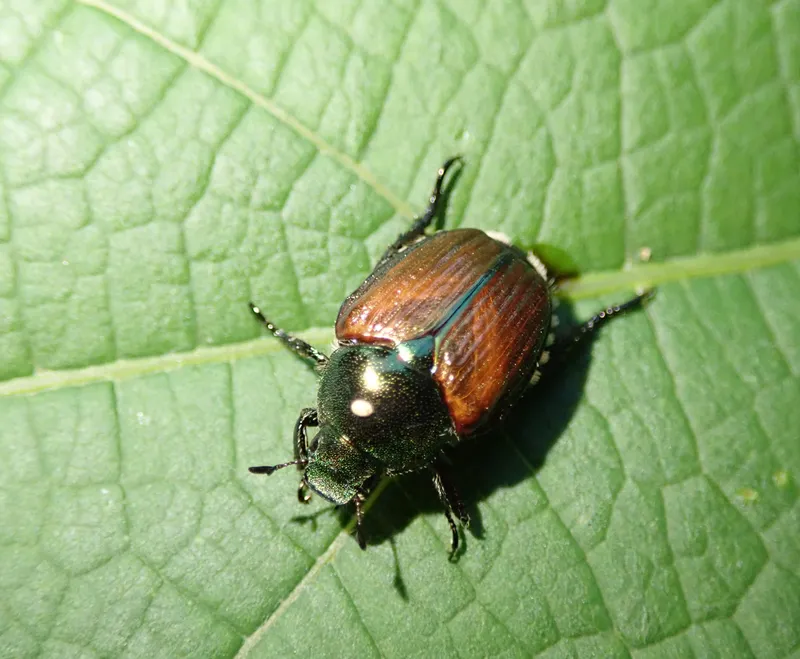
UMN describes adults as one-third to one-half inch long, with a metallic green head and thorax, copper-brown wing covers, five patches of white hair on each side of the abdomen and two at its tip. Colorado State University (CSU) Extension adds that the wing covers stop short of the abdomen tip. The Oregon Department of Agriculture lists a body length of 0.4 to 0.6 inch (10 to 15 mm) and says a suspect insect is unlikely to be one if its size and marks do not all match.
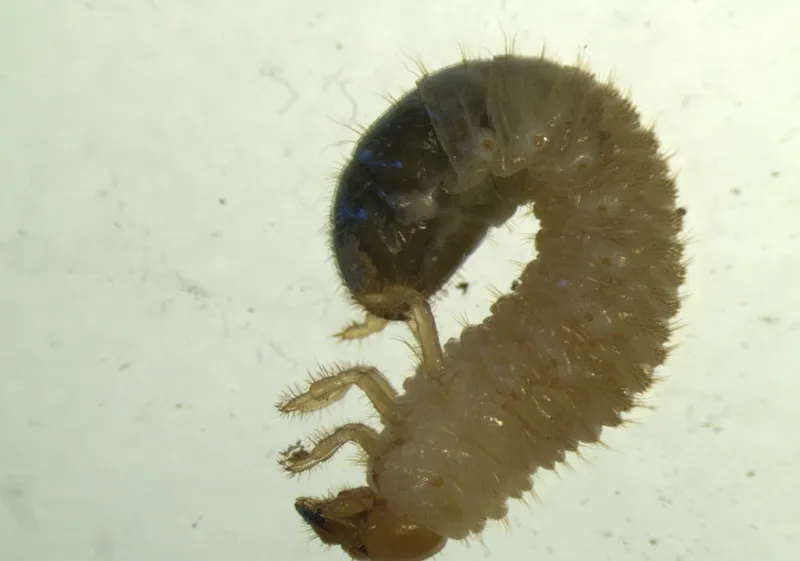
The grubs are C-shaped, white to cream with a tan head, from 1/8 inch to about 1 inch (UMN). They look like other lawn grubs. CSU says the sure sign is a V-shaped pattern of hairs under the tip of the abdomen, which takes a 10x hand lens to see.
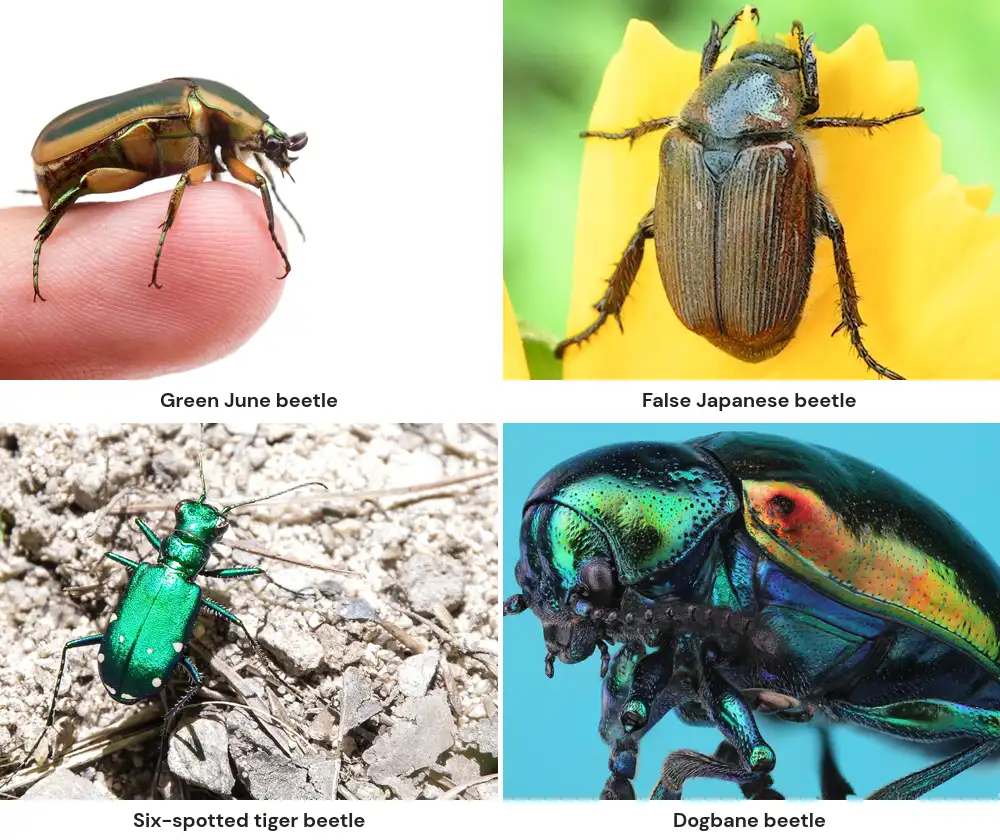
Japanese Beetle Look-Alikes
Check for the white tufts first. Several green or copper beetles get reported as Japanese beetles, and most are harmless or helpful.
| Beetle | Key marks | Harmful? | Source |
|---|---|---|---|
| Japanese beetle (Popillia japonica) | Metallic green head and thorax, copper-brown wing covers, five white tufts per side | Yes: adults skeletonize leaves, grubs eat roots | UMN |
| Green June beetle (Cotinis nitida) | Larger, 3/4 to 1 inch; velvety green to dull brown, shiny green or gold underside, small flat horn on the head | Somewhat: adults eat ripe fruit; heavy grub numbers can kill turf patches | Penn State, Mississippi State |
| False Japanese beetle, sand chafer (Strigoderma arboricola) | 3/8 to 7/16 inch; dull copper brown; no white tufts; lands on people in light clothing | Cosmetic damage to flowers and foliage; no crop damage reported from adults | UMN, University of Nebraska |
| Six-spotted tiger beetle (Cicindela sexguttata) | About 1/2 inch; bright metallic green, 0 to 8 white spots on the wing-cover edge; long legs, big eyes | No: a predator of insects; can bite painfully | UMN, Ohio State |
| Dogbane beetle (Chrysochus auratus) | 8 to 10 mm; metallic blue-green; found on dogbane | No damage to economically important plants reported | UKy |
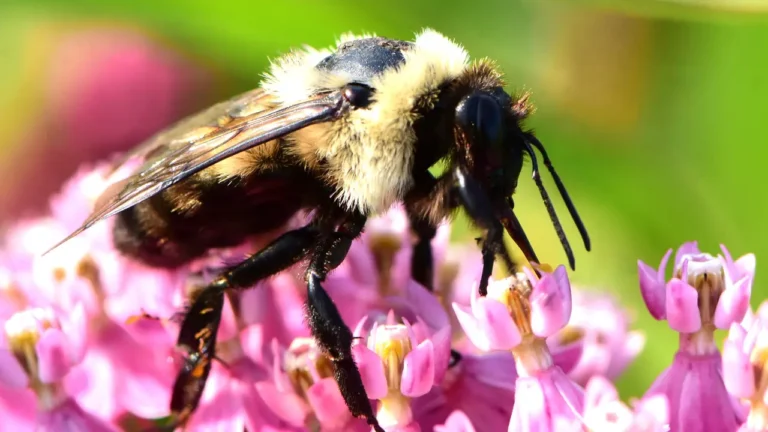
The false Japanese beetle turns up on roses, honeysuckle and peonies (UMN). The dogbane beetle eats dogbane and milkweed-family relatives, so you may meet it near milkweed (UKy). UMN calls the false beetle’s head dull metallic green and Nebraska says it is not; both agree it lacks tufts.
Life Cycle and Timing
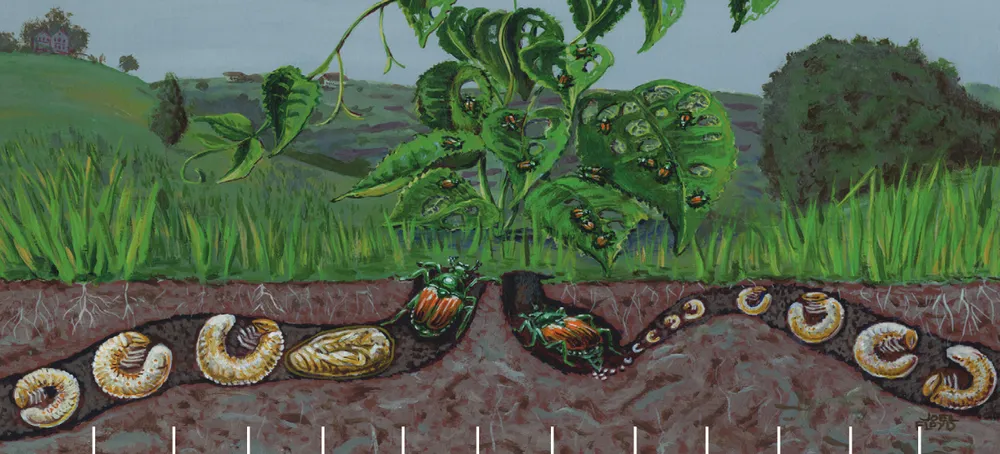
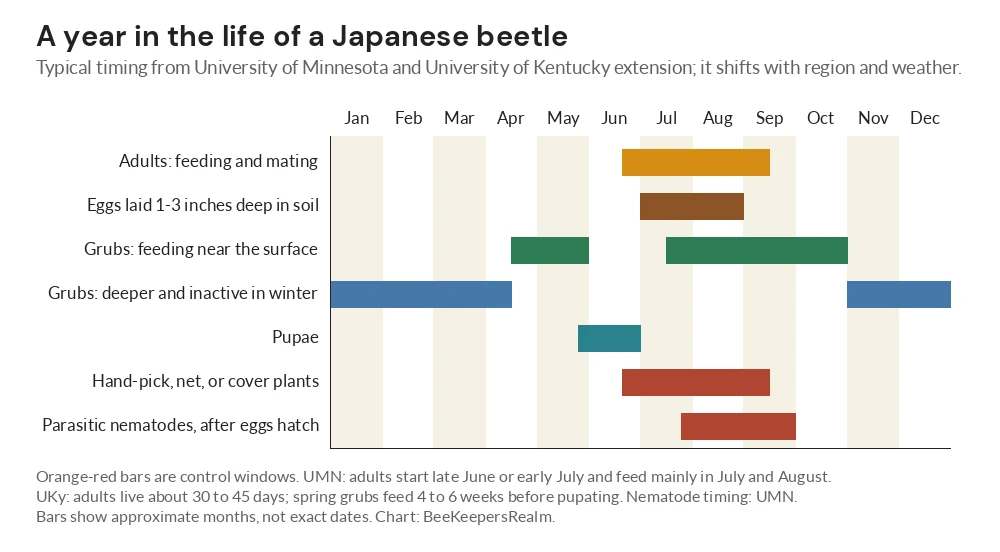
Most populations have one generation a year. Adults leave the soil in late June or early July and feed mainly in July and August, with some active into September (UMN). Each lives about 30 to 45 days (UKy). Females burrow 1 to 3 inches down and lay up to 60 eggs in several batches. Eggs hatch in about two weeks, and grubs pass through three stages feeding on roots (UMN).
The grubs move deeper when autumn soil cools to about 60°F and go inactive near 50°F. In spring they rise once soil passes 50°F, feed 4 to 6 weeks, then pupate (UKy).
What Japanese Beetles Eat and the Damage They Do
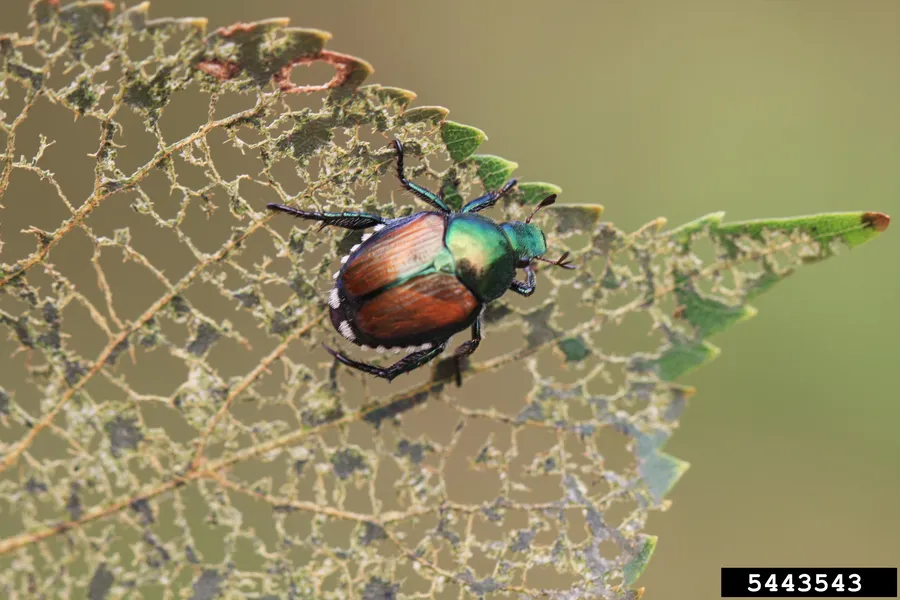
Adults feed on the leaves, flowers or fruit of more than 300 plant species (UMN, USDA APHIS). UMN names rose, grape, linden, apple, crabapple, cherry, plum, birch, elm, raspberry, currant, basil, Virginia creeper, hollyhock, marigold, corn silks and soybean. They chew the tissue between the veins, leaving a lace-like skeleton that browns and may drop.
One beetle eats little; the harm comes from groups. Damaged leaves give off odors that draw in more beetles, so one plant can be swarmed while its neighbor is barely touched (UMN, UKy). Healthy mature trees and shrubs usually tolerate it, young or unhealthy plants can be stunted or killed, and rose blooms are often ruined (UMN). Other leaf-chewers such as sawfly larvae look similar, so confirm the beetles first.
The beetle was first found in New Jersey in 1916 and now occurs throughout the eastern US except Florida (UMN). It is another accidental invader, like the spotted lanternfly. CSU reports permanent populations on Colorado’s Front Range and in Mesa County, while Utah State says its eradication program cleared Utah but traps keep catching new beetles.
Grub Damage in Lawns
Grubs chew grass roots, so turf browns and dies in patches that roll back like a loose carpet. Healthy turf typically tolerates up to 10 grubs per square foot, and moles, skunks and crows may dig up the lawn hunting them (UMN). Irrigated, grassy lawns draw egg-laying females, so they often hold more grubs in a dry summer (UKy). Treating the lawn will not save your roses: adults fly in from elsewhere, so grub control does not reduce beetles on landscape plants (UMN, UKy, CSU).
When and Where They Are Recorded in the US
We pulled US research-grade iNaturalist observations of Popillia japonica on November 16, 2026, and got 60,398 records. These are observations, not beetle counts, but the shape matches extension timing: 93% fall in June to August, July alone holds 51%, September has 3,106 and October only 297.
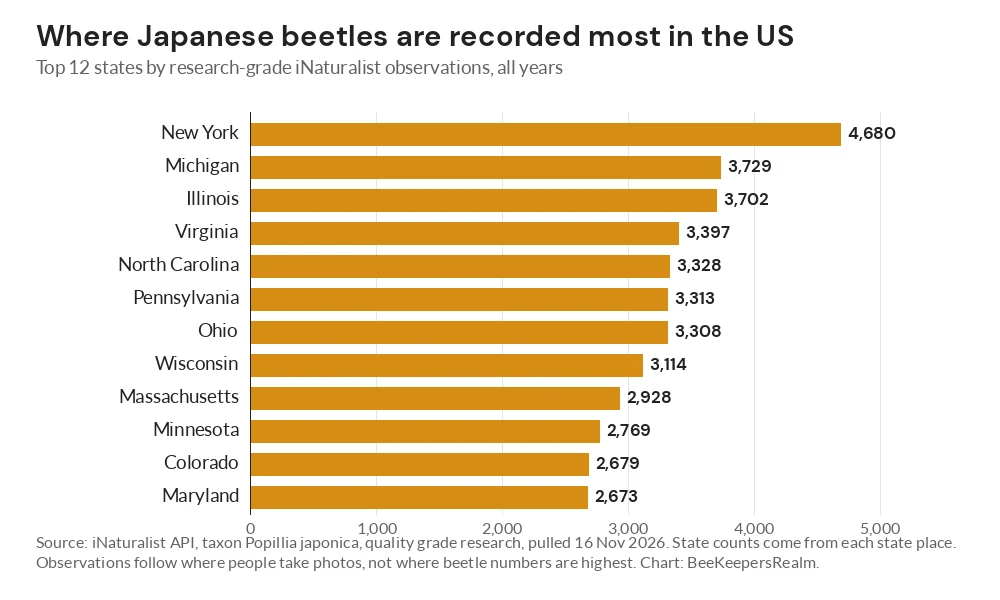
New York leads with 4,680 records, then Michigan (3,729), Illinois (3,702) and Virginia (3,397). Colorado ranks 11th with 2,679, which fits CSU’s report of established Front Range populations. The West is nearly blank: California 1, Oregon 4, Washington 2, and none for Idaho, Utah or Nevada. If you find one there, tell your state department of agriculture. Our citizen science guide covers how such records get made.
Do Japanese Beetle Traps Work?
They catch many beetles but usually fail to protect plants, and in a home garden they can raise damage. Traps pair a female sex pheromone with a floral lure, which the Kentucky authors of ENTFACT-451 say can draw thousands of beetles a day.
“Don’t use Japanese beetle traps. They attract more beetles than they catch. While these traps can collect an impressive number of beetles, research at the University of Kentucky has demonstrated that more beetles fly toward the traps than are caught.”
The Kentucky paper’s own counts sit behind a paywall, so we do not quote them. What we could read:
| Source | What it found |
|---|---|
| UKy ENTFACT-451 (D.A. Potter and colleagues) | Traps attract many more beetles than are caught; nearby plants likely suffer more damage than with no trap |
| Held, University of Kentucky (2003 trade article) | In replicated experiments traps did not cut damage to nearby plants, raised their defoliation and did not affect grubs in surrounding turf |
| Switzer and colleagues, Eastern Illinois University (2009, soybean field) | Most arriving beetles landed on plants before touching the trap; females caught were smaller and carried fewer eggs |
| North Carolina State University | Traps may catch up to 75% of the beetles that approach, but are not control devices; keep them far from plants |
| CSU | Traps have never been shown to reduce damage to nearby plants; mass trapping was part of the early-2000s Palisade, Colorado eradication |
| Lincoln University and University of Missouri (2014 to 2016) | Large perimeter traps (15 around a half-acre elderberry plot, 16 for 2.5 acres of blueberries) held blueberry defoliation to 0.3% (2014), 0.07% (2015) and 0.02% (2016); cutting the elderberry plot to five traps in 2017 allowed heavy injury on some perimeter plants |
| Utah State University | Mass trapping can reduce small, localized populations; empty traps every 1 to 3 days and keep them away from valued plants |
The pattern: a perimeter system of high-capacity traps can protect a small fruit planting, while one or two bag traps near your roses do not. Purdue’s landscape guide agrees.
How to Control Adults Without Harming Bees
- Start early. Act when the first beetles appear in late June, because damaged leaves attract more (UMN).
- Hand-pick into soapy water in the evening or early morning, when beetles are cool and sluggish (UMN). They drop when disturbed, so hold the bucket under the branch (CSU).
- Cover plants that are not in bloom. Fine netting or cheesecloth works on valued plants (UKy). UMN says not to cover plants in bloom that need pollination: hand-pick until bloom ends and fruit sets, then cover.
- Pick less-preferred plants when you replace something (table below).
- Skip folk repellents. UKy calls insecticidal soap, garlic, hot pepper and orange-peel extracts and companion planting generally ineffective. UMN found no evidence that four o’clocks kill beetles.
| Plants | Finding | Source |
|---|---|---|
| Arborvitae, spruce, fir, pine | Usually not damaged | UMN |
| Oak, red and silver maple, redbud, magnolia, ginkgo, white poplar | Usually not damaged | UMN |
| Common and Japanese tree lilac, forsythia, dogwood | Usually not damaged (UMN); Utah State lists lilac, dogwood and magnolia as avoided | UMN, Utah State |
| Boxwood, rhododendron, yew, clematis, chrysanthemum, daylily | Usually not damaged | UMN |
| Peony | No damage from adults in field or caged tests; its bud nectar feeds spring Tiphia wasps | UConn Extension |
| Zonal geranium | Seldom eaten itself (UMN), but roses planted with geraniums generally had more beetles than roses alone | UMN, Held (Kentucky) |
| Rose, grape, linden, apple, crabapple, birch, raspberry | Preferred hosts, for contrast | UMN |
“Usually not damaged” is not “never damaged.” When you add nectar plants, our list of native plants for pollinators is a starting point; check each against the lists above.
Grub Control: Milky Spore, Nematodes and Timing
Treat only if the lawn needs it. UMN says to treat grubs only to protect turf. Dig a square foot at the edge of a brown patch and count first.
Timing beats product. UMN puts a preventive treatment in the month or so before adults emerge and lay eggs (mid-June to mid-July in Minnesota). A curative treatment works best from late July to mid-September, while grubs are 1/2 inch or less. Large grubs in late fall are not controlled, and spring treatment is not advised.
Milky spore is weak. It is the bacterium Paenibacillus popilliae, sold as a powder.
“In areas of the eastern United States, where milky spore has long been widespread, it annually infects a small number of grubs, resulting in some reduction of the Japanese beetle populations (less than 5%).”
UMN goes further: commercial milky spore has not been shown to give any benefit in modern university research trials.
Nematodes are inconsistent. CSU says Heterorhabditis nematodes can give good control, but UMN and UConn report mixed results. UMN says to apply after eggs hatch, on a cool overcast day or in the evening, watering before and after. UConn says to buy them fresh and apply at once. They generally spare beneficial insects (UMN).
Habits help. Mow higher for a bigger root mass, and let the top inches of soil dry in July and early August to kill eggs and tiny grubs (CSU). Our lawn-to-pollinator-habitat guide covers a lawn that also feeds bees.
Natural Enemies: Tiphia Wasps and the Winsome Fly
Two parasites of Japanese beetles were released in the US and are now established in Minnesota, per UMN. The winsome fly (Istocheta aldrichi) lays white eggs on adult beetles, which die within 5 to 6 days. In 2024 UMN measured 16% to 30% parasitism at the Minnesota Landscape Arboretum, 20% at an apple orchard and 17% in a Shoreview yard, with 25% to 55% in females. Do not kill a beetle carrying white eggs.
The spring Tiphia (Tiphia vernalis) stings a third-stage grub underground and attaches one egg to it. Cornell says USDA imported it from Korea in the 1920s and early 1930s, that an old survey found it attacked 60% of grubs on average, and that it does not parasitize native scarab beetles. UMN says it is unclear how common the Tiphia is in Minnesota, while the fly has become abundant around the Twin Cities and is likely suppressing beetles. Tiphia are solitary and do not form nests or swarms (Cornell, UConn), and none of our sources describes stings to people.
Adults also take honeydew, tulip tree nectar and peony bud nectar (Cornell), which makes them incidental flower visitors, not crop pollinators. Scoliid wasps, covered in our scoliid wasp guide, also hunt grubs, but the extension programs we read name Tiphia and the winsome fly as the established Japanese beetle enemies.
Bees, Pollinators and Japanese Beetle Sprays
Many plants beetles eat are bee plants, and linden is the worst timing clash: a major nectar tree that beetles love.
“It is known that it enters linden flowers, and this tree blooms during July when Japanese beetles are causing the most damage.”
Nixon was writing about imidacloprid, a systemic neonicotinoid. He said it stays in a tree for slightly over a year, with higher levels in the first weeks, overlapping beetle attack and flowering, and that it does not enter the blossoms of some plants. He also cited a 2013 Oregon bumble bee kill, with estimates of 25,000 bees, after dinotefuran was applied to linden in bloom, which the label prohibits.
UMN says imidacloprid and dinotefuran are very toxic to pollinators, to avoid them on bee-attractive plants or wait until bloom ends, and not to treat soil within 4 to 5 feet of such plants. CSU says imidacloprid labels bar use on flowering plants until all petals have fallen. The EPA’s 2013 bee advisory box on neonicotinoid labels carries wording such as “Do not apply this product while bees are foraging. Do not apply this product until flowering is complete and all petals have fallen.”
| Active ingredient | Bee hazard according to extension | Source |
|---|---|---|
| Imidacloprid, dinotefuran (neonicotinoids) | Very toxic to pollinators; do not apply to plants in bloom | UMN, CSU |
| Bifenthrin, cyfluthrin, lambda-cyhalothrin, permethrin (pyrethroids) | Toxic to bees; cannot be used on bee-visited plants in bloom | UMN, CSU |
| Carbaryl, acephate | Toxic to bees; carbaryl cannot be used on bee-visited plants in bloom | UMN, CSU |
| Pyrethrins | Toxic if sprayed on bees; short-lived; bloom use only at dawn or dusk | UMN, CSU |
| Neem oil (azadirachtin) | Low risk to bees (UMN) but hazardous if sprayed directly (CSU); lasts days | UMN, CSU |
| Bacillus thuringiensis galleriae | Not toxic to bees; 1 to 2 weeks of protection | UMN, CSU |
| Chlorantraniliprole | Low risk to bees; longer lasting | UMN, CSU |
Never spray open blooms. CSU says short-lived products allowed on blooming plants should go on at dawn or dusk when bees are not flying, and many applicators spray at night so residue dries. That timing does not rescue a high-hazard product the label bars on blooms. In lawns, UMN says to mow flowering weeds such as clover and dandelion just before or after any grub treatment and to avoid ground-nesting bee areas. Our guides to pollinator-safe pest control and DriftWatch and BeeCheck cover the wider picture. Linden stays a good bee tree (see basswood honey), with a drought caveat in our plants toxic to bees guide.
Frequently Asked Questions
How do I get rid of Japanese beetles?
Hand-pick adults into soapy water, net plants that are not in bloom, and skip traps. Treat grubs only to protect turf, since that will not reduce beetles on shrubs (UMN).
Are Japanese beetles harmful?
To plants, yes: adults skeletonize leaves and grubs kill turf. We found no extension source describing stings or bites to people.
Why shouldn’t you squish Japanese beetles?
The worry is that crushed beetles attract more. Ask Extension quotes CSU’s Whitney Cranshaw and Kentucky’s Dan Potter saying squashing will not increase attraction, because the aggregation signals come from damaged plants.
What month do Japanese beetles go away?
Most feeding ends by mid to late August (UMN), though some beetles last into September. Our iNaturalist pull falls from 11,409 records in August to 3,106 in September.
What do Japanese beetles hate the most?
No plant or home spray is proven to repel them. UKy calls garlic, pepper and orange-peel extracts and companion planting generally ineffective. Neem oil deters feeding for several days (UMN).
What is the natural enemy of Japanese beetles?
The winsome fly and the spring Tiphia wasp. UMN says the fly is abundant around the Twin Cities and likely suppressing beetles, while the wasp’s numbers are unclear.
Are Japanese beetles the same as grubs?
They are one species at two stages: grubs are the larvae and beetles the adults. Not every lawn grub is a Japanese beetle, since other scarabs have similar grubs (UMN, CSU).
How do you get rid of Japanese beetle grubs?
Time it: preventive treatment in the weeks before adults lay eggs, curative treatment in late July to mid-September while grubs are small (UMN). Nematodes are inconsistent and milky spore is weak.
The Bottom Line
Identify by the white tufts, hand-pick or net instead of trapping, plant less-preferred species, and treat grubs only when the lawn needs it. Keep neonicotinoids off blooming linden and other bee plants.
Image credits: Featured photo: Japanese beetle in Guelph, Ontario, Ryan Hodnett, CC BY-SA 4.0, via Wikimedia Commons. Bugwood photos are licensed CC BY 3.0 US. The false Japanese beetle photo is labelled Strigoderma arbicola by its photographer. Charts use US research-grade iNaturalist observations. Other credits are in the captions.
Sources: University of Minnesota Extension; University of Kentucky ENTFACT-451; Colorado State University Extension; USDA APHIS; University of Illinois Extension; Cornell IPM, spring Tiphia; UConn Extension, plants that help natural enemies; Switzer et al. 2009, Journal of Economic Entomology; Missouri IPM, mass trapping; Utah State University Extension; NC State TurfFiles; Ask Extension, squashing question; EPA, neonicotinoid labeling (archived); Oregon Department of Agriculture; Purdue E-75.