Reviewed by Michael R. · How we review
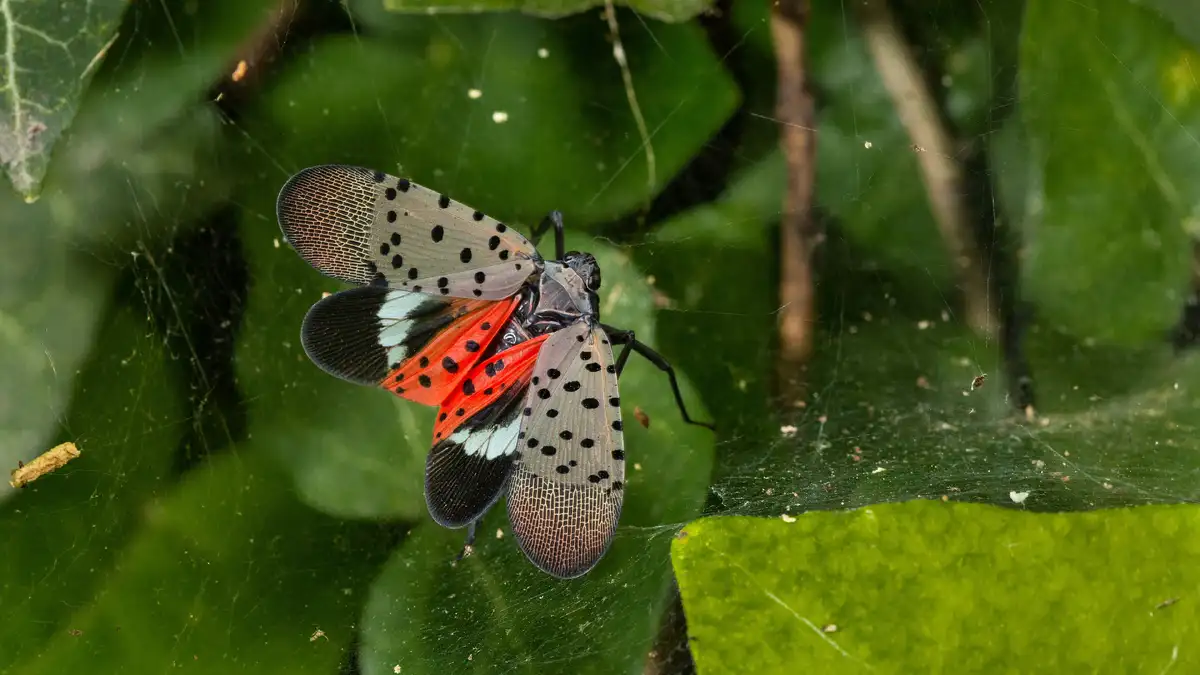
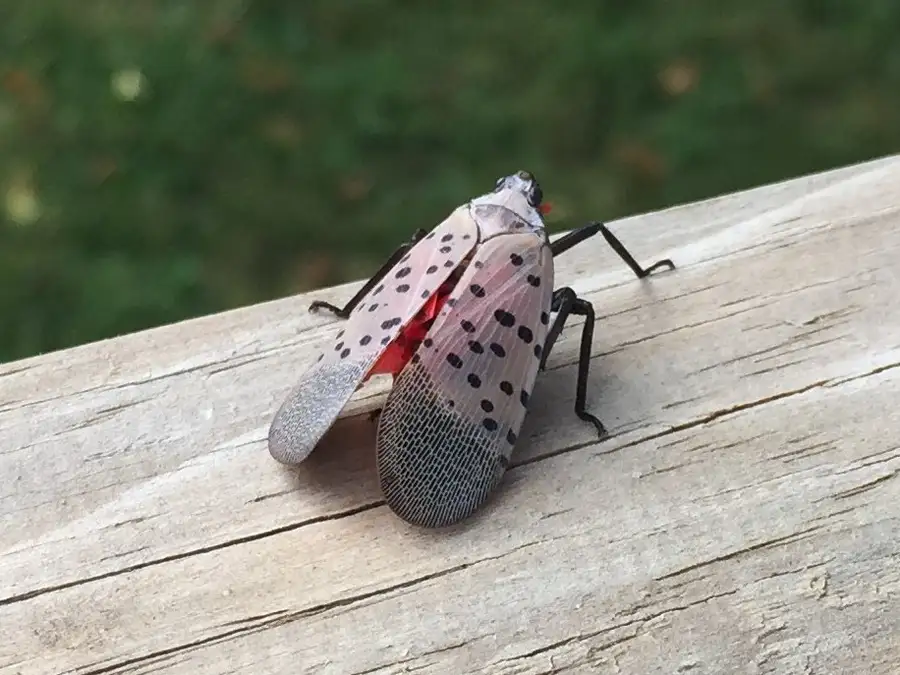
The spotted lanternfly (Lycorma delicatula) is an invasive planthopper from Asia, found in the United States since 2014. USDA APHIS lists it in 19 states and Washington, D.C. Adults are about 1 inch long, with gray, black-spotted forewings and red hindwings. It cannot bite or sting, but its sticky honeydew coats plants and patios, and in late summer honey bees turn it into dark, smoky honey. What the research flags for bees is how people treat it.
Key Takeaways
- One generation a year: gray-brown egg masses from fall to spring, black nymphs with white spots from late April or May, red nymphs from July, winged adults from late July until hard frost.
- APHIS (page updated Aug 26, 2025) lists 19 states and D.C. New Hampshire reported its first detection in August 2026, and Michigan confirmed a new population in Berrien County in fall 2026.
- Tree of heaven is the preferred host and grapevines are hit hardest: NC State Extension cites up to 90% yield loss in infested vineyards.
- Honey bees collect the honeydew, and Penn State says the dark honey is safe to eat. We found no peer-reviewed study showing harm to colonies.
- Scrape or smash egg masses and trap nymphs with circle traps. Never spray blooming plants, and skip sticky bands: Penn State says they catch pollinators and birds.
Table of Contents
- What a Spotted Lanternfly Is
- How to Identify Each Life Stage
- When to Look: Life Stages by Month
- Where Spotted Lanternflies Are in the US
- What They Feed On: Tree of Heaven and Crops
- Are They Harmful to People and Pets?
- Spotted Lanternflies and Honey Bees
- Treating Lanternflies Without Harming Pollinators
- What to Do If You Find One
- Look-Alikes: What Else Gets Mistaken for One
- Frequently Asked Questions
What a Spotted Lanternfly Is
Despite the name it is a planthopper, not a fly. The first US infestation was found in Berks County, Pennsylvania, in 2014, and Cornell IPM says it was thought to have arrived as egg masses on a stone shipment in 2012. It drinks plant sap through a straw-like mouthpart and can live only about 48 hours without a plant. APHIS says it lays eggs on any hard surface, including grills, vehicles, trailers, firewood, outdoor furniture and bikes, which is how it travels. Pennsylvania has one generation a year.
“Spotted lanternflies do not bite or sting. They feed exclusively on plants outdoors and can only survive for about 48 hours without feeding on a plant.”
How to Identify Each Life Stage
| Stage | Look | Months | Where you find it | What to do | Source |
|---|---|---|---|---|---|
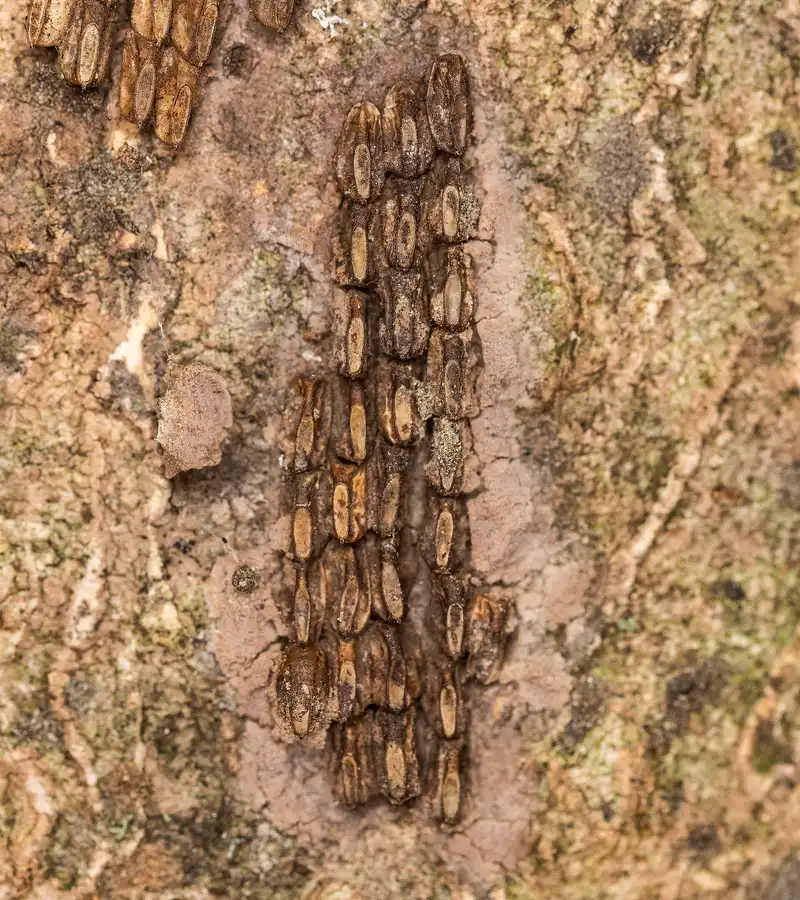
| Egg mass | Gray-brown, mud-like or putty-like covering; 1 to 1.5 in; 30 to 50 eggs | Laid Sept to Dec, most in Oct; visible Sept to May | Trees, stone, brick, grills, vehicles, firewood, hive boxes | Scrape into alcohol or hand sanitizer, or smash | Penn State, APHIS |
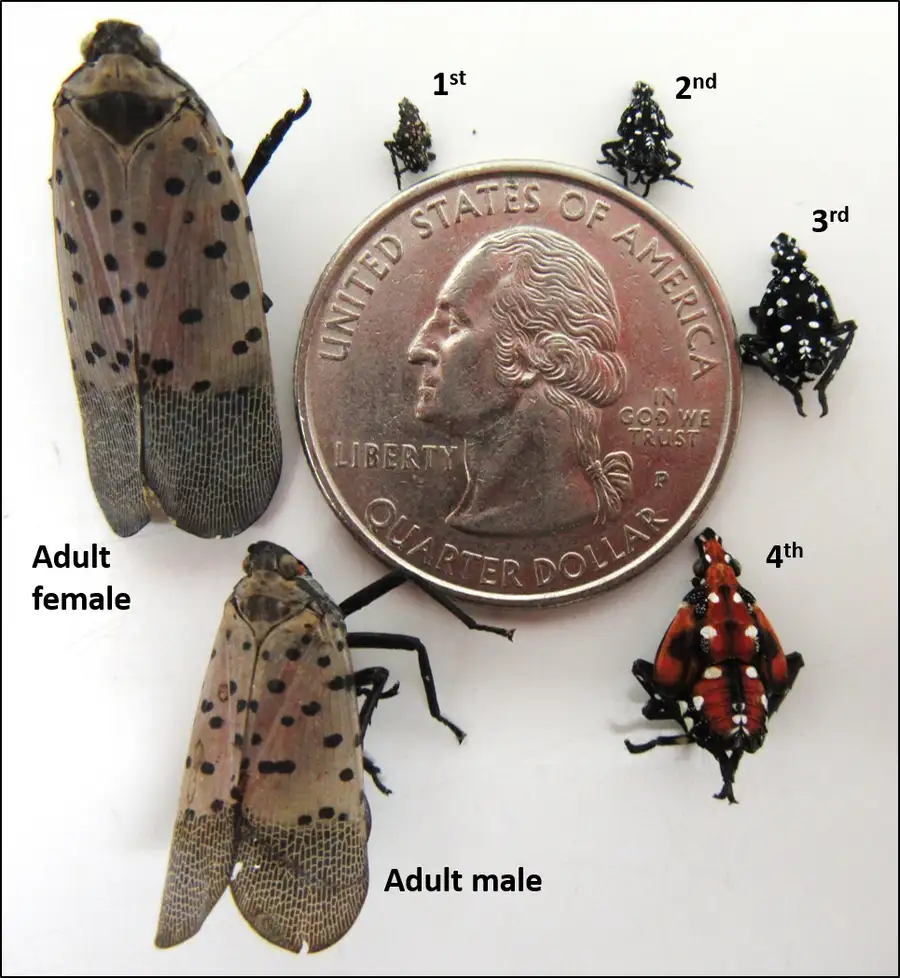
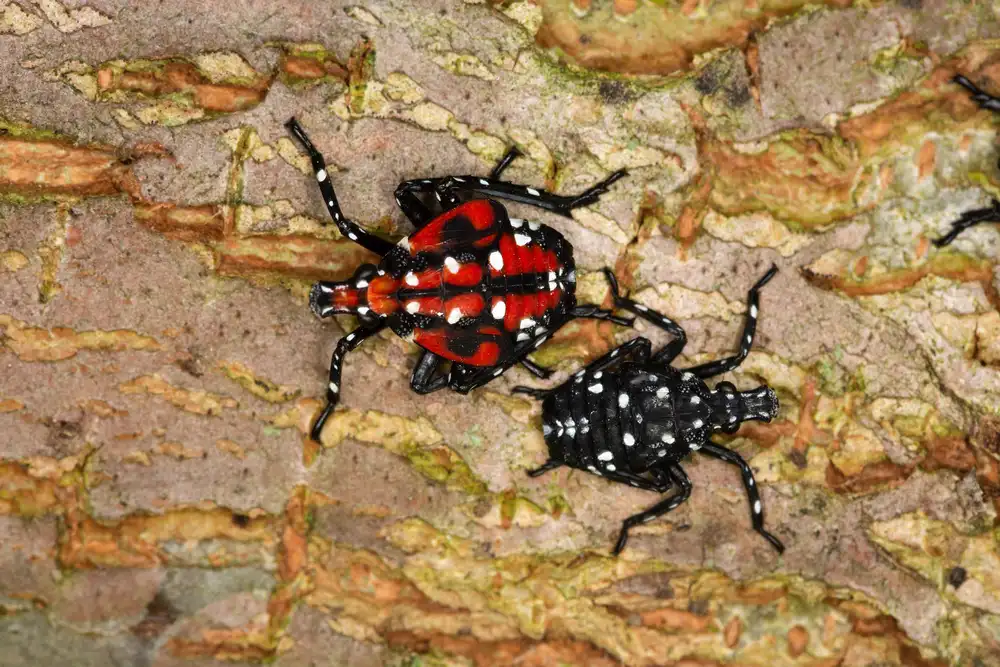
| Early nymph (1st to 3rd instar) | Black with bright white spots; 1/8 to 1/4 in; strong jumper | Late April or May to July | New growth on many plants, tree of heaven | Squash; circle trap on trunks | Penn State, UMass |
| Late nymph (4th instar) | Red with black stripes and white spots; about 1/2 in | July to Sept | Same plants; climbs trunks | Squash; circle trap on trunks | Penn State, UMass |
| Adult | About 1 in; gray-brown black-spotted forewings, red, black and white hindwings, yellow abdomen | Late July until hard frost | Trunks and woody stems: tree of heaven, maples, grapevines | Squash; check vehicles; report in new areas | APHIS, Penn State |
Months are Pennsylvania and Massachusetts timing and shift by a few weeks elsewhere; NC State Extension says egg masses in North Carolina are mostly seen from mid-October to spring.
Hatchlings are only about 1/8 inch and can be mistaken for ticks or spiders. Adults rest with wings folded, showing only camouflaged forewings; the red appears when they jump, glide or fly, according to Penn State’s photo guide.
To tell fresh egg masses from old ones, look for the covering and for oval emergence holes at the top of each egg. Penn State says masses a female never laid will not hatch, so a dead adult full of eggs needs no further action.
Video: NC State Extension’s 9-minute video, made with the NC Department of Agriculture’s Plant Industry Division, covers identification, the life cycle, crop and tree impact, hitchhiking, egg-mass removal, trapping and reporting, going by its official chapter list.
When to Look: Life Stages by Month
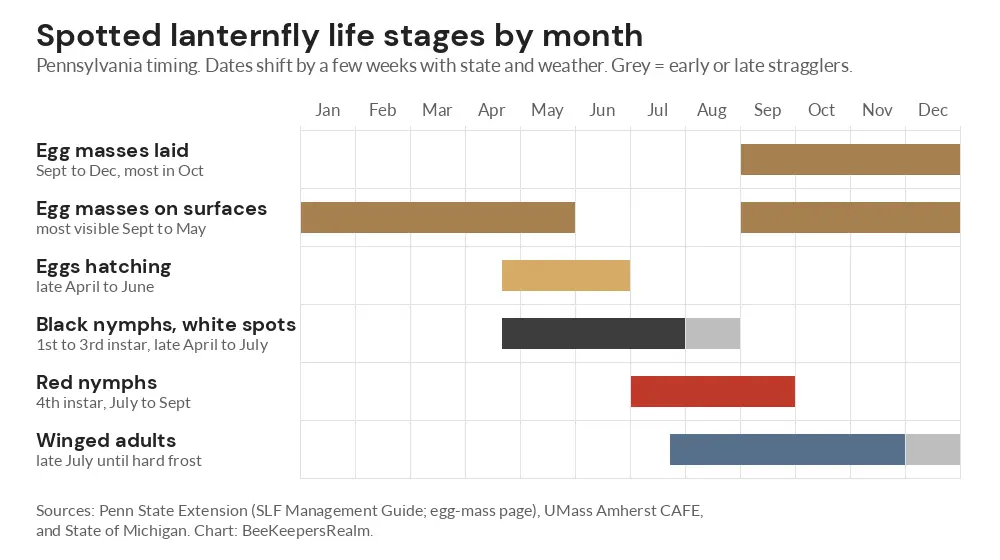
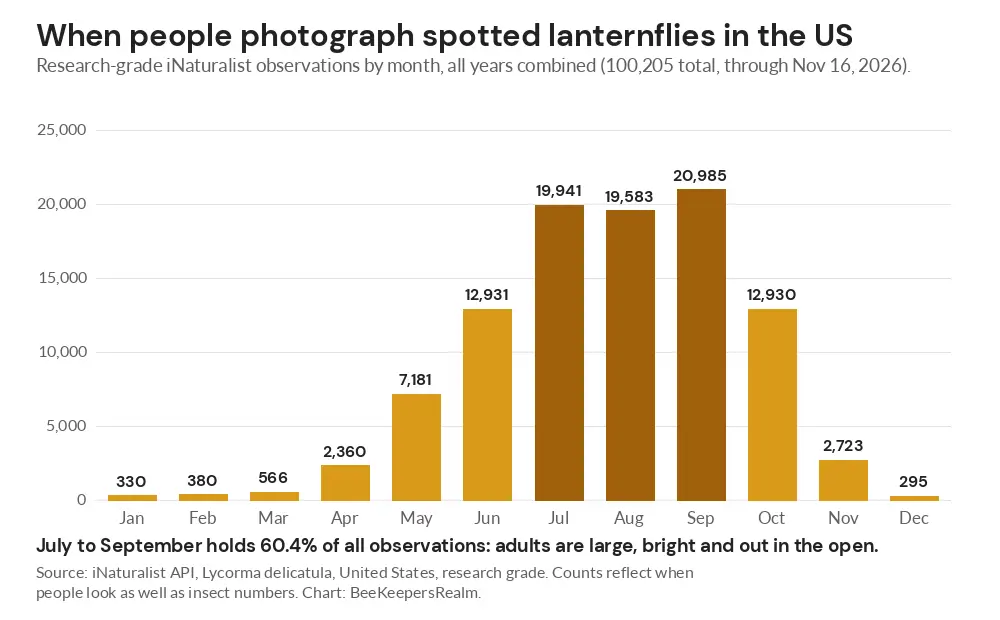
We also pulled the iNaturalist API on November 16, 2026. It holds 100,205 research-grade US observations of the species, and July to September account for 60.4% of them, with September the peak at 20,985. Yearly counts grew from 2 in 2015 to 26,553 in 2025, with 24,742 so far in 2026, though more observers means more records. Adults die after hard frosts and the eggs overwinter, per Penn State; a Massachusetts forest-pest coordinator told the Greenfield Recorder that typical Massachusetts winters are “nowhere near cold enough” to kill them.
Where Spotted Lanternflies Are in the US
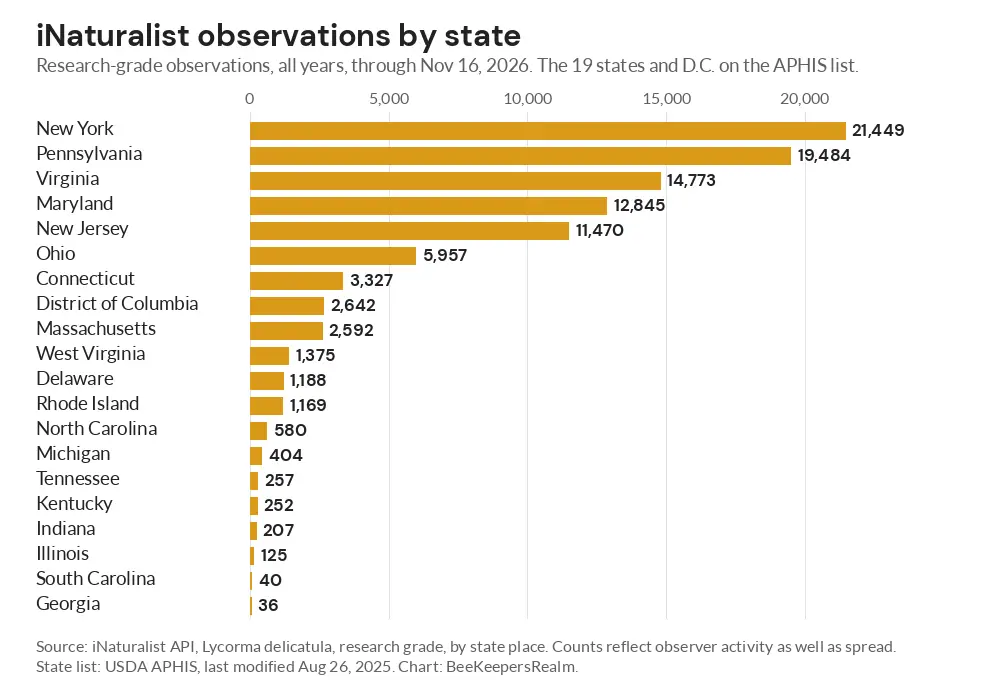
APHIS lists Connecticut, Delaware, Georgia, Illinois, Indiana, Kentucky, Maryland, Massachusetts, Michigan, New Jersey, New York, North Carolina, Ohio, Pennsylvania, Rhode Island, South Carolina, Tennessee, Virginia, West Virginia and the District of Columbia; its page was last modified August 26, 2025. Penn State’s October 2025 count is 17 established states, so totals vary by source and definition.
Newer reports: New Hampshire confirmed a “small number” in Salem in August 2026 but no evidence of an established population. Michigan confirmed a population near Niles, its first in the southwest. Massachusetts reported 186 known infestations after 78 new communities in 2026, per the Greenfield Recorder. Ohio issued a statewide quarantine effective February 17, 2026 and, according to WCPO, no longer asks residents to report sightings, so reporting rules differ by state.
Quarantine zones change, so use your state’s page and the Cornell county map rather than a list in an article. These are the official pages APHIS links for each state; APHIS’s Ohio link now returns a 404, so Ohio points to news coverage. Penn State says quarantine orders require items moved out of infested areas to be inspected, residents to check belongings before leaving a quarantined county, and businesses in quarantined Pennsylvania counties to hold a free permit.
| State | Official page | State | Official page |
|---|---|---|---|
| Connecticut | CT Agricultural Experiment Station | New Jersey | NJ Department of Agriculture |
| Delaware | DE Department of Agriculture | New York | NY Agriculture and Markets |
| District of Columbia | DC Urban Forestry | North Carolina | NC Department of Agriculture |
| Georgia | GA Department of Agriculture | Ohio | Ohio statewide quarantine (WCPO) |
| Illinois | IL Department of Agriculture | Pennsylvania | Penn State Extension |
| Indiana | IN DNR Entomology | Rhode Island | RI Department of Environmental Management |
| Kentucky | University of Kentucky Entomology | South Carolina | Clemson Plant Industry |
| Maryland | MD Department of Agriculture | Tennessee | TN Protect Our Forests |
| Massachusetts | Mass.gov | Virginia | VDACS |
| Michigan | Michigan Invasives | West Virginia | WV Department of Agriculture |
Numbers are not predictable. Penn State says populations rise steadily over several seasons in newly infested areas, but where lanternflies have been present for years they can drop sharply or rebound from one season to the next, and the causes are not fully understood. A low year is often followed by an increase.
What They Feed On: Tree of Heaven and Crops
Tree of heaven (Ailanthus altissima) is the preferred host, per APHIS. Penn State describes it as an invasive tree with large compound leaves, smooth-edged leaflets and a foul odor when crushed, easily confused with sumac, black walnut and hickory, whose leaflet edges are toothed. Lanternflies do not need it to complete their life cycle. Penn State counts over 70 host species and NC State over 100. In home gardens, Penn State says nymphs have been reported on cucumber, basil, rose, peony and Russian sage, usually for under a week, and conifers are poor hosts.
Grapes suffer most. NC State Extension documents up to 90% yield reduction in infested vineyards, and Penn State says heavy feeding has contributed to the death of grapevines, tree of heaven and black walnut saplings. Hops, fruit trees and maples are also hosts. Penn State calls the insect mainly a nuisance in home landscapes, and says damage to vegetables is seldom reported.
Are They Harmful to People and Pets?
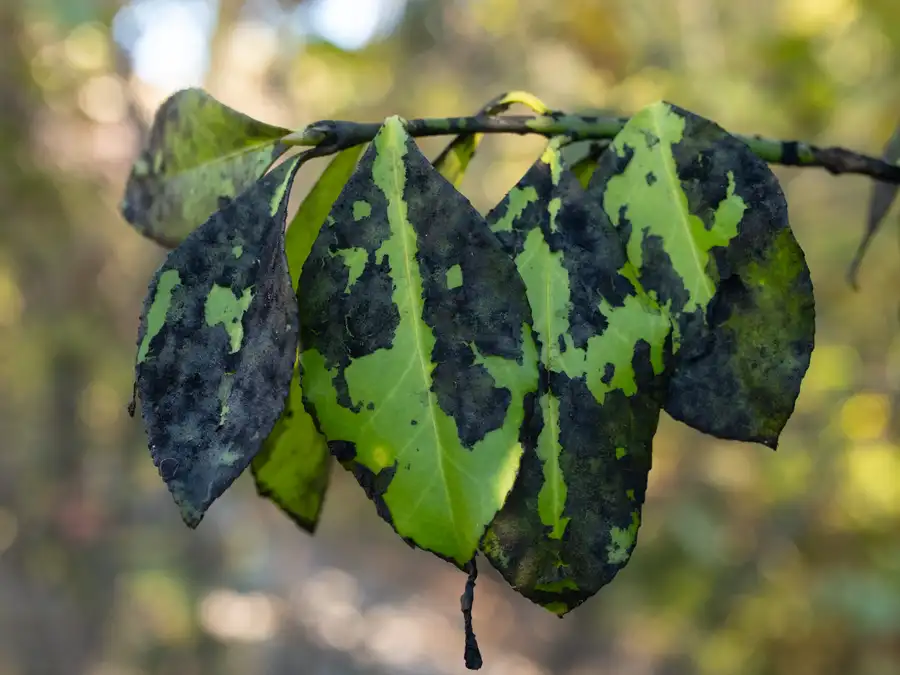
No bite or sting: Penn State, Cornell and APHIS all say so. The Invasive Species Centre in Canada adds that some research suggests they may sequester plant toxins, which is unconfirmed, so keep pets from eating them. The mess is the honeydew: Penn State says it can fall like light rain, and sooty mold stains decks, patios and vehicles. It also draws ants and wasps; see our guide to yellow jackets.
Spotted Lanternflies and Honey Bees
This is the angle the top-ranking lanternfly guides mostly skip. Penn State apiculture educator Robyn Underwood explains it plainly.
“Honey bees readily collect this honeydew and process it as honey.”
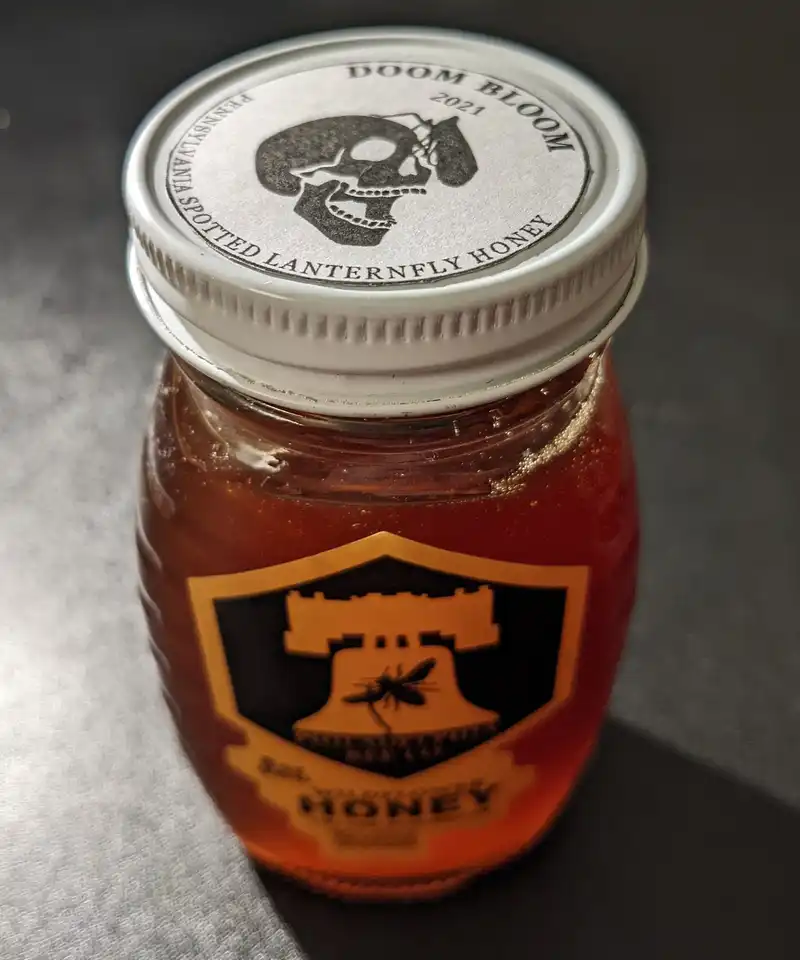
Beekeepers noticed it first in the Philadelphia area: Atlas Obscura reports that a Philadelphia beekeeper found an unfamiliar aroma and a deep reddish-brown harvest in fall 2019, and beekeepers across southeastern Pennsylvania sent samples to Penn State. Adults excrete the honeydew from August to October. Penn State says the honey has a smoky odor, a dark brown color that is not nearly as dark as buckwheat honey, less sweetness and a lingering aftertaste. It says the taste likely depends on the plant the lanternflies feed on and on how much honeydew versus floral nectar ends up in the honey, so batches will vary. For how bees turn nectar or honeydew into honey, see how bees make honey. Honeydew honey is also a separate category from blossom honey in standards, which use electrical conductivity among their tests; we found no published conductivity or sugar profile for lanternfly honey. European beekeepers have long harvested honeydew honey from aphids and other insects and often sell it as forest honey, Smithsonian magazine notes; lanternfly honey is an American version.
| Question | What the sources say | Source |
|---|---|---|
| Is the honey safe to eat? | Yes. Preliminary lab tests found pesticide levels from lanternfly treatment “exceedingly small.” | Penn State |
| Does treatment pesticide reach honey? | Near dinotefuran-treated trap trees in 2017, none was detected in bees, wax or honey, but it was in honeydew samples (3 to 100 ng per sample). | Underwood et al. 2019 |
| Does it harm colonies? | We found no peer-reviewed study of harm. Beekeepers in long-infested areas report bees overwinter very well on it. | Penn State |
| Who else uses the honeydew? | At 43 sites in southeastern Pennsylvania, 78% of 1,576 feeding observations were Hymenoptera, including 33 species, and the invasive European hornet was aggressive toward native consumers. | Cannon and Helmus 2025 |
If you do not want the honey, Penn State advises removing spring and summer honey by the end of July and not adding fall supers; the bees keep the honeydew as winter feed. That matters for how much honey bees need for winter. Yellow jackets, which also come to honeydew, are a fall pest at hives; see how to protect beehives from yellow jackets.
Beekeepers also spread lanternflies. Penn State says eggs can be laid on hive boxes, lids, bottom boards, stands and pallets, and adults jump into vehicles, so inspect equipment before moving a beehive, and ask your state bee inspector about local rules. For other invasive insects near hives, see the yellow-legged hornet, Asian needle ant and European paper wasp.
Treating Lanternflies Without Harming Pollinators
Penn State says a few lanternflies on a large, healthy tree are unlikely to cause permanent damage, and advises trapping or swatting before insecticides. These are Penn State’s pollinator notes.
| Method | Pollinator note |
|---|---|
| Squash nymphs and adults; scrape egg masses | No chemicals. Fewer than 2% of egg masses on a tree are within reach (to 10 ft); do not climb ladders. |
| Circle trap | Recommended. Place about 4 ft up on smooth-bark trees from hatching (late April to June); remove at season end. |
| Sticky bands | Not recommended; if used, add a mesh wildlife barrier (not chicken wire) and check daily. |
| Contact sprays | Never on blooming plants; highest chance of non-target harm. |
| Systemic insecticides | Usually applied by professionals, after bloom, to target adults. |
| Home remedies | None approved; milkweed has no supporting data. |
Insecticides do not keep lanternflies out: Penn State says treating nymphs or adults will not stop more arriving later. Reduced-toxicity contact products such as soaps and oils can work on both stages, but they need thorough coverage and act for a short time.
“However, these are not recommended because this sticky material is not selective and can capture other animals, including pollinators, butterflies, birds, squirrels, and more.”
Michigan State University researchers tested an inexpensive trap, a rough “lampshade” wrapped on a trunk to attract egg-laying females. At their sites about 80% of egg masses were laid on the traps, even where populations were low, so the traps also help detect lanternflies near the edges of known infestations.
Biological control is not a fix yet. Penn State says no known natural enemy is expected to reduce populations significantly in the US. Spiders, mantises and birds eat some, a fungus (Beauveria bassiana) gave inconsistent results, and researchers are evaluating natural enemies from Asia in USDA quarantine facilities. UMass names the parasitoid wasp Dryinus sinicus as a candidate.
The systemic products Penn State lists, dinotefuran and imidacloprid, are neonicotinoids. A 2023 Penn State study found dinotefuran in the flowers of only one tree of heaven sampled after post-bloom spraying, at very low levels. But residues carried into red maple flowers the next spring could harm early-spring bees, especially after fall dinotefuran or spring or summer imidacloprid. The researchers advise mid-summer timing for dinotefuran. To plan around hives, see pollinator-safe pest control and DriftWatch and BeeCheck.
This is educational information, not professional advice. Read and follow the product label and your state’s rules.
What to Do If You Find One
- In a new area, document first. Photograph the insect, egg masses or infestation, and note the street address, cross roads, landmarks or GPS coordinates. Cornell IPM also suggests collecting one in a bag to freeze, or in a jar of rubbing alcohol or hand sanitizer. Report it to your state; New York and New Hampshire run online forms, and Pennsylvania uses 1-888-4BAD-FLY.
- In an infested area, destroy it. Squash nymphs and adults, and scrape egg masses from fall to spring into rubbing alcohol or hand sanitizer.
- Trap and protect. Use circle traps from hatching. Penn State says they need a trunk wide enough to wrap, so they will not work on bushes or most vines.
- Check before you travel. APHIS says to check doors, bumpers, wheel wells, grills and roofs, keep windows closed and park about 15 feet from trees in quarantine zones.
- Remove tree of heaven if practical. Penn State says herbicide on the roots works best, since a cut tree sprouts again.
- Call a professional for systemic treatments or large trees; Penn State notes trunk injection needs specialized equipment.
Look-Alikes: What Else Gets Mistaken for One
At rest, with the red hindwings hidden, an adult can pass for a moth, so check the forewings first.
| Look-alike | Confused with | How to tell |
|---|---|---|
| Boxelder bug | Late nymph | Young boxelder bugs are red and elongated; lanternfly nymphs have white spots on body and legs. |
| Brown marmorated stink bug nymph | Early nymph | It has small side spikes, visible antennae and white bands on its legs. |
| Ilia underwing moth | Adult | Red-orange underwings, but mottled bark-colored upper wings. |
| Tiger moth | Adult | Red underwings, but geometric upper-wing pattern. |
| White-lined sphinx | Adult | Pink underwing stripe, brown upper wings with white lines. |
| Spongy moth egg mass | Egg mass | Tan and fuzzy, not gray and putty-like. |
Source: State of Michigan look-alike guide; APHIS also lists the Ailanthus webworm moth and Asian longhorned beetle.
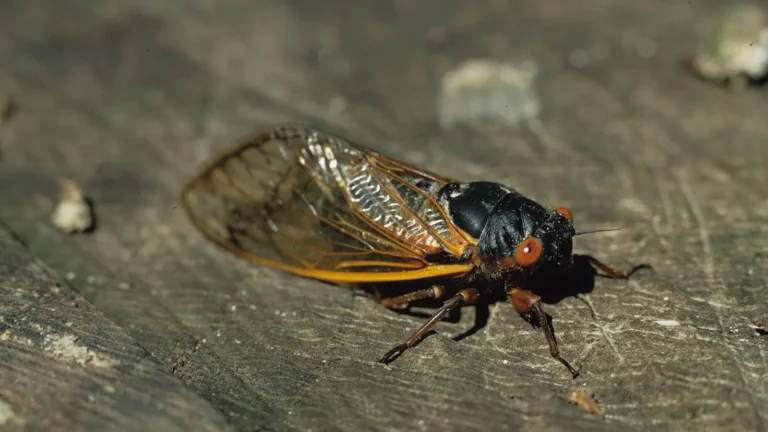
Like the spotted lanternfly, cicadas feed on plant sap, but they are North American true bugs that spend years underground rather than invasive planthoppers.
Another accidental invader, the Japanese beetle, arrived in New Jersey in 1916 and has since spread across the eastern US.
Frequently Asked Questions
Why is the spotted lanternfly such a problem?
It stresses or kills grapevines and some trees (NC State cites up to 90% yield loss in infested vineyards), and its honeydew and sooty mold foul plants and property. It also spreads by hitchhiking on vehicles and goods, which makes quarantines hard to hold.
Should I be killing spotted lanternflies?
In established areas, yes: squash them and scrape egg masses from fall to spring. In a new area, photograph and report first, because officials want to confirm a new population before it is destroyed.
What happens if a lanternfly bites you?
Nothing, because they cannot bite or sting. Their mouthparts only pierce plant tissue, and APHIS says a lanternfly captured for identification will not hurt you.
What do I do if I see a spotted lanternfly?
See the steps above: document and report in new areas, destroy elsewhere, and check vehicles before you leave.
Do spotted lanternflies hurt honey bees?
Bees collect their honeydew. We found no peer-reviewed harm to colonies; the documented concern is insecticide residues.
Is spotted lanternfly honey safe to eat?
Penn State says yes, citing preliminary tests showing very low pesticide levels.
Do spotted lanternflies die in winter?
Adults die after hard frosts, but the eggs overwinter and hatch in spring. Penn State describes one generation a year, so the egg masses are what carry the population through the cold.
What do spotted lanternfly eggs look like?
Gray-brown, mud-like patches about 1 to 1.5 inches long, holding 30 to 50 eggs. Penn State says the covering is white and glossy when fresh, then dries to a dull gray-brown that can crack like mud.
Where are spotted lanternflies in the US?
APHIS lists 19 states and D.C., all in the eastern US, and New Hampshire reported a first detection in August 2026; see the state table above for each official page.
The Bottom Line
Scrape eggs, trap nymphs, remove tree of heaven, and leave sticky bands and blooming-plant spraying alone.
Image credits: featured photo by Stephen Ausmus, USDA-ARS, public domain; the life-stage photo by Andrew Dechaine, USDA, public domain; Alex Abair (CC BY 4.0), Walthery (CC BY-SA 4.0) and Kches16414 (CC BY-SA 4.0). All via Wikimedia Commons, resized or cropped. Charts by BeeKeepersRealm.