Reviewed by Daniel M. · How we review
Yellow jackets are wasps. The name covers the social wasps of two genera, Vespula and Dolichovespula, which are usually black and yellow with a barely visible waist. Each colony starts from one queen in spring, nests in the ground, in a wall void or in a hanging paper nest, and peaks in late summer, when big colonies turn defensive and workers swarm sweet drinks and garbage. The first hard frost ends the colony.
Educational information, not professional pest-control or medical advice. Call a licensed pest professional for any nest you cannot safely avoid, and read the EPA’s guide to safe pest control before using a pesticide. For stings, see our sting first aid guide, and call 911 for trouble breathing or swallowing.
Key Takeaways
- Yellow jackets are wasps, not bees. The bald-faced hornet is an aerial yellow jacket, not a true hornet.
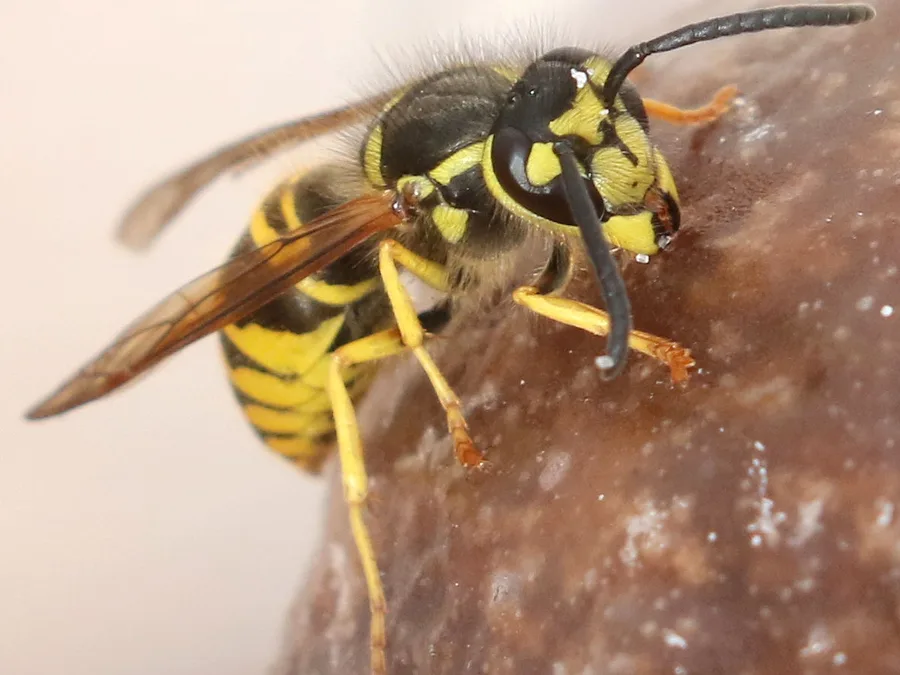
- To identify one: 1/2 to 1 inch long, jagged yellow and black stripes, a barely visible waist, and a smooth, shiny body instead of a fuzzy one.
- Colonies usually last one season. A lone queen starts the nest, workers peak in late summer, and the first hard frost kills the colony. Only new queens overwinter.
- Late summer is the worst time because colonies are at their largest and food is scarcest. Foraging workers then scavenge sweets and garbage, and nests are defended hard.
- Most nests are in the ground or in wall and attic voids. Never plug a wall entrance, and call a professional for a nest near people.
- Trap lures are species-specific. The common lure, heptyl butyrate, attracts mainly the western yellow jacket, so it can fail elsewhere.
Table of Contents
- Are Yellow Jackets Wasps?
- How to Identify a Yellow Jacket
- Yellow Jacket Species in the United States
- Yellow Jacket Nests: Where They Are and How Big They Get
- The Colony Year, Season by Season
- Why Yellow Jackets Get Aggressive in Late Summer
- What Yellow Jackets Eat
- Are Yellow Jackets Beneficial?
- Yellow Jacket Stings: What the Extension Sources Say
- What to Do About Yellow Jackets
- Frequently Asked Questions
Are Yellow Jackets Wasps?
Yes. Yellow jackets are social wasps in the family Vespidae. UC IPM uses the word for species in two genera: Vespula, whose ground- and cavity-nesting species are the most troublesome, and Dolichovespula, the aerial nesters. “Yellow jacket wasp” and “yellowjacket” name the same insect, and UF/IFAS notes there is no firm agreement on writing it as one word or two. PestWorld, the National Pest Management Association’s consumer site, counts about 16 species in the United States. Penn State lists the German yellowjacket’s other common name as the European wasp.
They are not bees, despite the nickname “meat bee.” UC IPM says honey bees are less brightly striped and hairier, and see our bee vs wasp guide for the full comparison.
Two naming traps are worth knowing. The bald-faced hornet is not a true hornet: UF/IFAS calls it another species of yellow jacket, and UC IPM lists it with the aerial yellow jackets. And “hornet” versus “yellow jacket” is partly habit; UF/IFAS says “hornet” tends to be used for species that nest above ground and “yellow jacket” for those that nest underground. Our guides to bald-faced hornets, the European hornet and bees, wasps and hornets together sort out the rest.
How to Identify a Yellow Jacket
Five checks separate a yellow jacket from most lookalikes:
- Size. UC IPM gives 1/2 to 1 inch. Ohio State Extension says a typical worker is about 1/2 inch and a queen about 3/4 inch.
- Stripes. Jagged, high-contrast yellow and black bands. The bald-faced hornet shows white instead of yellow, according to UC IPM, and Ohio State notes the abdomen pattern helps separate species.
- Waist. UC IPM describes a very short, narrow waist that is barely visible, unlike the slim waist of a paper wasp.
- Body surface. Ohio State describes yellow jackets as hard, shiny and mostly hairless. Honey bees have dense hair and flattened hind legs that carry pollen.
- Behavior. Yellow jackets scavenge human food and garbage, which honey bees, paper wasps and mud daubers generally do not.
In this two-minute UC IPM video, the narrator says yellow jackets are less than three-quarters of an inch long with jagged yellow and black stripes and no obvious wasp waist, and that they are often confused with honey bees, syrphid flies, paper wasps and mud daubers. It contrasts their paper nests in underground holes or wall cavities, and the large hanging nests of aerial yellow jackets, with the open umbrella nests of paper wasps and the small hard mud nests of mud daubers. It adds that problem species scavenge human food and garbage in late summer and fall.
| Insect | Body | Nest | Temperament and food |
|---|---|---|---|
| Yellow jacket | 1/2 to 1 in; jagged yellow and black bands; barely visible waist; smooth | Underground, in wall cavities, or a hanging nest fully enclosed in gray paper with one entrance | Scavenges food and garbage; defends the nest hard; stings repeatedly |
| Honey bee | Less brightly striped, more hair, pollen on the hind legs | Often a cavity in a tree or house | Usually not drawn to food; unlikely to sting unless trapped or stepped on |
| Paper wasp | About 1 in; slender; long waist and legs | One open “umbrella” comb under an eave; about 15 to 200 wasps | Rarely aggressive; keeps away from people unless the nest is by a door |
| Mud dauber | Dark, thread-waisted | Small, hard mud nest | Rarely stings and does not defend the nest |
Sources: UC IPM Pest Notes, “Yellowjackets and Other Social Wasps” (Mussen and Rust, UC ANR Publication 7450); Ohio State University Extension, HYG-2075.
For more detail on each lookalike, see our guides to paper wasps and mud daubers, and bee sting vs wasp sting if you are trying to work out what stung you.
Yellow Jacket Species in the United States
Which yellow jacket you have decides where the nest is, how big it gets and whether a store-bought trap lure will work. This table collects what extension sources say about the species you are most likely to meet.
| Species | Where it nests | Where it is common | Notes |
|---|---|---|---|
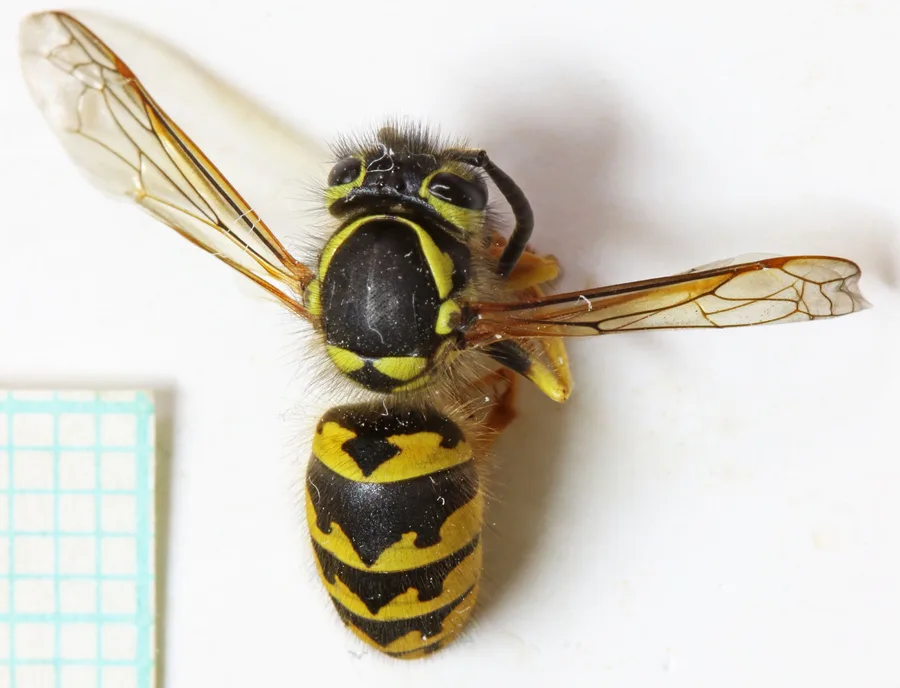
| Eastern yellowjacket (Vespula maculifrons), native | In the ground in woodlands, pastures, parks and lawns; occasionally in wall voids in northern cities | Most of the eastern U.S., from North Dakota to Texas and east to the Atlantic | Wide anchor-shaped black mark on the first abdominal segment; the yellow cheek band does not completely encircle the eye |
| German yellowjacket (V. germanica), invasive from Eurasia | In North America mostly open cavities such as wall voids and attics; sometimes underground | Northern U.S. coast to coast; south of Washington, D.C. mainly in the higher Appalachians | Small spade-shaped black mark on the first abdominal segment and black dots down both sides; 1,000 to 3,000 workers in fall; most commercial traps do not attract it, says Ohio State |
| Western yellowjacket (V. pensylvanica), native | Ground nests | Western states; UC IPM calls it the most commonly encountered species in California, and WSU calls it the most common and aggressive species in its area | The “meat bee”; the common trap lure heptyl butyrate attracts mainly this species |
| Southern yellowjacket (V. squamosa) | Underground, as UF/IFAS describes Florida’s yellow jackets | The South; one of the two yellow jackets UF/IFAS lists for Florida | Can build very large multi-year colonies; Clemson cites an estimated 250,000 workers in one South Carolina nest |
| Common yellowjacket (V. vulgaris) | Cavities such as rotted tree stumps at higher elevations (UC IPM) | One of three yellow jackets Ohio State lists for Ohio | UC IPM says meat bait is believed to improve catches of this species and the German yellowjacket |
| Aerial yellowjackets (Dolichovespula arenaria and D. maculata, the bald-faced hornet) | Hanging paper nests on eaves or tree limbs, with the entrance at the bottom | Described in both California (UC IPM) and Florida (UF/IFAS) fact sheets | Do not turn to scavenging at season’s end but are extremely defensive near the nest; D. arenaria sometimes bites and stings at once |
Sources: Penn State Extension fact sheets on the German yellowjacket and eastern yellowjacket; UC IPM Pest Notes 7450; Ohio State Extension HYG-2075; UF/IFAS; Clemson HGIC; Washington State University Entomology.
The German yellowjacket is the invader to watch. Penn State says it was first detected in New York in 1891, stayed uncommon until the 1970s, and now outcompetes native yellow jackets. Ohio State says it first appeared in Ohio in 1975 and is now that state’s dominant species. Penn State says its habit of nesting in buildings may be one reason it was able to spread.
Yellow Jacket Nests: Where They Are and How Big They Get
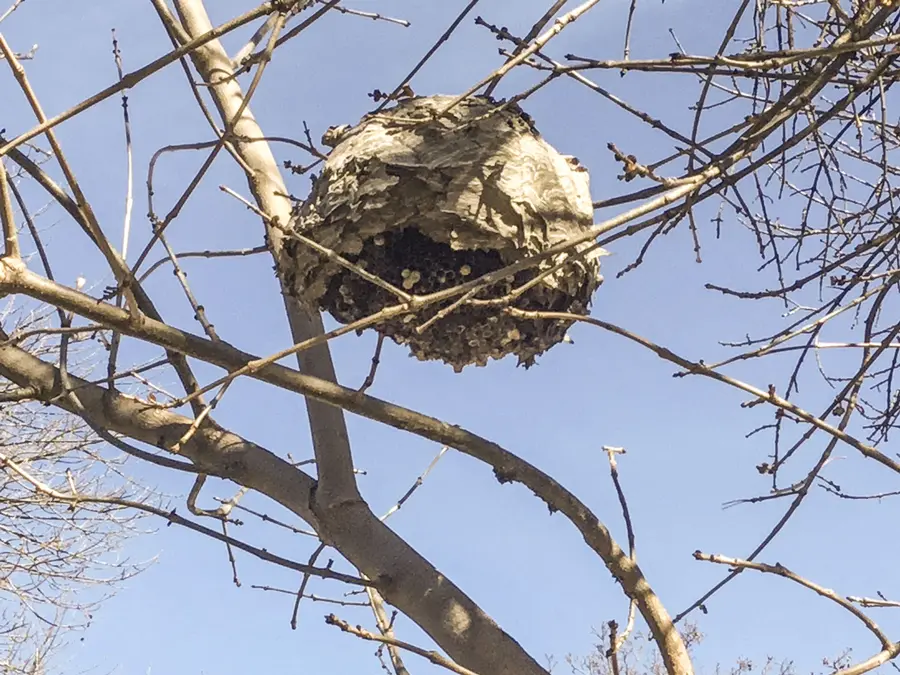
Most yellow jacket nests are hidden. Ohio State lists animal burrows, thick mulch piles, rotted tree trunks, wall voids and ceilings. UC IPM says many nests are in old rodent burrows, and that when a nest sits in a wall or ceiling, the wasps can moisten and dig the material until a wet patch becomes a hole. UF/IFAS says a ground nest often gives itself away when a few yellow jackets fly low to the ground and disappear into it. UC IPM adds that wasps flying straight in and out of one spot are probably flying to and from a nest. Bumble bees also nest in the ground, so see our guide to bumble bee ground nests if the traffic looks fuzzy rather than glossy.
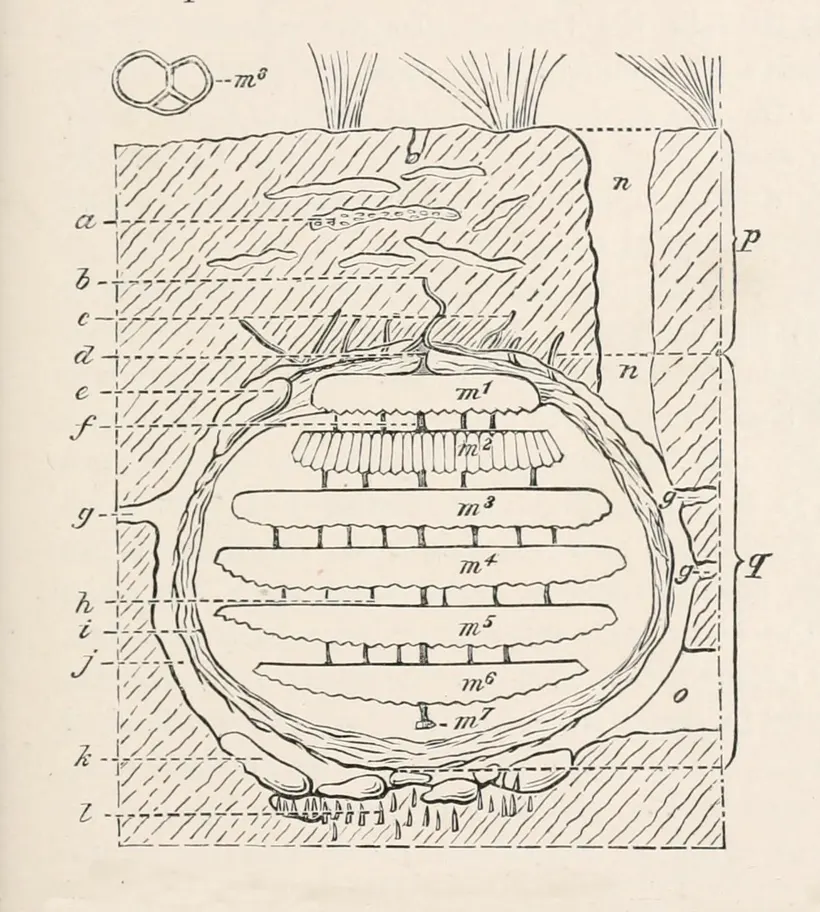
Ohio State says the nest is built entirely of wood fiber and wasp saliva, enclosed except for a small opening at the bottom, with many tiers of comb inside, sometimes 10 or more. Aerial yellow jackets hang the same kind of nest from an eave or a limb.
How big can a colony get?
Sources disagree because species, regions and counting methods differ. UC IPM gives 1,500 to 15,000 individuals depending on the species. Ohio State says Ohio nests reach about 4,000 to 5,000 workers and 10,000 to 15,000 cells by August through late September, and Penn State puts German yellowjacket nests at 1,000 to 3,000 workers in fall. Paper wasp nests, by comparison, hold about 15 to 200 wasps.
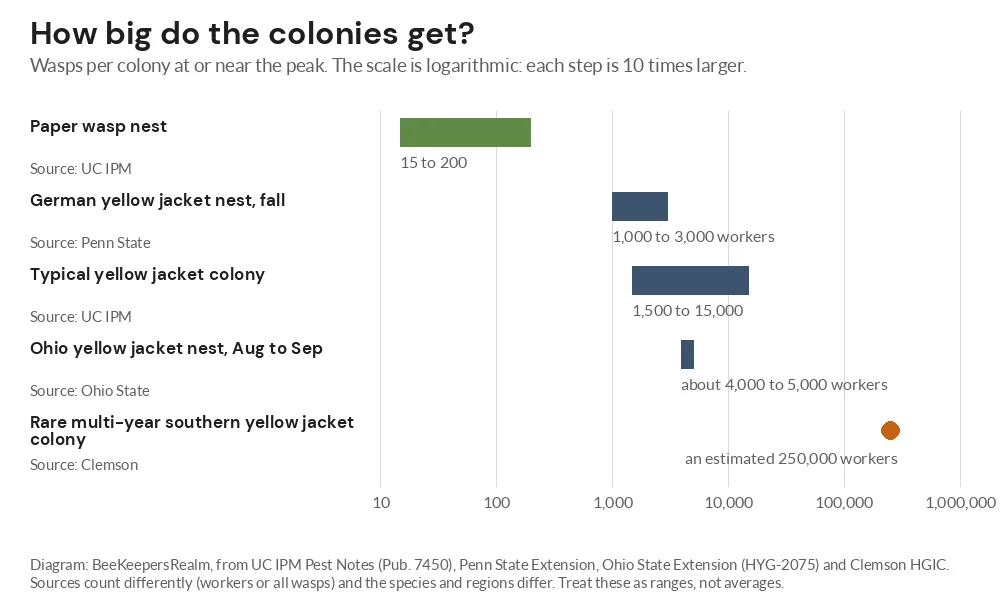
A few colonies break the pattern. UC IPM says some yellow jacket colonies in very mild winters, and in coastal California south of San Francisco, survive for several years and become quite large. Penn State says such perennial German yellowjacket nests are occasionally found in North America but are not common. Clemson describes a southern yellow jacket colony in Charleston County, South Carolina, in August 1991, with an estimated 250,000 workers that was thought to have been used for more than one year.
Foragers travel. Ohio State says yellow jackets fly 300 to 1,000 yards from the nest in search of food, so the wasps at your picnic may nest well away from your yard. For help telling nests apart, and when to call a professional, see our wasp nest removal guide.
The Colony Year, Season by Season
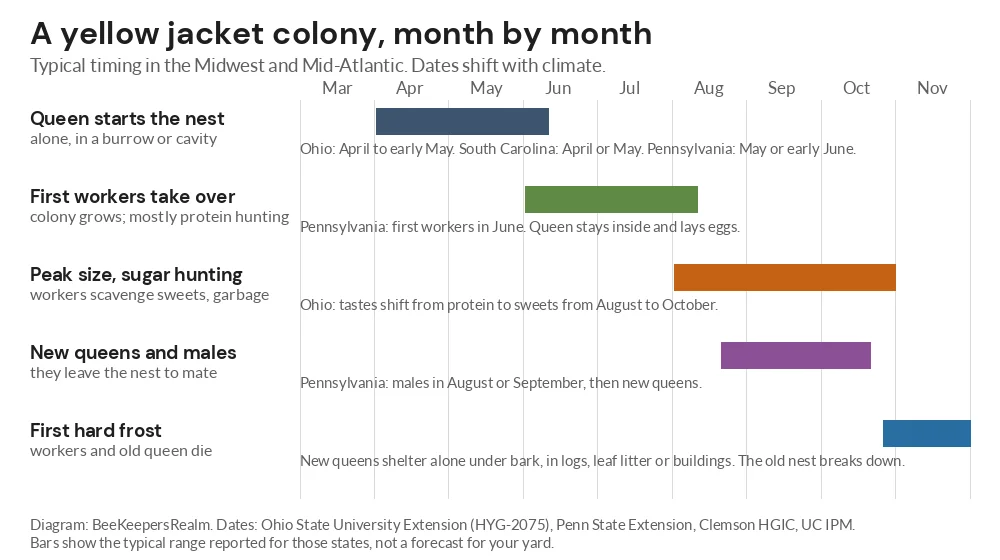
Every yellow jacket colony is annual. Only new, mated queens survive the winter, and each starts over alone in spring.
| Stage | Typical timing | What is happening |
|---|---|---|
| Queen founds the nest | Ohio: April and early May. South Carolina: April or May. Pennsylvania: May or early June | The overwintered queen feeds on nectar and insects, picks a site such as an abandoned mouse or rabbit burrow, builds a small paper nest and lays eggs. Ohio State says she feeds the first larvae for about 18 to 20 days. |
| Workers take over | Pennsylvania: first workers in June | Workers expand the nest, forage, feed the larvae and guard the entrance. The queen stays inside and lays eggs. |
| Growth phase | Spring to midsummer | UC IPM says larvae need a lot of protein, so workers mostly hunt other insects and take some sugar. |
| Peak and sugar hunt | Late summer; Ohio State puts the shift to sweets at August through October | Growth slows or stops. UC IPM says the colony now needs large amounts of sugar, and foraging wasps look for sweet things. |
| New queens and males | Pennsylvania: males in August or September, followed by new queens | Reproductives leave to mate. Males die soon after, and new queens look for a protected place to hibernate. |
| Decline | First hard frost or cold weather | Workers and the old queen die. Clemson says abandoned nests above ground rarely get reused, and Ohio State says they break down over winter. |
Sources: Ohio State Extension HYG-2075; Penn State Extension (eastern yellowjacket); Clemson HGIC factsheet 2486; UC IPM Pest Notes 7450. Timing varies with climate and the species.
Penn State says overwintering queens sometimes turn up inside homes in winter and spring, and that sealing cracks in siding and around windows and pipes is the long-term fix. Where you live changes the dates, not the order. A mild winter or heated structure is the main exception: Penn State notes German yellowjacket nests in warm places can survive the winter and grow into a second season.
Why Yellow Jackets Get Aggressive in Late Summer
The late-summer reputation is real, and extension sources agree on the cause. UC IPM puts it plainly:
“Defensive behavior increases as the season progresses and colony populations become larger while food becomes scarcer.”
Three things stack up at once:
- The colony is at its largest. A bigger colony simply has more workers available to defend it.
- Their diet turns to sugar. UC IPM says fall foragers are mainly scavengers, showing up at picnics, garbage cans, pet food dishes and ripe fruit. Ohio State adds that perfume, hairspray and flowery clothing attract them.
- Nests get disturbed. Ohio State says yellow jackets primarily sting to protect the nest but will also sting away from it if threatened or restrained. Ground nests can be hit with a mower, and Ohio State warns that any noise or disturbance near a nest can provoke stinging.
Squashing a wasp makes it worse. UF/IFAS says an injured yellow jacket releases an alarm pheromone that draws defensive behavior from the whole colony, and Ohio State advises walking away instead of swatting. One nuance from UF/IFAS: a yellow jacket at your picnic is looking for food, not defending a nest, and is less aggressive than one at the entrance. UC IPM still warns that a scavenger may sting if you try to swat it from food.
Aerial nests follow a different pattern. UC IPM says aerial yellow jackets do not turn into scavengers at the end of the season, but they defend a disturbed nest fiercely.
What Yellow Jackets Eat
Adults and larvae eat differently. Ohio State says adults feed on sugars and carbohydrates such as fruit, nectar and tree sap, while larvae need protein from insects, meat and fish. Workers chew captured prey into a paste for the larvae, and Clemson says the larvae give back a sugary secretion that the adults eat, an exchange called trophallaxis. The protein hunting fits the “meat bee” nickname UC IPM mentions.
Penn State describes the German yellowjacket as an omnivore that preys on insects, scavenges carcasses and discarded food, and drinks honeydew from scale insects and spotted lanternflies. Penn State also warns that wasps sipping from a soda can can cause a sting on or in the mouth or throat. UC IPM says to cover soda cans, and Clemson says to check open containers before drinking.
Around honey bees, the picture is mixed. Clemson says yellow jackets are a problem around beehives in fall and will rob honey given the chance, stressing weak colonies. Penn State says German yellowjackets sometimes attack honey bees but usually target individual bees, and honey bees often repel them. For the beekeeper’s side of this, see how to protect beehives from yellow jackets.
Are Yellow Jackets Beneficial?
For most of the year, yes. Clemson’s honey bee specialist puts it this way:
“Yellowjackets are beneficial around home gardens and commercially grown fruits and vegetables at certain times because they feed on caterpillars and harmful flies.”
Penn State says eastern yellow jackets reduce populations of earwigs and caterpillars, so a nest can be ignored unless it is close to a building entrance, in a mowed lawn or anywhere the public is likely to meet it. UC IPM says most social wasps should be protected and encouraged to nest where people and animals rarely go. It also says none of their natural enemies, which include birds, skunks, bears and spiders, gives satisfactory control around the home. Clemson adds that skunks and bears dig up underground nests in fall to eat the young.
Yellow Jacket Stings: What the Extension Sources Say
- They can sting repeatedly. Clemson says a yellow jacket does not leave its stinger in the victim, unlike a honey bee. UC IPM notes the stinger has no barbs and can be used repeatedly, especially when a wasp gets inside clothing.
- Pain is comparable to a honey bee’s. Our guide to the Schmidt sting pain index puts a typical yellow jacket sting in the same tier as a honey bee’s.
- Many stings are a medical issue. UC IPM says multiple-sting encounters can damage red blood cells and tissue, and the breakdown products can block the kidneys. Ohio State says to seek medical attention for more than ten stings or stings in the mouth or around the eyes.
- Allergy is the big risk. Ohio State says to get emergency care right away after a past allergic reaction, or with difficulty breathing or swallowing, throat or neck tightness, confusion or fainting. PestWorld adds that people can become hypersensitive after being stung.
This guide does not cover treatment. For first aid, home remedies and when to use epinephrine, read our guide to treating bee and wasp stings.
What to Do About Yellow Jackets
Remove what draws them
UC IPM’s list is short and works: keep food, including pet food, covered or indoors; cover soda cans; keep garbage in sealed cans and empty them regularly; and pick up ripe fruit. UC IPM also warns that once wasps find food, they keep hunting around that spot long after the food is gone. Ohio State adds keeping screens on doors and windows in good repair and picking picnic sites away from open trash.
Traps help, within limits
UC IPM says lure traps can reduce the number of foraging workers in a small area but do not eliminate large populations, and that the common lure, heptyl butyrate, attracts primarily the western yellow jacket. Ohio State agrees that no trap gives rapid knockdown and that most commercial traps do not attract the German yellowjacket, the most common nuisance there. UC IPM says traps work best as queen traps in late winter to early spring, and should go between the area you want to protect and the nesting area, away from where people sit. For honey-bee-safe baits and trap placement near hives, see our hive protection guide.
If you find a nest
| Nest | What the sources say |
|---|---|
| Ground nest far from people | Penn State says it can be ignored unless it is near a building entrance, in a mowed lawn or where the public passes. Clemson says yellow jacket colonies do not normally survive the winter. |
| Ground nest where people walk or mow, or anyone is allergic | UF/IFAS says the safest option is a professional pest control operator. Penn State says anyone with known sensitivity should have nests near the home removed by professionals. |
| Wall void, attic or ceiling | Do not plug the entrance. Penn State says professionals should treat nests inside walls or attics, and UC IPM says nest removal for cavity-dwelling yellow jackets is not practical because the nests are inaccessible. |
| Hanging aerial nest | Clemson says an out-of-the-way nest can be left for cold weather to kill. UC IPM says that if a nest must be eliminated, calling a professional is easiest and safest, and warns that wasps attack when they sense poison being applied. |
“NEVER attempt to control yellowjackets in a wall by plugging the opening. This can cause yellowjackets to chew through the interior sheetrock walls and enter the home.”
If you do decide to treat a nest yourself, every extension guide here says the same two things: use only a product labeled for yellow jackets, and follow the label exactly. UC IPM warns that stings are likely even at night, and Ohio State says to hire a professional. We do not give pesticide products or amounts here. See our wasp nest removal guide for cost ranges and when to call a pro.
If you disturb a nest
Clemson advises walking away slowly while covering your face with both hands, then heading for dense vegetation, a vehicle or a building, because swift movements attract more yellow jackets. Ohio State says that if you have disturbed a whole nest, protect your face and run. After that, see sting first aid.
If you keep bees
Narrow entrances, strong colonies and a clean apiary matter most; the details are in our guide to protecting beehives from yellow jackets.
Frequently Asked Questions
Are yellow jackets wasps or bees?
Wasps. They belong to the wasp family Vespidae, and UC IPM notes they are less hairy and more brightly striped than honey bees.
Are yellow jackets hornets?
Not usually. The bald-faced hornet is actually a yellow jacket, while true hornets, such as the European hornet, are a separate group.
What is the difference between a yellow jacket and a regular wasp?
Yellow jackets are wasps, so the useful question is how they differ from other wasps. Compared with paper wasps, they are stockier, have a barely visible waist, nest in enclosed paper nests, and scavenge human food.
Are yellow jackets aggressive?
Mostly when defending a nest. UC IPM says defensive behavior increases through the season, and ground- and cavity-nesting species defend vigorously. Aerial yellow jackets also defend hard but do not scavenge at season’s end.
Can yellow jackets sting more than once?
Yes. Clemson and UC IPM both say they can sting repeatedly.
Where do yellow jackets nest?
Mainly underground in old rodent burrows and in wall or ceiling voids. Aerial species hang nests from eaves and tree limbs.
What attracts yellow jackets?
Sweet drinks, ripe fruit, meat, pet food and open garbage. Ohio State says they are also drawn to perfume, hairspray and flowery clothing.
When do yellow jackets die in the fall?
Workers and the old queen die with the onset of cold weather, and Clemson says colonies do not normally survive the winter. New queens shelter alone through winter.
Should I destroy a yellow jacket nest?
Not always. Penn State says an eastern yellow jacket nest far from people can be ignored. A nest near a door, a mowed lawn, a wall void or an allergic family member calls for a professional.
Do yellow jackets attack honey bee hives?
Sometimes, mostly in fall. Clemson says they will rob honey from weak colonies, while Penn State says honey bees often repel them. See our hive protection guide.
Next Steps
Identify the nest type first, then decide whether it needs action at all. Our wasp nest removal guide covers costs and who to call, and our sting first aid guide covers what to do if the worst happens.
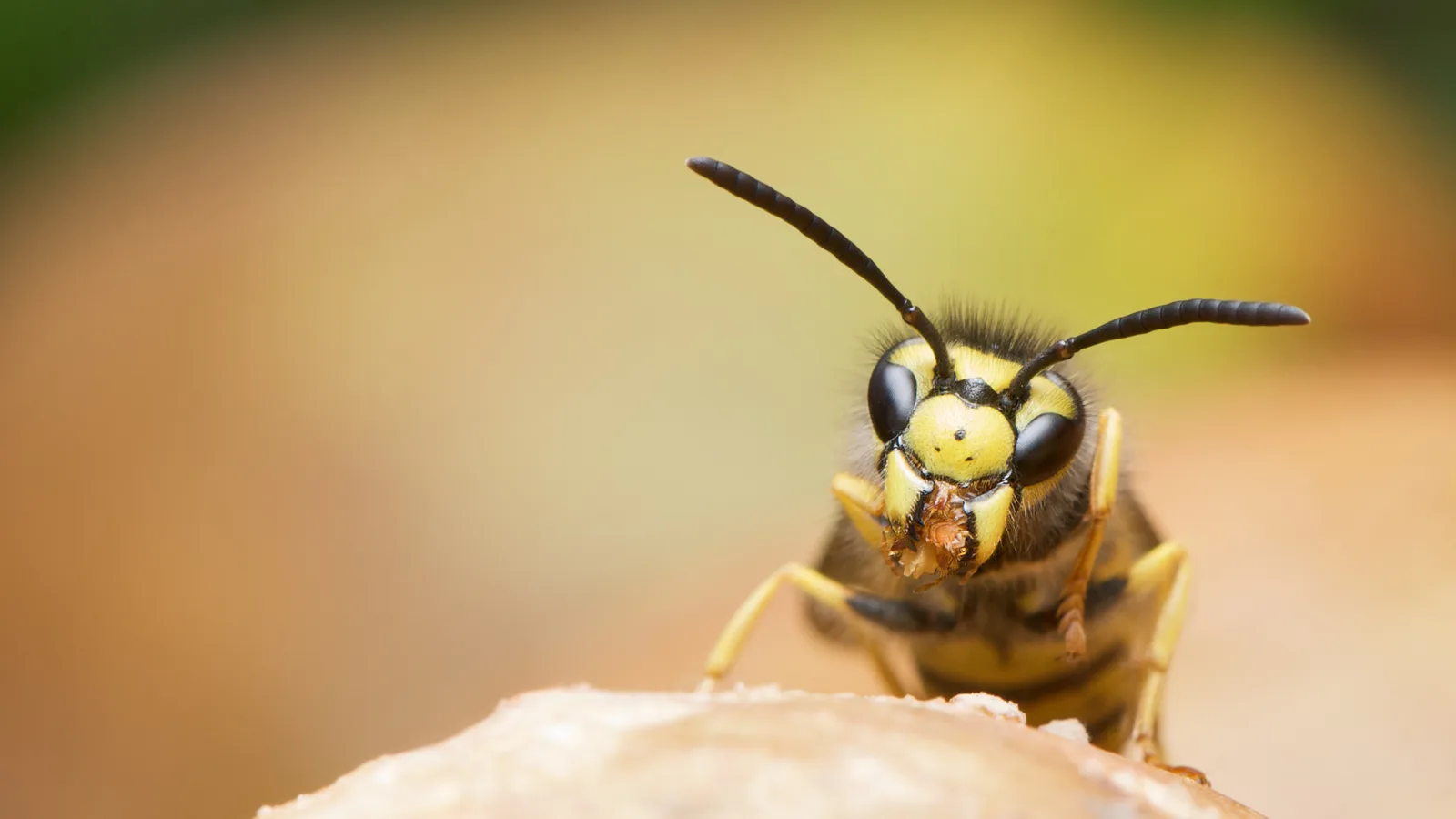
Featured image: a German yellowjacket (Vespula germanica) worker, face on. Photo: Bernie, via Wikimedia Commons, public domain, cropped.