Reviewed by Elena P. · Last Updated November 4, 2026 · How we review
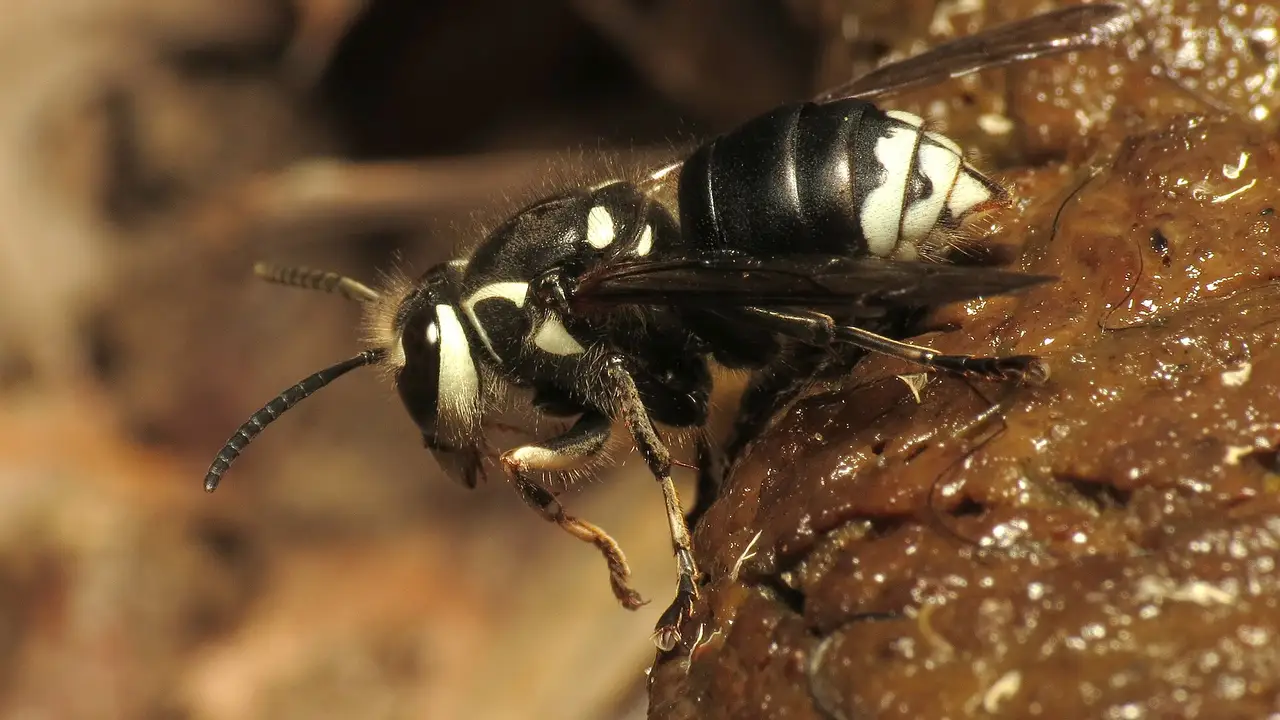
A bald-faced hornet (Dolichovespula maculata) is a large black-and-white wasp that is not a true hornet. It is an aerial yellowjacket, named for its white face. It builds a gray, paper-covered nest out in the open, usually in a tree or shrub, and defends it hard: Iowa State Extension says it will usually attack if you come within 3 feet. Its sting rates a 2 on Schmidt’s 4-point pain scale, the same as a honey bee’s, but it can sting again and again.
Away from the nest it is a calm insect that ignores picnics. For the true hornets it gets mistaken for, see our hornet vs wasp guide.
Key Takeaways
- It is a yellowjacket, not a hornet. Penn State Extension counts 7 or 8 Dolichovespula species in North America, and the bald-faced hornet is the most common one in Pennsylvania.
- Look for a black body, a white face, white markings on the thorax and a white-banded tip on the abdomen. Workers run about 5/8 to 3/4 inch; queens range from 3/4 to just over an inch, depending on the source.
- The nest is gray, egg-shaped and layered, with its main opening at the bottom. A peak colony holds 100 to 400 workers.
- The sting rates 2 of 4. The stinger carries 7 tiny barbs, but the species almost never loses it, so it can sting repeatedly.
- Nests away from foot traffic can be left alone. Colonies die in fall and the nest is never reused.
Table of Contents
- What a Bald-Faced Hornet Is
- How to Identify a Bald-Faced Hornet
- Bald-Faced Hornet Nest: Size, Shape and Location
- The Colony Season: When the Nest Starts and Dies
- Bald-Faced Hornet Sting: Pain, Barbs and Danger
- How Aggressive Is It?
- What to Do About a Nest
- Bald-Faced Hornets and Honey Bees
- Frequently Asked Questions
- The Bottom Line
What a Bald-Faced Hornet Is
The bald-faced hornet is a native North American wasp in the yellowjacket family. Penn State Extension notes that the only true hornet in North America is the introduced European hornet, Vespa crabro. NC State Extension says it is called a hornet because of its large size and aerial nests.
Penn State puts it in most of the 48 contiguous states, throughout Canada and in Alaska. Wikipedia calls it most common in the southeastern United States, so sources differ on where it is thickest.
| Bald-faced hornet | European hornet | Ground yellowjacket | Paper wasp | |
|---|---|---|---|---|
| True hornet? | No, aerial yellowjacket | Yes | No | No |
| Look | Black with a white face | Large, reddish brown with a yellow abdomen | Black and yellow | Slender, with varied markings |
| Nest | Gray paper ball in the open | Usually hidden in a hollow tree or wall void | Hole in the ground | Open umbrella comb, no outer shell |
See our European hornet guide. Two invasive hornets are also in the news: the northern giant hornet and the yellow-legged hornet. Neither has a white face.
How to Identify a Bald-Faced Hornet
The Missouri Department of Conservation describes a fairly large wasp that is mostly black, with white or ivory markings on the face, thorax and toward the tip of the abdomen. Its wings are translucent dark brown. Wikipedia counts three white stripes at the end of the body. Unlike the wasps we call yellowjackets, it is not yellow at all.
Size is where sources disagree. Penn State gives 13 to 20 mm for the queen and her offspring. The University of Maryland Extension gives 5/8 to 3/4 inch for workers and just over an inch for queens, while Missouri lists 1/2 to 3/4 inch for workers and 3/4 inch for the queen. Cornell’s pest management program calls it the largest yellowjacket in North America, at least 0.6 inch long.
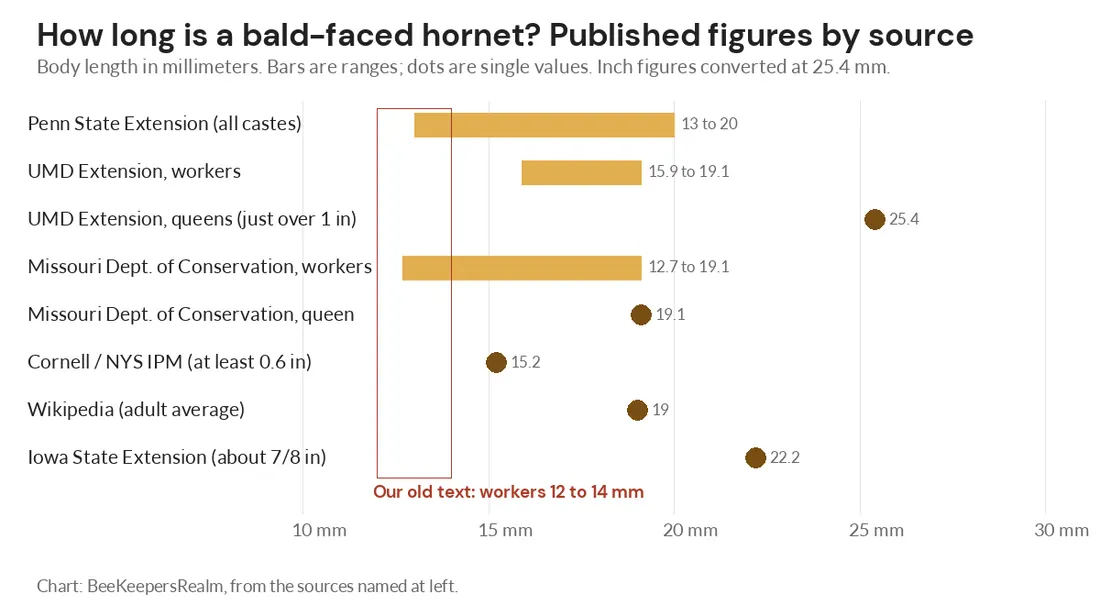
Because a worker from one colony can match a queen from another, per Wikipedia, use the markings, not the size, to confirm. To sort it from other stinging insects, start with our bee vs wasp identification guide.
Bald-Faced Hornet Nest: Size, Shape and Location
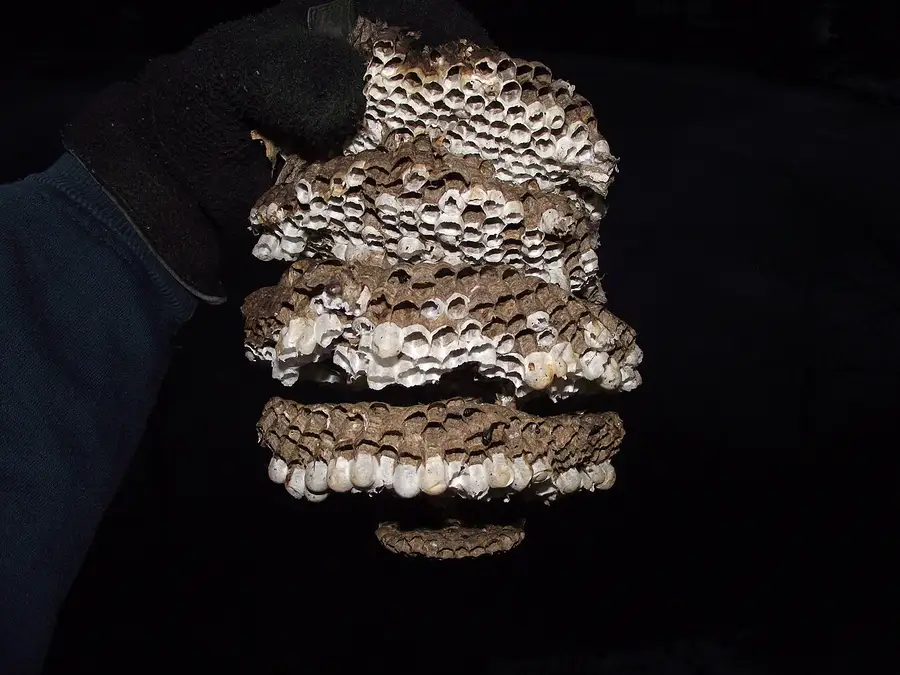
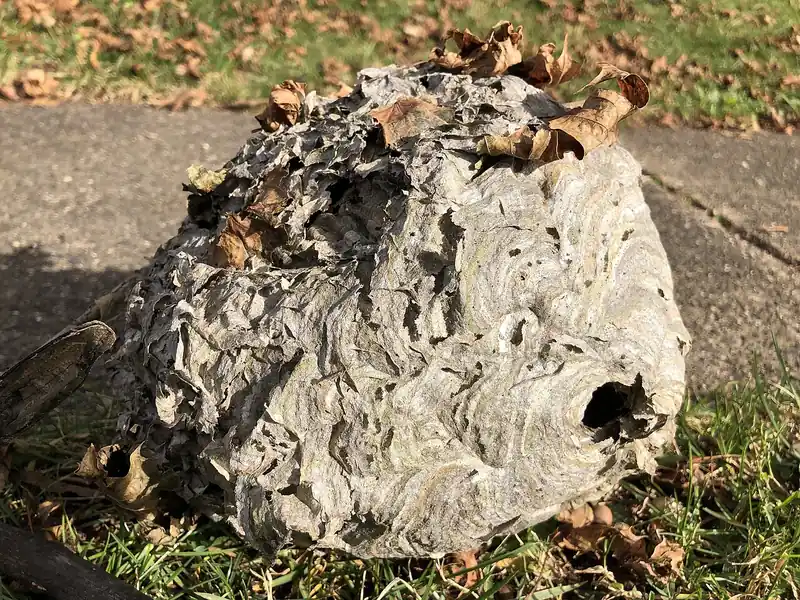
A bald-faced hornet nest is a gray, egg-shaped or cone-shaped ball of paper made from chewed wood fiber and saliva. Iowa State describes three or four tiers of comb inside a thick, multilayered outer shell, with a single opening at the bottom. The University of Maryland notes that the lowest opening is the main entrance, though other arched openings can appear around the top.
| Nest fact | Figure | Source |
|---|---|---|
| Workers at peak | 100 to 400 | Penn State, Iowa State, UMD |
| Height above ground | At least 3 ft; trees up to 60 ft or more | Penn State, UMD |
| Largest size reported | 24 in tall by 18 in across (Pennsylvania) | Penn State |
| Typical late-summer size | Larger than a basketball | Cornell NYS IPM |
| Common supports | Tree branch, shrub, utility pole, house siding | Iowa State |
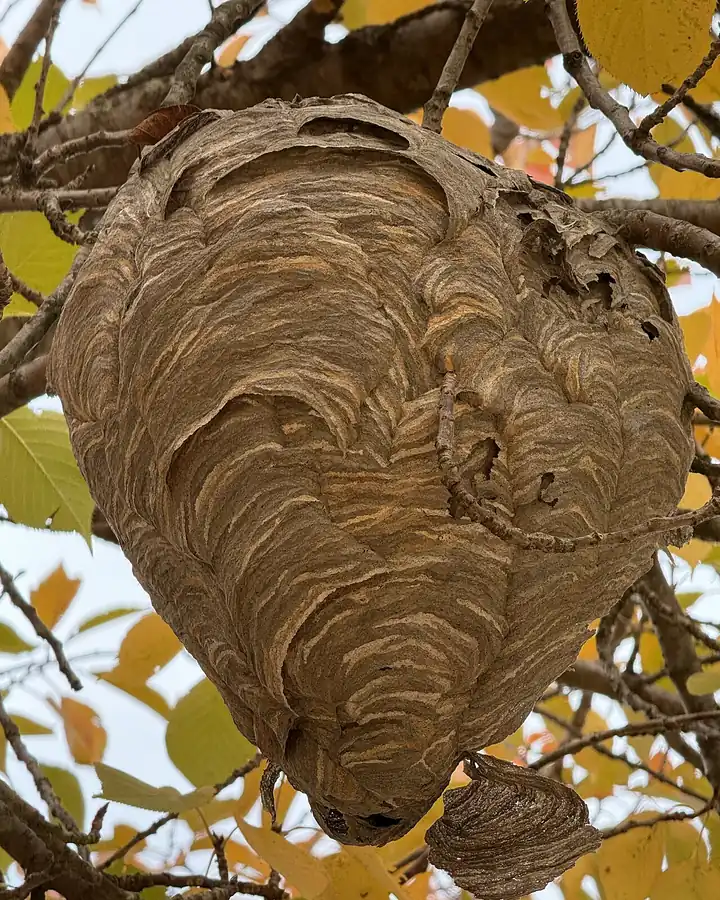
The University of Maryland says nests are easy to miss until winter reveals them, which is why a nest seems to appear overnight. Iowa State adds that growth is slow at first and speeds up by mid-summer.
The Colony Season: When the Nest Starts and Dies
Each colony starts alone. Penn State says a queen that overwintered in a hollow tree, rock pile, under bark or in a building wall or attic emerges in spring, chews weathered wood into paper and builds a few brood cells. Her first daughters take over building, foraging and defense. Cornell puts the start of a new nest in late April or May.
Wikipedia reports that the season depends on latitude: about 122 days in Washington (mid-May to mid-September), 153 in Indiana, and 155 to 170 in central California, where nests start as early as late March.
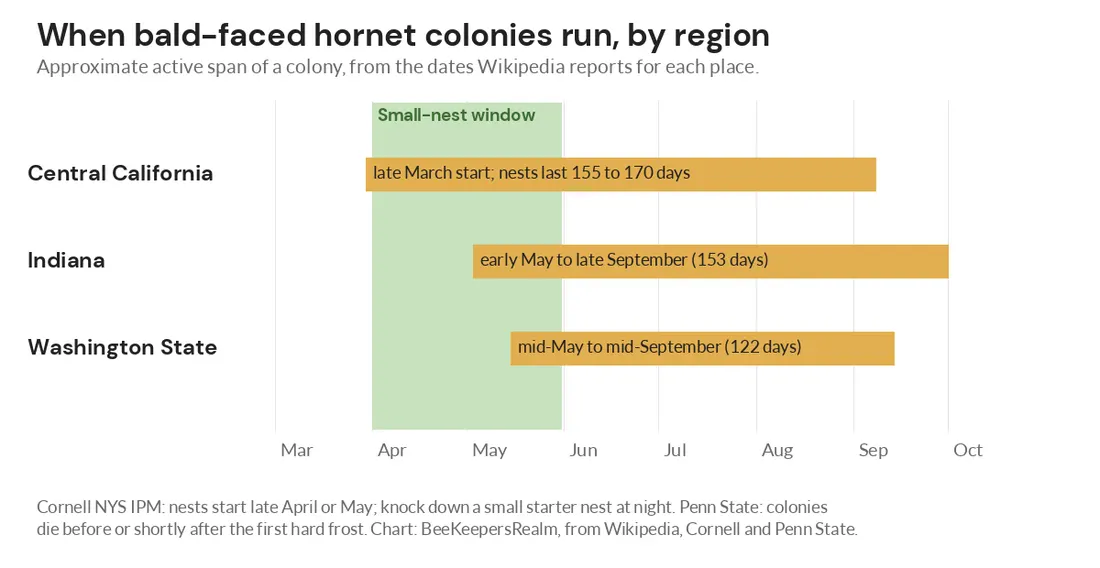
Late in summer the colony raises males and new queens. Iowa State says they leave to mate and the mated queens hibernate, while the old queen, workers and males die of age or cold. Penn State says most of the colony is gone before or shortly after the first hard frost, and Iowa State confirms the old nest is never reused.
Bald-Faced Hornet Sting: Pain, Barbs and Danger
Justin Schmidt’s 2019 table in Toxins rates the bald-faced hornet sting 2 on his 1-to-4 scale, anchored on the honey bee at 2. That is the same pain score as the honey bee, so a single sting is not unusually severe on that scale. Our Schmidt pain index guide explains how the scale works.
The bigger issue is repeats. Cornell’s fact sheet says the stinger “is not barbed” and each hornet can deliver multiple stings. A 2021 study in Insects by Bissessarsingh and Starr counted 7 lancet barbs on the bald-faced hornet’s stinger, with a serration index of 0.76, and recorded stinger loss as almost never. So the barbs are tiny and the stinger does not stay in the skin. The practical result is the same: it can sting repeatedly, unlike a honey bee. We compare the two in bee sting vs wasp sting.
Wikipedia reports that it can spray venom into the eyes of nest intruders. We found no extension or journal source confirming this, so treat it as unverified, but protect your eyes near any nest.
Multiple stings often occur near a nest, Cornell warns, and the best response is to leave the area quickly. North Carolina State notes that people allergic to stings can die without prompt medical attention. Follow the steps in how to treat a bee or wasp sting, and call emergency services for trouble breathing, a swollen face or throat, or dizziness. This is educational information, not medical advice; see MedlinePlus on insect stings.
How Aggressive Is It?
Defensive near the nest, calm elsewhere. Iowa State sets the distance:
“Hornets are very protective of their colony and will usually attack if someone approaches within 3 feet of the nest.”
Away from home, the picture changes:
“Aggressive nest defense makes these wasps a stinging threat, but their foragers do not collect sweets or food scraps and are not aggressive away from the nest.”
The University of Maryland adds that you should not mow under a nest, strike the tree or wall holding it, or shine a light at the entrance, and that late in the season, as the colony’s social order breaks down, workers may be more easily agitated.
What to Do About a Nest
Match the response to the location. Penn State says nests can be ignored unless they sit within about 10 feet of a building entrance, low under an eave or in shrubs beside a mowed lawn. Penn State adds that they eat other yellowjackets and pollinate flowers while sipping nectar, and Missouri says they should not be destroyed indiscriminately.
- Small starter nest in April or May. Cornell says the best time to act is at night, when all colony members are present; knock the small nest down with care, using red-filtered light so guards are not alerted.
- Large summer nest near people. Cornell says summer nests can hold hundreds of defenders and that a pest professional may be needed because of sting and allergy risk. The same goes for anyone with a known sting allergy, per Penn State.
- Doing it yourself. Iowa State says to spray into the entrance at night with a product made for the purpose, wear heavy clothing, and leave the nest up until every wasp is dead, which can take a day or two. Penn State warns that spraying only the outside angers the colony. Follow the product label.
- Home remedies and old nests. The University of Maryland says not to burn or flood a nest, which raises sting risk, and that empty nests in trees need not be removed.
Our wasp nest removal guide covers the decision steps for every kind of nest, and the predatory wasp comparison chart sorts the species by risk.
Bald-Faced Hornets and Honey Bees
Beekeepers sometimes see bald-faced hornets near hives. Rusty Burlew of Honey Bee Suite says a hive offers live bees, dead bees, nectar, honey and pollen, but that the hornets “mostly just take dead ones from the ground around the hives.” That is one beekeeper’s report, and we found no university data on how often they kill live bees. They are far less of a threat than the invasive hornets covered above. If your hive is under pressure, the culprit is more often a yellowjacket; see how to protect beehives from yellow jackets.
Frequently Asked Questions
Is a bald-faced hornet a true hornet?
No. It is an aerial yellowjacket in the genus Dolichovespula. The only true hornet long established in the U.S. is the European hornet.
Can a bald-faced hornet sting more than once?
Yes. Its stinger has 7 tiny barbs but almost never stays in the skin, so it can sting repeatedly.
How painful is a bald-faced hornet sting?
It rates 2 on Schmidt’s 4-point scale, the same as a honey bee. Allergic people can have a severe reaction.
How big is a bald-faced hornet nest?
Larger than a basketball by late summer, per Cornell. Penn State reports nests up to 24 inches tall and 18 inches across.
Do bald-faced hornets reuse their nest?
No. Iowa State says each nest is built from scratch every year and the old one cannot be reused.
Are bald-faced hornets dangerous to honey bees?
Mostly a nuisance. One beekeeper reports they mainly collect dead bees; there is no solid data on live-bee kills.
The Bottom Line
Leave an out-of-the-way nest alone, stay well beyond 3 feet of any nest, and call a professional for a large one by a door. To compare other stingers, see our bee, wasp and hornet identification guide.
Image credits: Hornet photo, Katja Schulz, via Wikimedia Commons, CC BY 2.0, cropped. Sources: Wikipedia; NC State Extension; Penn State Extension; University of Maryland Extension; Cornell NYS IPM fact sheet; Bissessarsingh and Starr 2021; Schmidt 2019; Honey Bee Suite.