Reviewed by Sofia T. · How we review
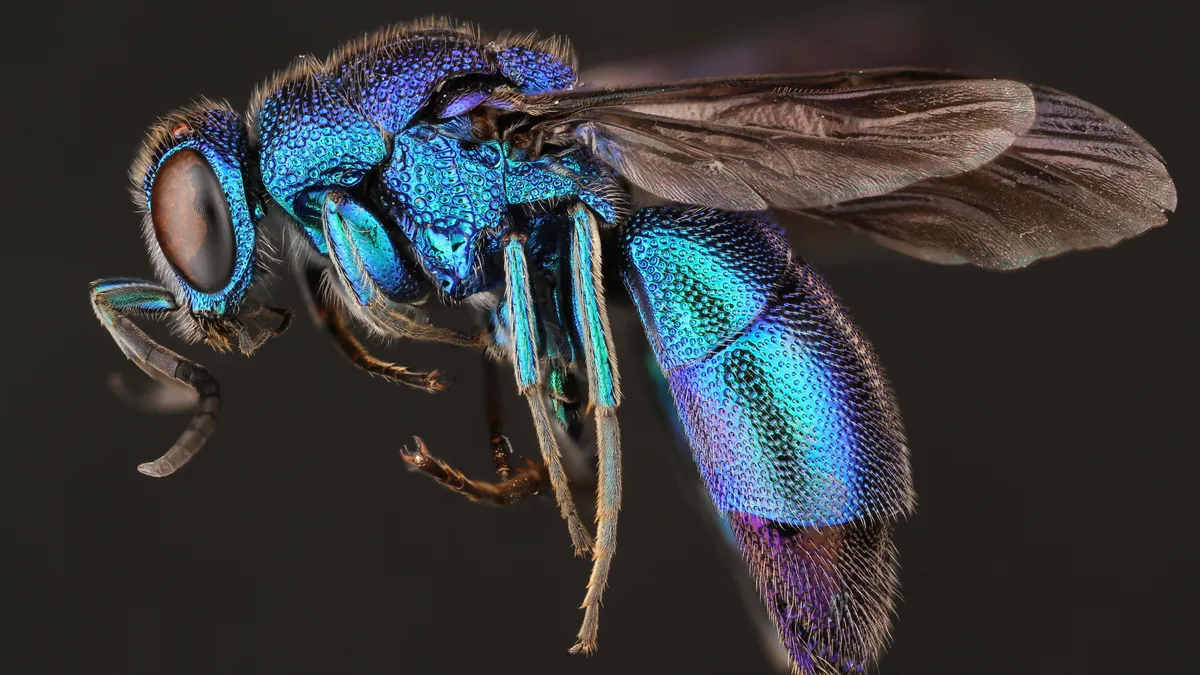
A cuckoo wasp is a small, metallic green, blue or red wasp in the family Chrysididae, and it lays its eggs in the nests of other wasps and bees. The cuckoo wasp larva then eats the host’s egg, young or stored food. Cuckoo wasps are not aggressive: the sting is reduced to an egg-laying tube, and none of the extension, state-agency or university sources we read reports a sting to a person. About 3,000 species have been named worldwide.
This page covers how to identify one, who it parasitizes, why it can curl into a ball and when US observers photograph it. Every claim comes from a named source, linked where we use it. We make no claim of personal field experience with these wasps.
Key Takeaways
- “Cuckoo wasp” means the family Chrysididae: metallic wasps with a coarsely pitted body. A 1982 synopsis counted 227 species north of Mexico, and Penn State Extension lists 47 for Pennsylvania alone.
- Females slip into other solitary wasps’ and bees’ nests. Some larvae are parasitoids that eat the host young; others are kleptoparasites that eat its stored food.
- Most can roll into a ball, with a flat or concave belly and hard cuticle to resist the host. Groups with harmless hosts cannot.
- They are not a sting risk. Kimsey and Bohart describe a “highly reduced sting,” and the Missouri Department of Conservation says female cuckoo wasps cannot sting.
- 65% of US iNaturalist observations fall in June to August, and Penn State says cuckoo wasps may turn up around mixed-species bee hotels.
Table of Contents
- What a Cuckoo Wasp Is, and What It Is Called
- How to Identify a Cuckoo Wasp
- How a Cuckoo Wasp Parasitizes Other Nests
- Who Parasitizes Whom: Cuckoo Wasp Groups and Hosts
- Why Cuckoo Wasps Roll Into a Ball
- Do Cuckoo Wasps Sting?
- Where and When to See Cuckoo Wasps
- Cuckoo Wasps and Bee Hotels
- Cuckoo Wasp vs Cuckoo Bee vs Cuckoo Bumblebee
- Frequently Asked Questions
- Next Step
- Sources
What a Cuckoo Wasp Is, and What It Is Called
In their 1990 world review, The Chrysidid Wasps of the World, Lynn Kimsey and Richard Bohart wrote, “Some 3000 apparently valid species of Chrysididae have been named.” These sit in 84 genera and four subfamilies, with a thousand or more still to be found. Their 1982 synopsis recognized 227 species north of Mexico. Both texts are published on Discover Life. Washington State University Extension gives “more than 200” North American species and says most occur in the west.
The name comes from the habit: a female lays her egg in a nest built by another insect, as the Old World cuckoo does with birds. Other names point at the color: gold, emerald and ruby wasp. In Britain, “ruby-tailed wasp” usually means Chrysis ignita and its look-alikes. “Jewel wasp” is also used for cuckoo wasps, but on Wikipedia it names the emerald cockroach wasp, Ampulex compressa, a cockroach hunter in a different family (Ampulicidae) and not a cuckoo wasp.
How to Identify a Cuckoo Wasp
NC State’s entomology course page lists three field marks: a metallic blue or green body with many pits in the surface, a strongly concave underside of the abdomen, and the ability to curl into a ball. The Missouri Department of Conservation uses the “sculptured or pebbly” pitted look to tell cuckoo wasps from metallic sweat bees. Size is small: Penn State gives 6 to 12 mm (about 0.25 to 0.5 inch) for the genus Chrysura.
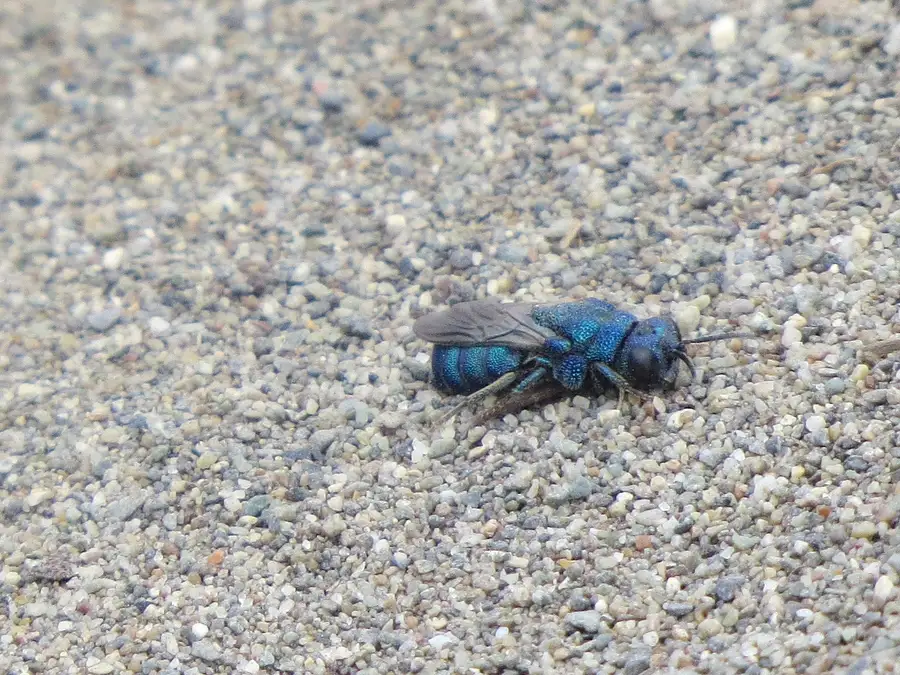
The color is mostly structural, made by interference rather than pigment, and the pits alter how it looks. Treat species names with caution. The UK recording site NatureSpot says Chrysis ignita “cannot be separated from other Chrysis species without expert examination,” and Penn State says two Chrysura species need male genitalia or DNA to separate. If you are unsure whether you have a cuckoo wasp or a sweat bee, see our guide to metallic sweat bees and our primer on telling a bee from a wasp.
How a Cuckoo Wasp Parasitizes Other Nests
The female hunts for nests, not prey. The University of Wisconsin-Milwaukee Field Station says she uses strong jaws to get into a host nest while the owner is out, and lays her eggs there. Hosts are known for “fewer than one fourth” of North American species (Kimsey and Bohart, 1982), so many life histories are inferred from relatives. Two terms matter:
- Parasitoid: the larva feeds on the host young and kills it.
- Kleptoparasite: the larva eats provisions the host collected for its own young.
Many species do both. In some, the larva waits on the host larva until it reaches the prepupal stage. In others it eats the host egg or young larva first, then the food. Adults visit flowers for nectar, and the UWM Field Station and WSU add aphid honeydew.
The oddest case is Pseudolopyga carrilloi. Kimsey and Bohart report that it lays its egg on free-living Nysius bug nymphs, and that the egg does not hatch unless a Solierella wasp later paralyzes the bug and stocks it in a nest. The cuckoo larva then eats the wasp egg and the bugs. For two mud-nest hosts, see our profiles of mud daubers and potter wasps.
Who Parasitizes Whom: Cuckoo Wasp Groups and Hosts
This table pulls scattered host records into one place. “KB 1990” is Kimsey and Bohart’s world review on Discover Life, “PSU” is Penn State Extension, and iNat counts are US research-grade iNaturalist observations pulled for this page.
| Cuckoo wasp group or genus | Host | What the larva eats | Where you see it | Source |
|---|---|---|---|---|
| Chrysis (for example C. fuscipennis) | Mud-nest wasps such as Sceliphron mud daubers and Eumenes potter wasps; C. cembricola uses the potter wasp Symmorphus canadensis | The host prepupa; the female may chew through the mud wall and cocoon to lay on it | Mud nests in exposed places; most recorded US genus (8,529 iNat observations) | KB 1990; PSU |
| Chrysura (for example C. kyrae) | Mason bees, including the horn-faced bee Osmia cornifrons | Attaches to the bee larva, which it generally kills and eats once the bee matures | Bee hotels in spring; adults emerge when the bees do | PSU |
| Hedychridium (for example H. solierellae) | Solierella wasps, which nest in twigs and the ground | The host’s provisions, and the host or a rival cuckoo larva | Running over sand and bare ground | KB 1990 |
| Pseudolopyga | Solierella wasps, through Nysius bug nymphs | The wasp egg, then the bugs | Twigs and ground nests in central California (1970 study); no US iNat records | KB 1990 |
| Stilbum cyanurum (Old World) | Sceliphron, Eumenes, Chalicodoma and Megachile | Egg laid in a sealed mud cell after the female softens the wall with a droplet | Observed in Hungary, photographed in Japan; no US iNat records | KB 1990 |
| Cleptinae (Cleptes) | Sawfly prepupae | The prepupa; the female chews a hole in the cocoon | Rare in photos: 12 US iNat observations | KB 1990; Wikipedia |
| Amiseginae (for example Adelphe) | Walking-stick eggs (Anisomorpha in a Georgia case) | The inside of the egg, after the female gnaws a hole in the shell | Rare in photos: 14 US iNat observations of Adelphe anisomorphae | KB 1990; Wikipedia |
The pattern is clear at subfamily level. Kimsey and Bohart say Amiseginae and Loboscelidiinae attack walking-stick eggs, Cleptinae attack sawfly prepupae, and Chrysidinae (apart from one genus that attacks moth caterpillars) use wasp and bee larvae. Single-species claims are shakier, as with Chrysis ignita. The Royal Entomological Society’s Insect Week says it “mainly parasitises mason bees,” yet Wikipedia says its hosts are believed to be potter wasps and that bee records are doubtful.
Why Cuckoo Wasps Roll Into a Ball
The roll-up is a defense against the host. Kimsey and Bohart describe the adult host as “a capable fighter,” equipped with powerful mandibles and a sting, so a cuckoo wasp in its nest is an intruder.
“However, chrysidine morphology allows them to roll up into an impenetrable ball if they happen to be attacked by the host.”
The diagram shows their reasoning. Cleptinae and Amiseginae attack hosts that cannot fight back, so their bellies stay convex and flexible and they cannot roll up. The main group, the Chrysidinae, attacks armed hosts and has a flat or concave belly under usually three hard segments.
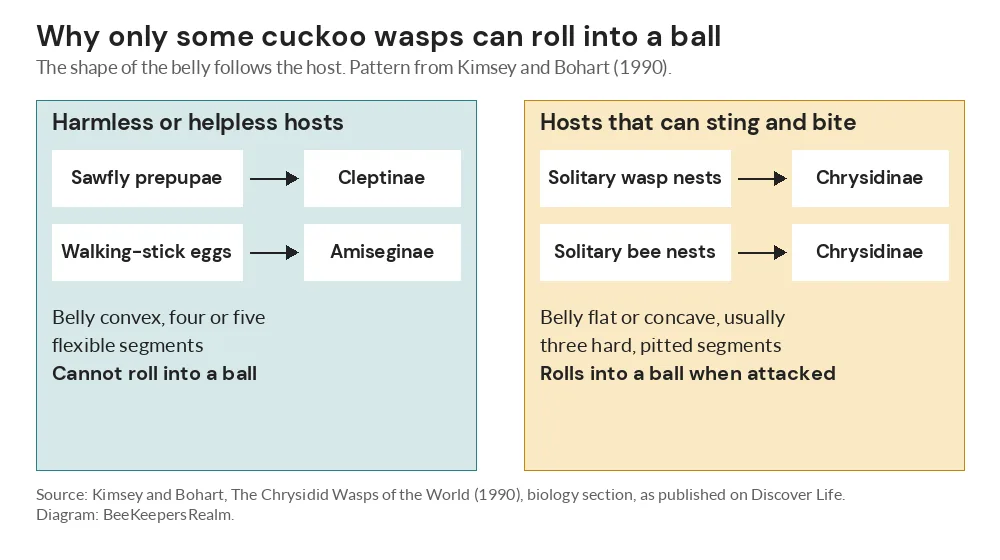
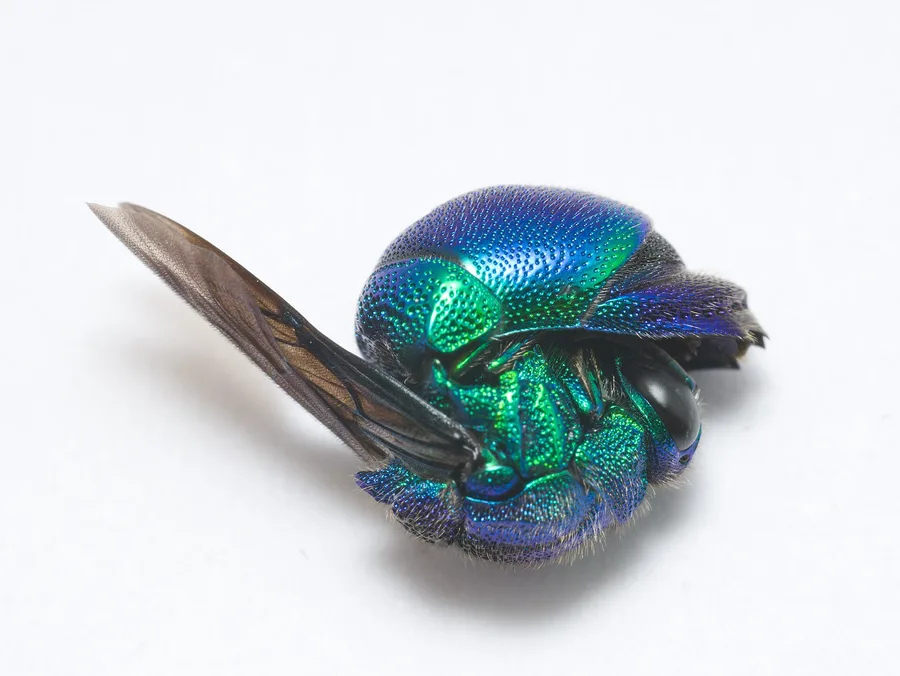
The UWM Field Station adds that in a pinch cuckoo wasps “roll up in a ball and stay still.” Wikipedia calls the curling “volvation” and compares it to a pill bug.
Do Cuckoo Wasps Sting?
Not in any way that matters to you. The family belongs to the stinging wasps, but the sting has become an egg-laying tube. Kimsey and Bohart write that “chrysidids have a highly reduced sting.” The Missouri Department of Conservation is more direct:
“Female cuckoo wasps cannot sting, which might explain the protective defensive posture in that group.”
Penn State says the Chrysura “stinger is soft and incapable of stinging.” The UWM Field Station is more careful: “many (but not all) sources say that cuckoo wasps have lost the ability to sting.” Some pest-control sites claim large species can give a mild prick, but we found no extension, state-agency or university source that documents a case. For wasps that do sting, see our comparison chart of stinging and predatory insects. This is educational information, not medical advice.
Where and When to See Cuckoo Wasps
Adults search sunny, dry places for host nests. Insect Week describes ruby-tailed wasps running over walls, banks and tree trunks, and NatureSpot notes sun-baked surfaces such as old walls and fence posts. Kimsey and Bohart say sweeping flowers such as wild buckwheat (Eriogonum) can turn up dozens of small ones.
For timing, we pulled the iNaturalist record. Research-grade observations of Chrysididae in the United States total 13,890, and 8,992 of them (65%) fall in June, July and August. July peaks at 3,422.
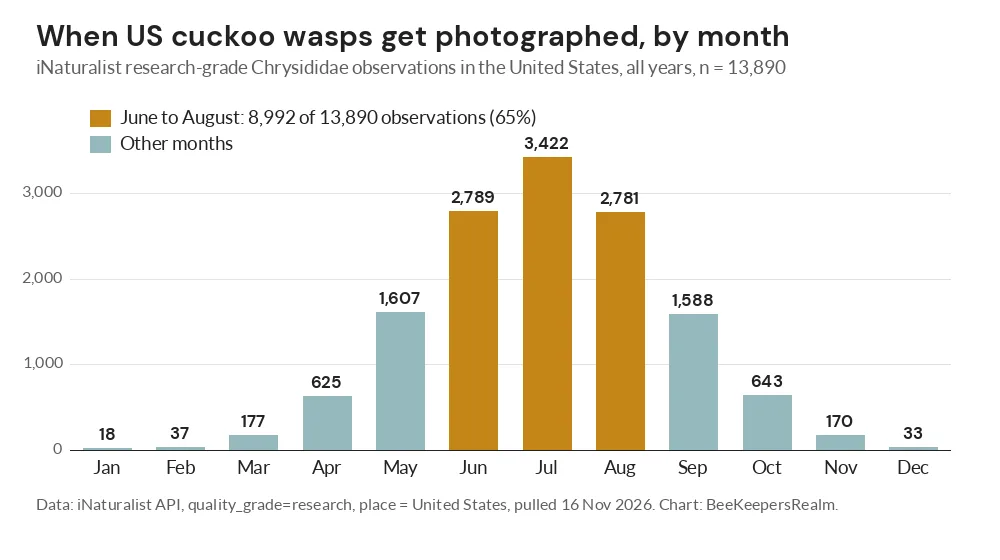
April to September holds 92% of records. Photos track observers as much as wasps. Among nine states we queried, Texas has 2,586 research-grade records, California 993, New York 783 and Pennsylvania 521, even though WSU says most species live in the west.
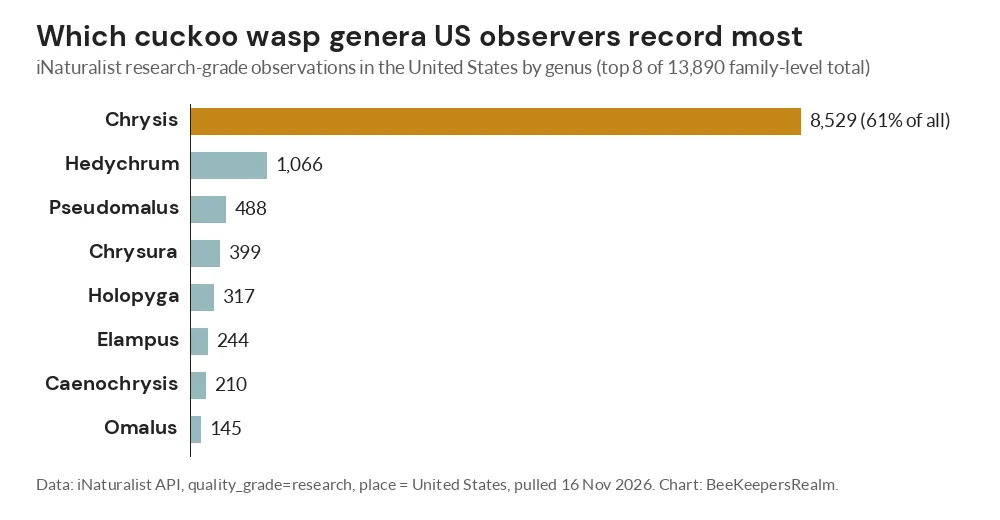
The record is lopsided. Chrysis has 8,529 observations (61%), and one species, Chrysis fuscipennis, has 6,257 (45% of the family). Because the genus is hard to separate by eye, read this as what observers and the iNaturalist community agreed on, not a census.
Cuckoo Wasps and Bee Hotels
A block of nest holes gathers hosts, so it can draw nest parasites. Penn State Extension says other cuckoo wasps parasitize various solitary bees and wasps, so they “may be found around mixed-species bee hotels,”, and it says three of the 47 Pennsylvania species are known to parasitize Megachilidae, a family that includes Osmia mason bees.
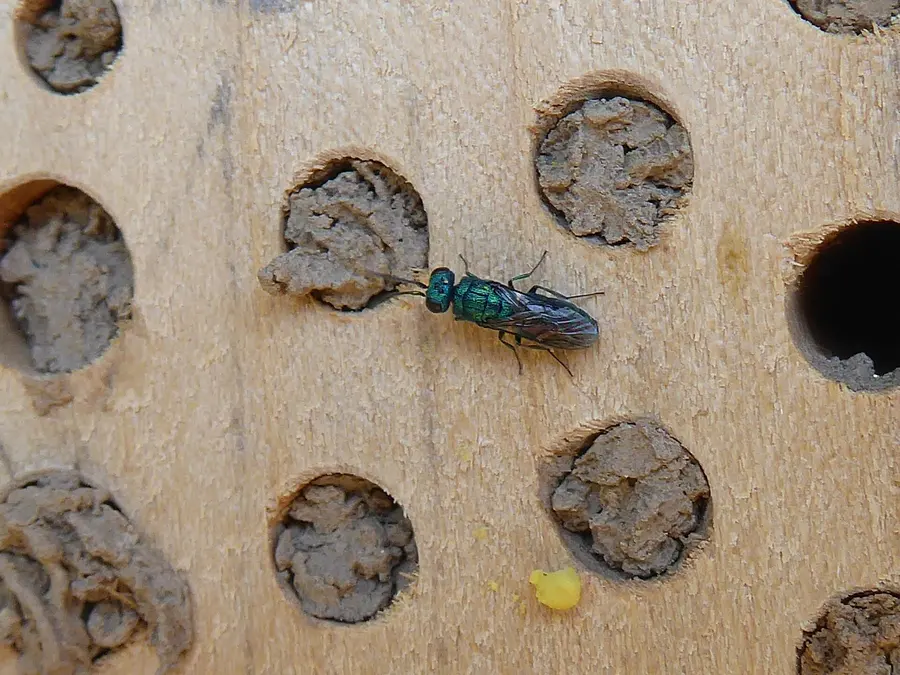
“Female cuckoo wasps enter an Osmia nest while it is still being provisioned and lay a single egg on the provisions.”
The bee larva keeps feeding while the wasp larva grows, and is generally killed and eaten once it matures. Penn State is the only source we found that links cuckoo wasps to a managed bee house, and it describes occasional parasitism, not a reason to panic. Our guides cover mason bees, leafcutter bees and how to build and maintain a mason bee house. Built-in nest holes, such as the bee bricks used in new walls, are the same kind of target; that is our inference, as we found no survey of cuckoo wasps on bee bricks.
Cuckoo Wasp vs Cuckoo Bee vs Cuckoo Bumblebee
All three cheat, but a cuckoo wasp is a wasp and the other two are bees.
| Check | Cuckoo wasp | Cuckoo bee | Cuckoo bumblebee |
|---|---|---|---|
| What it is | Wasp, family Chrysididae | True bee, such as Nomada and Sphecodes | Bumblebee, subgenus Psithyrus |
| Look | Metallic, coarsely pitted, usually three visible abdominal segments | Lacks the pollen-carrying hair of other bees | Bumblebee shape, no pollen baskets on the hind legs |
| Host | Solitary wasps and bees (also sawflies, walking-stick eggs) | Solitary bees | A whole bumblebee colony |
| Method | Egg slipped into a nest cell; larva eats host young or food | Egg slipped into a provisioned cell; larva eats the pollen | Invades the colony, subdues the queen, uses her workers |
| Defense | Hard cuticle; rolls into a ball | Not described in our sources | Thicker armor and chemical camouflage |
For the bee versions, see our guides to cuckoo bees and cuckoo bumblebees. Another bee-like nest parasite is the bee fly, and a different family of harmless parasitic wasps is covered in our ichneumon wasp guide. Our native bee identification chart places them all.
Frequently Asked Questions
Do cuckoo wasps sting humans?
Not in the sources we read. The Missouri Department of Conservation says female cuckoo wasps cannot sting, and Kimsey and Bohart describe a highly reduced sting.
Are cuckoo wasps dangerous?
No source we read lists them as a danger to people or pets. The harm is to other insects, whose young the larvae kill.
What does a cuckoo wasp look like?
A small metallic wasp, often green, blue, purple or red, with a coarsely pitted body and a concave underside of the abdomen.
Are cuckoo wasps parasitic?
Yes. Kimsey and Bohart say all known chrysidids are parasites, either parasitoids or cleptoparasites.
Why are they called cuckoo wasps?
Like the cuckoo bird, the female lays her egg in a nest built by another species, and the larva takes over the food.
What do cuckoo wasps eat?
Larvae eat host eggs, larvae or stored provisions. Adults drink flower nectar, and the UWM Field Station and WSU add aphid honeydew.
Where are cuckoo wasps found?
Worldwide except Antarctica, according to the UWM Field Station. In the US, species are most numerous in the west (WSU).
Next Step
If a metallic insect turns up on a wall or bee hotel, check for a pitted body, a concave belly and four wings, then compare it with our guide to types of bees in the US.
Sources
- Lynn S. Kimsey and Richard M. Bohart, The Chrysidid Wasps of the World (1990), and Richard M. Bohart and Lynn S. Kimsey, A Synopsis of the Chrysididae in America North of Mexico (1982), text published on Discover Life
- Penn State Extension, Enemies of Mason Bees (updated August 8, 2024)
- Missouri Department of Conservation, Halictid Bees (Sweat Bees)
- Washington State University Extension, Chrysididae: Cuckoo Wasps
- University of Wisconsin-Milwaukee Field Station, Bug of the Week: Cuckoo Wasp (October 20, 2009)
- Also read: NC State Entomology, Insect Week (Royal Entomological Society), NatureSpot and Wikipedia, November 2026
- iNaturalist API, research-grade Chrysididae observations in the United States, pulled November 16, 2026
Image credits: Featured photo of a pinned Chrysis cuckoo wasp from Austin, Texas (filed on Commons as Chrysis fuscipennis; the specimen label reads “Chrysis sp.”) by Alejandro Santillana via Wikimedia Commons, CC0, cropped to 16:9. Other photo credits are in each caption. Charts and the diagram are by BeeKeepersRealm.