Reviewed by Thomas B. · How we review
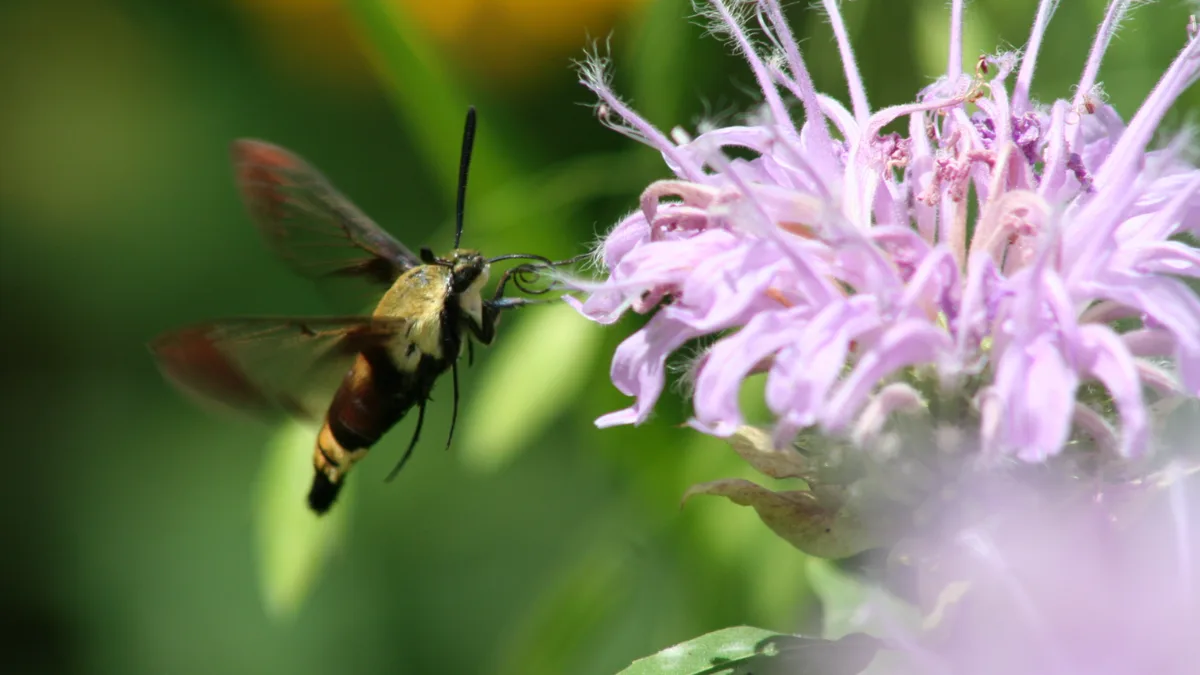
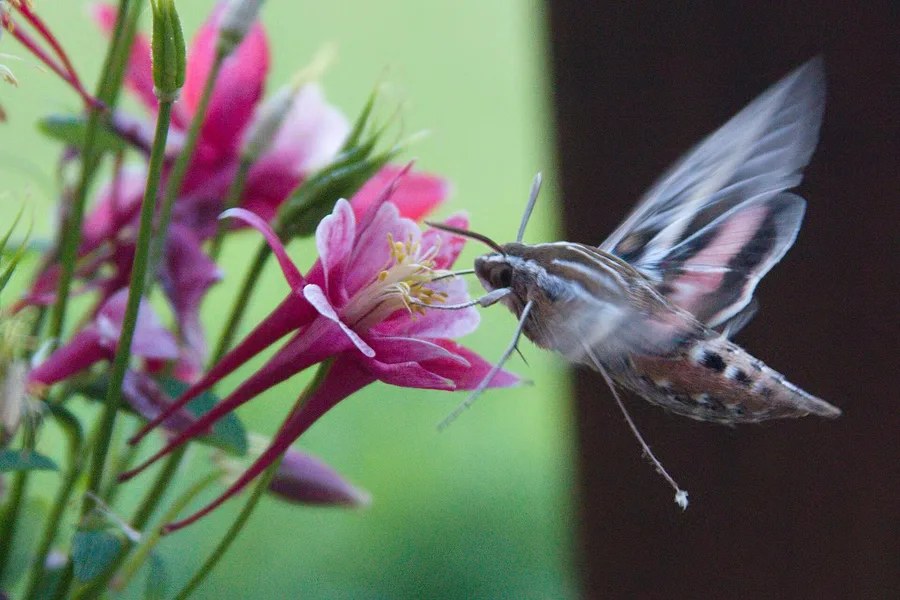
A hummingbird moth is a day-flying sphinx moth (family Sphingidae) that hovers at flowers and sips nectar through a long, coiled tongue, and it cannot sting or bite. In the United States the name usually means the hummingbird clearwing (Hemaris thysbe), the snowberry clearwing (H. diffinis, also listed as the bumblebee moth) or the white-lined sphinx (Hyles lineata). The quickest test against a real hummingbird is the head: a moth has two antennae, a bird has none.
This guide sets the species side by side, compares them with a hummingbird and a bumblebee, and covers caterpillars, flowers and timing. It rests on named agencies and universities, plus our own iNaturalist count. We make no claim of personal field experience with these moths.
Key Takeaways
- Hummingbird moths are insects, not birds. The Missouri Department of Conservation (MDC) says clearwing moths fly by day, hover and sip with a long proboscis, and the antennae are the giveaway.
- Legs and body colour separate the look-alikes: pale legs and a red-brown abdomen mean hummingbird clearwing, black legs and a gold-and-black body mean snowberry clearwing, and a larger olive-brown moth with white-streaked wings is a white-lined sphinx.
- They are not rare. The Butterflies and Moths of North America (BAMONA) ranks both clearwings “G5,” demonstrably secure worldwide.
- In our iNaturalist count, about 79% of US hummingbird clearwing sightings fall in July and August.
- The caterpillars are green hornworms on honeysuckle, viburnum and snowberry. Tomato hornworms are different moths, and Bt sprays kill clearwing caterpillars.
Table of Contents
- What a Hummingbird Moth Is
- Hummingbird Moth Species: ID Table
- Hummingbird Moth vs Hummingbird vs Bumblebee
- Caterpillars and Host Plants
- Flowers They Visit and How They Pollinate
- Are Hummingbird Moths Rare? When to Look
- How to Attract Hummingbird Moths
- The Old World Hummingbird Hawk-Moth
- Frequently Asked Questions
What a Hummingbird Moth Is
“Hummingbird moth” is a nickname, not one species. Beatriz Moisset of the US Forest Service counts four in North America, all in the clearwing genus Hemaris, and names the snowberry and hummingbird clearwings as the most familiar. Clearwings get their name from wing patches that lose their scales and turn glassy. Gardeners also call the white-lined sphinx a hummingbird moth, because it hovers the same way, so it appears in the table below.
All of them are sphinx or hawk moths. MDC’s “Hummingbird Imposters” explains that most sphinx moths fly between dusk and dawn, but the clearwings are active by day, when hummingbirds and bumblebees are out, and their wings buzz in flight much as a hummingbird’s do.
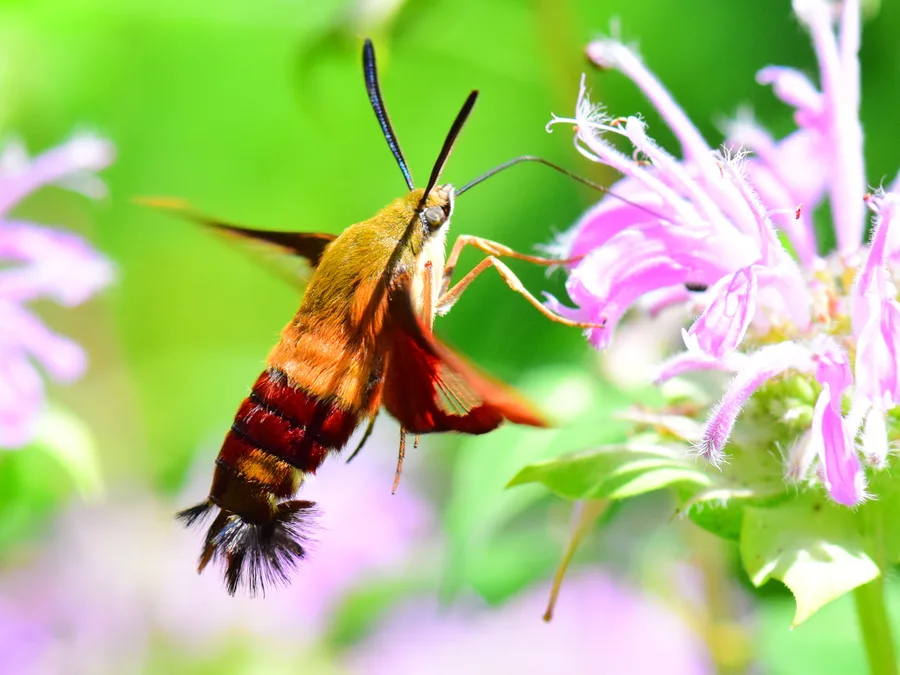
The bird-like flight is convergence, not copying: MDC’s field guide says the hummingbird clearwing is probably not “mimicking” a bird but solved the same problem of drinking from deep flowers by hovering. The bee-like colour is real mimicry, and the U.S. Fish and Wildlife Service profile lists “Bumblebee Moth” as a common name of the snowberry clearwing. Moths are not the only bee mimics at your flowers: see our guides to hover flies, the bee fly and bees versus wasps.
Hummingbird Moth Species: ID Table
The table draws on the BAMONA species pages, cross-checked against MDC’s field guide. BAMONA warns that wing patterns are too variable to identify these moths alone, so use the legs and the side of the thorax first. Western readers should also know H. thetis, which BAMONA places west of the Continental Divide, overlapping the snowberry clearwing in places such as Colorado.
| Species | Look | Range | Flight time | Caterpillar host plants | Source |
|---|---|---|---|---|---|
| Hummingbird clearwing (Hemaris thysbe) | Olive to golden-olive back, dark burgundy abdomen, wide reddish-brown wing borders; pale legs; no band on the side of the thorax; wingspan 1 9/16 to 2 3/16 in | Maine and Newfoundland south to Florida and Texas, west across the Great Plains; also Alaska south to Oregon | North: one brood, April to August. South: two broods, March to June and August to October | Honeysuckle, snowberry, viburnum, hawthorn, cherry, plum | BAMONA, MDC |
| Snowberry clearwing (H. diffinis) | Golden back, black and yellow abdomen, black stripe through the eye and down the thorax, black legs, thin wing borders; 1 1/4 to 2 in | East of the Continental Divide, Maine to Florida | Two broods, March to August (September in Missouri) | Snowberry, honeysuckle, dogbane; MDC adds coralberry | BAMONA, MDC |
| Slender clearwing (H. gracilis) | Like the hummingbird clearwing, but reddish legs and a brown band on the side of the thorax; 1 9/16 to 1 3/4 in | Nova Scotia and Maine west to North Dakota; Atlantic coast to central Florida | Probably two broods, March to August | Blueberries and laurel | BAMONA, MDC |
| White-lined sphinx (Hyles lineata) | Dark olive-brown forewing with a tan band and white vein streaks, black hindwing with a pink band; 2 7/16 to 3 9/16 in; mostly dusk to dawn, sometimes by day | Most of the US and southern Canada; also Eurasia and Africa | Two broods, February to November | Many plants, including willow weed, evening primrose, purslane, grape, tomato | BAMONA, MDC, UW Extension |
| Hummingbird hawk-moth (Macroglossum stellatarum), Old World | Grey-brown forewing, orange hindwing, black-and-white body with a fan-shaped tail; 5.0 to 5.8 cm | Portugal to Japan; migrant to the UK | May to September in the UK | Bedstraws, wild madder | Wildlife Trusts, Butterfly Conservation, Wikipedia |
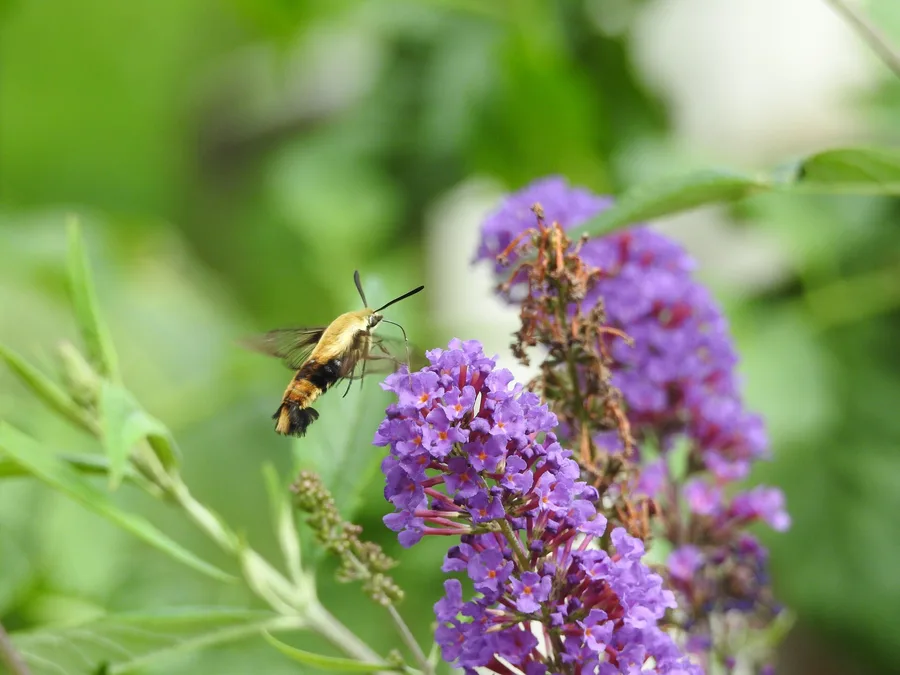
In the field, check the legs first (pale, black or reddish), then the side of the thorax (a dark stripe through the eye points to the snowberry clearwing), then size and hour. The University of Wisconsin-Madison Extension notes the white-lined sphinx is larger than the hummingbird clearwing, has fully scaled wings and is more active at dusk.
Hummingbird Moth vs Hummingbird vs Bumblebee
Clearwings get mistaken for two other things. This table compares one with a ruby-throated hummingbird and a bumblebee; the bumblebee guide covers the bee side.
| Check | Clearwing hummingbird moth | Hummingbird | Bumblebee |
|---|---|---|---|
| Antennae | Two, easy to see | None | Two |
| Wings | Two pairs, with clear panels | One pair, opaque | Two pairs |
| Size | About 1 1/2 in long; wingspan 1 1/4 to 2 1/4 in | About 3 in long | 1/2 to 1 in long |
| Feeding tool | Coiled, tongue-like proboscis | Firm beak | Long hairy tongue, folded under the head in flight |
| At the flower | Hovers; sometimes lands | Almost never lands | Lands and walks on the flower |
| Rear end | Tail tip opens into a fan | Tail feathers | Rounded abdomen tip |
| Body covering | Fuzzy hair | Feathers | Dense fur |
Sources: Farmers’ Almanac and MDC (antennae, wings, landing, covering), Mass Audubon (lengths), MDC (wingspan, bumblebee length), Wisconsin Horticulture (proboscis), Wikipedia (bumblebee tongue, abdomen, fur), US Forest Service (tail fan), and our hover fly guide citing Purdue (bee wings).
Landing is the best single clue. MDC puts it this way:
“Although sphinx moths sometimes land on a flower while feeding, hummingbirds almost never do.”
Caterpillars and Host Plants
The caterpillars are hornworms: smooth, plump larvae with a horn on the last segment. MDC describes the hummingbird clearwing’s as green and finely granular with a pale line down each side. The snowberry clearwing’s is green with black spots around its breathing pores, a yellow collar and a black horn with a yellow base. The Forest Service says the eggs are tiny, round and green, laid under host leaves.
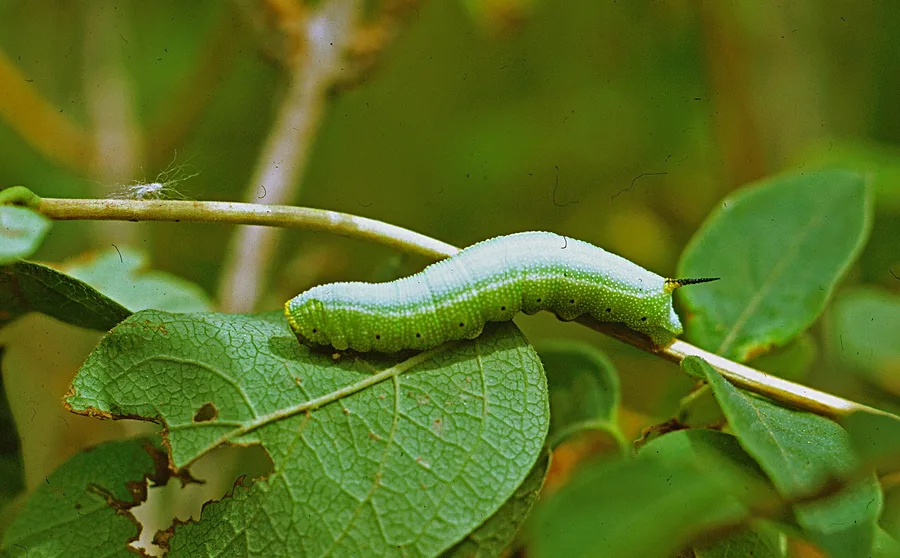
Host plants are narrower than flower choice; the table lists them by species. A full-grown caterpillar drops to the ground and spins a loose cocoon (Forest Service), and MDC says the pupae overwinter in the soil. Moisset’s profile ends on a point gardeners rarely hear:
“That leaf litter so hated by some gardeners provides a shelter to this beautiful pollinator.”
BAMONA lists “none reported” under management needs for both clearwings, so they are not known as garden pests. The hornworms that eat tomatoes are other moths: MDC names the five-spotted hawk moth as the tomato hornworm. The white-lined sphinx is the exception, with outbreaks that BAMONA says damaged tomatoes, grapes and garden crops in Utah.
Flowers They Visit and How They Pollinate
Hovering lets a moth reach nectar most insects cannot. MDC notes that the proboscis roughly matches the flower tube, and that fuzzy bodies carry pollen between blooms. The Forest Service adds that such flowers seem to favour long-tongued pollinators, and MDC’s 2015 Conservationist calls the hummingbird clearwing the primary pollinator of some orchids.
BAMONA’s adult food lists name honeysuckle, bee balm, lilac and phlox for the hummingbird clearwing, lantana and lilac for the snowberry clearwing, and columbine, larkspur and petunia for the white-lined sphinx. Wisconsin Horticulture adds Verbena bonariensis, butterfly bush and purple coneflower. Our pollination syndromes explainer shows how flower shape tracks the pollinator, and the moon garden for moths covers the pale, sweet-scented blooms that MDC says moth-pollinated plants tend to have.
Are Hummingbird Moths Rare? When to Look
No. BAMONA rates the hummingbird and snowberry clearwings G5, “demonstrably secure globally,” and the slender clearwing G4, “apparently secure.” MDC calls the hummingbird clearwing “reasonably common.” The slender clearwing is the scarce one: iNaturalist holds 236 research-grade US records for it, against 22,216 for the hummingbird clearwing.
For timing, we pulled iNaturalist research-grade US observations in November 2026. They show when people photograph moths, not exact flight dates.
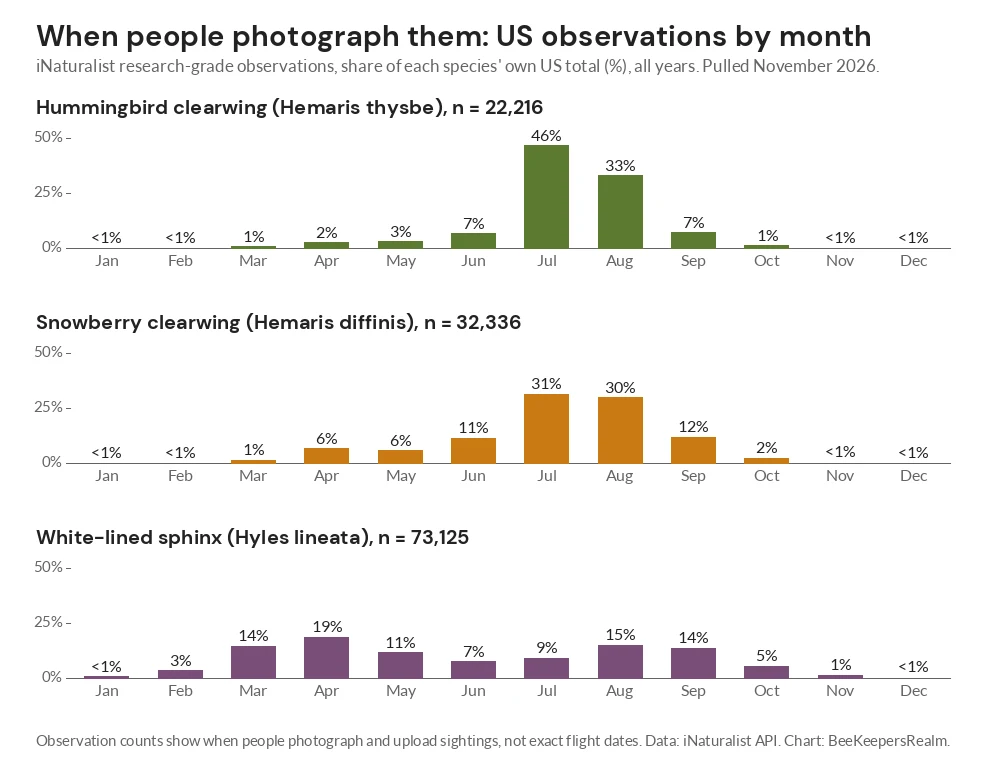
Both clearwings peak in July and August: 79% of hummingbird clearwing sightings and 61% of snowberry clearwing sightings. The white-lined sphinx peaks in March to April and again in August to September, which fits BAMONA’s two broods.
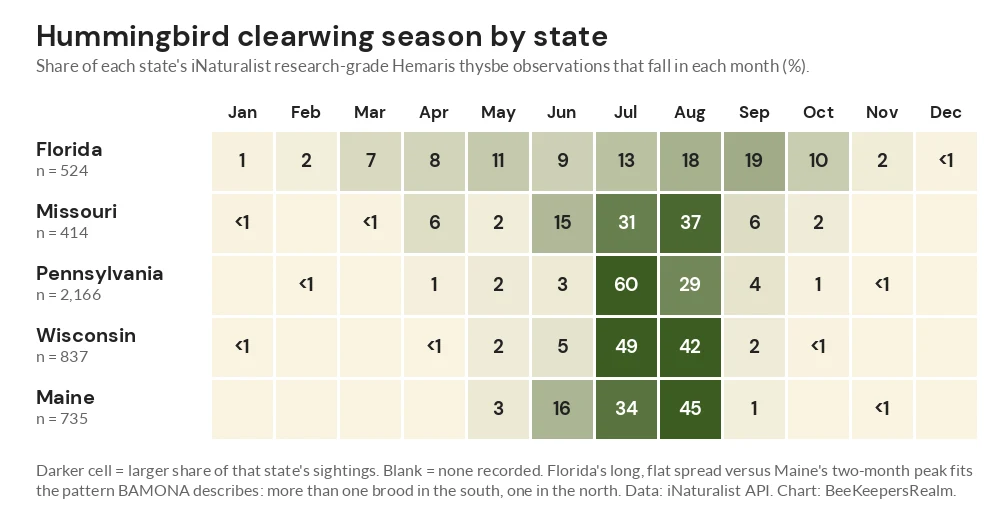
Region changes the season. In Florida, sightings run from March to October and about half fall in July to September. In Pennsylvania and Wisconsin, 89% and 91% land in July and August. That agrees with BAMONA, which gives two broods in the south and one in the north, and with the Forest Service, which says northern pupae wait out the winter.
How to Attract Hummingbird Moths
- Nectar flowers. Grow tubular blooms in sequence from spring to autumn, such as bee balm, phlox, native coral honeysuckle, verbena, lilac and butterfly bush. Our guide to native plants for pollinators helps with regional picks.
- Host plants. Add snowberry or coralberry, a viburnum or a blueberry, depending on the local clearwing. The Forest Service says females lay eggs on larval food plants.
- Leaf litter. Leave some under shrubs, because the pupae overwinter there.
- No caterpillar sprays. Farmers’ Almanac advises skipping broad-spectrum insecticides that kill caterpillars before they pupate. Bt (Bacillus thuringiensis var. kurstaki) is sold as a targeted biological spray, but it still kills moth larvae.
“Because this insecticide kills larvae of butterflies, moths and skippers (lepidopterans), care should be taken so that nontarget plants are not treated and drift on other plants does not occur.”
LSU AgCenter adds that Bt does not kill bees, so the harm falls on caterpillars. See also our pollinator-friendly gardening tips.
The Old World Hummingbird Hawk-Moth
Readers in Europe, Africa and Asia usually mean Macroglossum stellatarum. The Wildlife Trusts describe a small day-flying hawk-moth with orange hindwings that hums as it hovers and reaches the UK as a migrant. Butterfly Conservation lists bedstraws and wild madder as caterpillar foods. Wikipedia says the species ranges from Portugal to Japan and is not the North American Hemaris moth, which Europeans call a bee moth.
Hawkmoths and clearwings also visit tubular flowers such as native and invasive honeysuckle.
Frequently Asked Questions
Is a hummingbird moth a hummingbird?
No. It is an insect with two antennae, six legs and a coiled tongue. The two only look alike because both hover at tubular flowers.
Are there hummingbird moths in North America?
Yes. The Forest Service counts four in the genus Hemaris, led by the hummingbird and snowberry clearwings, and gardeners also apply the name to the white-lined sphinx.
What is a hummingbird hawk moth?
It is Macroglossum stellatarum, an Old World hawk-moth with orange hindwings. North American hummingbird moths are different species.
Are hummingbird moths rare?
No. BAMONA rates both clearwings secure worldwide, and iNaturalist lists over 22,000 US hummingbird clearwing records. The slender clearwing is the least common.
Do hummingbird moths sting or bite?
No. MDC says moths with the yellow-and-black bee pattern have no stinger, and the Old Farmer’s Almanac says they do not sting or bite.
Is a hummingbird moth caterpillar a tomato hornworm?
No. Tomato hornworms are the larvae of the five-spotted hawk moth, per MDC. Clearwing caterpillars feed on honeysuckle-family plants, though white-lined sphinx caterpillars can damage garden crops.
How do you attract hummingbird moths?
Plant tubular nectar flowers such as bee balm, phlox and native coral honeysuckle, add a host shrub like snowberry or viburnum, leave leaf litter, and avoid caterpillar sprays including Bt.
Next Step
Next time one visits, check the legs and the antennae first. This page is educational information about wildlife, not pest-control advice.
Sources
- BAMONA species pages: Hemaris thysbe, H. diffinis, H. gracilis, H. thetis, Hyles lineata
- Missouri Department of Conservation: Hummingbird Clearwing, Snowberry Clearwing, White-Lined Sphinx, Bumblebees, “Hummingbird Imposters” (2001), “Plants & Animals” (2015)
- Beatriz Moisset, US Forest Service; Susan Mahr, University of Wisconsin-Madison Extension (February 2025); Mass Audubon; LSU AgCenter on Bt; U.S. Fish and Wildlife Service species profile
- Old Farmer’s Almanac (April 2026) and Farmers’ Almanac (July 2026); The Wildlife Trusts and Butterfly Conservation (linked above); Wikipedia on the hawk-moth and bumblebee (read November 2026)
- iNaturalist research-grade observations via the iNaturalist API, pulled November 2026
Image credits: featured photo of a hummingbird clearwing at wild bergamot by Rick Hansen, US Fish and Wildlife Service, public domain, via Wikimedia Commons, cropped to 16:9. Other photo credits are in each caption. Charts are by BeeKeepersRealm.