Last Updated September 15, 2026
Honeybees cannot pollinate tomatoes effectively for a simple reason: tomato flowers keep their pollen locked inside pore-like anthers that only release it when vibrated at a specific frequency, a technique called buzz pollination — and honeybees, despite having all the physical equipment needed, never evolved the ability to do it. Bumblebees and many solitary bees can, which is exactly why commercial tomato greenhouses worldwide stock bumblebee colonies instead of honeybee hives, even though honeybees are the default pollinator for nearly everything else in modern agriculture.
Key Takeaways
- Buzz pollination, or sonication, is a technique where a bee grips a flower and rapidly vibrates its flight muscles — without moving its wings — at a frequency that shakes trapped pollen loose from anthers that don’t release it through normal contact alone.
- Crops including tomato, eggplant, pepper, potato, kiwi, blueberry, and cranberry rely on or strongly benefit from buzz pollination because their flowers have poricidal anthers — pore-like openings rather than the slits found on many other flowers.
- Honeybees cannot sonicate at all, despite possessing the same basic flight-muscle anatomy other bees use to do it — entomologists describe them as having the physical “hardware” for it without the behavioral “software.”
- Bumblebees are the standard commercial solution for greenhouse tomato pollination worldwide, with research showing just one or two bumblebee visits can push fruit set above 80%, compared to roughly 30% with no insect pollination at all.
- Buzz pollination is one of the clearest, most commercially consequential behavioral differences between honeybees and other bees — a genuinely different pollination story than the broader native-bee coverage on this site’s pollinator gardening content.
Table of Contents
- What Buzz Pollination Actually Is
- Why Honeybees Can’t Do It
- The Crops That Depend On It
- Why Greenhouses Stock Bumblebees, Not Honeybees
- Frequently Asked Questions
What Buzz Pollination Actually Is
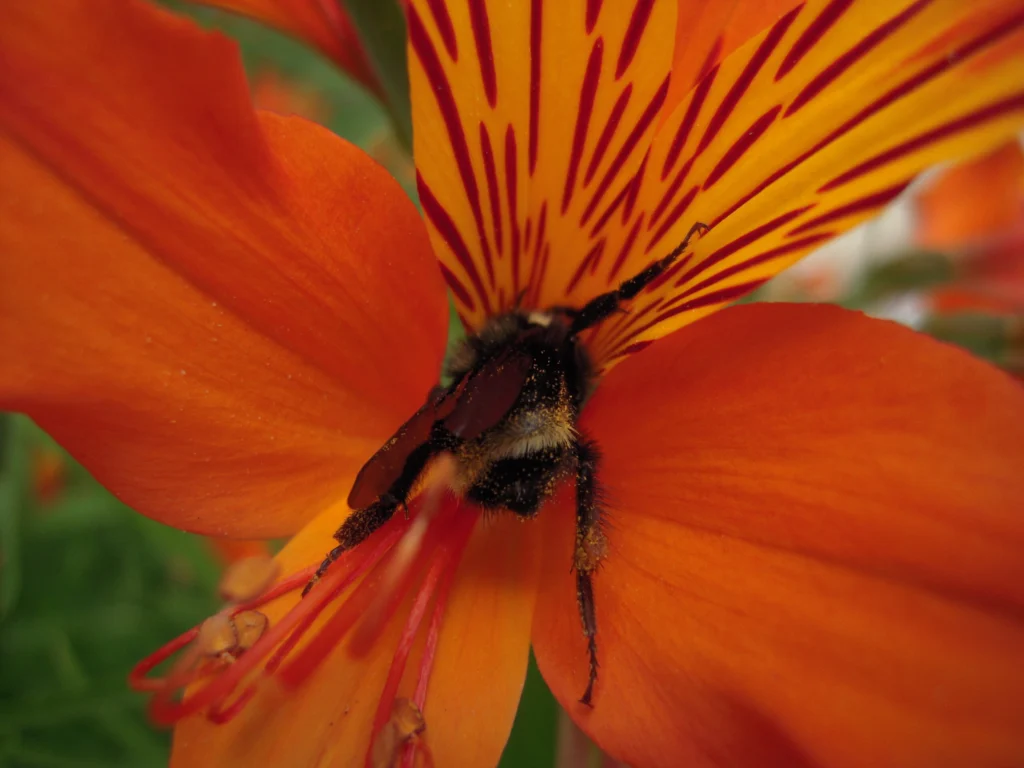
Most flowers release their pollen fairly easily through ordinary contact — a bee brushes against the anther, and pollen grains stick to its body. Some plant families evolved a more restrictive system instead: poricidal anthers, which hold pollen inside a capsule-like structure that only opens through small pores rather than a full-length slit. To get pollen out of a poricidal anther, a bee has to grip the flower and vibrate its flight muscles at high frequency without actually flapping its wings — generating a buzzing sound audible to a nearby human, which is where the technique gets its common name. That vibration shakes the pollen loose through the pores, where it falls onto the bee’s body (and, in commercial crops, onto the flower’s own stigma in the process, achieving pollination). The more technical name for the behavior is sonication. The vibration itself is fast: published measurements of bumblebee floral buzzes generally fall in the range of roughly 240–400 Hz, similar to a musical note between the B below middle C and the G above it.
Why Honeybees Can’t Do It
Here’s the detail that surprises most people, including many beekeepers: honeybees have the same basic flight-muscle structure that bumblebees and other sonicating bees use to buzz-pollinate, but they never evolved the behavioral capacity to actually do it. As one long-running beekeeping reference site puts it, honeybees have the anatomical “hardware” for sonication but lack the behavioral “software” — for reasons that remain somewhat unresolved in the research, honeybees simply do not vibrate their flight muscles against a flower’s anthers the way bumblebees, many solitary bees, and even some other insect groups do. It’s a rare, clean example of a specific pollination skill that’s genuinely absent from the world’s most economically important managed pollinator, despite that species otherwise being a generalist capable of visiting an enormous range of flower types.
The Crops That Depend On It
A specific group of economically significant crops evolved poricidal anthers and, as a result, depend on or strongly benefit from buzz-pollinating insects: tomato, eggplant, pepper, and potato — all members of the nightshade family — along with kiwifruit, blueberry, and cranberry. Tomatoes are a particularly clear case: their flowers are self-fertile and can technically set some fruit from wind vibration alone, but greenhouse tomatoes grown indoors, where there’s no wind at all, are almost entirely dependent on buzz-pollinating insects to achieve commercially viable fruit set. Research compiled by Ohio State University’s agricultural extension service on greenhouse tomato pollination found that just one or two bumblebee visits to a tomato flower can push fruit set above 80%, compared to roughly 30% with no pollinator visits at all — a large enough gap to matter directly to a grower’s yield. More recent research has looked at the mechanism even more closely: a 2025 study in Horticulture Research found that sonic vibration physically disrupts the interlocking trichomes holding a tomato flower’s anther cone together, which is what actually releases the pollen — a more precise explanation than earlier assumptions about vibration alone shaking pollen loose (Horticulture Research, 2025).
Why Greenhouses Stock Bumblebees, Not Honeybees
This is the direct commercial consequence of honeybees’ inability to sonicate: greenhouse tomato operations worldwide buy and deploy commercially reared bumblebee colonies specifically for pollination, rather than relying on honeybees the way most other crops do. According to Ohio State University Extension’s published guidance on the subject, the vast majority of commercial bumblebee colonies sold for pollination purposes go specifically into tomato greenhouses, reflecting just how central this one behavioral quirk is to an entire segment of commercial agriculture. Full details on the mechanics and management of greenhouse bumblebee pollination are published by Ohio State University Extension. It’s a useful, concrete counterpoint to this site’s broader guide to bumblebees as pollinators: buzz pollination isn’t just one more thing bumblebees happen to do better than honeybees, it’s a specific, well-documented behavior with an entire branch of commercial greenhouse agriculture built around it.
For how flower traits match different pollinators, see pollination syndromes.
Frequently Asked Questions
What is buzz pollination?
Also called sonication, it’s a technique where a bee grips a flower and vibrates its flight muscles at high frequency without flapping its wings, shaking pollen loose from anthers that only release pollen through small pores rather than an open slit.
Why can’t honeybees buzz pollinate?
Honeybees have the same basic flight-muscle anatomy other bees use to sonicate, but they never evolved the behavior of vibrating against a flower’s anthers to release pollen — a gap researchers describe as having the “hardware” without the “software.”
Which crops need buzz pollination?
Tomato, eggplant, pepper, and potato (all nightshades), along with blueberry, cranberry, and kiwifruit, all have poricidal anthers that benefit from or depend on buzz-pollinating insects.
Why do greenhouse tomato growers use bumblebees instead of honeybees?
Because honeybees cannot buzz-pollinate at all, and greenhouse tomatoes grown indoors have no wind to shake pollen loose on their own — commercially reared bumblebee colonies are the standard solution used worldwide.
How much does buzz pollination actually improve tomato yield?
Research cited by Ohio State University Extension found that just one or two bumblebee visits to a tomato flower can raise fruit set above 80%, compared to roughly 30% with no insect pollination at all.
How fast does a bee vibrate when buzz pollinating?
Published measurements generally put bumblebee floral buzzing in the range of roughly 240–400 Hz — fast enough to be clearly audible, and distinct from the lower-pitched hum of ordinary flight.
Related Reading
Image credits: Photo: Bob Peterson, CC BY-SA 2.0, via Wikimedia Commons.