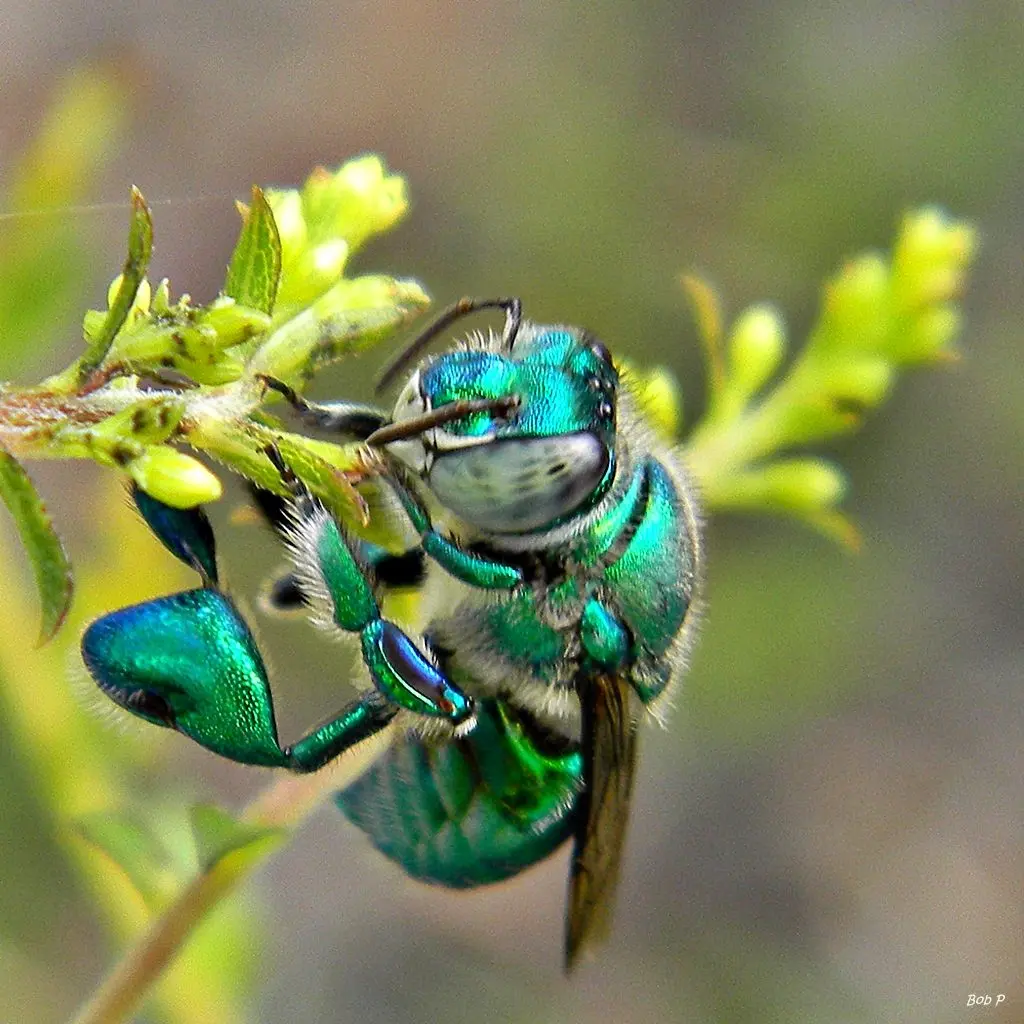
Male orchid bees don’t visit orchids to collect food at all — they scrape fragrance compounds off the flowers, store them in pouches on their own hind legs, and later release that collected scent during courtship displays to attract females, making them essentially the only pollinators on Earth that visit flowers to build a perfume rather than to eat. In the process, they pollinate roughly one in ten neotropical orchid species, many of which have evolved to be pollinated by one or two specific orchid bee species and no others — one of the most tightly specialized pollination relationships found anywhere in nature.
Key Takeaways
- Orchid bees (tribe Euglossini) are a group of mostly metallic, iridescent bees native to Central and South America, closely related to bumblebees and honeybees within the family Apidae.
- Only male orchid bees collect floral fragrance compounds — using specialized brushes on their front legs to gather scent, then transferring it into pouches in their swollen hind tibiae for storage.
- The collected fragrances aren’t food; researchers believe males use them, likely as raw material or precursors, to produce their own courtship pheromones, releasing the stored scent blend during display flights to attract females.
- Male euglossine bees are the exclusive pollinators of every species in two entire neotropical orchid subtribes — Stanhopeinae and Catasetinae — meaning those orchids can only reproduce through this bee behavior, not through any other pollinator.
- The relationship is often highly species-specific: a given orchid species’ fragrance chemistry may attract only one or a handful of the dozens of orchid bee species present in the same habitat, an unusually precise example of coevolution between a pollinator and its plant.
Table of Contents
- What Orchid Bees Are
- How Fragrance Collection Actually Works
- Why Collect Perfume Instead of Food
- An Unusually Precise Pollination Relationship
- Frequently Asked Questions
What Orchid Bees Are
Orchid bees make up the tribe Euglossini, a group of bees native to the forests of Central and South America, most familiar for their strikingly metallic, often iridescent green, blue, or gold coloring — a visual departure from the more familiar black-and-yellow banding of honeybees and bumblebees, their closer relatives within the bee family Apidae. Species in genera like Euglossa, Eulaema, and Exaerete range from roughly bee-sized to noticeably larger, and are prized by tropical entomologists and photographers alike for both their appearance and their genuinely unusual behavior around orchids.
How Fragrance Collection Actually Works
Only male orchid bees engage in fragrance collection, and the mechanics are specific: a male lands on a fragrance-producing flower — most famously certain orchid species, though other plants and even non-floral sources can serve as fragrance sources too — and uses specialized brushes on his front tarsi to scrub at the area of the flower that produces its scent compounds. He then transfers the collected material by rubbing his front legs against grooves on his hind legs, ultimately packing the fragrance into pouches inside his noticeably swollen hind tibiae. A male will visit numerous fragrance sources over his lifetime, gradually building up and refining a personal chemical blend stored in those leg pouches, sometimes returning to the same flowers repeatedly to add more.
Why Collect Perfume Instead of Food
Because this behavior is entirely unrelated to feeding — male orchid bees still need nectar for energy, which they obtain separately from ordinary foraging — scientists have spent decades working out what the fragrance-collecting behavior is actually for. The leading explanation, supported by observed courtship behavior, is that males later release their accumulated fragrance blend during display flights at communal courtship sites called leks, where females assess and choose among displaying males. Researchers believe the collected floral compounds function as precursors or direct components of the male’s own sex pheromone output, meaning the fragrance a male has spent his life accumulating becomes part of how he tries to attract a mate — a form of chemical self-presentation built entirely from ingredients scavenged from the environment rather than produced internally from scratch.
An Unusually Precise Pollination Relationship
The orchid side of this relationship is just as remarkable as the bee side. Male euglossine bees are the sole pollinators of every species within two entire neotropical orchid subtribes, Stanhopeinae and Catasetinae — meaning those orchids have no backup pollination strategy if their specific orchid bee visitors disappear from an area. Because fragrance chemistry varies precisely between orchid species, and different orchid bee species respond to different specific fragrance combinations, a given orchid may only ever be visited by one or two orchid bee species out of dozens present in the same forest — a level of pollinator specificity well beyond the more generalist relationships this site has covered in guides like mason bees as orchard pollinators, which forage across a broad range of flowering fruit trees rather than depending on one plant lineage’s chemistry. Peer-reviewed research on the mechanics of this fragrance-based specificity is available through the National Institutes of Health’s PubMed Central archive.
Frequently Asked Questions
Do orchid bees collect pollen from orchids?
Not in the conventional sense from most of the orchids they’re famous for visiting. Male orchid bees collect fragrance compounds, not pollen or nectar, from those specific flowers — a completely different foraging behavior from typical pollen collection.
What do male orchid bees do with the fragrance they collect?
They store it in pouches inside their swollen hind tibiae and release it later during courtship display flights, where researchers believe it functions as a component of the male’s own sex pheromone used to attract females.
Do female orchid bees collect fragrance too?
No, only males exhibit this behavior. Females forage conventionally for pollen and nectar to provision their nests.
How specific is the relationship between orchid bees and orchids?
Very. Some orchid species are pollinated by only one or a few specific orchid bee species out of dozens present in the same habitat, based on precise matches between the orchid’s fragrance chemistry and what a given bee species is attracted to.
What do orchid bees look like?
Most species have strikingly metallic, iridescent coloring in green, blue, or gold, distinguishing them visually from the more familiar black-and-yellow patterns of honeybees and bumblebees.
Related Reading
Image credits: Photo: Bob Peterson, CC BY-SA 2.0, via Wikimedia Commons.