Reviewed by Sofia T. · How we review
Carpenter ants are large black, or red and black, ants that hollow out damp or decayed wood for nests but do not eat it. Workers run about 1/4 to 1/2 inch long, with one bump (a single node) at the waist and a smoothly rounded back. Coarse sawdust with insect parts, big ants at night and winged ants indoors in spring suggest a nest nearby. The fix is to find the nest and the moisture feeding it, not to spray the ants you see.
Ants, bees and wasps share an order (Hymenoptera). If a fat, bumblebee-like insect is drilling the wood instead, see our guide to carpenter bees; the table below separates the two.
Key Takeaways
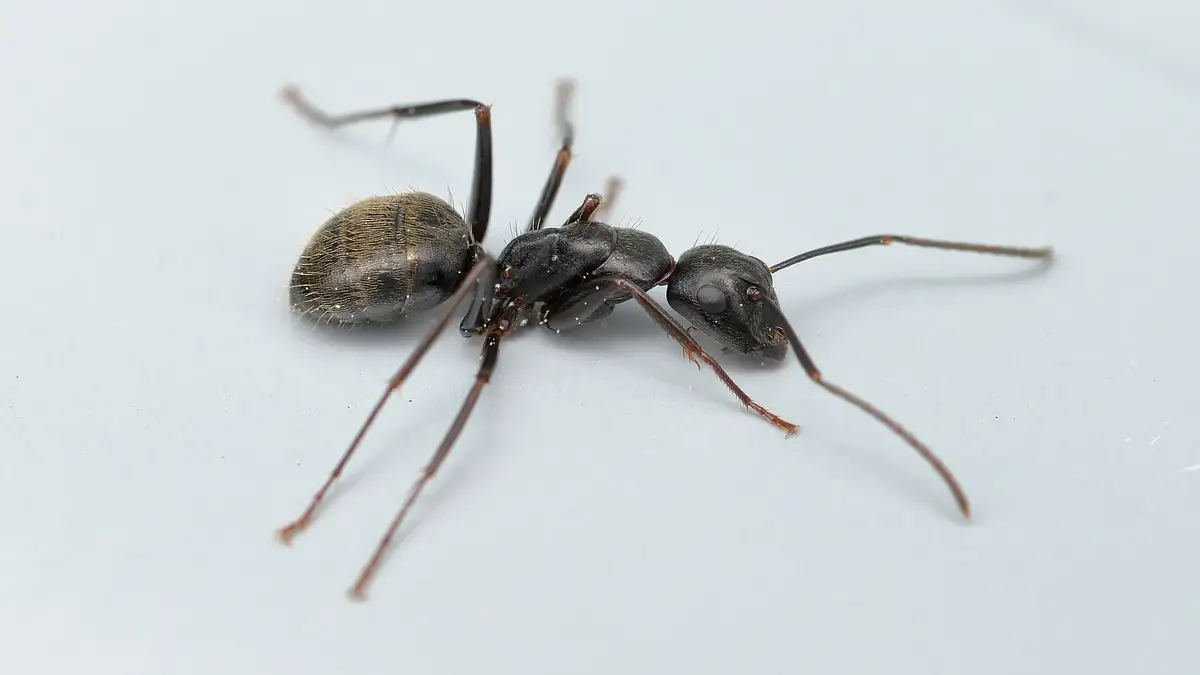
- Look for one waist node, an evenly rounded thorax in side view, black or red-and-black color, and workers of different sizes in one colony.
- They excavate wood and push out coarse frass with insect parts. They do not eat wood, and their galleries are smooth, with no soil.
- Ants indoors do not prove a nest indoors. The parent nest is usually outside. Ants indoors in winter, or many winged ants in spring, point to a nest inside.
- Damage is usually slow, often years, and starts in wood that is already damp or decayed.
- They can bite and spray formic acid, but cannot sting.
- Control means finding the nest. Spraying workers does not reach the colony, and hidden nests often need a professional.
Table of Contents
- How to Identify a Carpenter Ant
- Carpenter Ant vs Termite
- Flying Carpenter Ants (Swarmers)
- How a Colony Works: Parent and Satellite Nests
- When Carpenter Ants Are Active
- Signs of Carpenter Ants
- How Serious Is the Damage?
- Carpenter Ant vs Carpenter Bee
- Do Carpenter Ants Bite?
- What to Do About Carpenter Ants
- Frequently Asked Questions
- The Bottom Line
How to Identify a Carpenter Ant
Four features separate a carpenter ant from most other ants, per the University of Minnesota Extension:
- One node. The waist has a single bump (the petiole). Many other ants have one or two.
- An evenly rounded thorax. Seen from the side, the middle body section is a smooth arc.
- Black, or red and black, depending on species and region.
- Workers of different sizes. Major and minor workers in one colony can look like two species.
They also have elbowed antennae and a narrow waist. Look-alikes usually do not infest wood.
How big is a carpenter ant?
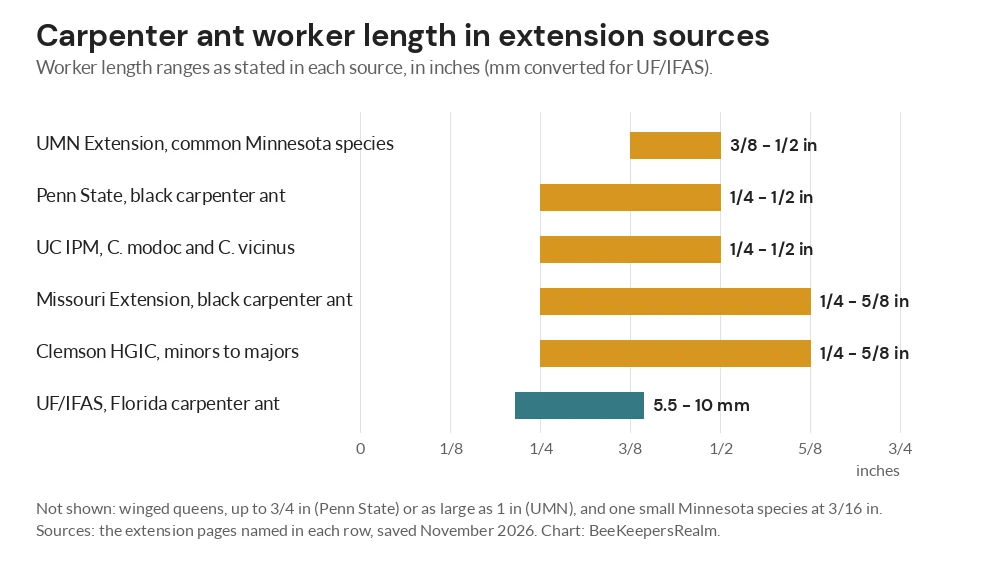
Extension sheets disagree a little. Penn State and UC IPM give workers as 1/4 to 1/2 inch, Minnesota says usually 3/8 to 1/2 inch, and Missouri and Clemson allow up to 5/8 inch for the largest. Winged queens run bigger, up to 3/4 inch at Penn State. A few homeowner pages quote 1/2 inch and up for workers, but a 1/4-inch ant can still be one.
Which species do you have?
| Species | Where | Look | Source |
|---|---|---|---|
| Black carpenter ant (Camponotus pennsylvanicus) | Eastern and central US | Dark, shiny brown to black | Penn State; UF/IFAS |
| Western black carpenter ant (C. modoc) | Western US | Uniformly black, dark red legs | UC IPM |
| Bicolored carpenter ant (C. vicinus) | Western US | Usually red and black | UC IPM |
| Florida carpenter ant (C. floridanus) | Florida north to North Carolina, west to Louisiana | Ash brown to rusty-orange head and thorax, black abdomen | UF/IFAS |
UC IPM calls C. modoc and C. vicinus the two most destructive western species. UF/IFAS says Florida carpenter ants mostly use existing voids or soft, rotten materials.
What else it might be
- Round holes in sound, unpainted wood: a carpenter bee. See carpenter bee holes.
- A fuzzy red-and-black “ant” on the ground: perhaps a velvet ant, a wingless wasp. Our predatory wasp and insect comparison chart lines up the look-alikes.
- A small, shiny dark ant: check the Asian needle ant, an invasive species that stings.
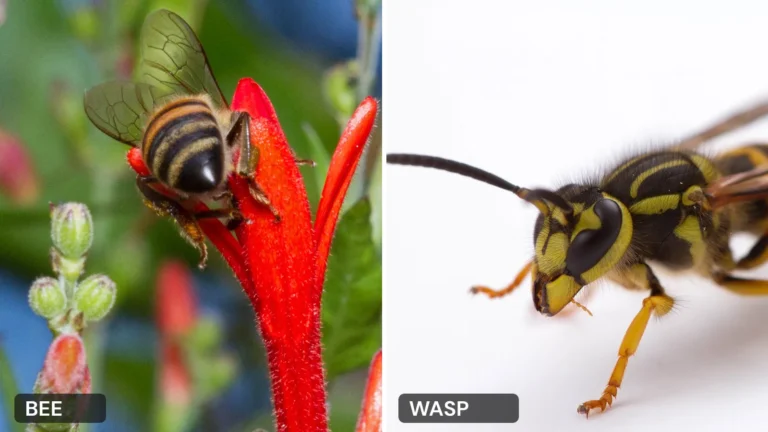
- A winged insect near a paper nest: a wasp. Start with bee vs wasp, then yellow jackets.
Carpenter Ant vs Termite
Both live in colonies and damage wood, but Penn State notes each needs different control. Carpenter ants excavate wood. Termites eat it.
| Carpenter ant | Termite | |
|---|---|---|
| Antennae | Elbowed (bent) | Straight, beadlike |
| Waist | Narrow, constricted | Broad, not constricted |
| Wings (winged forms) | Front pair longer than hind pair | All four about equal |
| In the debris | Coarse, fibrous sawdust with dead insect parts | Soil particles and fecal pellets (UC IPM: six-sided pellets for drywood termites) |
| Damage pattern | Smooth, clean galleries with a “well-sanded” look, no soil | Galleries with soil particles or fecal pellets |
| Eats wood? | No | Yes |
| Season | Night foraging in spring and summer; winged ants in spring or early summer | Flight timing varies by species and region; ask your local extension office |
| Sources | UMN Extension; Penn State Extension; UC IPM | |
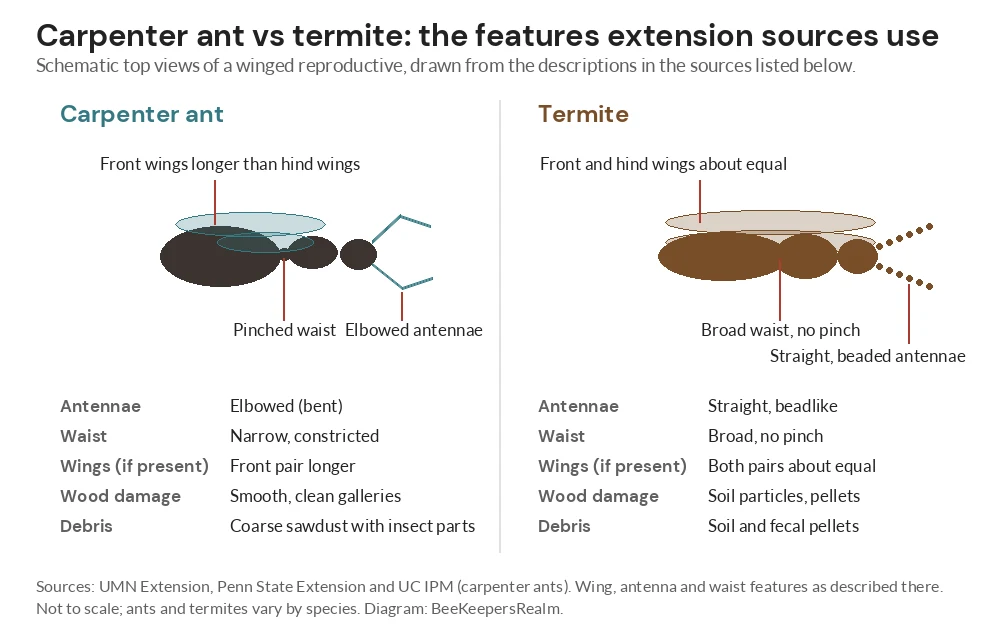
Penn State describes termite workers as creamy white and usually hidden; carpenter ant workers are dark and often seen walking about. Winged forms are the hard case, so check antennae, waist and wings.
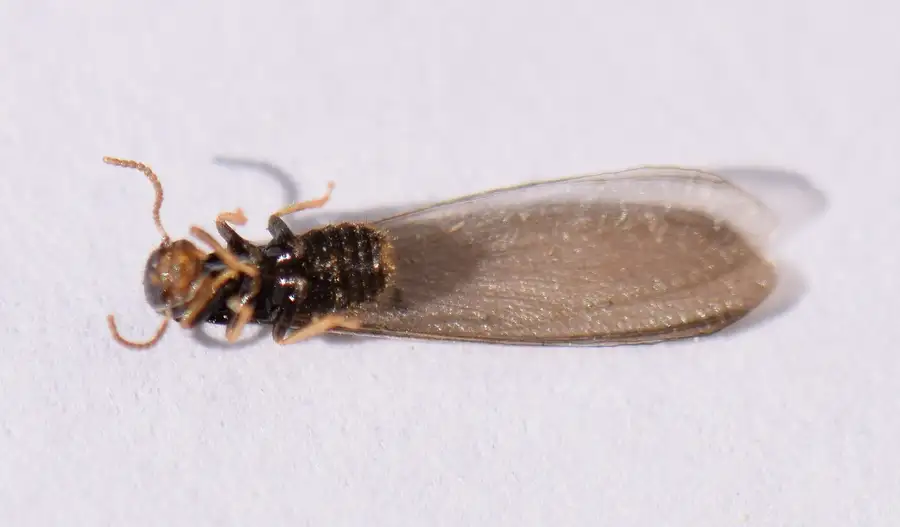
Flying Carpenter Ants (Swarmers)
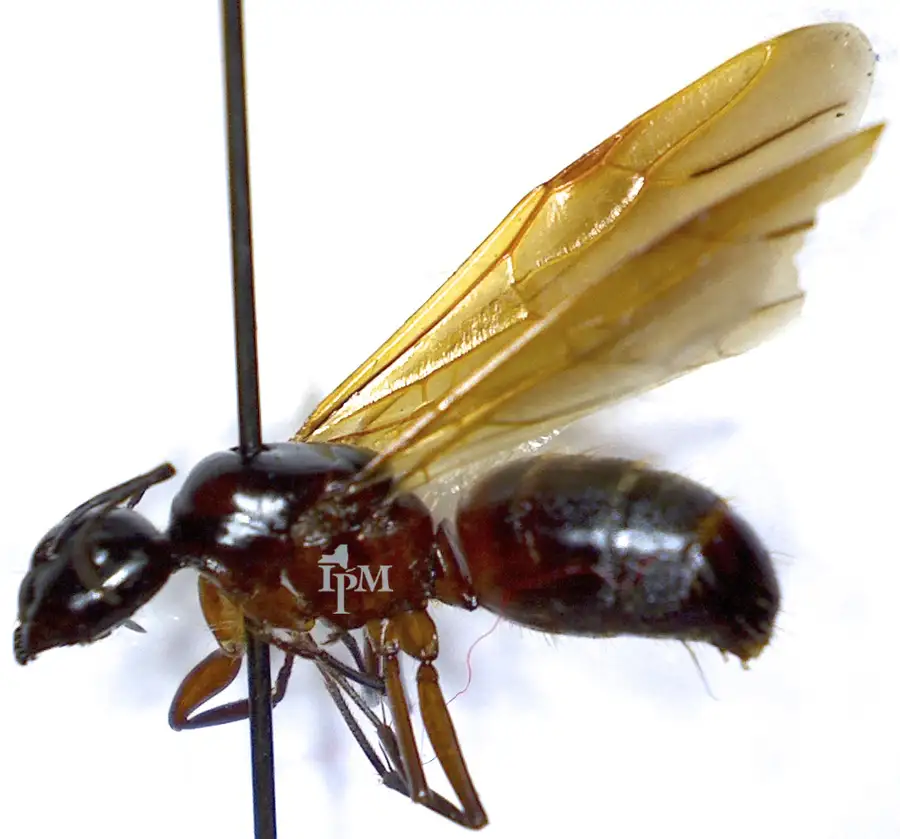
Mature colonies produce winged males and females. Penn State says a colony usually does not do so until it is several years old and has about 2,000 to 3,000 workers. The winged ants leave on warm days in spring or early summer. After a brief mating flight the male dies, and the female sheds her wings and looks for soft, moist, decaying wood.
What you find indoors matters. Minnesota says large numbers of winged ants indoors are a sure sign of a nest in the building. One or a few winged queens are probably newly mated females that wandered in.
How a Colony Works: Parent and Satellite Nests
Minnesota Extension describes two kinds of nest. The parent nest holds the queen and is usually outdoors in decaying wood such as stumps, logs or roots. Satellite nests hold workers, pupae and mature larvae, and can sit in fairly dry spots like insulation, hollow doors and wall voids. Workers travel between them, sometimes up to 100 yards for food.
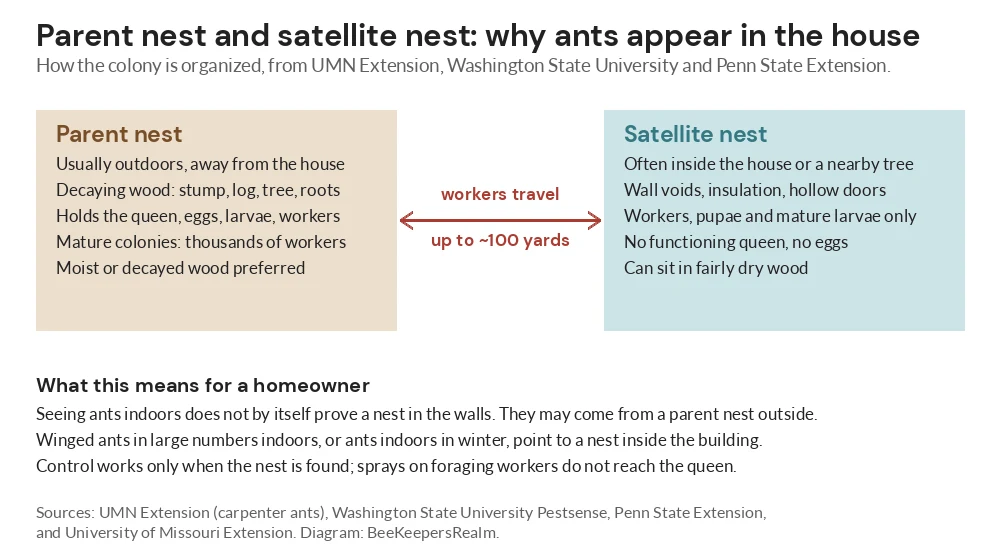
That is why one ant on the counter does not prove a nest in the walls, and why killing ants indoors rarely ends the problem: the queen stays in the parent nest.
Carpenter ants do not eat wood; Minnesota says they remove it as they excavate galleries. They eat protein and sugar: insects and aphid honeydew outdoors, meats, pet food and sweets indoors, foraging between sunset and midnight in spring and summer.
When Carpenter Ants Are Active
Most people meet them in spring and early summer. Penn State suggests night checks from 10 p.m. to 2 a.m., May through July. We pulled research-grade US records from iNaturalist to see the pattern.
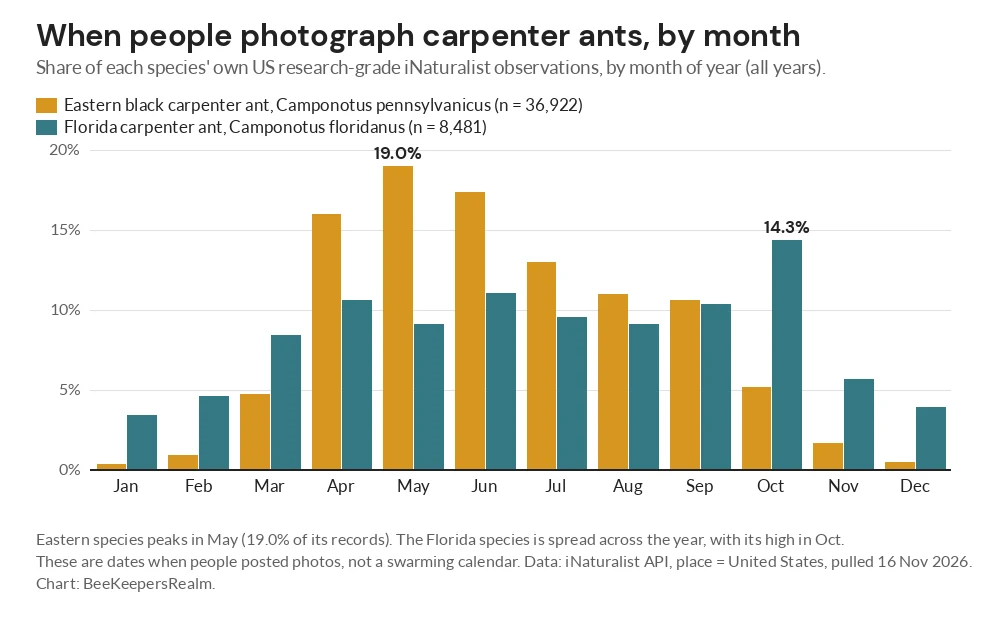
The eastern black carpenter ant (36,922 records) peaks in May at 19.0%, and April through July hold about two-thirds of its records. The Florida carpenter ant (8,481 records) is spread through the year, peaking in October at 14.3%, which fits UF/IFAS calling it active year-round. These are photo dates, not a swarming calendar, but they show why “what month?” depends on your region.
Signs of Carpenter Ants
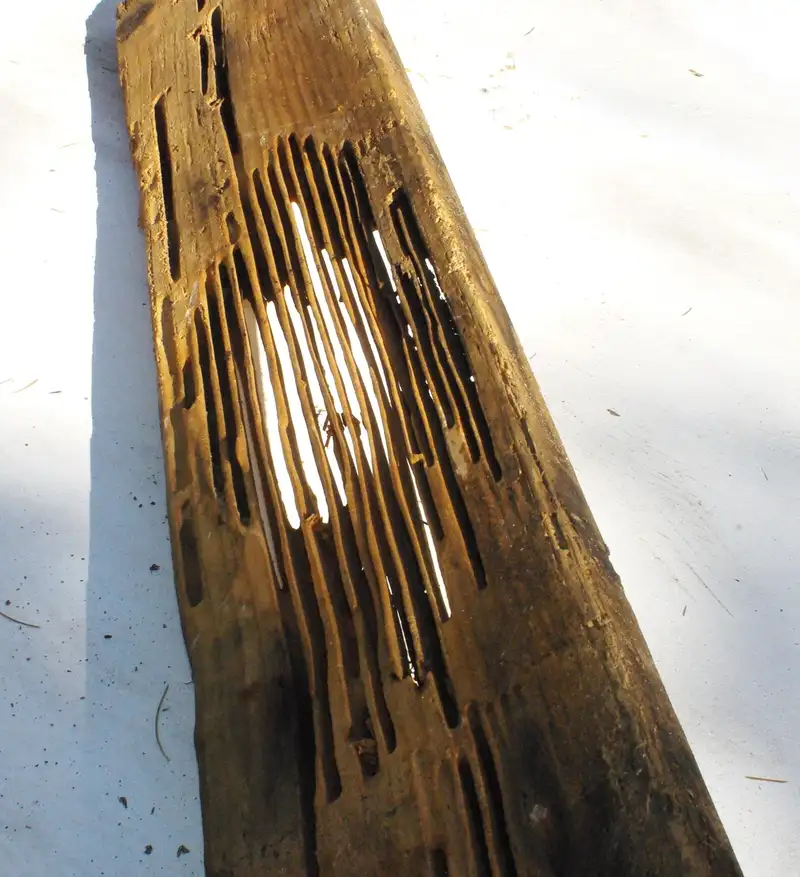
- Frass. Penn State describes piles of coarse, stringy wood particles and dead insect parts sifting from siding cracks, behind moldings, in basements and attics, and under porches.
- Smooth galleries, clean and well-sanded, without sawdust inside (Minnesota).
- Rustling. An active colony may make a dry rustling that gets louder if disturbed. Tap the area and listen.
- 20 or more workers seen indoors consistently (Minnesota).
- Winged ants indoors, especially late winter through spring.
How Serious Is the Damage?
Usually slow, and tied to moisture. Penn State says carpenter ants will not usually infest wood that is sound and below 15 percent moisture. They go first for wood softened by leaks, condensation or poor ventilation.
“Generally, damage occurs slowly, often taking years to occur.”
Sources differ on how far it goes. Penn State says a nest expanding into timbers rarely causes structural damage. UC IPM says large colonies can spread from damaged wood into sound wood and compromise structural integrity. If you find galleries in a beam, joist or sill, have someone check how much wood is gone.
Carpenter Ant vs Carpenter Bee
Both nest in wood and neither eats it. For the bee side, see our guides to carpenter bees and carpenter bee holes.
| Carpenter ant | Carpenter bee | |
|---|---|---|
| Nest | Galleries in damp or decayed wood, or voids such as wall voids and hollow doors | Female bores a round entrance hole about 1/2 inch wide into sound, usually unpainted wood |
| Debris | Coarse sawdust-like frass with dead insect parts | Stains below the hole from bee droppings |
| Appearance | 1/4 to 1/2 inch, black or red and black, narrow waist, elbowed antennae | Females about 5/8 to 1 inch, robust, with a shinier abdomen than a bumblebee |
| Sting or bite | Bites and sprays formic acid; cannot sting | Males cannot sting; females sting only if provoked or handled |
| Season | Night foraging in spring and summer; winged ants in spring or early summer | Adults mate in spring and nest; new adults emerge late summer; one generation a year |
| Sources | UMN, Penn State and UC IPM (ants); Penn State and UC IPM (bees) | |
Quick test: ants are small, many, and come and go in lines at night. Bees are few and big, hover near eaves in daytime, and leave a perfectly round hole.
Do Carpenter Ants Bite?
Yes. They bite, but they do not sting. UC IPM puts it this way:
“Carpenter ants can’t sting but can inflict painful bites with their powerful jaws and spray formic acid into the wound, causing a burning sensation.”
UF/IFAS adds that the ant can spray formic acid into the fresh wound if it is not removed quickly. This is general information, not medical advice; see a doctor if a bite causes more than local pain.
What to Do About Carpenter Ants
Extension sources agree on the order: remove what attracts them, find the nest, then treat the nest. This is educational information, not professional pest-control advice. Follow the label of any product you use.
Fix the moisture first
Penn State lists leaking roofs, defective flashing, leaking gutters and downspouts, condensation on pipes, and leaking tubs, showers or appliances. Replace water-damaged wood. UGA Extension adds attic vents, chimneys, skylights, and a vapor barrier and ventilation in crawl spaces.
Trim branches and move wood
- Trim branches so none touch the house, roof, eaves or power lines (Minnesota).
- Store firewood off the ground and far from buildings (Minnesota, Penn State).
- Remove stumps, logs and waste wood near the building; Penn State says within 100 yards.
- Seal where utility lines enter, and keep foundation mulch 2 to 3 inches deep (UC IPM).
Find the nest
Minnesota advises watching workers between sunset and midnight in spring and summer, using a flashlight covered with red film. Bait helps you follow them: in spring they favor protein, and Minnesota suggests small pieces of tuna packed in water. Clemson notes preferences shift with the seasons, toward protein in spring and sweets in winter.
Baits, sprays and dusts
| Method | What the sources say | Limit |
|---|---|---|
| Spraying foraging workers | Temporarily reduces ants you see | Does not eliminate a nest: ants carry little insecticide back, and few of the colony forage at once (Minnesota) |
| Slow-acting baits | Workers share bait with the nest; useful when the nest cannot be found | Can take weeks or months; ants may ignore a bait, so swap it (Minnesota, UC IPM) |
| Dust or liquid into the nest | The best method once the nest is located (Minnesota) | Often needs small drilled holes; Minnesota says not to do this yourself |
| Removing infested wood or a stump | Try removing the wood holding the parent colony (Penn State, Minnesota) | Not always possible |
Penn State says dusts of diatomaceous earth, silica aerogel or boric acid have low or no mammalian toxicity, but satellite colonies are unlikely to be eliminated without professional materials.
A note on flowering plants and pollinators
Many outdoor ant treatments are insecticides, and nests in trees and stumps are often near flowers. The National Pesticide Information Center advises:
“Do not spray flowers directly. Do not spray while pollinators are active. Spraying in the evening, after bees have returned to their hives, allows for spray residues to dry overnight.”
Our guide to pollinator-safe pest control products explains how to read a label for bee hazards.
When to call a professional
Minnesota says carpenter ant control is complex and usually best done by an experienced professional, who has the equipment and a wider range of products. Call one when you cannot find the nest, when ants return after you fix the moisture, or when a structural member is damaged. If the nest turns out to be wasps, see how to identify a wasp nest and when to call a pro.
If the ants are building a soil mound in the lawn instead of nesting in wood, you may be looking at fire ants.
Frequently Asked Questions
Should I be worried if I have carpenter ants?
A few outdoors is normal. Many indoors, or any in winter, suggests a nest in the building, probably in damp wood.
How do you get rid of carpenter ants?
Find and destroy the nest, replace damaged wood and fix leaks. Slow-acting baits help when the nest is hidden.
What month are carpenter ants most active?
Spring and early summer in most of the country, when winged ants appear. Penn State suggests night checks May through July. In Florida, UF/IFAS says they are active year-round.
How do I know if it’s a carpenter ant?
Look for one waist node, an evenly rounded back in side view, elbowed antennae, and black or red-and-black color. Workers of different sizes on one trail are a clue.
Which is worse, termites or carpenter ants? Does one mean the other?
Neither is harmless. Termites eat wood, while carpenter ants excavate it, and extension sources describe carpenter ant damage as usually slow. Having one does not by itself mean the other is present, and control differs, so identify which you have.
Can carpenter ants fly?
Only winged males and queens, in spring or early summer. Workers have no wings.
What happens when carpenter ants bite you?
Their jaws can inflict a painful bite, and the ant may spray formic acid into the wound, causing a burning sensation (UC IPM). They cannot sting.
The Bottom Line
Treat carpenter ants as a moisture problem with an ant attached. Fix the leak, find the nest, and call a professional if it is inside the walls.
Image credits: featured photo of an eastern black carpenter ant worker by Ryan Hodnett (Wikimedia Commons), cropped; termite swarmer by PumpkinSky and damaged board by Nwbeeson, all CC BY-SA 4.0; winged queen specimen by NY State IPM Program at Cornell University, CC BY 2.0. Photos resized or cropped. Charts and diagrams by BeeKeepersRealm.