Reviewed by Daniel M. · How we review
Fire ants are stinging ants of the genus Solenopsis. In the United States the pest is usually the red imported fire ant (Solenopsis invicta): a reddish-brown ant, 1/8 to 1/4 inch long, that builds dome-shaped soil mounds with no central opening across the South. It bites to grip, then stings repeatedly, and about a day later each sting becomes a white pustule that you should not pop. A small share of people are allergic to the venom.
Fire ants are Hymenoptera, like bees and wasps. This guide covers identification, where the USDA says they live, stings, hives and what extension entomologists say works. It is educational information, not medical advice.
Key Takeaways
- Look for workers of many sizes, a two-segment waist, and a soil mound with no central hole. Disturbed ants swarm up anything vertical.
- The USDA lists 13 states and Puerto Rico under federal imported fire ant quarantine.
- A sting burns at once and forms a sterile white pustule within about 24 hours. Leave it unbroken.
- Call 911 for trouble breathing, throat or tongue swelling, or collapse. Estimates of severe reactions range from under 1% to 6% of people stung.
- Texas A&M’s Two-Step Method (broadcast bait, then treat problem mounds) is the extension standard. Boiling water kills about 60% of mounds and also kills plants.
- Fire ants can raid weak hives and sting beekeepers in numbers. Use stands with moats or barriers, and keep insecticide off bees.
Table of Contents
- What Are Fire Ants?
- How to Identify a Fire Ant
- Fire Ants vs Other US Ants
- What a Fire Ant Mound Looks Like
- Where Fire Ants Live in the US
- Fire Ant Bite vs Sting
- First Aid for Fire Ant Stings
- Allergic Reactions and When to Call 911
- Fire Ants and Beehives
- How to Get Rid of Fire Ants
- Pets, Livestock and Wildlife
- Frequently Asked Questions
- The Bottom Line
What Are Fire Ants?
Several species share the name. Four groups matter in the US:
- Red imported fire ant (S. invicta), the common pest. Native to central South America, it reached the US between 1933 and 1945, at Mobile, Alabama, or Pensacola, Florida, according to UF/IFAS.
- Black imported fire ant (S. richteri), first reported at Mobile in 1918 and, says Texas A&M, still limited to parts of Mississippi and Alabama.
- The hybrid of the two, which Texas A&M counts with them as imported fire ants.
- Native fire ants, such as the tropical fire ant (S. geminata) and the southern fire ant (S. xyloni). UF/IFAS says S. geminata is much less common than the red imported species in Florida and has large, square-headed workers that mill seeds.
How to Identify a Fire Ant
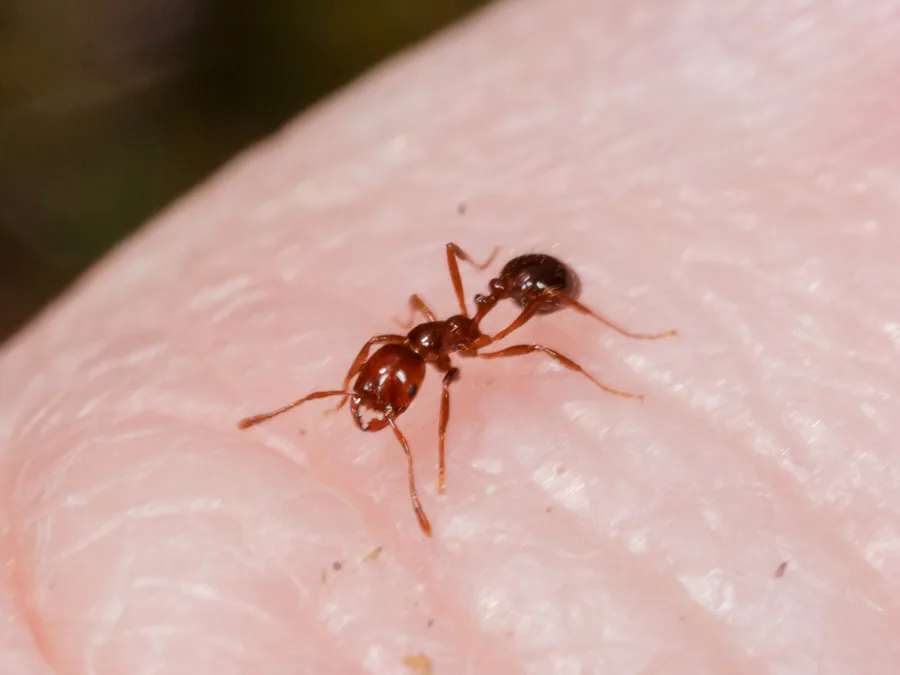
Use several clues together, because many small ants look alike. UF/IFAS describes the red imported fire ant worker this way:
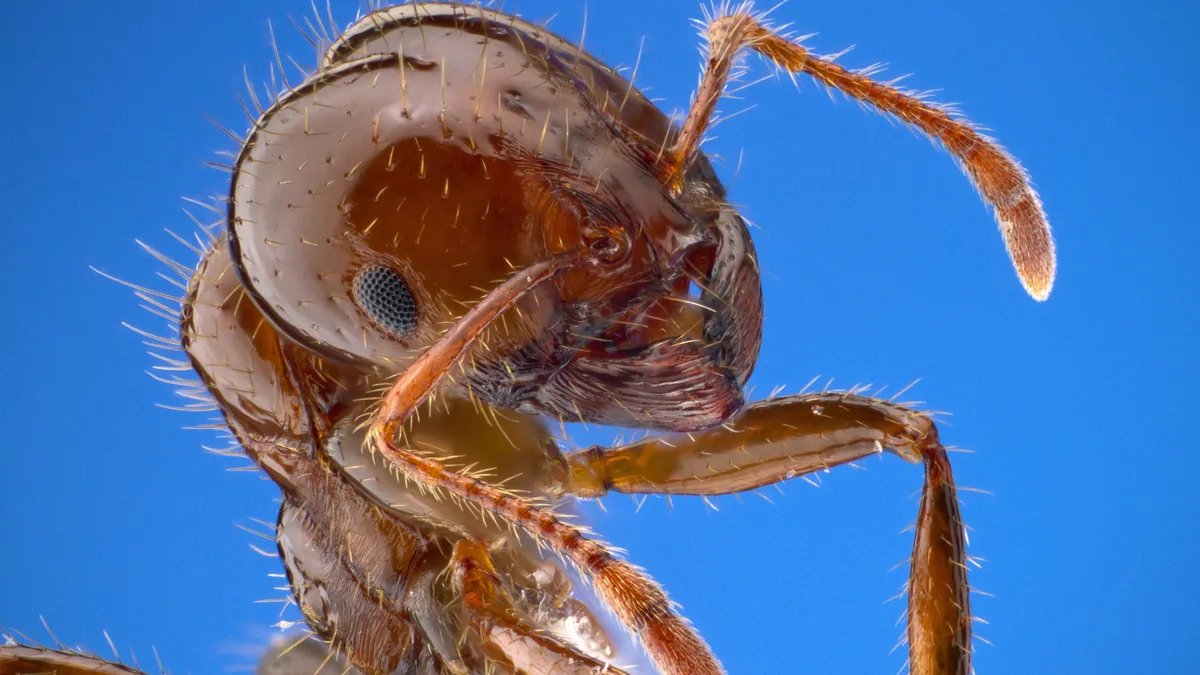
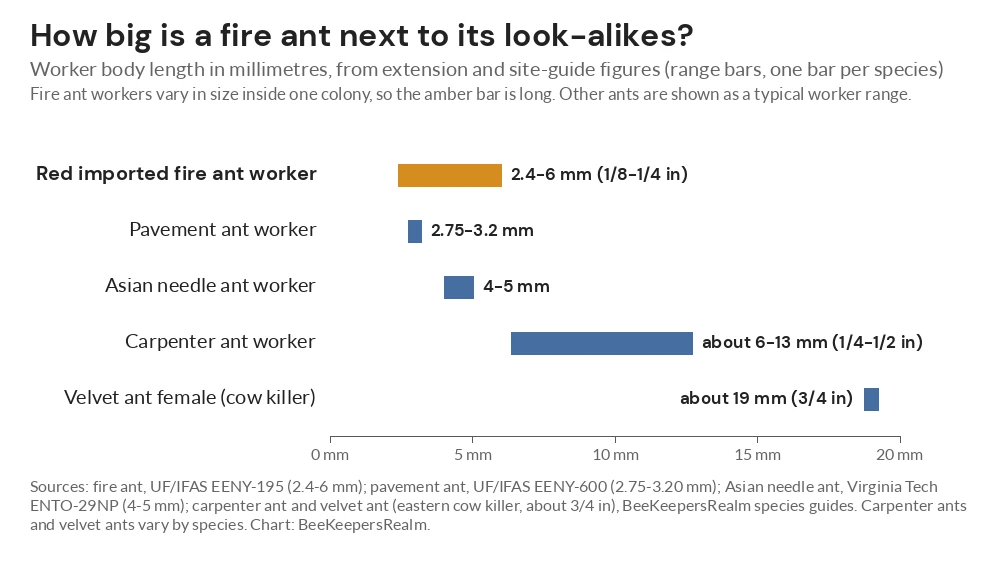
- Many sizes in one colony. Workers range from 2.4 to 6 mm (1/8 to 1/4 inch). Texas A&M says many native ants have workers of uniform size.
- Color. Red to brown, with a black, shiny rear section (the gaster).
- A two-segment waist between the middle and rear body.
- Antennae. Ten segments, ending in a two-segment club. A sting sits at the tip of the abdomen.
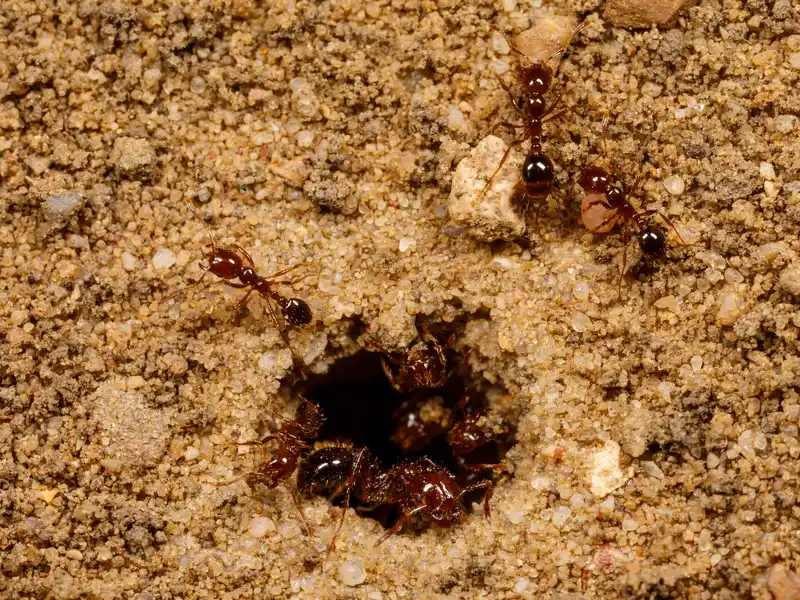
- Behavior. When a mound is disturbed, ants pour out and run up vertical surfaces, per Texas A&M and the USDA.
A two-segment waist alone does not prove it, because UF/IFAS describes pavement ants with two segments too. Size variation, the mound and the sting separate a fire ant.
Fire Ants vs Other US Ants
Several ants and one wasp get mistaken for fire ants. Our predatory wasp and insect comparison chart covers the stinging wasps beyond ants.
| Insect | Worker size | Color | Nest | Sting or bite | Where |
|---|---|---|---|---|---|
| Red imported fire ant | 2.4-6 mm (1/8-1/4 in), many sizes | Red-brown, black rear | Soil mound, no central opening | Bites to grip, then stings repeatedly; white pustule | South; 13 states plus Puerto Rico under quarantine |
| Carpenter ant | About 1/4-1/2 in | Black, or red and black | Galleries in damp or decayed wood, no soil mound | Bites and sprays formic acid; cannot sting | Widespread |
| Asian needle ant | 4-5 mm (about 1/5 in) | Shiny black to dark brown, lighter legs | Leaf litter, logs, mulch | Painful sting; usually no blister (Virginia Tech) | Spreading in the Southeast; first found in Mississippi in 2013 (Mississippi State) |
| Pavement ant | 2.75-3.2 mm | Dark brown to nearly black | Soil, with crater-shaped mound entrances | Does not often sting people (UF/IFAS) | One of the most commonly met ants in the US (UF/IFAS) |
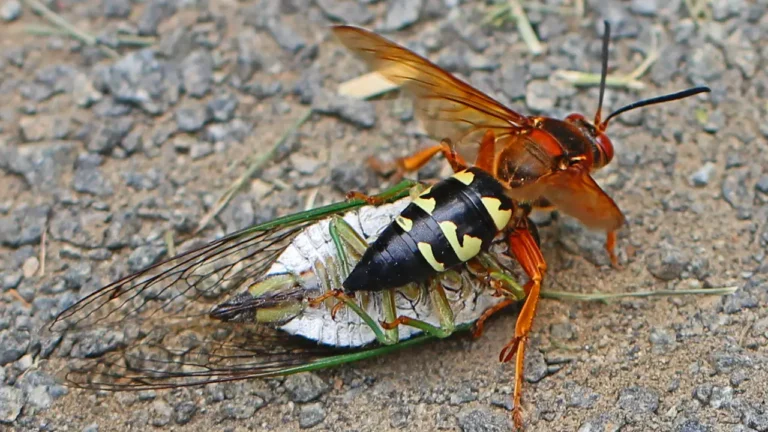
| Velvet ant (not an ant) | Eastern cow killer about 3/4 in | Fuzzy, red and black | Ground; a solitary wasp | Painful sting only if grabbed; females only | Mostly the eastern US (the cow killer) |
What a Fire Ant Mound Looks Like
Fire ants build mounds of loose soil in open, sunny places such as pastures, parks, lawns and meadows, according to the USDA. UF/IFAS and Texas A&M say mounds seldom exceed 18 inches across, although APHIS says large field nests can stand 18 to 24 inches high.
The giveaway is what is missing. Texas A&M notes that other small soil-nesting ants usually have a central nest opening, while fire ant mounds have none, and fireants.com describes undamaged mounds as fluffy piles without visible entry or exit holes. A poked mound erupts quickly.
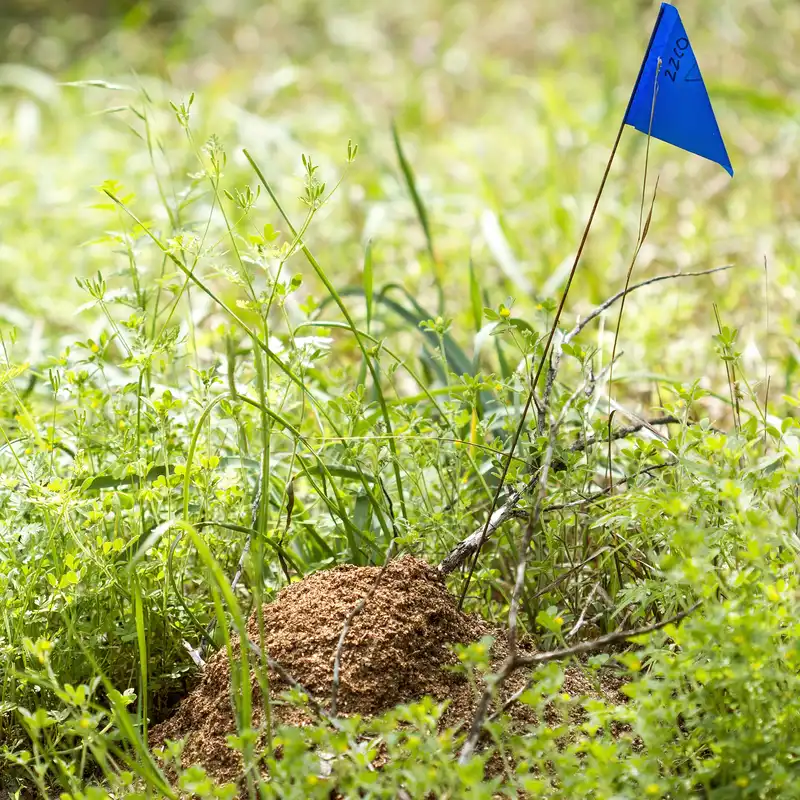
Texas A&M says single-queen colonies usually produce fewer than 300 mounds per acre, while multiple-queen colonies, whose workers move freely between mounds, exceed 300.
Where Fire Ants Live in the US
The USDA’s Animal and Plant Health Inspection Service (APHIS) says imported fire ants infest more than 367 million acres in Alabama, Arkansas, California, Florida, Georgia, Louisiana, Mississippi, North Carolina, Oklahoma, South Carolina, Tennessee, Texas, Virginia and Puerto Rico. That page was last modified on 17 September 2026. The quarantine stops human-assisted spread through nursery stock, hay, soil-moving equipment and similar items, and APHIS publishes the boundaries as an interactive map and a regulated-areas list under 7 C.F.R. 301.81-3.
The red imported fire ant arrived in the 1930s and reached Texas in the 1950s, spreading by mating flights, moving colonies and flood water, per Texas A&M. Winter sets its northern limit: survival in Oklahoma depends on freezing soil. Older sources give smaller areas (260 million acres at Texas A&M and ACAAI), so the APHIS figure reflects decades of growth.
Federal quarantine by state
The area column comes from the latest APHIS regulated-areas list we could read (dated 27 October 2022, archived copy), because APHIS’s live map and PDF block automated access. Check the interactive map for current county lines. County counts are our tally. The 2022 list also named Doña Ana County, New Mexico, which is not on APHIS’s current state list.
| State or territory | Quarantined area (APHIS list, 2022) | iNaturalist research-grade observations |
|---|---|---|
| Alabama | Entire state | 648 |
| Arkansas | 50 counties | 199 |
| California | Orange County plus parts of Los Angeles and Riverside counties | 258 |
| Florida | Entire state | 4,802 |
| Georgia | Entire state | 1,084 |
| Louisiana | Entire state | 979 |
| Mississippi | Entire state | 312 |
| North Carolina | 75 counties plus parts of Granville and Iredell | 1,654 |
| Oklahoma | 22 counties | 118 |
| South Carolina | Entire state | 951 |
| Tennessee | 75 counties | 4 |
| Texas | 188 counties plus part of Lubbock County | 11,280 |
| Virginia | 18 counties and independent cities | 200 |
| Puerto Rico | Entire territory | 125 |
What community observations show
We pulled research-grade iNaturalist records of S. invicta for every US state on 16 November 2026: 22,501 observations. They are observations, not range, since they show where people photograph and post. Texas supplies 11,280 (50%) and Florida 4,802 (21%). All but 12 come from quarantined states: Maryland has 8, and Arizona, Kansas, New York and Ohio have one each, which can be short-lived colonies or misidentifications. Tennessee shows only 4 because iNaturalist files the red-black hybrid separately. UGA Extension says black imported fire ants and a large hybrid population occupy northeastern Mississippi, northwestern Alabama and southern Tennessee, and iNaturalist holds 380 research-grade hybrid observations from Tennessee (900 US-wide) that this chart leaves out.
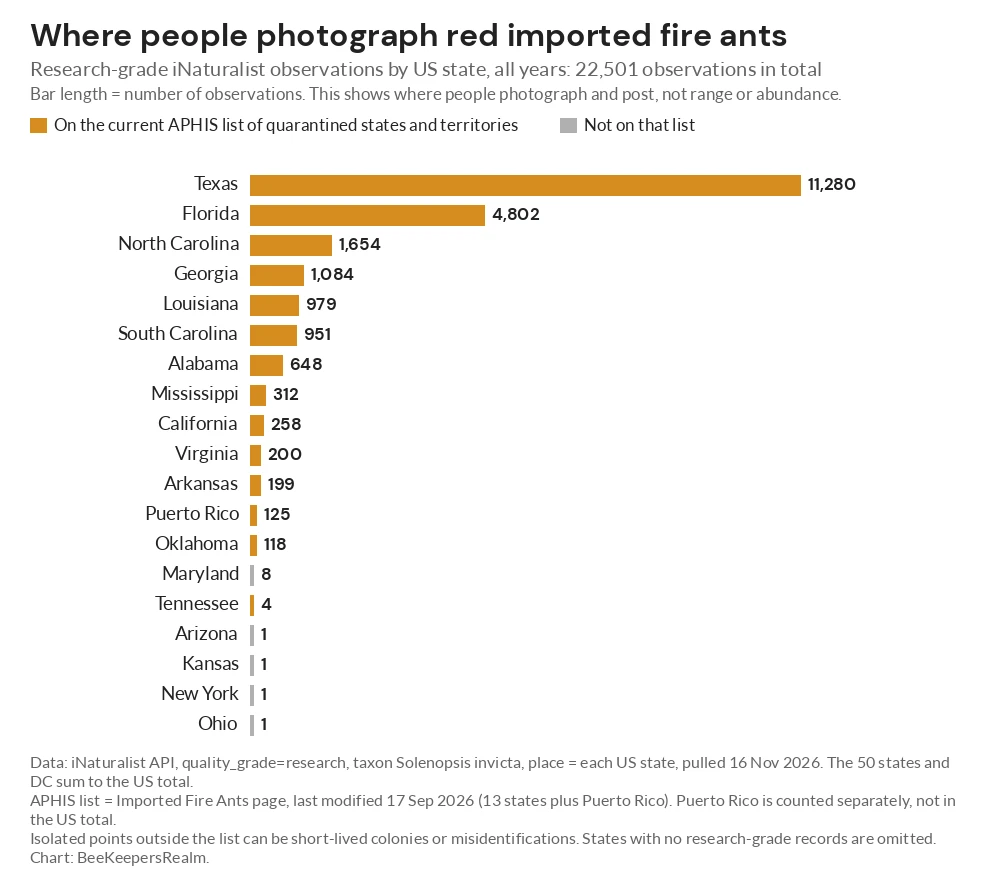
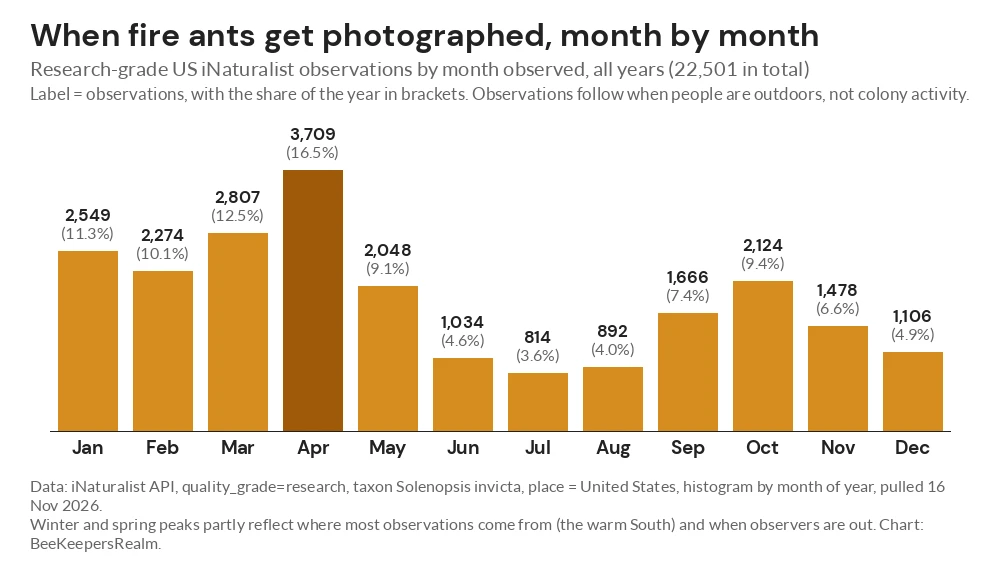
By month, observations peak in April (3,709, 16.5%) and bottom out in July (814, 3.6%). That tracks when people photograph outdoors, not colony activity.
Fire Ant Bite vs Sting
People say “bite,” but the sting does the damage. fireants.com explains that ants bite to get a firm grip, then sting repeatedly. ACAAI, the American College of Allergy, Asthma and Immunology, lists fire ants with yellow jackets, hornets and wasps as insects that sting repeatedly, unlike a honey bee, which leaves its stinger behind. Our bee sting vs wasp sting guide compares those stings.
What is in the venom
UF/IFAS says about 95% of the venom is alkaloids, which cause the pain and the pustule. MedlinePlus names the chemical as piperidine, and a Texas A&M medical fact sheet identifies the piperidine alkaloid solenopsin A, which kills cells at the site; white blood cells collect there and form the pustule. The remaining venom is protein (under 1%, per Texas A&M), which triggers allergic reactions. If ants are brushed off before they sting, Texas A&M says no pustule forms.
On Justin Schmidt’s pain scale the fire ant rates 1.2 out of 4, close to a sweat bee and below a honey bee; see our Schmidt sting pain index page.
Hour by hour
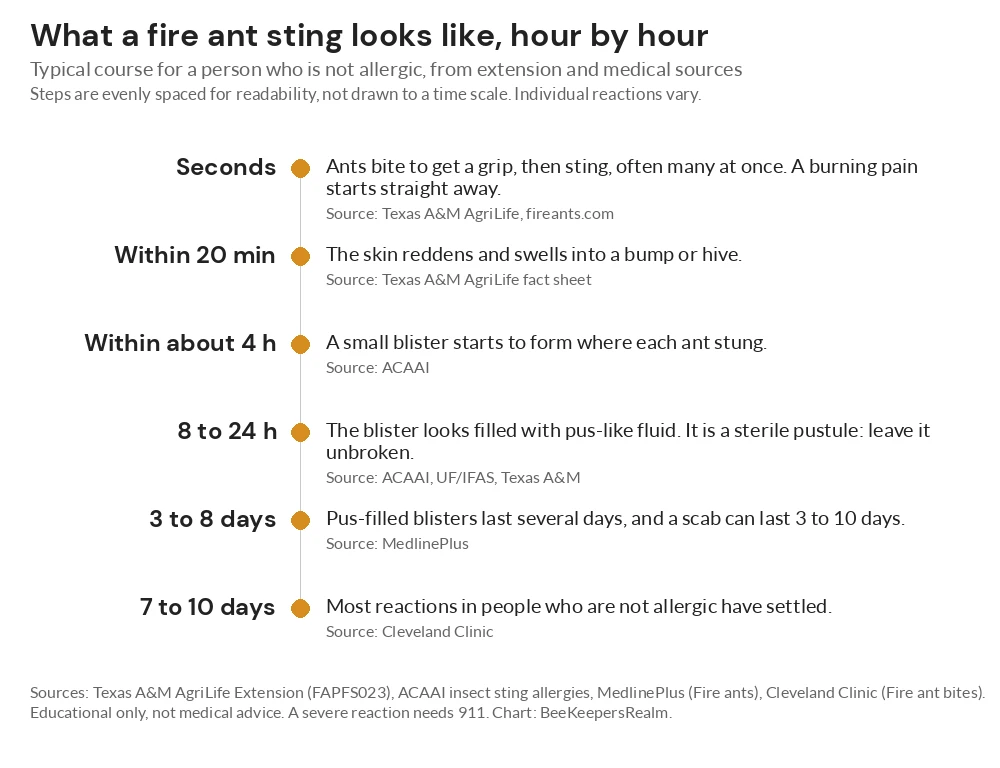
ACAAI gives the timing: an itchy hive or lump that usually fades in 30 to 60 minutes, a small blister within four hours, and pus-like contents by 8 to 24 hours. MedlinePlus says pus-filled blisters last 3 to 8 days and a scab 3 to 10 days.
Do not pop the pustule
ACAAI says what you see is really dead tissue, with little chance of infection unless the blister is opened:
“Treatment for fire ant stings is aimed at preventing secondary bacterial infection, which may occur if the pustule is scratched or broken. Clean the blisters with soap and water to prevent secondary infection. Do not break the blister.”
Cleveland Clinic agrees that popping blisters can lead to infections and scars.
First Aid for Fire Ant Stings
Educational information, not medical advice. For a severe reaction, call 911; otherwise talk to a clinician or pharmacist. The steps follow MedlinePlus, ACAAI, the Asthma and Allergy Foundation of America (AAFA) and Cleveland Clinic. For stings in general, see our guide to treating bee and wasp stings.
- Move away and brush the ants off quickly, before they sting.
- Wash with plenty of soap and water. MedlinePlus says not to use alcohol.
- Cool the area. For mild stings, MedlinePlus suggests ice wrapped in a cloth, 10 minutes on and 10 off. Shorten it if circulation is poor.
- Calm the itch. ACAAI says topical corticosteroid ointments and oral antihistamines may help. Cleveland Clinic mentions hydrocortisone cream twice a day.
- Leave blisters intact. If one breaks, AAFA says to clean it with soap and water and apply antibiotic cream.
Swelling that spreads is common after multiple stings; our guide to bee sting swelling explains what counts as a normal local reaction.
Allergic Reactions and When to Call 911
Call 911 or your local emergency number for any of these after a sting, according to ACAAI, MedlinePlus and Texas A&M:
- Trouble breathing or tightness in the chest
- Swelling of the tongue or throat, a hoarse voice or trouble swallowing
- Hives, itching or swelling away from the sting site
- Dizziness, a sharp drop in blood pressure, fainting, or severe nausea or sweating
Estimates of severe reactions vary. Texas A&M’s medical fact sheet cites anaphylaxis in 0.6 to 6% of people stung and more than 80 reported deaths, while its FAQ says around 1% are hypersensitive. Cleveland Clinic says about 2% of stings lead to severe reactions. Very young and older people and those with weakened immune systems react most severely (Texas A&M). ACAAI says anyone who has had an allergic reaction to an insect sting has a 60% chance of a similar or worse reaction if stung again.
If you have a diagnosed fire ant allergy, AAFA says to use epinephrine right away. Poison control is 1-800-222-1222 (MedlinePlus). Our bee sting first aid kit guide covers what an allergic person should carry.
Immunotherapy for fire ant allergy
Allergy shots exist for fire ants. AAFA says the treatment uses an extract of the whole body of the ant, which has been shown to work. Our bee venom immunotherapy guide explains the bee and wasp version, which uses venom extracts. An allergist decides who qualifies.
See a doctor if
Seek care for excessive swelling, itching or redness (Texas A&M), for many stings at once, or for a broken blister that becomes infected and may need antibiotics (Cleveland Clinic).
Fire Ants and Beehives
Texas A&M’s beekeeper publication ENTO-021 is the clearest extension statement. Its author, entomologist Bastiaan Drees, writes:
“Worker ants can invade bee hives and feed on pollen, bee pupae, and developing bee larvae (protein), occasionally destroying weakened hives.”
It also warns that fire ants sting repeatedly and in numbers when disturbed, which puts beekeepers at risk. Its advice:
- Check hive locations before and after placing hives, and identify the ants correctly.
- Do not leave dead brood or other protein near hives, which attracts foragers.
- Inspect hives and remove fire ants before moving bees. Fire ants can spread on hives, and quarantine rules cover moving them out of regulated counties.
UF/IFAS entomologist William Kern’s apiary guide (ENY-169) calls exclusion the long-preferred method: ant stands with a moat of water and detergent, fine dust such as talc in dry places, or a sticky barrier. He adds that his experience has been generally positive with fire ants living under hives protected by ant guards, because they much prefer foraging for small hive beetle larvae in the soil and dead bees on the ground. See our guides to protecting hives from ants, removing ants from hives naturally and hive stand height.
Ground-nesting bees
Fire ants favor open, sunny ground, according to the USDA, while our ground bees guide describes native ground-nesting bees tunneling into bare, dry soil, so the habitats can overlap. We found no extension study measuring fire ant effects on ground-nesting bees, so treat this as possible overlap, not proven harm. Our ground bees guide shows how to tell a bee hole from an ant mound.
Pollinator safety when treating mounds
Texas A&M advises beekeepers not to apply insecticide directly to bees, to treat late in the evening or early in the morning when bees are not active, and to use the products and formulations least toxic to bees. Our pollinator-safe pest control guide explains how to read a label for bee hazards. Texas A&M treats baiting around hives as optional; our own ant guides take a more cautious line and advise keeping insecticides away from hive entrances and comb.
How to Get Rid of Fire Ants
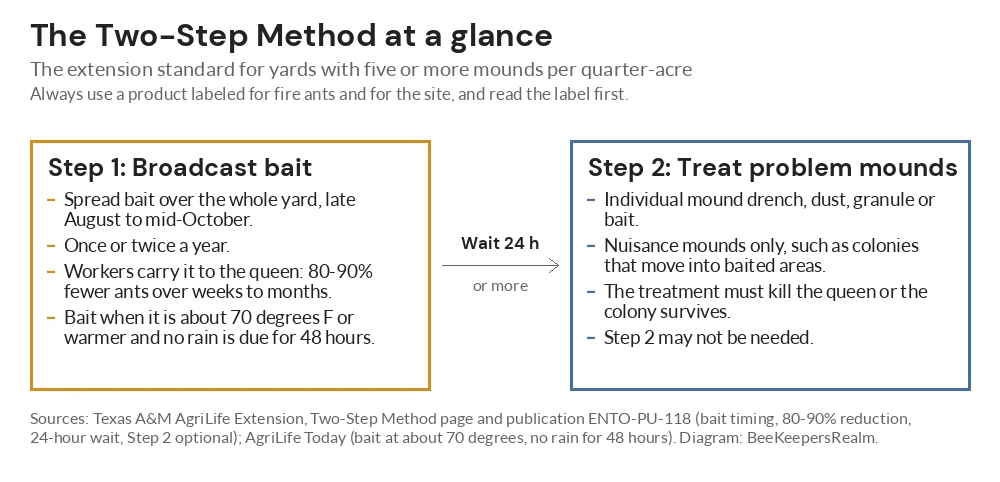
No method is permanent. Texas A&M says none is 100% effective all the time, and ants re-invade, often after the next rain. The extension programs of Texas A&M, UF/IFAS, Georgia and Oklahoma State share one backbone, the Two-Step Method:
“Two-stepping includes broadcasting a bait insecticide over your entire yard sometime between late August and mid-October, and then treating individual, problem mounds with an approved mound drench, granule, bait, or dust insecticide.”
Step 1 works because workers carry the bait to the queen; Texas A&M says it cuts ant numbers 80 to 90% over weeks to months. Step 2 is for nuisance mounds, no sooner than 24 hours after baiting. Treating mounds alone suits small areas with fewer than 20 mounds per acre or yards where you want to keep native ants, and the treatment must kill the queen or the colony survives.
Baits vs mound treatments
Extension sources name active ingredients, not brands, and we follow that. Use only a product labeled for fire ants and the site, and read the label first, especially for vegetable gardens.
| Method | How it works | Speed | Best for |
|---|---|---|---|
| Broadcast bait | Workers carry it to the queen. Ingredients include hydramethylnon, indoxacarb, spinosad, abamectin, methoprene, pyriproxyfen and fenoxycarb | Indoxacarb 3-10 days, hydramethylnon about 2-3 weeks, spinosad several weeks, abamectin, methoprene and others 1-2 months in spring (Texas A&M) | Whole yards, large areas |
| Mound drench, dust or granule | Contact insecticide such as pyrethrins or pyrethroids on one mound | Pyrethrins and pyrethroids kill in minutes; acephate and carbaryl in about a day | Problem mounds, small areas |
| Boiling water | 2-3 gallons of very hot water poured on the mound | Kills about 60% of treated mounds | A few mounds away from plants |
| Spinosad or d-limonene (organic-certified) | Spinosad as bait or drench; d-limonene (citrus oil) as drench | Spinosad bait several weeks; d-limonene quick but short-lived | Vegetable beds, organic gardeners |
| Phorid flies (biological control) | Parasitic flies decapitate workers | Slow; suppresses, does not eliminate | Area-wide, not sold to homeowners |
Timing and soil temperature
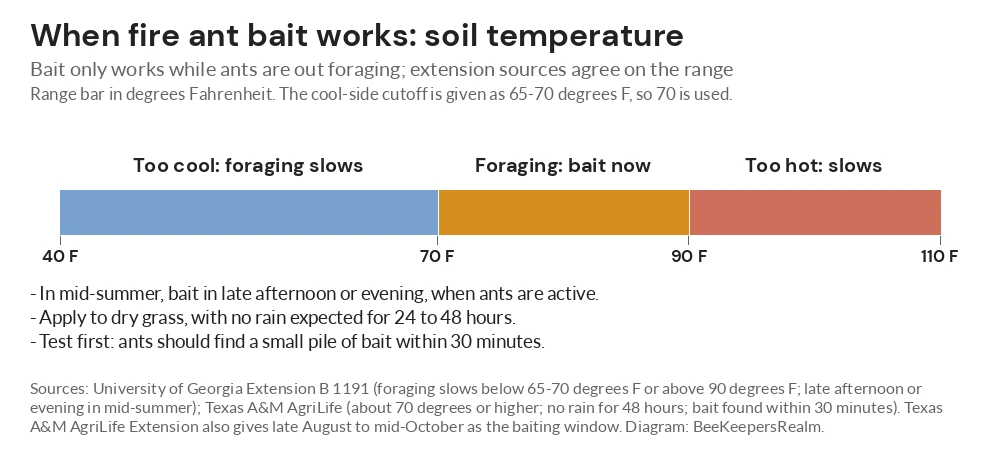
Bait only works while ants forage. University of Georgia Extension says foraging slows when soil temperature is below 65 to 70 degrees Fahrenheit or above 90, so bait in late afternoon or evening in mid-summer. Texas A&M AgriLife says to bait at about 70 degrees or higher, avoid rain for 48 hours, and sprinkle bait around the mound, not on it. Texas A&M adds fresh bait, dry grass, and a quick test: put a small pile near a mound and see whether ants find it within 30 minutes. Bait once or twice a year, with late August to mid-October the best window.
Why disturbing mounds fails
Kicking or digging a mound does not work. Texas A&M says colonies that are regularly disturbed or knocked down may move, but that does not eliminate the ants. Disturbed ants also go into defense mode and ignore bait (AgriLife Today). Shoveling one mound onto another fails in multiple-queen colonies, whose ants tolerate neighbors.
Boiling water
Texas A&M says 2 to 3 gallons of very hot or boiling water on a mound kills ants about 60% of the time, citing a 1980 study; otherwise the ants probably move. It also kills grass and plants it touches and can cause serious burns, and works best when ants are near the surface, such as on cool, sunny mornings. Instant grits, molasses, aspartame and club soda do not work, and Texas A&M strongly discourages pouring gasoline, diesel, ammonia or chlorine on mounds.
Biological control with phorid flies
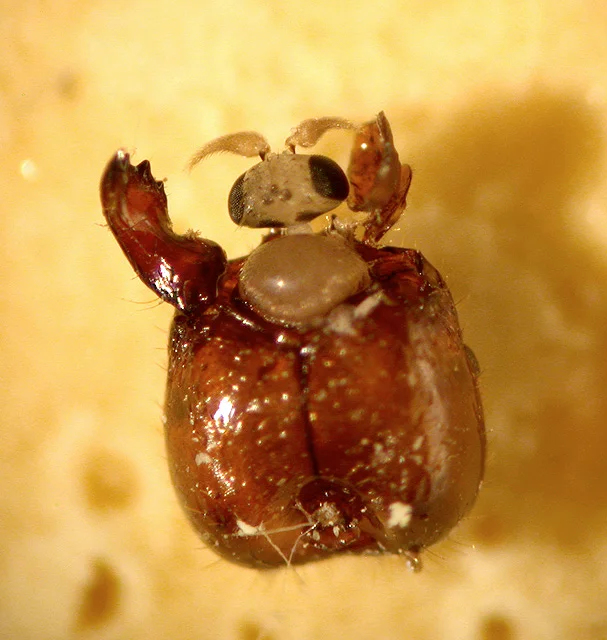
Scientists have released South American phorid flies (Pseudacteon tricuspis and P. curvatus) that decapitate worker fire ants. UF/IFAS and Texas A&M say they have established where released, are highly host-specific and are not available to the public. At best they suppress fire ants.
Pets, Livestock and Wildlife
APHIS says young and newborn animals are especially vulnerable. Texas A&M’s penned animal publication (ENTO-023) says confined animals such as chickens, goats, rabbits, kenneled pets and stabled horses are at higher risk, and that ants are drawn to manure-breeding flies, water in dry spells and feed, including dry dog food. Its wildlife publication (ENTO-019) names fawns, ground-nesting birds and reptiles around birth or hatching. Keep animals and children off treated areas until vegetation and soil are dry.
Frequently Asked Questions
What do fire ants look like?
Reddish-brown ants, 1/8 to 1/4 inch long, with a darker rear, a two-segment waist and workers of many sizes. Their mounds have no central hole.
Where are fire ants found in the US?
APHIS lists Alabama, Arkansas, California, Florida, Georgia, Louisiana, Mississippi, North Carolina, Oklahoma, South Carolina, Tennessee, Texas, Virginia and Puerto Rico, some only in part.
Do fire ants bite or sting?
Both. They bite to grip the skin, then sting, and can sting repeatedly.
Should you pop a fire ant bite?
No. ACAAI says not to break the blister, and Cleveland Clinic warns that popping can lead to infection and scars.
How long do fire ant bites last?
MedlinePlus says pus-filled blisters last 3 to 8 days and a scab 3 to 10 days. Cleveland Clinic says reactions usually clear within 7 to 10 days.
When should you see a doctor after a fire ant sting?
Call 911 for trouble breathing or throat or tongue swelling. Otherwise seek care for excessive swelling, signs of infection or many stings.
Does boiling water kill fire ants?
About 60% of the time, according to Texas A&M, and it kills the plants it touches. Bait plus mound treatment is more reliable across a yard.
What is the best way to get rid of fire ants?
Extension programs recommend the Two-Step Method: broadcast bait over the yard once or twice a year, then treat problem mounds with a labeled mound treatment.
The Bottom Line
Identify the ant first, treat stings with soap, cold and an unbroken blister, and know the 911 signs. Bait the whole yard in fall, then treat problem mounds, and keep insecticide away from bees.
Image credits: featured photo of a red imported fire ant worker by Alex Wild, University of Texas Insects Unlocked program (Wikimedia Commons, CC0), cropped; mound photo by Alex Wild (Commons, CC0), cropped; worker photos by Meghan Cassidy via iNaturalist (Commons, Commons), CC BY-SA 4.0, cropped and resized; phorid fly photo by Sanford Porter, USDA ARS (Commons), public domain. Charts by BeeKeepersRealm.