Reviewed by Elena P. · How we review
Ground bees are small native bees, mostly mining, cellophane, sweat and digger bees, that dig tunnels about 1/4 inch wide in bare, dry soil. They are gentle, rarely sting, and a nesting patch is busy for only about three to four weeks, usually in spring, so the best fix is to leave them alone. If you need them gone, water the patch, thicken the turf or mulch it; extension services do not recommend insecticide. If dozens of insects stream through one hole in late summer, those are probably yellowjackets, which do need care.
Educational information only, not medical or pest-control advice. If you use any pesticide, follow its label. Emergency: trouble breathing, a swelling throat or tongue, or dizziness after any sting means calling 911.
Key Takeaways
- Most bees nest underground. NC State Extension puts it at about 70% of the world’s 20,000-plus species.
- One bee per hole means solitary bees; many insects sharing one hole means yellowjackets or bumble bees.
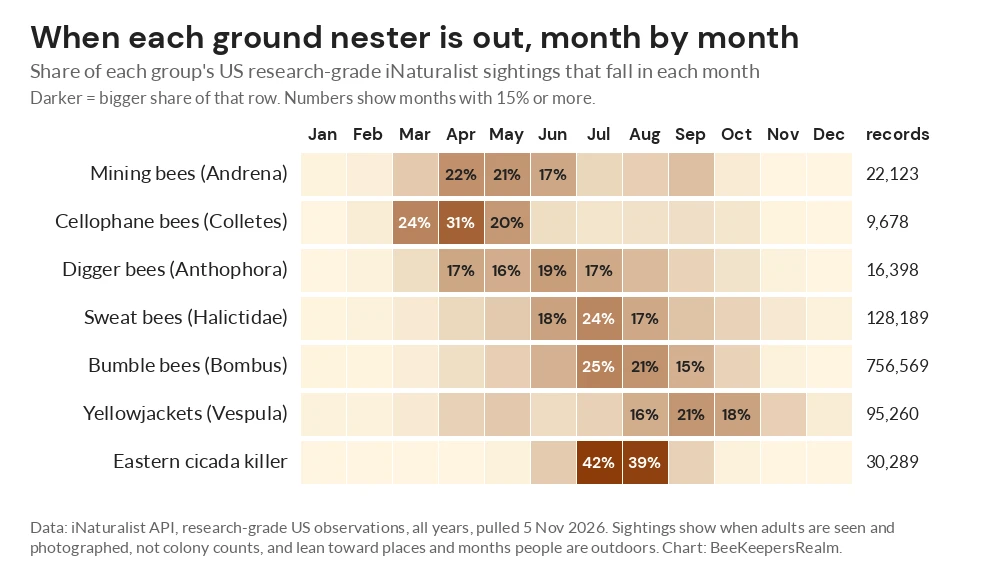
- In our pull of US iNaturalist nest records, 91% of mining and cellophane bee nests were logged from March to May, while 72% of yellowjacket nests were logged from July to October.
- To move ground bees on, change the soil: daytime sprinkling, denser turf, or thick mulch spread in fall.
- Vinegar, cinnamon, dish soap and boiling water have no extension backing. Gasoline is dangerous and pollutes soil.
Table of Contents
- What Ground Bees Are
- Ground Bee or Yellowjacket? Identification Table
- When Each One Shows Up
- Are Ground Bees Dangerous to Kids, Pets or Allergies?
- Why They Are Worth Keeping
- How to Get Rid of Ground Bees Without Killing Them
- When Insecticide or a Professional Makes Sense
- Frequently Asked Questions
- The Bottom Line
What Ground Bees Are
“Ground bee” is a homeowner’s name for any bee nesting in soil, and the US has hundreds of species. Each female digs her own burrow, stocks cells with pollen and nectar, lays an egg on each and dies within weeks. Her young emerge the next year, as our solitary bee life cycle guide explains.
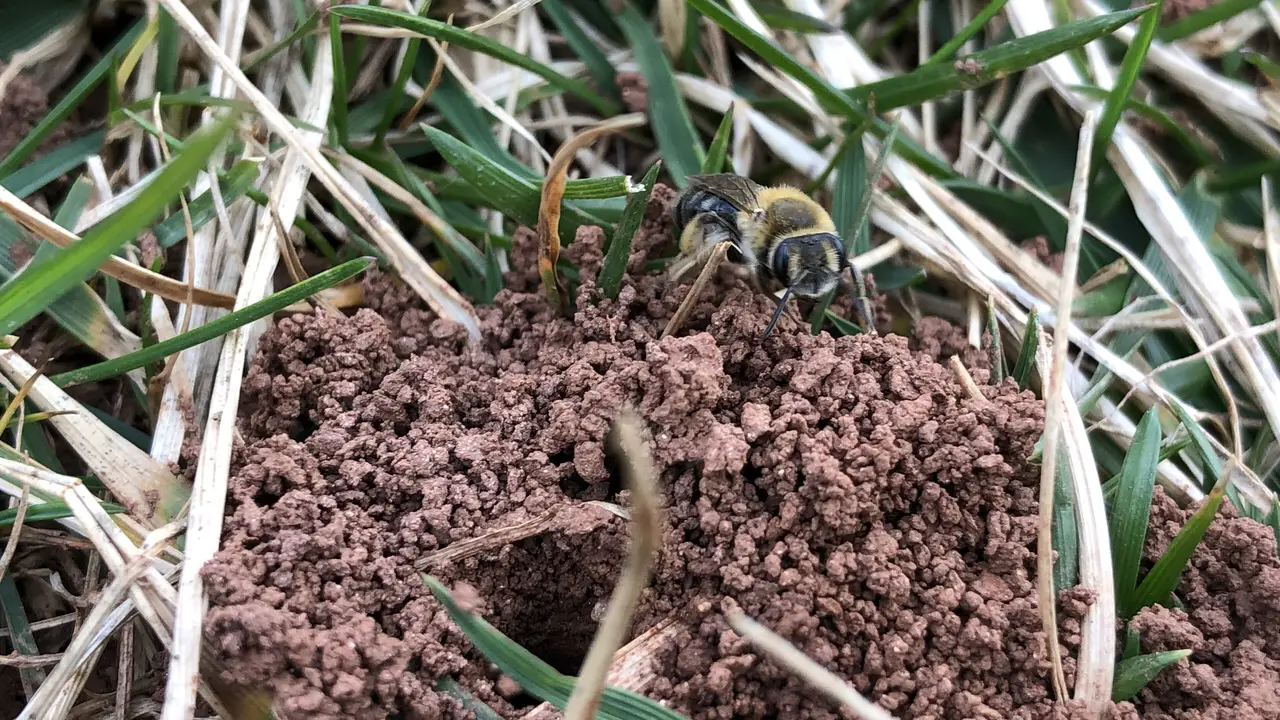
Many females choose the same sunny, dry, thin-grassed patch, as Clemson Extension and the Connecticut Agricultural Experiment Station (CAES) describe, so one lawn can hold dozens of small soil cones, each with a hole in the middle. Most bees zipping low over them are males hunting for mates, and Oregon State Extension notes males have no stingers.
Ground Bee or Yellowjacket? Identification Table
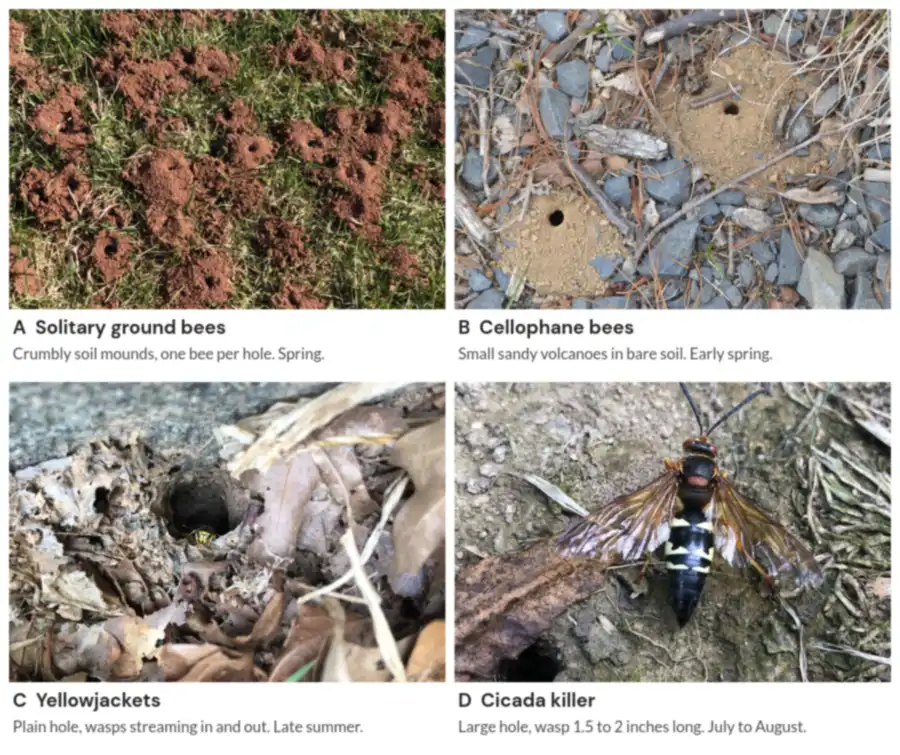
Watch one hole from 6 to 10 feet away for a minute. The CAES fact sheet on ground nesting bees gives the key test: many wasps share one yellowjacket entrance, while each solitary bee uses her own.
| Insect | Looks like | Nest entrance | Main season | Solitary or social | Sting risk |
|---|---|---|---|---|---|
| Mining bees (Andrena) | Small, often dark and hairy; smaller than a penny | Soil mound with a central hole | March to May | Solitary, in clusters | Very low |
| Cellophane bees (Colletes) | Small, about the size of a mining bee | Holes 1/4 to 1/2 inch in bare, sandy soil | March and April; some species in fall | Solitary, in clusters | Very low |
| Sweat bees (Halictidae) | Tiny and dark, or metallic green | Small holes, often in bare patches | Summer to early fall | Solitary to social | Low |
| Digger bees (Anthophora) | Round and fuzzy, like a small bumble bee | Holes in clay or banks, often with a turret | Spring to summer, peak June | Solitary, in clusters | Very low |
| Bumble bees (Bombus) | Large, fuzzy, black and yellow | One opening, often an old rodent burrow | Spring to fall; colony dies in fall | Social | Moderate if the nest is disturbed |
| Yellowjackets (Vespula) | Smooth, shiny, jagged yellow and black stripes; 1/2 to 1 inch | One plain hole with heavy traffic | Colonies peak late summer and fall | Social, 1,500 to 15,000 wasps | High; sting repeatedly |
| Cicada killers | Wasp 1.5 to 2 inches, black with pale yellow bands | Large hole with a pile of loose soil | July and August | Solitary | Low; males cannot sting |
Sources: NC State, CAES, UC IPM, University of Kentucky and Oregon State Extension. More species: our native bee chart sorted by nesting behavior.
The usual mix-up is with yellowjackets:
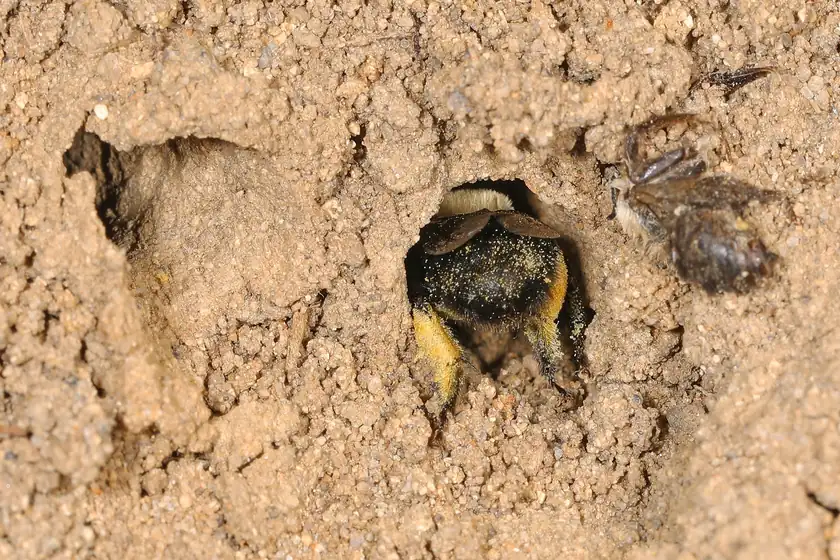
“Every year I get plenty of calls about “angry stinging ground bees” in late summer, but these are almost always ground-nesting yellowjackets (Vespula spp.).”
When Each One Shows Up
The calendar is the quickest clue. On 5 November 2026 we pulled all research-grade US iNaturalist observations for the seven groups above, just over a million, and counted them by month.
Nest photos make the split sharper. Of 296 US mining and cellophane bee records tagged as a nest, 91% were logged from March through May and 2% from July through October. Of 270 yellowjacket nest records, 72% fell from July through October and only 8% from March through May. Cicada killer burrows were 79% July and August.
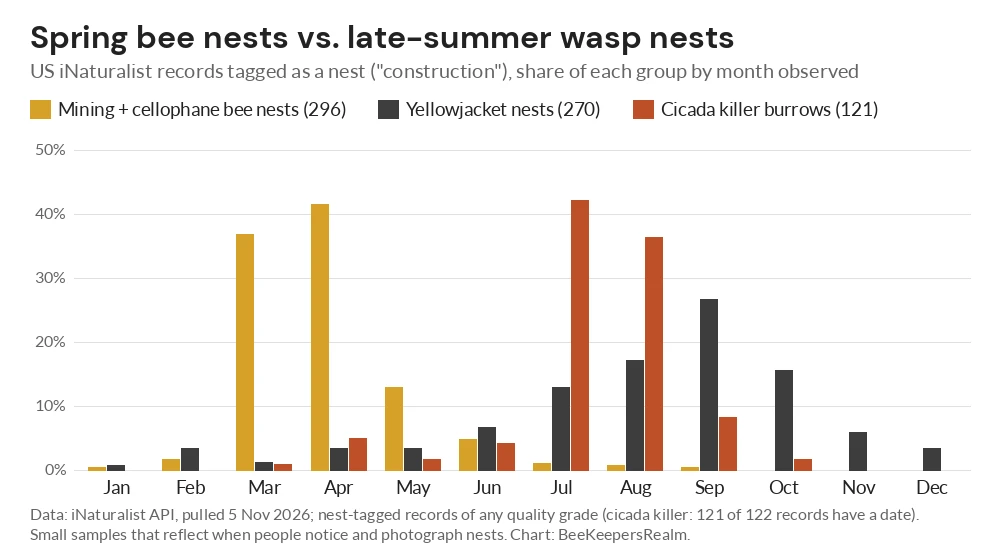
A busy patch of mounds in April is almost certainly bees; stings while mowing in August or September point to yellowjackets.
Are Ground Bees Dangerous to Kids, Pets or Allergies?
Clemson Extension says solitary ground bees are neither aggressive nor defensive of their nests, and people and pets can keep using the lawn. USDA entomologist James Cane notes their weak stingers carry little venom and they sting only if handled.
- Kids: teach them to watch, not dig. CAES says these bees sting only when stepped on or cornered, so wear shoes.
- Pets: bee patches are low risk; a dog digging at a yellowjacket hole can be stung many times.
- Allergies: anyone with a venom allergy should keep away from all nests and carry the epinephrine their doctor prescribed. See our first aid guide for bee and wasp stings.
- Mowing: if wasps boil out of a hole, Oregon State Extension advises leaving the area immediately.
Why They Are Worth Keeping
Ground bees are some of the first pollinators of spring. CAES counts over 80 wild bee species visiting apple blossoms in Connecticut, and NC State names the southeastern blueberry bee, Habropoda laboriosa, as an important blueberry pollinator. Nor do they ruin lawns: Clemson says poor growing conditions thin the turf, and the bees simply use the bare soil.
How to Get Rid of Ground Bees Without Killing Them
Waiting is the simplest method: CAES says a site is usually busy for three to four weeks. If that is too long, change the soil so it stops suiting them.
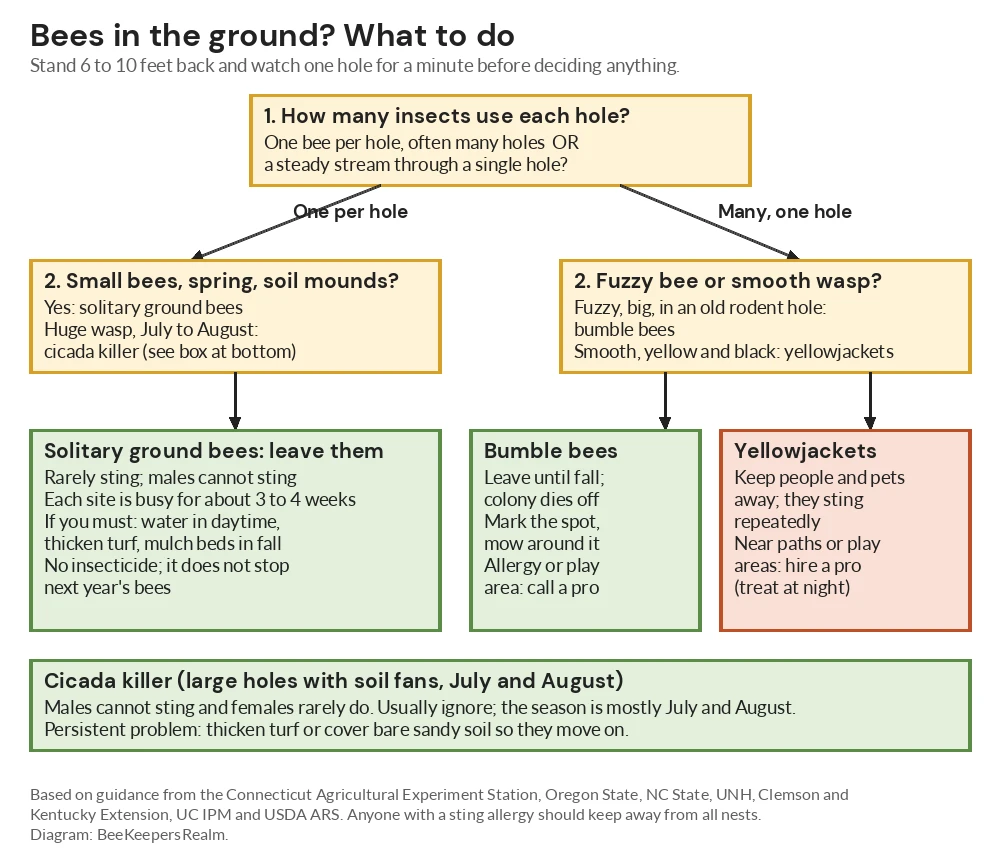
- Sprinkle in daytime. Oregon State says heavy watering discourages nesting, and Cane explains why: females returning to a soaked site find mud and lost landmarks, and often abandon the nest. To keep the bees instead, he advises watering at night.
- Thicken the turf. Seed bare spots and correct the growing conditions. Cane notes bees generally will not nest in thick turf.
- Mulch paths and beds. CAES suggests mulch, pea gravel or groundcover there, and tilling plus organic matter on open ground. Timing matters:
“Thick mulches of bark, wood chips or loose gravel are likewise impenetrable for ground-nesting bees. This fact can be used to persuade bees to abandon an inconvenient nesting site by simply strewing the mulch in the autumn.”
Insecticide is the wrong tool for solitary bees. CAES, Clemson and NC State Extension all advise against it, and the University of New Hampshire explains why it fails:
“Using chemicals to kill ground nesting bees is not recommended. Though wasp and hornet sprays directed into burrows will kill the individuals, more will be back to nest again next season unless soil conditions change.”
What about vinegar, cinnamon or dish soap?
Several top-ranking pages push vinegar, cinnamon, dish soap or boiling water. No extension source we read recommends them, and none changes the soil that drew the bees. Never pour gasoline into a hole: it is a fire hazard and contaminates soil.
When Insecticide or a Professional Makes Sense
Yellowjackets are the exception. A ground nest beside a path, play area or door is a real hazard, and UC IPM’s yellowjacket guidance calls a professional the easiest and safest option. Doing it yourself means protective clothing and a product labeled for yellowjacket nests; Oregon State adds that night treatment works best, when the colony is inside, and that nests can have several entrances. See our wasp nest removal guide.
Nests away from foot traffic can be left; Oregon State notes that in many areas the colony dies at the first hard freeze. Bumble bee nests also end in fall, and University of Kentucky Extension calls cicada killer control generally unnecessary.
Ground nests can also belong to bumblebees; see bumblebee facts and ID.
Frequently Asked Questions
What is the fastest way to get rid of ground bees?
For solitary bees, waiting three to four weeks. Daytime sprinkling of the patch can speed their move.
Will ground bees go away on their own?
Yes. Adults die after nesting; their young emerge the following year.
Do ground bees sting?
Rarely. Males cannot sting, and females sting only if stepped on or handled.
Does dish soap or vinegar kill ground bees?
No extension source recommends either, and neither stops new bees nesting next year.
What smells do ground bees hate?
We found no research showing a scent that repels them. Moisture, dense turf and mulch work.
Do ground bees come back every year?
Often. NC State notes some aggregations reuse the same spot and grow yearly.
Are ground bees dangerous to dogs?
Rarely. A dog digging into a yellowjacket nest is the real risk.
The Bottom Line
Spring mounds with one bee per hole are harmless pollinators that leave on their own. A single busy hole in late summer is usually a yellowjacket nest; keep people away and call a professional if it sits where people walk.
Image credits: Featured photo: Famartin, via Wikimedia Commons, CC BY-SA 4.0, cropped. Charts use iNaturalist research-grade and nest-tagged observations pulled 5 November 2026.