Reviewed by Elena P. · How we review
A queen bee is the only sexually developed female in a honey bee colony and the mother of nearly every bee in it. She has two jobs: laying eggs, up to about 1,500 a day at the spring peak by Mid-Atlantic extension figures, and giving off pheromones that keep the colony working as one. Workers raise her from an ordinary fertilized egg, feeding the larva royal jelly the whole way, and she emerges about 16 days after the egg is laid.
This page is the overview of the queen bee. Each section points to our detailed guide when you need the step-by-step version, and every number is tied to a named source, because published queen figures disagree more than most pages admit.
Key Takeaways
- A queen develops from egg to adult in about 16 days, against about 21 for a worker and 24 for a drone.
- Royal jelly for her whole larval life separates her from a worker. University of Illinois research adds that what worker larvae get on top of it, plant compounds in pollen and honey, helps push them toward worker development.
- She mates only early in life, on one or more flights about a week after emerging, with an average of 12 drones in NC State’s figures (range one to more than 40), and stores the sperm for life.
- Peak laying is up to 1,500 eggs a day in MAAREC’s figures; Penn State says a quality queen can top 2,000.
- Most queens are productive for 2 to 3 years, though some live 5 years or more.
- If a colony loses its queen, an emergency replacement lays at the earliest about 17 to 23 days later, and no new workers emerge for roughly six weeks, by our arithmetic from extension figures.
- To spot her, look for the long abdomen, not the color. Marked queens carry a dot coded to the year they were raised; 2026 is white.
Table of Contents
- What a Queen Bee Does in the Colony
- Queen vs. Worker vs. Drone: How to Tell Them Apart
- How a Larva Becomes a Queen
- The Mating Flight and Drone Congregation Areas
- How Many Eggs a Queen Lays
- Queen Pheromones: The Colony’s Chemical Glue
- How Long a Queen Bee Lives
- Swarming and Supersedure: How Colonies Replace Queens
- What Happens When a Colony Loses Its Queen
- How Beekeepers Find and Mark the Queen
- Frequently Asked Questions
- The Bottom Line
What a Queen Bee Does in the Colony
A honey bee colony has thousands of workers (up to about 60,000), several hundred drones in late spring and summer, and normally one queen, according to the Mid-Atlantic Apiculture Research and Extension Consortium (MAAREC).
The queen’s first job is reproduction: fertilized eggs become workers or new queens, unfertilized eggs become drones. Her second job is chemical. Her pheromones work as a social glue that keeps workers from raising rival queens or laying eggs of their own.
She is not a ruler. She does not forage or build comb, and she has no pollen baskets or working wax glands. Workers feed and groom her and, when she weakens, raise her replacement; Penn State Extension calls that “a collective decision.” For centuries she was called the “king bee”; the Dutch naturalist Jan Swammerdam’s dissection proved the king bee was a queen.
Queen bee numbers, checked against the sources
Most pages give one number for each queen fact. The primary sources do not agree, so here is who says what.
| Question | What the sources say |
|---|---|
| Egg to adult queen | About 16 days (Penn State Extension; FAO) |
| Age at first mating flights | 5 to 8 days after emerging (Penn State); about one week (MAAREC) |
| Drones she mates with | 7 to 15 (MAAREC); about 10 (FAO); average 12, range one to more than 40 (NC State, 2007) |
| Mating deadline | Loses the ability to mate if bad weather delays her more than 20 days (MAAREC) |
| Start of laying | About 48 hours after mating (MAAREC) |
| Eggs per day at peak | Up to 1,500 (MAAREC); 1,500 to 2,000 in a strong, well-fed colony (FAO); over 2,000 for a quality queen (Penn State) |
| Eggs per year and lifetime | Up to 250,000 a year; possibly more than a million in her life (MAAREC) |
| Lifespan | Productive 2 to 3 years, sometimes living 5 (MAAREC); 2 to 3 years “for a long-lived queen” (NC State); seven or more years possible, with output falling after year one or two (Penn State) |
Compiled by BeeKeepersRealm from the MAAREC, Penn State Extension, FAO and NC State sources linked in this article, checked November 2026. Google’s AI Overview for “queen bee” also cites “up to 3,000” eggs a day; none of these primary sources supports that figure.
Queen vs. Worker vs. Drone: How to Tell Them Apart
A laying queen is the longest bee in the hive. Her abdomen is stretched by her ovaries and runs well past the tips of her folded wings, so she looks like a worker with too much tail.
| Queen | Worker | Drone | |
|---|---|---|---|
| Number per colony | One | Thousands, up to about 60,000 | Several hundred, late spring and summer |
| Egg | Fertilized | Fertilized | Unfertilized |
| Egg to adult | About 16 days | About 21 days | About 24 days |
| Larval diet | Royal jelly throughout | Royal jelly for about 3 days, then worker jelly | Royal jelly at first, then honey and pollen |
| Body | Longest; abdomen extends well past the wings | Smallest; wings reach the abdomen tip | Largest and stoutest; eyes meet on top of the head |
| Stinger | Curved and longer, with fewer, shorter barbs; can sting repeatedly | Barbed; usually lost when it stings a person | None |
| Typical adult life | Productive 2 to 3 years; up to 5 or more | About 6 weeks in summer; up to 6 months if reared in fall | About 3 to 5 weeks in spring and summer; expelled in fall |
| Job | Lays eggs; makes the queen pheromones | Nursing, comb building, guarding, foraging | Mating with virgin queens |
Sources: MAAREC, Penn State Extension and FAO; drone life from Mark Winston and Stanley Schneider as summarized by Honey Bee Suite. See also our guide to worker bee jobs by age and the drone bee’s role.
“Her wings cover only about two-thirds of the abdomen, whereas the wings of both workers and drones nearly reach the tip of the abdomen when folded.”
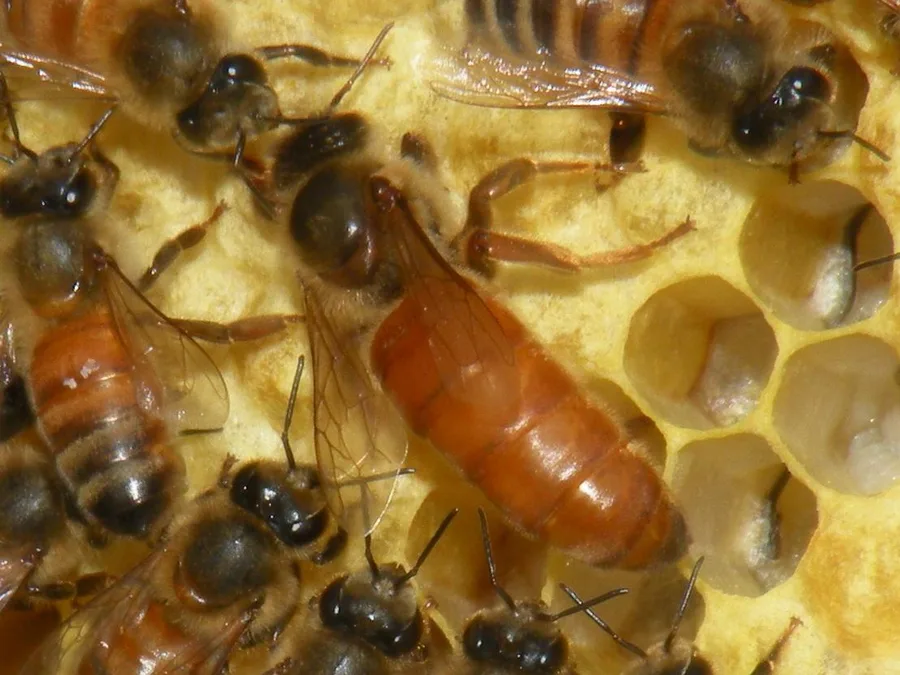
Size only works for a mated, laying queen. Penn State notes that a virgin queen’s abdomen “is not yet distended”, so she runs quickly across the comb and is hard to find. Many guides call the queen’s stinger smooth; MAAREC says it has fewer, shorter barbs than a worker’s. Either way she can sting more than once, mainly against rival queens.
In this 10-minute 2016 video from the University of Guelph’s Honey Bee Research Centre, apiary manager Paul Kelly finds a queen in a small colony frame by frame. He uses very little smoke, scans each frame for the queen’s long abdomen instead of looking at every bee, and watches the next frame still in the box, because a mated queen moves away from the light. He says about half the queens he finds turn up that way.
How a Larva Becomes a Queen
Any fertilized egg can become a queen or a worker. The difference is food and housing. According to Penn State Extension’s guide to queen development, by Kate Anton and entomologist Christina Grozinger, all larvae get royal jelly for their first three days. Royal jelly is a protein-rich secretion from glands in the heads of nurse bees, which are largest in nurses 6 to 12 days old. On the third day, larvae destined to be workers switch to worker jelly, a mix of royal jelly, pollen and nectar. Queen larvae keep getting royal jelly to the end.
Any female larva under three days old can still become a queen, but Penn State says the larger, more vigorous queens come from the youngest larvae, under one day old. Every larva receives about 10,000 nurse visits during development.
A queen grows in her own cell, which hangs vertically and is shaped, in the FAO’s words, “somewhat like a groundnut”. The larva lies on a bed of royal jelly, and leftover jelly is often still in the cell after she emerges. Recent research suggests the cell itself also shapes the queen; see our note on how queen cell architecture affects development.
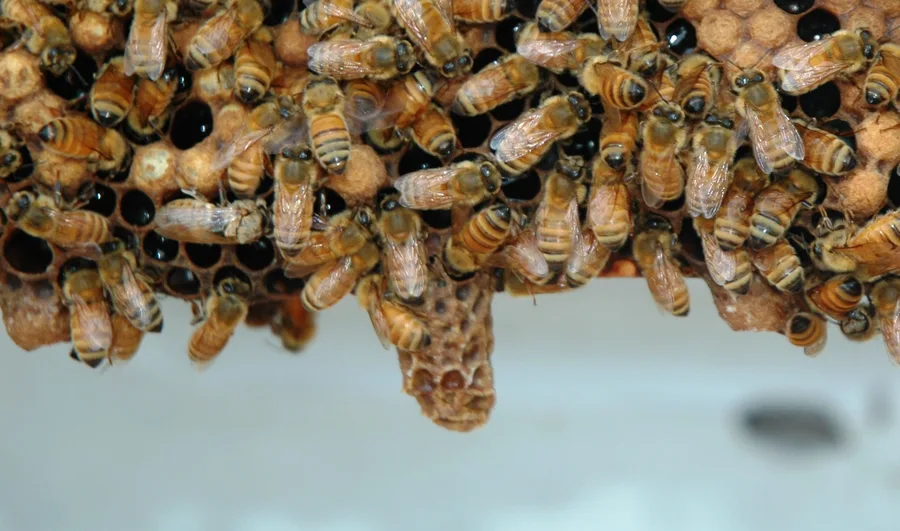
Royal jelly may be only half the story. In 2015 University of Illinois researchers reported that p-coumaric acid, a plant compound found in the honey and beebread fed to worker larvae, pushes larvae down the worker path. Royal jelly lacks it.
“For years, people have wondered what components in royal jelly lead to queen development, but what might be more important is what isn’t in royal jelly – plant chemicals that can interfere with development.”
The queen’s development timeline
| Day (from egg) | What happens |
|---|---|
| 0 | Egg laid in a queen cup, or in a worker cell the bees then rebuild |
| 3 | Egg hatches; the larva lies on a bed of royal jelly |
| About 9 | Cell capped; the larva spins a cocoon and pupates |
| About 16 | Virgin queen emerges; the first out kills rival queens |
| About 21 to 24 | Mating flights, 5 to 8 days after emerging |
| About 2 days after mating | She starts laying |
Sources: Penn State Extension (days 3, 9, 16 and mating age) and MAAREC (laying about 48 hours after mating).
That 16-day schedule is the shortest of the three castes, which Penn State calls “a fascinating evolutionary adaptation”: the first queen out can kill her sisters before they kill her, and the colony spends less time without a laying queen. In MAAREC’s stage lengths, used in the chart below, queen, worker and drone cells are capped when the larvae are about 6, 5½ and 6½ days old.
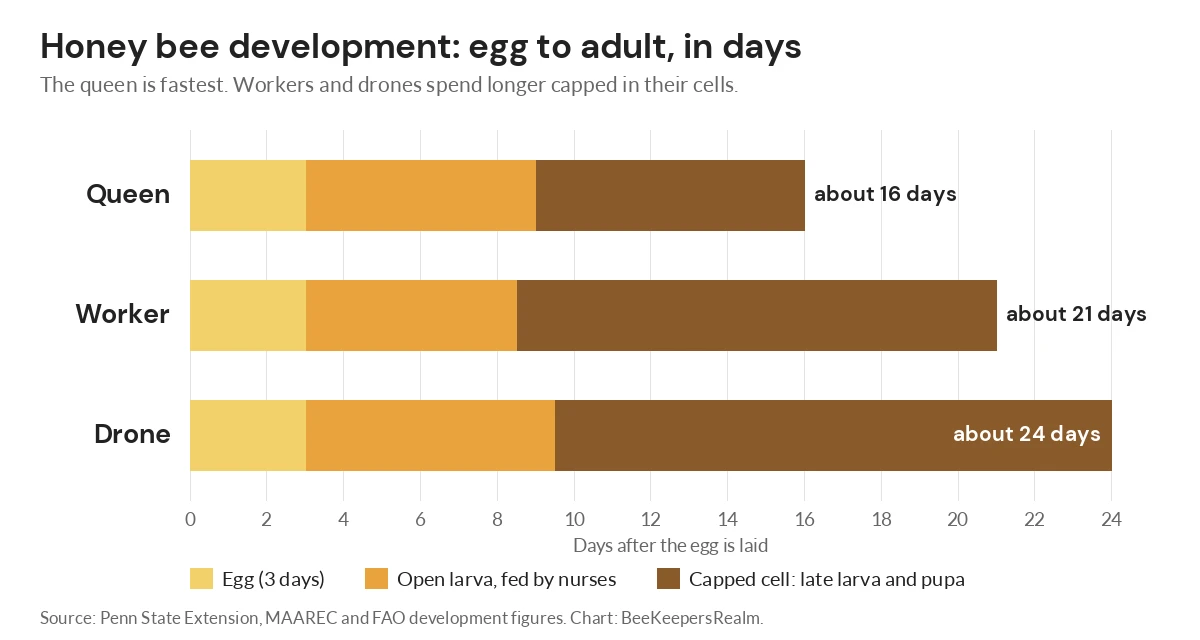
Beekeepers use the same clock to raise queens on purpose; our queen cell timing guide follows it day by day, and queen rearing basics for U.S. beekeepers covers grafting and graft-free methods.
The Mating Flight and Drone Congregation Areas
A new queen mates only early in life, on one or several flights over a few days. Penn State says a virgin first spends five to eight days in the hive while her reproductive organs mature and her flight muscles strengthen. MAAREC adds the flight details: she circles the hive to learn its location, leaves alone, is gone about 13 minutes and mates, usually in the afternoon, with seven to fifteen drones more than 20 feet up.
Drones do not wait at their own hives. They gather in drone congregation areas, open patches of sky where males from many colonies collect; the FAO notes that several thousand drones must be in the area for mating to succeed. A 2021 harmonic-radar study that tracked individual drones (Woodgate and colleagues, iScience) found they favored the same spots two years running and often visited several of them on one flight. A drone dies right after mating.
How many partners matters. In a 2007 study, NC State’s David Tarpy, Christina Grozinger and Freddie-Jeanne Richard inseminated queens with semen from one drone or ten. Workers paid more attention to the multiply inseminated queens, whose pheromone blend had changed. The university’s news release put natural matings at one to more than 40 drones, 12 on average.
“This tells us the workers can tell how many drones the queen has mated with.”
She stores the sperm in an organ called the spermatheca and keeps it for life. She begins laying about two days after mating, releasing sperm for each egg laid in a worker or queen cell and none for eggs in the larger drone cells. If rain or cold delay her more than about 20 days, MAAREC says she can no longer mate and will lay only drone eggs, one route to a drone-laying queen. For the day-by-day window and weather effects, see our virgin queen mating flight timeline and signs of a virgin queen in the hive.
How Many Eggs a Queen Lays
A good queen lays up to about 1,500 eggs a day at her peak, according to MAAREC, and Penn State says a quality queen can top 2,000, more than her own body weight in eggs in a day. Over a year that adds up to as many as 250,000 eggs, and possibly more than a million in her lifetime.
The rate is not hers alone to set. The FAO says 1,500 to 2,000 eggs a day is possible only when the colony is strong, the queen well fed and empty comb available. Workers control her output through how much they feed her and how many cells they clean, and they eat eggs when food runs short.
Laying follows the seasons. MAAREC describes queens laying most in spring and early summer, tapering off in early October and laying few or no eggs until about January. That calendar is for Mid-Atlantic colonies, so adjust it to your climate.
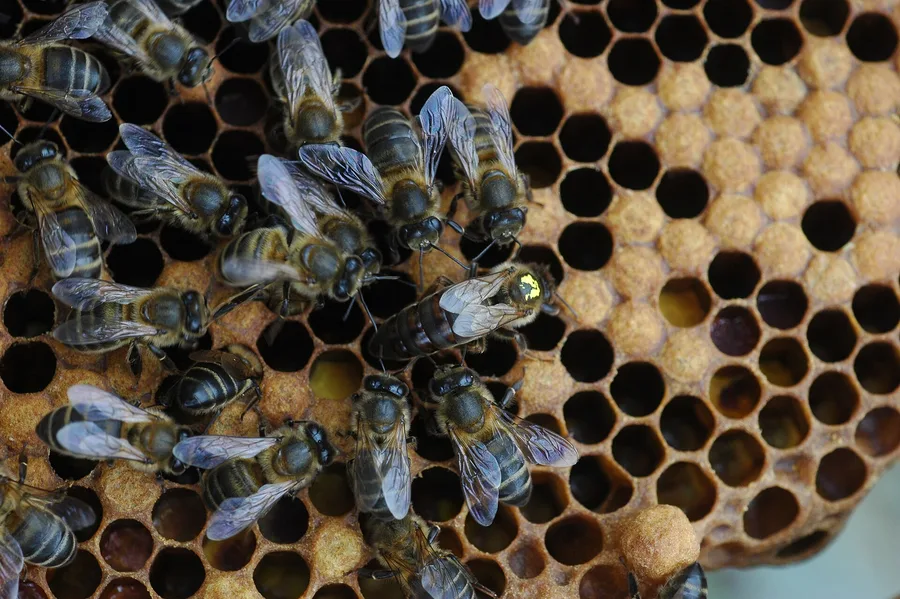
Before laying, she puts her head and front legs into a cell to measure it, which tells her whether to fertilize the egg. A queen’s eggs sit one per cell, upright at the center of the bottom. Several eggs per cell, or eggs stuck to the walls, point to laying workers instead. Our guide to reading a brood frame shows how to judge her pattern.
Queen Pheromones: The Colony’s Chemical Glue
Workers know their queen by smell, not by sight. Penn State explains that she produces a blend of chemicals from several glands. The most important come from her mandibular glands: a subset of five compounds known as queen mandibular pheromone, or QMP.
QMP does three main jobs. It stops workers’ ovaries from developing, so they don’t become laying workers. It suppresses the rearing of new queens. And it draws a retinue, the ring of workers that face the queen, lick and touch her, and then carry her scent through the hive. A virgin queen’s blend is different: it draws little retinue inside the hive but strongly attracts drones on the mating flight. The mix changes once she mates, and, as NC State found, with how well she mated.
When her output falls, as it does with age, the colony reads it as a failing queen. MAAREC says that when the queen substance “is no longer adequate,” workers prepare to supersede her. More on the colony’s chemical signals is in our guide to how bees use pheromones.
How Long a Queen Bee Lives
A queen bee can live several years, far longer than any worker or drone, but her useful life is shorter. MAAREC gives “as long as 5” years with an average productive life of 2 to 3. Penn State says queens can live seven or more years, but their productivity typically falls after the first year or two.
That decline is why beekeepers requeen. Penn State notes that some replace a queen only when she fails, others every year, and commercial beekeepers as often as twice a year.
For side-by-side lifespans of all three castes, see how long honey bees live. If your queen is slowing down, the best time to requeen covers timing by season.
Swarming and Supersedure: How Colonies Replace Queens
Colonies raise new queens in three situations, according to MAAREC: to swarm, to supersede an old queen, or in an emergency when the queen is suddenly lost.
Swarming
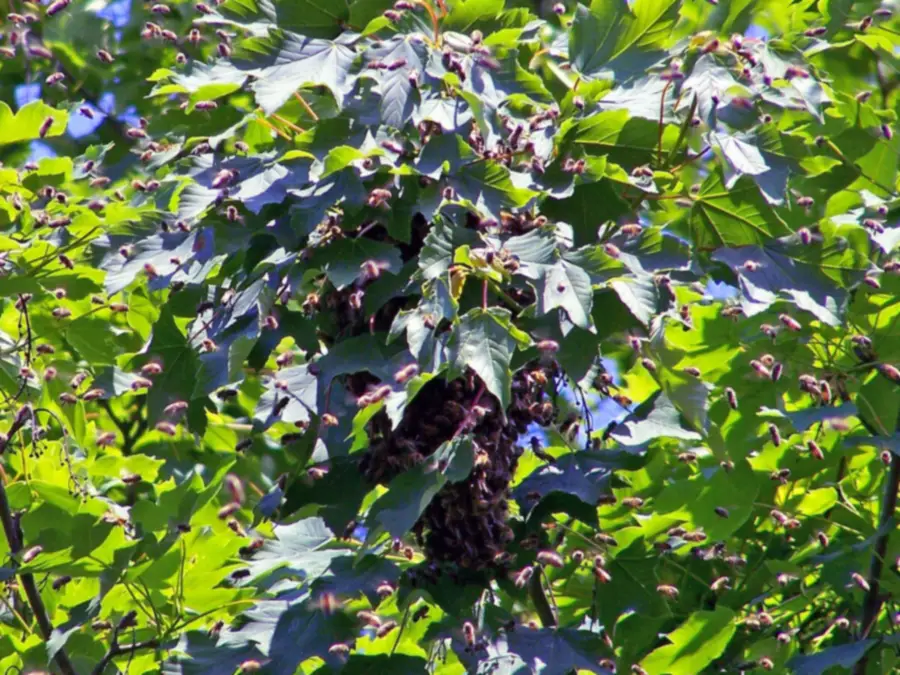
Swarming is how a colony reproduces. It builds queen cells, often along the bottom edges of the combs; the FAO says as many as 20 may be present. Workers feed the old queen less so she slims down and can fly. Before the new queens emerge, 30 to 70% of the workers fill up on honey and leave, usually with the old queen, then hang in a cluster near the old hive until scouts find a new home. If the queen is lost at that stage, the swarm goes back. The colony left behind keeps the queen cells, and the first virgin to emerge kills her rivals.
Supersedure
Supersedure is a quiet replacement of a failing queen. The bees build a few cells, usually on the face of the comb and about the same age. MAAREC says supersedure queens tend to be better than emergency queens because they get more royal jelly, and that the old queen and her daughter may share the hive for a while. That is the most common way to find two queens in one hive.
Cell position helps but is not proof. Our comparison of swarm cells vs. supersedure cells covers the clues, and spotting supersedure before a hive swarms covers what to do about each.
What Happens When a Colony Loses Its Queen
If a queen is killed or lost, the workers pick young larvae, no more than 3 days old, and turn their worker cells into emergency queen cells that hang down the face of the comb. If there are no young larvae, the colony cannot make a queen at all.
The queen-loss clock
We put the extension figures together to show how long recovery takes, assuming the bees start emergency cells right away and the weather cooperates.
| Days after queen loss | What happens | Basis |
|---|---|---|
| 0 | Queen lost; workers start emergency cells on larvae up to 3 days old | MAAREC, Penn State |
| About 10 to 13 | New virgin queen emerges | 16-day development minus the 3 to 6 days the chosen larva had already grown from its egg |
| About 15 to 21 | Mating flights begin | 5 to 8 days after emerging (Penn State) |
| About 17 to 23 at the earliest | First eggs | About 48 hours after mating (MAAREC); bad weather adds days |
| About 30 to 33 | Last chance to mate | Mating ability is lost after about 20 days of delay (MAAREC) |
| About 38 to 44 at the earliest | First new workers emerge | 21 days after the first eggs |
Arithmetic by BeeKeepersRealm from the sources named. Real colonies often run later.
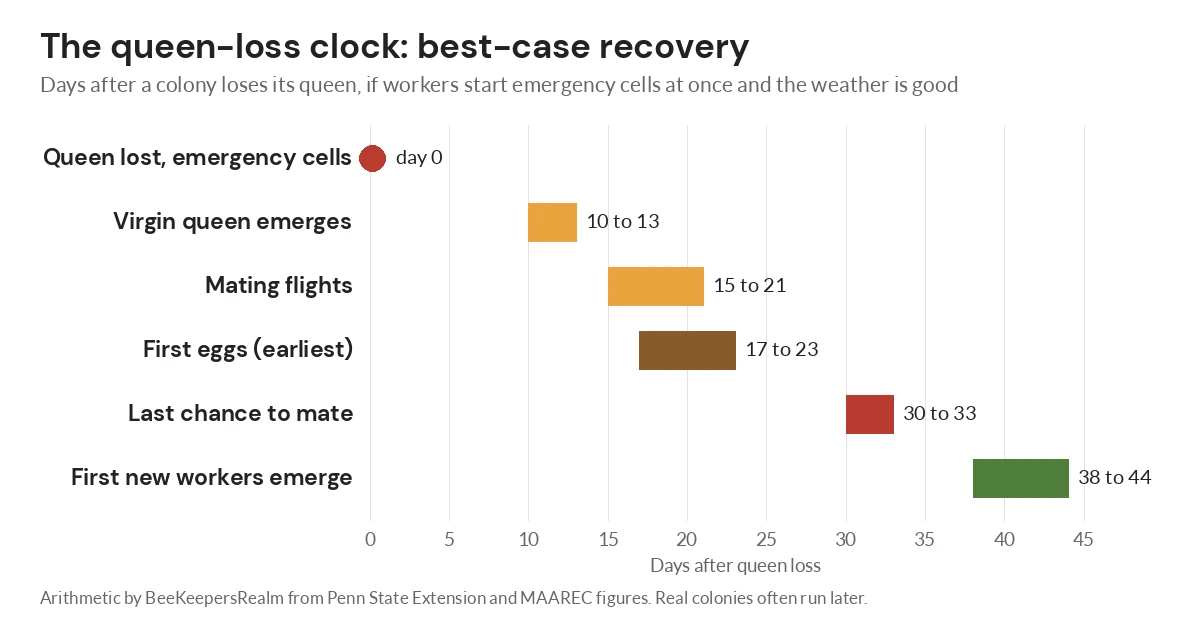
For about six weeks, then, no new workers emerge while older bees keep dying. That is why many beekeepers add a frame of eggs and young brood or introduce a mated queen instead of waiting. Our guide to how long a hive can stay queenless covers that decision.
When there is nothing to raise a queen from, workers’ ovaries develop. MAAREC says laying workers usually mean a colony has been queenless for one or more weeks. Their marks are five to fifteen eggs in a cell, eggs on the cell walls instead of the base, and small drones reared in worker cells.
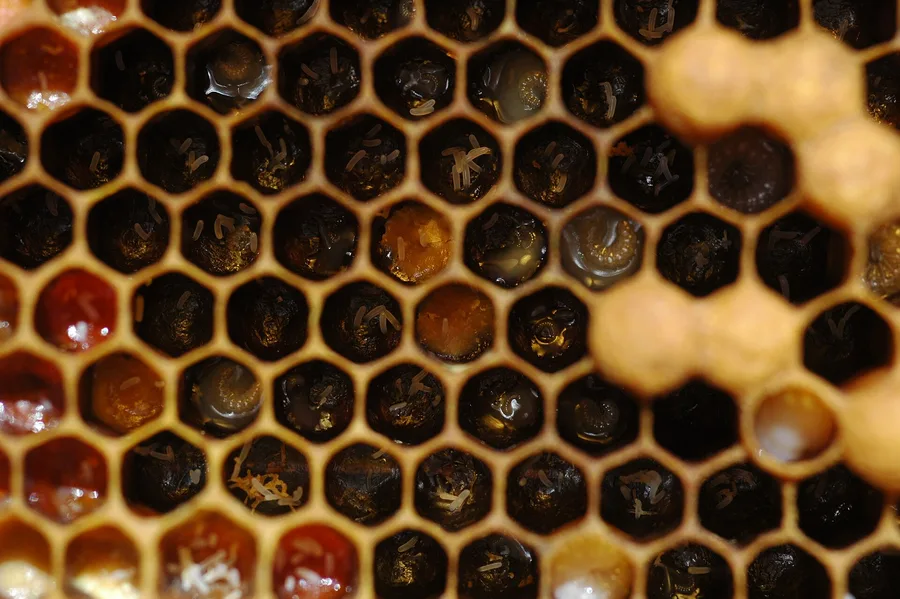
To check your own hive, start with the signs a hive is queenless and how to diagnose laying workers. To replace her, see how to requeen a hive and our step-by-step guide to introducing a new queen bee.
How Beekeepers Find and Mark the Queen
Finding the queen gets easier with a method. These are the habits Paul Kelly demonstrates in the Guelph video above:
- Use only a little smoke. Heavy smoke sets the bees, and the queen, running.
- Practice on small colonies in spring, on a sunny day.
- Scan each frame’s edges and then its middle for her long abdomen; don’t inspect every bee.
- As you lift a frame, look at the next one still in the box, and check first the side that was facing away from the light.
- If you see fresh eggs, she was there recently. Then forget the eggs and go back to hunting for her abdomen.
- Work briskly, or she may wander onto the box walls or honey frames.
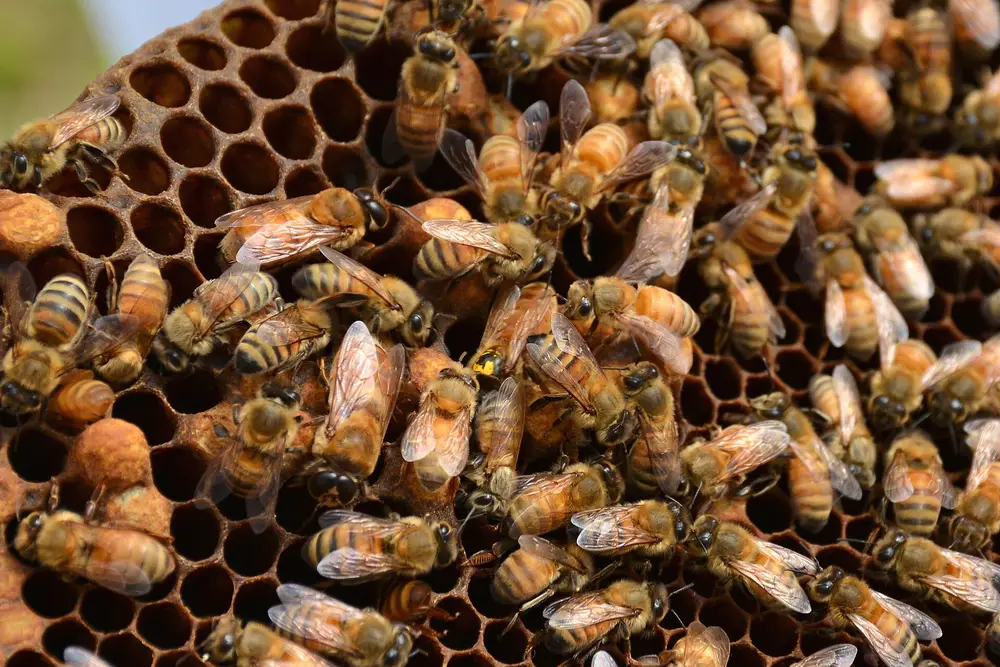
Marking makes the search far quicker. Beekeepers put a dot of paint on the queen’s thorax, using an international color code tied to the last digit of the year she was raised:
| Year ends in | Color | Next years |
|---|---|---|
| 1 or 6 | White | 2026, 2031 |
| 2 or 7 | Yellow | 2027, 2032 |
| 3 or 8 | Red | 2028, 2033 |
| 4 or 9 | Green | 2029, 2034 |
| 5 or 0 | Blue | 2030, 2035 |
The usual memory aid is “Will You Raise Good Bees”. The color then tells you her age at a glance, which matters because output falls after a year or two.
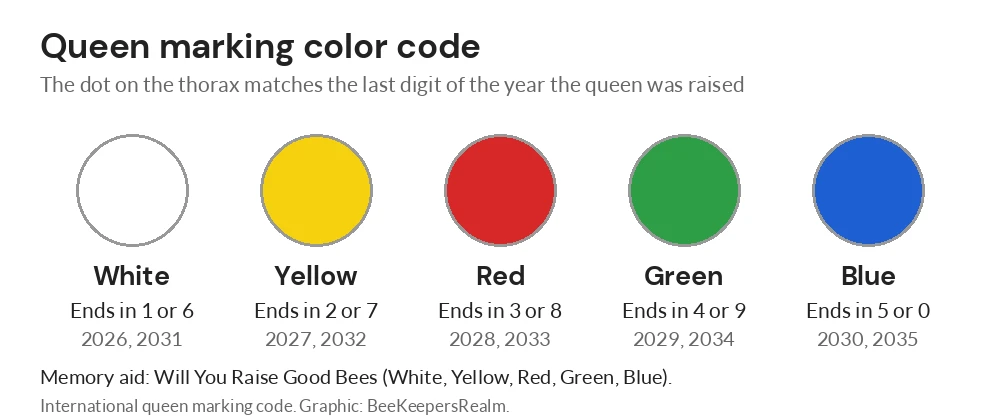
For every year through 2035 and what to do if a mark wears off, see our queen marking color chart by year. Pen choices are compared in the best queen marking pens, and clipping a queen’s wings weighs the other common way of tagging her.
Frequently Asked Questions
How does a bee become a queen bee?
Workers rear a fertilized egg or a larva under three days old in a large vertical queen cell and feed it royal jelly for its whole larval life. She emerges about 16 days after the egg was laid.
What is special about a queen bee?
She is the colony’s only sexually developed female and the source of the pheromones that hold it together. She stores sperm from one mating period for years and can lay up to about 1,500 eggs a day.
How do you identify a queen bee?
Look for a bee noticeably longer than the workers, with an abdomen that extends well past her folded wings, often ringed by workers facing her. Many beekeepers also mark her thorax with a colored dot.
How long does a queen bee live?
Usually 2 to 3 productive years. Some live 5 years or more, but egg-laying typically declines after the first year or two.
What happens when a queen bee dies in a hive?
If there are larvae under three days old, workers raise an emergency queen, who lays at the earliest about 17 to 23 days after the loss. Without young larvae, the colony cannot replace her and laying workers may appear.
What does a queen bee eat?
Royal jelly, as a larva and as an adult. Workers attend and feed her constantly, and how much they feed her helps set how many eggs she lays.
Can a queen bee sting you?
Yes, she has a stinger and can sting more than once, but she uses it mainly against rival queens.
Can a hive have two queens?
Yes, for a while. During supersedure an old queen and her daughter may share the hive, and some beekeepers run managed two-queen colonies. See how two-queen hives work.
The Bottom Line
The queen is the colony’s egg-layer and chemical signal, not its boss. When you inspect, eggs tell you more than a sighting: one centered egg per cell means a laying queen was there within the last three days. If eggs disappear, use the queen-loss clock above to decide whether to wait or step in.
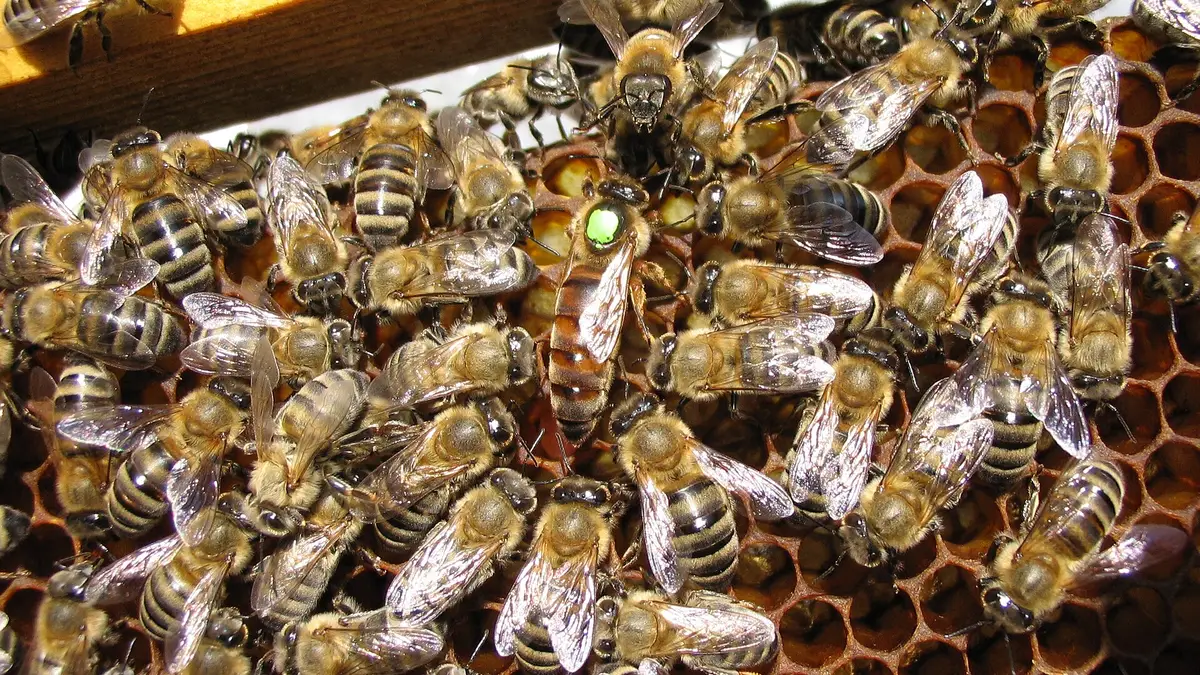
Image credits: Featured photo of a green-marked queen and her retinue: Plamen Petrov, CC BY-SA 4.0, via Wikimedia Commons (File:Imgonline-com-ua-dexifpelrJwptYU0R.jpg). Cropped and resized.