Beeswax is not a building material bees find — it is a substance their own bodies manufacture, secreted as liquid and hardened into scales thinner than a human fingernail. Roughly 1,100 of those scales are needed to make a single gram of wax, which gives some sense of how much metabolic effort a colony puts into building comb.
Only worker bees produce wax, and only during a specific window of their adult life, using a set of glands most beekeepers never see even though they inspect hives regularly.
Key Takeaways
- Wax is produced by eight mirror-surfaced glands on the underside of a worker’s abdomen, on sternite segments 4 through 7.
- Production is concentrated in young workers roughly 12 to 17 days old; the glands gradually shrink once a bee begins regular flight, though they can reactivate later if the colony needs to build new comb, such as after swarming.
- Wax leaves the gland as a clear, colorless liquid that hardens into thin scales on contact with air — the scales only turn opaque white after a bee chews and works them with her mandibles.
- Mandibular gland secretions are added during chewing, meaning finished wax is a worked mixture, not the raw glandular secretion alone.
- Producing wax is metabolically expensive, which is a major reason colonies only draw large amounts of new comb during a strong nectar flow.
The Eight Glands That Make Comb Possible
Wax comes from eight paired glands located on the inner surface of the sternites — the ventral plates — on abdominal segments 4 through 7 of a worker bee. Each gland has a smooth, mirror-like surface where liquid wax collects and spreads in a thin film before hardening into a small, pale scale, sometimes described as looking like a fish scale or a flake of ice (Apidologie, ultrastructure of the wax gland complex). At the cellular level, the gland complex involves three distinct cell types — epithelial cells, oenocytes, and adipocytes — working together to synthesize and secrete a mixture of hydrocarbons, fatty acids, and lipophorin proteins that together make up beeswax.
A Job for Young Bees Only
Wax production is tied closely to age. Glands are largest and most active in workers roughly 12 to 17 days old — not coincidentally, close to the same window in which bees also serve as nurse bees and comb-builders inside the nest, described in more detail in our guide to worker bee roles. Once a bee begins regular foraging flights, her wax glands gradually degenerate and comb-building is effectively handed off to younger nestmates. That said, the glands are not permanently retired: older bees can reactivate wax production if the colony suddenly needs to build comb quickly, such as after swarming into a new cavity with no existing structure.
From Liquid to Scale to Finished Comb
Freshly secreted wax is glass-clear and colorless. It only becomes the opaque white material most people picture as “beeswax” after a bee physically works it: she passes a hardened scale forward, leg to leg, until she can grip it with her mouthparts, then chews it while adding secretions from her mandibular glands until it becomes pliable enough to shape. That chewing and mixing step is why finished comb wax is a worked composite, not simply the raw gland secretion applied directly (beeswax composition and processing).
Why Comb-Building Is Expensive, and When Colonies Actually Do It
Producing wax costs a colony real energy — converting nectar-derived sugars into wax is metabolically demanding, which is why colonies concentrate large-scale comb building into periods of strong nectar flow rather than spreading it evenly across the season. It also explains why beekeepers who provide already-drawn comb, rather than bare foundation, can meaningfully reduce how much of a colony’s incoming nectar gets diverted into wax production instead of stored honey — a practical consideration covered from the equipment side in our guide to choosing a beehive as a beginner.
What This Looks Like on an Actual Frame
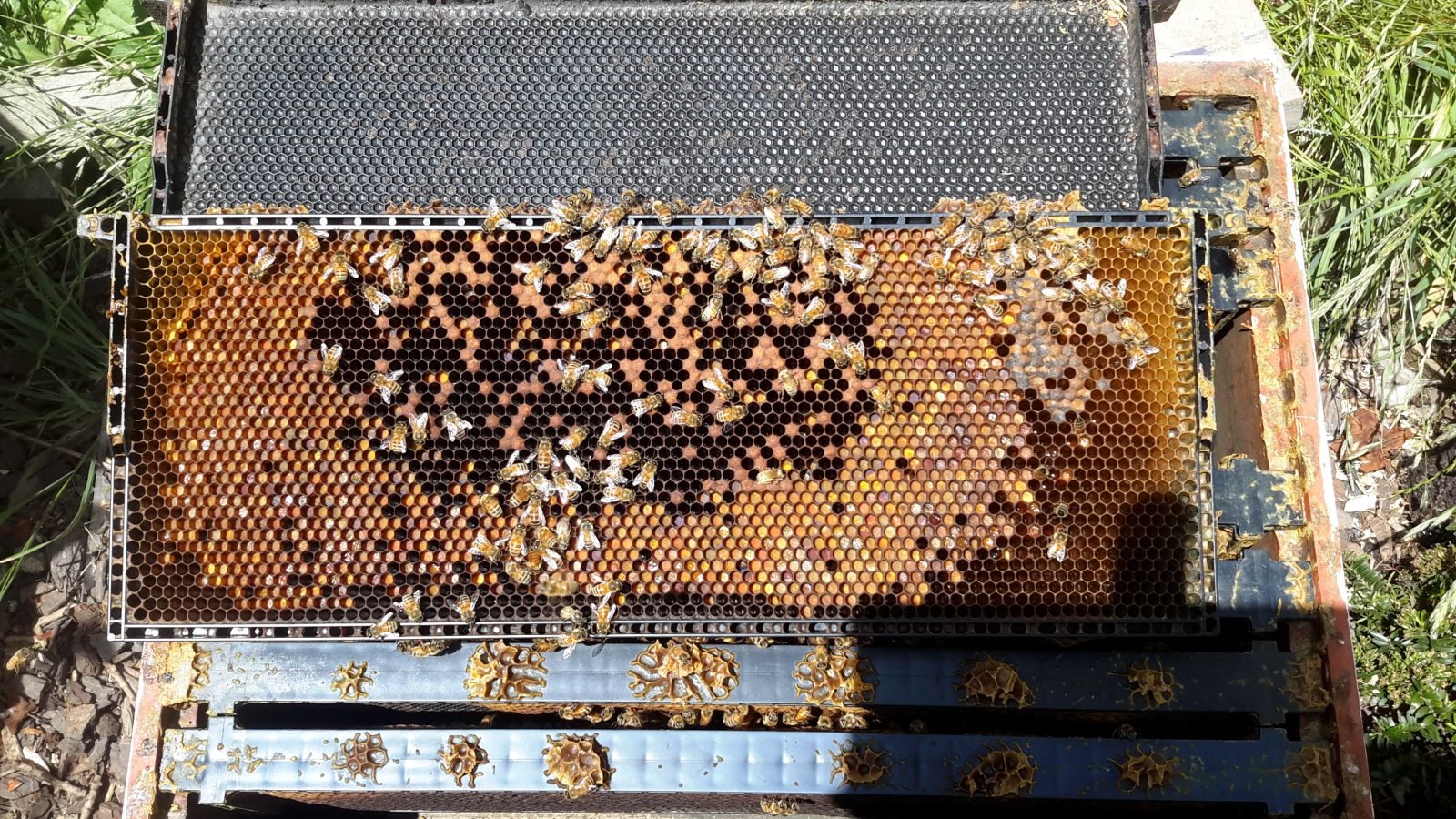
On a working brood frame, the product of this whole process is visible at a glance: capped honey cells built entirely from worked wax surrounding a ring of stored pollen, itself destined to become fermented bee bread, with brood cells at the center of the frame. Every one of those cell walls, from the brood nest outward, started as a handful of scales off a young worker’s abdomen.
FAQ
Where does beeswax actually come from?
It is secreted by eight glands on the underside of a worker bee’s abdomen, on sternite segments 4 through 7, as a clear liquid that hardens into thin scales on contact with air.
Which bees produce wax?
Only worker bees, and mainly younger workers roughly 12 to 17 days old, before their wax glands begin to degenerate once regular foraging flight starts.
Why is fresh beeswax white and not yellow?
Freshly secreted wax scales are actually clear and colorless. They turn opaque white only after a bee chews and works them with mandibular gland secretions; the familiar yellow color comes later, largely from propolis and pollen pigments absorbed over time.
How many wax scales does it take to make a gram of beeswax?
Roughly 1,100 individual wax scales are needed to produce one gram of beeswax.
Can older bees still produce wax if needed?
Yes. While wax glands typically shrink once a worker starts foraging, they can be reactivated in older bees when a colony urgently needs new comb, such as after swarming into an empty cavity.