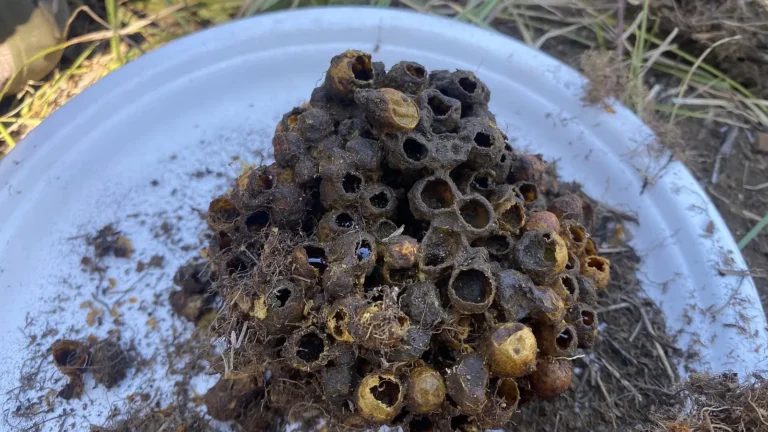
Reviewed by Elena P. · How we review
Carpenter bee holes are the round, half-inch nest entrances that female bees drill into bare, weathered softwood, and the most reliable way to stop them is to finish the wood with paint or varnish before spring, then treat or seal existing holes only when it works: in early spring before nesting starts, or in fall once the new adults have settled in to hibernate. Most university guidance agrees on that much. It splits on paint, plugs and surface sprays, and we found no peer-reviewed test showing that traps or kitchen-cupboard repellents cut damage.
This page is about the holes: what to do about them, and when. To confirm the insect first, see our carpenter bee identification guide. Every treatment claim below comes from a named university source, and where those sources disagree we say so. Pesticide details are only what extension publications and labels say; always follow the product label.
Key Takeaways
- A carpenter bee hole is round, about 1/2 inch across, with coarse sawdust beneath it. The tunnel behind it runs 6 to 10 inches and can be reused and extended for years.
- Timing decides whether treatment works. UC IPM says treating active nests in late spring and summer “does little good” because the brood cells are sealed. Treat in early spring or fall, wait a day or two, then seal.
- Damage is usually cosmetic at first. On the worst of seven boards from a ten-year-old bench, bees had removed 18% of the wood (UGA). Years of reuse, plus woodpeckers, are what make it structural.
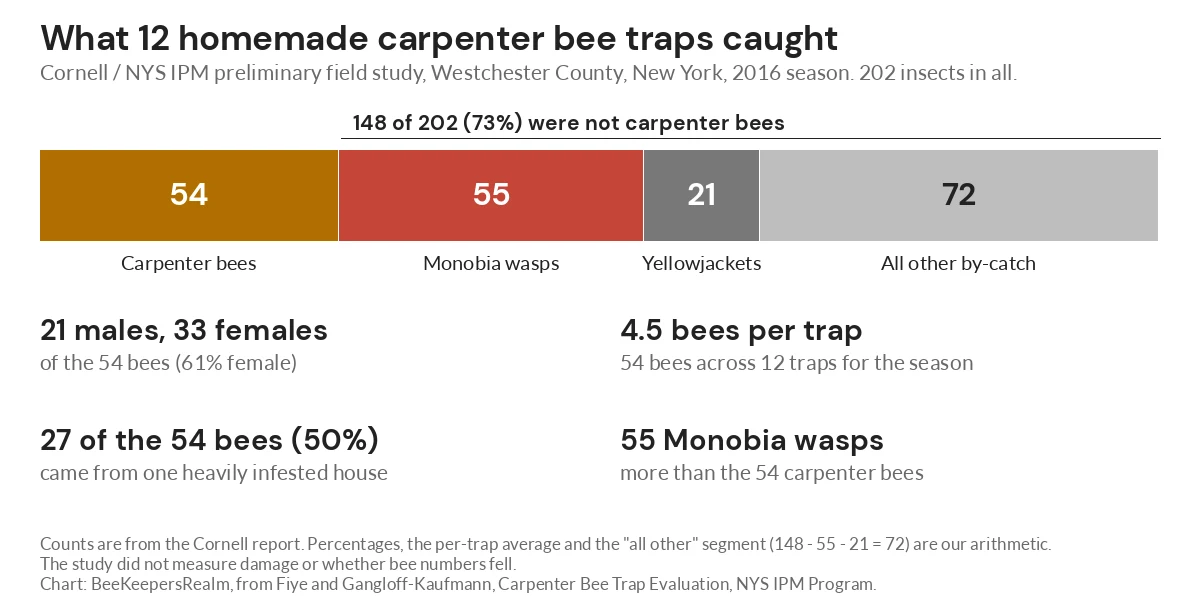
- Traps catch bees but not selectively: 12 homemade traps in a Cornell study caught 54 carpenter bees and 148 other insects, and no study shows they reduce damage.
- Citrus oil, almond oil, vinegar and noise have no university test behind them, and Clemson’s apiculture coordinator advises against WD-40.
- Paint or varnish is the best-supported prevention, though NC State doubts how well it works.
Table of Contents
- Is It Really a Carpenter Bee Hole?
- What Happens Inside the Wood
- How Much Damage Do the Holes Really Do?
- When Treating a Hole Works, and When It Doesn’t
- How to Fill Carpenter Bee Holes
- Stopping New Holes: Wood, Paint and Barriers
- Do Carpenter Bee Traps Work?
- Citrus, Almond Oil, WD-40 and Noise: What Evidence Exists
- Why Not Kill Every Carpenter Bee?
- When to Call a Professional
- Frequently Asked Questions
- The Bottom Line
Is It Really a Carpenter Bee Hole?
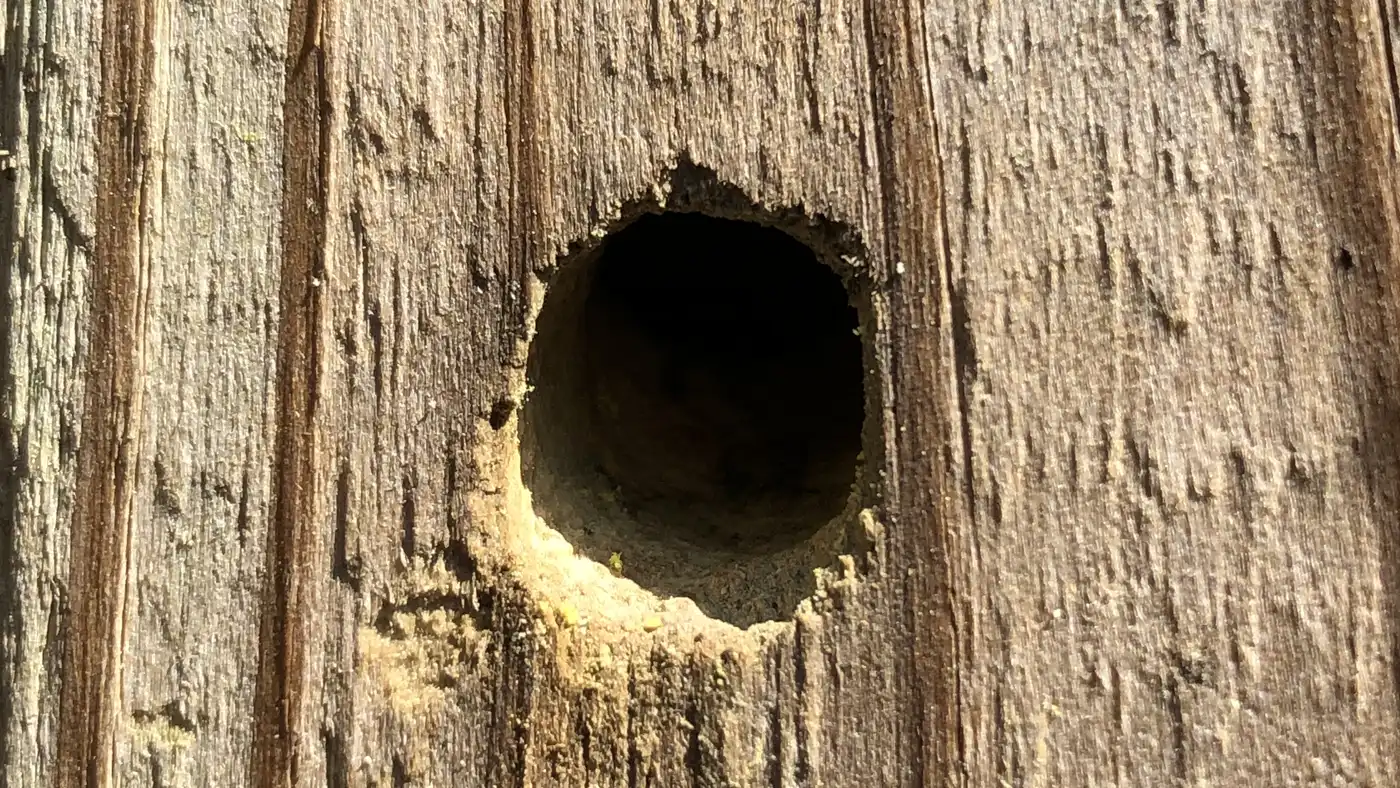
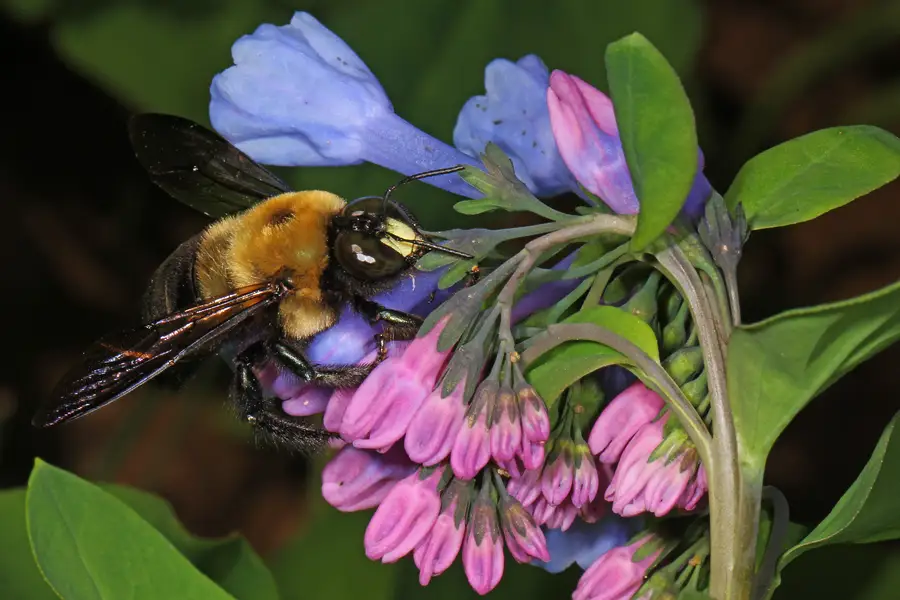
A carpenter bee hole is a clean, round entrance about 1/2 inch across, usually on the underside of a board where rain does not easily enter. Sawdust pushed out of the hole is the sign of an active nest, according to the University of Georgia’s IPM program (UGA), and the bees leave stains on the surface below. The bee is easy to separate from a bumble bee once you look at the abdomen: UGA describes the eastern carpenter bee as having a yellow, fuzzy thorax and a smooth, hairless, metallic black abdomen, while a bumble bee is hairy all the way back.
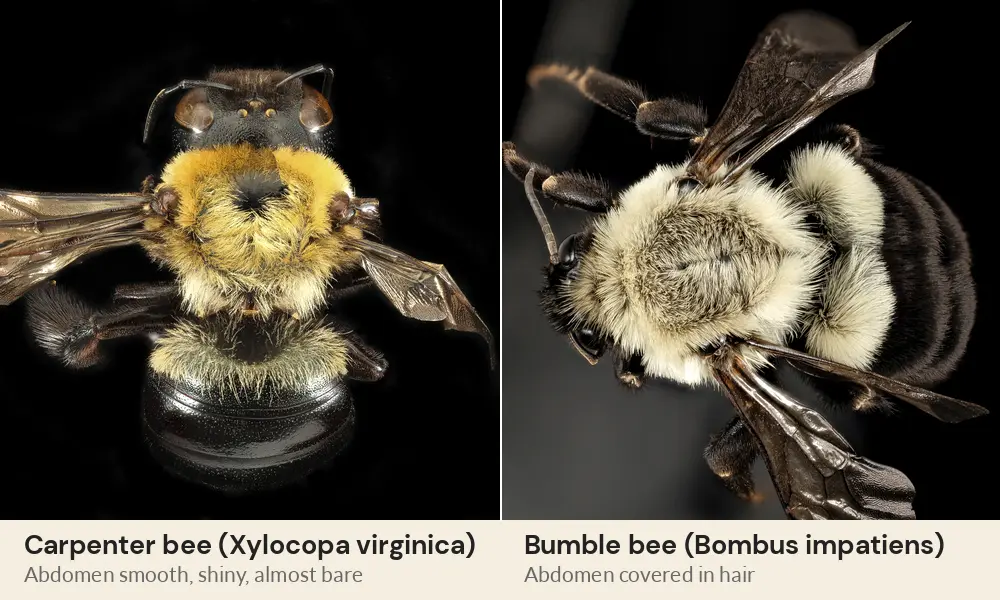
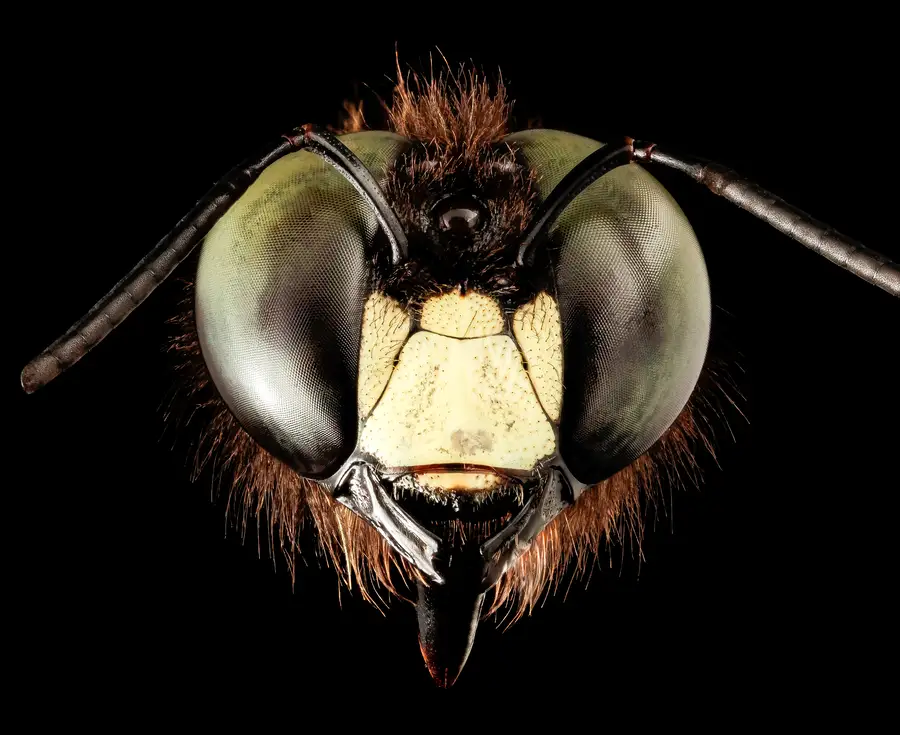
The large bee that hovers and darts at your head is usually a male. UGA notes that male carpenter bees are harmless because they lack a stinger, and that males are the ones with a pale patch on the face. Our guide to bumblebees covers the true look-alike, and how to tell bees, wasps and hornets apart covers the rest.
One more check: UC IPM, the University of California’s statewide program, describes carpenter bees as building nests in wood. A hole in soil or a lawn edge points to another insect, such as a ground-nesting mining bee, and needs a different response. Which carpenter bee you have depends on where you live: UGA gives the eastern carpenter bee’s range as southern Canada to Florida and from the Rockies to the Atlantic, while UC IPM’s photos show the mountain and valley carpenter bees of California.
What Happens Inside the Wood
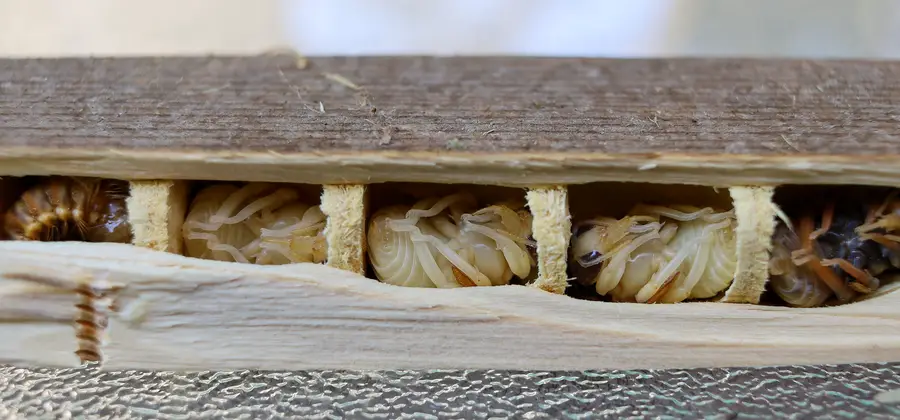
After mating in spring, a female drills in about an inch, turns sideways and tunnels along the grain, according to Clemson’s apiculture coordinator as quoted by FOX Carolina. UC IPM’s Pest Notes put the finished nest at tunnels 1/2 inch wide and 6 to 10 inches deep, partitioned into chambers that each hold one egg and a supply of pollen. Several bees may share a common entry hole that leads to different tunnels, and over the years the tunnels can extend as far as 10 feet into a timber.
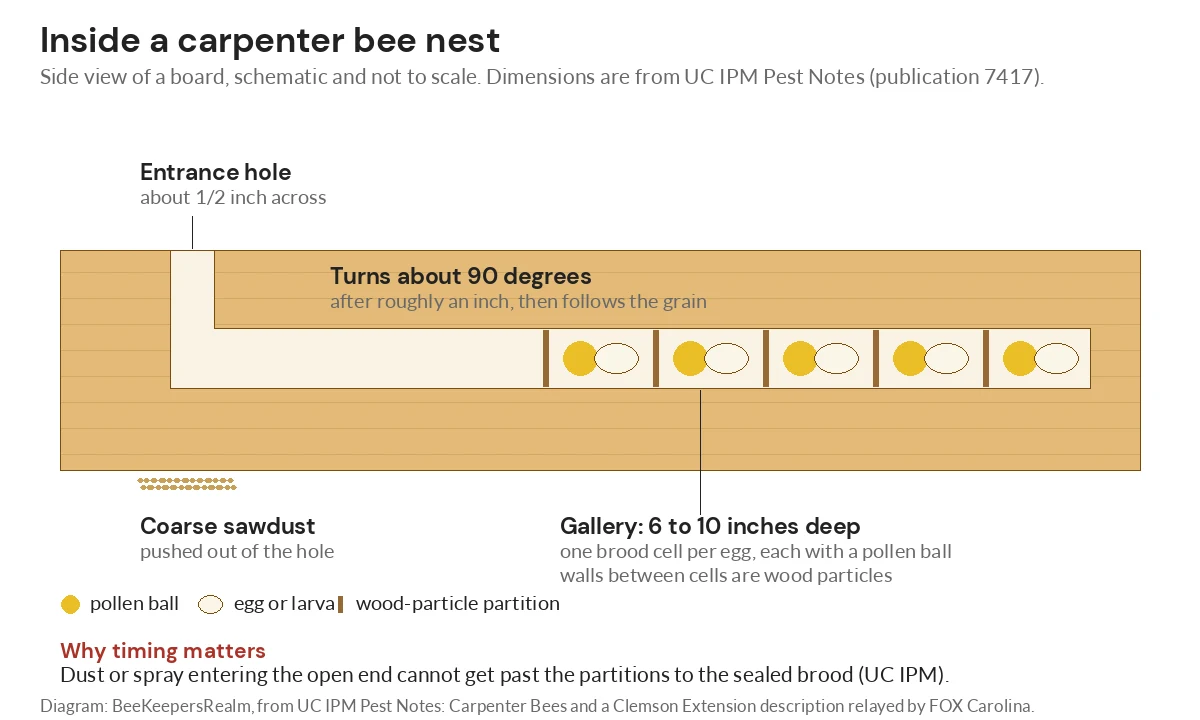
There is one generation a year. Development from egg to adult takes about three months, the new adults emerge in late summer to feed, and they overwinter, often in the old tunnels, then emerge in spring to mate (UC IPM). Males guard the nests and usually die by early summer, soon after mating (UGA). The social picture is looser than “solitary” suggests: NC State says up to five females may share a nest in spring, and UGA adds that in multi-female nests only one lays eggs. That is why a single hole can house several bees, and why the same hole is so attractive the next spring. For more on where these bees spend the cold months, see where bees go in winter.
How Much Damage Do the Holes Really Do?
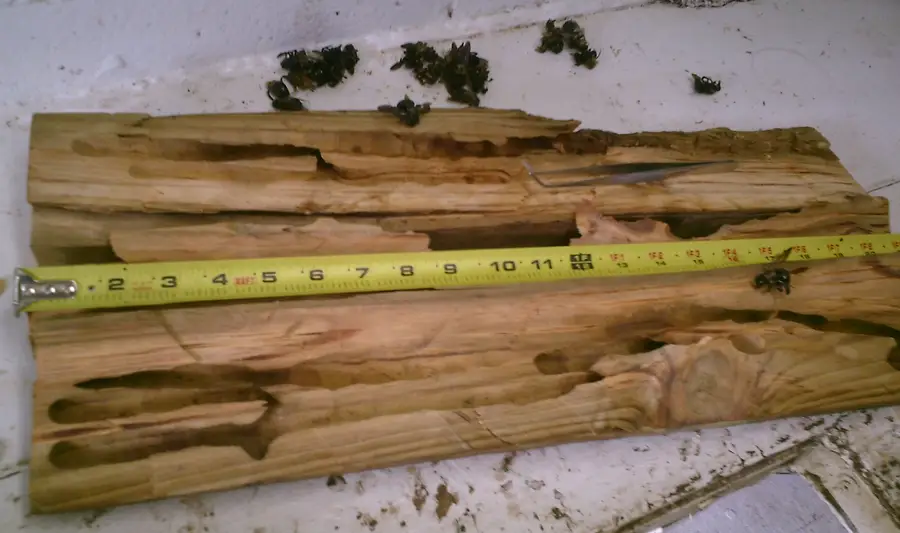
Carpenter bees do not eat wood; they excavate it to make a nest and push the debris out. UC IPM says the galleries can weaken structural wood and leave unsightly holes and stains, but rarely cause severe damage. UGA put a number on it, reported as one author’s own observation rather than a published trial: of seven boards removed from a decade-old bench, the most-damaged, a 7-foot 2×4, had lost 18% of its wood. It carried 15 holes, 28 galleries of 2 to 21 inches in 13 separate nests, and 28 feet of tunnel in total. By our arithmetic that is four board-lengths of tunnel packed into one board, and the other six boards lost no more than 18%.
So the worst case is real but slow: ten years of reuse. What speeds it up is a second visitor. UGA says carpenter bee nests are always attractive to woodpeckers, and there is no way to discourage them from pecking open the wood to reach the larvae. That is why a few holes in a deck rail are usually a cosmetic job, while woodpecker damage is the signal to act sooner.
When Treating a Hole Works, and When It Doesn’t
This is where most online advice goes wrong. UC IPM is blunt about the calendar:
“It does little good to treat active nests (those containing eggs, larvae, or pupae) in late spring to summer as indicated by females bringing in loads of pollen, since each brood chamber is sealed with partitions of wood particles at each end which prohibits pesticides from penetrating to the brood.”
UC IPM’s two windows are early spring, before nesting has begun, and fall, after all the adults have emerged and are settling in to hibernate. The sealed cells are also why developing bees can chew their way out after the pesticide has faded.
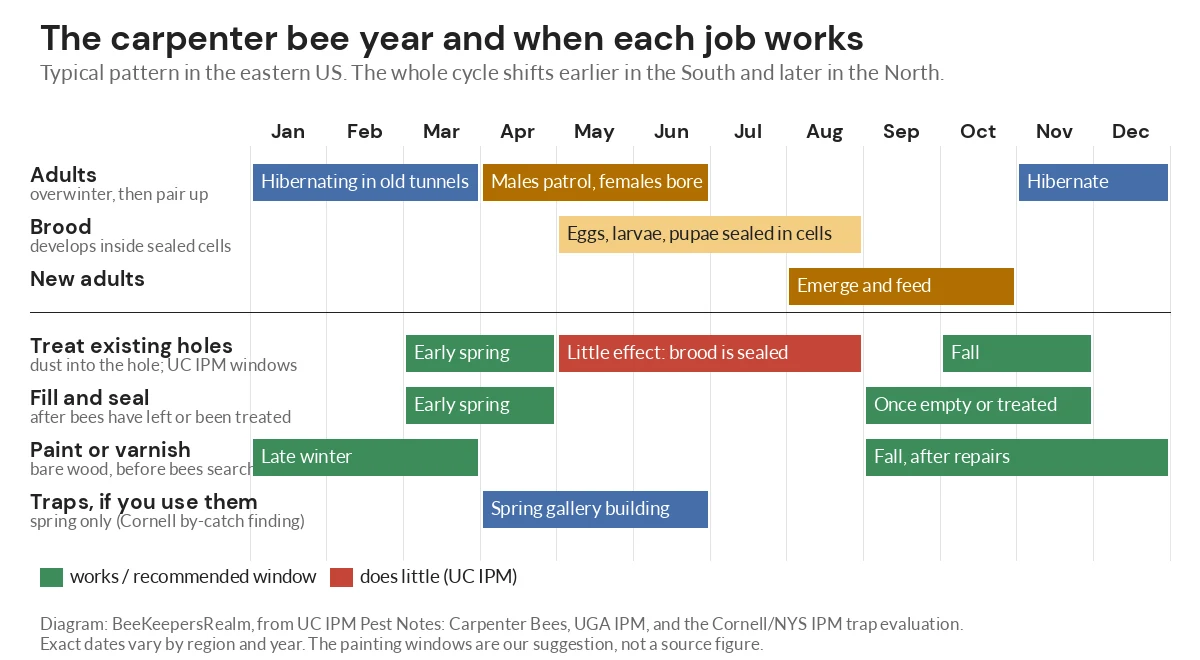
| Window | What the bees are doing | What UC IPM says to do |
|---|---|---|
| Early spring, before nesting | Overwintered adults in the old tunnels; nesting not started | Treat tunnels holding adult bees, wait a day or two, then seal |
| Late spring to summer | Eggs, larvae and pupae in sealed cells; females carrying pollen | Treating does little good; wait |
| Fall, after adults have emerged | New adults settling into tunnels to hibernate | Treat tunnels, wait a day or two, then seal |
For the treatment itself, UC IPM says to treat at night, when the adults have returned to the tunnel, and to wait a day or two before sealing so every adult is exposed. It says to puff dust into the nest hole with a bulb applicator, and lists dusts containing pyrethrin, borate or pyrethroids such as deltamethrin and cyfluthrin as labeled for carpenter bees. It warns that the dusts can cause serious lung irritation if inhaled, that many are sold only to licensed pest control professionals, and that this product information can go out of date. We give no amounts here: the product label is the only source for how much to use, what gear to wear and where it is legal.
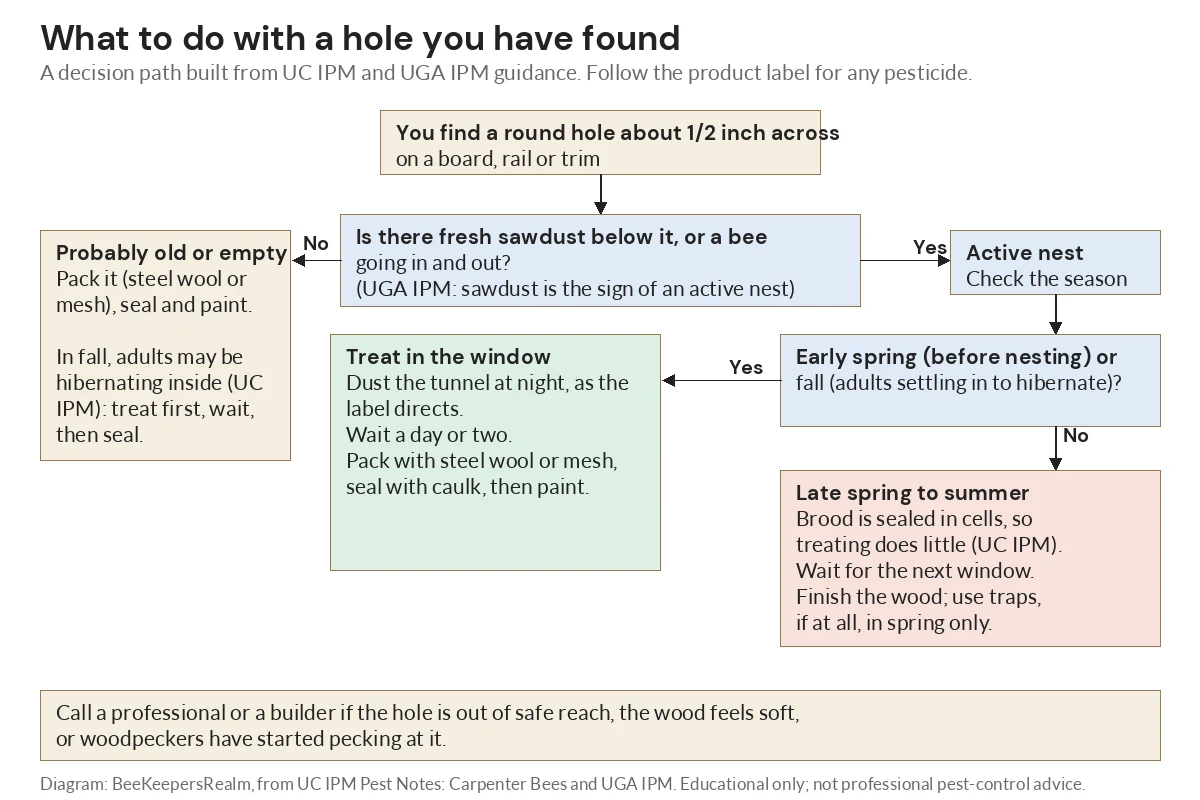
Surface sprays are a separate question, and the sources split. UGA says applying pesticide to the outside of lumber is not effective and not recommended for preventing nests. Clemson’s coordinator told FOX Carolina that a labeled pyrethroid spray on the surface can deter new holes but will not control bees already inside existing ones. NC State News says treating wood with paint or pesticides is not really effective. Treat a surface spray as short-lived at best.
This is educational information, not professional pest-control or safety advice. Read and follow the label of any product you use.
How to Fill Carpenter Bee Holes
Fill a hole only when it is empty or has been treated, and fill it with something the bees cannot simply chew through.
- Check whether it is active. Fresh sawdust below the hole means a bee is working it (UGA). UC IPM says to wait until the bees have emerged before filling the tunnels.
- If you treated it, wait a day or two. UC IPM gives that gap so returning adults pick up the dust before the hole is closed.
- Pack the tunnel with something unchewable. UC IPM says steel wool plus caulk; UGA suggests stainless steel or copper mesh. The Clemson coordinator warned that caulk alone can be chewed through.
- Finish the repair. UC IPM says to paint or varnish the filled area, which also removes the bare wood the next female would pick.
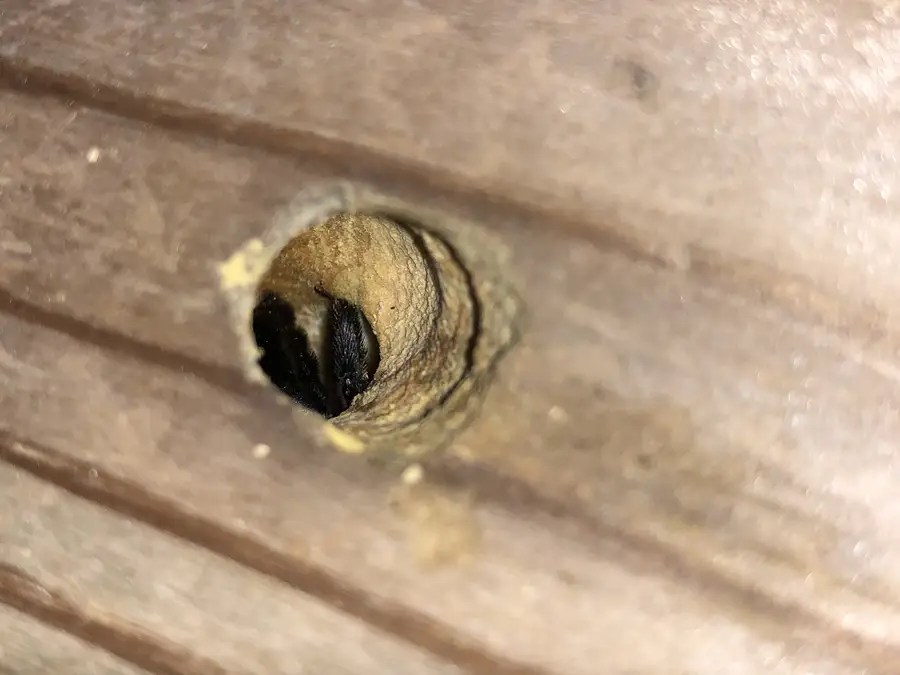
We found no controlled test of sealing a live nest, so the safest sequence is the one the extension sources describe: treat in a window, wait, then seal. A hole that looks vacant in September can be occupied by November, because UC IPM says adults move back into old tunnels to hibernate in fall.
Stopping New Holes: Wood, Paint and Barriers
Prevention is where the evidence is strongest, and where the sources most openly disagree. UC IPM’s advice is plain: build exposed parts from hardwoods, which the bees do not normally attack, fill cracks and depressions so the wood is less attractive, paint or varnish exposed surfaces regularly, and cover rough areas such as timber ends with wire screening or metal flashing. UGA calls coating all exposed wood with paint or varnish the primary proactive intervention.
NC State’s entomologists are more skeptical.
“treating your wooden porch, deck or siding with paint or pesticides isn’t really effective (since the bees don’t eat the wood).”
That piece adds that bees prefer softer wood such as pine but “will drill into whatever is available,” and that composite materials or very hard woods such as black locust or ipe work but cost more. Here is how the sources line up:
| Question | What the sources say | Our read |
|---|---|---|
| Does paint or varnish help? | UC IPM and UGA recommend it. NC State says it is not really effective. Clemson’s coordinator told FOX Carolina only oil-based paint helps as a deterrent. | Best-supported prevention, not a guarantee. Use an oil-based finish and keep it maintained. |
| Do surface insecticide sprays help? | UGA: not effective. NC State: not really effective. Clemson: can deter new holes, will not control bees in existing holes. | Short-lived at best. |
| What should you plug holes with? | UC IPM: steel wool and caulk. UGA: stainless steel or copper mesh. Clemson: caulk alone can be chewed through. | Unchewable core, sealant over it. |
| Does wood choice matter? | UC IPM: bees avoid most hardwoods. NC State: bees prefer soft wood but will use what is available; composites and very hard woods work. | Hardwood or composite for new rails and trim; finish any softwood. |
Do Carpenter Bee Traps Work?
Traps catch carpenter bees, but there is almost no evidence about whether they protect wood. The best data we found is a preliminary field study by the NYS IPM Program at Cornell, written up by Matthew Fiye and Jody Gangloff-Kaufmann. They hung 12 homemade traps at six sites in Westchester County, New York: eleven made from a 4×4 block with an entrance hole and a two-bottle funnel, and one larger box design. The traps went up in April 2016 and were checked through July.
| Measure | Result |
|---|---|
| Traps and sites | 12 traps, 6 sites |
| Carpenter bees caught | 54 (21 males, 33 females), about 4.5 per trap |
| Other insects caught | 148, which is 73% of the 202 insects in all |
| Most common by-catch | 55 Monobia quadridens wasps, more than the bees; 21 yellowjackets |
| Where the bees came from | 27 of 54 (50%) at one heavily infested house |
The homeowner at that house said bee activity was lower than in earlier years and credited the traps. That is one resident’s impression, not a measurement; the study did not count tunnels or damage, and said no published study had shown whether traps cut populations or damage. The authors note that many of the by-catch insects are predators and parasitic wasps. The Monobia wasp is a mason wasp, in the same group as the potter wasps in our guide, and the catch also included the European paper wasp and yellowjackets; our bee vs. wasp identification guide shows how to tell them apart. The authors suggest deploying traps only in spring, during gallery building, because the Monobia wasps appeared later in the season.
“There have been no objective, peer-reviewed evaluations of the efficacy of repellents or the ability of carpenter bee traps for managing infestations.”
The same UGA page adds a sobering scale check: an established nest can produce 1 to 20 bees each year, so a full trap bottle does not prove control. Clemson’s coordinator told FOX Carolina a mason jar trap can work on a small number of bees. We do not rank commercial traps here; that is a separate, product-driven question and none of these studies tested branded designs.
Citrus, Almond Oil, WD-40 and Noise: What Evidence Exists
Almost none that would satisfy a researcher. UGA says there are no objective, peer-reviewed evaluations of repellents, and NC State says research has yet to back up repellents or plugging entrances, adding that its scientists are testing the idea. The most specific commentary we found is from Clemson’s Ben Powell, answering a list of social-media remedies for a local TV station in 2022. That is an expert’s opinion, not a trial, but it is the best public checklist.
| Remedy | What we found |
|---|---|
| Citrus spray | Clemson: bees may act adversely, but it soaks into the wood. No university test found. |
| Almond oil | No university test found; it appears in retailer advice. |
| Vinegar spray | Clemson: bees may act adversely, but it soaks into the wood. |
| Peppermint oil | Clemson: no science to prove it works, though it can repel; bees also forage on peppermint. |
| WD-40 in the hole | Clemson: not recommended; can stain and damage wood. |
| Motor oil in the hole | Clemson: not effective, since the tunnel turns sideways; can damage wood. |
| Music, wind chimes, noise | No university test found in the sources we read. |
| Fake wasp nest (paper bag) | Clemson: no data to prove it scares bees away. |
| Swatting | NC State: effective only if you keep at it all day. Clemson: mostly hits males, while females make the tunnels. |
If you try a repellent anyway, treat it as a trial, not a treatment: note the date, count fresh sawdust piles, and compare with last year.
Why Not Kill Every Carpenter Bee?
UC IPM calls carpenter bees generally beneficial because they pollinate crop and non-crop plants, and says damage can usually be managed with prevention, so insecticide use is not recommended for most situations. UGA’s page shows why. It cites a study (Tucker and colleagues, 2019) that examined 23 nests and estimated the bees collected 8.6 billion pollen grains over 7,150 foraging trips between May and June, which is roughly 310 trips per nest by our arithmetic. UGA’s authors also collected more than 50 other insects or brood, including mason bees, resin bees and several wasps, from 45 carpenter bee nests. Old tunnels become housing for other native insects. For the wider picture, see our guide to native bee species in the United States.
When to Call a Professional
These are our rules of thumb, not source claims. Call a licensed pest professional if the holes are out of safe reach from a ladder, if you want a dust product the label restricts to licensed applicators, or if the same wood has been reinfested for several years. Have a builder look at wood that feels soft, rails that sag, or siding that woodpeckers have worked over, because by then the question is repair rather than bees.
Frequently Asked Questions
What happens if you plug a carpenter bee hole?
An empty or treated hole stays closed and stops the next female reusing it. A live nest is less clear: the Clemson coordinator says bees can chew through caulk, and UC IPM warns that sealed brood can chew out. We found no controlled test, so treat, wait a day or two, then seal.
Do carpenter bee traps really work?
They catch bees; whether they protect wood is unproven. Cornell’s 12 traps caught 54 carpenter bees and 148 other insects, and UGA found no peer-reviewed evaluation of traps.
What does WD-40 do to carpenter bees?
Clemson’s coordinator does not recommend it, saying it can stain and damage wood. We found no test showing it controls carpenter bees.
What smell do carpenter bees hate?
No tested answer exists. Citrus, almond and peppermint oils are popular suggestions, but UGA says repellents have not been objectively evaluated, and Clemson notes bees forage on peppermint.
Does paint stop carpenter bees?
It lowers the odds, according to UC IPM and UGA, which recommend painting or varnishing exposed wood. NC State is less convinced, and Clemson says oil-based paint is the one that helps.
When is the best time to fill carpenter bee holes?
Once the bees have left or the hole has been treated. UC IPM says to wait until the bees have emerged, and its treatment windows are early spring and fall, so a fall repair should follow a treatment and a wait rather than assume the tunnel is empty.
How many carpenter bees live in one hole?
Usually one nest-building female, though NC State says up to five females may share a nest in spring. UGA says only one lays eggs, and an established nest can produce 1 to 20 bees a year.
Do carpenter bees sting?
Males cannot sting. UC IPM says females sting only when provoked or handled roughly. For what a sting feels like and how to treat it, see bee sting vs wasp sting.
Do carpenter bees ever go away?
Nesting is over by midsummer, but the bees do not leave: new adults emerge in late summer and often overwinter in the same tunnels (UC IPM), then return to the same wood. Our carpenter bee guide covers their yearly habits.
The Bottom Line
Finish bare wood, treat or fill holes only in early spring or fall, and do not count on traps or home remedies to protect your deck. If the wood is already damaged, treat the repair as a carpentry job and the bees as a yearly chore until the wood is finished.
Image credits: Featured photo: Famartin, via Wikimedia Commons (file page), CC BY-SA 4.0, cropped and resized.