Reviewed by Daniel M. · How we review
Bee sting swelling is usually a normal local reaction: a red, puffy welt at the sting that can keep growing for up to 48 hours and fades within about a week. Swelling that spreads well past the sting, even up a whole arm, is most often a large local reaction, which peaks two to three days after the sting and is not life-threatening. Swelling of the lips, tongue or throat, or hives away from the sting, can mean anaphylaxis and needs emergency care.
Educational information only, not medical advice. For allergy care, follow your doctor and the American College of Allergy, Asthma and Immunology’s insect sting guidance.
Emergency: if anyone has trouble breathing, a swelling tongue or throat, hives away from the sting, dizziness or fainting after any sting, call 911 and use their epinephrine auto-injector if they carry one.
Key Takeaways
- Normal swelling stays at the sting. Mayo Clinic says it usually goes down within a few hours, while a moderate reaction can worsen for a day or two and last up to seven days.
- A large local reaction is swelling generally more than 3 inches across, per the ACAAI. Cleveland Clinic says it usually starts 6 to 12 hours after the sting and lasts 5 to 10 days.
- In 310 patients seen at an Austrian university clinic, large local reactions lasted a median of 7 days, and only 2.9% followed a sting on the trunk.
- Redness in the first 24 hours comes from the venom, not infection. Redness still spreading after 3 days is a reason to call a doctor, according to Seattle Children’s.
- Swelling away from the sting, or in the lips, tongue or throat, is not a local reaction. Treat it as anaphylaxis.
- One large local reaction carries a small risk of a whole-body reaction to a later sting. In an Italian study, people with two or more large local reactions had none across 238 later stings.
Table of Contents
- Normal Swelling, Large Local Reaction or Allergy?
- How Long Does Bee Sting Swelling Last?
- Where You Were Stung Changes the Swelling
- Wasp Sting Swelling: What Is Different
- Swelling, Infection or Allergy? Check the Clock
- What Helps the Swelling Go Down
- Does a Big Swelling Mean You Are Becoming Allergic?
- When to Get Medical Care for Swelling
- Frequently Asked Questions
Normal Swelling, Large Local Reaction or Allergy?
Allergy groups such as the ACAAI sort sting reactions by where the swelling is, not only by how big it is. Swelling that starts at the sting and stays connected to it is a local reaction, however large. Swelling or hives somewhere else on the body is a systemic reaction.
| Normal local reaction | Large local reaction | Systemic reaction (anaphylaxis) | |
|---|---|---|---|
| Where it swells | At the sting site | Spreads out from the sting, often over a hand, arm or leg | Away from the sting: lips, tongue, throat, or hives elsewhere |
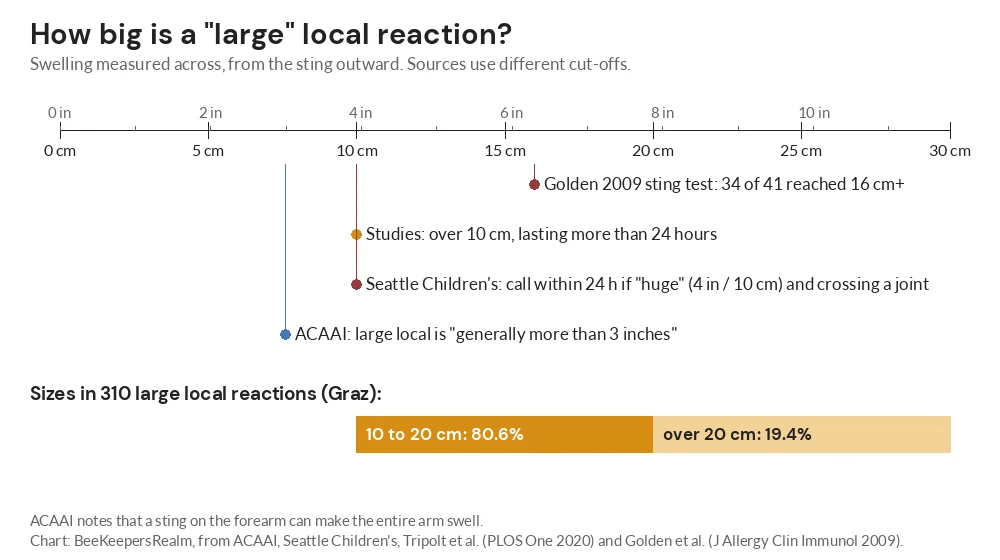
| Size | A welt | Generally more than 3 in (ACAAI); studies use over 10 cm, about 4 in | Not defined by size |
| When it starts | Right away | 6 to 12 hours after the sting | Usually 15 to 60 minutes, sometimes within minutes |
| Peak | Within hours; a moderate reaction worsens for 1 to 2 days | 2 to 3 days after the sting | Minutes to hours |
| How long it lasts | Hours, up to 7 days for a moderate reaction | 5 to 10 days; median 7 in one 310-patient study | Needs emergency treatment |
| Dangerous? | No | Usually not, unless it is in the mouth or throat | Yes: epinephrine, then 911 |
Sources: Mayo Clinic, “Bee sting: Symptoms and causes” (2024); ACAAI, “Insect Sting Allergies”; Cleveland Clinic, “Paper Wasp Sting” (2024); Tripolt et al., PLOS One, 2020.
Normal local reaction
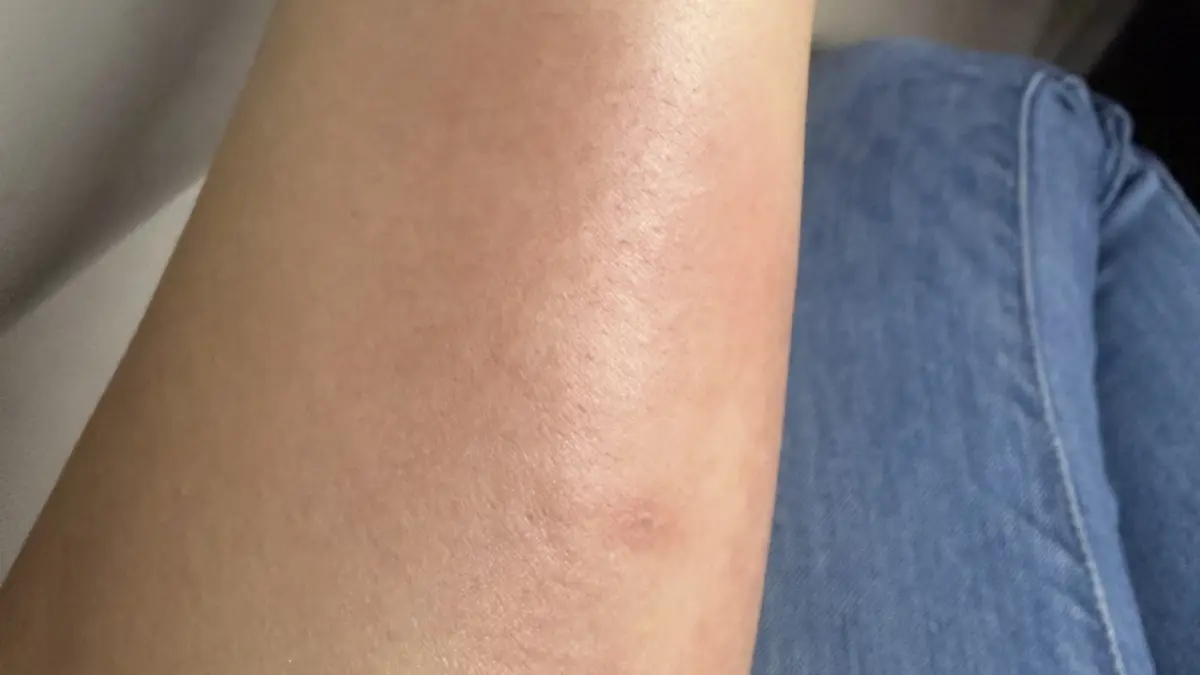
Mayo Clinic describes the usual sting as sharp burning pain, a welt and swelling that go away within a few hours in most people. A moderate reaction adds itching and flushing, with swelling that worsens over a day or two and can last up to seven days.
Large local reaction
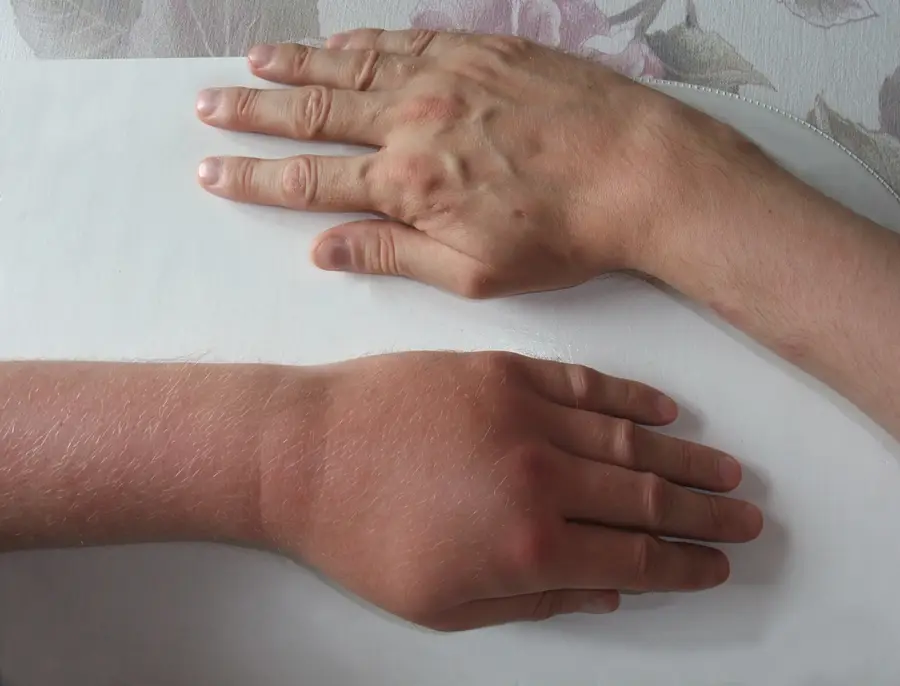
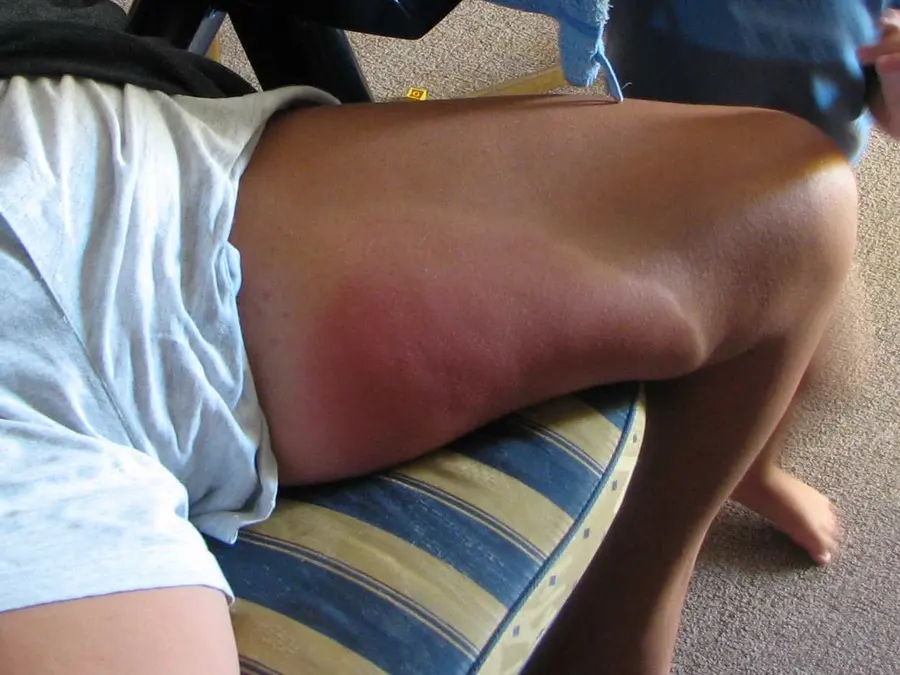
The ACAAI defines a large local reaction as swelling generally more than 3 inches around the sting; a sting on the forearm can swell the entire arm. It usually peaks two to three days after the sting, can last a week or more, and is not life-threatening. Cleveland Clinic says about 10% of local reactions spread this way, and people often report them as more painful. The bee lab of the U.S. Agricultural Research Service in Tucson describes how far it can spread:
“Swelling can sometimes be severe. For instance, if stung on the finger, the arm may be swollen even up to the elbow. Swelling such as this is fairly common, even though it may be alarming.”
What drives it is not fully settled. A 2020 study from the Medical University of Graz notes that an IgE-dependent late-phase inflammatory reaction has been suggested, and it found venom-specific IgE antibodies in 80.7% of its 310 large local reactors.
Swelling that signals an allergic reaction
The ACAAI lists hives, itching and swelling in areas other than the sting site, a hoarse voice, and swelling of the tongue or throat among the signs of a severe allergic reaction. Mayo Clinic says anaphylaxis usually starts 15 minutes to an hour after the sting, and Seattle Children’s says the breathing and swallowing trouble mainly comes in the first 2 hours. So swelling that builds overnight at the sting, with no other symptoms, fits a local reaction rather than anaphylaxis. If epinephrine has been prescribed, use it first and then call 911; our first-aid guide for bee and wasp stings covers the steps.
In this six-and-a-half-minute episode of the UF/IFAS Beekeeping Academy, Dr. Ellis of the University of Florida Honey Bee Research and Extension Laboratory walks through six categories of sting reaction, from pain and redness at the sting to life-threatening anaphylaxis. He describes a large local reaction as a wrist sting that swells the arm to above the elbow and grows for 24 to 72 hours or longer, and he groups the first three categories as local reactions that usually need no medical help. He reminds viewers that he is not a medical doctor and to ask an allergist.
How Long Does Bee Sting Swelling Last?
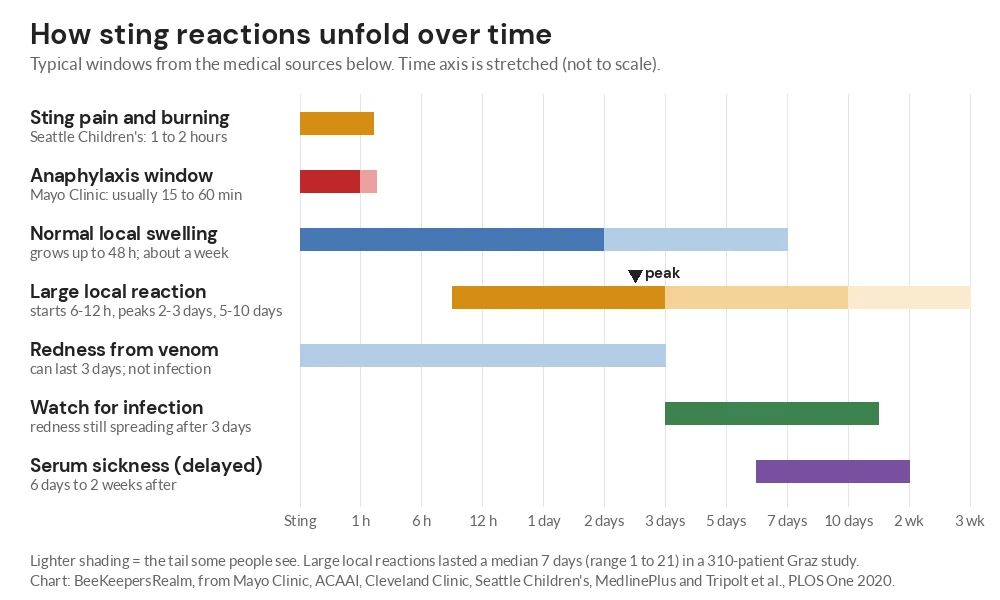
Most bee sting swelling is gone within a week: MedlinePlus, from the U.S. National Library of Medicine, says people who are not allergic usually get better within 1 week. The table puts each source’s timing into one sequence.
| Time after the sting | What is typical | Source |
|---|---|---|
| First minutes | Sharp burning pain, a welt, sometimes a white area around the puncture | Mayo Clinic; UF/IFAS |
| 15 minutes to 2 hours | The window when anaphylaxis usually starts | Mayo Clinic; Seattle Children’s |
| 1 to 2 hours | Severe pain fades; itching often follows | Seattle Children’s |
| 6 to 12 hours | A large local reaction begins to spread | Cleveland Clinic |
| Up to 48 hours | Normal swelling can still grow | Seattle Children’s |
| 2 to 3 days | A large local reaction peaks; venom redness can last this long | ACAAI; Seattle Children’s |
| Day 3 | Symptoms not gone: see a clinician | Mayo Clinic |
| About 1 week | Most people are better; normal swelling may last 7 days | MedlinePlus; Seattle Children’s |
| 5 to 10 days | A large local reaction resolves; in Graz, median 7 days, range 1 to 21 | Cleveland Clinic; Tripolt et al. |
| 6 days to 2 weeks | Delayed serum sickness is possible: fever, muscle or joint pain, rash or hives | Cleveland Clinic |
Why it often looks worse the next day
Swelling that is bigger on day 2 than on day 1 is expected: Seattle Children’s says normal swelling from venom can increase for 48 hours. A 2025 case report in the Journal of the American College of Emergency Physicians Open attributes the inflammation to the venom’s neuropeptides, histamine and proinflammatory compounds, and says it can take 5 to 10 days to resolve. Cleveland Clinic’s bee sting page adds that discoloration can take seven to 10 days to clear.
Where You Were Stung Changes the Swelling
Hands, fingers and feet
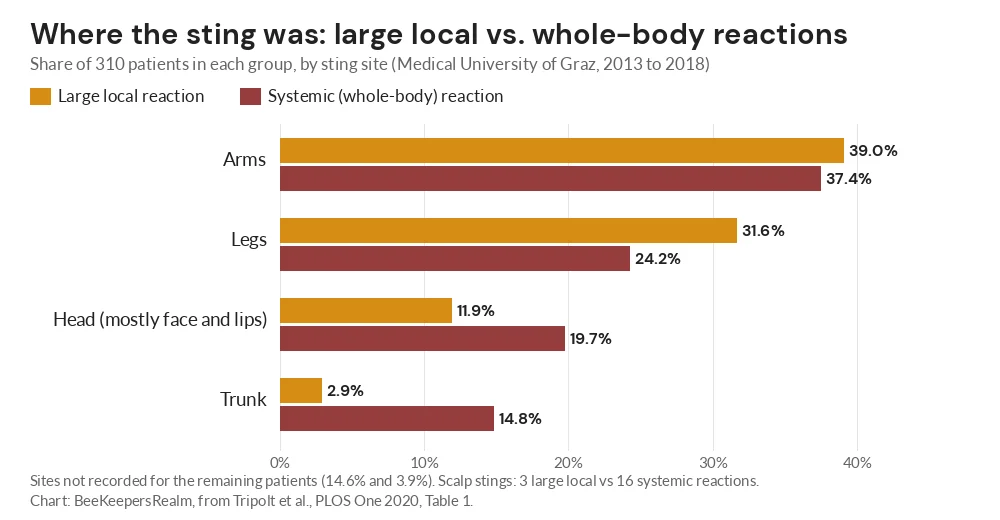
Arms and legs are where large local reactions usually happen. In the Graz study, 39.0% followed stings on the arms and 31.6% on the legs. Because a finger sting can swell the arm up to the elbow, take rings off early; MedlinePlus advises loosening clothing and removing rings and other tight jewelry.
Trunk and scalp
Only 2.9% of the Graz large local reactions followed a sting on the trunk, against 14.8% of the systemic reactions, and scalp stings accounted for 3 large local reactions against 16 systemic ones. The authors suggest the thicker deep layer of skin (the reticular dermis) in those areas makes large local reactions less likely.
Face and eyelids
Facial stings swell dramatically, and the sources differ on how worried to be. Seattle Children’s says stings on the face can cause a lot of swelling around the eye and that this looks bad but is not serious. Cleveland Clinic says stings around or directly to the eye need emergency care to keep the swelling from damaging the eye, and that stings anywhere on the head, face or neck deserve quick medical attention. For a sting on or right next to the eye, follow the more cautious advice.
Mouth and throat
Swelling here can block the airway even without an allergy. MedlinePlus says to call Poison Help (1-800-222-1222) or an emergency room if the person was stung inside the mouth or throat, and Dr. Ellis’s video says a large local reaction in the mouth or neck that starts to restrict airflow needs medical attention right away.
Wasp Sting Swelling: What Is Different
Wasp sting swelling follows the same three patterns as bee sting swelling, and some of the timing data above comes from wasp stings. Cleveland Clinic’s large local figures, a 6 to 12 hour start and 5 to 10 days to clear, come from its paper wasp page. Three things differ.
- Venom per sting. Cleveland Clinic says the average wasp sting injects one-tenth the venom of an average bee sting, but wasps sting harder and can sting more than once.
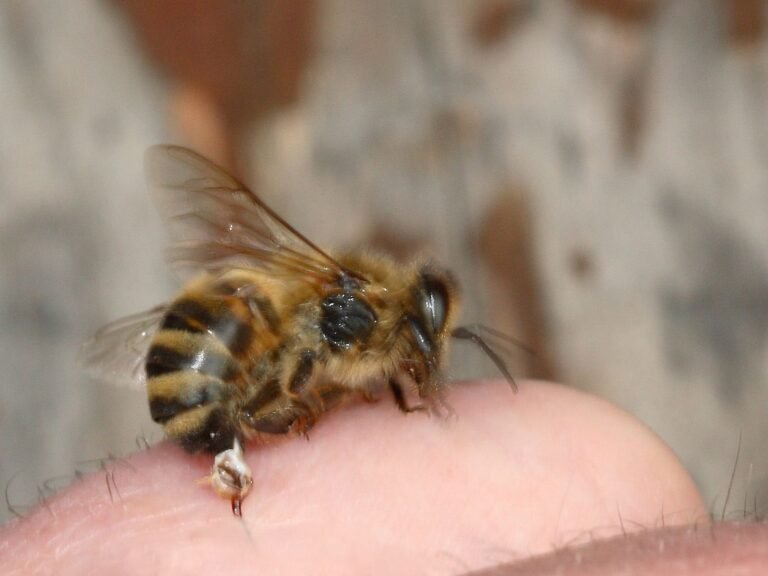
- The stinger. A honey bee stinger usually stays in the skin. A 2021 study of 51 wasp species found that German, eastern and western yellowjackets often leave theirs too, while paper wasps, European hornets and bald-faced hornets almost never do. All the vespid wasps examined except those in the subfamily Stenogastrinae have barbed stingers, so a wasp that leaves no stinger behind still has a barbed one. See which bees and wasps lose their stingers.
- Which venom you react to. In the Graz study, more large local reactors had IgE to wasp venom alone (31.0%) than to bee venom alone (16.8%), and 32.9% had it to both. Allergists test the venoms separately; our bee sting vs wasp sting comparison explains why.
If you are not sure what stung you, our guides to paper wasps and their stings and telling hornets from wasps can help. The first aid is the same either way.
Swelling, Infection or Allergy? Check the Clock
Allergy, large local reaction and infection keep different schedules, so when a symptom appears tells you as much as what it looks like.
| What you see | When it usually appears | What it suggests | What to do |
|---|---|---|---|
| Hives elsewhere; lips, tongue or throat swelling; wheezing; dizziness | Minutes to about 2 hours | Anaphylaxis | Epinephrine if prescribed, then 911 |
| Swelling spreading out from the sting | Starts at 6 to 12 hours, peaks at 2 to 3 days | Large local reaction | Cold, elevation, antihistamine; call a clinician if it is severe |
| Redness at the sting | First 24 hours | Venom, not infection | Home care |
| Redness getting larger after 72 hours | Day 3 or later | Possible infection | Contact a doctor within 24 hours |
| Fever with spreading redness | Any time; infection is uncommon | Likely infection | Seek care now |
| Fever, aching joints, rash or hives | 6 days to 2 weeks | Serum sickness | See a clinician |
Sources: Mayo Clinic; ACAAI; Cleveland Clinic; Seattle Children’s, “Bee or Yellow Jacket Sting” (reviewed May 2025).
Seattle Children’s gives the clearest rule for the redness question:
“More than 72 hours since the sting and redness getting larger. Note: infection is not common. Redness that starts in the first 24 hours is due to venom.”
Cleveland Clinic says stings rarely get infected on their own; scratching lets germs in. The AAAAI advises not breaking blisters and seeing a physician if swelling progresses or the site seems infected.
What Helps the Swelling Go Down
Cold, elevation and an antihistamine are the standard combination; the ACAAI recommends all three for a large local reaction.
- Cold: MedlinePlus advises ice wrapped in a clean cloth, 10 minutes on and 10 minutes off, with shorter times for anyone with poor circulation.
- Elevation: raise the stung arm or leg, which the AAAAI and Cleveland Clinic both say helps reduce swelling.
- Itch: the AAAAI lists topical steroid ointments or oral antihistamines. Follow the label dose.
- Pain: the ACAAI suggests acetaminophen or ibuprofen and says not to give aspirin to anyone under 19.
- Severe or spreading swelling: the ACAAI says antihistamines and corticosteroids are sometimes prescribed, and the Graz authors note that a few days of systemic corticosteroids are added when swelling keeps spreading. That is a clinician’s decision.
The AAAAI says to scrape out a bee’s stinger within 30 seconds. Our step-by-step sting treatment page covers stinger removal and what the evidence says about baking soda, vinegar and other home remedies. If you are stung often, keep the basics in a bee sting first aid kit.
Does a Big Swelling Mean You Are Becoming Allergic?
Usually not, but one large local reaction is not a guarantee either. Mayo Clinic notes that one type of reaction does not mean you will always have the same reaction, or that the next will be worse. A 2015 study from a hospital allergy unit in Civitanova Marche, Italy, put numbers on it. Of 396 patients whose venom allergy began with a systemic reaction, only 17 (4.2%) had a large local reaction first. The 81 patients with only large local reactions had each had at least two, across 238 stings, with no systemic reaction. Of 53 followed for three years, 31 were stung again, 59 stings in all, and still had only large local reactions.
“Our findings confirm that patients with repeated LLRs to stings had no risk of SR, while a single LLR does not exclude such risk.”
Not everyone agrees on the size of the risk. A 2019 study by Bilò and colleagues in Allergy, which included 662 large local reactors, reported that about a quarter had a systemic reaction to a later sting. Pucci and two co-authors called that study flawed, citing unreliable identification of the culprit insect, and put the long-standing estimate at about 4%. The 2025 case report above says a history of anaphylaxis, mast cell disease or asthma in someone with a large local reaction warrants an epinephrine prescription and referral to an allergist. If you are unsure, ask about venom allergy testing.
What this means for beekeepers
Beekeepers see more of these reactions. The 2015 Italian paper cites reported prevalences of large local reactions as high as 26.4% in the general population and 38% in beekeepers. Allergy shots can shrink them: in a small 2009 trial led by David Golden in the Journal of Allergy and Clinical Immunology, 7 to 11 weeks of venom immunotherapy cut the size of large local reactions by 42% and their duration by 53%, against 18% in untreated controls, and the benefit grew after 2 to 4 years. The paper notes that the shots were not recommended for large local reactions, and it was a feasibility study of 29 patients. Our guides cover how venom allergy shots work and keeping bees with a sting allergy. Fewer stings help too; see how to calm defensive bees during inspections.
When to Get Medical Care for Swelling
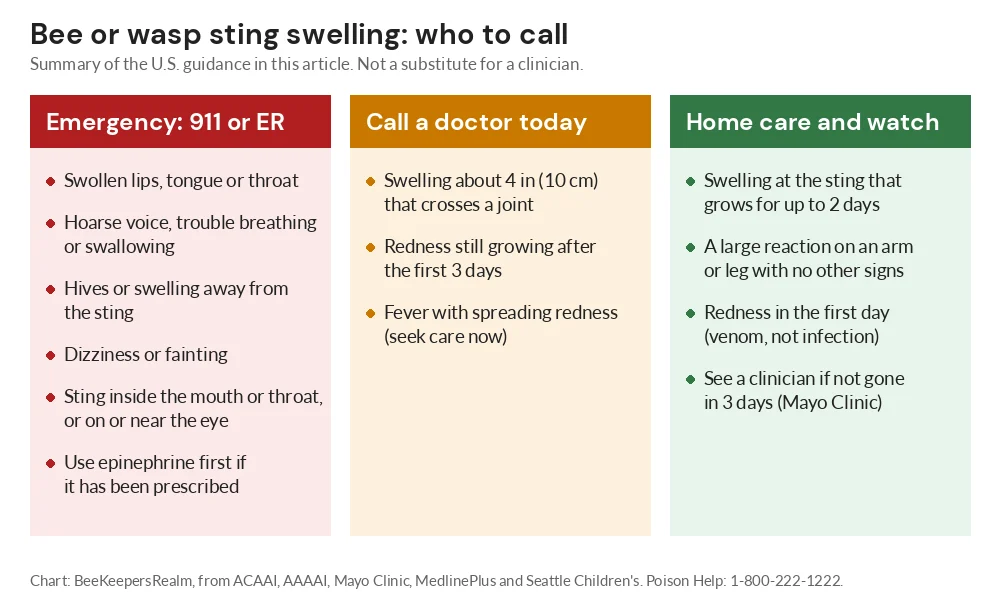
Call 911 or go to an emergency room for any of the allergy signs above, or for a sting inside the mouth or throat (MedlinePlus) or on or near the eye (Cleveland Clinic). Mayo Clinic adds multiple stings in children, older adults and people with heart or breathing problems. People who carry epinephrine should read about EpiPen prescriptions and storage for beekeepers.
Contact a doctor within 24 hours if swelling reaches about 4 inches (10 cm) and spreads across a joint such as the wrist, or if redness is still getting larger after 72 hours, per Seattle Children’s. Fever with spreading redness needs care sooner.
Make an appointment if symptoms have not gone away within three days (Mayo Clinic), or if you keep getting large reactions and want to know your risk.
Frequently Asked Questions
When should I worry about bee sting swelling?
Call 911 if swelling appears away from the sting or in the lips, tongue or throat, or comes with hives, wheezing or dizziness. Call a doctor if it reaches about 4 inches across a joint or redness is still spreading after 3 days.
Is it normal for a bee sting to swell more the next day?
Yes. Seattle Children’s says normal swelling can increase for 48 hours, and a large local reaction usually peaks two to three days after the sting.
Why is my bee sting still swollen after 3 days?
A large local reaction usually lasts 5 to 10 days, so day 3 is often its peak. Mayo Clinic advises seeing a clinician if symptoms have not gone away within three days, and redness that is still growing then can mean infection.
Can a bee sting make your whole arm swell?
Yes. That is a large local reaction. The ACAAI says a forearm sting can swell the entire arm, and it is not life-threatening on its own.
What do you put on a bee sting to reduce swelling?
Wrapped ice, 10 minutes on and 10 off, and elevation. Seattle Children’s suggests 1% hydrocortisone cream for itching or swelling.
Will Benadryl reduce swelling from bee stings?
Diphenhydramine is an oral antihistamine, and the ACAAI lists antihistamines with ice and elevation for large local swelling. If there are signs of anaphylaxis, the ACAAI says to inject epinephrine immediately.
How long does it take for bee venom to leave the body?
We found no source that times this. The sting pain usually fades within 1 to 2 hours. The swelling that follows is the body’s inflammatory response, which can take 5 to 10 days to settle in a large local reaction.
How long does wasp sting swelling last?
About as long as bee sting swelling: hours to a few days for a normal reaction, and 5 to 10 days for a large local reaction, according to Cleveland Clinic.
If Big Swellings Keep Happening
Repeated large swellings are usually a nuisance rather than a danger, but they are worth one conversation with an allergist, especially for beekeepers. For the separate risk of many stings at once, see the Africanized bee safety guide.