Reviewed by Sofia T. · How we review
When do wasps die off? Most social wasps die off in late autumn. In cold-winter parts of the U.S. and in the UK, the workers, the males and the old queen die between late September and the first hard frosts, as food runs short and freezing nights shut the colony down. Only newly mated queens survive, hibernating alone under bark, in logs, in leaf litter or in wall voids, and each starts a new nest in spring. The old nest is not reused. The exception is a mild winter: in coastal California south of San Francisco and in Hawaii, some yellowjacket colonies live on for years.
This guide covers yellowjackets, paper wasps, bald-faced hornets and European hornets, plus the common and German wasps behind most UK searches. For how bees handle the same season, see where bees go in winter.
Key Takeaways
- A social wasp colony lasts one year. Workers, males and the founding queen die in late autumn; only young mated queens overwinter.
- Extension guides tie the end to the first hard frost, which the National Weather Service defines as 28°F or lower for an extended period.
- Paper wasps finish first: in Pennsylvania few are left by the end of September. Yellowjackets and European hornets peak in late summer and last until frost.
- Late-season wasps crowd your food because workers lose the sugary secretions their larvae used to give them.
- Some yellowjacket colonies survive mild winters, notably in coastal California and Hawaii.
- Old nests are not reused, so in cold-winter areas an empty nest can be removed safely in winter.
Table of Contents
- When Do Wasps Die Off? Timing by Species and Region
- Who Dies and Who Survives
- Do Wasps Hibernate? Where the Queens Go
- Why Late-Season Wasps Crowd Your Food
- Where Wasp Colonies Survive the Winter
- Do Wasps Reuse Old Nests?
- What to Do About a Nest in Fall or Winter
- Frequently Asked Questions
When Do Wasps Die Off? Timing by Species and Region
No calendar date ends the wasp season. A queen founds the colony alone in spring, workers build it up through summer, and late in the season it switches to raising males and new queens. University of Maryland Extension says a nest is largest by late summer or early autumn and that freezing weather ends whatever activity is left. Species differ in how early they wind down; if you are unsure which you have, see how to tell a hornet from a wasp.
| Wasp and where | Colony peak | When the colony ends | What overwinters |
|---|---|---|---|
| Eastern yellowjacket, eastern U.S. | Males in August and September, then new queens | At the onset of cold weather | Mated queens under bark, in logs or leaf litter |
| German yellowjacket (German wasp), U.S. and UK | Usually 1,000 to 3,000 workers in fall | Declines as food fails; the first hard frost or two finishes it | Mated queens in dry, protected spots |
| Northern paper wasp, Pennsylvania | A few dozen adults, sometimes over 200 | Few if any left by the end of September | Mated queens, often under bark or inside walls |
| Bald-faced hornet (an aerial yellowjacket), most of the U.S. | Late summer to early autumn | Freezing weather | Mated queens only |
| European hornet, eastern U.S.; native in the UK | Mid-September, usually 200 to 400 workers | The first hard frost or two | Queens under bark of fallen trees or in wall voids |
| Common wasp, UK | Thousands of workers by autumn | Recorded until late October in Leicestershire | New queens |
| Western yellowjacket, western U.S. and Hawaii | Late summer and fall | Every fall on the mainland; some Hawaiian colonies last more than a year | Queens; in Hawaii, sometimes whole colonies |
Sources: Penn State Extension, Ohio State University Extension, University of Maryland Extension, Missouri Department of Conservation, Field Studies Council, NatureSpot, Utah State University Extension and a 2021 Scientific Reports study of Hawaiian colonies.
“First hard frost” is a real threshold. The National Weather Service calls it a hard freeze when the air stays at 28°F or lower for an extended period. One chilly night rarely ends a colony, which is why Penn State says to wait for a hard frost or two, and a nest in a heated wall can outlast one in a tree.
For UK readers: the Natural History Museum says worker wasps of social species die off late in autumn, while recently emerged females hibernate. NatureSpot records the common wasp in Leicestershire from April to late October, and the British Pest Control Association says queens emerge from early March to the end of May.
In this eight-minute video from February 2024, the Green Wasp Removal crew opens an eastern yellowjacket nest built against foam insulation in a basement bulkhead entrance, partly from the chewed foam itself. Every wasp inside is dead. They explain that only the new queens, mated in fall, survive by hibernating elsewhere, though they have occasionally found a lone queen wintering in an old nest.
Who Dies and Who Survives
The die-off is built into the colony. Workers are sterile females, and Landcare Research in New Zealand says nearly all die before they are three weeks old, so a nest lives only while the queen keeps laying. The British Pest Control Association gives a common wasp worker 12 to 22 days and a queen about 12 months. Once the colony switches to males and new queens, no replacement workers are coming.
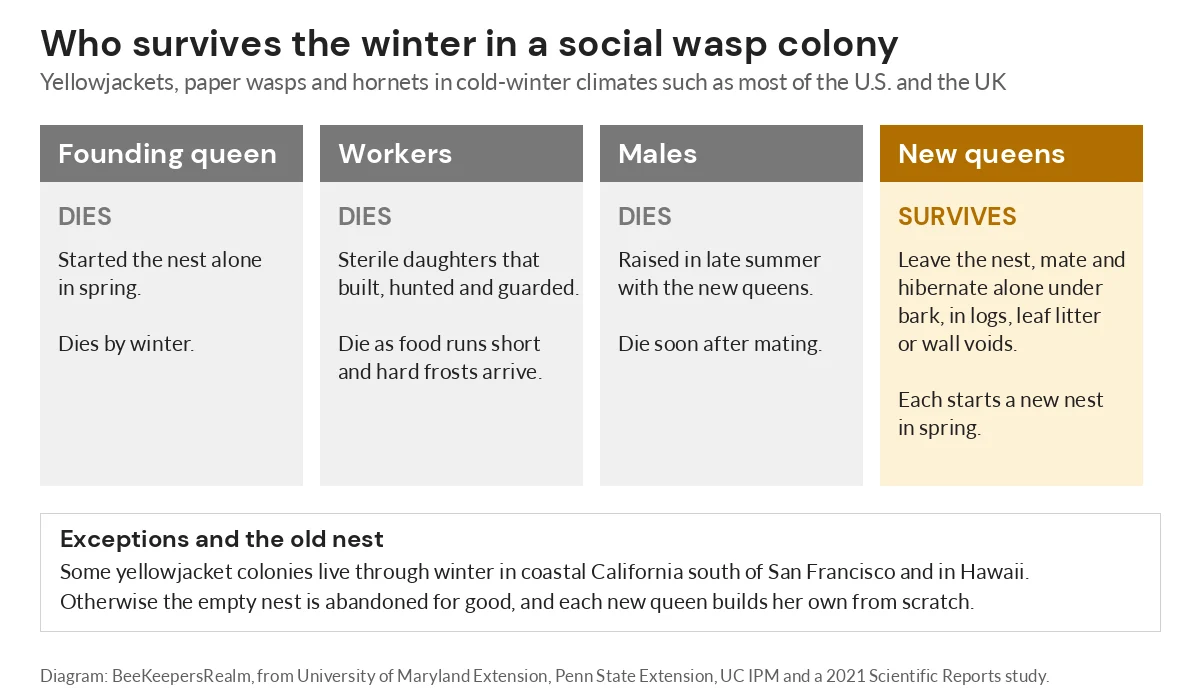
Maryland describes the same end for yellowjackets, hornets and paper wasps: males die soon after mating, and by winter the original queen, the workers and the males are all dead. One nest can release many young queens; Landcare Research says an average nest in New Zealand produces 1,000 to 2,000 a season. Honey bees do the opposite and winter as a whole colony on stored honey.
Do Wasps Hibernate? Where the Queens Go
Only the new queens do. University of Maryland Extension calls it a hibernation-like state and lists the sites: leaf litter, tree bark, compost piles, logs, soil cavities and wall voids. Landcare Research says a hibernating queen tucks her antennae between her legs and bites into the surface to hang on. Hibernation uses little of her stored fat and most queens survive it, though the Natural History Museum notes that only some make it through the winter.
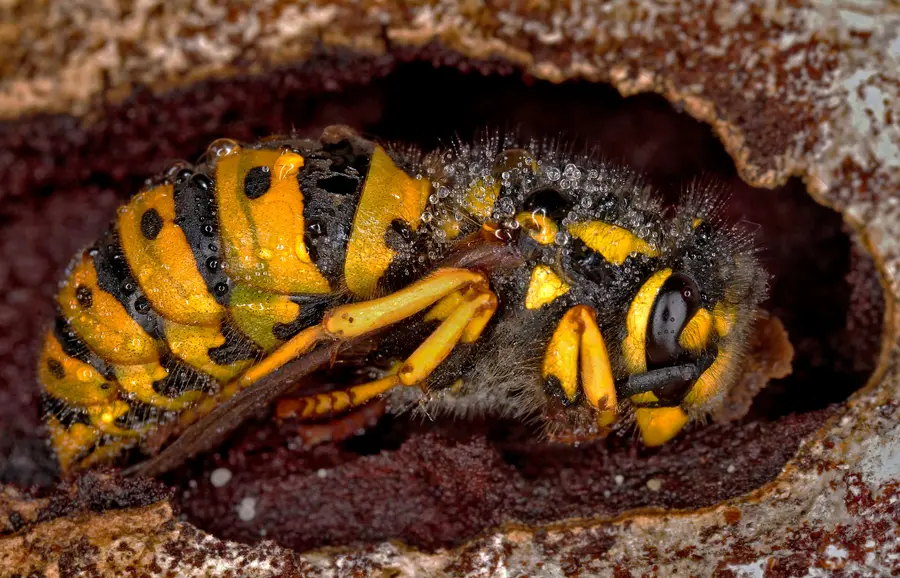
The Missouri Department of Conservation says a winter warm spell can wake paper wasp queens, which is why you might see one flying on a warm February day. Queens in a wall void sometimes wander into the house; Penn State reports this with German yellowjackets and European hornets in winter and spring. UC IPM says yellowjacket queens emerge for good in late winter to early spring.
Why Late-Season Wasps Crowd Your Food
Through summer, workers hunt insects for the larvae, and the larvae pay them in a sugary secretion. Late in the season that trade breaks down, as Seirian Sumner, a behavioural ecologist at University College London, explains:
“But the ratio of workers to larvae shifts, and as summer tips into autumn, this ratio shifts further, leaving more and more workers under-employed and – importantly – without their sibling-administered sugar fix.”
U.S. guides describe the same shift. UC IPM says colonies stop growing by late summer and need large amounts of sugar, so foragers turn up at picnics, garbage cans, outdoor pet food and ripe fruit. Ohio State puts the switch from protein to sweets at August to October, when nests hold roughly 4,000 to 5,000 workers. Penn State says wasps grow more defensive into fall as local food runs short.
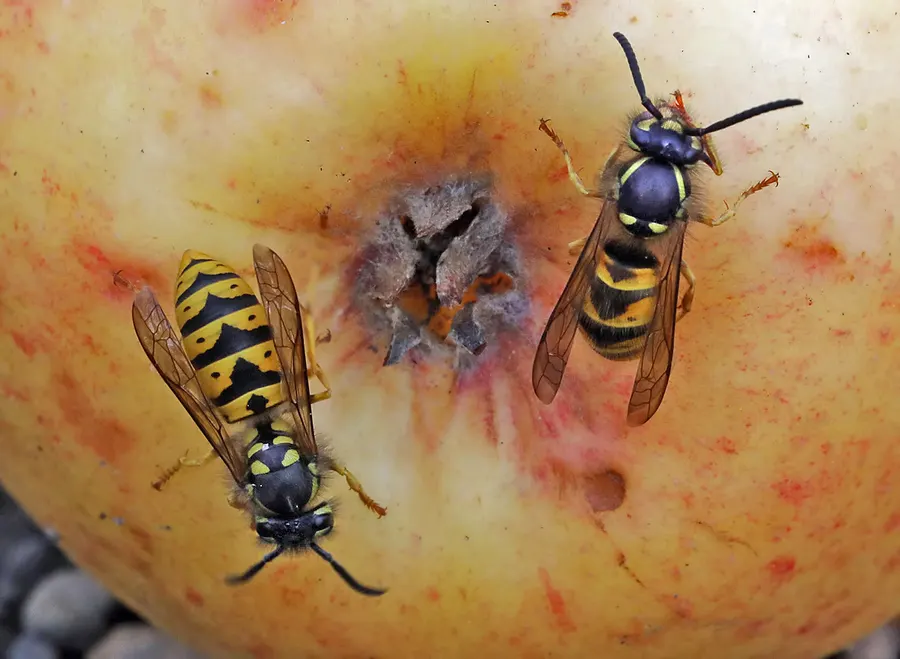
Not every wasp joins in. UC IPM says aerial nesters such as the bald-faced hornet do not turn scavenger at season’s end, though they defend their nests hard. European hornets do take sugar in fall and, flying at night, are drawn to porch lights. Beekeepers see the same hunger when late-season yellowjackets raid weak hives. If one stings you, see how a wasp sting compares with a bee sting.
Where Wasp Colonies Survive the Winter
The annual cycle is a cold-climate rule. Where winter is mild, a yellowjacket colony can keep its workers and carry on.
“In very mild winters or in coastal California south of San Francisco, however, some yellowjacket colonies survive for several years and become quite large.”
Penn State Extension says German yellowjacket nests occasionally survive in a warm climate or a heated, insulated building. Mated queens return to the parent nest, which grows into a second season and can hold hundreds of queens, but such perennial nests are uncommon in North America. In New Zealand, Landcare Research says about 10% of German wasp nests survive the winter.
Hawaii is the best-studied U.S. case. A 2021 study in Scientific Reports found multi-year western yellowjacket colonies relatively common there, while mainland populations normally die each fall. Extra food and warming did not improve winter survival in its experiments; virus load and colony density predicted survival in one study year. Britain is the other extreme: the Natural History Museum says winter cuts colony growth short there.
Do Wasps Reuse Old Nests?
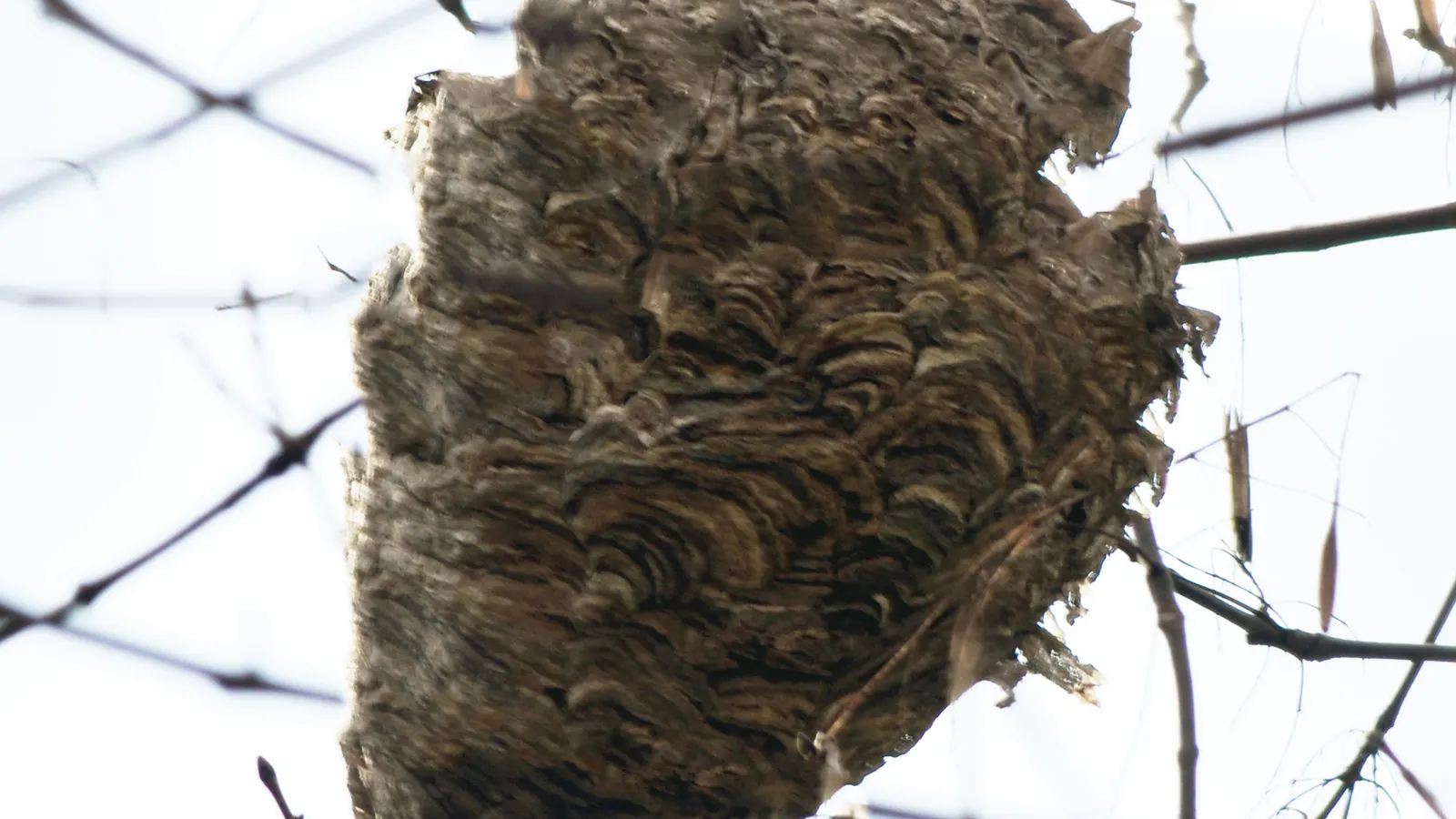
No. University of Maryland Extension says old nests are not reused and each queen starts from scratch every spring. Missouri’s field guide says paper wasp nests are very rarely reused, and the University of Kentucky says the paper shell disintegrates over winter in cold-winter states.
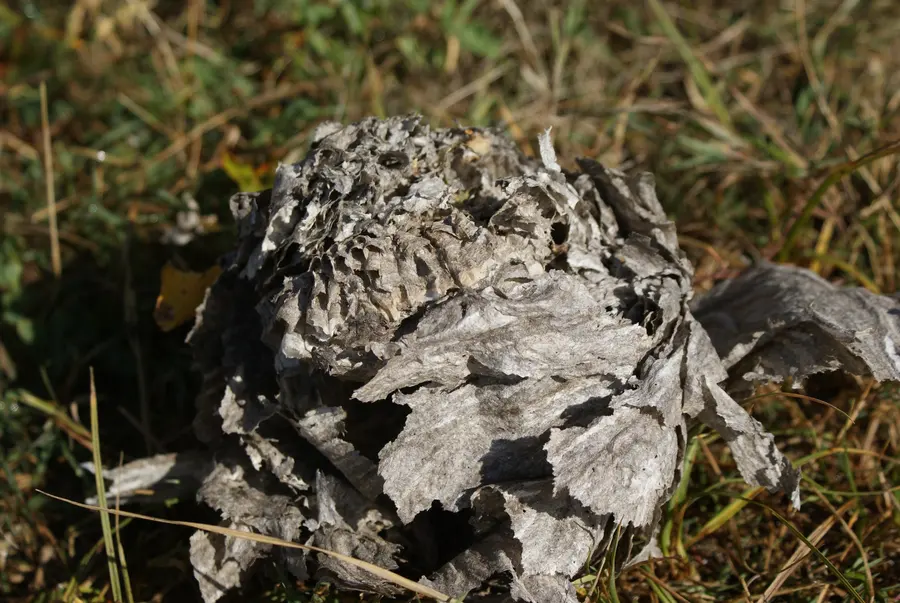
A nest in the same spot next year is a new colony. Penn State makes the point for the European hornet: a nest in one tree does not mean another will be built there the following year.
What to Do About a Nest in Fall or Winter
Educational information only, not professional pest-control or medical advice. If anyone in the home is allergic to stings, have an active nest handled by a professional.
- Far from people? Wait. Penn State calls waiting for the first hard frost or two the simplest control for an annual nest; Maryland says a nest stops being a threat after a killing frost in late autumn.
- Removing an empty nest. UC IPM says nests can be removed safely in winter without spraying. In mild areas, or for a nest in a heated wall, watch the entrance on a warm afternoon first; steady traffic means it is still active.
- Sealing a wall void. Penn State suggests marking the entrance while wasps use it and blocking it in winter or early spring. Kentucky warns not to seal an active entrance, because the wasps may chew their way indoors.
- A wasp indoors in winter. It is usually a lone queen, not a nest. Put it outside or dispose of it, then seal gaps around windows, pipes and siding.
For telling nest types apart and when to call a pro, see our guide to wasp nest removal.
Frequently Asked Questions
What month do wasps go away?
In cold-winter U.S. states, after the first hard frosts of late autumn; Pennsylvania’s paper wasps are mostly gone by the end of September. In the UK, common wasps are recorded until late October.
Why are wasps still around in October?
The colony is near its largest and no hard freeze has ended it yet. Workers with no larvae to feed them spend warm days hunting sugar.
Do wasps die in winter?
All but the new queens. Some yellowjacket colonies survive mild winters in coastal California and Hawaii.
Will wasps return to a nest after winter?
No. A new queen may pick a similar spot, but she builds a new nest.
Should I kill a wasp in my house in winter?
It is usually a single overwintering queen and poses little risk. Put it outside or kill it, then seal the gap it came through.
Can I remove a wasp nest in winter?
Yes, in cold-winter areas once hard frosts have ended activity. In mild climates, check for traffic first.
What temperature kills wasps?
The extension guides cited here give no single number. They point to the first hard frost or two; the National Weather Service sets a hard freeze at 28°F or lower.
How long do wasps live?
A common wasp worker lives about 12 to 22 days; a queen lives about 12 months.
The Bottom Line
If a nest is out of the way, let the first hard frosts do the work, then take it down in winter. In mild climates, watch for traffic before you assume the colony is gone.
Image credits: Featured photo: Mara Koenig, U.S. Fish and Wildlife Service, via Wikimedia Commons, public domain, cropped and resized.