Reviewed by Michael R. · How we review
A bee fly is a fuzzy, bee-shaped true fly in the family Bombyliidae, and it cannot sting or bite. Bee flies are harmless to people and pets. The only harm is done by their larvae, which are parasites in the nests of some solitary bees, wasps and beetles. We found no source that lists honey bees as a host. You can tell one from a bee by its single pair of wings, very short antennae and, in many species, a long, straight beak used to sip nectar while hovering.
That is the short answer. The rest of this page is for readers who want to be sure what they are looking at: a side-by-side comparison of a honey bee, a bee fly and a hover fly, the three bee flies you are most likely to meet in the United States, and what each one does to the bees around it. Everything below comes from named agencies and universities, linked where we use them. We make no claim of personal field experience with these flies.
Key Takeaways
- Bee flies cannot sting or bite. The Missouri Department of Conservation (MDC) says so directly, and UC ANR agrees. The long “needle” on many species is a drinking straw for nectar.
- Three field marks separate a bee fly from a bee: one pair of wings instead of two, very short antennae, and a habit of hovering at flowers. Many species hold their wings out to the side at rest.
- The harm is to other insects, not to you. The larvae feed on the eggs and young of hosts such as ground-nesting bees, carpenter bees, wasps and beetles. In North America about 800 species exist, and most hosts are unknown.
- Honey bees are not on any host list we found. Mason and leafcutter bees are occasional victims of the spotted bee fly, and the SARE pollinator-management guide says no control measure exists.
- The tiger bee fly is the one homeowners notice: a large black fly with spotted wings that hovers near wood where carpenter bees nest, and whose larvae feed on those bees.
- Adults are real pollinators. A US Forest Service writer argues that early-spring bee flies may visit some wildflowers more often than the bees do.
Table of Contents
- What a Bee Fly Is, and What It Is Not
- Bee vs Bee Fly vs Hover Fly: Side by Side
- Are Bee Flies Harmful?
- What Bee Fly Larvae Do
- Bee Flies and Your Bees: Honey, Mason and Mining Bees
- Bee Flies You Can Meet in the US
- The Tiger Bee Fly and Carpenter Bees
- Bee Flies as Pollinators
- When and Where You Will See Bee Flies
- Frequently Asked Questions
- Next Step
- Sources
What a Bee Fly Is, and What It Is Not
A bee fly is a true fly, meaning a member of the order Diptera, that happens to look like a bee. The Missouri Department of Conservation field guide describes the family as “fairly large,” with about 800 species in North America, and says most “resemble pudgy, fuzzy bees, while others look like strangely fuzzy mosquitoes.” Worldwide the family holds roughly 4,500 described species, according to UC Agriculture and Natural Resources (UC ANR), with many more undescribed. Size runs from about a quarter inch to nearly two inches (MDC gives 1/4 to 1 3/4 inches, depending on species).
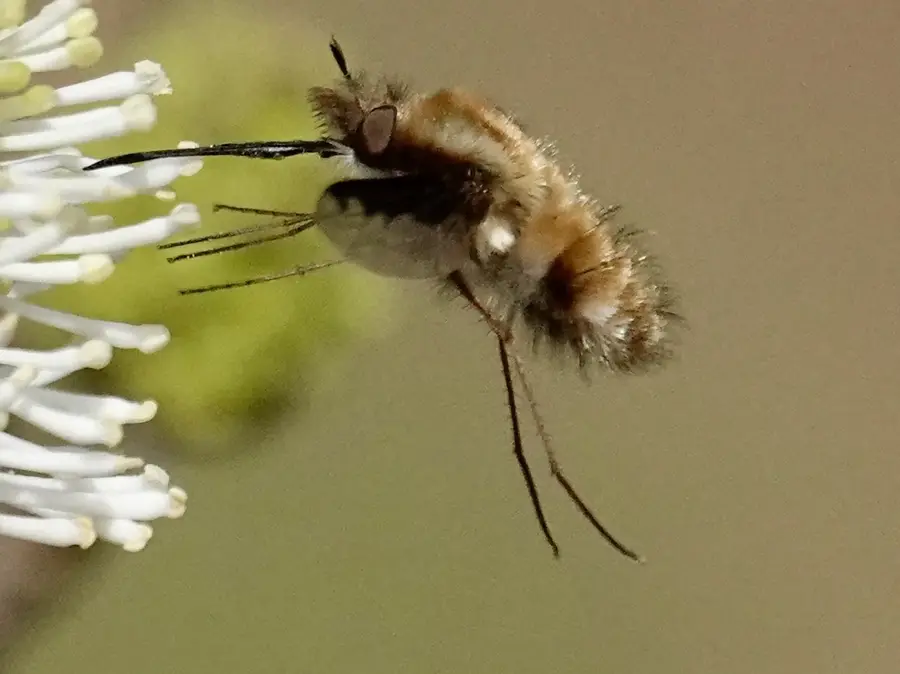
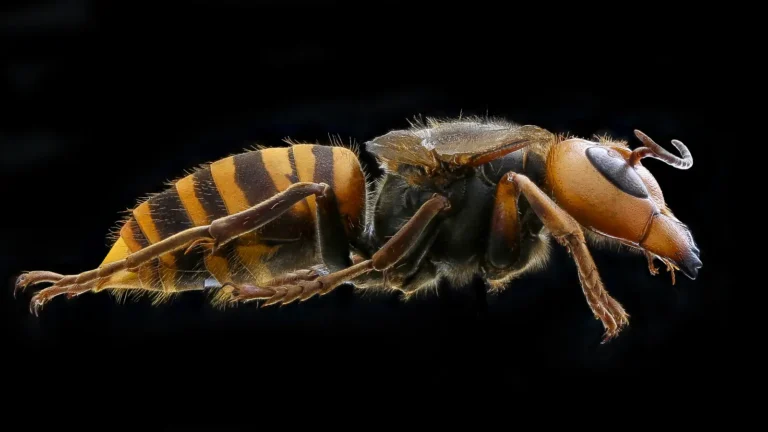
The resemblance is mimicry. MDC notes that bee flies lack any ability to sting or bite, and that their bee mimicry “helps them avoid many would-be predators.” Their hovering flight adds to the disguise. A few species with a long, pointed beak still look imposing, but the beak is only a mouthpart. Wikipedia’s entry on the family adds a detail that helps with identification: unlike a butterfly, a bee fly holds its proboscis straight and cannot retract it.
It is also not a hover fly. Hover flies are a different family of true flies (Syrphidae) and are the more common bee look-alike in gardens. We cover them in our guide to hover flies. Bee flies are the fuzzier, longer-legged, often beaked ones that hover motionless over bare ground or a flower and rarely stay still on it. If you are not sure whether your insect is a fly at all, our short answer on whether bees are insects covers how flies fit the picture.
Bee vs Bee Fly vs Hover Fly: Side by Side
None of the top results for “bee fly” puts the three look-alikes next to each other, so here they are. The montage shows a honey bee, a greater bee fly and a drone fly, a hover fly that mimics honey bees. The table lists the checks that hold up across the sources we read.
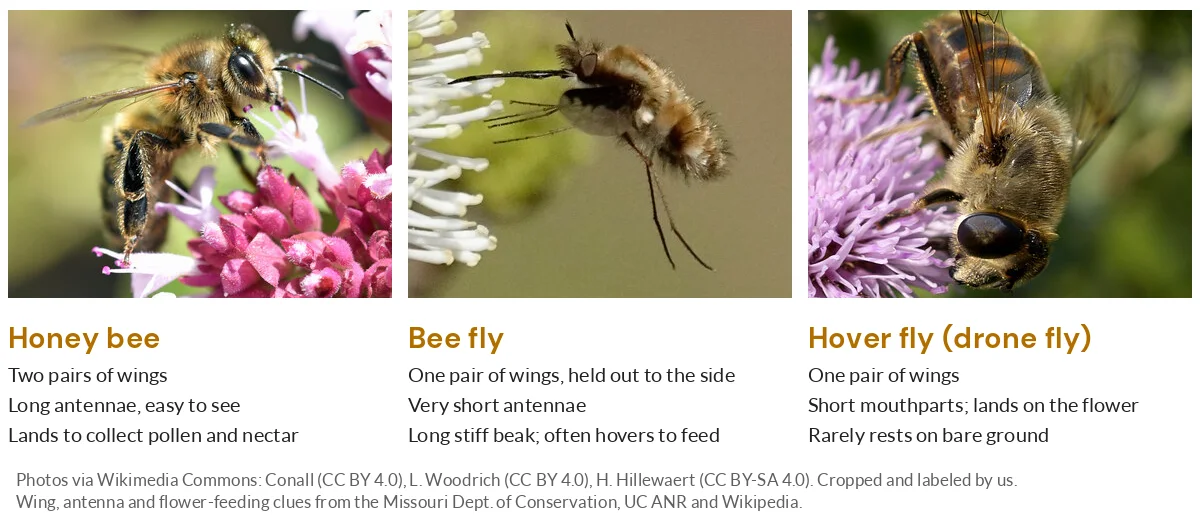
| Check | Honey bee | Bee fly | Hover fly |
|---|---|---|---|
| Wings | Two pairs | One pair, often held out to the side at about 45 degrees at rest | One pair |
| Antennae | Longer and easy to see | Very short | Very short (all flies) |
| Mouthparts | No long straight beak | Many species: long, straight, rigid beak that cannot retract | Usually short |
| At flowers | Lands and works the bloom | Long-beaked species hover and sip without landing | Settles on the flower like a bee |
| At rest | On flowers or the hive | Often sits on bare, sunny ground | Rarely rests on the ground |
| Legs | Short | Often long and thin | Usually not long and thin |
| Sting or bite | Females can sting | No | No |
| Young | Fed in the nest by workers | Parasites of other insects | Many eat aphids; others eat decaying matter |
Sources for the table: MDC and UC ANR for wings and antennae, Wikipedia’s Bombyliidae and hoverfly entries for mouthparts, resting and legs, and our hover fly guide for the larvae. The wing count and antenna length are the most reliable checks, because they hold for every species. The beak and the hovering depend on the species. Wikipedia warns that bee flies without a long beak or long legs can be “hard to tell apart” from hover flies at first glance, and that species with a short beak do land and walk on flower heads. When in doubt, count wings and look at the antennae.
If your question is bee versus wasp rather than bee versus fly, see how to tell a bee from a wasp, and for the many native bees a bee fly can be confused with, our guide to types of bees in the US.
Are Bee Flies Harmful?
To people and pets, no. MDC says bee flies “are not bees and they do not sting or bite,” and UC ANR says the same in fewer words: “They neither bite nor sting.” The proboscis that scares people is used for nectar. Cornell’s NYS IPM Program says even the biggest, most menacing-looking species, the tiger bee fly, is “anything but dangerous to people and pets.” We found no source reporting that bee flies spread disease to humans.
To other insects, yes, in a limited way. Wikipedia describes the larvae of the family as parasitoids, which are parasites that kill their hosts, and the Bombylius major larvae as parasites of solitary bees including Andrena, the genus of mining bees. That is the “dark side” the US Forest Service pollinator profile describes. But the damage has not been measured at the population level in any of the sources we read. The Ohio State University BYGL article on the tiger bee fly states plainly that its author “could not find information on the overall impact” on carpenter bee numbers. In our reading, a bee fly in your yard is a sign of a working food web, not an infestation to fix.
“bee flies should be appreciated for their role in reducing the potential numbers of truly problematic insects such as cutworms, armyworms, carpenter bees, and grasshoppers.”
That framing, pests in some gardens and a friend in others, is the honest answer to “good or bad.” Whether a given bee fly is welcome depends on whose nest it is visiting. The next two sections cover how it works and which bees are involved.
What Bee Fly Larvae Do
Most bee flies grow up as parasites, and the method is unusual enough that it has its own name. MDC says most undergo hypermetamorphosis: the female deposits or flings her eggs onto or into the nest of a specific host, and the first larval stage is active and mobile. It finds the host larva or the stored food, attaches itself, and in later stages becomes “a quite sedentary maggot” that feeds on its host. It then pupates, leaves the host nest and emerges as a winged adult.
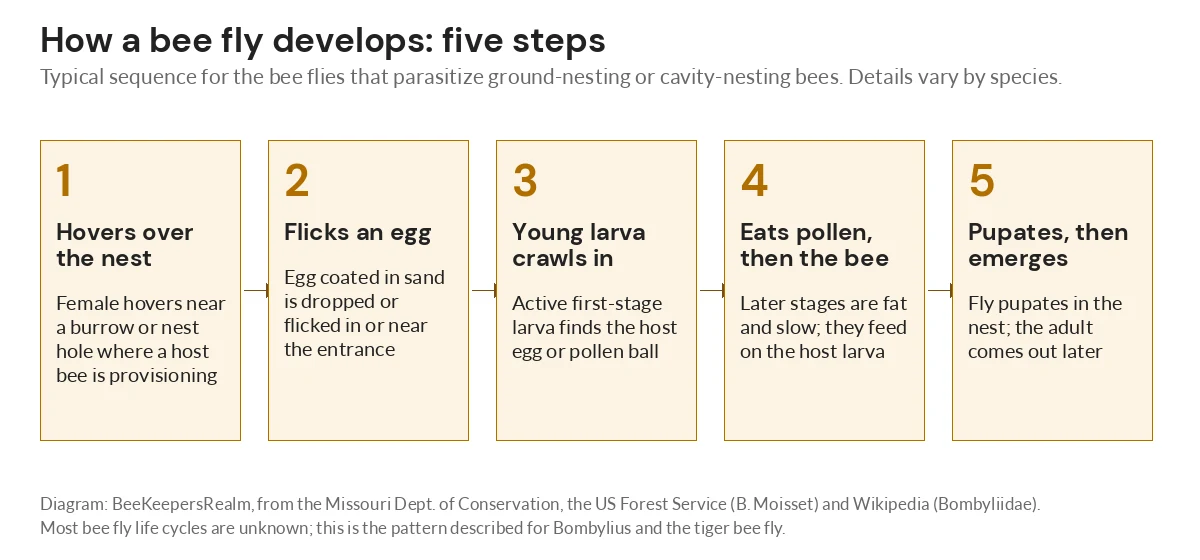
The egg delivery is the part most readers remember. In the bee flies that behave this way, the female hovers steadily above a burrow entrance and releases an egg in mid-air with a sharp flick of the abdomen. Wikipedia says this earns some species the nickname “bomber flies.” Just before release, each egg is coated with sand from a chamber at the tip of the abdomen where she has stored grains. The coating is assumed to add weight for better aim, slow drying out and mask the egg’s scent so the host does not react by cleaning out or abandoning the nest. Beatriz Moisset, writing for the US Forest Service, describes the same flick over an open bee burrow: the fly “does not even need to land.”
The host is usually a bee that is away foraging. Moisset explains that a mother bee needs many trips to collect enough pollen for each larva, so the fly “takes advantage of the mother’s absence.” The fly larva then eats the stored pollen, then the bee larva, and stays in the nest as a pupa until the next spring. For the host side of the story, see our guide to the solitary bee life cycle, which explains why a single cell holds one egg and one pollen loaf.
Not every bee fly attacks bees. MDC lists the hosts of the family as beetles, moths, flies, grasshoppers and katydids, bees and wasps, antlions and even parasitic insects such as ichneumon wasps and tachinid flies, which themselves parasitize other insects. Wikipedia adds that the life cycles of most species are not known, and calls the family one of the most poorly known relative to its number of species. Treat any claim of the form “bee flies do X” as true of some species, not all.
Bee Flies and Your Bees: Honey, Mason and Mining Bees
This is the question the top results leave vague, and it matters most to people who keep bees. We checked every source we fetched for this article, from MDC, USFS, UC ANR and Cornell to the Wikipedia entries and the SARE pollinator-management guide. None names a honey bee as a bee fly host. The documented hosts are other insects, as the chart shows. That is an absence of evidence, so we state it as exactly that: no host record found, not proof of impossibility.
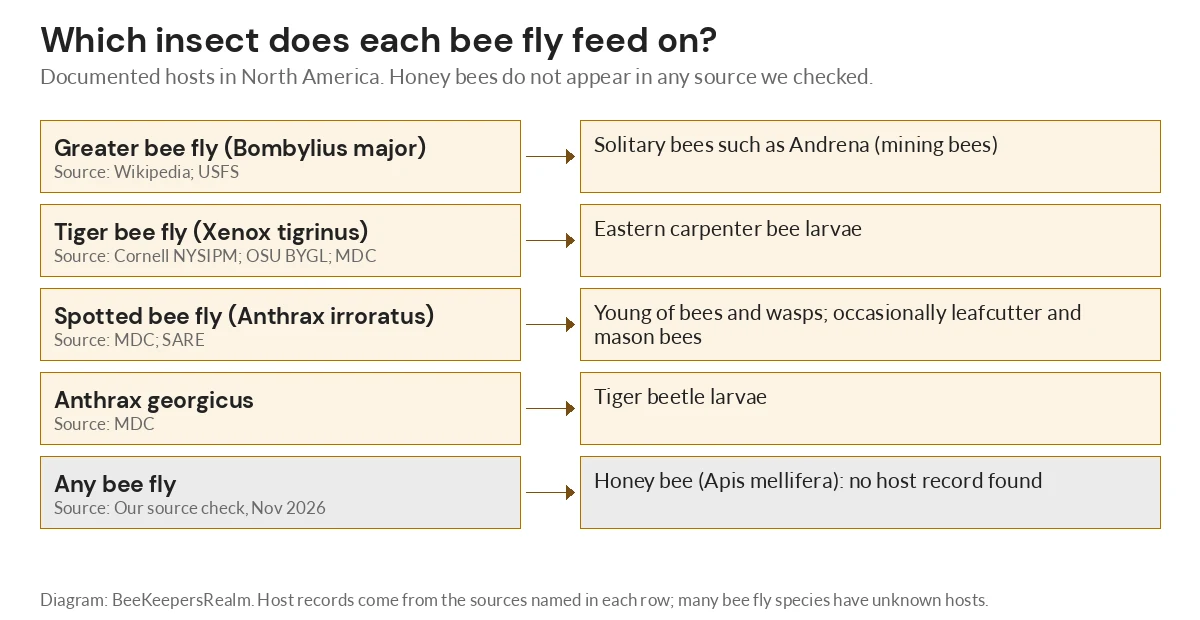
The bees that can be affected are the solitary ones that nest in the ground or in tubes. The guide Managing Alternative Pollinators, published by the Sustainable Agriculture Research and Education program (SARE), says two fly species are “occasional minor predators” of leafcutter and mason bees. One is the dewy bee fly, Anthrax irroratus, whose larvae are “occasionally found feeding on immature bees” and which has two spikes on the head of the immature fly “used to break through cell partitions.” MDC calls the same species the spotted bee fly. SARE’s closing line is blunt: no known control measures exist.
What that means in practice, with the caveat that it is our reading of the sources and not a tested protocol:
- Honey bee keepers: there is nothing to do. A bee fly hovering near your apiary is after nectar or a nest of some other bee.
- Mason and leafcutter bee hosts: losses from this fly are described as occasional and minor, and the guide offers no remedy. Our walkthrough on how to build and maintain a mason bee house covers the nest-box hygiene that matters more, and our leafcutter bee profile covers the other managed host.
- Mining bee and other ground-nesting bee watchers: the greater bee fly hovering over bare soil in early spring is looking for just these nests. Our profile of mining bees explains what the nests look like.
It is a different story from other flies that do attack honey bees. The parasitic fly behind “zombie bees” is a separate insect, covered in our article on the parasitic fly that turns honey bees into the living dead. And bee flies are unrelated to robber flies, which catch adult bees in the air.
Bee Flies You Can Meet in the US
With roughly 800 species in North America, no page can list them all. These four are the ones named in the US sources we read, and they cover most of the behaviors above. The table puts their field marks, timing and hosts side by side.
| Bee fly | What it looks like | When and where | What the larvae feed on |
|---|---|---|---|
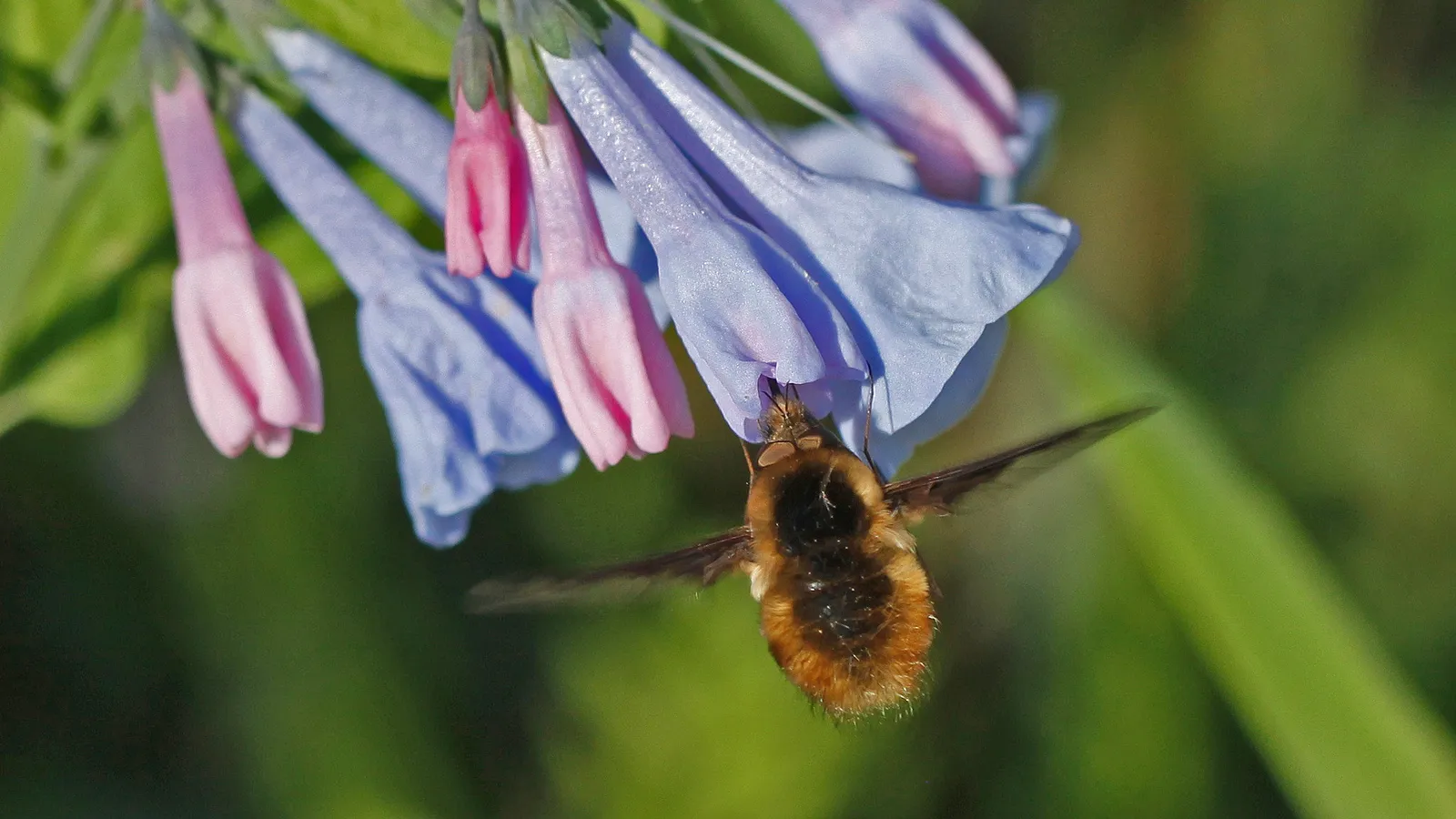
| Greater bee fly, Bombylius major | Brown, furry and round like a small bumble bee, with a long straight beak and wings swept back at rest | Early spring; hovers just above bare ground and at spring flowers such as spring beauty | Nests of solitary bees such as Andrena |
| Tiger bee fly, Xenox tigrinus | Large, black with white flecks on the abdomen; black wings with clear spots; about 3/4 inch to over an inch long | Warm summer days; hovers around wooden fences, decks and roof overhangs | Larvae of eastern carpenter bees |
| Spotted bee fly, Anthrax irroratus | Dark, with speckled wings; adults do not feed | May through August, in forested areas | Young of bees and wasps, including occasionally leafcutter and mason bees |
| Anthrax georgicus | A bee fly with no common name | Seen at a Missouri prairie | Tiger beetle larvae |
Table sources: MDC (family, tiger bee fly and species captions), the US Forest Service (greater bee fly), Cornell NYS IPM (tiger bee fly description) and SARE (spotted bee fly hosts). The greater bee fly is not only American; the US Forest Service notes that Bombylius flies are widely distributed in the northern hemisphere, in North America, Europe and Asia.
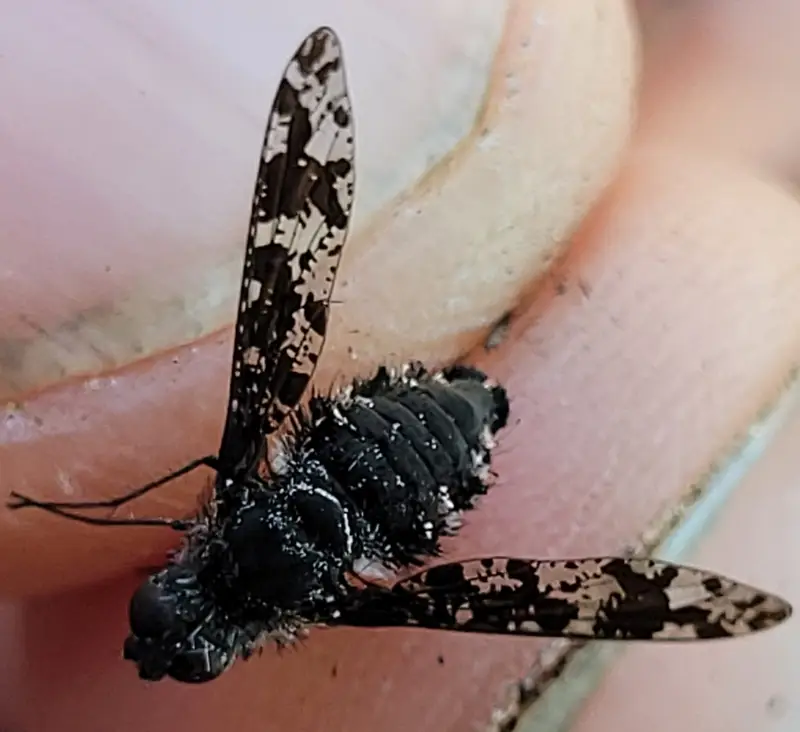
Not every bee fly fits the “fuzzy bumble bee” description. Wikipedia notes that body length in the family ranges from about 1 millimeter to 2.5 centimeters, and that many species are mimics of bees and wasps, while others are slender, dark or speckled. If your insect is round, furry, brown and hovers at a flower with a long beak, it is probably a Bombylius. If it is large, black and patrols a wooden structure, it is probably the tiger bee fly.
The Tiger Bee Fly and Carpenter Bees
The tiger bee fly gets its own section because it is the bee fly most people notice. Cornell’s NYS IPM Program describes the experience: on a warm summer day, “a large dark colored insect” jets around a house or deck, with “a startling buzz,” flies right at you but avoids crashing, and lands gently on the structure in plain sight. It looks menacing, and it is anything but dangerous.
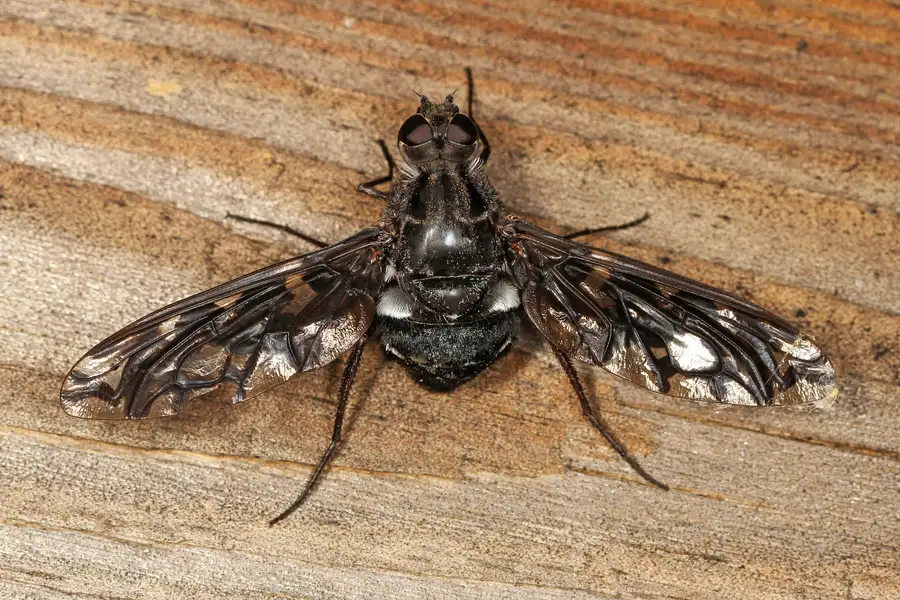
The reason it hangs around wood is carpenter bees. According to Cornell, the female hovers around the dime-sized nest openings and lays her eggs inside. The larvae wander the gallery until they find young carpenter bees, attach to the much larger bee larva, and suck it dry as they develop. MDC’s tiger bee fly page says the same: the fly “parasitizes the larvae of carpenter bees,” so females are seen hovering near wooden structures where carpenter bees have excavated nests, and tiger bee flies “rely on populations of their hosts (carpenter bees) to survive.”
“tiger bee flies help control carpenter bees, but in a rather grim way.”
Cornell calls the relationship a form of biological control, noting carpenter bees are thought to nest almost exclusively in man-made structural wood. It also says seeing a tiger bee fly means you probably have carpenter bees “and a partner in their management.” That is a claim about presence and biology, not a promise of damage reduction. The Ohio State article found no data on how much the fly actually limits carpenter bee numbers, so do not count on it to protect a deck. If you do have carpenter bee holes, our guide to carpenter bee holes covers what actually works and when, and the carpenter bee identification guide helps you confirm the bee first. Whatever you decide, it is worth knowing the fly near the nest is a beneficial insect that cannot hurt you, and is easy to kill by mistake.
Bee Flies as Pollinators
Adult bee flies feed on nectar and pollen, and the fuzz that makes them bee-like also carries pollen. MDC says adults favor members of the sunflower family such as coneflowers and asters, and that some prefer lilacs or apple or plum blossoms. Many feed while hovering, without perching on the flower itself.
The US Forest Service piece by Moisset makes a specific, sourced claim about early-spring flowers. Bombylius flies visit spring beauty, Claytonia virginica, the same flower visited by some bees such as Andrena. By not landing, she suggests, the fly may avoid predators waiting in the flower, such as crab spiders or ambush bugs, yet “some pollen sticks to their furry coat and is easily transported to other flowers.”
“They are just as efficient pollinators of these flowers as are the bees and they are more frequent visitors so, all and all, they probably pollinate more flowers than these bees.”
That is one author’s conclusion about one flower, not a study result for every bee fly. Wikipedia is more general: bee flies “significantly contribute to cross pollination” and are the main pollinators of some desert plants, though most species are less likely to visit flowers in urban parks and suburban gardens than other pollinator groups. For the broader picture of how flies compare with bees, see our explainer on pollination syndromes.
When and Where You Will See Bee Flies
Timing depends on the species, so “spring insect” is only partly right. The greater bee fly is an early-spring visitor, hovering just above ground over bare soil where bees are digging nests. MDC gives May through August for the spotted bee fly, and Cornell places the tiger bee fly on warm summer days. UC ANR photographed a bee fly nectaring on a zinnia in a California pollinator garden on September 19, so late-season sightings happen too.
Habitat follows food and hosts. MDC says bee flies are usually found where food sources are abundant and suitable egg-laying sites exist, and that females hover where their hosts probably nest: over bare ground for ground-nesting hosts, near decaying trees for wood-boring beetles, around wooden structures for carpenter bees. Wikipedia says adults favor sunny conditions and dry, often sandy or rocky areas, and that they are often seen resting on bare, sun-exposed ground.
If you want to see more of them, the sources point to simple habitat steps rather than anything special. Plant native nectar flowers that bloom across the season, leave patches of bare, sunny soil, and avoid insecticides that would also reach the host nests. We did not find a research source on managing a yard specifically for bee flies, so treat this as general pollinator advice. For other bee look-alikes and what they eat, our comparison chart of predatory wasps and insects sorts them by behavior, and the ichneumon wasp guide covers another harmless parasite with a frightening look.
Frequently Asked Questions
Are bee flies harmful?
Not to people, pets or honey bees as far as the sources show. They cannot sting or bite. Their larvae are parasites of some solitary bees, wasps and beetles, so they can harm those insects, but no source we found measures an effect on bee populations.
Do bee flies sting or bite?
No. MDC says they “do not sting or bite,” and UC ANR says “They neither bite nor sting.” The long beak looks like a stinger but is a mouthpart for drinking nectar.
Are bee flies in the US?
Yes. MDC counts about 800 species in North America, and Missouri lists them statewide. Common ones include the greater bee fly in early spring, the spotted bee fly from May to August and the tiger bee fly in summer.
What do you do if a bee fly flies around you?
Nothing is needed. Cornell says a tiger bee fly may fly straight at you while avoiding contact, and that it is harmless. A bee fly hovering near you is more likely investigating a flower, bare ground or a nearby nest. Do not swat it.
Is a bee fly a bee or a fly?
A fly. It has one pair of wings, not two, and very short antennae (MDC, UC ANR). It belongs to the family Bombyliidae in the order Diptera.
What is the difference between a bee fly and a hover fly?
Both are bee-mimicking true flies, but they belong to different families. Bee flies are fuzzier, often have longer legs and a long straight beak, and hover without landing or rest on bare ground. Hover flies usually settle on the flower and rarely rest on the ground. See the comparison table above and our hover fly guide.
Do bee flies attack honey bees?
We found no source listing honey bees as a host or a target. The documented hosts are other bees (solitary and carpenter bees), wasps and beetles. Bee fly larvae live in nests, not in honey bee colonies, and adults feed on nectar.
Why do bee flies hover?
Hovering lets long-beaked species feed without landing. The US Forest Service suggests it may also help them avoid predators that wait in flowers, such as crab spiders, and it lets females flick eggs into burrows from the air.
Next Step
If you spotted a fly in your garden and want a name, use the wing count and the antennae, then check whether it matches one of the four species above. If you keep mason, leafcutter or other solitary bees, read the solitary bee life cycle to see when a fly can reach the nest, and for the full set of native look-alikes see our guide to native bee species.
Sources
- Missouri Department of Conservation, Bee Flies and Tiger Bee Fly field guide entries
- Beatriz Moisset, US Forest Service, Bee Flies (Bombylius spp.)
- NYS IPM Program, Cornell University, The Tiger Bee Fly: Friend or Foe? (August 21, 2023)
- Joe Boggs, Ohio State University BYGL, The Tiger Bee Fly: A Carpenter Bee Nemesis (August 14, 2023)
- SARE, Managing Alternative Pollinators, Appendix A: Flies
- UC Agriculture and Natural Resources Bug Squad, Bee Flies: Pollinators with a Bad Reputation (September 2023)
- Wikipedia, Bombyliidae and Hoverfly (read November 2026; used for structure, mouthparts and egg-laying details)
Image credits: Featured photo of a bee fly at Virginia bluebells by Judy Gallagher, via Wikimedia Commons, CC BY 2.0, cropped to 16:9. Other photo credits are in each caption. Diagrams are by BeeKeepersRealm.