
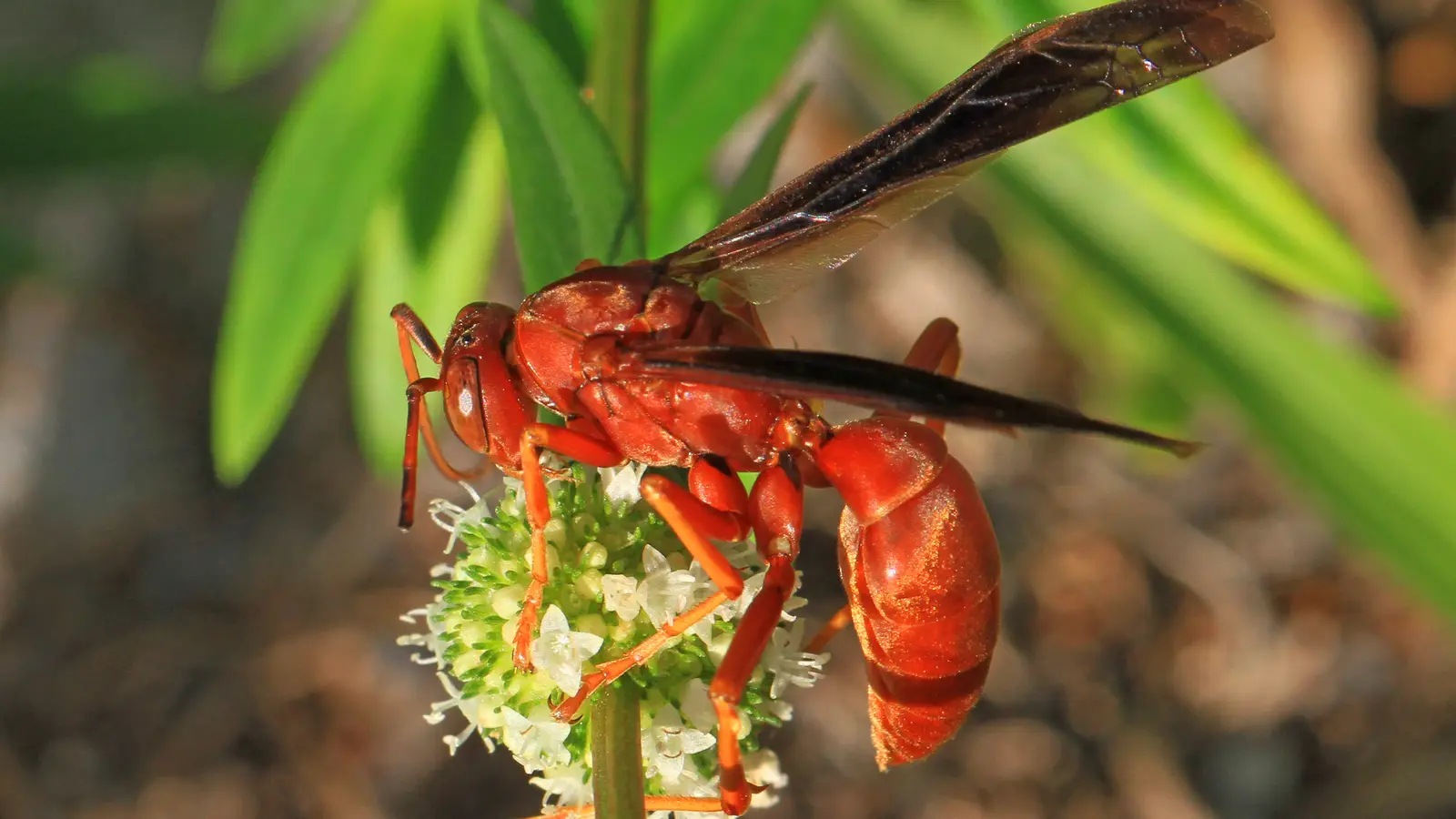
Reviewed by Elena P. · How we review
A red paper wasp is one of two rust-red paper wasps native to the eastern and south-central United States: the fine-backed red paper wasp (Polistes carolina) and the coarse-backed red paper wasp (Polistes rubiginosus, called P. perplexus in older guides). Both are 3/4 to 1 inch long with dark wings, hang open umbrella-shaped nests under eaves, and sting only to defend the nest. The sting hurts but is a serious danger mainly to people allergic to wasp venom.
Educational information, not medical advice. For sting allergy, see the American College of Allergy, Asthma and Immunology’s insect sting guidance.
Emergency: after any sting, call 911 for trouble breathing, a swelling tongue or throat, hives away from the sting, dizziness or fainting.
Key Takeaways
- “Red paper wasp” covers two eastern species. A 2012 revision showed that the wasp long called P. perplexus is P. rubiginosus.
- Females differ at the cheek: bare in P. carolina, silvery-haired in P. rubiginosus.
- In 7,149 iNaturalist records we pulled, the fine-backed species dominates the Deep South and the coarse-backed one Missouri, Illinois, Arkansas and Oklahoma.
- LSU AgCenter counts up to 20 to 30 workers per nest at a time, not the 5,000 repeated online.
- The stinger has small barbs but rarely stays in skin, so one wasp can sting again.
Table of Contents
- Which Wasps Are Called Red Paper Wasps?
- How to Identify a Red Paper Wasp
- Red Wasp Look-Alikes
- Where Red Paper Wasps Live: 7,149 Records Mapped
- Nest, Colony Size and Seasons
- Are Red Paper Wasps Aggressive or Dangerous?
- What to Do About a Red Paper Wasp Nest
- Frequently Asked Questions
- The Bottom Line
Which Wasps Are Called Red Paper Wasps?
In the eastern US the name means two near-identical members of the genus covered in our paper wasp identification guide. In Arizona it can also mean the Neotropical red paper wasp, P. canadensis.
For decades the eastern pair was treated as one variable species. In 2012 Royal Alberta Museum entomologist Matthias Buck and colleagues split it using male genitalia, head measurements and DNA barcodes:
“Polistes carolina of authors is a complex of two or three species.”
The same paper restored the 1836 name P. rubiginosus for the wasp named P. perplexus in 1872. The University of Florida’s Featured Creatures profile still uses perplexus, and the University of Arkansas Arthropod Museum still treats “rubiginosa” as a junior synonym of carolina.
How to Identify a Red Paper Wasp
Look for a slender, rust-red wasp with dark wings and long legs that dangle in flight. The LSU AgCenter fact sheet puts it at 3/4 to 1 inch (20 to 25 mm). Either sex may show black marks around the eyes or yellow on the mouthparts and legs. Males have longer, hooked antennae and cannot sting.
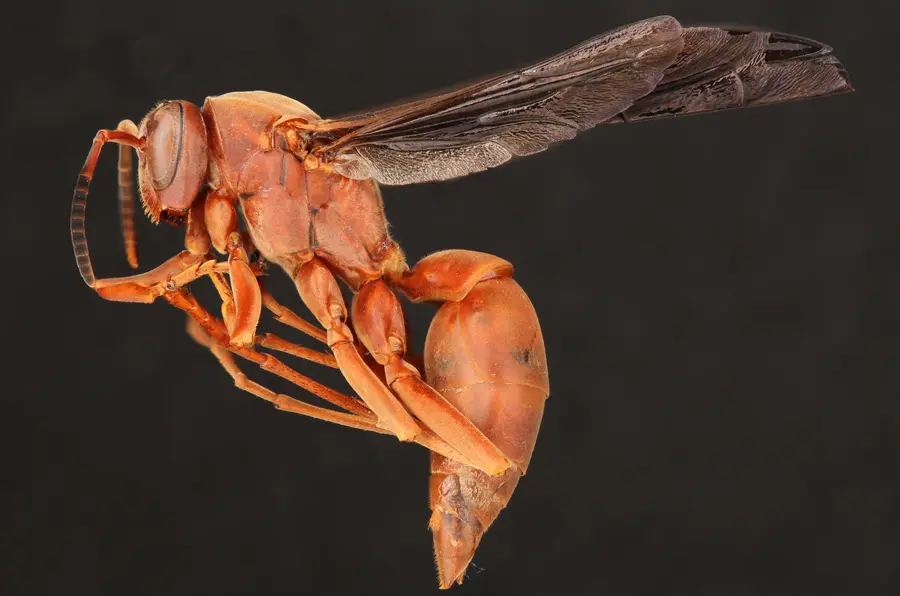
Fine-backed or coarse-backed: the cheek test
UF/IFAS warns that variable color makes field identification challenging. On a female, check the cheek below the eye: bare in P. carolina, covered in sparse silvery hairs in P. rubiginosus. Both sexes differ in the cross-ridges just above the waist, fine or coarse, hence the common names. Either trait needs a sharp side-on photo or a hand lens.
| Wasp | How it looks | Where in the US | Schmidt pain (1 to 4) |
|---|---|---|---|
| Fine-backed red paper wasp (P. carolina) | Rust-red; female cheeks bare; fine ridges | New York to Florida, west to Kansas and eastern Texas | Not rated |
| Coarse-backed red paper wasp (P. rubiginosus) | Rust-red; female cheeks silvery-haired; coarse ridges | Pennsylvania to Georgia, west to Kansas, Oklahoma and Texas; rare in Florida | Not rated |
| Neotropical red paper wasp (P. canadensis) | Mahogany-brown, purplish-black wings | Arizona | 3 |
| Ringed paper wasp (P. annularis) | Rust head and thorax, black abdomen with one yellow ring | Eastern half of the US | 3 |
| Metric paper wasp (P. metricus) | Darker, more black on thorax and legs | Eastern US | Not rated |
Sources: UF/IFAS; LSU AgCenter; Buck et al. 2012; Schmidt, Toxins, 2019 (honey bee = 2).
Red Wasp Look-Alikes
Besides the metric and ringed paper wasps above, watch for:
- European paper wasp: yellow and black with orange antennae; see our European paper wasp guide.
- Velvet ant: red and fuzzy, but the female is wingless; see the velvet ant (cow killer) guide.
Where Red Paper Wasps Live: 7,149 Records Mapped
UF/IFAS maps P. carolina from New York, Ohio and Pennsylvania to Florida and west to Arkansas, Illinois, Kansas and eastern Texas; Buck and colleagues put P. rubiginosus over much the same ground except Florida. To see how they actually split, we pulled every research-grade US record from the iNaturalist public API on November 5, 2026: 4,895 for P. carolina and 2,254 for P. rubiginosus.
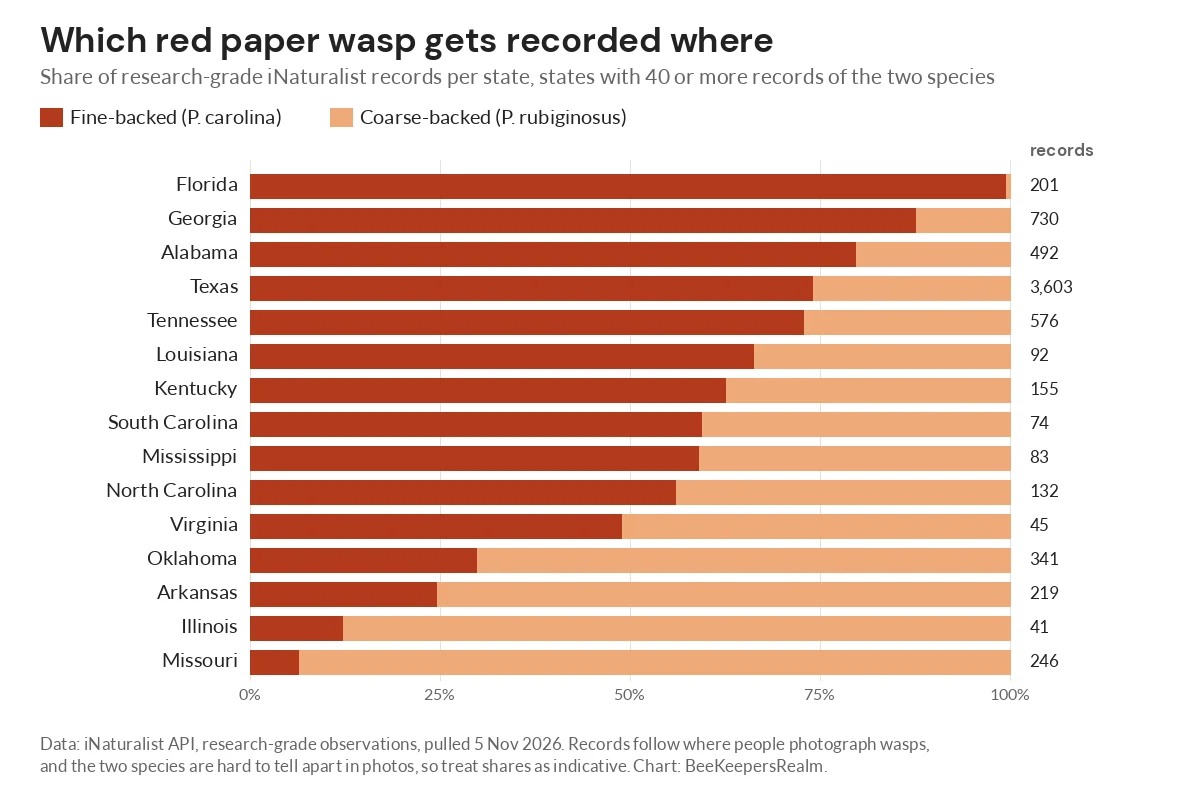
- Fine-backed in the Deep South: 200 of 201 Florida records, 88% in Georgia, 80% in Alabama.
- Coarse-backed on the western and northern edge: 94% of Missouri records, 88% in Illinois, 75% in Arkansas, 70% in Oklahoma and all 24 from New Jersey.
- Texas has both and half of all records, 3,603, of which 74% are fine-backed.
Records follow where people carry cameras, and few photos show the cheek, so treat these as indicative. Still, the Arkansas museum page calls its red wasp P. carolina, while Arkansas records favor the coarse-backed species three to one. Out west, all 49 research-grade US records of P. canadensis come from Arizona.
Nest, Colony Size and Seasons
The nest is a single, uncovered comb of paper cells hanging open side down from one stalk, made from wood fiber chewed with saliva. LSU says it typically tops out around 6 inches across, under eaves or in tree hollows, sheds, electrical boxes and fences.
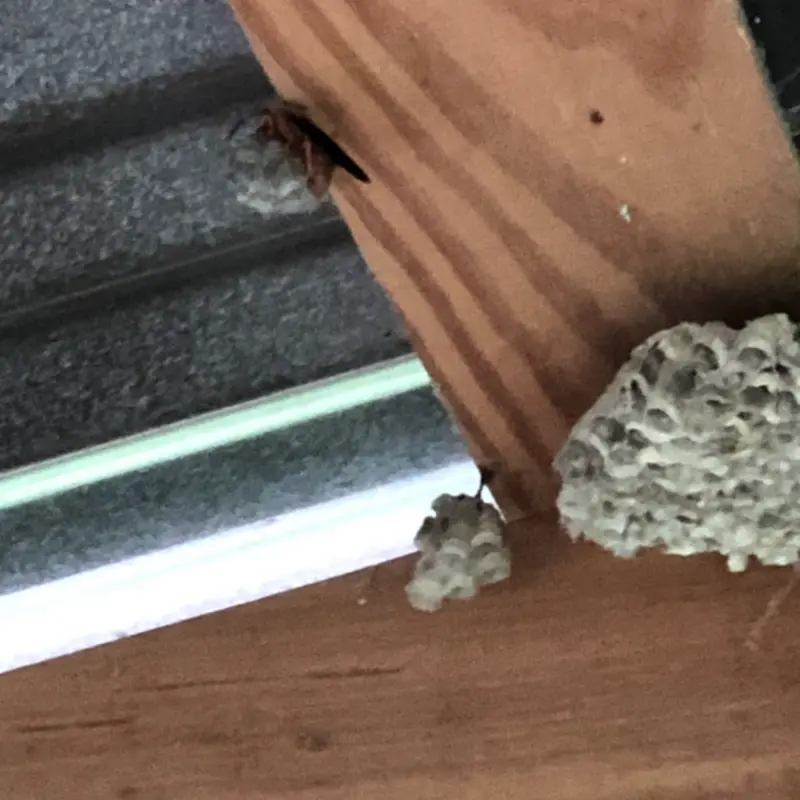
Colonies are small. LSU counts up to 20 to 30 workers at one time, and UF says the most successful Polistes nests yield hundreds of offspring over a season. The Arkansas museum page says 3,000 to 5,000 individuals, and Southern Living, which cites it, repeats “up to 5,000.” None of the extension or research sources we checked supports thousands.
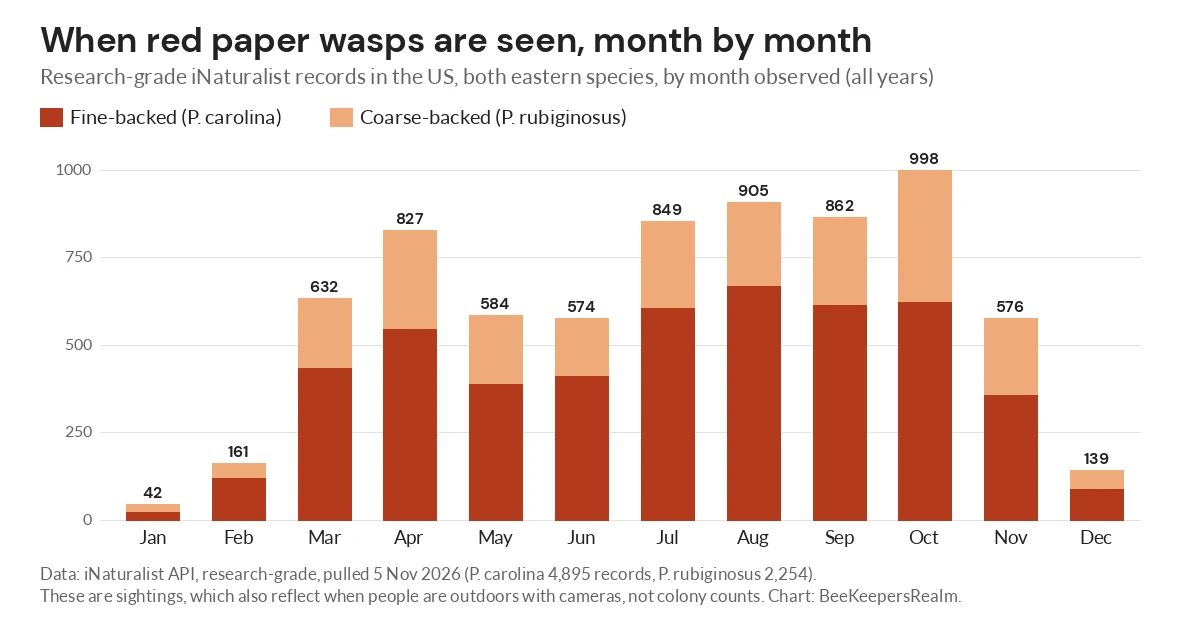
Per UF and LSU, mated queens winter in sheltered spots, found nests in spring and raise workers first; males and new queens come late, and the nest is abandoned in fall. The Missouri Department of Conservation says paper wasp nests are very rarely reused. Our iNaturalist pull follows the same rhythm: sightings jump in March and April, dip in early summer and peak at 998 in October.
For what happens after the first frosts, see when wasps die off and where queens spend the winter.
Are Red Paper Wasps Aggressive or Dangerous?
Away from the nest, rarely; the Missouri Department of Conservation says foraging paper wasps are usually not aggressive. UF puts it plainly:
“This species, however, is not particularly aggressive and typically stings only when threatened.”
At the nest it is different. LSU warns that paper wasps can be aggressively defensive if bothered, and Texas Parks and Wildlife magazine notes that workers on a threatened nest shake their front legs in warning.
How bad is the sting?
Only females sting, with a modified egg-laying tube. Justin Schmidt’s 2019 pain table skips both eastern species, but P. canadensis and the ringed paper wasp score 3 of 4, against 2 for a honey bee. P. canadensis venom killed half of test mice at 2.4 mg/kg, close to the honey bee’s 2.8. See our Schmidt sting pain index guide.
The stinger is not smooth. A 2021 comparison of 51 social wasp species counted about 5 or 6 barbs per lancet in the North American Polistes measured, including P. metricus, the fine-backed species’ closest known relative. The barbs rarely anchor in skin, so the wasp pulls free and can sting again; our bee sting vs wasp sting comparison explains why a honey bee’s stays.
For most people a sting means sharp pain and a swollen welt; the real dangers are allergy and many stings at once. See our bee and wasp sting first-aid guide.
What to Do About a Red Paper Wasp Nest
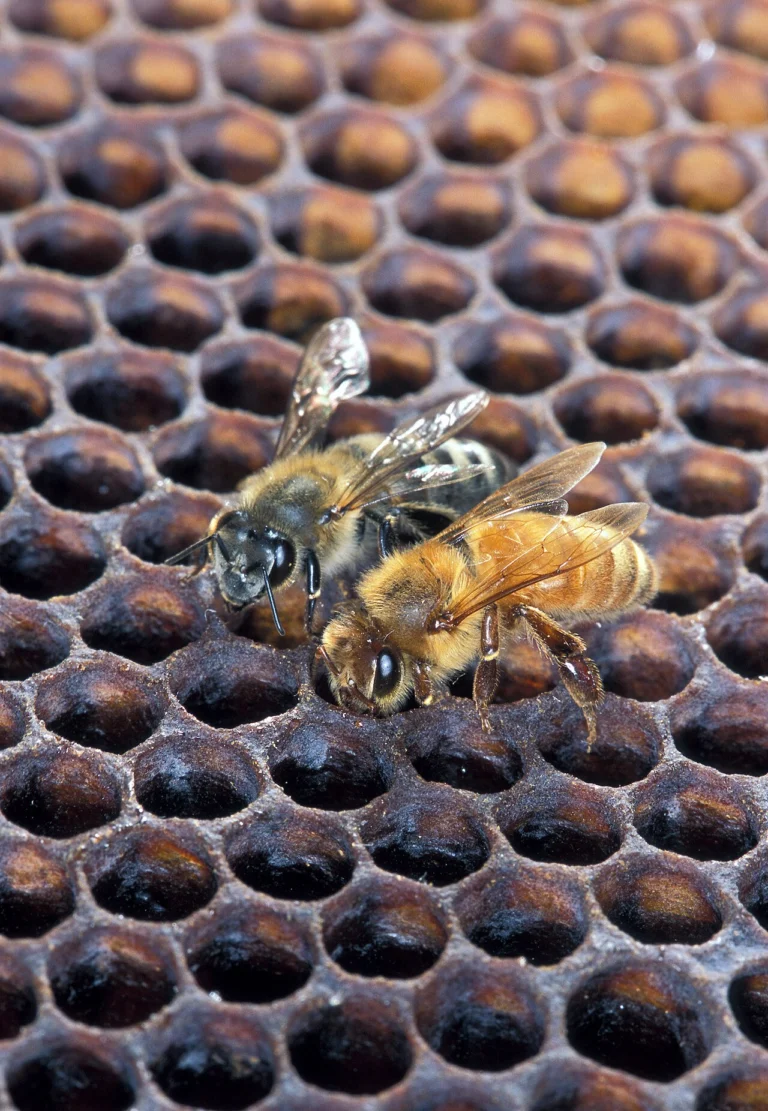
A nest away from doors and paths can stay: UF notes that P. carolina hunts caterpillars, cicadas and beetle larvae, and no extension profile we checked lists honey bees as prey. When one has to go:
- Act early. A new spring nest often has only the queen; UF and LSU say to knock it down with a broom. LSU suggests checking likely sites from March through May.
- Treat larger nests in the evening, when the wasps are home and inactive, with an aerosol labeled for wasps, sprayed from a distance and never near an open flame.
- Skip the fake nests. LSU addresses the paper-bag decoy tip directly:
“There are no data that back up these claims. In fact, these paper facsimiles provide a perfect material for workers to use in nest construction.”
For allergies or a high, large or in-wall nest, hire a professional; see our wasp nest removal guide.
Frequently Asked Questions
Are red paper wasps aggressive?
Not away from the nest, but they defend it hard.
What happens if you get stung by a red paper wasp?
Sharp pain, then a red, itchy welt. Wash, apply cold and watch for allergy signs.
How venomous are red paper wasps?
No venom data exist for the eastern species; their relative P. canadensis tested about as toxic as honey bee venom.
What attracts red paper wasps?
Sheltered overhangs, flowers and caterpillars; in fall, new queens seek winter shelter.
Do red paper wasps bite?
The “bite” is the sting. Their jaws are for scraping wood fiber and chewing prey.
Do red paper wasps reuse their nests?
Very rarely, though subtropical colonies may keep one for several seasons.
The Bottom Line
A rust-red wasp under your eave is almost certainly a native, caterpillar-hunting paper wasp. Remove the nest early if it is in the way, leave it if not, and plan ahead if anyone is allergic.
Image credits: Featured photo: Judy Gallagher, Florida, via Wikimedia Commons, CC BY 2.0, cropped.
)_(35549913493)_(cropped).jpg)


